
Category: Governing Energy

  • Can Machines Think?

    Can Machines Think?

    In 1950, the mathematician Alan Turing put forth this question.  Rather than attempt to answer it using conventional logic, he proposed a new disruptive model–the Imitation Game.

    The Problem

    One can look at Alan Turing (1912-1954) as the “father of theoretical computer science and artificial intelligence.”  His contributions to modern computer science cannot be understated.  He posited whether computers could one day have the cognitive capabilities of humans.  Some argue that day has arrived.  Yet, how do we know?

    The Turing Game

    The Imitation Game is played by three people (humans).

    (A) a Man,

    (B) a Woman, and

    (C) an Interrogator (of either gender)

    • The Interrogator, segregated into a separate room, is to determine which of the two players is the man and which is the woman.
    • The interrogator askes the two players (known only as “X and Y” or “Y and X”) a series of questions, the answers to which are written or passed through an intermediary so as not to expose the player’s gender.
    • The role of Player (B) is to assist (C) determine the gender of (A), while (A) is to deceive (C).

    However,

    • “What will happen when a machine takes the part of A in this game?  Will the interrogator decide wrongly as often when the game is played like this as he does when the game is played between a man and a woman?  These questions replace our original, Can Machines Think?

    In his paper, Turing goes to elaborate in detail but for our purposes, the bottom line.

    Will the error rate from a human only decision process be the same as when a machine (digital decision maker) become one of the players?

    Early AI and the Turing Test

    In 1955, McCarthy and Shannon, along with Marvin Minsky and Nathaniel Rochester, defined the AI problem as, “that of making a machine behave in ways that would be called intelligent if a human were so behaving.  In 2013, when asked about Turing’s test in a taped interview, Minsky said, ‘The Turing test is a joke, sort of, about saying a machine would be intelligent if it does things that an observer would say must be being done by a human.’”   This materially connects the early definition of the AI problem to Turing’s test.

    Our intent here is not to split academic hairs but to put forth this concept that predates most readers and is typically not a subject of serious discussion.  The point being that the problem was documented 75 years ago or earlier and this pioneering thinking is the basis of our contemporary definition and implementation of Artificial Intelligence.

    Before Turing

    In one sense, we all stand on the shoulders of giants who preceded us.  “When you think about the origins of computer science, the name Ada Lovelace might not come to mind immediately—but it should.  Born in 1815, Ada Lovelace was an English mathematician and writer whose visionary work laid the foundation for modern computing.  Collaborating with Charles Babbage (considered to be the father of computing), the inventor of the Analytical Engine, Lovelace wrote what is widely recognized as the first algorithm designed for a machine.”

    Ada was the first to explicitly articulate this notion and in this she appears to have seen further than Babbage.  She has been referred to as ‘prophet of the computer age‘.  Certainly, she was the first to express the potential for computers outside mathematics.”  In the computer Familia, we might also want to think of her as the grandmother of computing.

    Other women who played a major role in the evolution of Artificial Intelligence (after Turing) include Navy Rear Admiral Grace Hopper, the inventor of the first compiler for a programming language as well as other innovations.  Many others made significant contributions.  No doubt women will continue to play a vital role with this game changing technology.

    The Solution(s)

    Twelve years have passed since Minsky’s statement that the Turing test is a joke.  Today’s artificial intelligence capability has changed that landscape.

    The argument becomes, not can ‘we’ meet the Turing test, but how far and fast will it be eclipsed.  This suggests exciting times with associated challenges and risks.

    Contemporary Thinking about the Test

    “As AI systems are increasingly deployed in high-stakes scenarios, we may need to move beyond aggregate metrics and static benchmarks of input–output pairs, such as the Beyond the Imitation Game Benchmark (BIG-bench). We should be prepared to evaluate an AI’s cognitive abilities in a way that resembles the realistic settings in which it will be used.  This can be done with modern Turing-Like Tests.”  As shown in the following figure.

    Looking ahead, Turing-like AI testing that would introduce machine adversaries and statistical protocols to address emerging challenges such as data contamination and poisoning.  These more rigorous evaluation methods will ensure AI systems are tested in ways that reflect real-world complexities, aligning with Turing’s vision of sustainable and ethically guided machine intelligence.”

    Computer Game Bot Turing Test

    “The computer game bot Turing test is a variant of the Turing test, where a human judge viewing and interacting with a virtual world must distinguish between other humans and video game bots, both interacting with the same virtual world. This variant was first proposed in 2008 by Associate Professor Philip Hingston of Edith Cowan University, and implemented through a tournament called the 2K BotPrize.”

    This pundit believes that the Turning test dam has been broken, and greater things lie ahead.

    Today’s Father of AI – Geoffrey Hinton, The Nobel Prize in Physics 2024

    “When we talk about artificial intelligence, we often mean machine learning using artificial neural networks. This technology was originally inspired by the structure of the brain.  In an artificial neural network, the brain’s neurons are represented by nodes that have different values.  In 1983–1985, Geoffrey Hinton used tools from statistical physics to create the Boltzmann machine, which can learn to recognize characteristic elements in a set of data.  The invention became significant, for example, for classifying and creating images.”

    Together with John J. Hopfield, they used physics to find patterns in information.  Dr. Hinton has expressed some concerns regarding his (AI) child as he states in the following interview from October 9, 2023.

    Theoretical Basis of Tests

    In this pundit’s opinion, the Turing test used Game Theory as a fundamental underpinning.  A later theory, Relationships, Behaviors and Conditions enables newer derivatives of the original Turing Test as well as supports different approaches to the problem.  These theories are briefly described.

    Finally, it is not necessary to read this section, as these details are provided for completeness and to support the position taken.  We understand that this level of detail is not for every reader.

    Over the past few years, there has been an impassioned argument regarding ‘The Science.”  We addressed this issue in 2020, and the following paragraph is taken from that Blog, They Blinded Me with Science.

    “According to Scientific American, Scientific claims are falsifiable—that is, they are claims where you could set out what observable outcomes would be impossible if the claim were true—while pseudo-scientific claims fit with any imaginable set of observable outcomes.  What this means is that you could do a test that shows a scientific claim to be false, but no conceivable test could show a pseudo-scientific claim to be false.

    Sciences are testable, pseudo-sciences are not.”

    There is academic peer reviewed agreement that both Game Theory and RBC hypotheses are testable.

    Game Theory

    Concurrent with Turing’s Imitation Game development, game theory was being formalized as an approach towards economic behavior modeling among economic ‘rational’ actors.

    Game theory emerged as a distinct subdiscipline of applied mathematics, economics, and social science with the publication in 1944 of Theory of Games and Economic Behavior, a work of more than six hundred pages written in Princeton by two Continental European emigrés, John von Neumann, a Hungarian mathematician and physicist who was a pioneer in fields from quantum mechanics to computers, and Oskar Morgenstern, a former director of the Austrian Institute for Economic Research.  They built upon analyses of two-person, zero-sum games published in the 1920s.”  This treatise was developed from the works of other pioneers of the 1920s and 1930s.

    An interesting side note, “The software industry is a little over half a century old (in 2005), but its roots date back to the textile loom programming of the seventeenth century that powered the Charles Babbage Difference Engine. In 1946, ENIAC (Electronic Numerical Integrator and Computer), the first large-scale general-purpose electronic computer built at the University of Pennsylvania, ushered in the modern computing era.

    That same year (1946), John von Neumann coauthored a paper, Preliminary Discussion of the Logical Design of an Electronic Computing Instrument.  The von Neumann general purpose architecture defines the process of executing a continuous cycle of extracting an instruction from memory, processing it, and storing the results has been used by programmers ever since.“(1

    Perhaps, this is part of the collision of the two major breakthroughs: Game Theory and the modern Computer Architecture.

    In 1996, this author’s doctoral dissertation, Cross Cultural Negotiations between Japanese and American Businessmen: A Systems Analysis, (Exploratory Study) was “An exploratory test of this framework in the context of two-person zero-sum simulated negotiation between Japanese businessmen and American salesmen, both living and working in the United States.  The integration of structural (game theory) and process theories (RBC) into a dynamic systems model seeks to better understand the nature of complex international negotiations.  Advanced statistical techniques, such as structural equation modeling are useful tools providing insight into these negotiation dynamics.”

    This work is the basis for the Cloud based Serious Games used to train Cross Cultural Teams.

    Relationships, Behaviors and Conditions (RBC) Framework

    This model has been part of numerous this pundit’s writings since 1996.  A brief overview from a 2011 article follows.

    “The Relationships, Behaviors, and Conditions (RBC) model was originally developed to address issues around cross cultural (international) negotiation processes.   Relationships are the focal point of this perspective, reflecting commonality of interest, balance of power and trust as well as intensity of expressed conflict.

    Behavior in this model is defined as a broad term including multidimensions – intentional as well as unintentional.  Finally, Conditions are defined as active and including circumstances, capabilities and skills of the parties, culture, and the environment.  Of course, time is a variable in this model as well.

    One key feature of the R B C Framework is its emphasis on interactive relationships while providing an environment for multiple levels of behavioral analysis. This makes it a useful tool to better understand the new regulatory processes currently unfolding.  As we will see later, the number of constituents now engaged belays the use of simplistic linear decision models.”(2)

    Operational Excellence

    The following excerpt from our 2017 Blog, Excellent Behaviors: Assessing Relationships in the Operational Excellence Ecosystem addresses the role of the RBC Framework in organizational excellence.

    “One of the hot business buzzwords of 2017 is “Operational Excellence.” It has been the subject for many pundits, including this one.

    In October and November we published a two-part series, Assuring Operational Excellence from Contractors and Their Subcontractors through BTOES Insights.  Each part included a link to additional information.

    The October edition featured an excerpt of our Implementing a Culture of Safety book. In the November edition we released our new Best Practice solution, Attaining & Sustaining Operational Excellence: A Best Practice Implementation Model. We are proud to make it available herein and in general.

    One of the basic tenets of the RBC Framework is the general construct that Relationships cannot be determined a priori.  The well-used example is a man and a woman sitting on a bench at a bus stop.  Are they married, siblings, coworkers, friends or simply two people waiting to catch the same/different bus?

    Their relationship cannot be known directly. However, their Behaviors will provide insight into how they relate to each other.  Romantic behavior may indicate marriage, dating, an affair etc.  They may still be coworkers but most likely are not strangers.

    The third dimension, Conditions (environment) can be considered the stage upon which behaviors play.  So, what does this have to do with Operational Excellence?

    Another component of our digital environment is Human Systems Integration (HSI). In our forthcoming book, we have defined HSI as, “Human Systems Integration (HSI) considers the following seven domains: Manpower, Personnel, Training, Human Factors Engineering, Personnel Survivability, Habitability, and Environment, Safety and Occupational Health (ESOH).  In simple terms, HSI focuses on human beings and their interaction with hardware, software, and the environment.”

    We have crossed the Turing Rubicon.  How will your organization capitalize on these Opportunities?

    Hardcopy References

    1. Shemwell, Scott M. (2005). Disruptive Technologies—Out of the Box. Essays on Business and Information Technology Alignment Issues of the Early 21st Century. New York: Xlibris. p. 127.
    2. _______ (2011, January). The Blast Heard Around the World. Petroleum Africa Magazine. pp. 32-35.

    Pre order our new book

    Navigating the Data Minefields:

    Management’s Guide to Better Decision-Making

    We are living in an era of data and software exponential growth.  A substantive flood hitting us every day.  Geek heaven!  But what if information technology is not your cup of tea and you may even have your kids help with your smart devices?  This may not be a problem at home; however, what if you job depends on Big Data and Artificial Intelligence (AI)?

    Available April 2025

    For More Information

    Please note, RRI does not endorse or advocate the links to any third-party materials herein.  They are provided for education and entertainment only.

    See our Economic Value Proposition Matrix® (EVPM) for additional information and a free version to build your own EVPM.

    The author’s credentials in this field are available on his LinkedIn page.  Moreover, Dr. Shemwell is the coauthor of the 2023 book, “Smart Manufacturing: Integrating Transformational Technologies for Competitiveness and Sustainability.”  His focus is on Operational Technologies.

    We are also pleased to announce our forthcoming book to be released by CRC Press in April 2025, Navigating the Data Minefields: Management’s Guide to Better Decision-Making.  This is a book for the non-IT executive who is faced with making major technology decisions as firms acquire advanced technologies such as Artificial Intelligence (AI).

    “People fail to get along because they fear each other; they fear each other because they don’t know each other; they don’t know each other because they have not communicated with each other.” (Martin Luther King speech at Cornell College, 1962).  For more information on Cross Cultural Engagement, check out our Cross-Cultural Serious Game.  You can contact this author as well.

    For more details regarding climate change models, check out Bjorn Lomborg and his book, False Alarm: How Climate Change Panic Costs Us Trillions, Hurts the Poor, and Fails to Fix the Planet.

    Regarding the economics of Climate Change, check out our blog, Crippling Green.

    For those start-up firms addressing energy (including renewables) challenges, the author can put you in touch with Global Energy Mentors which provide no-cost mentoring services from energy experts.  If interested, check it out and give me a shout.

  • Seems Like Yesterday

    Seems Like Yesterday

    Hard to believe that 13 years ago the offshore oil and gas industry changed forever.  On April 20, 2010 the Deepwater Horizon drilling rig exploded, later sank.  “Approximately 134 million gallons of oil had spilled into the Gulf, the largest offshore oil spill in U.S. history.”

    One recent LinkedIn comment suggested that nothing had changed regarding field operation safety.  The right referred to management’s position as SAC (Safety as Convenient).  In other words, business as usual.  This may be the case for some organizations but I think the larger issue is the industry transformation to one of a Culture of Safety aka Safety Culture.

    In the immediate aftermath, this pundit and his colleagues were directly involved in this change process.  Working with the aerospace industry, we put forth new ways of managing the work process to assure field processes were completed properly and in keeping with regulatory requirements.  As part of this effort, we worked with Human Factors experts to help process organizations to sustain High Reliability.

    We believe across a number of fronts the sector has made a lot of progress.  Moreover, in 2015 this pundit was invited to present ‘oil & gas lessons learned’ at the International Atomic Energy Agency Technical Meeting on Developing Improvement Programmes for Safety Culture in Vienna, Austria.

    The Center for Offshore Safety and its Good Practices and Safety and Environmental Management System (SEMS) Certification process has been widely accepted.  Additionally, deepwater well containment rapid response systems such as the Marine Well Containment Company (MWCC) are in place.

    There is always room for improvement; however, it is fair to say the industry has taken the Safety Culture seriously and has made great strides.

    Transformational Tools

    There are a wide variety of tools readily available for organizations interested in adopting a Safety Culture.  These include the Bureau of Safety and Environmental Enforcement’s (BSEE) Safety Culture Policy.

    A Safety Culture is not limited to a single sector or even to private enterprises.  Other examples include NASA, Healthcare and SHRM among others.

    In addition to our 2014 seminal book on the subject, IMPLEMENTING A CULTURE of SAFETY: A ROADMAP FOR PERFORMANCE BASED COMPLIANCE we offer a number tools designed with industry experts to assist with this transformation.  These include:

    Finally, our new book Smart Manufacturing: Integrating Transformational Technologies for Competitiveness and Sustainability can help as well even if your organization is not a manufacturer.

    If your organization does not have a Safety Culture, why not?

    For More Information

    The photograph source is NOAA.

    Please note, RRI does not endorse or advocate the links to any third-party materials herein.  They are provided for education and entertainment only.

    See our Economic Value Proposition Matrix® (EVPM) for additional information and a free version to build your own EVPM.

    The author’s credentials in this field are available on his LinkedIn page.  Moreover, Dr. Shemwell is a coauthor of the just published book, “Smart Manufacturing: Integrating Transformational Technologies for Competitiveness and Sustainability.”  His focus is on Operational Technologies.

    “People fail to get along because they fear each other; they fear each other because they don’t know each other; they don’t know each other because they have not communicated with each other.” (Martin Luther King speech at Cornell College, 1962).  For more information on Cross Cultural Engagement, check out our Cross Cultural Serious Game.  You can contact this author as well.

    For more details regarding climate change models, check out Bjorn Lomborg ands his latest book, False Alarm: How Climate Change Panic Costs Us Trillions, Hurts the Poor, and Fails to Fix the Planet.

    Regarding the economics of Climate Change, check out our recent blog, Crippling Green.

    For those start-up firms addressing energy (including renewables) challenges, the author can put you in touch with Global Energy Mentors which provide no-cost mentoring services from energy experts.  If interested, check it out and give me a shout.

  • What We’ve Got Here is Failure to Communicate!!

    What We’ve Got Here is Failure to Communicate!!

    “The single biggest problem in communication is the illusion that it has taken place.”

    George Bernard Shaw

    The 1967 movie Cool Hand Luke, popularized the term, “What we’ve got here is failure to communicate.”  The American Film Institute lists this statement as number 11 out of the top 100 movie quotes.  The basis of this exchange is the prisoner in a Florida prison camp, refusing a guard’s continual demands.

    Clash of Titans

    In our 1994 presentation, Organizational Conflict and Dispute Resolution we positioned Diversity as a Function of Culture.  Another way to look at this is a function of ‘tension at the margin.’  We defined this term as, “Stress between competing bodies—the engine of power.”  The idiom was derived from the Pressure Differential in powerful weather events such as hurricanes.  The blog went on state, “Humans constantly deal with this phenomenon and sometimes the stress caused by this dichotomy can seem to be overwhelming.  Sometimes, it seems this powerful internal engine races without a governor.”  Sometimes, cultural clashes seem to have these same titanic properties.

    Cultural Governance

    This pundit has a somewhat different opinion on ESG than typically featured in the media.  This framework is only a set of standards that responsible firms have been using for years.  We addressed this issue in June 2005 in the piece, The Corporate Bar is Raised! which is a chapter in our 2011 book, Essays on Business and Information II: Maximizing Organizational Performance.

    The final paragraph in the piece states, “The linkage between robust embracement of strong governance and shareholder rights coupled with transparency and dispatch when things go badly will provide strong positive sustainability.  The corporate bar is raised, but isn’t this where it should have been all along?”  How is this any different than current ESG models?

    Governance sets a framework as well as an ethical methodology for advancing competing positions.  In one sense collaboration is the ultimate goal as the intent of the whole is to maximize success.  Governance models that are not aligned with that goal are sub-optimal.

    R B C

    There is a great deal of discussion about Energy Transformation today.  It is not only a political football but many consulting and technology company are pushing their products and solutions.  No doubt some of dubious value.  All parties have an agenda!

    The word transformation suggests that the current Condition or environment demands changes in Behavior.  The result of these changes drives new Relationships (RBC) among economic actors.

    It is one thing to move from wood and dung as fuel to the coal that powered steamships and now other fossil fuels that power almost everything as well as the feedstocks for almost everything the modern world uses and social transformations.  There are major differences between the two Differential Pressures.

    Energy Transformation is heavily dependent on hard infrastructure.  The ability to economically replace gas stations with plug in sites, the time it takes to ‘refuel’ a mobile machine, and so forth and so one.  This is a decades long process and not something that can be done on a simplistic political timeline.

    Social Transformation is not easy either.  However, the process mostly requires changing collective mindfulness.  This process can unfold rather quickly.

    For example, events of Pearl Harbor, 9/11 as well as the adoption of ‘Smart phones,’ political party positions, weather events, etc. can transform thoughts in weeks, months and even days.  In this sense it is easier to accomplish.

    Fin

    Change happens when all parties feel like there is something in it for them.  Where exogenous or endogenous, new Conditions can drive better Behaviors and thus new Relationships.  However, individuals need to know the value they will derive.  A failure to communicate need not be fait accompli.

    Do You Know if You Are Communicating with Your Friends, Colleagues and Others?

    For More Information

    Please note, RRI does not endorse or advocate the links to any third-party materials herein.  They are provided for education and entertainment only.

    The author’s credentials in this field are available on his LinkedIn page.

    “People fail to get along because they fear each other; they fear each other because they don’t know each other; they don’t know each other because they have not communicated with each other.” (Martin Luther King speech at Cornell College, 1962).  For more information on Cross Cultural Engagement, check out our Cross Cultural Serious Game.  You can contact this author as well.

    For more information regarding climate change models, check out Bjorn Lomborg ands his latest book, False Alarm: How Climate Change Panic Costs Us Trillions, Hurts the Poor, and Fails to Fix the Planet.

    For those start-up firms addressing energy (including renewables) challenges, the author is a member of Global Energy Mentors which provide no-cost mentoring services from energy experts.  If interested, check it out and give us a shout.

  • Crisis Management: The Need for Internal Consistency

    Crisis Management: The Need for Internal Consistency

    Attributed to former US Senator and Governor Rhode Island, Lincoln Chafee, “Trust is built with consistency.”  Moreover, from statistics we know that Internal Consistency, “measures whether several items that propose to measure the same general construct produce similar scores.”  The follow on definition statistical reliability, “is the consistency of a set of measurements or measuring instrument, often used to describe a test.”

    In our July 20, 2021 post, Are Your DEI Wheels Spinning? we posited that positive behavioral change as a result of a new situation/condition must result in relationships built on trust.  Without said trust, positive behavioral change is unlikely.

    Situational Change and Differences of Opinion

    Responsible individuals, organizations, and even industrial sectors can disagree.  In fact, ‘academic argument’ is a key component of the Scientific Method and science is never settled.  Moreover, most situations are fluid and those in crisis tend to be agitated.

    That said, crisis management techniques demand well defined processes with identified owners.  Moreover, data must be shared and meet the dual tests of ‘valid and reliable.’  There is no room for sloppiness or data bias as was found in more than one occasion during the Covid-19 pandemic.

    Some argue that Covid-19 data issues are unique and due the global nature of the problem.  However, we are told that Big Data is the future or actually is now.  Solving Climate Change, enabling driverless electric vehicles and so on and so forth.  Based on current performance, it would appear we have a ways to go.  Despite statements to the contrary it is possible implement decision support systems quickly and with success.  This is actually not a new process.

    Street Cred

    Often viewed from the perspective of the colloquial.  One attains credibility based on perceived performance and not necessarily as a function of actual accomplishment.  Usually, highly visible this Influencer can hold sway in larger ways than are actually justified.  However, in their orbit these individuals hold the trust of their followers.  Those holding contrary views will lack trust from this group but may hold significant trust from others skeptical of said leader.

    Both sides can loose trust and cred if ‘holes’ appear in the story line, narrative or agenda.  If the internal consistency of each position is weak, internal group pressures may ultimately destroy any impression of belief and trust.

    This is somewhat where the world is with the established Public Health authorities.  Many hold the perception of perhaps actual misinterpretation, analysis and presentation of the Covid-19 data sets.  The counter position lacks credibility as well.

    R B C

    We have been a proponent of the Relationships, Behaviors, Conditions model for almost thirty years.  Simply put, when situations or conditions change, human behavior changes and vis-à-vis.  This directly impacts on the relationships between individuals or groups, even societies.

    Large, controversial conditional movements, often with poor and even incompetent supporting data can lead to the erosion and even the complete breakdown of trust among affected parties.  Emotional, hyperbole, draconian and biased positions can accelerate the breakdown of trust.

    Once this bond is broken, rebuilding trust is a very lengthy process.  Rebuilding trust is an act of leadership!

    What is your organization doing to keep trust intact?

    For More Information

    Please note, RRI does not endorse or advocate the links to any third-party materials.  They are provided for education and entertainment only.

    For more information on Cross Cultural Engagement, check out our Cross Cultural Serious Game

    We presented, Should Cross Cultural Serious Games Be Included in Your Diversity Program: Best Practices and Lessons Learned at the Online Conference, New Diversity Summit 2020 the week of September 14, 2020.  Check Out this timely event and contact the organizer for access to the presentations!!

    You can contact this author as well.

  • Are Your DEI Wheels Spinning?

    Are Your DEI Wheels Spinning?

    Originally published as a LinkedIn article on July 6, 2021, this updated version is reprinted here with the permission of the author.  Links to relevant sources are added.

    Lately, many LinkedIn posts bemoan the state of Diversity, Equity, Inclusion (DEI) initiatives. The seeming slow take up of great ideas.

    Some argue that DEI initiatives are no more than window dressing or organizational efforts to stave-off litigation. To others, they have the appearance of one more management initiative that if waited out will simply go away like so many others before.

    Fundamentally, DEI initiatives require change. A change of (B)ehaviors in the face of seemingly new situations or influencing (C)onditions (Circumstances, Capabilities, Cultures, Environments). When these two variables evolve, so do exiting (R)elationships. The RBC model is well established in social science and was first used to model Cross-Cultural (international business) Negotiations.

    It is multi-dimensional including a temporal schema capable of addressing numerous aspects of human behavior. Furthermore, it encompasses cultural as well as other situational aspects such as individual backgrounds.

    We tested this model using Japanese and American executives. This culturally diverse group needed to develop a level of trust if negotiation outcomes were to be successful.

    Likewise, successful DEI initiatives require that culturally diverse groups develop a high level of trust among those working together and/or members of teams.

    “Tell Me and I Forget. Teach Me and I Remember. Involve Me and I Learn”

    Attributed to Benjamin Franklin, this quote tells us all we need to know. The so-called Death by PowerPoint lecture long in vogue are often forgettable. Instruction, along with the homework prerequisite and tests are traditional methods. Finally, engaging individuals, teams, departments and even entire organizations can create long standing sustainable knowledge that is the basis for behavioral transformation.

    Paper based serious games or “games whose purpose is other than entertainment” originated in the late 1960-70s. In a nutshell, this is an interactive training solution. Subsequently, online serious games can incorporate actual scenarios designed to immerse players solving real world challenges.

    Rather than a video game whereby players engage with electronic decision trees, human-to-human serious games train players/teams to deal with diverse yet real colleagues. Collaborative scenarios direct participants to collectively solve problems while learning how their culturally dissimilar counterparts address the same challenge.

    Scenarios can drive engagement by all players including those who may not be typically involved in decision making processes. This is also a safe, no-harm no-foul environment with little to no individual decision-making risk.

    Transformation

    Any successful ‘change’ initiative must answer the What’s in It for Me? question. Humans may resist change if they do not see personal value from such actions. Moreover, while senior executive leadership is required, heavy handed top down My Way or The Highway may result in direct resistance, and/or a more crowed freeway to the exit ramp.

    For example, the current version of the smart phone was first available circa 2007. According to Statista, approximately 1.38 billion smartphones were sold in 2020. Likewise, over 46 percent of the global population own these devices.

    What does this have to do with DEI? In 2006 cellphones were great and becoming ubiquitous. No one knew they needed a smartphone. Our collective Behavioral transformation was caused because the What’s in it for Me question was answered.

    One component of the Conditions criteria, Capability changed as this technology enabled individuals to drive new behaviors based on Apps that emerged. The resulting transformation in our Relationships is well documented, i.e., the use of text as opposed to voice.

    Sustained transformation requires continued energy. The term ‘initiative’ implies a short-term event and one that will pass.

    Trust must be established and maintained. Over time, sustained energy will result in critical mass, or the (statistically significant) number of individuals engaged and trusting each other. This self-sustaining energy is transformation.

    Reframing DEI Initiatives into the RBC Framework can enable dramatic and rapid transformation. Take advantage of these types of cross-cultural models.

    For More Information

    Please note, RRI does not endorse or advocate the links to any third-party materials.  They are provided for education and entertainment only.

    For more information on Cross Cultural Engagement, check out our Cross Cultural Serious Game

    We presented, Should Cross Cultural Serious Games Be Included in Your Diversity Program: Best Practices and Lessons Learned at the Online Conference, New Diversity Summit 2020 the week of September 14, 2020.  Check Out this timely event and contact the organizer for access to the presentations!!

    You can contact this author as well.

  • Complicity or Write a Book?

    Complicity or Write a Book?

    I Need a Book Deal!


    With the change of the US federal administration, previous key individuals are now coming out and writing books regarding their former boss.  This all the while with plenty of video evidence where these individuals pontificated a position and even changed their position dramatically while in the employ and in seemingly in support of that administration’s policy.

    Now some of the very architects of the US response to the Coronavirus are claiming their innocence all the while blaming others for thousands of deaths.  The nerve.  If true, she is equally responsible and perhaps more since she is a medical doctor.  First do no harm.

    We all have a boss and most need a job; however, when does an individual’s moral compass come to play?  Senior officials who will be gainfully employed doing something else fail to come forward or even resign.  THEN they claim victimhood!  The LOVE of power is so intoxicating.

    Remember, ordinary Germans were widely condemned after World War II for much less personal involvement.

    Credibility?

    Many institutions lack any credulity today.  This is not news and is a widely held view.  Any wonder when so called responsible parties now claim they could have reduced deaths but failed to do so?

    Organizational maleficence often leads to criminal charges and many executives have gone to jail.  If many of the books written after every administration are true, should at least some authors be at least censured for the complicity they themselves are documenting?

    ESG

    We have addressed the issue of governance a number of times.  Most notably in 2011, as part of our Changing the Dialogue monographs, Asset/Equipment Integrity Governance: Operations–Enterprise Alignment (A Case for Board Oversight) addressed the role of operations including environmental and social issues as critical components of the role of organizations.

    As part of the Safety and Environmental Management System tenets, the right for individuals to express themselves without redress is sacrosanct.  Surely, this includes senior officials?  If they can’t or rather seek to write ‘tell all’ books later, governance models are at risk.

    The days of Yes Men (and Women) and Empty Suits are over.  Perhaps, organizations need to clean house.

    How Do You Know Y0ur Advisors are Being Honest with You?

    For More Information

    Please note, RRI does not endorse or advocate the links to any third-party materials.  They are provided for education and entertainment only.

    For more information on Cross Cultural Engagement, check out our Cross Cultural Serious Game

    We presented, Should Cross Cultural Serious Games Be Included in Your Diversity Program: Best Practices and Lessons Learned at the Online Conference, New Diversity Summit 2020 the week of September 14, 2020.  Check Out this timely event and contact the organizer for access to the presentations!!

    You can contact this author as well.

  • Open Sesame

    Open Sesame

    A Year of Leadership–Or Not!

    On March 2, 2021 the Governor of Texas announced its 100% reopening–effectively proclaiming an end of the Covid-19 crisis.  Needless to say in our hyper-partisan world, many widely decried the decision and even accused him or bringing physical death to the state population.

    Mississippi announced a similar rollback of virus driven constraints.  Likewise, Connecticut is rapidly easing similar restrictions.  These state join others with loose Covid-19 protocolsThis pundit expects this trend to gain speed quickly and worldwide.

    Meanwhile, the President of the United States accuses these decisions as being made by Neanderthals, while the Director of NIAID position has move from NO mask to wearing MUTIPLE masks.  The political divide regarding the path forward remains wide.

    Consent of the Governed

    “You can fool all the people some of the time, and some of the people all the time, but you cannot fool all the people all the time,” is attributed to Abraham Lincoln.  This oft quote is usually seen through a political lens.  More importantly, it is a position from a Leader!

    Driven by suspect data we were told that this virus had an Armageddon like quality.  At one point over 2 million Americans were projected to die and the hospital systems would be overwhelmed, perhaps irrevocably.  Hospital ships were mobilized and economies brought to their knees all to save lives.  Perhaps, even our own.

    To be clear, many did succumb and many lives were destroyed or at least changed forever.  We mourn those and recognize the serious of this pathogen.


    A few of my family and friends have been infected but fortunately with only minor symptoms and limited hospitalization.  In this we are very fortunate.

    Crises can happen at any time, hurricane, winter storms, hostilities are part of the human conditions.  How we respond it the difference between chaos and inconvenience.  Leadership determines the outcome!

    If you have lost someone to Covid-19, cancer, accident, fire (I lost two family members) or other tragedies, statistical arguments are meaningless as the probability is 100%.  However, for the overall population likelihood of recovering from the coronavirus has always been quite high.

    Many questions have been raised regarding the myriad of conflicting “authoritative” information and misinformation the public has endured for 12 months.  With no conclusive or definitive game plan put forth by authorities, we were left to fend for ourselves.

    A resident of the Houston metropolitan area, this writer has noted that traffic is almost back to normal.  This suggests that the governed no longer have faith in political or medical leadership demanding yet another year under their ‘knowledgeable’ thumb.

    Once that credibility is lost, game over for leaders pontificating that to be safe we must hunker down forever.  Not sure even the Londoners did that during the Blitz.

    The Future is Bright

    Rulers attempt to dictate through a never ending series of edicts.  Knowledgeable governed conduct reasonable due diligence and make there own risk adjusted behavioral decisions.

    Likely, recent events are driven by the political class learning that enough is enough.  After all, we are adults and capable of living our own lives.

    Agree that the pathogen is still with us and we must address it.  Vaccines have a long history of success and processes are in place for safe openings.

    Society is opening with or without the politicians.  Remember the Speakeasies during Prohibition of the 1920s?

    Expect more to run to a microphone and claim leadership.  Ultimately, this process is irrelevant.  Getting out ahead of a parade and claiming to be the Grand Marshal does not make it so.

    Regardless, 2020 is over and there is NO interest in repeating it in 2021.  Message from the governed–we will take our chances going forward!  Our  R B C Framework model at work.

    Covid-19 is not over but seems to be getting to remission thanks to the army of men an women who have risen to the challenge in less than a year and saved countless lives.

    How are you leading your organization to recapture Normal?

    For More Information

    Please note, RRI does not endorse or advocate the links to any third-party materials.  They are provided for education and entertainment only.

    For more information on Cross Cultural Engagement, check out our Cross Cultural Serious Game

    We presented, Should Cross Cultural Serious Games Be Included in Your Diversity Program: Best Practices and Lessons Learned at the Online Conference, New Diversity Summit 2020 the week of September 14, 2020.  Check Out this timely event and contact the organizer for access to the presentations!!

    You can contact this author as well.

  • Teaming Safely

    Teaming Safely

    “For safety is not a gadget but a state of mind”


    Second only to the basic need for food, water and what is required to sustain physical life, safety and security are the next step in Maslow’s Hierarchy of Needs.  In other words one cannot love or feel belonging or achieve a level of esteem without having the warmth of safety much less attain self-actualization.

    More recently, team safety has come to be defined as Inclusive.

    There are three components of team safety:

    • Sociological — “developing and maintaining friendly social bonds is a fundamental organizing principle of human behavior”
    • Psychological — “defined as a shared belief that the team is safe for interpersonal risk taking”
    • Physiological — “relating to the way in which a living organism or bodily part functions”

    If members do not feel ‘safe’ then the team is not capable of high performance.  Moreover, the synergistic value that can be derived from team diversity can not be captured.

    Attaining Safety

    While the need to be safe is coded in our DNA so to speak, we are not inherently safe.  Individuals as well as teams must be proactive to reach situational safety.

    We are Mindful when we are in touch with ourselves and the environment through nurturing feelings.  Interesting, being mindful is a major requirement of High Reliability Organization/Team.  High reliability is a necessary ingredient for an organization’s Safety Culture and by extension its Teams (including third party ecosystem members).

    Safety is a learned behavior.  Therefore, effective training and ongoing reinforcement are necessary. Moreover, realistic scenarios are mandatory making the learning process relevant.

    Take the following maturity assessment and implement your team training program!

    What is your Team’s Culture of Safety Maturity?

    For More Information

    Please note, RRI does not endorse or advocate the links to any third-party materials.  They are provided for education and entertainment only.

    For more information on Cross Cultural Engagement, check out our Cross Cultural Serious Game

    We presented, Should Cross Cultural Serious Games Be Included in Your Diversity Program: Best Practices and Lessons Learned at the Online Conference, New Diversity Summit 2020 the week of September 14, 2020.  Check Out this timely event and contact the organizer for access to the presentations!!

    You can contact this author as well.


  • Agility, Resiliency, Sustainability

    Agility, Resiliency, Sustainability

    In a recent Harvard Business Review, I was struck by an article about Best Practices for small businesses.  From that piece, “To successfully navigate Volatile, Uncertain, Complex and Ambiguous (VUCA) challenges like Covid-19, family business leaders can look to best practices from another organization that specializes in VUCA situations—the U.S. military’s Special Operations Forces (SOF)” (emphasis added).  There are a lot of good ideas in the article that organizations can implement immediately.  Moreover, we have long recognized that properly vetted and adjusted as necessary, Best Practices from others can add significant value to organizations in other industries.

    Out of the Darkness

    It is easy to be overwhelmed these days.  Mildly put, most if not all organizations were thrown into chaos in less than a month.  Depending on your business you are either partially operating or still waiting to open-up.

    Regardless, how you work in June will be different than early March (~60 days as of this writing).  Traditional recession management and recovery techniques may not be applicable this time.

    There are lots of ideas about how to use technology going forward.  Digitalization, IoT, IT-OT, among others are hawked as THE solution.  Problem is, it is not that simple, and it takes time and money to implement.  Many midsize firms do not have those privileges/resources.

    There are a lot of actions most organizations can take without major CAPEX investments in time and money.

    Years ago, we recognized that certain industrial sectors, particularly those with a high-risk profile such as energy or others deemed to be part of Critical Infrastructures face unique challenges.  Some have a tendency towards incremental change or even the status quo.  Change is often slow with setbacks.

    Moreover, for every major firm there can be thousands of organizations in the supply chain ecosystems all of which must work well if total costs and profitability for all are to be effectively addressed.

    This seemingly daunting task yet it need not be.  There is a solution set available that can help organizations manage through this dark period and into the light, thriving.

    The mission of The Rapid Response Institute is;

    “Helping Clients Achieve Organizational Agility, Resiliency and Sustainability”

    To that end, we have developed solutions, methodologies, and tools enabling enterprises of all sizes to not just survive but thrive after disruptive events.  Much of this is either free or at low cost.

    Rapid Response

    In our 2009 White Paper, Rapid Response Management: Thriving in the New World Order we posited our new approach to managing your business.  “Rapid Response Management (RRM) is an organizational construct or mental model that enables the organization and its key partners to rapidly sense changes and respond accordingly–quickly.  While it maximizes the effectiveness of management knowledge to address change, it is not simply gut feel.  Rather it is a simple yet sophisticated, methodical paradigm any organization can quickly and inexpensively implement.”

    RRM is a creative and well documented method for running your business.  The thinking was well advanced by 2009 and has been further ‘stress tested’ over the past decade.

    We have updated RRM with our Operational Excellence Platform and interested readers are invited to check that out as well.  Our offerings are designed to help our clients get through crises such as Covid-19.

    We are updating this white paper and it will be available as an e-book in the near future.  If you would like to reserve a free copy, Contact us.

    We are here to shed some light during this dark period.  For no cost, no obligation discussion contact us.  We can put decades of experience dealing with business cycle adversity on your team.

    Feel like your trapped?  You’re NOT!

    For More Information

    Please note, RRI does not endorse or advocate the links to third-party materials.  They are provided for education and entertainment only.

    For more information on Cross Cultural Engagement, check out our Cross Cultural Serious Game

    We presented, Should Cross Cultural Serious Games Be Included in Your Diversity Program: Best Practices and Lessons Learned at the Online Conference, New Diversity Summit 2020 on April 9, 2020.  The summit will be offered again soon.  Check it Out!!

    You can contact the author as well.

  • 2020 Vision: Are Your Stars Aligned This Year?

    2020 Vision: Are Your Stars Aligned This Year?

    Depending on one’s perspective, 2020 is either the end of the last decade or the beginning of this one.  One can argue that our actual birthday is the day we were born and 12 months later we are one year old.  This suggests that on our tenth birthday we have lived a decade and a new one begins.  Probably this conundrum will still be a subject of discussion in 3020.

    Going to our favorite breakfast cafe the Sunday after New Year’s Day, the parking lot was overflowing from patrons of the local gym in the strip center.  New Year’s resolutions in full force.  History suggests we will not have a parking problem by sometime in February.

    Another Failure of Change Management?

    Perhaps, but good intentions without an execution plan and realistic metrics play a role too.  Clarity of vision is important during times of transformation.

    Organizational lucidity is also important.  The annual Letter from the Chairman of every US public company will extol virtues for their coming fiscal year.  Note to those in sales—this is what is important to management, i.e., the organization’s value proposition so read it and act accordingly.

    Vision Duality

    We all have a vision about the future of our career.  However, another vision is emerging—machines.  One topical subject is the so-called Digital Twin or a representation of reality as a 3D graphic.

    This pundit and others have espoused this tool in support of Operational Excellence initiatives.  This extends human vision in ways that were not available in the past.

    One can surmise as this year progresses, clarity in operations may get much better.  It follows that those willing to take advantage and ‘change’ how they see the world will progress faster and farther than those who choose not to.

    Is the Future in the Stars?

    Probably, but not as many astrologers would have us believe.

    Stars will align this year for each individual who takes the initiative to make that happen.  Not astrological destiny, but proactive leadership with new ‘star’ management systems.

    The Year is Almost Three Percent Old, What Have You Done So Far?

    For More Information

    Please note, RRI does not endorse or advocate the links to other third-party materials.  They are provided for education and entertainment only.

    For more information on Cross Cultural Engagement, check out our Cross Cultural Serious Game

    You can contact the author as well.

    End Notes

      https://www.farmersalmanac.com/new-decade-2020-or-2021-100900

  • Safety Santa: Another Case of Operational Excellence Success

    Safety Santa: Another Case of Operational Excellence Success

    A year ago, it was the pleasure of this blogger to report that Santa Clause completed yet another successful global fulfillment process AND importantly, the process was in compliance with the US Federal Aviation Authority’s (FAA) regulations.  A great deal of progress since the advent of one red light on the nose of the lead reindeer!

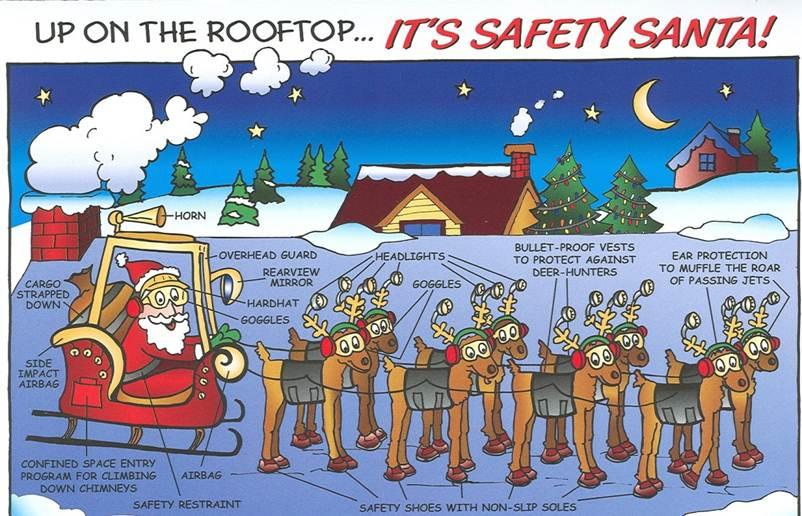
    This year we are once again pleased to report that not only have the flying sled and its power plants remained in compliance with the FAA but has now taken additional steps forward.  Incorporating new technologies and processes, safety has been enhanced in the following manner:

    • Addressing Slips, Trips and Fails with new safety/skip proof landing gear
    • A new Confined Space program along with appropriate personal safety gear
    • An alarm Klaxon and Better Lighting
    • Enhance Safety Restraints such as airbags and an overhead guard
    • Extensive Head, Vision, and Hearing Protection systems
    • Better Work Place Violence technology enabled processes
    • A new Cargo Restraint system

    It looks like the arctic region of the Occupational Safety and Health Administration (OSHA) outreach program is having great success.  Interested readers are invited to review the above safety Infographic for further details and perhaps new insights.

    Simplified Business Model

    There are a lot of lessons herein for those who don’t live at a mythical north pole.  First, it seems that much if not all the safety improvements made are inexpensive and easily implemented.

    Next, change management and new policies appear to be welcomed by those affected.  Answering the, “What’s In It For Me” question when adopting new technologies.

    Management is also ‘walking the walk’ with employees by driving the sled and taking the same risks as the rest of the team fulfilling customer requirements, i.e., snow covered rooftops and chimneys.  One can argue that this entire team is the Customer Facing part of the system.  Finally, customers have high expectations that must be met, and late delivery is not an option—this project has a fixed deadline!

    Stakeholder Value

    With billions of children waiting and using a complex and global logistics system, this team does not disappoint.  Earlier competitors have long dropped off the map.

    So why with a clear monopoly does this organization still seek greater Operational Excellence with its transformational Safety Culture?

    Simple—safe and excellent operational performance is good business!  Less unplanned downtime increases the bottom line.  Few incidents increase morale and the bottom line.

    Fewer legal issues, regulatory matters, and so forth and so on positively impact the bottom line.  With such significant ROI, what’s a stakeholder not to like?

    Is Your Operational Safety on Par with Ole Saint Nick?

    For More Information

    Please note, RRI does not endorse or advocate the links to other third-party materials.  They are provided for education and entertainment only.

    For more information on Cross Cultural Engagement, check out our Cross Cultural Serious Game

    You can contact the author as well.

  • Lessons in Servant Leadership: What Did You Say?

    Lessons in Servant Leadership: What Did You Say?

    Watch almost any media talk show and the interviewer will often interrupt the guest trying to answer the question just posed.  This is such a common phenomenon that it is accepted behavior perhaps driven by ratings that come from on-air confrontation.  It is part of the culture!

    Why ask the question if you’re only going to impose your view in the middle of an answer?  Perhaps guests are just convenient foils.

    When briefing senior management, colloquial wisdom is to get to the point quickly and succinctly.  Words to live by and often put forth by this pundit.  Yet it is amazing how many of us violate the axiom by continuing to talk.

    Truly listening with all senses is a rare skill.  How often have we been in a situation such as a sales call when the customer is interrupted by members of the sales team?

    It is more difficult to close a deal when the preconceived notions of the seller override the buyer’s response.  Often in such a situation the client’s body language will give a clue as to her irritation when ‘talked over.’

    The Power of Listening

    So, you have made your pitch and are now sitting quietly waiting for the client to respond.  However, the so called ‘pregnant pause’ ensues.

    The overwhelming desire is to ‘jump in’ and say something to break the silence.  But how does that close a deal when an offer has just been made?

    Such behavior usually results in either prolonged negotiation or no deal.  The human inclination to talk can be irresistible.  A better behavior is to shut up and listen!

    Some research shows that good listening is beneficial to both employees and their organizations.  However, barriers to better listening include:

    • Loss of Power—The appearance of weakness or not in control of the situation
    • Takes Time and Effort—Daily time pressures may negatively impact on the work product
    • Fear of Change—The speaker must refrain from making ‘foregone conclusions’ until a response is articulated

    In addition to certain listening skills, a good listener must have the ‘intention’ to become one and resist the urge to interrupt.  This can become the framework for real dialogue and exchange of ideas and information.

    Getting to Yes

    In a TEDx Talk, the coauthor of the negotiation book, Getting to Yes discusses the value of listening in any human interaction.  The investment of less than 16 minutes of your time will be enlightening.  One suspects the almost 900,00 viewers would agree.

    Our inherent nature to ‘rattle on’ distracts us from our goals.  We recently discussed the value of understanding the difference between Wants, Likes and Needs.

    Truly listening and understanding your counterpart’s feelings (or deeply personal Needs) will unlock the key to getting a deal done—Yes!  This is a major component of  servant leadership.

    R B C

    Human (B)ehaviors in certain situations or (C)onditions establish (R)elationships between two or more parties.  We have been extending this construct for almost 25 years and it has broad applicability.  What kind of Relationship is established if one or more individuals do not listen to others?

    How Well Do You Listen to Your Colleagues and Family Members and Do They Listen to You?

    For More Information

    Please note, RRI does not endorse or advocate the links to other third party materials.  They are provided for education and entertainment only.

    For more information on Cross Cultural Engagement, check out our Cross Cultural Serious Game

    You can contact the author as well.

    End Notes

      https://en.wiktionary.org/wiki/pregnant_pause

      https://hbr.org/2018/05/the-power-of-listening-in-helping-people-change

      https://therrinstitute.com/want-like-need/

  • In Defense of Humans—Machines Are Not Ready Yet

    In Defense of Humans—Machines Are Not Ready Yet

    I recently submitted an internal organizational document that was spellchecked in addition to my review; several times.  One sentence where there the intent was to say, “that which is …” was change to “that witch is …”

    Did I type it wrong or did ‘auto correct’ take over the decision process?  In any event spellcheck did not perform adequately against minimal Quality Assurance standards.  And how many of us ‘fat finger’ text messages?

    Is this is the technology that is going to drive me to work safely over 200 days a year; round trip?  I hope not.

    One pervasive message—technology gets better with time (more mature).  Is this true?

    How old is spellcheck?  By some accounts it dates to the 1960s.  Most believe by the late 1970s.  So close to half a century.  Yet!

    Usually a spellchecker is not used in a life or death situation.  That is unless it’s for your resume or job application!  However, what about software that is utilized for critical processes, i.e., medicine, process control, etc.

    There are many examples where apparent software failures have negatively impacted human life.  This pundit has written this subject including a look at Man Machine Codependency.  In another blog we commented on problems associated with valid and reliable analysis of Big Data.

    In this author’s opinion, software is getting better and while most likely will not be perfect, will change our daily processes.  The human overlords will need to be trained and/or retrained for the digitalization era.

    This cautionary tale is not about this writer’s inability to use word processing tools.  As we depend on these tools for critical decision making, we must have the core knowledge of the subject we are tackling.

    During a class on digitalization for my master’s level students, I put forth several examples where errors were made by various software applications.  Most had a level of comedy to them, but ALL have potential real-world consequences (bold font).

    • All People in Canada are the Same AgeDemographics for Census or Marketing
    • In Excel 2007, multiplying 77.1 times 850 yielded 100,000 instead of the accurate answer 65,535—Accounting or Engineering
    • The Making of a Fly, a classic work in developmental biology, was listed on Amazon.com as having 17 copies for sale: 15 used from $35.54, and two new from $23,698,655.93 (plus $3.99 shipping)–Procurement
    • Finally, Airline Disaster on AutopilotSafety for the Traveling Public

    This writer has authored books, articles, speeches, presentations, and blogs for many years.  Arguably, he can claim some experience as a writer.  Subject Matter Expert?

    In one instance, the ‘witch’ word won over my intent.  Did the technology cause this error?  Probably, as the goddess of Halloween is not something I typically pontificate about—not on my radar, so to speak.

    Humans can rule for the foreseeable future.  That is unless we seed to the technology.  Most importantly, algorithmic errors can lead to cataclysmic business and even life events.

    Finally, I spellchecked this blog before publication, and it caught the ‘witch’ word this time.  Go figure.

    How Prepared is Your Organization to Oversee the Digitalization Transformation?

    For More Information

    Please note, RRI does not endorse or advocate the links to other materials.  They are provided for education and entertainment only.

    You can contact the author more information as well.

    End Notes

      https://en.wikipedia.org/wiki/Spell_checker

      https://therrinstitute.com/wp-content/uploads/2018/10/Man-Machine-Codependency-September-22-2014.pdf

      https://therrinstitute.com/wp-content/uploads/2018/10/Big-Data-Revisited-December-15-2016.pdf

      https://consult2050.com/job-disruption-due-to-digitalization/

  • Chain of Custody: Is Your Management System Ready?

    Chain of Custody: Is Your Management System Ready?

    This eliminates the possibility for human error.”  This is an actual quote taken from one of the many blockchain ‘credible’ websites readily available—citation withheld to protect the guilty.    And, the Titanic was unsinkable!

    From another credible sources, “Is blockchain secure for my business?  Simply put, it can be.  But, not by just turning the key.  Security will depend on a variety of factors, none sic (not) the least of which requires a robust risk management framework?”

    In their white paper, KPMG argues that while the current blockchain frenzy is focused on the new technology, the question of its applicability to a business solution remains elusive.  Falling in love with a ‘shiny new software object’ has been seen before.  Most recently, digitalization and IoT.

    The organization’s economic buyer requires more depth in the decision-making process.  Has a valid Business Use Case been developed for its implementation?  This can be a time-consuming activity as the various constituencies must be queried to assess their assessment of the Economic Value of this CAPEX.  Unfortunately, there are no shortcuts to this risk mitigation process.

    This blogger has focused on the need for Governance and appropriate Management Systems for many years.  Historically it has been a challenge for business and government entities to keep up with the explosion of technology.

    While third parties are often the weakest link in supply chain management and this is one of the problems that Chain of Custody solutions address, technology alone is not a solution.  As with any transformational initiative, the broader impact, unintended consequences as well as other tangible and intangible exposures must be understood and managed accordingly.

    Just for the record, human error can never be eliminated.  It is human folly to believe that a technology can free us from our human nature.  High Reliability Organizations (HRO) recognize this frailty and respond accordingly.

    The promised of today’s technology suites can be of high value.  History teaches us that this value may not be realized if the problem being addressed, their implementation and sustained (maturity) processes are inadequately formulated.

    How Will Your Organization Assure It Will Realize the Value from Blockchain Investments?


    https://advisory.kpmg.us/articles/2017/securing-the-chain.html

    Shemwell, Scott M. (2018, October). How to make the case to the C-Suite: Selling Large Scale Data Management Projects to the C Suite. Foundations: The Journal of the Professional Petroleum Data Management Association. Volume 5 Issue 2. pp. 6-8.

    https://sceweb.uhcl.edu/helm/RationalUnifiedProcess/process/modguide/md_bucm.htm

    https://therrinstitute.com/economic-value-proposition-matrix/

    https://therrinstitute.com/are-organizational-governance-models-broken-why-cant-management-get-a-handle-on-things/

  • Brand Your Digital Oilfield Culture: Internalize Its Transformation

    Brand Your Digital Oilfield Culture: Internalize Its Transformation

    Our recent article, “The Digital Oilfield Culture: Transformation Value for the Organizational Ecosystem” (pp.24-26) takes a somewhat different change management approach.  Why not brand your digital oilfield culture?

    Most consumers are familiar with the so-called ‘Brand Name.’  These are names so ubiquitous that in some cases that we take them for granted.  Soft drinks, beer, fast food and automobiles are only a small sample of ‘product/service’ brands most can immediately relate to; even subconsciously.

    Hearing a brand name elicits a response, usually positive but possible negative as well.  This is the way organizations seek to have their product become part of the lexicon.  Examples include Xeroxing and Googling among others.

    Digital Oilfield Culture

    “Systemic Digital Oilfield Culture can be defined as the Core Set of Values and Behavioral Economics of ALL participants of the extended organization and its Enterprise Risk Management strategy that reflect a Strong Bond Governance commitment to behaving as a High Reliability Enterprise Ecosystem in a Safe and Environmentally responsible manner.”

    Ok, while accurate, this author’s definition of a Systemic Digital Oilfield Culture may be stiff and boring to some.  What does it mean to me and why do I care?

    As noted in past blogs and written pieces, a successful cultural transformation must address the. “What’s in it for ME” question.  Moreover, the answer must make sense to me if I am to internalize it.

    Taken from consumer marketing a, “Brand Essence is the emotional heart of a brand, summed up in a few words.  The Brand Essence Wheel is a format for capturing and communicating the conceptual subtleties of the brand.” (Chung and Doran, 2016).

    Successful brand strategies can create fierce lifelong loyalties, i.e., the cola wars of the 1970’s attempts to capture the emerging Baby Boomer demographic.  So why not take advantage of this marketing strategy when transforming the culture of an organization?  Create these fierce loyalties for your organization’s success!

    Brand Wheel Construct

    In accordance with the theory, the Digital Oilfield Culture Brand Wheel (First Draft) is composed of two major categories:

    Facts & Symbols or those components of the Brand that address the “hard” and often more measurable aspects.

      • What the Culture does do for ME
      • How I would Describe the Culture

    Brand Personality addresses the more emotional side of the Brand

      • How the Brand make ME look
      • How the Brand makes ME feel

    The wheel is then populated with those criteria of interest to the organization (generally developed through a series of workshops at all levels of the firm and its ecosystem).  One example is depicted in the following (Version 1.0) graphic.

    Final Thoughts

    There is a significant body of knowledge about the highs and lows of organizational transformation/change management.  The preponderance of the evidence suggests the transformation of a digitalized organization is difficult and often fleeting.

    The B2C sector has demonstrated repeated and sustained success creating perceived value to the individual (ME).  In B2B sectors, Rah Rah, executive sponsorship, training, etc. all have their place with change.  Yet, this is approach has proved wanting.

    Most importantly, strong Brands are sustained when the Rah-Rah fades.  Just Do It is the tag line of one major brand.  Betting most readers know what firm that is.

    Is Digital Oilfield Cultural Branding in Your Organization’s Future?

    For More Information

    The complete article is available from Petroleum Africa magazine and a ‘for fee’ copy can be downloaded.  In addition to a more detailed discussion of the branding process, it contains a high-level Implementation Plan.

    You can also contact the author as well.

    End Notes

      Shemwell, Scott M. (2019, May/June). The Digital Oilfield Culture: Transformational Value for the Organizational Ecosystem. Petroleum Africa Magazine. Issue 3. pp. 24-26.

    Petroleum Africa magazine has graciously allowed the re-publication of this edition.  See our full article.

      Ibid.

      https://en.wikipedia.org/wiki/Cola_wars

  • Human—Machine Interface in the Age of Digitalization: Can the Machine be Trusted and When Should the Human Intervene?

    Human—Machine Interface in the Age of Digitalization: Can the Machine be Trusted and When Should the Human Intervene?

    On March 10, 2019 the second Boeing 737 Max 8 (in approximately 5 months) crashed in Ethiopia.  This incident has led to extensive investigations and as of this writing that model aircraft is grounded.

    This pundit cannot and will not hazard a guess as to ‘why’ this aviation incident happened and what its ramifications will be—not our area of expertise.  However, this raises another issue that seems to be buried in the headlines.

    Recently, the President of the United States is purported to have said, “Airplanes are becoming far too complex to fly.  Pilots are no longer needed, but rather computer scientists from MIT.  I see it all the time in many products.”

    In our era of Digitalization, this question/belief is one that many Boards and senior executives may be asking/holding.  It is our understanding that pilots can override the sophisticated autopilot (whose sensor may have been sending erroneous data).  This begs the question, what is the protocol for the Human taking over from the Machine?

    What level of training do pilots receive?  What are the ramifications to their career if they make the wrong decision?  These and other questions are being asked continuously.

    In this blog series as well as in numerous other articles/speeches, we have commented on this issue.  Interested readers should review several other Critical Mass Blog writings et al. so that information will not be repeated herein.

    The question posed in the title, ‘Can the Machine be Trusted and When Should the Human Intervene?’ can be answered and has been many times.  A combination of training and experience will give the human the confidence to make difficult decisions in times of stress.

    Recent examples include the landing of US Airways Flight 1549 on the Hudson in 2009, elite military successes, sports teams, and other feats where a small group took charge at difficult moments and as the saying goes, “saved the day.”

    Scaling Training and Especially Experience

    So how does an organization ‘broadly’ train its large global workforce as well as its ecosystem?  Moreover, how does the same workforce gain ‘experience?’

    The saying goes something like, “You can have 30 years of experience in your career or you have one year of experience 30 times.”  Unfortunately, many organizations consist of the latter—employees/contractors and this includes senior executives as well!

    Some organizations see training as a cost.  Many have tuition reimbursements programs and send employees to a myriad of conferences and workshops.  However, other than high level platitudes, what is the value of any of this to the employee and/or the organization?

    There is also plenty of evidence that traditional training programs do not provide long term knowledge and do not address the experience issue at all.

    Immersion

    Immersive training is one form of experience.  The individuals live the situation and realistic options she or he is faced with.

    Moreover, on-demand information feeding remote individuals addressing major field problems is important too.  These information feeds can (and probably should) include Subject Matter Expertise from those who came before the contemporary workforce.

    In other words, taking the knowledge of those with 30 years of experience and making it available to those with only a few at the task step level is essentially having that senior individual in the cockpit with the more inexperienced person.

    Sounds good on this ‘paper’ blog but is this model realistic?  It absolutely is and at a price point that makes the value proposition compelling.

    No longer a week-long instructor led workshop where the information is quickly forgotten but knowledge on-demand in a matter that the user can absorb during a critical moment.  One report about the recent airliner crashes was that the pilots were ‘looking up’ procedures in the event of …

    Who has time for that in life and death situations?  No one!  The answer must be in front of you in a ‘heads up display’ manner on demand.

    Enabling technology is available at reasonable price points.  Blowing stuff up and killing people because employees/contractors are ill equipped to do their job is unacceptable.

    Could Your Organization Withstand a Max 8 Incident?  If Not, What is Being Done to Mitigate this Risk?


    For more information on Risk Mitigation check out our Operational Excellence Platform.

      https://www.marketwatch.com/story/trump-today-president-says-airplanes-far-too-complex-to-fly-after-boeings-737-max-crash-2019-03-12

  • Fleeting Success: In Pursuit of Sustainability

    Fleeting Success: In Pursuit of Sustainability

    Winston Churchill is credited with saying, “Success is not final, failure is not fatal: it is the courage to continue that counts.”  The late Prime Minister nailed it; once again!

    Our journey through life, including our career is a marathon not a sprint.  While we celebrate success, often at happy hour or a party, we recognize it is only a moment.

    Early in this writer’s career, a multi-million-dollar deal closed after more than a year of effort.  A celebration ensued.  The next day the sales manager, “Asked what was next?”

    Attain and Sustain

    Organizational initiatives seem to procreate.  In some ways like the Tribbles of the original Star Trek series.  Cute furry things, the Tribbles multiple at such a rate as to almost consume the Enterprise.  Only the transporter beam saves the crew.

    Like the rah-rah of New Year’s Resolutions, the question is not will I go to the gym in January, but will I still set foot on the treadmill in June or even March.  The road to you know where is paved with good intentions.  It is the sustained energy of the execution that assures more successes than failures—and that failures are teachable moments.

    Culture is one of the current buzzwords, yet Cultural Transformation is the key to sustainability.  Courage requires the organization to pick itself up, so to speak and continue the journey to a sustained high level of Operational Excellence.

    Easy to Say

    According to Forbes, in 2018 “enterprises are expected to invest $1.3 trillion (USD) in digital transformation initiatives to apply digital capabilities to improve efficiencies, increase customer value and create new monetization opportunities.”  The article goes on to posit, that almost $900 billion of that spend will be wasted as goals are not attained.

    Why are these projects always seemed doomed to fail?  A quick Google search identifies a large body of knowledge over the years documenting these types of failure.  So, the beat goes on.

    Hard to Do

    There is also a body of work documenting the “should do’s” of organizational transformation.  In fact, this author has contributed several articles and books on this subject.  Most notably, Implementing a Culture of Safety: A Roadmap for Performance Based Compliance.

    A Missing Piece

    There is a lot of talk about Operational Excellence, Digitalization, High Reliability Organizations, Human Factors, Safety Culture et al.  As with the Forbes data, many are suffering the same fate.  No wonder senior management is skeptical of new spend for more ‘Tribble-itiatives.’

    For example, when a critical infrastructure sector discusses the transformation to a Safety Culture, the term is often expressed as singular, i.e., there is one industry safety culture.  However, all firms have their own ecosystems consisting of multiple and sometimes disparate entities.

    They have developed a culture that is a source of pride, competitive advantage, etc.  Their culture differentiates each organization from their peer group.

    The following figure presents the actual nature of a firm’s Safety Culture.  The reality is that a large organization’s “culture” is a combination of multiple cultural dimensions.  It is this ‘nature of culture’ that must be better understood if a transition process is to be successful and sustained.

    Readers should note that the multi-dimension structure is continuously changing as business, technology, and regulatory environments impact on the Relationships, Behaviors, and Conditions of the situation.  This dynamic requires continual managerial energy and training to sustain the change desired.

    Cross Cultural Engagement

    It would seem to be a daunting if not impossible task to effectively and efficiently train a large work force including relevant third-party suppliers on an ongoing basis.  Of course, the cost would be prohibited as well.

    Not so fast, e-learning serious games are now available to support the training requirements necessary to “sustain” the transformation.  Moreover, specific scenarios can quickly be developed to meet specific organizational requirements.

    The games are developed using Game Theory and Human Behavioral theories.  They simulate a real-world environment and have been shown to give great results over decades.  With Cloud technology, these training tools are now inexpensive and readily available to all.

    Why have your Organization’s Business Transformation Initiatives Failed?

    Check out our Cross Cultural Serious Game


      https://en.wikipedia.org/wiki/The_Trouble_with_Tribbles

      https://www.forbes.com/sites/forbestechcouncil/2018/03/13/why-digital-transformations-fail-closing-the-900-billion-hole-in-enterprise-strategy/#1f5923507b8b

      https://www.xlibris.com/Bookstore/BookDetail.aspx?BookId=SKU-0143303003

      Shemwell, Scott M. (2015, November 28). Comments and Thoughts Regarding the IAEA Technical Meeting on Developing Improvement Programmes for Safety Culture November 2-4, 2015. Vienna, Austria.

  • Resolution: Celebrating a New Operational Start–One More Time

    Resolution: Celebrating a New Operational Start–One More Time

    It is hard to believe we are now 19 years into the century.  Seems like only yesterday we were worried whether the lights would stay on at Y2K.

    Each year many of us promise to do better at a list of things, some personal and some professional.  Some days or weeks later, some or all of our resolutions go unmet.

    For many heavy industry sector firms, January 1st is also the start of a new fiscal year.  New budgets will be released, and management will extol their workforce to meet new (possibly stretch) targets.

    If the equity markets are a barometer of things to come (leading indicator), then the Conditions organizations will find themselves in will most likely be volatile and some segments may even face significant challenges.

    For example, WTI crude oil closed on January 4th at US$ 47.96/bbl.  Some are bullish on this sector, with an expectation higher prices in the future.  History has shown this faith may not bear out.

    Regardless, organizational Behavior will need the flexibility to adjust in a process relevant time frame as conditions change.  The resulting Relationship with the firm’s ecosystem is a function of the behavior in the conditions or market circumstance.

    In other words, the R B C Framework is applicable in our everyday corporate life.  Why is this important?

    One way to view the global marketplace is one of continual change.  Often purveyors of Change Management/Organizational Transformation present this as a point in time.  Statements about continuous improvement are seemingly afterthoughts.

    We have developed an Operational Excellence Platform, as depicted in the following figure.  Please note that it is built upon the R B C Framework.

    Since the nature of Relationships across the organizational ecosystem will continuously evolve based on the marketplace, it follows that maintaining Operational Excellence depends on these tree factors.  Safe and profitable operations on strong, positive relationships.

    How well does your organization understand the R B C Framework for its ecosystem?

    Further Reading

    The author and others have published extensively on this subject.  The list of appropriate articles and papers is too extensive to list here.  However, readers are invited to peruse Dr. Shemwell’s extensive list of blogs and publications.

    See our Economic Value Proposition Matrix® (EVPM) for additional information and a free version to build your own EVPM.

    For further information Contact Us.

  • Command and Control: Is this the Way to Run the modern Railroad?

    Command and Control: Is this the Way to Run the modern Railroad?

    The managerial model, Command and Control (C&C) dates back to the dawn of humanity when tribal chieftains dictated the behavior of the group.  It survives to this day in many forms.  Typically, one thinks of military operations as the current manifestation of C&C in the western world.

    According to Wikipedia, by one definition found in The US Department of Defense (DOD) Dictionary of Military and Associated Terms, “command and control functions are performed through an arrangement of personnel, equipment, communications, facilities, and procedures employed by a commander in planning, directing, coordinating, and controlling forces and operations in the accomplishment of the mission.”  This definition has evolved from a more simplistic version found in the Cambridge Dictionary, ”situation in which managers tell employees everything that they should do, rather than allowing them to decide some things for themselves.”

    One suspects that most laypeople believe the latter definition to be to be the typical approach to C&C in their organizations.  In today’s complex (often global) organizational ecosystem, that version is outdated.

    The International Command and Control Institute, publication (circa 2005) , Understanding Command and Control develops this management construct in great detail.  As the following figure suggests, even a simple C&C structure such as a heating/AC system is driven by a set of KPIs.

    This is indicative of the digitalization of the system versus the analog controls many of us can recall from our youth.  Adding another layer, today’s ‘Smart’ thermostat operates within a well-defined governance schema such as the Internet of Things.

    Strong Bond Governance

    We first made the case for “Strong Bond Governance” in our September 17, 2013 Governing Energy blog, Strong vs. Weak?  In Critical Infrastructure sectors such as energy, medicine, etc. as defined by the US Department of Homeland Security we make the case for the construct of High Reliability Management (HRM).

    The Strong Bond Governance (SBG) paradigm enables HRM.  SBG demands Board of Directors and C Suite engagement in operations.

    Not directly but by putting in place a governance structure.  This has not always been the case with a number of catastrophic man-made disasters as the result.

    In some ways, C&C mimics HRM.  However, there are some significant differences.  HRM sets in place a structure designed to meet the test of adversities.

    • Preoccupation with Failure—a recognition that ‘failure is an option’ and the organization must respond quickly and effectively to mitigate exposure and recover. C&C does not directly address is concern.


    • Reluctance to Simplify—today’s organizational ecosystems are complex. Reducing operational decisions to the so-called Power Point three bullets, High, Likely, Low is completely unsatisfactory and potentially exposes the firm to business or technical process catastrophe.  Likewise, C&C models do not directly address this approach.


    • Operational Sensitivity—the field is where organizational action is, and senior management must have a focus on this critical component of the business. C&C also has a focus on operations, especially in the military sector.


    • Resiliency—things will go ‘bump in the night.’ Organizations must but in place the processes and expertise to rapidly respond to goblins that will be encountered.  C&C does not address this process.


    • Deference to Expertise—engage those who have the ‘know how’ to solve problems and that is mostly likely not the management team. This is substantially difference than the C&C model

    HRM allows management to look at computer dashboard and get a snapshot of most if not all aspects of the organization.  However, this does not mean that these individuals can manage from afar.  Those closed to and more knowledge about this issue must take the lead.

    Concluding Thoughts

    Watching the news, History Channel and/or various movies, one can see that even the military no longer uses simplistic C&C.  Small semi-autonomous teams take on the bad guys.  To be sure there is a Mission, Rules of Engagement and other governance controls in place.

    This provides local commanders the latitude needed to accomplish the mission at a minimum of human (good guy/non-combatants) and other collateral damages.  Additionally, military aircraft employ ‘High Reliability Management’ techniques where the expertise of the entire crew is used rather than the Captain dictating operational performance.

    Asiana Flight 214 crashed attempting a landing at San Francisco in July 2013.  One causal component was deemed to be the C&C culture of the Korean pilots.  Cockpit Management might have saved this aircraft and the lives lost.

    Likewise, those organizations and their ecosystems in critical infrastructure sectors that use HRM enjoy safer and more productive track records than those that do not—better bottom line.  The October 2014 Ebola scare is an example where the public health sector employed HRM and limited the impact of a highly contagious deathly pathogen.

    There is a tendency when the stakes are high for management to take the ‘reigns.’  In other words, engage in micromanagement.  The usual results are often sub-optimal.  The ‘gut instinct’ towards simplistic C&C is a strong urge and this addiction must be put into remission.

    A well-established Strong Bond Governance, High Reliability Organization can weather any storm the markets or nature can throw at it.  However, this organization transformation must precede the advent of major challenges!

    Traditional C&C is not an OE Imperative