
Author: RRI

  • The 1950s Were So Good Because the 1930s & 40s Were So Very Bad

    The 1950s Were So Good Because the 1930s & 40s Were So Very Bad

    An early Baby Boomer, born in 1948 this post war pundit watched (pun intended) the beginning of the broadcast television age, featuring I Love Lucy, The Honeymooners, The Ozzie and Harriet show, Leave It To Beaver, Disney’s Mickey Mouse Club, The Roy Rogers Show, Superman, Looney Tunes, Captain Kangaroo, The Howdy Doody Show and more.  A technological wonder, no less an important marvel than today’s Smart devices.

    The 1950s were a time of a non-existent (TV) American family that has never been reproduced.  My generation was raised watching June Cleaver cleaning her house all dressed up and wearing pearls.  I do not recall my mother (of that peer group) dressed as such doing daily chores.

    After the horrors of World War II and coming off the Great Depression era, America needed a pause.  Europe and Asia needed to rebuild themselves after their self imposed stupidity.  The so-called Happy Days established an Americana right up there with Norman Rockwell‘s vision.

    The 1950s set the stage for our 21st Century.  It established a ‘can do’ approach that persists to this day.  Many do not know that the transistor, the basis of all modern Cloud solutions was invented in the late 1940s and came into fruition during the 1950s.  Enabling the Apollo moonshot ten years later.

    On the down side, the Korean War draw and the Cold War with potential Nuclear Holocaust loomed large and set the stage for defeat in Vietnam.  This first American rout would not be our last.  Afghanistan!

    “Déjà Vu All Over Again”

    Apologies to Yogi Berra, it does feel sometimes like we are in a pre-1950s era.  Economic uncertainty, global political unrest, domestic turmoil, Covid-19, even pending European military hostilities, Asia etc. are all taking their toll on our collective psychic.  It all seems so similar to the late 1930s.

    The British Minister at the time, Neville Chamberlain, perceived as the appeaser did not live to the see the rout of 1940’s totalitarianism.  Had he, he might offer some thoughts about our current situation.  Winston Churchill most certainly would as would Ronald Reagan, Harry Truman, Dwight Eisenhower, Abraham Lincoln and others.

    Economically, the world fell apart.  Since the safety nets of today that did not exist back then, the impact was massive.  However, our safety nets are under attack.  Inflation may destroy the middle and other classes.  Just like it did in the 1970sStagflation.  The worst of all possible economic worlds.

    Our parents and grandparents survived significant and in some cases life threatening problems.  Collectively, society emerged stronger and perhaps happier.  Paraphrasing from the TV series Mission Impossible, “Our mission, should we choose to accept it is to rise to the challenge and makes this world a better place for those who follow.”

    We also remember the 1950s as so good because the 60s and 70s were subsequently very bad.  This does not need to be the case with this social/economic cycle.  We are not doomed to repeat that history and can change our destiny.

    Seems that we are not really trying.  Have we become the nanny state?  Making our parents and grandparents so proud.

    And Yet

    The 1950s were by no means perfect.  Long simmering civil rights tensions began to manifest and certainly many did not enjoy the environment many of us fondly look back upon.  However, this period was a pause that would be rudely awakened, perhaps when JFK was assassinated on November 22, 1963.  Or maybe earlier when Rosa Parks took her stand (or seat) on a bus in Montgomery, Alabama in 1955 about the time Martin Luther King Jr. was coming into prominence.

    Throughout the 1960s a number of horrendous crimes would be committed against innocent children, activists and others–ultimately leading the assassination of Dr. King.  Moreover, the 1970s would start with Kent State and the Jackson State killings.

    Lessons Learned

    For many, the 1950s were happy days, for others not so much.  Guessing most readers were not alive during this period and perhaps even their parents were too young.

    History is the ultimate task master.  Dooming new generations to relive the past.  However, this need not be the case.  We can and should learn from the follies and successes of those who precede us.

    The 1950s were unique in many ways.  Many in my generation believe that to be true.  However, it seems we are reliving the 1930-1950s era and the outcome might be similar.

    Our challenge is to make sure that does not happen.  History need not repeat itself.  It is up to us.

    What Are Your Organization’s Future/Contingency Plans?

    For More Information

    Please note, RRI does not endorse or advocate the links to any third-party materials.  They are provided for education and entertainment only.

    For more information on Cross Cultural Engagement, check out our Cross Cultural Serious Game

    We presented, Should Cross Cultural Serious Games Be Included in Your Diversity Program: Best Practices and Lessons Learned at the Online Conference, New Diversity Summit 2020 the week of September 14, 2020.  Check Out this timely event and contact the organizer for access to the presentations!!

    For more on DEI Standards, see the newly released ISO-30415.

    You can contact this author as well.

  • 100

    100

    This edition marks the 100th post in our Critical Mass Blog series.  We have sought to provide thoughtful, unbiased insight into the contemporary business and organizational challenges we all face.  Since our first blog post on November 27, 2017 our world has turned over in ways none expected.  Likely, this trend will continue.

    This series continues a tradition of newsletters, opinion pieces and other on line punditry first begun in 1998 with our New Millennium News.  A bi-monthly email with a subscription base of approximately 7,000 readers.  A huge number at that time.  We estimate that hundreds of thousands or more have benefited from this knowledge transfer.

    Coincidentally, we reach this milestone as we begin the new year–a time of renewal.  We will continue to address critical issues individuals, businesses, agencies and others face as we all navigate an increasingly perilous path.  This series has addressed Human Resource issues including Diversity, Equity and Inclusion (DEI) Teams , the arrival of Smart Technology, International Business, Covid-19, Supply Chain Management, Operational Excellence, Cultural Transformation (including Safety Culture) Sales, Risk Mitigation and of course Leadership.  Today’s organizations must be very good at all of these disciplines!

    Available Tools

    The mission of the Rapid Response Institute (RRI) is to enable our clients with the ability to posture themselves in their market segments so that they can thrive in volatile markets and capitalize on uncertainty, not suffer because of them.  This is especially important for those economic actors in Critical Infrastructure sectors.

    In support of this mission the firm has developed a suite of Intellectual Property (IP) which includes Know How, practical roadmap Books and guidelines as well as Software as a Service (SaaS) solutions among others.  Many readers know that once a process has been standardized with minimal configuration required, the data is the ultimate driver.  This is the heart of most Enterprise Resource Planning (ERP) solutions.

    With advances in technology, RRI has taken these once multi-million dollar solutions to a price point as well as Use Case where all organizations can utilize this capability.  Moreover, our advancements in work flow such as epitomized in our Cross Cultural Serious Games, Economic Value Proposition Matrix, and Smart OpEx (Operations Management System) and Risk Simulation Modeling add immediate and significant value to the challenges faced as articulated above.  Other Free Tools are available as well.

    Pulling It All Together

    The method to our madness is–Operations!!  As some are fond of saying with derision, “It’s All About the Benjamins.”  Well, it actually is.  If ‘for-profit’ firms are not profitable, they fail.  No amount of Environmental, Social, and Governance (ESG) will save them if they cannot deliver to paying customers.

    Everything RRI does helps organizations to deliver stakeholder value, compliant with ESG standards.  That is our Bottom Line and we are also pleased that Dr. Shemwell, Managing Director has been an independent advocate for responsible corporate success since 2004.

    FYI, major losses and legal actions do not enhance stakeholder value.  Neither for employees, local communities or equity holders.  Everyone loses when in terrible scenarios such as Deepwater Horizon, internal bias corporate hubris, poor high reliability processes/human factor shortcomings or lack of actual DEI.

    This journey continues.  Stay tuned for the next 100 editions where will continue to provide our thoughts on relevant matters.  Thank you very much for your readership and support.

    How is Your Organization Positioned for the Next Four Years?

    For More Information

    Please note, RRI does not endorse or advocate the links to any third-party materials.  They are provided for education and entertainment only.

    For more information on Cross Cultural Engagement, check out our Cross Cultural Serious Game

    We presented, Should Cross Cultural Serious Games Be Included in Your Diversity Program: Best Practices and Lessons Learned at the Online Conference, New Diversity Summit 2020 the week of September 14, 2020.  Check Out this timely event and contact the organizer for access to the presentations!!

    For more on DEI Standards, see the newly released ISO-30415.

    You can contact this author as well.

  • Getting to Diverse and Inclusive Teams

    Getting to Diverse and Inclusive Teams

    Diversity, Equity, and Inclusion (DEI) Team Models

    There is a tendency to see DEI through the lens of initiatives or often a process semi-outside the daily ‘organizational’ grind.  Does this represent reality?

    Organizations spend countless sums training employees and others they depend on for Operational Excellence performance.  They often trust global Teams to add stakeholder value.

    No less than Microsoft names a software product, Teams.  A tool designed to foster collaboration.

    The Way We Do Business

    Culture is often defined as ‘who we are.’  The approach an organization takes towards its ecosystem.  If this model is an accurate representation, it suggests that when organizations launch initiatives meant to address current social mores, they likely fail or at least do not live up to full potentials.

    Change management, often referred to as transformation often takes on the mantel of ‘you will be changed.’  Contemporarily, take the Covid-19 vaccine or you will be fired!  Not surprisingly, this mandate is resisted and seemingly increasingly with each new warning.

    As of this writing, the all out war (on decrees) has been declared by the likes of the Navy Seals, Health Care Workers, Law Enforcement and others with the demands from the Feds.  Likely, the result will be a draw at best, with the administration quietly acquiescing.  Too many critical, non-replaceable positions are at risk.  Not to mention votes.

    Governance

    In October 2011, we published our first draft of, Asset/Equipment Integrity Governance: Operations–Enterprise Alignment.  We recognized that traditional organizational Governance models were strictly focused on finance and maleficence therein.  The reality is that revenue is generate by operations and as such governance is critical as well.  Safety Culture, is intangible but now required by most organizations in Critical Infrastructure sectors.

    Flash forward to today and Environmental, Social, and Governance (ESG) is the model most organizations use.  Effectively, this expands governance to include a broad range of non-financial commitments.  From this blogger’s perspective, likely DEI will fall under this governance model.  Therefore, moving it from the ‘initiative status’ to the ‘way we do business.’

    Team Building

    This dynamic environment requires workforce upskilling.  The need to constantly assure that individuals have current Knowledge, Skills and Abilities (KSAs) necessary to meet current challenges.  KSAs now include the ability/necessity to work across cultural/diverse lines.

    When one thinks of a ‘team’ it is not a homogenous collection of like minded and ‘like’ individuals.  Teams are a collection of hopefully, ‘fit for purpose’ individuals who comprise the KSAs needs to accomplish the task(s) at hand.  Teams can mirror the discrete views of its members.

    For example, our early research on the subject assessed the different approaches Japanese nationals took when negotiating with white American males.  In each case, the individual players were deemed to be homogenous.

    Nothing could be further from the truth.  Each individual, in this case all males were of different ages, different education, from different regions of their respective countries, married or not and so forth and so on.

    The reality is that individuals do not negotiate deals.  Teams do.   Members of teams, like juries need to arrive at the same place prior to engaging with other collaborative counterparts.

    Juries need to be arrive at consensus.  Likewise, organizational team members must arrive at a similar place internally prior to going forward.  This not to say that individuals must cave to the will of the majority or the Tyranny of the Minority.  It is to say, a common position that all must accept as part of collaboration or consensus.

    Inclusive?

    There is no doubt that token individuals and in some case high profile figureheads have been put forth to ‘prove’ inclusivity.  Thankfully, those days are fading.

    Teams need to have the input of all members, even contrarians.  Often it is the outlier that has the most insight into a difficult problem.  Differences of opinion need to be resolved and a go forward plan agreed upon.

    Often, individuals do not speak up.  Perhaps they are new to the environment, shy or unsure of themselves.  Whatever the reason their input must be sought and at least given a fair hearing.

    Training can help elicit input from the reticent.  Moreover, they help dominate individuals acknowledge and accept said input.

    How Does Your Organization Assure Real Inclusion?

    For More Information

    Please note, RRI does not endorse or advocate the links to any third-party materials.  They are provided for education and entertainment only.

    For more information on Cross Cultural Engagement, check out our Cross Cultural Serious Game

    We presented, Should Cross Cultural Serious Games Be Included in Your Diversity Program: Best Practices and Lessons Learned at the Online Conference, New Diversity Summit 2020 the week of September 14, 2020.  Check Out this timely event and contact the organizer for access to the presentations!!

    For more on DEI Standards, see the newly released ISO-30415.

    You can contact this author as well.

  • Learn from the Big Guy

    Learn from the Big Guy

    We have all heard the flight attendant say, “Thank you for flying with us and welcome your destination, another on time arrival.”  Usually stated with gusto, as if an on time arrival was uncommon!

    Pundits and politicians are telling us that Santa will be late this year.  More salt on the wound, the jolly elf may not have everything on our list.  “Say it isn’t so, oh the humanities.”  Pass the eggnog please, Clark.

    This prognosticator suspects they are all wrong!!  Every young child knows that Santa, Mrs. Claus and their host of elves make all the toys, all year long at the North Pole.  So what’s the problem?  They are wrapping (pun?) things up even as you read this piece, right?

    Well, the dirty little secret is that somewhere along the way, Santa outsourced and even offshored his manufacturing and much of his distribution.  Must have been when the elves went on strike during Y2K.  Toy manufacturing no longer takes place at the North Pole.

    Be ‘SMART’ About Things

    However, Santa is a visionary.  He is a SMART Manufacturing Early Adopter, even an Innovator.  Shortly after, “The term Smart Manufacturing was coined in 2006 at a National Science Foundation workshop on Cyberinfrastructure,” Santa secretly developed his Proof of Concept and later a Pilot at a North Pole toy facility.  Legend has it that by 2012 he was deploying enterprise level SMART Toy Manufacturing at global scale.

    Today, some of Santa’s Helpers appear to be struggling against the firm deadline.  Their level of ’empowerment’ and creativity will determine how well the territory they are responsible for fares later this month.

    For those in real trouble, one suspects that Santa has already done two (2) things.  First he has probably sent in Teams of supply chain Subject Matter Expert elves to help suppliers get processes back on track  Additionally, he has transferred business from those who might miss the deadline to those forward looking firms that value High Reliability Organizational traits and will perform against the deadline.

    Santa is not only SMART, he and his organization are Resilient!

    Disruptions Amongst Us

    When things go bump-in-the-night with a supply chain, the worst thing Santa’s Helpers can do is fib.  Check is in the mail, dog ate my homework, I over slept, my car would not start, my computer crashed and so forth and so on.  Like most parents of small children, he has heard it all before over his long life.

    Santa always knows ‘who has been bad and good,’ and Data Analytics does not lie about his supply chain ecosystem.  You can try to hide but you cannot run.  While coal is out favor these days, Santa still have plenty to deliver as necessary.  Coal in your stocking would ruin a Carbon Free Holiday, so behave.

    Yes Virginia,

    There is a Santa Claus and he has never screwed things up!  He will fly from his distribution center at the North Pole the night of December 24th.  As he always has.  On the morning of the 25th, kids all over the world will celebrate.  The supply chain Grinch will not steal from the kiddos.  All will be joyful and full of song.

    Santa will deliver, despite the challenges faced.  If he can, why can’t your organization?  For those who have seen the movie Miracle on 34th Street, you know he is real?  In that movie, he delivers a house to a skeptical young girl.  He found a way.

    Santa has a global distribution problem– yet he always delivers on time to the largest customer base of all!  He has to for if he failed and his customer’s lost faith in him, it might be the end of the month of December as we know it.  The stakes could not be higher.

    Usher in the New Year

    Paraphrasing the late Secretary of Defense Donald Rumsfeld, “You go to war with the supply chain you have, not the supply chain you might want or wish to have at a later time.”  A later time always comes regardless of preparation or not.  If your organization is one of Santa’s Helpers/Suppliers that did not have business processes that were ‘smart’ enough this year, Happy New Year!  Start January 2nd to transform the old ways.

    For more about SMART Manufacturing, keep an eye our for the release of our 2022 book, “Smart Manufacturing: Integrating Transformational Technologies for Competitiveness and Sustainability.”  We will announce it on these pages when it is available.

    Hope you all found a bit of holiday cheer in this piece.  The story may be tongue-in-cheek, but the message is real.  It is time for all of us to ‘Get Smart.’  For those of you who were children of the 1960s, you will get the pun.  For the rest of you, GOOGLE IT!

    Happy Holidays

    For More Information

    Please note, RRI does not endorse or advocate the links to any third-party materials.  They are provided for education and entertainment only.

    For more information on Cross Cultural Engagement, check out our Cross Cultural Serious Game

    We presented, Should Cross Cultural Serious Games Be Included in Your Diversity Program: Best Practices and Lessons Learned at the Online Conference, New Diversity Summit 2020 the week of September 14, 2020.  Check Out this timely event and contact the organizer for access to the presentations!!

    You can contact this author as well.

  • THE SCIENCE: The Reason We Need STEM

    THE SCIENCE: The Reason We Need STEM

    Almost every day, we hear that “The Science” says . . .  We are told Covid-19 and Climate Change are based on The Science and as such we must accept that expert analyses as ‘settled.’  Then something changes and once more the science police demand we accept their new interpretation.

    The near-term result: confusion and lack of trust, even acrimony.  The Science, as presented by the media, politicians and others is a static solution.  As we follow The Science, we are told we must adjust but not necessarily why.

    There is no reason to trust to fate or our political betters (call themselves elites).  The Science is not that mysterious.  The term is meant to deride most of us, including degreed scientists like this author.  Might want to ask those pontificating to define the ‘Scientific Method.’

    Set at the beginning of the 20th Century Space Race, the movie, Hidden Figures brought broad attention to the mathematical genius of a group of then unknown women.  They were instrumental helping the fledgling NASA achieve the early goals of manned space flight, including the lunar landings.  They understood The Science better than others.

    On the Shoulders of Giants

    With the social deck stacked against them, these women rose above the norms of the time and accomplished feats unknown and certainly unexpected by contemporaries.  Perhaps more importantly, they demonstrated that math and science is not reserved for elites.  They educated all of us.

    We live in a technological age and told shortly everything will be ‘Smart.’  The workforce will change, and our view of the world will be dramatically different.  Moreover, many of us will no longer be relevant or even employable.  Balderdash!

    Science, Technology, Engineering, and Math (STEM)

    STEM is the anacronym for the set of technical knowledge embodied in these ‘hard’ disciplines.  Collectively, they form the backbone of our 21st Century economy and social advancement.  While liberal arts disciplines are important, STEM knowledge is critical if we are to hold the ‘experts’ accountable.

    Increasingly, ‘soft’ or social skills are also seen as important.  The old concept of the ‘Nerd’ is giving way to the technologist with human empathy.

    The emerging generation(s) will need STEM expertise as well as soft skills.  In some ways this is no different than previous times when the Titans of Industry changed their world.  Building on new technologies, they built business.  A successful business requires a knowledgeable workforce that can monetize technology.

    The titans this time are everyday men and women, even juveniles.  Knowledge of STEM subjects is dictating individual success or failure.  Get on the STEM train.

    Role of R B C

    We have routinely commented on the Relationships, Behaviors, Conditions model first put forth in the 1990s.  From a previous blog, “One of the basic tenets of the RBC Framework is the general construct that Relationships cannot be determined a priori.  The well-used example is a man and a woman sitting on a bench at a bus stop.  Are they married, siblings, coworkers, friends or simply two people waiting to catch the same/different bus?

    Their relationship cannot be known directly.  However, their Behaviors will provide insight into how they relate to each other.  Romantic behavior may indicate marriage, dating, an affair etc. They may still be coworkers but most likely are not strangers.

    The third dimension, Conditions (environment) can be considered the stage upon which behaviors play.”

    One can make the case that STEM is a condition or situation.  In other words, our technology environment.  The behavior of individuals with these skill sets will determine the relationship these individuals have with their peers, customers/business ecosystem and economy/society in general.

    Finally

    We spend a lot of time, quoting “The Science.”  Most vocalizing the term are not scientists or even qualified to understand its basic tenets.  But taken as gospel because of some perceived authority, i.e., politicians, newscasters, celebrities and bureaucrats among others.

    This scientist suggests that STEM is necessary to assure the emerging generations understand “The Science” and how it can actually be used to benefit mankind.  And, oh yea and make a buck!

    Where does STEM fit in Your Organization’s Strategy?

    For More Information

    Please note, RRI does not endorse or advocate the links to any third-party materials.  They are provided for education and entertainment only.

    For more information on Cross Cultural Engagement, check out our Cross Cultural Serious Game

    We presented, Should Cross Cultural Serious Games Be Included in Your Diversity Program: Best Practices and Lessons Learned at the Online Conference, New Diversity Summit 2020 the week of September 14, 2020.  Check Out this timely event and contact the organizer for access to the presentations!!

    You can contact this author as well.

  • Heavy Metal Rocks

    Heavy Metal Rocks

    Not the rock bands of the 1960s–1980s, but the mining required to extract the heavy metals necessary for electric vehicles and other renewable energy solutions.  So, what is a heavy metal and why do we care?

    Typically, “In science, a heavy metal is a metallic element which is toxic and has a high densityspecific gravity or atomic weight. However, the term means something slightly different in common usage, referring to any metal capable of causing health problems or environmental damage.”  Often these toxic elements are carcinogenic.

    For most readers this will not come as a surprise.  The heavy metals in batteries can be recycled, thus minimizing their negative impact on the environment and subsequently, humans and other life forms, i.e., the food chain.  However, smaller batteries are typically tossed into the trash.  Larger ones such as lead acid automotive batteries are usually reclaimed (for a fee to the consumer).

    From this pundit’s perspective, it is too early in the technology maturity to fully understand how millions of EV (electric vehicle) will be recycled effectively and economically.  Managing the lifecycle of these ‘elements’ from mining, use, recycling and reuse is a significant component of these renewables.  There is a cost associated with this process, both monetary and socially.

    Total Carbon Ownership

    In the business, the term TCO usually referees to the Total Cost of Ownership.  Updated, this Lifecycle metric may better reflect the Total Carbon impact of a product/solution, i.e., large scale batteries, solar panel, fossil fuels, etc.

    TCO = Carbon as a function of two major lifecycle elements; Operations and Decommissioning.

    For this purpose we define Operations (aka Use) as the lifecycle process from mineral extraction, manufacturing, deployment and maintenance.

    Decommissioning is the process of taking out of service, removal and appropriate disposal of components, including recycling.

    Follow on from our blog of November 2, 2021, where Milton Friedman detailed the complex supply chain required to manufacture a simple yellow graphite pencil, one can only imagine how complex the requirements are for a wind turbine.  Carbon neutral is not a simple problem to solve.

    Enter Structural Dynamics

    Many readers understand that Machine Learning Algorithms use the statistical multivariable method, Multiple Linear Regression–defined as, where “one variable is estimated by the use of more than one other variable.”  While this tool can be useful when assessing the impact and relationships of several independent variables, it does not necessarily help organizations to understand their TCO.

    Theoretically, every economic actor in the supply chain or the decommissioning process can calculate their carbon footprint for each​ product/step they control.  In the real world, such intangibles, i.e., safety are open to interpretation, ‘fudging’ or worse.  Moreover, we can expect large gaps or errors (inadvertent or otherwise) in carbon models that must be addressed if we are to realistically address the carbon problem.

    In the 1990s as a result of watching a number of systemic enterprise failures and/or poor performance, and wondering how this happened with such regularity the questions was raised–why?  This led this author coin the term with the subsequent book, Structural Dynamics: Foundation of Next Generation Management Science.

    Most do not understand the processes and structural changes at work on a daily basis.  Focused on near term performance metrics, they lose sight of the forest while concentrating on the trees.  The subsequent disruption caused is often rapid and economically cataclysmic.

    Structural Dynamics uses tools such as Structural Equation Modeling (SEM) to seek to identify the underlying process and structural movements.  It appears to be a useful tool to address the Total Carbon Ownership that organizations will have to address in the very near future.

    Dealing With Residuals

    Whether heavy metals or carbon, organizations must also assure ESG (Environmental, Social, and Governance) criteria are met throughout the energy lifecycle.  However, there is a cost associated with these and other organizational structures from the deployment and/or use of energy of all types.

    TCO is a decades long cost that can transcend actual corporate life, i.e., acquisition, bankruptcy, etc.  Currently, the oil and gas industry is littered with assets no one claims ownership.  Two cases follow:

    • Stranded assets are, “those investments which are made but which, at some time prior to the end of their economic life (as assumed at the investment decision point), are no longer able to generate an economic return, as a result of changes in the market and regulatory environment.”  These resources are no longer worth continued investment.
    • Abandoned assets have reached the end of life.  By one source, it is estimated that there are approximately 53,000 Gulf of Mexico offshore oil and gas well in this category.  Remediation costs range from $500k to $10 million per well–min $26.5 billion.

    It is reasonable to expect that all sources in the ‘energy basket’ will have similar end of life futures.  Green is therefore, not unique.

    “Forewarned is Forearmed”

    A Serious Assessment

    This pundit believes that scant attention has been paid to the lifecycle (economic and social) price of renewables and that the Total Carbon Ownership cost has never been calculated–certainly not published.  However, there are tools that will shed light on this going forward.

    TCO is a function of a detailed and long lifecycle, not unlike oil and gas assets that in some cases are over half a century old.  Any subsequent model of this process is by default complex, detailed and full of unknowns, or unmeasured latent variables.

    The approached this writer has developed using Structural Equation Modeling driven by Structural Dynamics seems well fitted to address this longitudinal and futuristic problem.

    For many, the so-called ‘green energy’ seems without consequences.  The history of energy suggests otherwise.  A full assessment using Structural Dynamics can reveal gaps, misunderstandings, errors and omissions.

    This model will advise management and even regulators what the true cost of an energy source is.  The approach is worthy of a serious discussion.  By the way, this model works for all sources of energy including coal and other fossil fuels as well as renewables.

    What is Your Firm’s TCO and How Can It be Lowered?

    For More Information

    Please note, RRI does not endorse or advocate the links to any third-party materials.  They are provided for education and entertainment only.

    Interested in Cross Cultural Engagement or DEI, check out our Cross Cultural Serious Game

    We presented, Should Cross Cultural Serious Games Be Included in Your Diversity Program: Best Practices and Lessons Learned at the Online Conference, New Diversity Summit 2020 the week of September 14, 2020.

    Contact the author for information on these and others subjects covered in the Critical Mass series.

  • The Secret of the Pencil

    The Secret of the Pencil

    The writing instrument, the pencil is purported to have been invented in 1795.  It has been around for a while and continues to serve a useful purpose.

    In the following video, the late economist Milton Friedman describes the process for manufacturing this simple longstanding tool.  The point he makes is that regardless of the simplicity and maturity of a product, it requires a robust supply chain from raw material through the distribution of the finished product.

    He makes the case that no single organization can make this simple tool without help from many economic actors and the thousands of organizations employed either as employees or part of individual supply chains.  This is a powerful argument for free market behaviors.  Well worth a little over 2 minutes of your time to view.

    As of this writing, there is probably more discussion about the global supply chain than this writer can remember.  The last time we saw such exposure was after the 2011 Tōhoku earthquake and tsunami, offshore Japan.  However, it was specific to goods and services provided from Japan.  This time it actually is different.  The current shipping disruption is purported to impact on the US holiday gift giving season.  The resulting impact on firms of all sizes may be dramatic and even impact on all levels of politics.

    States like Florida and Georgia and others are arguing that Asian shippers gain value by landing at their ports versus the closer ones on the West Coast of the United States.  If the economics bear this model out, significant long-term changes may be made.

    Pundits, including this one like to talk about Creative Destruction and the systemic changes that can come about as the result of an event.  While the pandemic may be the causal incident, the global supply chain will likely be the lasting impactful change in global commerce.

    As with the simple, mature product the pencil, every firm’s lifeblood is its supply chain.  How it works through this transformational period may help declare the winners and losers going forward.

    In our forthcoming book, we address the emerging Smart Manufacturing model and the role of the supply chain in the future.  Expect this component to become even more important.  Disruptions like the current one will ruin more than just the ability to manufacture automobiles.  Those with weak SC strategies will most likely fail.

    What is Your Firm Doing to Develop the Robust Supply Chain of the Future.

    For More Information

    Please note, RRI does not endorse or advocate the links to any third-party materials.  They are provided for education and entertainment only.

    Interested in Cross Cultural Engagement or DEI, check out our Cross Cultural Serious Game

    We presented, Should Cross Cultural Serious Games Be Included in Your Diversity Program: Best Practices and Lessons Learned at the Online Conference, New Diversity Summit 2020 the week of September 14, 2020.

    Contact the author for information on these and others subjects covered in the Critical Mass series.

  • Are We There Yet?

    Are We There Yet?

    Who among us have not uttered these words as a child or for those who are parents heard them?  Usually in the context of a trip in an automobile, but perhaps now in our journey to the next . . .

    Society is on a number of interconnected journeys.  Most visible is the Covid-19 transit (hopefully) out of the pandemic category.  Supply chain issues are very visible to the public as well.  More toilet paper anyone?

    Not as conspicuous but perhaps in the long run more impactful is our collective trip to ‘Smart.”  We are finalizing our book, Smart Manufacturing: Integrating Transformational Technologies for Competitiveness and Sustainability, due out in 2022.  In it we discuss a full range of issues and the societal transformation that is occurring.

    In one sense, this all began circa 2007 with the advent of the commercial smartphone.  How has our relationship with the phone changed since then.  Needless to say it has in a dramatic fashion in less than fifteen years.  A personal smart device that enables telephone calls in addition to a host of ever growing Apps.

    There are some enterprise level smart firms, most notably in the tech sector, i.e., social media.  Imagine when 15 years from now ALL major organizations and their supply chain partners are fully smart?  Sounds like a good deal doesn’t it?  However!

    There is risk associated with this transformation.  Notable recent examples include the Colonial Pipeline ransomware in May 2021 and the devastation caused to the East Coast of the US.  More recently, the October 2021 outage at Facebook, WhatsApp and Instagram ostensively caused by a single internal issue.

    These are scary, yet the most insidious will be the social cultural changes.  The very nature of jobs will change.  For example, we have already dipped our toe in the online video conferencing waters.  Many workers will remain remote indefinitely.  However, not everyone wants the isolation that comes from a home office.  They miss the human interaction and the gossip at the preverbal ‘water cooler.’

    Also, consider this.  What Knowledge, Skills and Abilities (KSAs) will you need in 5, 10 or 15 years to remain a viable employee?  By some accounts, up to 60 percent of the workforce will need to be reskilled or upskilled.  This is a huge number and this writer knows from personal experience that not all individual can or want to be re-purposed.

    Moreover, most digitalization initiatives have failed to date.  The IT project track record has been poor for decades.

    This suggests the road will be rocky for many, but not all.  As always, there will be winners and losers.  Both sectors, firms and even at the individual level.

    Historically, once an individual graduated from school and got job/career path formal education ended.  Yes many go back to night school, test for credentials, i.e., CPA, PE etc.  Some professions require ongoing Continuing Professional Education (CPE).  Yet most do not.

    It will be imperative at all levels, that we continuously re-invent ourselves throughout our careers.  The reality is–We Never Get There.  This is a lifelong journey.

    What Are You Doing to Assure Relevancy Tomorrow?

    For More Information

    Please note, RRI does not endorse or advocate the links to any third-party materials.  They are provided for education and entertainment only.

    Interested in Cross Cultural Engagement or DEI, check out our Cross Cultural Serious Game

    We presented, Should Cross Cultural Serious Games Be Included in Your Diversity Program: Best Practices and Lessons Learned at the Online Conference, New Diversity Summit 2020 the week of September 14, 2020.

    Contact the author for information on these and others subjects covered in the Critical Mass series.

  • Welcome to the 70s—Again!

    Welcome to the 70s—Again!

    This Baby Boomer graduated from college in 1970.  Just in time for Saturday Night Fever and Grease, Avocado colored refrigerators and Harvest Gold dinnerware.  Plus, the best friend a then bachelor ever had–the microwave oven!

    Not to forget the Gasoline Lines and Hyper Inflation, Vietnam, Peace/Race Protests/Riots, a Major Recession, Stagflation and other wonderful (not) youthful memories–ugly political and economic time not wished on future generations.  Adjusted for inflation a gallon of gasoline was $0.36 in 1970.  By 1980 it was $1.19–greater than a 330% increase.

    Seems like as Yoga Berra once said, “It’s like déjà vu all over again,” or ‘Those who do not learn history are doomed to repeat it.”  Yet here we are again, or so it seems.

    While I am not dusting off my leisure suit or growing what’s left of my hair, if as this boomer believes we are beginning to relive the 1970s economy, so what should we do?  How should we respond to this new, yet old situation?

    Most financial planners, corporate executives, academics, regulators and others were either not old enough or even alive when the economic and political shocks of the 1970s engulfed the globe.  Without this experienced knowledge, many maybe ill equipped to deal with the current  tsunami that is building.  Perhaps a critical concern for everyone’s 401K retirement investments?

    Hyper inflation is a cancer.  It destroys economies and even societies, not to mention families and individuals in its wake.  Real estate may be a winner if anyone can afford to purchase your house.  However, equities struggle and cash is toast.  From 1970 to 1980 the Dow Jones Industrial Average advanced a scant 5 percent.

    How does this compare with an over 300% increase in the gasoline we all needed for our automobiles?  Short answer, it does not and individual households went backward during that period.

    So What Do We Do Now?

    Flight to quality.  But what represents quality?  Big Tech comes to mind but what is the underlying value proposition of a web based database?  The outage of a major player blamed on a network issue and a number of (internal) cascading issues–the plague of many industrial incidents including Deepwater Horizon questions that proposition.

    Are companies this vulnerable in our age of digitalization, or was this a sign of something else?  As with many IT oriented decisions, “It depends.”  The fact that one of the world’s largest, high profile web based companies suffered a significant outage, not as a result of a cyber attack but apparently its own technical incompetency is not reassuring in a Cloud based global economy.

    The something else–we have discussed the need for High Reliability for complex sectors including the 16 sectors the US Homeland Security deems as Critical Infrastructure.  Social media is not on that list, but manufacturing is.  In our forthcoming (2022) book, “Smart Manufacturing: Integrating Transformational Technologies for Competitiveness and Sustainability,” we address risk mitigation strategies that can inoculate organizations from such catastrophic IT failures.

    Heavy industries such as oil and gas are routinely criticized when a catastrophic incident occurs.  These need no longer happen and we have put forth strategies routinely for more than a decade including in our 2014 book, Implementing a Culture of Safety: A Roadmap to Performance-Based Compliance.

    As we move into the ‘Smart’ era, it will be incumbent on organizations to take steps to mitigate what happened to a web based chat room provider.  The exogenous risk of critical infrastructure failing is significant, per the recent Colonial Pipeline ransomware attack and the systemic damage done to the US east coast.

    The 1970s were marked by turmoil and follow on from the late 1960s.  Richard Nixon took the country off the Gold Standard opening up significant economic and individual distress.  We appear to be on the cusp of Yogi’s cautionary tale.  It does not have to be, but appears likely.  Is the US dollar no longer the world’s reserve currency in a era of bitcoin?  If so, what are the ramifications?

    Finally, as the son of parents from the Greatest Generation, I admit I never faced the challenges they endured.  During my 20s, the period was an inconvenience, yet one I do not care to relive in my 70s.  The graphic was taken from the Internet without citation.  The author is unknown but we acknowledge his/her sense of humor.  AND I can relate to it!

    The Fed has indicated Inflation (Stagflation?) is here to stay.  To this individual, this is a scary statement even though it posited as essentially ‘no big deal.’  We will see in a year if it was as big a deal as it was in the 1970s.

    How will You Manage in this Environment?

    For More Information

    Please note, RRI does not endorse or advocate the links to any third-party materials.  They are provided for education and entertainment only.

    Interested in Cross Cultural Engagement or DEI, check out our Cross Cultural Serious Game

    We presented, Should Cross Cultural Serious Games Be Included in Your Diversity Program: Best Practices and Lessons Learned at the Online Conference, New Diversity Summit 2020 the week of September 14, 2020.

    For more information on these and others subjects covered in the Critical Mass series contact this author.

  • Data, Data Everywhere but Not an Answer in Sight

    Data, Data Everywhere but Not an Answer in Sight

    Awash with data, how many decisions made actually use it to add value?  Too few one suspects and partly because decision-making systems are not designed for this volume.  Much is made about Big Data and the value it can add to a business.  However, there is little said about the software applications and compute power that are necessary.

    Data, like information is a continuous feed from a variety of often conflicting sources. How this often subjective data is normalized which can lead to skewed results.

    One has only to look at daily news casts about any given subject to find a variety of ‘opinions’ as opposed to actual non-bias reporting.  One can argue that there is no objectivity with most analyses.

    So it is true with data analysis.  Data bias is a well known phenomena and clouds objectivity.  This matters most when organizations are making critical decisions.

    As we enter into the ‘Smart’ era data issues will not only be on the Critical Path, they will be the possibly be a major point of failure and significant operational losses and perhaps significant injury or even loss of life.

    In the last blog we discussed the difference in a methodology (The Science) vs new and often conflicting data.  We expand on the data mess, confusion, apparent flip flop, bias(es) and political agendas.

    While all of this might be political sport for a pandemic.  Can you run an organization based on this data?  Probably not a successful one!

    This author has addressed organizational governance issues for decades. We saw Sarbanes-Oxley, Asset Integrity, and now ESG.  It is time data had a seat at the board room?

    Decision Maker Beware

    Management is paid to make decisions based on uncertain, incomplete and often conflicting inputs.  It pays to have an understanding of the limitations of data and the software application decision makers.  Your career may depend on it.

    How Do You Know that the Data Upon Which You Make Decisions is Valid and Reliable?

    For More Information

    Please note, RRI does not endorse or advocate the links to any third-party materials.  They are provided for education and entertainment only.

    For more information on Cross Cultural Engagement, check out our Cross Cultural Serious Game

    We presented, Should Cross Cultural Serious Games Be Included in Your Diversity Program: Best Practices and Lessons Learned at the Online Conference, New Diversity Summit 2020 the week of September 14, 2020.  Check Out this timely event and contact the organizer for access to the presentations!!

    You can contact this author as well.


  • It’s Not THE Science, It’s THE Data

    It’s Not THE Science, It’s THE Data

    Watching one of the Sunday morning political news shows recently, as yet another pol described that the ‘science is changing‘ and mentioning the results of new data, it dawned on me that smart individuals are conflating science with data.

    By one definition, Science is “he intellectual and practical activity encompassing the systematic study of the structure and behaviour of the physical and natural world through observation and experiment.”  A number of publications suggest that the Scientific Method has been use to study the Coronavirus family of viruses  for decades.  Moreover, this Body of Scientific Knowledge regarding viruses is substantial.  By one account from 2013 (long before the current lemming like behavior), there are over one million virus types of vertebrates of which over 300,000 infect mammals.  This suggests there is a large body of scientific knowledge about virus behavior.

    What is changing over 18+ months is the data captured regarding Covid-19.  Whether diverse data sets from different collection processes is clarifying or obfuscating decision support models is up to interpretation, as it always is in these types of dynamic, evolving situations.

    So, when someone says, “they are following the science” they most likely are not knowledgeable about what they speak.  They are making decisions based on new, as well as the the sum total data set with all of its biases, errors, omissions and agendas that go  with it.  Different positions and responses to the virus is not the result of science changing but further analysis based on emerging data.  ‘The data’ is not nearly as forceful as the science says and the confusion that reigns from this approach is predictable.

    While research processes can change based on new discoveries, DATA analysis is the largest value.  For example, no one talks of new IT science, they talk about new tools and data assessment processes.

    Data Analysis is the key to New knowledge and the Scientific Method supports this Approach, not the other way around.

    For More Information

    Please note, RRI does not endorse or advocate the links to any third-party materials.  They are provided for education and entertainment only.

    For more information on Cross Cultural Engagement, check out our Cross Cultural Serious Game

    We presented, Should Cross Cultural Serious Games Be Included in Your Diversity Program: Best Practices and Lessons Learned at the Online Conference, New Diversity Summit 2020 the week of September 14, 2020.  Check Out this timely event and contact the organizer for access to the presentations!!

    You can contact this author as well.

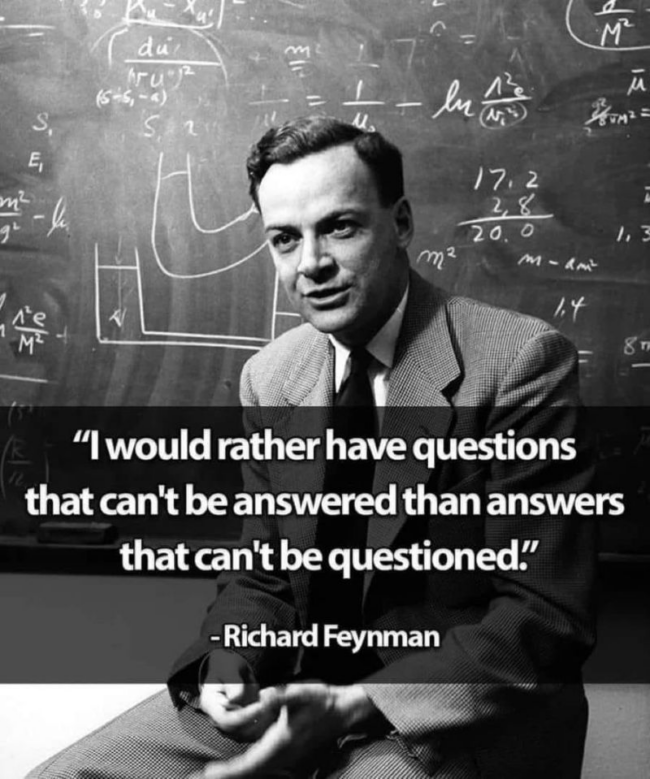
  • Questions, Questions, Questions

    Questions, Questions, Questions

    Picture sourced from LinkedIn, author unknown.

    It seems like there are a lot of answers these days, even to questions that have not been posed.  As of this writing, this author understands that masks work for Covid-19 but vaccines not so much although we are advised to get the shots and even a third one this fall.  So many flip-flops I feel like I spent the last year on a beach.

    Claiming, The settled Science says … is an answer designed to shut down debate.  Facts are, unless one believes the world is flat or the earth is the center of the universe (thank you Galileo Galilei), science is never settled.  If it were. we would be living in a Flintstones’ world.

    “And the Answer Is . . .”

    Thank you Alex.  For almost two years, we have been told the answers to the Covid-19 crisis are understood and the data is valid and reliable.   Then it isn’t.  Blamed on a dynamic and changing environment, we are told “we are following the science.”  Or perhaps just a political slogan.

    Pay no attention to that man behind the curtain!”  Just sit down, shut up and do as your told is often the mantra when authorizes’ edicts are questioned.  Good advise for a toddler but not so much for those over the age of 10.

    Are We There Yet?

    Tesla crashes are the latest Big Data enabled autopilot failures.  The level of maturity regarding digitalization and its various cousins has been discussed in this blog before.  Begging the question, are we ready for data Prime Time?

    We are besieged with answers from all manner of pundits, both electronic and in person.  We are told, “we must believe” without any serious discussion or in-depth assessment of the explanation.  Moreover, many of these statements regarding technology have not undergone the Scientific Method process.

    The result; many do not believe.  Covid-19 vaccination concerns are but one example of this squandering of faith.  Readers may have other issues that bother them.

    One consistent argument for not taking the inoculation is that vaccines take many years to develop and vet.  Perhaps, in the past but (1) we don’t have years with this deadly virus and (2) technology marches on and perhaps years are no longer required.  One can argue that this lack of trust is a result of so many answers in advance of the questions.

    How is your organization assuring that Answers are not being provided before the Questions are asked?

    For More Information

    Please note, RRI does not endorse or advocate the links to any third-party materials.  They are provided for education and entertainment only.

    For more information on Cross Cultural Engagement, check out our Cross Cultural Serious Game

    We presented, Should Cross Cultural Serious Games Be Included in Your Diversity Program: Best Practices and Lessons Learned at the Online Conference, New Diversity Summit 2020 the week of September 14, 2020.  Check Out this timely event and contact the organizer for access to the presentations!!

    You can contact this author as well.

  • Crisis Management: The Need for Internal Consistency

    Crisis Management: The Need for Internal Consistency

    Attributed to former US Senator and Governor Rhode Island, Lincoln Chafee, “Trust is built with consistency.”  Moreover, from statistics we know that Internal Consistency, “measures whether several items that propose to measure the same general construct produce similar scores.”  The follow on definition statistical reliability, “is the consistency of a set of measurements or measuring instrument, often used to describe a test.”

    In our July 20, 2021 post, Are Your DEI Wheels Spinning? we posited that positive behavioral change as a result of a new situation/condition must result in relationships built on trust.  Without said trust, positive behavioral change is unlikely.

    Situational Change and Differences of Opinion

    Responsible individuals, organizations, and even industrial sectors can disagree.  In fact, ‘academic argument’ is a key component of the Scientific Method and science is never settled.  Moreover, most situations are fluid and those in crisis tend to be agitated.

    That said, crisis management techniques demand well defined processes with identified owners.  Moreover, data must be shared and meet the dual tests of ‘valid and reliable.’  There is no room for sloppiness or data bias as was found in more than one occasion during the Covid-19 pandemic.

    Some argue that Covid-19 data issues are unique and due the global nature of the problem.  However, we are told that Big Data is the future or actually is now.  Solving Climate Change, enabling driverless electric vehicles and so on and so forth.  Based on current performance, it would appear we have a ways to go.  Despite statements to the contrary it is possible implement decision support systems quickly and with success.  This is actually not a new process.

    Street Cred

    Often viewed from the perspective of the colloquial.  One attains credibility based on perceived performance and not necessarily as a function of actual accomplishment.  Usually, highly visible this Influencer can hold sway in larger ways than are actually justified.  However, in their orbit these individuals hold the trust of their followers.  Those holding contrary views will lack trust from this group but may hold significant trust from others skeptical of said leader.

    Both sides can loose trust and cred if ‘holes’ appear in the story line, narrative or agenda.  If the internal consistency of each position is weak, internal group pressures may ultimately destroy any impression of belief and trust.

    This is somewhat where the world is with the established Public Health authorities.  Many hold the perception of perhaps actual misinterpretation, analysis and presentation of the Covid-19 data sets.  The counter position lacks credibility as well.

    R B C

    We have been a proponent of the Relationships, Behaviors, Conditions model for almost thirty years.  Simply put, when situations or conditions change, human behavior changes and vis-à-vis.  This directly impacts on the relationships between individuals or groups, even societies.

    Large, controversial conditional movements, often with poor and even incompetent supporting data can lead to the erosion and even the complete breakdown of trust among affected parties.  Emotional, hyperbole, draconian and biased positions can accelerate the breakdown of trust.

    Once this bond is broken, rebuilding trust is a very lengthy process.  Rebuilding trust is an act of leadership!

    What is your organization doing to keep trust intact?

    For More Information

    Please note, RRI does not endorse or advocate the links to any third-party materials.  They are provided for education and entertainment only.

    For more information on Cross Cultural Engagement, check out our Cross Cultural Serious Game

    We presented, Should Cross Cultural Serious Games Be Included in Your Diversity Program: Best Practices and Lessons Learned at the Online Conference, New Diversity Summit 2020 the week of September 14, 2020.  Check Out this timely event and contact the organizer for access to the presentations!!

    You can contact this author as well.

  • Are Your DEI Wheels Spinning?

    Are Your DEI Wheels Spinning?

    Originally published as a LinkedIn article on July 6, 2021, this updated version is reprinted here with the permission of the author.  Links to relevant sources are added.

    Lately, many LinkedIn posts bemoan the state of Diversity, Equity, Inclusion (DEI) initiatives. The seeming slow take up of great ideas.

    Some argue that DEI initiatives are no more than window dressing or organizational efforts to stave-off litigation. To others, they have the appearance of one more management initiative that if waited out will simply go away like so many others before.

    Fundamentally, DEI initiatives require change. A change of (B)ehaviors in the face of seemingly new situations or influencing (C)onditions (Circumstances, Capabilities, Cultures, Environments). When these two variables evolve, so do exiting (R)elationships. The RBC model is well established in social science and was first used to model Cross-Cultural (international business) Negotiations.

    It is multi-dimensional including a temporal schema capable of addressing numerous aspects of human behavior. Furthermore, it encompasses cultural as well as other situational aspects such as individual backgrounds.

    We tested this model using Japanese and American executives. This culturally diverse group needed to develop a level of trust if negotiation outcomes were to be successful.

    Likewise, successful DEI initiatives require that culturally diverse groups develop a high level of trust among those working together and/or members of teams.

    “Tell Me and I Forget. Teach Me and I Remember. Involve Me and I Learn”

    Attributed to Benjamin Franklin, this quote tells us all we need to know. The so-called Death by PowerPoint lecture long in vogue are often forgettable. Instruction, along with the homework prerequisite and tests are traditional methods. Finally, engaging individuals, teams, departments and even entire organizations can create long standing sustainable knowledge that is the basis for behavioral transformation.

    Paper based serious games or “games whose purpose is other than entertainment” originated in the late 1960-70s. In a nutshell, this is an interactive training solution. Subsequently, online serious games can incorporate actual scenarios designed to immerse players solving real world challenges.

    Rather than a video game whereby players engage with electronic decision trees, human-to-human serious games train players/teams to deal with diverse yet real colleagues. Collaborative scenarios direct participants to collectively solve problems while learning how their culturally dissimilar counterparts address the same challenge.

    Scenarios can drive engagement by all players including those who may not be typically involved in decision making processes. This is also a safe, no-harm no-foul environment with little to no individual decision-making risk.

    Transformation

    Any successful ‘change’ initiative must answer the What’s in It for Me? question. Humans may resist change if they do not see personal value from such actions. Moreover, while senior executive leadership is required, heavy handed top down My Way or The Highway may result in direct resistance, and/or a more crowed freeway to the exit ramp.

    For example, the current version of the smart phone was first available circa 2007. According to Statista, approximately 1.38 billion smartphones were sold in 2020. Likewise, over 46 percent of the global population own these devices.

    What does this have to do with DEI? In 2006 cellphones were great and becoming ubiquitous. No one knew they needed a smartphone. Our collective Behavioral transformation was caused because the What’s in it for Me question was answered.

    One component of the Conditions criteria, Capability changed as this technology enabled individuals to drive new behaviors based on Apps that emerged. The resulting transformation in our Relationships is well documented, i.e., the use of text as opposed to voice.

    Sustained transformation requires continued energy. The term ‘initiative’ implies a short-term event and one that will pass.

    Trust must be established and maintained. Over time, sustained energy will result in critical mass, or the (statistically significant) number of individuals engaged and trusting each other. This self-sustaining energy is transformation.

    Reframing DEI Initiatives into the RBC Framework can enable dramatic and rapid transformation. Take advantage of these types of cross-cultural models.

    For More Information

    Please note, RRI does not endorse or advocate the links to any third-party materials.  They are provided for education and entertainment only.

    For more information on Cross Cultural Engagement, check out our Cross Cultural Serious Game

    We presented, Should Cross Cultural Serious Games Be Included in Your Diversity Program: Best Practices and Lessons Learned at the Online Conference, New Diversity Summit 2020 the week of September 14, 2020.  Check Out this timely event and contact the organizer for access to the presentations!!

    You can contact this author as well.

  • Roadmap to Decision Making In the ‘Smart’ Era

    Roadmap to Decision Making In the ‘Smart’ Era

    “Nothing is more difficult, and therefore more precious, than to be able to decide.”

    Napoleon Bonaparte

    Volumes have been written on decision-making and this pundit has offered his share of insight and comment on the subject as well.  Some of our comments regard the appropriateness of the human intercession in electronic decision making.  Others raise questions regarding algorithm fallibility.  Moreover, Human Factors must be considered for any technology initiative which are becoming increasingly important.

    If one unpacks the previous paragraph a substantial level of complexity emerges.  As complexity increases so does risk and the need from proper governance.  However, many still see this potential transformation through the lens of just another IT initiative.

    Roadmap

    The oil and gas industry faced a similar dilemma at the dawn of the 21st Century.  At the time, referred to as DOFF or Digital Oilfield of the Future, a plethora of technologies became available.  The task was to transform 100 plus years of traditional operation to what is now referred to as the Digital Oilfield, aka Integrated Operations and a number or synonyms.  While this processes continues to evolve as new solutions emerge, i.e., Cloud, at the time much was trial and error.

    In conjunction with industry leadership, we released our Roadmap to Enterprise Optimization: A Guide to the Impact of Information Driven Field Operations on the Petroleum Corporation in the fall of 2004.  We believe it was the first industry (POSC) supported effort that was not simply research but a ‘bona fide’ action plan or roadmap to success based on industry/other knowledge, standards, economic value and best practices.

    Click for full size Integrated Operations Framework or graphic

    Since then, we have updated this roadmap into an Operational Excellence Platform.  Note that Integrated Operations is a key component.  The platform is a robust detailed solution that is available not just to the energy sector but all sectors identified by Homeland Security as Critical Infrastructure.  These sectors were recently identified as susceptible to hacking by the US government.

    Getting Smart

    Enormous corporate (shareholder) wealth has been destroyed implementing ‘game changing’ technology enabled transformation efforts.  Are we about to do that again, getting smart?  The easy answer is yes, but it does not have to be.

    Roadmap constructs are well understood and provide guidance.  In some models the step by step process provide practitioners with well defined models that can lead to success–defined as on time and under budget performance against Key Performance Indicators (KPIs).

    We are in the process of writing a book, to be released in 2022.  One chapter will define a roadmap for the transformation to ‘Smart’ for a major industrial segment.  As with earlier works, it will focus on the human element aligned with a technology assessment process.

    Get Smart was a comedic TV show spoofing the Cold War ‘spy’ environment of the 1960s.  Getting Smart today may not be a lot different.  The goal under a ‘Cone of Silence‘ was to attain and sustain competitive advantaged achieving superior stakeholder returns.

    Getting smart in 2021 will require a ‘Roadmap to Smart.’  A set of ‘to do’ processes that assures success.

    What is your Organization’s Plan to put Smart Decisioning Making Processes in Place?


    For More Information

    Please note, RRI does not endorse or advocate the links to any third-party materials.  They are provided for education and entertainment only.

    For more information on Cross Cultural Engagement, check out our Cross Cultural Serious Game

    We presented, Should Cross Cultural Serious Games Be Included in Your Diversity Program: Best Practices and Lessons Learned at the Online Conference, New Diversity Summit 2020 the week of September 14, 2020.  Check Out this timely event and contact the organizer for access to the presentations!!

    You can contact this author as well.

  • ESG Implementation–Strong v Weak Revisited

    ESG Implementation–Strong v Weak Revisited

    “A healthy corporation acts on the interests of its stakeholders and customers”

    — Ari Melber, Journalist

    Currently, organizations are being implored to implement Environmental, Social, and Governance (ESG) driven business models.   Proponents even suggest that investment in organizations that do not have this imprimatur should be avoided or even divested.

    However, one wonders what has changed?  Successful firms, private and public have long understood that they must add value to their constituencies.  One example, a few decades ago an energy services provider used its high volume oilfield pumps to help a small town in Kansas where it had a district office drain flood waters.  Why would they do this?  Perhaps because employees lived in this community or perhaps it was just the right thing to do.

    Flash forward and we find organizational largess still in place.  During the recent Texas freeze, a local furniture retailer opened its doors to dispossessed individuals and families.  The owner has a long record of supporting the community and his responses to local disasters is legendary.

    After the Deepwater Horizon incident in April 2010, our firm started to look at Asset Integrity issues in oilfield operations.  Our discoveries transcended several Critical Infrastructure segments.  The recent failure of the Colonial Pipeline is a manifestation of issues uncovered yet not resolved more than a decade ago!

    Focus on Operations

    In 2011, we posited that organizational governance was not just a financial issue at the ‘C’ level.  Rather its true focus should be at the revenue generating asset level.  This led to our 2011 groundbreaking monograph, Asset/Equipment Integrity Governance: Operations–Enterprise Alignment.  Therein, we posited a new governance model that incorporated the ESG components widely discussed today.

    Moreover, in 2014 our book, IMPLEMENTING A CULTURE of SAFETY: A ROADMAP FOR PERFORMANCE BASED COMPLIANCE identified the requirement for organizations in the Critical Infrastructure space to change governance models to one of Strong Bond.

    Following the release of our AIG model, we put forth a Strong v Weak governance model to manage High Reliability Organizations (HRO) necessary for firms in Critical Infrastructure sectors.  Strong Bond is appropriate for organizations in Critical Infrastructure segments, while Weak Bonds may be better for retail.

    One suspects that ESG is another tick in the box.  If ten years (or earlier) from now another critical system fails, it will not be because HRM processes were not followed or ESG verbiage was in the annual report Letter to Shareholders; it will be because nothing really changed.  As of this writing the US Federal government is advising organizations in Critical Infrastructure sectors to more aggressively address cybersecurity risks.

    Why is this? Do Boards and CEOs need politicians and bureaucrats to tell them about the details of running a business?  If they do, investors may want to revisit their portfolios.

    One suspects that the ESG fad will fade. There will always be a new management mantra that consultants will put forth.  Well run organizations will remain well run.  Others not so much.

    Governance models come and go.  Regardless, how will you assure your organization is well run?

    For More Information

    Please note, RRI does not endorse or advocate the links to any third-party materials.  They are provided for education and entertainment only.

    For more information on Cross Cultural Engagement, check out our Cross Cultural Serious Game

    We presented, Should Cross Cultural Serious Games Be Included in Your Diversity Program: Best Practices and Lessons Learned at the Online Conference, New Diversity Summit 2020 the week of September 14, 2020.  Check Out this timely event and contact the organizer for access to the presentations!!

    You can contact this author as well.

  • Its the Heart

    Its the Heart

    “A good, quick, small team can beat a big, slow team any time.”

    Paul William “Bear” Bryant, legendary college football coach

    In the early 1990s my former wife and I, both avid sailors decorated our boat for the local Christmas Boat Lane Parade.  While we had some help, most of the work was performed by the two of us.  That 27 foot sailboat, one of the smallest in the fleet that year won the overall Best In Fleet Grand Prize.  During the presentation, we were asked how many worked decorating the boat which had over 10,000 Christmas tree lights mounted on several three dimensional frames.  At the awards ceremony, when we told them that it was a very small team–this explanation was met with disbelief.

    During World War II, the mathematician, Alan Turing led a small tightly knit team breaking the German Enigma code, saving upwards to several million people.  A dramatization of his team’s challenges were captured in the 2014 movie, The Imitation Game.

    These two very different examples have one thing in common–Coach Bryant’s admonition.  Entrepreneurs such as Steve Jobs, Sir Richard Branson, Elon Musk and others have long argued that one should hire the best people and turn them loose.  Looks like sound advise.  This may be the reason start up firms consistently beat established larger organizations with greater resources.

    Inclusion

    Teams often appear to be cliques.  Much like the kids game where teams are divided up based on favoritism as ‘buddies’ are selected.  Any non-buddy can be effectively excluded since he or she may not be part of the in-crowd.

    In the movie, Turning was initially shunned by both team members as well as his superior.  He did not fit in.  In a large team he may have drifted into the background where his perspectives might not even be heard.  However, as a key ‘different’ member of a small team, his views could not be easily dismissed although they were disagreed with and even hated.  Yet they became part of the discussion and eventually the entire team supported him and ‘now their’ solution saved millions.

    During this period, the Tuskegee Airmen faced even greater challenges.  While some individuals and units may have been forced to accept them, their highly visible contributions could not be denied by those directly benefiting from their inclusion into the air bombardment task force.  Likely, this would not be as conspicuous if they were part of a larger organization.

    Bottom Line

    Not only are small high performance teams usually more successful, they offer all team members a better opportunity to be included in the activity.  This is even more true virtually when it is often difficult to prevent one party from attempting to dominate meetings.  Talking over people and/or raising one’s voice is a tried and true way to bully in a meeting and it is almost impossible to control virtually with a large group.

    Similar to atomic energy, it is not the amalgamation of large quantities of dynamite that makes the biggest bang.  It is the release of the smallest that is the Big Bang!  Harness the power of your team atom.

    What is Your Organization’s Small Team Strategy?

    For More Information

    Please note, RRI does not endorse or advocate the links to any third-party materials.  They are provided for education and entertainment only.

    For more information on Cross Cultural Engagement, check out our Cross Cultural Serious Game

    We presented, Should Cross Cultural Serious Games Be Included in Your Diversity Program: Best Practices and Lessons Learned at the Online Conference, New Diversity Summit 2020 the week of September 14, 2020.  Check Out this timely event and contact the organizer for access to the presentations!!

    You can contact this author as well.

  • Point of View

    Point of View

    What Are We Doing?


    An interesting sign of the times.  Individuals on social media who identify themselves by name, photo, job (even senior) title, organization etc. are taking controversial positions on a variety of often emotional subjects.  In the old days discussions about , sex, politics and religion were off limits in the corporate environment.  Apparently, not any more.

    If the recent election results are to be believed; 74 million voted for one candidate and 81 million for the other.  So if you are pontificating about one position, you are potentially alienating half of your clients, coworkers, superiors, etc.  What’s the point in doing this?

    Short term high possibly; however, items posted online remain forever.  Seems career limiting for a brief moment of venting.

    New Normal Model?

    First Amendment and all that aside, shouldn’t all of us govern our written feelings?  Writing, so and so is a jerk and I can’t stand him or her maybe a feel good moment.  However, do we do this in real life?  Generally not.

    Like sexting, baring your soul online might not be the best approach.  Tempered, as in the real world is probably a better model.  Most of us filter our response to controversial subjects in a business and even social environments.

    Why is this filter frequently off when we are online?  Some believe there that online presences have a level of anonymity.  Yet there is no evidence this is remotely true.

    Passions of the moment can run deep and after all it is just my opinion and it is my right to express it.  Theoretically this is correct but certain individuals are having accounts closed if the perception by monitors disagrees with their position.  More importantly, the sticky nature of posts may come back to haunt posters.

    Suggestion

    We are all entitled to our opinions and can express them in a number of ways.  The voting booth and political activism are one way.  Our religious affiliation is another and our sexual preferences are accepted these days.  Taking others to task online for their preference seems intolerant and not relevant when one is seeking to advance one’s career using social media.

    Put the older filters back on and reserve judgment for the voting booth, the bedroom and houses of worship.  The cost of venting on these subjects may be quite high and you may never know why you were not promoted, hired, or sales proposal rejected.  Finally, most organizations will have a clause as part of the employment agreement not to use company affiliation the way many are.

    We all have opinions, yet how are you remaining professional online?

    For More Information

    Please note, RRI does not endorse or advocate the links to any third-party materials.  They are provided for education and entertainment only.

    For more information on Cross Cultural Engagement, check out our Cross Cultural Serious Game

    We presented, Should Cross Cultural Serious Games Be Included in Your Diversity Program: Best Practices and Lessons Learned at the Online Conference, New Diversity Summit 2020 the week of September 14, 2020.  Check Out this timely event and contact the organizer for access to the presentations!!

    You can contact this author as well.

  • You’re Kidding, Right?

    You’re Kidding, Right?

    Not Again


    In 2018 we posted an opinion regarding social media driven sales ‘cold calling.’  As noted then, the comments went along the lines, “I reviewed your profile and I know I can help.”  This unsolicited approach continues to be blown off by this and other pundits/potential customers as amateurish.

    Recently, the tactic has sifted.  Now the argument seems to refrain (not literally), “I have reviewed your profile and I would like to offer you something that you have no interest in.”  What?

    In the past few weeks, I have been offered the opportunity to ‘buy in’ to an insurance agency, retain a coach, buy a franchise specifically chosen for me, and any number of prospect generation engagements.  Kidding right?  As if I do not know how to run my business?

    Innovative solutions that individuals and organizations are not aware of can add value and ‘reaching out’ to inform those unaware is legitimate and a long standing sales approach.  Most prospects welcome this knowledge and then can make an informed decision as to the relevance to their needs.

    Lunch and Learn models come to mind.  If I respond to this invitation, perhaps I am a qualified prospect worthy of follow up.

    The Call Back . . .

    Then, “Since you did not respond, I am sending you the same crap again“.  Maybe there was no response because the owner of a software company does not want to invest in the insurance business.

    A follow up should further the prospects knowledge, thus generating interest.  Regurgitating the same o ‘ same o ‘ is pointless, if not insulting.

    What a waste of everyone’s time, including the seller.  If the idea is just to blast everyone and see what sticks, this approach has never really worked.

    For example, somehow despite my being on the ‘no mail’ list this writer routinely receives (snail) junk mail from an AC service company that is not nearby, two real estate brokers I have no relationship with (one because they sold the house next to mine last year) and the infamous, home insurance renewal scam.

    Finally, I love the one whereby the vendor will send me qualified leads for my stock brokerage business.  What filter did that guy use?  Maybe AI.  As might be expected, none of these vendors received a call back, much less a sale.

    Someone With Your Name

    We have all received notification that someone with your surname has died and her/his bank account has millions in it.  “I am writing to you because we can transfer this wealth to you.  Just send us your banking information.”

    How is any of this different from online cold calling?  At its core, it is not.  These approaches to selling are abusive and condescending.  Moreover, they are not likely to win any business.  They come across as scams and not bonifide offers.

    Develop a Value Proposition

    If you want my business, explain how its adds value to my life.  Don’t just blast out something you HOPE will get my attention.  Why do I need coaching?  Why do I need a franchise or insurance agency?  Tell me something that matters to me.

    I am sure this message will not be heeded and I expect to continue to receive worthless materials from people I do not know.  The waste of bits and bites will not stop.  Just know that like rewards from the African princesses, such requests will go to Junk.

    For a sales model that works, see our Economic Value Proposition Matrix® (EVPM).  Additional information and a free version to build your own EVPM is available.

    Are You Doing Your Homework and Presenting Yourself/Organization as a Legitimate Provider?

    For More Information

    Please note, RRI does not endorse or advocate the links to any third-party materials.  They are provided for education and entertainment only.

    For more information on Cross Cultural Engagement, check out our Cross Cultural Serious Game

    We presented, Should Cross Cultural Serious Games Be Included in Your Diversity Program: Best Practices and Lessons Learned at the Online Conference, New Diversity Summit 2020 the week of September 14, 2020.  Check Out this timely event and contact the organizer for access to the presentations!!

    You can contact this author as well.


  • Complicity or Write a Book?

    Complicity or Write a Book?

    I Need a Book Deal!


    With the change of the US federal administration, previous key individuals are now coming out and writing books regarding their former boss.  This all the while with plenty of video evidence where these individuals pontificated a position and even changed their position dramatically while in the employ and in seemingly in support of that administration’s policy.

    Now some of the very architects of the US response to the Coronavirus are claiming their innocence all the while blaming others for thousands of deaths.  The nerve.  If true, she is equally responsible and perhaps more since she is a medical doctor.  First do no harm.

    We all have a boss and most need a job; however, when does an individual’s moral compass come to play?  Senior officials who will be gainfully employed doing something else fail to come forward or even resign.  THEN they claim victimhood!  The LOVE of power is so intoxicating.

    Remember, ordinary Germans were widely condemned after World War II for much less personal involvement.

    Credibility?

    Many institutions lack any credulity today.  This is not news and is a widely held view.  Any wonder when so called responsible parties now claim they could have reduced deaths but failed to do so?

    Organizational maleficence often leads to criminal charges and many executives have gone to jail.  If many of the books written after every administration are true, should at least some authors be at least censured for the complicity they themselves are documenting?

    ESG

    We have addressed the issue of governance a number of times.  Most notably in 2011, as part of our Changing the Dialogue monographs, Asset/Equipment Integrity Governance: Operations–Enterprise Alignment (A Case for Board Oversight) addressed the role of operations including environmental and social issues as critical components of the role of organizations.

    As part of the Safety and Environmental Management System tenets, the right for individuals to express themselves without redress is sacrosanct.  Surely, this includes senior officials?  If they can’t or rather seek to write ‘tell all’ books later, governance models are at risk.

    The days of Yes Men (and Women) and Empty Suits are over.  Perhaps, organizations need to clean house.

    How Do You Know Y0ur Advisors are Being Honest with You?

    For More Information

    Please note, RRI does not endorse or advocate the links to any third-party materials.  They are provided for education and entertainment only.

    For more information on Cross Cultural Engagement, check out our Cross Cultural Serious Game

    We presented, Should Cross Cultural Serious Games Be Included in Your Diversity Program: Best Practices and Lessons Learned at the Online Conference, New Diversity Summit 2020 the week of September 14, 2020.  Check Out this timely event and contact the organizer for access to the presentations!!

    You can contact this author as well.

  • Post Covid-19 Operational Performance

    Post Covid-19 Operational Performance

    Not the So-Called New Normal


    The light at the end of the Covid-19 tunnel may not be the train many still believe.  Populations are being inoculated at very high rates.  Moreover, there is ample evidence in my metropolitan area that the general population no longer believes or adheres to the ‘advice of experts.’  This should surprise no one who understands the US long history of civil disobedience.

    We pundits forecasting the new normal following a traumatic social event always get it wrong and so we will again this time.  There is a simple reason for this–Human Behavioral Economics.  Another leg of the three legged stool is the Technology Readiness Level (TRL) and not all technologies are at the same level or even play well together.  Finally, Organizational Culture must be ready as well.  If these situational settings are not met, the crisis passes and we get back into the comfortable and familiar.

    Following the initial euphoria that we could work from home and not wear pants, many discovered this really was not for them.  Many children did not do as well in a stay at home educational setting and teachers were challenged as well.  Moreover, many tasks require personal engagement.

    Many are Called . . .

    As always winners and losers will emerge and it will take some time for that rank order to solidify.  While digital is important and we have supported that business model for decades, bits will not physically move the barrels.  Still will take heavy industrial technology and processes.

    Using information and other technologies to drive Operations Management Systems are the future.  Not necessarily driven by IT firms but those digital engineers steeped in both disciplines.

    If Organizations are to achieve successful Sustainability, they first need a High Reliability level of Agility and Resiliency.  The only get these attributes when they perform at a high level of Excellence.

    So as we arrive at another new normal, we need to recognize that not everything from the past was bad and not everything we see today is good.  Some processes will be sustained and coupled with newer one.  New Normals do not really destroy the past; we continue to evolve.

    Even innovation from Creative Destruction is not instantaneous.

    How will your organization take advantage of emerging opportunities?

    For More Information

    Please note, RRI does not endorse or advocate the links to any third-party materials.  They are provided for education and entertainment only.

    For more information on Cross Cultural Engagement, check out our Cross Cultural Serious Game

    We presented, Should Cross Cultural Serious Games Be Included in Your Diversity Program: Best Practices and Lessons Learned at the Online Conference, New Diversity Summit 2020 the week of September 14, 2020.  Check Out this timely event and contact the organizer for access to the presentations!!

    You can contact this author as well.

  • Open Sesame

    Open Sesame

    A Year of Leadership–Or Not!

    On March 2, 2021 the Governor of Texas announced its 100% reopening–effectively proclaiming an end of the Covid-19 crisis.  Needless to say in our hyper-partisan world, many widely decried the decision and even accused him or bringing physical death to the state population.

    Mississippi announced a similar rollback of virus driven constraints.  Likewise, Connecticut is rapidly easing similar restrictions.  These state join others with loose Covid-19 protocolsThis pundit expects this trend to gain speed quickly and worldwide.

    Meanwhile, the President of the United States accuses these decisions as being made by Neanderthals, while the Director of NIAID position has move from NO mask to wearing MUTIPLE masks.  The political divide regarding the path forward remains wide.

    Consent of the Governed

    “You can fool all the people some of the time, and some of the people all the time, but you cannot fool all the people all the time,” is attributed to Abraham Lincoln.  This oft quote is usually seen through a political lens.  More importantly, it is a position from a Leader!

    Driven by suspect data we were told that this virus had an Armageddon like quality.  At one point over 2 million Americans were projected to die and the hospital systems would be overwhelmed, perhaps irrevocably.  Hospital ships were mobilized and economies brought to their knees all to save lives.  Perhaps, even our own.

    To be clear, many did succumb and many lives were destroyed or at least changed forever.  We mourn those and recognize the serious of this pathogen.


    A few of my family and friends have been infected but fortunately with only minor symptoms and limited hospitalization.  In this we are very fortunate.

    Crises can happen at any time, hurricane, winter storms, hostilities are part of the human conditions.  How we respond it the difference between chaos and inconvenience.  Leadership determines the outcome!

    If you have lost someone to Covid-19, cancer, accident, fire (I lost two family members) or other tragedies, statistical arguments are meaningless as the probability is 100%.  However, for the overall population likelihood of recovering from the coronavirus has always been quite high.

    Many questions have been raised regarding the myriad of conflicting “authoritative” information and misinformation the public has endured for 12 months.  With no conclusive or definitive game plan put forth by authorities, we were left to fend for ourselves.

    A resident of the Houston metropolitan area, this writer has noted that traffic is almost back to normal.  This suggests that the governed no longer have faith in political or medical leadership demanding yet another year under their ‘knowledgeable’ thumb.

    Once that credibility is lost, game over for leaders pontificating that to be safe we must hunker down forever.  Not sure even the Londoners did that during the Blitz.

    The Future is Bright

    Rulers attempt to dictate through a never ending series of edicts.  Knowledgeable governed conduct reasonable due diligence and make there own risk adjusted behavioral decisions.

    Likely, recent events are driven by the political class learning that enough is enough.  After all, we are adults and capable of living our own lives.

    Agree that the pathogen is still with us and we must address it.  Vaccines have a long history of success and processes are in place for safe openings.

    Society is opening with or without the politicians.  Remember the Speakeasies during Prohibition of the 1920s?

    Expect more to run to a microphone and claim leadership.  Ultimately, this process is irrelevant.  Getting out ahead of a parade and claiming to be the Grand Marshal does not make it so.

    Regardless, 2020 is over and there is NO interest in repeating it in 2021.  Message from the governed–we will take our chances going forward!  Our  R B C Framework model at work.

    Covid-19 is not over but seems to be getting to remission thanks to the army of men an women who have risen to the challenge in less than a year and saved countless lives.

    How are you leading your organization to recapture Normal?

    For More Information

    Please note, RRI does not endorse or advocate the links to any third-party materials.  They are provided for education and entertainment only.

    For more information on Cross Cultural Engagement, check out our Cross Cultural Serious Game

    We presented, Should Cross Cultural Serious Games Be Included in Your Diversity Program: Best Practices and Lessons Learned at the Online Conference, New Diversity Summit 2020 the week of September 14, 2020.  Check Out this timely event and contact the organizer for access to the presentations!!

    You can contact this author as well.

  • Teaming Safely

    Teaming Safely

    “For safety is not a gadget but a state of mind”


    Second only to the basic need for food, water and what is required to sustain physical life, safety and security are the next step in Maslow’s Hierarchy of Needs.  In other words one cannot love or feel belonging or achieve a level of esteem without having the warmth of safety much less attain self-actualization.

    More recently, team safety has come to be defined as Inclusive.

    There are three components of team safety:

    • Sociological — “developing and maintaining friendly social bonds is a fundamental organizing principle of human behavior”
    • Psychological — “defined as a shared belief that the team is safe for interpersonal risk taking”
    • Physiological — “relating to the way in which a living organism or bodily part functions”

    If members do not feel ‘safe’ then the team is not capable of high performance.  Moreover, the synergistic value that can be derived from team diversity can not be captured.

    Attaining Safety

    While the need to be safe is coded in our DNA so to speak, we are not inherently safe.  Individuals as well as teams must be proactive to reach situational safety.

    We are Mindful when we are in touch with ourselves and the environment through nurturing feelings.  Interesting, being mindful is a major requirement of High Reliability Organization/Team.  High reliability is a necessary ingredient for an organization’s Safety Culture and by extension its Teams (including third party ecosystem members).

    Safety is a learned behavior.  Therefore, effective training and ongoing reinforcement are necessary. Moreover, realistic scenarios are mandatory making the learning process relevant.

    Take the following maturity assessment and implement your team training program!

    What is your Team’s Culture of Safety Maturity?

    For More Information

    Please note, RRI does not endorse or advocate the links to any third-party materials.  They are provided for education and entertainment only.

    For more information on Cross Cultural Engagement, check out our Cross Cultural Serious Game

    We presented, Should Cross Cultural Serious Games Be Included in Your Diversity Program: Best Practices and Lessons Learned at the Online Conference, New Diversity Summit 2020 the week of September 14, 2020.  Check Out this timely event and contact the organizer for access to the presentations!!

    You can contact this author as well.


  • I Didn’t Do It, He Did — I Didn’t Do It Either, Someone Else Did

    I Didn’t Do It, He Did — I Didn’t Do It Either, Someone Else Did

    “When converted into productive thought and action, the energy it takes to blame, shame, and game is enough to launch anyone into heights of real success and happiness.”

     – Charles F Glassman

    Entrée

    It is not often that an entire geographically LARGE state loses power and water simultaneously.  Now we know it can happen!  Welcome to Texas (ERCOT) circa the dawn of the 21st Century.

    The finger pointing and claims, ‘not my responsibility’ surfaced immediately at all political levels.  As I sat in my power free, cold, waterless house, I was moved that political leadership was focused on saving their own hides.

    Benjamin Franklin’s words, “We must all hang together, or, most assuredly, we shall all hang separately” are lost on our hyper partisan world.  Earth to all polls, there is enough blame on this one to go around.  This society loves to Share and Like and is quick to find fault.

    The usual suspects will pontificate about blaming others and legal initiatives have already surfaced.  Good media, but who actually cares?

    This blog post is not about politics or the blame game.  It rather posits a solution that sees that this never happens again–anywhere.

    Operational Excellence Platform

    Excellent performance requires a conscious effort at all levels of an organization and its ecosystem.  We embodied a approach for heavy industry in our 2012 article, High Reliability Management in Process Industries: Sustained by Human Factors.  In that piece we put forth the argument that High Reliability Management is a strong methodology for management large complex systems such as the Texas Electric Power Grid.  HRM provides organizations with Agility, Resiliency and Sustainability in the face of large complex incidents.

    As we have previously put forth, Normal Accident Theory (NAT) posits, “that some accidents are inevitable because of system complexity.”  While logical, this model has its critics and lacks empirical evidence.

    The Texas electricity power grid got into process/technological/engineering trouble rather quickly.  Debate will rage for years as to what actually happened.  However, it seems practitioners at all levels practiced NAT.  Like Deepwater Horizon, this event did not have to happen.

    Safety Culture

    At the core of High Impact Performance is a strong safety culture.

    Systemic Safety Culture as the Core Set of Values and Behavioral Economics of ALL participants of the extended organization and its Enterprise Risk Management strategy that reflect a Strong Bond Governance commitment to behaving as a High Reliability Enterprise Ecosystem in a safe and environmentally responsible manner.

    Going Forward

    The over used phrase, ‘teachable moment’ suggests that we learn from our history so as not to repeat it.  Most likely oxen will be gored, witch hunts abound and the likelihood of little tangible progress will be made.

    Career losses will most like exceed the six board members who have already resigned.  All because the reactive NAT model was followed.  One is well advised not to follow this lead.

    How are you making sure that your operations processes are proactive?

    For More Information

    Please note, RRI does not endorse or advocate the links to any third-party materials.  They are provided for education and entertainment only.

    For more information on Cross Cultural Engagement, check out our Cross Cultural Serious Game

    We presented, Should Cross Cultural Serious Games Be Included in Your Diversity Program: Best Practices and Lessons Learned at the Online Conference, New Diversity Summit 2020 the week of September 14, 2020.  Check Out this timely event and contact the organizer for access to the presentations!!

    You can contact this author as well.


  • Is Your Remote Team Aligned?

    Is Your Remote Team Aligned?

    Recently, my team and I were tasked with a delicate decision making process.  Due to its nature and signatory level, team members were only authorized to explore and present options.  The final decision was mine alone.  Our project governance model clearly defined this decision making process.

    One day I received a call from remote members explaining they were going to a vendor site to assess our options–I concurred.  Several hours later they let me know that they had made a decision and signed a contract.  When challenged about their actions they informed me that the vendor had demanded that they ‘act fast.’

    Twice in my career I was the C level executive responsible for global operations.  In one case, one of my direct reports was in a different office along with my boss, the CEO.  I received multiple calls from the CEO over a period that ‘so and so’ had stopped by to talk and decisions were made about my operations.  “Well you were not here was the excuse and it seemed like a good idea to me.”  Would it surprise anyone that ‘so and so’ was relieved shortly thereafter?

    In another, the software development operation was in a different part of town.  Development plans were agreed to and then in some cases materially changed with without authority or even informing management.  Needless to say, projects were late or not completed.  After a few weeks of this, the development lead was terminated.

    Remote Management Governance

    Based on the above paragraphs, some may argue that I am not a very good manager.  Perhaps, they are right; however, the point is remote management can be very difficult.  Empowered individuals and teams must have boundaries.

    Yes, hire smart people and get out of the way.  However, there are limits as even Steve Jobs, the micromanager would agree.

    Evidence suggests that working remotely has its challenges and not everyone is well suited for it.  Some individuals will need additional support.

    There is a great deal of information available about remote management.  Some is sound, but this Though Leader on the subject disagrees with much the advice.  It seems for many, this is their ‘first rodeo’ while remote management goes back to antiquity.  While not the first, the Roman Empire functioned well from a bureaucratic or management perspective.

    Inclusive Teams

    Currently, much of the discussion focuses on the Inclusion of team members.  We are recognizing that Diversity is not enough if not every one participates.

    Previously, we had put forth the construct that cross cultural teams have many of the same characteristics of diverse groups.  We can extend this model and success that Inclusive Teams include those individual who are not as well suite for remote teams as others.

    Managing diverse remote teams and assuring that all team members are valued contributors requires a level of managerial engagement that is constant, consistent and appropriately empowering.  ALL members must be encouraged to participate and their input must be acknowledged by the others.  Only then can Steve Jobs and Elon Musk like decisions be taken and not by those who tend to dominate groups unilaterally.

    D&I in a Post-Pandemic World

    Typically, D&I has been defined as a function of ethnicity and/or gender.  Last year we put forth the construct that Cross-Cultural and D&I are similar models of human behavior and best practices from both could add value to the other.

    Diversity must now include those are not well suited for new business models; however, flawed they may be–jury is still out regarding the effectiveness and efficiency of full time remote teamsInclusion means they must be actively involved.  Leaders at all levels must assure this model is successful.

    How Do You Assure the Reluctant Remote Team Members are Included?

    For More Information

    Please note, RRI does not endorse or advocate the links to any third-party materials.  They are provided for education and entertainment only.

    For more information on Cross Cultural Engagement, check out our Cross Cultural Serious Game

    We presented, Should Cross Cultural Serious Games Be Included in Your Diversity Program: Best Practices and Lessons Learned at the Online Conference, New Diversity Summit 2020 the week of September 14, 2020.  Check Out this timely event and contact the organizer for access to the presentations!!

    You can contact this author as well.


  • What Is Your Opinion Based On?

    What Is Your Opinion Based On?

    “Without data, you’re just another person with an opinion.”

    ~ W. Edwards Deming

    Data and its use is a very hot topic these days.  Significant controversy exists over decision making regarding Covid-19 strategies and the quality or lack there of the data supporting government policies.  Scientific disagreements and so called ‘academic arguments‘ are appropriate, especially when facing the NEW.  However, the way some data is being used should give us all pause.

    We will learn a lot from this pandemic, one important opportunity is to understand how incomplete and competing data can/must be used in important decision processes.  By definition, every decision is made with incomplete and/or poor quality data.  Moreover, all data is not revealed by traditional data analysis–Latent variables play a major role in any assessment process.

    Opinions Are Like …

    There are a number of ways to complete the above sentence and we will leave that to the reader.  As Deming mentioned, if the data supporting a position is not valid and reliable, it enters the arena of “FAKE.”  According to Accenture, “Fake data is data that is unverified, maliciously tampered with, or just plain wrong.”

    Unfortunately, much of what is passed today, especially on social media might be classified in the fake category.  With no quality assurance, even by institutional resources, positions are advanced as gospel and are often not just wrong but driven by agendas.

    For example, months ago, hydroxychloroquine was vilified by an on air journalist, yet a world leading medical expert posited that it helped.  Presently, the pendulum has swung against this drug.  Questions of the efficacy of the data have been resurrected.

    It is beyond the scope of this piece to address data nuances. Interested parties may find the Public Health Research Guide: Primary & Secondary Data Definitions useful.  Moreover, it is not necessary to become a data expert or data scientist.  The construct, Wisdom of the Crowds suggest that the knowledge and decision of a large group can be better than experts.

    If you have expertise in data, ask this simple question “Is the data reliable and valid?”  Also, follow the wisdom of physicist Richard Feynman, “If it disagrees with experiment, its wrong.”

    With so many claiming to follow The Science, it is important that individuals have a level of understanding about the data that supports The Science.  Sadly, from this physicist’s perspective secondary, unvetted data is often the weak foundation of their positions.

    So, What Are Your Statements Based On?

    For More Information

    Please note, RRI does not endorse or advocate the links to any third-party materials.  They are provided for education and entertainment only.

    For more information on Cross Cultural Engagement, check out our Cross Cultural Serious Game

    We presented, Should Cross Cultural Serious Games Be Included in Your Diversity Program: Best Practices and Lessons Learned at the Online Conference, New Diversity Summit 2020 the week of September 14, 2020.  Check Out this timely event and contact the organizer for access to the presentations!!

    You can contact this author as well.

  • Passing of the Greatest Generation

    Passing of the Greatest Generation

    Salute Ladies and Gentlemen!

    December 7, 1941 was 79 years ago.  A twenty-year-old at the time would be 99 today, almost a centenarian.  My father is 98 and not likely to see 2021.

    We live in a technological age, and despite the pandemic it is relatively easy living for many.  No one is asking our youth to go to foreign lands with the likelihood of not returning.

    If the Twentieth Century has taught us anything, it is that youth has stood up repeatedly despite the dithering of politicians.  Many of this century’s young warfighters continue this proud tradition of defending our nation and our freedoms.

    Born at the dawn of the last century, this generation saw the Great Depression and volunteered for the (hopefully) final global conflict; World War II.  Since Pearl Harbor, our world has changed dramatically and quickly.

    They saw the transformation of the United States into a global Super Power and slogged through some 45 years of the Cold War.  China moved from the backward nation occupied by Japan to its current position.

    The (possible) Chinese saying/curse, “May You Live In Interesting Times” applies to this selfless generation who laid the ground work for our modern world.  On way they invented the transistor in 1947—the foundation of our “Smart Technologies.”

    As they pass from the scene, in the words of Abraham Lincoln at Gettysburg, “It is for us the living, rather, to be dedicated here to the unfinished work which they who fought here have thus far so nobly advanced.”

    We must pick up their gauntlet.  In one sense it is a heavy lift; however, those who came before us have lightened our load.

    What Are You Doing to Make Your Parents and Grandparents Proud?

    For More Information

    Please note, RRI does not endorse or advocate the links to any third-party materials.  They are provided for education and entertainment only.

    For more information on Cross Cultural Engagement, check out our Cross Cultural Serious Game

    We presented, Should Cross Cultural Serious Games Be Included in Your Diversity Program: Best Practices and Lessons Learned at the Online Conference, New Diversity Summit 2020 the week of September 14, 2020.  Check Out this timely event and contact the organizer for access to the presentations!!

    You can contact this author as well.

  • Covid-19 Positive: Telemedicine Kicked into High Gear

    Covid-19 Positive: Telemedicine Kicked into High Gear

    Crisis Drives Change

    In 2001 this writer approached the Houston medical community, post tropical storm Allison which flooded many basements in the Houston Medical Center with the loss of experimental data and other records.  We proposed the development of an Internet based solution to hold and manage medical records of all types.  The response to my organization’s offer to digitize records was met with disbelief and ultimate rebuke.

    At the time I was employed by a major corporation with the technology and financial resources to accomplish this task.  Sales Objections included privacy, doctors will not ‘buy in,’ insurance will not pay for it and a host of other lame excuses.

    Flash forward to 2020.  Why are thing so different now and the idea of ‘digitalization’ almost universally accepted?

    Twenty years is a career for many, yet it took a crisis this year to kick the medical sector into action at critical mass—Coronavirus, aka Covid-19.  As often the case large organizations are content to stay with the status quo.  Culture, processes, and even individual bonuses incent lethargy and complacency.  This common trait is not limited to one sector.

    Moreover, advances in online telemetry support the physician’s ability to treat many aliments remotely.  The industry did not just ‘jump’ to the current state, it evolved over time.  For example, remote and inaccessible areas such as Antarctica have taken advantage of telemedicine including remotely directed surgeries.

    Democratization

    We may look back on 2020 as the seminal moment when medicine was digitalized.  Despite current access issues such as we are finding with K-12 education, most will have the ability to interact online in the near future.  Moreover, a number of COTS (commercial off the shelf) health solutions such as found in a variety of Smart phone products enable remote diagnosis and monitoring on a global basis.

    The catalyst for taking telemedicine to the next level is Covid-19!  A good Positive.

    How is your organization taking advantage of remote operational technologies?

    For More Information

    Please note, RRI does not endorse or advocate the links to any third-party materials.  They are provided for education and entertainment only.

    For more information on Cross Cultural Engagement, check out our Cross Cultural Serious Game

    We presented, Should Cross Cultural Serious Games Be Included in Your Diversity Program: Best Practices and Lessons Learned at the Online Conference, New Diversity Summit 2020 the week of September 14, 2020.  Check Out this timely event and contact the organizer for access to the presentations!!

    You can contact this author as well.

  • How Bored Are You? – Adding Value During the Pandemic

    How Bored Are You? – Adding Value During the Pandemic

    A friend of mine sent me this uncited picture, so my apologies to the originator as I cannot give you the rightful credit deserved.  If you see this, let me know and I will update this blog.

    We are all enduring 2020 in our own way.  Sometimes positive but often negative.  Battling my own 2020 demons, I was never tempted to invent new mathematics.

    Other than the obvious humor of this likeness, what value add have we provided society since March?  For some dealing with job changes/loss and the kiddos at home may make developing calculus a seemingly easy task.  Some families have faced hospitalization and even the loss of loved ones.

    We all have been touched by this disease and personally, family and close friends have contracted it.  So far, all are recovering or have.

    With vaccines on the near horizon and with a pathogen (typical) lifecycle record of less than a couple of years, we may all move on and back to normal—in this pundit’s opinion not the new normal many prognosticate pontificate.  Likely, the old mask-less normal.

    We all have choices to make and in many cases have already made them.  While therapeutics and vaccines look very promising, the virus is still with us.  Personally, we have four choices.  Where we find ourselves at the end is a function of current behaviors.

    Note that developing new math is probably not one of them; however, new Apps are a distinct possibility.  New art, writing, music, businesses and a plethora of other options can be your contribution.  Carpe diem or make the most of your Isaac Newton moment.

    This virus is often compared to the 1918 so-call Spanish Flu; however, six pathogens have haunted the human race since then with another 14 in recorded history—not to mention polio that started circa 1916 and ran well into the 1950s..  Seems that one way or another we are all sentenced to live with this kind of scourge.

    How we make the best of it is up to each one of us.  Spend your time well—add value as opposed to waistline.

    What will you tell your kids you did during the 2020 pandemic?

    For More Information

    Please note, RRI does not endorse or advocate the links to any third-party materials.  They are provided for education and entertainment only.

    For more information on Cross Cultural Engagement, check out our Cross Cultural Serious Game

    We presented, Should Cross Cultural Serious Games Be Included in Your Diversity Program: Best Practices and Lessons Learned at the Online Conference, New Diversity Summit 2020 the week of September 14, 2020.  Check Out this timely event and contact the organizer for access to the presentations!!

    You can contact this author as well.