
Tag: operational excellence

  • Reputation, Reputation, Reputation

    Reputation, Reputation, Reputation

    “It takes 20 years to build a reputation and five minutes to ruin it.  If you think about that, you’ll do things differently.”

    – Warren Buffett

    It is fascinating how many accident videos get posted to social media.  Guess we all go to NASCAR races to see car wrecks.  In some cases, videos are personal disasters for those involved.  In some cases, they are downright funny and in the category of what were they thinking.

    Equipment and facilities damage, lost production/project time, personal injury litigation are just some obvious costs.  One hidden cost is reputational damage.  Would you hire a firm that hires, does not train, and/or tolerates some of this behavior?  Probably not, and in some case a strong safety record is part of the procurement decision process.

    Risk Mitigation

    Most of the social media video show failures in occupational safety.  Typically, in the United States these would fall under the Occupational Safety and Health Administration (OSHA) and/or state and local safety regulations.  This is laudable, but without a broader safety governance framework, a lackadaisical attitude can continue.

    Under a Strong Bond Governance Framework, a robust Operations Management System (OMS) enables both public and private firms to realize the Safety Culture they seek that will keep them off the social media most watched list.

    Strong Bond Governance

    An organizational governance model with the following attributes first put forth by the author in our seminal 2014 book, following the Deepwater Horizon incident.

    • Direct, defined relationships that enables open and valid information between governance members.
    • Led by authorities who are closely connected and strongly bonded.
    • Strong Governance, Risk, and Compliance (GRC) system.
    • Back office and field processes combined into a single information model (OT-IT).
    • Designed for application and use in Mission-Critical Environments. [i]

    [i] Holland, Winford “Dutch” E. and Shemwell, Scott M. (2014). Implementing a Culture of Safety: A Roadmap to Performance-Based Compliance. New York: Xlibris.

    Operational Excellence

    Operational Excellence is the execution of the business strategy more consistently and reliably than the competition, with lower operational risk, lower operating costs, and increased revenues relative to its competitor.  It is needed more than ever in today’s technology driven rapidly changing business models, which require organizations to undergo end-to-end business transformation. Operational Excellence can also be viewed as execution excellence. 

    However, the focus of Operational Excellence goes beyond the traditional continuous improvement methods to a long-term change in organizational culture.  Companies in pursuit of Operational Excellence do two things significantly differently than other companies: they manage their business and operational processes systematically and invest in developing the right culture. 

    Operational Excellence manifests itself through integrated performance across revenue, cost, and risk. It focuses on meeting customer expectation through the continuous improvement of the operational processes and the culture of the organization.  The goal is to develop one single, integrated enterprise level management system with ideal flow.  The second component, a culture of Operational Discipline, is commonly described as doing the right thing, the right way, every time.  This culture is built upon guiding principles of integrity, questioning attitude, always problem-solving, daily continuous improvement mind-set, level of knowledge, teamwork, and process driven.

    Organizations attain and sustain Operational Excellence using tools such as Operations Management System OMS).

    A Typical OMS Framework includes all the major areas involved in organizational processes such as shown in this graphic.

    OMS is a collection of processes and procedures enabling a company to effectively manage business practices and achieve the highest level of Operational Excellence in daily operations.

    One of the more notable examples is the Safety and Environmental Management System (SEMS).  SEMS embodies the Safety Culture into the organization’s OMS.  This systemic model is incorporated into a Strong Bond Governance Framework causing safety to become ‘the way we do business.’  In other words, the culture of the organization and by extension its Ecosystem.

    Systemic Safety Culture

    In a culture of safety, people are not merely encouraged to work toward change; they take action when it is needed.  Inaction in the face of safety problems is taboo, and eventually the pressure comes from all directions — from peers as well as leaders. There is no room in a culture of safety for those who uselessly point fingers or say, “Safety is not my responsibility, so I’ll file a report and wash my hands of it.” 

    — Institute for Healthcare Improvement

    Systemic Safety Culture is the Core Set of Values and Behavioral Economics of ALL participants of the extended organization and its Enterprise Risk Management strategy that reflect a Strong Bond Governance commitment to behaving as a High Reliability Enterprise Ecosystem in a safe and environmentally responsible manner.

    Most Safety Cultures have a set of tenets similar to the nine shown in the following list.  These are based on those developed by the Bureau of Safety and Environmental Enforcement’s (BSEE) for marine offshore oil and gas operations and are typical of those used in other Critical Infrastructure sectors.

    Nine Tenets of a Culture of Safety

    1. Leadership
    2. Problem Identification and Resolution
    3. Personal Accountability
    4. Work Processes
    5. Continuous Learning
    6. An Environment for Raising Concerns
    7. Effective Communications
    8. Trust and Respect
    9. Inquiring Attitude

    Finally, it is common practice for parties to refer to a singular industry ‘Safety Culture.’  In reality since each organization has its own culture, there are literally hundreds if not thousands of Safety Cultures in any critical infrastructure sector.  As shown in the above figure, each individual can interact routinely with a myriad of other cultures, both internal to their organization as well as with external economic players.

    After the Deepwater Horizon disaster in 2010, the authors quickly recognized that all economic players in the industry regardless of size would need to immediately adopt a Safety Culture if they were to survive.

    The resulting 2014 book, Implementing a Culture of Safety: A Roadmap for Performance Based Compliance remains one the few that readers can use as a roadmap to incorporate a Safety Culture into their Operational Excellence business model regardless of industry.

    Smart OpEx

    Fifteen years ago, large organizational Operations Management Systems were struggling to incorporate structural safety as more than the so-called, ‘slips, trips and falls’ of OSHA regulations to one where safety is endemic to the culture.  Smaller firms, often participants in the supplier ecosystem were largely forgiven.  The logic being that the major contractors and operators would assure that the final work product met Safety Culture requirements.  This is no longer the case.  Firms of all sizes in every business sector with an operations component now require an OMS to manage not just internal operations but third-party contractors as well.

    The Smart OpEx Operations Management System software solution is joint venture between The Rapid Response Institute LLC and Knowledge Ops, Inc.

    As Mr. Buffet mentions, reputations can be lost in an instant.  According to a 2007 Harvard Business Review article, “In an economy where 70% to 80% of market value comes from hard-to-assess intangible assets such as brand equity, intellectual capital, and goodwill, organizations are especially vulnerable to anything that damages their reputations.”  While almost 20 years old, the premise of the HBR piece remains the case as Boeing, Bud Light, and others can attest.

    Put systems with checks and balances in place that enable the organizational governance and protect the company from entering the Halls of the Disreputable.

    An individual’s and organization’s reputation are everything.  How are you assuring both are protected?

    Pre order our new book

    Navigating the Data Minefields:

    Management’s Guide to Better Decision-Making

    We are living in an era of data and software exponential growth.  A substantive flood hitting us every day.  Geek heaven!  But what if information technology is not your cup of tea and you may even have your kids help with your smart devices?  This may not be a problem at home; however, what if your job depends on Big Data and Artificial Intelligence (AI)?

    Available April 2025

    For More Information

    Please note, RRI does not endorse or advocate the links to any third-party materials herein.  They are provided for education and entertainment only.

    See our Economic Value Proposition Matrix® (EVPM) for additional information and a free version to build your own EVPM.

    The author’s credentials in this field are available on his LinkedIn page.  Moreover, Dr. Shemwell is the coauthor of the 2023 book, “Smart Manufacturing: Integrating Transformational Technologies for Competitiveness and Sustainability.”  His focus is on Operational Technologies.

    We are also pleased to announce our forthcoming book to be released by CRC Press in April 2025, Navigating the Data Minefields: Management’s Guide to Better Decision-Making.  This is a book for the non-IT executive who is faced with making major technology decisions as firms acquire advanced technologies such as Artificial Intelligence (AI).

    “People fail to get along because they fear each other; they fear each other because they don’t know each other; they don’t know each other because they have not communicated with each other.” (Martin Luther King speech at Cornell College, 1962).  For more information on Cross Cultural Engagement, check out our Cross-Cultural Serious Game.  You can contact this author as well.

    For more details regarding climate change models, check out Bjorn Lomborg and his book, False Alarm: How Climate Change Panic Costs Us Trillions, Hurts the Poor, and Fails to Fix the Planet.

    Regarding the economics of Climate Change, check out our blog, Crippling Green.

    For those start-up firms addressing energy (including renewables) challenges, the author can put you in touch with Global Energy Mentors which provide no-cost mentoring services from energy experts.  If interested, check it out and give me a shout.

  • Value from Elon Musk’s ‘Idiot Index’?

    Value from Elon Musk’s ‘Idiot Index’?

    “If the ratio is high, you’re an idiot.” – Elon Musk

    “Musk developed the ‘idiot index,’ which calculated how much more costly a finished product was than the cost of its basic materials.  If a product had a high idiot index, its cost could be reduced significantly by devising more efficient manufacturing techniques.”

    Effectively, what he is saying that if the Cost of Goods Sold (COGS) is too high, a product may either become too expensive or not sell well, if at all.  This is the basic Supply-Demand curve from Economics 101.  He is also indicating that Gross Profit will be negatively impacted as well.

    It’s the Cost Structure Stupid

    Paraphrasing the candidacy of Bill Clinton in 1992, an organization needs to develop a cost structure that not only lowers Total Cost as low as possible but sustains this approach while assuring the produced product/service is fit-for-purpose.

    According to the Corporate Finance Institute, “Cost structure refers to the various types of expenses a business incurs and is typically composed of fixed and variable costs.  Costs may also be divided into direct and indirect costs.  Fixed costs are costs that remain unchanged regardless of the amount of output a company produces, while variable costs change with production volume.

    Direct costs are costs that can be attributed to a specific product or service, and they do not need to be allocated to the specific cost object.  Indirect costs are costs that cannot be easily associated with a specific product or activity because they are involved in multiple activities.

    Operating a business must incur some kind of costs, whether it is a retail business or a service provider.  Cost structures differ between retailers and service providers, thus the expense accounts appearing on a financial statement depend on the cost objects, such as a product, service, project, customer or business activity.  Even within a company, cost structure may vary between product lines, divisions or business units, due to the distinct types of activities they perform.”

    We see that cost management is much more than simply lowering the procurement costs of parts or subcomponents going into the manufacturing product.  It is all about the design of the firm and its culture!

    Parasite Control

    One of the challenges all organizations face is ‘Cost Creep.’  Management needs to but guardrails in place to assure a low-cost structure business model remains that way.  Service firms are just as susceptible as manufactures. 

    According to one source circa 2000, professional services cost creep aka parasite control can be defined as, “Too many people whose services are not really required trying to use it as their meal ticket.”  Originally used in the context of the space exploration sector; however, in this writer’s opinion this issue is not restricted to that one industrial segment.

    At one point in my career, I was the executive responsible for a number of large successful simultaneous consulting engagements.  Other projects were either not doing as well or winding down.  Two things started happening.

    First, I discovered that those not on one of my projects were trying to bill their time to one or more projects.  Either as a direct ‘accounting code’ attempt or more frequently as a ‘contributor.’  One individual even tried to charge for his local mileage under the premise that while he lived in Houston, he was tied to a practice in Atlanta.  Thus, in his opinion he was remote.

    Point being, any project can be subject to parasite control.  “Cost Creep” is an ongoing managerial problem that must be shut down when found, the real costs clawed back and allocated correctly.

    Robust Cost Management

    Aggressively addressing costs at all levels is neither idiotic nor stupid.  It has always been a business fact of life and as of this writing, the federal government bureaucracy is discovering it is the ‘new normal.’

    Moreover, this never-ending pursuit of cost perfection will have a new player shortly.  Artificial Intelligence (AI) is rapidly gaining traction in our everyday operations.  The audit process is part of cost management, and we already have examples of the use of AI in the audit process.  Expect more to come and sooner rather than later.

    We have an Operations Management System implementation underway where AI will play a pivotal role in Phase II later this year.  We will report back once it has ‘gone live.’

    What are your organization’s plans to vigorously manage costs?

    Pre order our new book

    Navigating the Data Minefields:

    Management’s Guide to Better Decision-Making

    We are living in an era of data and software exponential growth.  A substantive flood hitting us every day.  Geek heaven!  But what if information technology is not your cup of tea and you may even have your kids help with your smart devices?  This may not be a problem at home; however, what if you job depends on Big Data and Artificial Intelligence (AI)?

    Available April 2025

    For More Information

    Please note, RRI does not endorse or advocate the links to any third-party materials herein.  They are provided for education and entertainment only.

    See our Economic Value Proposition Matrix® (EVPM) for additional information and a free version to build your own EVPM.

    The author’s credentials in this field are available on his LinkedIn page.  Moreover, Dr. Shemwell is the coauthor of the 2023 book, “Smart Manufacturing: Integrating Transformational Technologies for Competitiveness and Sustainability.”  His focus is on Operational Technologies.

    We are also pleased to announce our forthcoming book to be released by CRC Press in April 2025, Navigating the Data Minefields: Management’s Guide to Better Decision-Making.  This is a book for the non-IT executive who is faced with making major technology decisions as firms acquire advanced technologies such as Artificial Intelligence (AI).

    “People fail to get along because they fear each other; they fear each other because they don’t know each other; they don’t know each other because they have not communicated with each other.” (Martin Luther King speech at Cornell College, 1962).  For more information on Cross Cultural Engagement, check out our Cross-Cultural Serious Game.  You can contact this author as well.

    For more details regarding climate change models, check out Bjorn Lomborg and his book, False Alarm: How Climate Change Panic Costs Us Trillions, Hurts the Poor, and Fails to Fix the Planet.

    Regarding the economics of Climate Change, check out our blog, Crippling Green.

    For those start-up firms addressing energy (including renewables) challenges, the author can put you in touch with Global Energy Mentors which provide no-cost mentoring services from energy experts.  If interested, check it out and give me a shout.

  • Process Audit-Musk Style: A Systems Analysis Solution

    Process Audit-Musk Style: A Systems Analysis Solution

    Auditing is defined as the on-site verification activity, such as inspection or examination, of a process or quality system, to ensure compliance to requirements.”  Elon Musk has just changed the Auditing Game!

    Most readers are aware that Elon Musk is leading a small task force of developers to assess the processes and spend of various federal government agencies, i.e., USAID.  This pundit has been of the belief that this group is using Artificial Intelligence (AI) to address this, as he did when assessing the proposed budget in December 2024.

    Observers were astonished with the speed and accuracy of this AI driven assessment.  Gone are the days of thousands of pages of unreadable bills where congressional leaders demand instantaneous passage in the ‘wee hours’ of night.  No more, “We have to pass the bill so that you can find out what is in it.”

    Too Big to Fail, No More!

    The long-standing mantra for major, critical sectors such as Money Center Banks is that they are too big and too important to be allowed to fail.  By this logic, US federal government agencies are at the top of that very short list.

    Assuming the following post on 𝕏 is factual, Musk and company have the developed the basis of a new company.  One that will restructure the way auditing is conducted for large complex organizations.

    The EKO article is a quick and compelling read, and we will not repost here.  Key take aways, this pundit took include that crawling through decades of data:

    • Three subsystems were mapped quickly as were payment flows across agencies.  Patterns were revealed that even career individuals did not know existed
    •  $17 billion in redundant programs were detected and are growing
    • “The beautiful thing about payment systems,” noted a transition official watching their screens, “is that they don’t lie. You can spin policy all day long, but money leaves a trail.”
    • “That trail led to staggering discoveries. Programs marked as independent revealed coordinated funding streams. Grants labeled as humanitarian aid showed curious detours through complex networks. Black budgets once shrouded in secrecy began to unravel under algorithmic scrutiny.”
    • “By 6 AM, Treasury’s career officials began arriving for work. They found systems they thought impenetrable already mapped. Networks they believed hidden already exposed. Power structures built over decades revealed in hours.”
    • “Their traditional defenses—slow-walking decisions, leaking damaging stories, stonewalling requests—proved useless against an opponent moving faster than their systems could react.  By the time they drafted their first memo objecting to this breach, three more systems had already been mapped.”

    The list goes on, but readers get the point and can do their own detailed review.  Also, one expects that much more will be made public in the near future.

    Graphic is taken from the linked 𝕏 article.

    2025-02-10_13h13_41

    Value Proposition to ‘We the People’

    Bureaucrats are hired hands.  The citizens of the United States of America are the client.  Some argue that government is different than a profit or non-profit organization.  But is it?  Isn’t government responsible for delivering goods and services in accordance with its customers wishes?  If not, what is the role of Washington, DC and every state capital?

    This pundit has focused on Operational Excellence (OE). We have developed economic models that document (with support) measurable as well as soft value that can be attained and sustained from OE initiatives.  We believe this approach is applicable to governmental agencies as well.

    Nature of Auditing

    According to the American Society for Quality (ASQ), Auditing has three components:

    • Process Audit–Verification that processes are working within established limits
    • Product Audit–Assess whether or not products and services conform to accepted standards and requirements
    • System Audit–Assessment of management systems, i.e., Operations Management Systems (OMS)

    The principal objective of the systems analysis phase is the specification of what the system needs to do to meet the requirements of end users.  Isn’t what Musk has done the holistic integration of data acquisition and initial assessment of the three components of an Audit?

    There are no longer three components (four if one included financial reporting) but ONE.  Not just Game Changing but the Creative Destruction of the esteemed auditing profession.

    Future Role of Professional Services

    This writer’s career spans the gulf of large software development teams to the configuration using tools by as few as one individual.  This is a pattern many processes deal with, for example fast food, discrete manufacturing, energy exploration, medical and others.

    Jobs are retooled and affected individuals find careers elsewhere and by the way, you’re never too old.  Millions of individuals in the private sector have met this challenge and some more than once.

    Apparently, Musk only had four (4) IT types working on this DOGE project.  Certainly, others had to assess his findings and make decision, but the data acquisition was inexpensive and fast.

    This suggests massive and wrenching changes to the professional services status quo.  Smaller, focused with fewer billable hours compensated teams.  The upside, this may lead to a Value Pricing Model.

    Musk Auditing LLC?

    Has Elon launched another company with the high visibility first customer?  This pundit thinks so.  And what a demo!

     “The US Auditing Services Market size is estimated at USD 51.88 billion in 2025, and is expected to reach USD 60.94 billion by 2030, at a CAGR of 3.27% during the forecast period (2025-2030).”  I rest my case.  Then there is the Rest of the World!

    One lesson for all of us; any profession can be instantly made irrelevant with emerging technologies and the will power of new entrants.  At all costs, stay ahead of the curve.


    How will your organization deal with this game changer?

    Pre order our new book

    Navigating the Data Minefields:

    Management’s Guide to Better Decision-Making

    We are living in an era of data and software exponential growth.  A substantive flood hitting us every day.  Geek heaven!  But what if information technology is not your cup of tea and you may even have your kids help with your smart devices?  This may not be a problem at home; however, what if you job depends on Big Data and Artificial Intelligence (AI)?

    Available April 2025

    For More Information

    Please note, RRI does not endorse or advocate the links to any third-party materials herein.  They are provided for education and entertainment only.

    See our Economic Value Proposition Matrix® (EVPM) for additional information and a free version to build your own EVPM.

    The author’s credentials in this field are available on his LinkedIn page.  Moreover, Dr. Shemwell is the coauthor of the 2023 book, “Smart Manufacturing: Integrating Transformational Technologies for Competitiveness and Sustainability.”  His focus is on Operational Technologies.

    We are also pleased to announce our forthcoming book to be released by CRC Press in April 2025, Navigating the Data Minefields: Management’s Guide to Better Decision-Making.  This is a book for the non-IT executive who is faced with making major technology decisions as firms acquire advanced technologies such as Artificial Intelligence (AI).

    “People fail to get along because they fear each other; they fear each other because they don’t know each other; they don’t know each other because they have not communicated with each other.” (Martin Luther King speech at Cornell College, 1962).  For more information on Cross Cultural Engagement, check out our Cross-Cultural Serious Game.  You can contact this author as well.

    For more details regarding climate change models, check out Bjorn Lomborg and his book, False Alarm: How Climate Change Panic Costs Us Trillions, Hurts the Poor, and Fails to Fix the Planet.

    Regarding the economics of Climate Change, check out our blog, Crippling Green.

    For those start-up firms addressing energy (including renewables) challenges, the author can put you in touch with Global Energy Mentors which provide no-cost mentoring services from energy experts.  If interested, check it out and give me a shout.

  • Can Machines Think?

    Can Machines Think?

    In 1950, the mathematician Alan Turing put forth this question.  Rather than attempt to answer it using conventional logic, he proposed a new disruptive model–the Imitation Game.

    The Problem

    One can look at Alan Turing (1912-1954) as the “father of theoretical computer science and artificial intelligence.”  His contributions to modern computer science cannot be understated.  He posited whether computers could one day have the cognitive capabilities of humans.  Some argue that day has arrived.  Yet, how do we know?

    The Turing Game

    The Imitation Game is played by three people (humans).

    (A) a Man,

    (B) a Woman, and

    (C) an Interrogator (of either gender)

    • The Interrogator, segregated into a separate room, is to determine which of the two players is the man and which is the woman.
    • The interrogator askes the two players (known only as “X and Y” or “Y and X”) a series of questions, the answers to which are written or passed through an intermediary so as not to expose the player’s gender.
    • The role of Player (B) is to assist (C) determine the gender of (A), while (A) is to deceive (C).

    However,

    • “What will happen when a machine takes the part of A in this game?  Will the interrogator decide wrongly as often when the game is played like this as he does when the game is played between a man and a woman?  These questions replace our original, Can Machines Think?

    In his paper, Turing goes to elaborate in detail but for our purposes, the bottom line.

    Will the error rate from a human only decision process be the same as when a machine (digital decision maker) become one of the players?

    Early AI and the Turing Test

    In 1955, McCarthy and Shannon, along with Marvin Minsky and Nathaniel Rochester, defined the AI problem as, “that of making a machine behave in ways that would be called intelligent if a human were so behaving.  In 2013, when asked about Turing’s test in a taped interview, Minsky said, ‘The Turing test is a joke, sort of, about saying a machine would be intelligent if it does things that an observer would say must be being done by a human.’”   This materially connects the early definition of the AI problem to Turing’s test.

    Our intent here is not to split academic hairs but to put forth this concept that predates most readers and is typically not a subject of serious discussion.  The point being that the problem was documented 75 years ago or earlier and this pioneering thinking is the basis of our contemporary definition and implementation of Artificial Intelligence.

    Before Turing

    In one sense, we all stand on the shoulders of giants who preceded us.  “When you think about the origins of computer science, the name Ada Lovelace might not come to mind immediately—but it should.  Born in 1815, Ada Lovelace was an English mathematician and writer whose visionary work laid the foundation for modern computing.  Collaborating with Charles Babbage (considered to be the father of computing), the inventor of the Analytical Engine, Lovelace wrote what is widely recognized as the first algorithm designed for a machine.”

    Ada was the first to explicitly articulate this notion and in this she appears to have seen further than Babbage.  She has been referred to as ‘prophet of the computer age‘.  Certainly, she was the first to express the potential for computers outside mathematics.”  In the computer Familia, we might also want to think of her as the grandmother of computing.

    Other women who played a major role in the evolution of Artificial Intelligence (after Turing) include Navy Rear Admiral Grace Hopper, the inventor of the first compiler for a programming language as well as other innovations.  Many others made significant contributions.  No doubt women will continue to play a vital role with this game changing technology.

    The Solution(s)

    Twelve years have passed since Minsky’s statement that the Turing test is a joke.  Today’s artificial intelligence capability has changed that landscape.

    The argument becomes, not can ‘we’ meet the Turing test, but how far and fast will it be eclipsed.  This suggests exciting times with associated challenges and risks.

    Contemporary Thinking about the Test

    “As AI systems are increasingly deployed in high-stakes scenarios, we may need to move beyond aggregate metrics and static benchmarks of input–output pairs, such as the Beyond the Imitation Game Benchmark (BIG-bench). We should be prepared to evaluate an AI’s cognitive abilities in a way that resembles the realistic settings in which it will be used.  This can be done with modern Turing-Like Tests.”  As shown in the following figure.

    Looking ahead, Turing-like AI testing that would introduce machine adversaries and statistical protocols to address emerging challenges such as data contamination and poisoning.  These more rigorous evaluation methods will ensure AI systems are tested in ways that reflect real-world complexities, aligning with Turing’s vision of sustainable and ethically guided machine intelligence.”

    Computer Game Bot Turing Test

    “The computer game bot Turing test is a variant of the Turing test, where a human judge viewing and interacting with a virtual world must distinguish between other humans and video game bots, both interacting with the same virtual world. This variant was first proposed in 2008 by Associate Professor Philip Hingston of Edith Cowan University, and implemented through a tournament called the 2K BotPrize.”

    This pundit believes that the Turning test dam has been broken, and greater things lie ahead.

    Today’s Father of AI – Geoffrey Hinton, The Nobel Prize in Physics 2024

    “When we talk about artificial intelligence, we often mean machine learning using artificial neural networks. This technology was originally inspired by the structure of the brain.  In an artificial neural network, the brain’s neurons are represented by nodes that have different values.  In 1983–1985, Geoffrey Hinton used tools from statistical physics to create the Boltzmann machine, which can learn to recognize characteristic elements in a set of data.  The invention became significant, for example, for classifying and creating images.”

    Together with John J. Hopfield, they used physics to find patterns in information.  Dr. Hinton has expressed some concerns regarding his (AI) child as he states in the following interview from October 9, 2023.

    Theoretical Basis of Tests

    In this pundit’s opinion, the Turing test used Game Theory as a fundamental underpinning.  A later theory, Relationships, Behaviors and Conditions enables newer derivatives of the original Turing Test as well as supports different approaches to the problem.  These theories are briefly described.

    Finally, it is not necessary to read this section, as these details are provided for completeness and to support the position taken.  We understand that this level of detail is not for every reader.

    Over the past few years, there has been an impassioned argument regarding ‘The Science.”  We addressed this issue in 2020, and the following paragraph is taken from that Blog, They Blinded Me with Science.

    “According to Scientific American, Scientific claims are falsifiable—that is, they are claims where you could set out what observable outcomes would be impossible if the claim were true—while pseudo-scientific claims fit with any imaginable set of observable outcomes.  What this means is that you could do a test that shows a scientific claim to be false, but no conceivable test could show a pseudo-scientific claim to be false.

    Sciences are testable, pseudo-sciences are not.”

    There is academic peer reviewed agreement that both Game Theory and RBC hypotheses are testable.

    Game Theory

    Concurrent with Turing’s Imitation Game development, game theory was being formalized as an approach towards economic behavior modeling among economic ‘rational’ actors.

    Game theory emerged as a distinct subdiscipline of applied mathematics, economics, and social science with the publication in 1944 of Theory of Games and Economic Behavior, a work of more than six hundred pages written in Princeton by two Continental European emigrés, John von Neumann, a Hungarian mathematician and physicist who was a pioneer in fields from quantum mechanics to computers, and Oskar Morgenstern, a former director of the Austrian Institute for Economic Research.  They built upon analyses of two-person, zero-sum games published in the 1920s.”  This treatise was developed from the works of other pioneers of the 1920s and 1930s.

    An interesting side note, “The software industry is a little over half a century old (in 2005), but its roots date back to the textile loom programming of the seventeenth century that powered the Charles Babbage Difference Engine. In 1946, ENIAC (Electronic Numerical Integrator and Computer), the first large-scale general-purpose electronic computer built at the University of Pennsylvania, ushered in the modern computing era.

    That same year (1946), John von Neumann coauthored a paper, Preliminary Discussion of the Logical Design of an Electronic Computing Instrument.  The von Neumann general purpose architecture defines the process of executing a continuous cycle of extracting an instruction from memory, processing it, and storing the results has been used by programmers ever since.“(1

    Perhaps, this is part of the collision of the two major breakthroughs: Game Theory and the modern Computer Architecture.

    In 1996, this author’s doctoral dissertation, Cross Cultural Negotiations between Japanese and American Businessmen: A Systems Analysis, (Exploratory Study) was “An exploratory test of this framework in the context of two-person zero-sum simulated negotiation between Japanese businessmen and American salesmen, both living and working in the United States.  The integration of structural (game theory) and process theories (RBC) into a dynamic systems model seeks to better understand the nature of complex international negotiations.  Advanced statistical techniques, such as structural equation modeling are useful tools providing insight into these negotiation dynamics.”

    This work is the basis for the Cloud based Serious Games used to train Cross Cultural Teams.

    Relationships, Behaviors and Conditions (RBC) Framework

    This model has been part of numerous this pundit’s writings since 1996.  A brief overview from a 2011 article follows.

    “The Relationships, Behaviors, and Conditions (RBC) model was originally developed to address issues around cross cultural (international) negotiation processes.   Relationships are the focal point of this perspective, reflecting commonality of interest, balance of power and trust as well as intensity of expressed conflict.

    Behavior in this model is defined as a broad term including multidimensions – intentional as well as unintentional.  Finally, Conditions are defined as active and including circumstances, capabilities and skills of the parties, culture, and the environment.  Of course, time is a variable in this model as well.

    One key feature of the R B C Framework is its emphasis on interactive relationships while providing an environment for multiple levels of behavioral analysis. This makes it a useful tool to better understand the new regulatory processes currently unfolding.  As we will see later, the number of constituents now engaged belays the use of simplistic linear decision models.”(2)

    Operational Excellence

    The following excerpt from our 2017 Blog, Excellent Behaviors: Assessing Relationships in the Operational Excellence Ecosystem addresses the role of the RBC Framework in organizational excellence.

    “One of the hot business buzzwords of 2017 is “Operational Excellence.” It has been the subject for many pundits, including this one.

    In October and November we published a two-part series, Assuring Operational Excellence from Contractors and Their Subcontractors through BTOES Insights.  Each part included a link to additional information.

    The October edition featured an excerpt of our Implementing a Culture of Safety book. In the November edition we released our new Best Practice solution, Attaining & Sustaining Operational Excellence: A Best Practice Implementation Model. We are proud to make it available herein and in general.

    One of the basic tenets of the RBC Framework is the general construct that Relationships cannot be determined a priori.  The well-used example is a man and a woman sitting on a bench at a bus stop.  Are they married, siblings, coworkers, friends or simply two people waiting to catch the same/different bus?

    Their relationship cannot be known directly. However, their Behaviors will provide insight into how they relate to each other.  Romantic behavior may indicate marriage, dating, an affair etc.  They may still be coworkers but most likely are not strangers.

    The third dimension, Conditions (environment) can be considered the stage upon which behaviors play.  So, what does this have to do with Operational Excellence?

    Another component of our digital environment is Human Systems Integration (HSI). In our forthcoming book, we have defined HSI as, “Human Systems Integration (HSI) considers the following seven domains: Manpower, Personnel, Training, Human Factors Engineering, Personnel Survivability, Habitability, and Environment, Safety and Occupational Health (ESOH).  In simple terms, HSI focuses on human beings and their interaction with hardware, software, and the environment.”

    We have crossed the Turing Rubicon.  How will your organization capitalize on these Opportunities?

    Hardcopy References

    1. Shemwell, Scott M. (2005). Disruptive Technologies—Out of the Box. Essays on Business and Information Technology Alignment Issues of the Early 21st Century. New York: Xlibris. p. 127.
    2. _______ (2011, January). The Blast Heard Around the World. Petroleum Africa Magazine. pp. 32-35.

    Pre order our new book

    Navigating the Data Minefields:

    Management’s Guide to Better Decision-Making

    We are living in an era of data and software exponential growth.  A substantive flood hitting us every day.  Geek heaven!  But what if information technology is not your cup of tea and you may even have your kids help with your smart devices?  This may not be a problem at home; however, what if you job depends on Big Data and Artificial Intelligence (AI)?

    Available April 2025

    For More Information

    Please note, RRI does not endorse or advocate the links to any third-party materials herein.  They are provided for education and entertainment only.

    See our Economic Value Proposition Matrix® (EVPM) for additional information and a free version to build your own EVPM.

    The author’s credentials in this field are available on his LinkedIn page.  Moreover, Dr. Shemwell is the coauthor of the 2023 book, “Smart Manufacturing: Integrating Transformational Technologies for Competitiveness and Sustainability.”  His focus is on Operational Technologies.

    We are also pleased to announce our forthcoming book to be released by CRC Press in April 2025, Navigating the Data Minefields: Management’s Guide to Better Decision-Making.  This is a book for the non-IT executive who is faced with making major technology decisions as firms acquire advanced technologies such as Artificial Intelligence (AI).

    “People fail to get along because they fear each other; they fear each other because they don’t know each other; they don’t know each other because they have not communicated with each other.” (Martin Luther King speech at Cornell College, 1962).  For more information on Cross Cultural Engagement, check out our Cross-Cultural Serious Game.  You can contact this author as well.

    For more details regarding climate change models, check out Bjorn Lomborg and his book, False Alarm: How Climate Change Panic Costs Us Trillions, Hurts the Poor, and Fails to Fix the Planet.

    Regarding the economics of Climate Change, check out our blog, Crippling Green.

    For those start-up firms addressing energy (including renewables) challenges, the author can put you in touch with Global Energy Mentors which provide no-cost mentoring services from energy experts.  If interested, check it out and give me a shout.

  • Strategic Sourcing?

    Strategic Sourcing?

    Is outsourcing software development strategic or simply a cost saving method?

    It Depends

    The most infamous words in software development.  Yes, it depends on the task at hand, but this cop out has long been a way to forego the development of a robust economic value and risk assessment.

    According to one vendor, “Engineering started becoming a commodity.”  But is this true if your product and organizational reputation are based on the long-earned perception that your organization provides the very best in safe and cost-effective solutions?

    What is your solution must work all the time, every time, e.g. medical equipment?  The list goes on, but readers get the point.

    Strategic Sourcing

    According to CIPS, the Chartered Institute of Procurement & Supply, “Strategic sourcing is about having a targeted approach to your procurement activity.  A sourcing strategy will help you to formalise the way you gather information, so you can find the best possible value that aligns with your organisation’s goals, long term.  Strategic sourcing is a long-term process and requires continuous re-evaluation of sourcing activities, analysis of the market and recognising your organisations goals.

    Strategic sourcing is important because it can help you save costs through the monitoring of the market and sourcing the right suppliers.  It also acts as a way to maintain long-term relationships with suppliers and they are selected on their compatibility with your organisation’s goals.”

    While strategic sourcing has its value, it cannot replace organization core competency.  These are two very different business requirements.

    Core Competency

    From One definition, “core competencies refer to the capabilities, knowledge, skills and resources that constitute its defining strengths.  Core competencies distinguish a company from other organizations and are, therefore, not easily replicated by those organizations, whether they’re existing competitors or new entrants into its market.”

    Not all engineering meets the test of core competency, but management must perform proper ‘due diligence’ before outsourcing technology and processes that either do or might meet this test.  In other words, effective Risk Profiling.

    Max 8 Headlines, Again

    The once storied aerospace firm, Boeing just can’t seem to catch a break.  A self-made purgatory: the gift that keeps on giving.  Offshoring engineering software development as a cost saving method appears to have backfired.

    Damningly, Multiple investigations – including a Justice Department criminal probe – are trying to unravel how and when critical decisions were made about the Max’s software.  During the crashes of Lion Air and Ethiopian Airlines planes that killed 346 people, investigators suspect, the MCAS system pushed the planes into uncontrollable dives because of bad data from a single sensor.

    That design violated basic principles of redundancy for generations of Boeing engineers, and the company apparently never tested to see how the software would respond, Lemme said.  “It was a stunning fail,” he said.  “A lot of people should have thought of this problem – not one person – and asked about it.”

    To this observer, it appears that this software met the test for core competency.  If this is the case, why would this be outsourced to save a few bucks?  It certainly appears to be outside the organization’s culture of redundancy that has served the organization well for decade.  A third-party vendor most likely would not share this cultural trait.

    How does your organization handle Bet Your Company procurement decisions?

    Pre order our new book

    Navigating the Data Minefields:

    Management’s Guide to Better Decision-Making

    We are living in an era of data and software exponential growth.  A substantive flood hitting us every day.  Geek heaven!  But what if information technology is not your cup of tea and you may even have your kids help with your smart devices?  This may not be a problem at home; however, what if you job depends on Big Data and Artificial Intelligence (AI)?

    Available April 2025

    For More Information

    Please note, RRI does not endorse or advocate the links to any third-party materials herein.  They are provided for education and entertainment only.

    See our Economic Value Proposition Matrix® (EVPM) for additional information and a free version to build your own EVPM.

    The author’s credentials in this field are available on his LinkedIn page.  Moreover, Dr. Shemwell is a coauthor of the recently published book, “Smart Manufacturing: Integrating Transformational Technologies for Competitiveness and Sustainability.”  His focus is on Operational Technologies.

    We are also pleased to announce our forthcoming book to be published by CRC Press in 2025, Navigating the Data Minefields: Management’s Guide to Better Decision-Making.  This is a book for the non-IT executive who is faced with making major technology decisions as firms acquire advanced technologies such as Artificial Intelligence (AI).

    “People fail to get along because they fear each other; they fear each other because they don’t know each other; they don’t know each other because they have not communicated with each other.” (Martin Luther King speech at Cornell College, 1962).  For more information on Cross Cultural Engagement, check out our Cross-Cultural Serious Game.  You can contact this author as well.

    For more details regarding climate change models, check out Bjorn Lomborg and his book, False Alarm: How Climate Change Panic Costs Us Trillions, Hurts the Poor, and Fails to Fix the Planet.

    Regarding the economics of Climate Change, check out our blog, Crippling Green.

    For those start-up firms addressing energy (including renewables) challenges, the author can put you in touch with Global Energy Mentors which provide no-cost mentoring services from energy experts.  If interested, check it out and give me a shout.

  • Operational Excellence Enabled by Leadership in Technology

    Operational Excellence Enabled by Leadership in Technology

    Both books focus on the use of advanced information technologies to attain and sustain Operational Excellence.  Today, organizations are drinking from a firehose of advanced solutions such as Big Data, Artificial Intelligence, Machine Learning, Business Intelligence, Virtual Reality, Digital Twins and much more.

    Moreover, the roles of executives at all levels are changing.  It is no longer satisfactory to leave major decision to Chief Technology/Digital/Information types.  Everyone has a stake in these (in some case $100 million or more, bet you company decisions).  For example,

    • The business need must be identified, verified and a detailed plan put in place to acquire and implement the technology of choice.
    • Is this aligned with organizational objectives?
    • How will these new technologies integrate into existing systems, if at all?
    • Does the organization have the maturity to undertake this process?  In other words, is it culturally ready and if not, what must be done to get ready?  Examples include upskilling the workforce, what new skills will be needed and so forth.

    The list is lengthy and detailed which is further explained the new book mentioned.  Additionally, what role do non-IT executives play in this process.  The Blogger believes is it no longer satisfactory to outsource the future ‘core competencies’ to the technology staff or key third parties, including Systems Integrators.  The so-called experts.  What agendas do these parties have and are they aligned with the organization mission and strategy?

    Bet Your Career

    These advanced and emerging and sometimes very immature software solutions will touch every division, department and individual employees as well at the organizational ecosystem.  Poor performance will end careers and possibly organizations.  As always, there will be winners and losers, both at the organization level as well as individuals.

    We could go on, but readers get the point.  This is game-changing for industry sectors, organizations including government agencies and finally for individuals.  Big decisions will need to be made and soon.

    What are you doing to prepare of this transformational tsunami?

    For More Information

    Please note, RRI does not endorse or advocate the links to any third-party materials herein.  They are provided for education and entertainment only.

    See our Economic Value Proposition Matrix® (EVPM) for additional information and a free version to build your own EVPM.

    The author’s credentials in this field are available on his LinkedIn page.  Moreover, Dr. Shemwell is a coauthor of the just published book, “Smart Manufacturing: Integrating Transformational Technologies for Competitiveness and Sustainability.”  His focus is on Operational Technologies.

    We are also pleased to announce our forthcoming book to be published by CRC Press in 2025, Navigating the Data Minefields: Management’s Guide to Better Decision-Making This is a book for the non-IT executive who is faced with making major technology decisions as firms acquire advanced technologies such as Artificial Intelligence (AI).

    “People fail to get along because they fear each other; they fear each other because they don’t know each other; they don’t know each other because they have not communicated with each other.” (Martin Luther King speech at Cornell College, 1962).  For more information on Cross Cultural Engagement, check out our Cross Cultural Serious Game.  You can contact this author as well.

    For more details regarding climate change models, check out Bjorn Lomborg ands his latest book, False Alarm: How Climate Change Panic Costs Us Trillions, Hurts the Poor, and Fails to Fix the Planet.

    Regarding the economics of Climate Change, check out our blog, Crippling Green.

    For those start-up firms addressing energy (including renewables) challenges, the author can put you in touch with Global Energy Mentors which provide no-cost mentoring services from energy experts.  If interested, check it out and give me a shout.

  • How Effective at Multitasking are We?

    How Effective at Multitasking are We?

    According to no less than the Cleveland Clinic, ” Studies (regarding multitasking) show it makes us less efficient and more prone to errors.”

    Cleveland Clinic goes on to make the case:

    • When tasks are easy and routine such as, “like listening to music while walking, or folding laundry while watching TV,” these are generally not a problem.
    • However, when tasks are difficult and complex the situation changes dramatically and attempts at multitasking can be dangerous and even deadly.

    Many of us live in neighborhoods where drivers can be fined if they talk on a cell phone (even handsfree) in a school zone.  Another example is the Federal Aviation Administration’s (FAA) Sterile Cockpit Rule which states, ” requiring pilots to refrain from non-essential activities during critical phases of flight, normally below 10,000 feet (3,048 meters).”

    Moreover, multitasking does not just have to be balancing a number of concurrent tasks, it can also  include managing tasks against some criteria, i.e. budget constraints.

    Safety, Safety, Safety

    In the blog series, as well as a host of publications include our 2014 book,  Implementing a Culture of Safety: A Roadmap to Performance-Based Compliance we have sought to drive the need for ALL organizations in the Critical Infrastructure sectors to live have a strong Safety Culture coupled with High Reliability operating performance.

    Meetings, Meetings, Meetings

    Similarly, many executives seem to prefer to spend their days going from meeting to meeting.  The belief is often that keeping busy is a proxy for progress.  In reality, it usually is not.

    Final Thoughts

    The referenced Cleveland Clinic article goes on to say, “The more we multitask, the less we actually accomplish, because we slowly lose our ability to focus enough to learn.”  In this multitasker, this sentence says it all.

    It is easy to watch TV while doing daily chores.  I do this all the time.  It is an entirely different matter to managing an offshore drilling process multitasking.  The systemic mistakes made in 2010 on the Deepwater Horizon are capture in detail in the book, Deepwater Horizon: A Systems Analysis of the Macondo Disaster.  Lessons learned are applicable to all in complex working environments.

    Does your organization favor multitaskers over those who focus?  If so, stakeholder value is likely degrading.

    For More Information

    Please note, RRI does not endorse or advocate the links to any third-party materials herein.  They are provided for education and entertainment only.

    See our Economic Value Proposition Matrix® (EVPM) for additional information and a free version to build your own EVPM.

    The author’s credentials in this field are available on his LinkedIn page.  Moreover, Dr. Shemwell is a coauthor of the just published book, “Smart Manufacturing: Integrating Transformational Technologies for Competitiveness and Sustainability.”  His focus is on Operational Technologies.

    “People fail to get along because they fear each other; they fear each other because they don’t know each other; they don’t know each other because they have not communicated with each other.” (Martin Luther King speech at Cornell College, 1962).  For more information on Cross Cultural Engagement, check out our Cross Cultural Serious Game.  You can contact this author as well.

    For more details regarding climate change models, check out Bjorn Lomborg ands his latest book, False Alarm: How Climate Change Panic Costs Us Trillions, Hurts the Poor, and Fails to Fix the Planet.

    Regarding the economics of Climate Change, check out our blog, Crippling Green.

    For those start-up firms addressing energy (including renewables) challenges, the author can put you in touch with Global Energy Mentors which provide no-cost mentoring services from energy experts.  If interested, check it out and give me a shout.

  • All Is Not Quiet

    All Is Not Quiet

    Organizational Conflict may not be visible.  Passive Aggressive executives may not exhibit the classic signs of stress.

    The stresses of everyday business are well understood by those in that mix.  Each individual has an agenda based on his/her personal desires as well as organizational job description and target (goal) requirements.

    By definition, this puts all in an organization conflict situation.  Moreover, this is not necessarily a negative environment.  Stress between individuals and division can lead to synergies beyond the immediate.

    This so-called Tension at the Margin concept is taken from the physical construct Surface Tension, a relationship between two different substances such as water and air.  In other words, there is always a bit of tension or stress between two or more different entities–living or inanimate. 

    The problem manifests itself when conflict becomes counter productive.  Political agendas overtake the goals of the organization and individuals see themselves as superior to the organizations of which they are employed.  We first addressed this issue in our 1994 peer reviewed article, Organizational Conflict and Dispute Resolution.

    Managed stress can add significant value; we see this in competitive sports everyday.  Unmanaged stress can lead to a cardiac event both personally and organizationally.

    How is your organization managing its Tension at the Margin?

    For More Information

    Please note, RRI does not endorse or advocate the links to any third-party materials herein.  They are provided for education and entertainment only.

    See our Economic Value Proposition Matrix® (EVPM) for additional information and a free version to build your own EVPM.

    The author’s credentials in this field are available on his LinkedIn page.  Moreover, Dr. Shemwell is a coauthor of the just published book, “Smart Manufacturing: Integrating Transformational Technologies for Competitiveness and Sustainability.”  His focus is on Operational Technologies.

    “People fail to get along because they fear each other; they fear each other because they don’t know each other; they don’t know each other because they have not communicated with each other.” (Martin Luther King speech at Cornell College, 1962).  For more information on Cross Cultural Engagement, check out our Cross Cultural Serious Game.  You can contact this author as well.

    For more details regarding climate change models, check out Bjorn Lomborg ands his latest book, False Alarm: How Climate Change Panic Costs Us Trillions, Hurts the Poor, and Fails to Fix the Planet.

    Regarding the economics of Climate Change, check out our recent blog, Crippling Green.

    For those start-up firms addressing energy (including renewables) challenges, the author can put you in touch with Global Energy Mentors which provide no-cost mentoring services from energy experts.  If interested, check it out and give me a shout.

  • What a Turkey

    What a Turkey

    How many times have you seen someone do something incredibly stupid, even risking their life?  What a turkey!

    Story goes that Benjamin Franklin proposed the turkey as the American National Bird.  Almost 250 years later, this bird often carries a different connotation.  Often maligned, this tasty fowl has its day once a year.  Even two are granted a presidential pardon.

    Enter Safety Culture

    This pundit has spent his career around field operations and heavy equipment, first with the military and later as an oilfield field engineer going on to extensive international travel.  I have seen and done silly, stupid and often dangerous things, yet I emerged uninjured–lucky.

    As a physicist and MBA I started looking at business/technical process from a systems perspective.  A big influence was Peter Senge’s classic book, The Fifth Discipline: The Art and Practice of the Learning Organization.  I could relate to its view of behavior from functional structure perspective.  This led me to Systems Dynamics from which we build several models.

    Finally, in the early to mid 1990s (as part of my doctoral dissertation) we developed our construct of Structural Dynamics which we defined as Structural Dynamics is defined as the morphology or patterns of motion toward process equilibrium of interpersonal systems.

    All of this prepared me for what was to happen next.  In April 2010, Deepwater Horizon exploded in the Gulf of Mexico.  My colleagues and I started looking at this incident through the systems lens described above.  What we saw was very different than conventional wisdom.

    For decades Charles Perrow’s Normal Accident Theory posits that we can expect accidents from complex systems–they are inevitable.  Enter High Reliability Management in Process Industries: Sustained by Human Factors, which suggests that accidents are NOT inevitable and management systems can be put in place to adequately manage even the most complex system of systems.  Moreover, we now know that many disasters failures such as an airliner crash are of the function of many smaller issues happening concurrently.

    This led us to develop four major solutions for better safety in Critical Infrastructure sectors.

    This solution set enables organization of all sizes (public and private) to meet their high performance, high reliability goals while maintaining a sate workplace across their ecosystems.  Also check out our book, Implementing a Culture of Safety: A Roadmap for Performance Based Compliance and perform your own Self-Assessment of your organization’s ecosystem Culture of Safety Maturity.

    A final note.  One of the best books I have read in this regard is Deepwater Horizon: A Systems Analysis of the Macondo  Disaster.  The lesson therein are useful across industry sectors.

    We all know that ‘birds of a feather flock together.’  On a complex project there are many opportunities that might bring out the turkey in us.  Tools are available to limit or prevent the foul damage.

    What processes and procedure does your organization have in place to herd your flock?

    For More Information

    Please note, RRI does not endorse or advocate the links to any third-party materials herein.  They are provided for education and entertainment only.

    See our Economic Value Proposition Matrix® (EVPM) for additional information and a free version to build your own EVPM.

    The author’s credentials in this field are available on his LinkedIn page.  Moreover, Dr. Shemwell is a coauthor of the just published book, “Smart Manufacturing: Integrating Transformational Technologies for Competitiveness and Sustainability.”  His focus is on Operational Technologies.

    “People fail to get along because they fear each other; they fear each other because they don’t know each other; they don’t know each other because they have not communicated with each other.” (Martin Luther King speech at Cornell College, 1962).  For more information on Cross Cultural Engagement, check out our Cross Cultural Serious Game.  You can contact this author as well.

    For more details regarding climate change models, check out Bjorn Lomborg ands his latest book, False Alarm: How Climate Change Panic Costs Us Trillions, Hurts the Poor, and Fails to Fix the Planet.

    Regarding the economics of Climate Change, check out our recent blog, Crippling Green.

    For those start-up firms addressing energy (including renewables) challenges, the author can put you in touch with Global Energy Mentors which provide no-cost mentoring services from energy experts.  If interested, check it out and give me a shout.

  • Why Corporate Initiatives Fail

    Why Corporate Initiatives Fail

    According to the Cambridge Dictionary, one definition of initiative is. “A new plan or action to improve something or solve a problem.”  In corporate parlance this often translates into yet another short-term and often politically correct effort to demonstrate forward motion/social citizenship.  Often forgotten faster than the evening news cycle as new searches for performance take their place.

    Organizations of all types, public, private, profit and nonprofit etc. tend to announce new initiatives with great fanfare and pronouncements about ‘transforming our culture.’  So why do they continuously fall short of expectations?

    According to a Forbes Survey released just before the pandemic, “When participants in our survey were asked to create a list of reasons for (change programs) failure, ‘insufficient budget’ was cited by 23% and ‘insufficient time’ by only 17%.  Instead, participants ranked poor communication (62%), insufficient leadership and support (54%), organizational politics (50%), lack of understanding of the purpose of the change (50%), lack of user buy-in (42%) and lack of collaboration (40%) as the most critical issues.”

    In aggregate, the article suggests a total failure rate of70%.  This percentage level was first put forth in the early 1990s and is accepted by many as still correct today.  While empirical evidence is sketchy, none-the-less, the perception of failure remains high.

    This tracks with other project failure statistics this author has seen over the years.  Yet, all of these failure attributes are human and therefore, manageable and correctable.

    Today’s Buzz

    The economy is always front and center.  More so today given Inflation and Supply Chain problems.

    In this blogger’s opinion and in order of priority other key issues include Diversity, Inclusion and Equity (DEI), Climate Change and Environmental, Social and Governance (ESG).  While different organizations may face other challenges, these Four tend to dominate the news.

    Often issues overlap or compound, thus exponentially amplifying the impact on society.  For example, the electric vehicle (EV) is touted as a lynchpin to ‘fixing’ the Climate Change issue.  However, supply chain issues currently limit battery production and one can surmise this is a long-term problem and not simply current shortages or delays.  If this is correct, meeting desired climate metrics is problematic.

    Diversity, Equity and Inclusion

    Perhaps the most emotional of the Big Four, DEI seeks to level the so-called playing field for all regardless of ethnicity, gender or behavioral preferences.  Almost all organizations have a DEI Initiative underway.  Yet, they seem to be stalling much to the frustration of advocates.

    According to one source, “The DEI industry is dominated by what scholars call ‘personnel managers,’ employees in human resources.”  This is also the observation of this pundit as well.

    LinkedIn profiles include, Chief Diversity Officers, any number of DEI consultants and others carrying similar titles as well as commercial organizations offering DEI products and solutions.  Much like the plethora of Safety Culture ‘experts’ and tools that emerged after Deepwater Horizon offshore drilling rig disaster in 2010.

    From a recent Korn Ferry article, “Experts say companies must treat DE&I as they would any other business issue and use data analytics to understand why things aren’t working.”  This author interprets this to mean that DEI must be incorporated into ‘the way we do business‘ or part of the organization’s culture.

    No longer a simple initiative, the next Chief Diversity Officer may be a Caucasian male or even redundant.  Then, DEI will no longer be seen as a separate and different department.

    Energy Transformation

    The president of the United States recently said, ““ it comes to the gas prices, we’re going through an incredible transition that is taking place that, God willing, when it’s over, we’ll be stronger and the world will be stronger and less reliant on fossil fuels when this is over.”  As many countries implement Climate Change policies, this transition is economically rough to say the least.

    And with no guarantees that these efforts will actually reduce the earth’s temperature decades out, is this a Big Bet with major consequences to all of us.  In our last blog, Innovation: The Key to the Global Future we addressed the economics in detail.  Interested readers should refer to that piece.

    An extensive assessment was developed by Bjorn Lomborg in his latest book, False Alarm: How Climate Change Panic Costs Us Trillions, Hurts the Poor, and Fails to Fix the Planet.  His credentials include the fact that he believes in global warming and is not a ‘denier’ as the phase goes.

    Caution to the lemmings jumping off the Energy Transition cliff, this is the ultimate initiative as it is political by nature.  Fickle by nature, political winds can change quickly and with that the value proposition.

    To some extent we are seeing this already as governments seek to address spirally energy costs, i.e., Germany restarts coal-fired power plants.  We might see more of this after the US midterm elections in November.

    ESG

    This initiative is treated as if it is new.  Well run companies have always enjoyed higher equity value.

    In 2011, we published our White Paper, Asset/Equipment Integrity Governance: Operations–Enterprise Alignment.  In that paper, we quoted, “During that period (2002), McKinsey & Company in conjunction with the Global Corporate Governance Forum conducted a study and found that over 75% of over 200 fund managers would value a stock at a higher price point if the company could demonstrate it had strong governance in place.  Moreover, the study also revealed that for western markets, firms with strong shareholder rights averaged 12-14% higher stock prices.”

    We previously addressed ESG in detail and how it fits in our Relationships, Behaviors, Conditions (RBC) Framework  (risk mitigation).  The operative word is Relationships.  This will include every stakeholder, so the impact can be substantial.

    For some organizations, ESG is new and the source of value in the annual Letter to Shareholders.  For others, business as usual incorporates those premises.  Begs the question, which organization would you like to invest in?

    Concluding Thoughts

    In this corporate animal’s experience, initiatives are seen as short-term events.  Leadership’s ‘rubber stamp’ does not carry gravitas.  Employees often ‘wait them out’ and go just about their business.  Others create media splash which dies quickly as well.  Only when change is codified in the organization’s culture do new approaches add sustained value.

    Initiatives fail because neither the board room nor the factory floor see them as adding value.  Fads driven by political winds, activists or social desires come and go.

    Strong governance is a proven value add.  A diverse workforce can add value but climate change as currently practiced will most like fail and fail Big and Expensive.  Society has addressed similar economic issues and will again.

    Are Your Organizational Initiatives Sustainable or Simply Fads?

    For More Information

    Please note, RRI does not endorse or advocate the links to any third-party materials herein.  They are provided for education and entertainment only.

    The author’s credentials in this field are available on his LinkedIn page.

    Disclaimer, the author has no personal or business relationship with Bjorn Lomborg or his publications other than reading and commenting on his latest book, False Alarm: How Climate Change Panic Costs Us Trillions, Hurts the Poor, and Fails to Fix the Planet.

    For those start-up firms addressing energy challenges, the author is a member of Global Energy Mentors which provide no-cost mentoring services from energy experts.  If interested, check it out and give us a shout.

    For more information on Cross Cultural Engagement, check out our Cross Cultural Serious Game.  You can contact this author as well.


  • A Windy Position

    A Windy Position

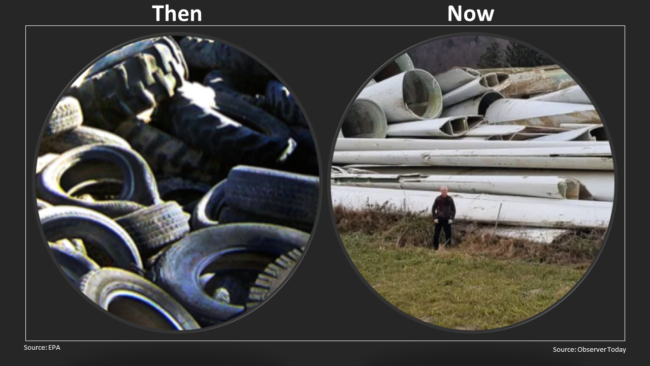
    In a recent online discussion, this pundit put forth the thought that fiberglass wind turbine blades can pose an environmental problem when decommissioned.  This position was quickly challenged with the rebuttal that burning coal ‘kills’ kids so it did not matter if discarded blades litter the countryside as it is worth it.

    According to research quoted by the European Wind Energy Association, “With wind turbine blades likely to account for some 50,000 tons of waste annually by 2020, growing 4 times by 2034 the landfill is not a viable long-term solution.”  Moreover, “Findings from the University of Strathclyde indicate a global increase of wind turbine blade waste from around 400,000 tons per annum in 2030 to around two million tons by 2050.”

    My rebuttal to the kills kids argument–what will this do to global population health?  Keep in mind, this is only one source of industrial (and consumer, i.e., EV automobiles) decommissioned assets.

    Disposal/Recycling

    “Glass-reinforced polymer composites (GRP), used in wind turbine blades around the world, is recognized as a hard-to-break-down source of pollution.”  Research is underway to address this problem and mostly likely progress will continue going forward.

    “Currently only a few recycling techniques are available to treat such an enormous quantity.  So most have been landfilled and many continue to be buried today.”  Other current options include:

    • Grinding–turning fiberglass into powder.  A labor intensive process that provides filler for other purposes
    • Incineration–the ash is usually disposed of in a landfill
    • Pyrolysis–decomposes into three recoverable substances: pyro-gas, pyro-oil, and solid byproduct— all of which can be recycled

    “While the overall life of the wind turbine does cause less pollution than coal-fired power plants do, the initial solution of just burying the fiberglass doesn’t seem in line with the goal to cause less pollution.” (Ibid)

    Really?  How is this saving the planet?

    Clearly, these alternative disposal processes have a financial cost greater than simply burying the blades.  If not, they would be used more frequently.

    Future generations will have to address this issue much like the current one continues to deal with asbestos from the past.  The KIDS will end up dealing with and paying for the folly of their parents and grandparents.

    A Contrarian Posture

    As noted, there is a romanticism about renewable energy sources, most commonly wind and solar.  However, we believe in the ‘no free lunch’ model.  There are risks and cost associated with every form of energy.

    In two recent editions, Heavy Metal Rocks and Going Green? Or NOT! we took an initial look at the financial cost over the renewable lifecycle as well the environmental impact that will need to be addressed.  The edition is a continuation of the premise that, “Technology Romance must be met with Fiscal Realities.”

    Society will eventually recognize the environmental damage done by solar and wind energy systems can be very high.  By then, the harm may have been done.

    As an example, many oil and gas assets are approaching end of life.  The decommission costs are very high and increasingly regulations are changing to hold asset owners accountable for these costs.  Generally, accountants refer to these as Reserves.

    Shouldn’t renewable asset holders be required to set aside reserves to cover the disposal of assets as well?

    Lifecycle Cost Structure

    For capital assets with significant planning, development, manufacture, deployment, operations & maintenance and finally decommissioning costs there is another dimension.  The Asset Maturity Model was developed to assist management understand how to best maximize asset performance over decades, in some cases.  This model is integrated into an economic value model which we be discussed herein.  There are also a number of tools and standards available to assist management, such as ISO 55001–Asset Management.

    In April 2022, Bloomberg published a piece, “Wind Power’s ‘Colossal Market Failure Threatens Climate Fight.”  The Global Wind Energy Council deemed the current wind energy situation a ‘Colossal Market Failure.’

    Blaming a mismatch (alignment) between governments policies and current markets, the risk is not only that net zero targets will not be met but the supply chain is contracting.  Moreover, one study suggests that for the US net-zero policies will cost more than 12% of our Gross Domestic Product (GDP) in 2050.  To put this in perspective, today Social Security cost 5% of GDP and Medicare/Medicaid 6.4 percent–11.4% combined.

    The ‘lack of alignment‘ is a major determent to successful organizations.  In our recent blog, ESG Explained we discussed the role organization and its ecosystem governance at length.  Building on our 2011  monograph, Asset/Equipment Integrity Governance: Operations–Enterprise Alignment; A Case for Board Oversight (AEIG) we developed the case for Operational Excellence as part of ESG.  Energy and supply chain management are key components of this enterprise approach.

    Total Cost of Ownership (TCO)

    TCO is a function of the acquisition cost, including all engineering, design, deployment, installation etc. as well as ALL costs associated with its lifecycle OPEX, including decommissioning, abandonment, and environment remediation.  It is all encompassing.  It is the long-standing metric that all projects must understand and model accordingly before a Capital Expenditure (CAPEX) is authorized.

    The following list are documented per citation links.  These are taken from a recent article challenging the Return on Investment (ROI) of current green initiatives.

    Readers will note that some are social costs, i.e., transition costs to new energy sources currently provide minuscule contributions to the Energy Basket.  These costs will grow dramatically going forward.

    •  “Making a transition from fossil fuels to green energy is costly.  Solar and wind can only deliver electricity, which accounts for less than a fifth of total energy consumption.
    • When the sun doesn’t shine or the wind doesn’t blow, prices rise quickly and we have to revert to fossil fuels for backup.
    • Batteries are inadequate and expensive, easily quadrupling solar electricity costs and failing to provide much power.
    • In 2021, Europe only had battery capacity to backup less than 1 ½ minutes of its average electricity usage.  By 2030, with 10 times the stock of batteries, and somewhat more usage needed, they’ll have enough for 12 minutes.
    • The Bank of America has found that achieving net-zero will cost $150 trillion over 30 years, almost twice the combined annual GDP of every country on Earth.
    • The annual cost of $5 trillion is more than all the world’s governments and households spend every year on education.
    • In a new study, McKinsey finds most of the poorest nations in Africa would have to pay more than 10 percent of their total national incomes every year toward climate policy.  This is more than these nations combined spend on education and health.
    • Reducing emissions just 80% will cost the United States more than $2.1 trillion every year from 2050, or more than $5,000 per person, per year.
    • The annual US cost of World War II is estimated at $1 trillion in today’s money.  Every year by 2050, climate policy could cost Americans more than twice what they paid during the Second World War.
    • Surveys show few people are willing to spend more than a few hundred dollars a year on climate policies.  Asking people to spend tens or hundreds times more is a recipe for failure.”

    These are significant tangible and intangible costs.  In this writer’s opinion, the business case has not been made for these and other total cost line items.  A more extensive study should be considered by readers who want to do a deep dive on these economics.

    Keep in mind, that these broader issues do not take into consideration regarding daily operations and maintenance.  These must be factored in as well.

    Finally, while these are ‘opinions’ from reputable sources, why are they not considered the economic models used today?  Seems like Data Bias, doesn’t it.

    EVPM

    Beginning in 2004, recognizing many of the TCO components as well as the economic value potential from a CAPEX, we developed what came to be known as our Economic Value Proposition Matrix model (EVPM).  This model is now mature, robust as well as integrating a Risk Matrix.

    It is an excellent tool for assessing both Tangible and Intangible components of value and cost.  Additionally, a free version is available and it is fully supported with training as well as other materials (including a video).

    Importantly, EVPM “Translates technology into the Language of Business” which make it an excellent tool for preparing to meet with the Chief Financial Officer (CFO) and/or Budget Committee.  Management makes decisions as a function of the risk associated economic value brought to the organization.  While technology has a level of romance to it, financial issues are the major decision making driver.

    The Energy Basket

    It is useful to look past the hype to see what the US energy basket actually looks like.   Slightly over three percent comes from wind and only 1.3 % is solar.  Fossil fuels (petroleum natural gas and coal) represent 79% of our current energy consumption.  In the opinion of this writer these disparities have been basically the same for decades.

    China and India burn 14 million tons of coal per day!  By all accounts, coal will play a major role in power production in these economies for some time to come.  As a function of the global percentage of coal used; China over 50%, India over 11% and the United States at approximately 8.5%.  Moreover, an assessment of its use by 130 countries is available to interested readers.

    The debate about ‘Clean Coal‘ continues.  None-the-Less, most likely coal will continue to be used for decades.  Keep in mind that 2050 is less than 28 year away.

    While regulation plays a role in the energy mix, economics are the fundamental driver.  Until the economics of non fossil fuels change, the basket will most likely not.

    The Lone Ranger is Missing

    Listening to some, it seems that all we have to do is focus on the Energy Transformation and in only a few short years magic will happen.  Hate to tell everyone, there is no Silver Bullet.  Transformation will take decades and should be led by those driven by market forces.

    One example, on April 29, 2022 the Texas Department of Transportation (TxDot) announced the two year closure of a major highway artery in the Houston metropolitan area to replace a concrete ramp.  Point being, road construction is well understood and a major proven technology and process.  Still, it will take a significant amount of time to perform this upgrade.

    How can we assume a major Energy Transformation using new technologies will unfold as optimistic parties suggest?  History suggests this is not likely.

    Closing Points

    This long time energy careerist believes that various energy sources from the basket should be used as economically appropriate.  While we all have an interest in a low pollution environment, if the economics as shown in this piece are close to correct, the resulting economic damage may be greater than a somewhat warmer planet.

    The data presented herein are documented.  The sources and quality of the data can be challenged but it should not be ignored.

    Finally, this piece has focused primarily on wind energy.  A similar analysis needs to be taken for every energy source including fossil fuels of all kinds.

    The demand for energy will continue to grow and even exponentially.  Clean fossil fuels are available and without strong energy balanced policies the future is bleak for many and not just because of climate change by the significantly higher cost of living and loss of opportunities due to energy starvation.

    The energy challenges are complex and dynamic.  This blog is not a comprehensive review, but simply a focus on a narrow aspect.  For example, we did not delve into issues such as Carbon Capture & Sequestration.  A calm, rational, economics discussion is in order.

    What does Energy Transition mean to you and how will you help the Less Fortunate be better off?

    For More Information

    Please note, RRI does not endorse or advocate the links to any third-party materials.  They are provided for education and entertainment only.

    For more information on Cross Cultural Engagement, check out our Cross Cultural Serious Game.  You can contact this author as well.

  • ESG Explained

    ESG Explained

    According to Investopedia, “Environmental, social, and governance (ESG) criteria are a set of standards for a company’s operations that socially conscious investors use to screen potential investments.”  Definitions of the three components are pretty straightforward:

    • Environmental–Generally refers to the stewardship of the planet and how organizations facilitate that responsibility.
    • Social–Facilitating organizational responsibility to the global society, at all levels from the globe to the local communities firms operate in.
    • (Corporate) Governance–Typically, the umbrella organizations put in place to assure issues such as transparency, fraud, safety culture and ethics are in compliance with social norms and local regulations.

    Since the Deepwater Horizon incident of April 2020, operators (oil and gas companies) have extended and enhanced the above criteria to their supply chain ecosystem and in some cases even customers with a Safety and Environmental Management System (SEMS).  This is true of most other Critical Infrastructure sectors as well.

    Likewise, the Sarbanes-Oxley Act of 2002 enhanced transparency and increased fraud protection after the Enron (and other) scandals.  Other incidents have triggered governance changes as well and some are referred to in linked materials.

    Why Is ESG Important?

    By one account, approximately $12 trillion in investments made in 2018 were driven by those who consider themselves socially responsible.  According to Forbes, in 2019 this accounted for almost 25% of total investments and are seen through the lens of sustainability.  Moreover, between 2016 to 2018, the growth rate in such firms grew at 38 percent.

    These numbers confirm our research going back to the turn of the century and perhaps earlier.  In 1993 we controversially posited that the Principles of Scientific Management were applicable to software development by Knowledge Workers.  Developed by Frederick Taylor, his monograph was published circa 1911.

    In other words, owners (investors) have always demanded top notch, legal and ethical performance.  Activist investors, i.e. Carl Icahn are not new.  As always, they have a very important role to play in the current markets.

    Asset/Equipment Integrity Governance

    There is a buzz of newness to ESG; however, from a contrarian perspective, this is not necessarily the case.  After the Deepwater Horizon failure with significant loss of live and many billions in economic losses to many parties including BP, it became clear that traditional Governance models did not have a focus on operations and the management of capital assets, i.e., manufacturing plants, marine vessels and other revenue producing sources.

    In our book we addressed a New Risk Environment from large corporate operations in which ‘failure is really not an option.”  We stated as a risk element, “Escalation of Consequences: The level of consequences of a disaster in the energy industry can now be larger than from the accidental release of a multi-megaton nuclear weapon.”

    Still governance models continued to struggle.  We believe that in the critical infrastructure sectors there is a lack of strong bonding, in other words top management is still hands off and operating from historical ‘control’ models that are no longer relevant or applicable.

    We do not believe this will change until a Strong Bond (tightly coupled) model is adopted.  We define the term as, “A strong model is used by High Reliability Organizations (HRO) and as part of that model, trained; knowledgeable personnel are empowered to make the right decisions in the field.  The strong model provides an organization with the capability to become and remain and HRO.”

    In 2011, we released our monograph, Asset/Equipment Integrity Governance: Operations–Enterprise Alignment; A Case for Board Oversight (AEIG).  In addition to developing a financial model documenting the Return on Investment (ROI) from strong governance, a Compliance Model, as well as a robust AEIG Matrix which incorporates an Asset Maturity Model are part of the solution.

    The AEIG extends the enterprise governance model to include the full ecosystem including subcontractors to its primary supply chain partners.  While not directly addressed at the time, Diversity, Equity and Inclusion (DEI) is implicit in the model.

    This roadmap is comprehensive and is a good starting point for developing and implementing a vigorous ESG initiative.  Other monographs in our Changing the Dialogue series (exploring our New Business Dynamics) include Structural Dynamics and Rapid Response Management are available online.

    Relationships, Behaviors, Conditions

    Scroll down on The Rapid Response Institute, Operational Excellence Platform page and you will find our R B C Framework Cultural Transformation model.  Shown below for ease of readership.

    The R B C model was originally developed to research international (cross cultural) negotiations.  We have extended it to support the transformation process to a robust and model organization culture such discussed herein.  Readers should note that this model is focused on Operational Excellence and is comprised on Processes & Methods supported by Enabling Tools.

    Built on Structural Dynamics which was developed as part of Dr. Shemwell’s doctoral dissertation in 1996.  It is defined as, “The morphology or patterns of motion towards process equilibrium of interpersonal systems.”

    This proven Framework is grounded in Management Science yet is a useful tool (Roadmap) that real originations can successfully and cost effectively implement.  We believe it is the best approach for attaining ESG.

    Summary

    One can view the current ESG status as part of a continuum to hold organizations accountable as appropriate and frankly, increase their Operational Excellence.  We have long known that firm’s that are well managed command superior stock market multiples and greater equity value.

    Many ‘self-serving’ consultants and pundit would have us believe ESG is breakthrough Thought Leadership in need of their help.  Nothing could be further from the truth.

    In the early 1990s, we document the history and evolution of Management Science/Thinking.   It is not written in stone, like most human endeavors it evolves and has for thousands of years.  ESG is a step in this continuum.

    How is Your Organization Addressing the Requirements of Active Investors?

    For More Information

    Please note, RRI does not endorse or advocate the links to any third-party materials.  They are provided for education and entertainment only.

    For more information on Cross Cultural Engagement, check out our Cross Cultural Serious GameTwo current online games; Safety Culture and Diverse Teams specifically address issues raised by ESG Criteria.  If you have any questions, please contact this author as well.

    Graphic Source: The Rapid Response Institute derived from a Storyblocks image under license.

  • Going Green? Or NOT!

    Going Green? Or NOT!

    The total or lifecycle carbon footprint for any energy source is a function of the manufacturing, commissioning, operation (including maintenance) and decommissioning of that asset.  Moreover, the value of an electric powered vehicles (EV) is seen as a function of the amount of fossil fuel no longer used by the vehicle.  However, this is only a sub-model of the to carbon footprint of any component in the Basket of (Energy) Goods, aka Energy Basket.

    All energy resources in the basket must be held to the same set of metrics.  These include Human Resources (including diversity and inclusion), Safety Culture, communities as well as the bottom line performance against governance standards (ESG).

    Risk Governance

    A governance framework that exceeds these standards follows.  Evolving over several decades, it reflects a comprehensive approach to operational risk that is often overlooked.  It addresses the entire life of a revenue producing asset.

    Lifecycle risk mitigation of an energy resource must include the end of the asset life processes.  What governance driven processes are in place to prevent the accumulation of wind turbine blades or spent solar panels stacked and abandoned?  Just like the tires stacked for decades.

    Turns out the answer is few.  Long life assets such as factories, skyscrapers, fossil fuel production systems, etc. are built to the engineering, industry and local regulatory standards of that day.  Ongoing operations, maintenance, upgrades and so forth keep them performing at acceptable levels.  However, governance models are often focused on the present.  End of asset life risk does not fit into the four quarter management mindset as the event may be sometime in the future.

    The above graphic represents a governance model built around operations and associated risks.  The archetype recognizes that many risk mitigation processes are inadequate for today’s complex organizations with multi-faceted global processes.

    Its framework is built upon the work done by the Treadwell Commission several decades ago to detect financial fraud.  This structure supports the extension into field operations and provides a structure for attaining and sustaining Operational Excellence.

    Risk mitigation is both quantitative and qualitative.  The risk associate with the use of any industrial energy source must be thoroughly assessed as a function of its lifecycle, not just its initial CAPEX and ongoing operations.

    Dumping v Decommissioning

    Illegal industrial dumping has long been a problem.  Today, some in the wind turbine sector appear to be following the decades long vehicle tire disposal process (or lack thereof).

    Lady Bird Johnson at least tried to hide the piles of tire debris but no one has found a way of completely dealing with this growing and massive problem.  As of 2017, some 17% were still disposed of in landfills.  In 2003, the EPA reports that almost 300 million tires are scraped each year.  Flash forward to today and this is likely a very conservative number.  That said, 17% equals approximately 50 million tires headed to landfills as opposed to recycling.

    Moreover, there is a long history of industrial dumping trash so as not to have to pay the disposal fees.  One wonders how many millions of tires destined for landfills (and other recycling) are just dumped?

    The decommissioning process is the responsible end-of-asset-life shutdown and removal.  The intent is to return the site to a condition similar to its initial environment and properly remove and dispose of equipment and materials.  It should not include stacking wind turbine blades next to a pile of discarded vehicle tires.

    Total Carbon Lifecycle Model

    Daily, we hear about the need to reduce carbon output to (net) zero.  Promises are made by many that by such and such a time this metric will be met.  Caveat: usually the time period is beyond the expected tenure of those making the statements.  Often lost in the discussion is the carbon cost of manufacturing and decommissioning.

    Carbon output should include the mineral extraction process, recycling of older materials if appropriate, transportation, manufacturing, installation, operations and decommissioning.  It also must include the carbon cost of the supply chain necessary to support the asset across its lifecycle.  For example, the carbon cost of an EV is not just the vehicle’s operation but the lifecycle of the vehicle as well as the electric power generation and distribution necessary to operate the automobile.  Do not forget the carbon cost of manufacturing a battery and disposing of it at end of life.

    Scrap

    Materials are often staged for recycling.  They feed a process that results in new useful product(s) that may add new value.  This is a useful recycling process that makes a lot of sense.  However, sometimes this is not as economical as new manufacturing.  These economics lead to dumping as the low-cost-solution.  Fields of discarded materials may or may not be awaiting recycling.

    Defining Green

    Being green is not simply using renewable electricity instead of gasoline.  If the carbon footprint is no different or even worse, then the problem is not solved and may even be made greater.

    Keep in mind that coal is still a major fuel in the generation of electricity.  According to the US Energy Information Administration (EIA), in 2020 over 60% of power is generated using fossil fuels of which over 19% is from coal.  This does not include the carbon footprint of materials and products imported to the US.

    So if the carbon footprint of a wind turbine is defined as its lifecycle and if at the end result is abandonment in a field, is the green value of that product positive?  Or is it just dumping not unlike the pollution of a nation’s river systems?

    Being green is not just plugging in your car overnight.  Like most things in life, it is systemic.

    Is Your Organization’s Green Plan Systemic or Myopic?

    For More Information

    Please note, RRI does not endorse or advocate the links to any third-party materials.  They are provided for education and entertainment only.

    For more information on Cross Cultural Engagement, check out our Cross Cultural Serious Game

    We presented, Should Cross Cultural Serious Games Be Included in Your Diversity Program: Best Practices and Lessons Learned at the Online Conference, New Diversity Summit 2020 the week of September 14, 2020.  Check Out this timely event and contact the organizer for access to the presentations!!

    For more on DEI Standards, see the newly released ISO-30415.

    You can contact this author as well.

  • 100

    100

    This edition marks the 100th post in our Critical Mass Blog series.  We have sought to provide thoughtful, unbiased insight into the contemporary business and organizational challenges we all face.  Since our first blog post on November 27, 2017 our world has turned over in ways none expected.  Likely, this trend will continue.

    This series continues a tradition of newsletters, opinion pieces and other on line punditry first begun in 1998 with our New Millennium News.  A bi-monthly email with a subscription base of approximately 7,000 readers.  A huge number at that time.  We estimate that hundreds of thousands or more have benefited from this knowledge transfer.

    Coincidentally, we reach this milestone as we begin the new year–a time of renewal.  We will continue to address critical issues individuals, businesses, agencies and others face as we all navigate an increasingly perilous path.  This series has addressed Human Resource issues including Diversity, Equity and Inclusion (DEI) Teams , the arrival of Smart Technology, International Business, Covid-19, Supply Chain Management, Operational Excellence, Cultural Transformation (including Safety Culture) Sales, Risk Mitigation and of course Leadership.  Today’s organizations must be very good at all of these disciplines!

    Available Tools

    The mission of the Rapid Response Institute (RRI) is to enable our clients with the ability to posture themselves in their market segments so that they can thrive in volatile markets and capitalize on uncertainty, not suffer because of them.  This is especially important for those economic actors in Critical Infrastructure sectors.

    In support of this mission the firm has developed a suite of Intellectual Property (IP) which includes Know How, practical roadmap Books and guidelines as well as Software as a Service (SaaS) solutions among others.  Many readers know that once a process has been standardized with minimal configuration required, the data is the ultimate driver.  This is the heart of most Enterprise Resource Planning (ERP) solutions.

    With advances in technology, RRI has taken these once multi-million dollar solutions to a price point as well as Use Case where all organizations can utilize this capability.  Moreover, our advancements in work flow such as epitomized in our Cross Cultural Serious Games, Economic Value Proposition Matrix, and Smart OpEx (Operations Management System) and Risk Simulation Modeling add immediate and significant value to the challenges faced as articulated above.  Other Free Tools are available as well.

    Pulling It All Together

    The method to our madness is–Operations!!  As some are fond of saying with derision, “It’s All About the Benjamins.”  Well, it actually is.  If ‘for-profit’ firms are not profitable, they fail.  No amount of Environmental, Social, and Governance (ESG) will save them if they cannot deliver to paying customers.

    Everything RRI does helps organizations to deliver stakeholder value, compliant with ESG standards.  That is our Bottom Line and we are also pleased that Dr. Shemwell, Managing Director has been an independent advocate for responsible corporate success since 2004.

    FYI, major losses and legal actions do not enhance stakeholder value.  Neither for employees, local communities or equity holders.  Everyone loses when in terrible scenarios such as Deepwater Horizon, internal bias corporate hubris, poor high reliability processes/human factor shortcomings or lack of actual DEI.

    This journey continues.  Stay tuned for the next 100 editions where will continue to provide our thoughts on relevant matters.  Thank you very much for your readership and support.

    How is Your Organization Positioned for the Next Four Years?

    For More Information

    Please note, RRI does not endorse or advocate the links to any third-party materials.  They are provided for education and entertainment only.

    For more information on Cross Cultural Engagement, check out our Cross Cultural Serious Game

    We presented, Should Cross Cultural Serious Games Be Included in Your Diversity Program: Best Practices and Lessons Learned at the Online Conference, New Diversity Summit 2020 the week of September 14, 2020.  Check Out this timely event and contact the organizer for access to the presentations!!

    For more on DEI Standards, see the newly released ISO-30415.

    You can contact this author as well.

  • Getting to Diverse and Inclusive Teams

    Getting to Diverse and Inclusive Teams

    Diversity, Equity, and Inclusion (DEI) Team Models

    There is a tendency to see DEI through the lens of initiatives or often a process semi-outside the daily ‘organizational’ grind.  Does this represent reality?

    Organizations spend countless sums training employees and others they depend on for Operational Excellence performance.  They often trust global Teams to add stakeholder value.

    No less than Microsoft names a software product, Teams.  A tool designed to foster collaboration.

    The Way We Do Business

    Culture is often defined as ‘who we are.’  The approach an organization takes towards its ecosystem.  If this model is an accurate representation, it suggests that when organizations launch initiatives meant to address current social mores, they likely fail or at least do not live up to full potentials.

    Change management, often referred to as transformation often takes on the mantel of ‘you will be changed.’  Contemporarily, take the Covid-19 vaccine or you will be fired!  Not surprisingly, this mandate is resisted and seemingly increasingly with each new warning.

    As of this writing, the all out war (on decrees) has been declared by the likes of the Navy Seals, Health Care Workers, Law Enforcement and others with the demands from the Feds.  Likely, the result will be a draw at best, with the administration quietly acquiescing.  Too many critical, non-replaceable positions are at risk.  Not to mention votes.

    Governance

    In October 2011, we published our first draft of, Asset/Equipment Integrity Governance: Operations–Enterprise Alignment.  We recognized that traditional organizational Governance models were strictly focused on finance and maleficence therein.  The reality is that revenue is generate by operations and as such governance is critical as well.  Safety Culture, is intangible but now required by most organizations in Critical Infrastructure sectors.

    Flash forward to today and Environmental, Social, and Governance (ESG) is the model most organizations use.  Effectively, this expands governance to include a broad range of non-financial commitments.  From this blogger’s perspective, likely DEI will fall under this governance model.  Therefore, moving it from the ‘initiative status’ to the ‘way we do business.’

    Team Building

    This dynamic environment requires workforce upskilling.  The need to constantly assure that individuals have current Knowledge, Skills and Abilities (KSAs) necessary to meet current challenges.  KSAs now include the ability/necessity to work across cultural/diverse lines.

    When one thinks of a ‘team’ it is not a homogenous collection of like minded and ‘like’ individuals.  Teams are a collection of hopefully, ‘fit for purpose’ individuals who comprise the KSAs needs to accomplish the task(s) at hand.  Teams can mirror the discrete views of its members.

    For example, our early research on the subject assessed the different approaches Japanese nationals took when negotiating with white American males.  In each case, the individual players were deemed to be homogenous.

    Nothing could be further from the truth.  Each individual, in this case all males were of different ages, different education, from different regions of their respective countries, married or not and so forth and so on.

    The reality is that individuals do not negotiate deals.  Teams do.   Members of teams, like juries need to arrive at the same place prior to engaging with other collaborative counterparts.

    Juries need to be arrive at consensus.  Likewise, organizational team members must arrive at a similar place internally prior to going forward.  This not to say that individuals must cave to the will of the majority or the Tyranny of the Minority.  It is to say, a common position that all must accept as part of collaboration or consensus.

    Inclusive?

    There is no doubt that token individuals and in some case high profile figureheads have been put forth to ‘prove’ inclusivity.  Thankfully, those days are fading.

    Teams need to have the input of all members, even contrarians.  Often it is the outlier that has the most insight into a difficult problem.  Differences of opinion need to be resolved and a go forward plan agreed upon.

    Often, individuals do not speak up.  Perhaps they are new to the environment, shy or unsure of themselves.  Whatever the reason their input must be sought and at least given a fair hearing.

    Training can help elicit input from the reticent.  Moreover, they help dominate individuals acknowledge and accept said input.

    How Does Your Organization Assure Real Inclusion?

    For More Information

    Please note, RRI does not endorse or advocate the links to any third-party materials.  They are provided for education and entertainment only.

    For more information on Cross Cultural Engagement, check out our Cross Cultural Serious Game

    We presented, Should Cross Cultural Serious Games Be Included in Your Diversity Program: Best Practices and Lessons Learned at the Online Conference, New Diversity Summit 2020 the week of September 14, 2020.  Check Out this timely event and contact the organizer for access to the presentations!!

    For more on DEI Standards, see the newly released ISO-30415.

    You can contact this author as well.

  • Data, Data Everywhere but Not an Answer in Sight

    Data, Data Everywhere but Not an Answer in Sight

    Awash with data, how many decisions made actually use it to add value?  Too few one suspects and partly because decision-making systems are not designed for this volume.  Much is made about Big Data and the value it can add to a business.  However, there is little said about the software applications and compute power that are necessary.

    Data, like information is a continuous feed from a variety of often conflicting sources. How this often subjective data is normalized which can lead to skewed results.

    One has only to look at daily news casts about any given subject to find a variety of ‘opinions’ as opposed to actual non-bias reporting.  One can argue that there is no objectivity with most analyses.

    So it is true with data analysis.  Data bias is a well known phenomena and clouds objectivity.  This matters most when organizations are making critical decisions.

    As we enter into the ‘Smart’ era data issues will not only be on the Critical Path, they will be the possibly be a major point of failure and significant operational losses and perhaps significant injury or even loss of life.

    In the last blog we discussed the difference in a methodology (The Science) vs new and often conflicting data.  We expand on the data mess, confusion, apparent flip flop, bias(es) and political agendas.

    While all of this might be political sport for a pandemic.  Can you run an organization based on this data?  Probably not a successful one!

    This author has addressed organizational governance issues for decades. We saw Sarbanes-Oxley, Asset Integrity, and now ESG.  It is time data had a seat at the board room?

    Decision Maker Beware

    Management is paid to make decisions based on uncertain, incomplete and often conflicting inputs.  It pays to have an understanding of the limitations of data and the software application decision makers.  Your career may depend on it.

    How Do You Know that the Data Upon Which You Make Decisions is Valid and Reliable?

    For More Information

    Please note, RRI does not endorse or advocate the links to any third-party materials.  They are provided for education and entertainment only.

    For more information on Cross Cultural Engagement, check out our Cross Cultural Serious Game

    We presented, Should Cross Cultural Serious Games Be Included in Your Diversity Program: Best Practices and Lessons Learned at the Online Conference, New Diversity Summit 2020 the week of September 14, 2020.  Check Out this timely event and contact the organizer for access to the presentations!!

    You can contact this author as well.


  • Questions, Questions, Questions

    Questions, Questions, Questions

    Picture sourced from LinkedIn, author unknown.

    It seems like there are a lot of answers these days, even to questions that have not been posed.  As of this writing, this author understands that masks work for Covid-19 but vaccines not so much although we are advised to get the shots and even a third one this fall.  So many flip-flops I feel like I spent the last year on a beach.

    Claiming, The settled Science says … is an answer designed to shut down debate.  Facts are, unless one believes the world is flat or the earth is the center of the universe (thank you Galileo Galilei), science is never settled.  If it were. we would be living in a Flintstones’ world.

    “And the Answer Is . . .”

    Thank you Alex.  For almost two years, we have been told the answers to the Covid-19 crisis are understood and the data is valid and reliable.   Then it isn’t.  Blamed on a dynamic and changing environment, we are told “we are following the science.”  Or perhaps just a political slogan.

    Pay no attention to that man behind the curtain!”  Just sit down, shut up and do as your told is often the mantra when authorizes’ edicts are questioned.  Good advise for a toddler but not so much for those over the age of 10.

    Are We There Yet?

    Tesla crashes are the latest Big Data enabled autopilot failures.  The level of maturity regarding digitalization and its various cousins has been discussed in this blog before.  Begging the question, are we ready for data Prime Time?

    We are besieged with answers from all manner of pundits, both electronic and in person.  We are told, “we must believe” without any serious discussion or in-depth assessment of the explanation.  Moreover, many of these statements regarding technology have not undergone the Scientific Method process.

    The result; many do not believe.  Covid-19 vaccination concerns are but one example of this squandering of faith.  Readers may have other issues that bother them.

    One consistent argument for not taking the inoculation is that vaccines take many years to develop and vet.  Perhaps, in the past but (1) we don’t have years with this deadly virus and (2) technology marches on and perhaps years are no longer required.  One can argue that this lack of trust is a result of so many answers in advance of the questions.

    How is your organization assuring that Answers are not being provided before the Questions are asked?

    For More Information

    Please note, RRI does not endorse or advocate the links to any third-party materials.  They are provided for education and entertainment only.

    For more information on Cross Cultural Engagement, check out our Cross Cultural Serious Game

    We presented, Should Cross Cultural Serious Games Be Included in Your Diversity Program: Best Practices and Lessons Learned at the Online Conference, New Diversity Summit 2020 the week of September 14, 2020.  Check Out this timely event and contact the organizer for access to the presentations!!

    You can contact this author as well.

  • Roadmap to Decision Making In the ‘Smart’ Era

    Roadmap to Decision Making In the ‘Smart’ Era

    “Nothing is more difficult, and therefore more precious, than to be able to decide.”

    Napoleon Bonaparte

    Volumes have been written on decision-making and this pundit has offered his share of insight and comment on the subject as well.  Some of our comments regard the appropriateness of the human intercession in electronic decision making.  Others raise questions regarding algorithm fallibility.  Moreover, Human Factors must be considered for any technology initiative which are becoming increasingly important.

    If one unpacks the previous paragraph a substantial level of complexity emerges.  As complexity increases so does risk and the need from proper governance.  However, many still see this potential transformation through the lens of just another IT initiative.

    Roadmap

    The oil and gas industry faced a similar dilemma at the dawn of the 21st Century.  At the time, referred to as DOFF or Digital Oilfield of the Future, a plethora of technologies became available.  The task was to transform 100 plus years of traditional operation to what is now referred to as the Digital Oilfield, aka Integrated Operations and a number or synonyms.  While this processes continues to evolve as new solutions emerge, i.e., Cloud, at the time much was trial and error.

    In conjunction with industry leadership, we released our Roadmap to Enterprise Optimization: A Guide to the Impact of Information Driven Field Operations on the Petroleum Corporation in the fall of 2004.  We believe it was the first industry (POSC) supported effort that was not simply research but a ‘bona fide’ action plan or roadmap to success based on industry/other knowledge, standards, economic value and best practices.

    Click for full size Integrated Operations Framework or graphic

    Since then, we have updated this roadmap into an Operational Excellence Platform.  Note that Integrated Operations is a key component.  The platform is a robust detailed solution that is available not just to the energy sector but all sectors identified by Homeland Security as Critical Infrastructure.  These sectors were recently identified as susceptible to hacking by the US government.

    Getting Smart

    Enormous corporate (shareholder) wealth has been destroyed implementing ‘game changing’ technology enabled transformation efforts.  Are we about to do that again, getting smart?  The easy answer is yes, but it does not have to be.

    Roadmap constructs are well understood and provide guidance.  In some models the step by step process provide practitioners with well defined models that can lead to success–defined as on time and under budget performance against Key Performance Indicators (KPIs).

    We are in the process of writing a book, to be released in 2022.  One chapter will define a roadmap for the transformation to ‘Smart’ for a major industrial segment.  As with earlier works, it will focus on the human element aligned with a technology assessment process.

    Get Smart was a comedic TV show spoofing the Cold War ‘spy’ environment of the 1960s.  Getting Smart today may not be a lot different.  The goal under a ‘Cone of Silence‘ was to attain and sustain competitive advantaged achieving superior stakeholder returns.

    Getting smart in 2021 will require a ‘Roadmap to Smart.’  A set of ‘to do’ processes that assures success.

    What is your Organization’s Plan to put Smart Decisioning Making Processes in Place?


    For More Information

    Please note, RRI does not endorse or advocate the links to any third-party materials.  They are provided for education and entertainment only.

    For more information on Cross Cultural Engagement, check out our Cross Cultural Serious Game

    We presented, Should Cross Cultural Serious Games Be Included in Your Diversity Program: Best Practices and Lessons Learned at the Online Conference, New Diversity Summit 2020 the week of September 14, 2020.  Check Out this timely event and contact the organizer for access to the presentations!!

    You can contact this author as well.

  • ESG Implementation–Strong v Weak Revisited

    ESG Implementation–Strong v Weak Revisited

    “A healthy corporation acts on the interests of its stakeholders and customers”

    — Ari Melber, Journalist

    Currently, organizations are being implored to implement Environmental, Social, and Governance (ESG) driven business models.   Proponents even suggest that investment in organizations that do not have this imprimatur should be avoided or even divested.

    However, one wonders what has changed?  Successful firms, private and public have long understood that they must add value to their constituencies.  One example, a few decades ago an energy services provider used its high volume oilfield pumps to help a small town in Kansas where it had a district office drain flood waters.  Why would they do this?  Perhaps because employees lived in this community or perhaps it was just the right thing to do.

    Flash forward and we find organizational largess still in place.  During the recent Texas freeze, a local furniture retailer opened its doors to dispossessed individuals and families.  The owner has a long record of supporting the community and his responses to local disasters is legendary.

    After the Deepwater Horizon incident in April 2010, our firm started to look at Asset Integrity issues in oilfield operations.  Our discoveries transcended several Critical Infrastructure segments.  The recent failure of the Colonial Pipeline is a manifestation of issues uncovered yet not resolved more than a decade ago!

    Focus on Operations

    In 2011, we posited that organizational governance was not just a financial issue at the ‘C’ level.  Rather its true focus should be at the revenue generating asset level.  This led to our 2011 groundbreaking monograph, Asset/Equipment Integrity Governance: Operations–Enterprise Alignment.  Therein, we posited a new governance model that incorporated the ESG components widely discussed today.

    Moreover, in 2014 our book, IMPLEMENTING A CULTURE of SAFETY: A ROADMAP FOR PERFORMANCE BASED COMPLIANCE identified the requirement for organizations in the Critical Infrastructure space to change governance models to one of Strong Bond.

    Following the release of our AIG model, we put forth a Strong v Weak governance model to manage High Reliability Organizations (HRO) necessary for firms in Critical Infrastructure sectors.  Strong Bond is appropriate for organizations in Critical Infrastructure segments, while Weak Bonds may be better for retail.

    One suspects that ESG is another tick in the box.  If ten years (or earlier) from now another critical system fails, it will not be because HRM processes were not followed or ESG verbiage was in the annual report Letter to Shareholders; it will be because nothing really changed.  As of this writing the US Federal government is advising organizations in Critical Infrastructure sectors to more aggressively address cybersecurity risks.

    Why is this? Do Boards and CEOs need politicians and bureaucrats to tell them about the details of running a business?  If they do, investors may want to revisit their portfolios.

    One suspects that the ESG fad will fade. There will always be a new management mantra that consultants will put forth.  Well run organizations will remain well run.  Others not so much.

    Governance models come and go.  Regardless, how will you assure your organization is well run?

    For More Information

    Please note, RRI does not endorse or advocate the links to any third-party materials.  They are provided for education and entertainment only.

    For more information on Cross Cultural Engagement, check out our Cross Cultural Serious Game

    We presented, Should Cross Cultural Serious Games Be Included in Your Diversity Program: Best Practices and Lessons Learned at the Online Conference, New Diversity Summit 2020 the week of September 14, 2020.  Check Out this timely event and contact the organizer for access to the presentations!!

    You can contact this author as well.

  • Post Covid-19 Operational Performance

    Post Covid-19 Operational Performance

    Not the So-Called New Normal


    The light at the end of the Covid-19 tunnel may not be the train many still believe.  Populations are being inoculated at very high rates.  Moreover, there is ample evidence in my metropolitan area that the general population no longer believes or adheres to the ‘advice of experts.’  This should surprise no one who understands the US long history of civil disobedience.

    We pundits forecasting the new normal following a traumatic social event always get it wrong and so we will again this time.  There is a simple reason for this–Human Behavioral Economics.  Another leg of the three legged stool is the Technology Readiness Level (TRL) and not all technologies are at the same level or even play well together.  Finally, Organizational Culture must be ready as well.  If these situational settings are not met, the crisis passes and we get back into the comfortable and familiar.

    Following the initial euphoria that we could work from home and not wear pants, many discovered this really was not for them.  Many children did not do as well in a stay at home educational setting and teachers were challenged as well.  Moreover, many tasks require personal engagement.

    Many are Called . . .

    As always winners and losers will emerge and it will take some time for that rank order to solidify.  While digital is important and we have supported that business model for decades, bits will not physically move the barrels.  Still will take heavy industrial technology and processes.

    Using information and other technologies to drive Operations Management Systems are the future.  Not necessarily driven by IT firms but those digital engineers steeped in both disciplines.

    If Organizations are to achieve successful Sustainability, they first need a High Reliability level of Agility and Resiliency.  The only get these attributes when they perform at a high level of Excellence.

    So as we arrive at another new normal, we need to recognize that not everything from the past was bad and not everything we see today is good.  Some processes will be sustained and coupled with newer one.  New Normals do not really destroy the past; we continue to evolve.

    Even innovation from Creative Destruction is not instantaneous.

    How will your organization take advantage of emerging opportunities?

    For More Information

    Please note, RRI does not endorse or advocate the links to any third-party materials.  They are provided for education and entertainment only.

    For more information on Cross Cultural Engagement, check out our Cross Cultural Serious Game

    We presented, Should Cross Cultural Serious Games Be Included in Your Diversity Program: Best Practices and Lessons Learned at the Online Conference, New Diversity Summit 2020 the week of September 14, 2020.  Check Out this timely event and contact the organizer for access to the presentations!!

    You can contact this author as well.

  • Teaming Safely

    Teaming Safely

    “For safety is not a gadget but a state of mind”


    Second only to the basic need for food, water and what is required to sustain physical life, safety and security are the next step in Maslow’s Hierarchy of Needs.  In other words one cannot love or feel belonging or achieve a level of esteem without having the warmth of safety much less attain self-actualization.

    More recently, team safety has come to be defined as Inclusive.

    There are three components of team safety:

    • Sociological — “developing and maintaining friendly social bonds is a fundamental organizing principle of human behavior”
    • Psychological — “defined as a shared belief that the team is safe for interpersonal risk taking”
    • Physiological — “relating to the way in which a living organism or bodily part functions”

    If members do not feel ‘safe’ then the team is not capable of high performance.  Moreover, the synergistic value that can be derived from team diversity can not be captured.

    Attaining Safety

    While the need to be safe is coded in our DNA so to speak, we are not inherently safe.  Individuals as well as teams must be proactive to reach situational safety.

    We are Mindful when we are in touch with ourselves and the environment through nurturing feelings.  Interesting, being mindful is a major requirement of High Reliability Organization/Team.  High reliability is a necessary ingredient for an organization’s Safety Culture and by extension its Teams (including third party ecosystem members).

    Safety is a learned behavior.  Therefore, effective training and ongoing reinforcement are necessary. Moreover, realistic scenarios are mandatory making the learning process relevant.

    Take the following maturity assessment and implement your team training program!

    What is your Team’s Culture of Safety Maturity?

    For More Information

    Please note, RRI does not endorse or advocate the links to any third-party materials.  They are provided for education and entertainment only.

    For more information on Cross Cultural Engagement, check out our Cross Cultural Serious Game

    We presented, Should Cross Cultural Serious Games Be Included in Your Diversity Program: Best Practices and Lessons Learned at the Online Conference, New Diversity Summit 2020 the week of September 14, 2020.  Check Out this timely event and contact the organizer for access to the presentations!!

    You can contact this author as well.


  • I Didn’t Do It, He Did — I Didn’t Do It Either, Someone Else Did

    I Didn’t Do It, He Did — I Didn’t Do It Either, Someone Else Did

    “When converted into productive thought and action, the energy it takes to blame, shame, and game is enough to launch anyone into heights of real success and happiness.”

     – Charles F Glassman

    Entrée

    It is not often that an entire geographically LARGE state loses power and water simultaneously.  Now we know it can happen!  Welcome to Texas (ERCOT) circa the dawn of the 21st Century.

    The finger pointing and claims, ‘not my responsibility’ surfaced immediately at all political levels.  As I sat in my power free, cold, waterless house, I was moved that political leadership was focused on saving their own hides.

    Benjamin Franklin’s words, “We must all hang together, or, most assuredly, we shall all hang separately” are lost on our hyper partisan world.  Earth to all polls, there is enough blame on this one to go around.  This society loves to Share and Like and is quick to find fault.

    The usual suspects will pontificate about blaming others and legal initiatives have already surfaced.  Good media, but who actually cares?

    This blog post is not about politics or the blame game.  It rather posits a solution that sees that this never happens again–anywhere.

    Operational Excellence Platform

    Excellent performance requires a conscious effort at all levels of an organization and its ecosystem.  We embodied a approach for heavy industry in our 2012 article, High Reliability Management in Process Industries: Sustained by Human Factors.  In that piece we put forth the argument that High Reliability Management is a strong methodology for management large complex systems such as the Texas Electric Power Grid.  HRM provides organizations with Agility, Resiliency and Sustainability in the face of large complex incidents.

    As we have previously put forth, Normal Accident Theory (NAT) posits, “that some accidents are inevitable because of system complexity.”  While logical, this model has its critics and lacks empirical evidence.

    The Texas electricity power grid got into process/technological/engineering trouble rather quickly.  Debate will rage for years as to what actually happened.  However, it seems practitioners at all levels practiced NAT.  Like Deepwater Horizon, this event did not have to happen.

    Safety Culture

    At the core of High Impact Performance is a strong safety culture.

    Systemic Safety Culture as the Core Set of Values and Behavioral Economics of ALL participants of the extended organization and its Enterprise Risk Management strategy that reflect a Strong Bond Governance commitment to behaving as a High Reliability Enterprise Ecosystem in a safe and environmentally responsible manner.

    Going Forward

    The over used phrase, ‘teachable moment’ suggests that we learn from our history so as not to repeat it.  Most likely oxen will be gored, witch hunts abound and the likelihood of little tangible progress will be made.

    Career losses will most like exceed the six board members who have already resigned.  All because the reactive NAT model was followed.  One is well advised not to follow this lead.

    How are you making sure that your operations processes are proactive?

    For More Information

    Please note, RRI does not endorse or advocate the links to any third-party materials.  They are provided for education and entertainment only.

    For more information on Cross Cultural Engagement, check out our Cross Cultural Serious Game

    We presented, Should Cross Cultural Serious Games Be Included in Your Diversity Program: Best Practices and Lessons Learned at the Online Conference, New Diversity Summit 2020 the week of September 14, 2020.  Check Out this timely event and contact the organizer for access to the presentations!!

    You can contact this author as well.


  • Covid-19 Positive: Telemedicine Kicked into High Gear

    Covid-19 Positive: Telemedicine Kicked into High Gear

    Crisis Drives Change

    In 2001 this writer approached the Houston medical community, post tropical storm Allison which flooded many basements in the Houston Medical Center with the loss of experimental data and other records.  We proposed the development of an Internet based solution to hold and manage medical records of all types.  The response to my organization’s offer to digitize records was met with disbelief and ultimate rebuke.

    At the time I was employed by a major corporation with the technology and financial resources to accomplish this task.  Sales Objections included privacy, doctors will not ‘buy in,’ insurance will not pay for it and a host of other lame excuses.

    Flash forward to 2020.  Why are thing so different now and the idea of ‘digitalization’ almost universally accepted?

    Twenty years is a career for many, yet it took a crisis this year to kick the medical sector into action at critical mass—Coronavirus, aka Covid-19.  As often the case large organizations are content to stay with the status quo.  Culture, processes, and even individual bonuses incent lethargy and complacency.  This common trait is not limited to one sector.

    Moreover, advances in online telemetry support the physician’s ability to treat many aliments remotely.  The industry did not just ‘jump’ to the current state, it evolved over time.  For example, remote and inaccessible areas such as Antarctica have taken advantage of telemedicine including remotely directed surgeries.

    Democratization

    We may look back on 2020 as the seminal moment when medicine was digitalized.  Despite current access issues such as we are finding with K-12 education, most will have the ability to interact online in the near future.  Moreover, a number of COTS (commercial off the shelf) health solutions such as found in a variety of Smart phone products enable remote diagnosis and monitoring on a global basis.

    The catalyst for taking telemedicine to the next level is Covid-19!  A good Positive.

    How is your organization taking advantage of remote operational technologies?

    For More Information

    Please note, RRI does not endorse or advocate the links to any third-party materials.  They are provided for education and entertainment only.

    For more information on Cross Cultural Engagement, check out our Cross Cultural Serious Game

    We presented, Should Cross Cultural Serious Games Be Included in Your Diversity Program: Best Practices and Lessons Learned at the Online Conference, New Diversity Summit 2020 the week of September 14, 2020.  Check Out this timely event and contact the organizer for access to the presentations!!

    You can contact this author as well.

  • How Dare You!!

    How Dare You!!

    Lessons in Leadership—how dare you put young people in jeopardy for loss of life or failures they will live with the rest of their life?

    As we end Veteran’s Week, we are reminded of President Herbert Hoover’s comment, “Older men declare war.  But it is the youth that must fight and die.”  Hoover was president in the late 1920s and died in 1964.  How many wars has the United States been in since 1930?

    Don’t bother to count—too many.  Probably more to come from political hawks who have never served much less been in combat nor have members of their family.  Not leadership but only positioning for personal gain.

    Disclosure: I have been in the military but not combat.  My father on the other hand was awarded the Silver Star during WW II.

    This piece is not about war or politics, it is about leadership or lack thereof.  After BP Horizon in 2010, this writer attended a conference where a VP responsible for operations from a well-known public oil & gas company admitted that he had never been on an offshore drilling rig but he and his colleagues were making arrangements to visit one soon.

    Dah!  What was he doing for 20 years—home office political parlor games?  Same is true for many Washington Generals/Admirals—check their resumes.

    You’ve Got to Be Kidding Me?  Yet it was true.

    This pundit repeatedly worked on drilling rigs during his 20s.  Begs the question, how can you ‘lead from behind’ when you do not have a clue what your people are dealing with?  How Dare You send young people in an operational grinder you know nothing about?

    Decision making, by definition is made with limited and incomplete data and information.  However, informed decisions are made by those who can put things in context.

    In today’ operationally intense environment, so called ‘ground truth’ is imperative.  Executives owe their employees, contractors and partners their very best and not just organizational politicly correct thinking.

    YOU are responsible for the lives and careers of your team and by extension their families.  There are countless suppliers of training, coaching, and all manner of consulting.  However, bottom line—Lead from the Front!

    The celebrated veterans of this week have blazed your trail.  The US infantry motto, “Follow Me” is not the vision of a desk bound manager espousing leadership consulting mantra.

    Admiral Chester Nimitz is credited with statement, “When you’re in command, command.”  Not the words of a manager but a leader.  I would take his dare.

    But you need to know what you are doing before you send young men and women into harm’s way, whether the military, oil field operation or any critical infrastructure mission or task.

    You owe it to them.  How Dare You if you don’t have the required expertise!  Bonuses don’t mean anything if members of your team are killed.

    Do Your People Respect Your Leadership?

    For More Information

    Please note, RRI does not endorse or advocate the links to any third-party materials.  They are provided for education and entertainment only.

    For more information on Cross Cultural Engagement, check out our Cross Cultural Serious Game

    We presented, Should Cross Cultural Serious Games Be Included in Your Diversity Program: Best Practices and Lessons Learned at the Online Conference, New Diversity Summit 2020 the week of September 14, 2020.  Check Out this timely event and contact the organizer for access to the presentations!!

    You can contact this author as well.

  • MVP: A Case of Failure

    MVP: A Case of Failure

    Not as Easy as it Seems

    When transforming this website to the Word Press platform, this author accepted the “wisdom” of various online sources and used a so called up and coming new Page Builder.  A huge mistake!

    After many failures and indeed public page lockups, I changed to a more established solution—the one used for this writing.  Over this technological journey, I was told by a number of support individuals to ‘deactivate’ plugins and troubleshoot from there.  While this sounds good on paper (or over chat call out), it does now work well when using this technology to run a business.

    Software Architecture

    According to Wikipedia, “the fundamental structures of a software system and the discipline of creating such structures and systems.  Each structure comprises software elements, relations among them, and properties of both elements and relations.  The architecture of a software system is a metaphor, analogous to the architecture of a building.  It functions as a blueprint for the system and the developing project, laying out the tasks necessary to be executed by the design teams.”

    The proliferation of Apps, Plugins and other products are a concern in any Open Source software development process that depends on a global set of independent development firms and individuals.

    As far back as the 1980s systems integrators decried the use of third-party memory cards in DEC mini systems.  The logic was that these organizations could not assure performance if these products were use.  To some extent they were right; however, in many ways it did not matter.

    However, when it came to service or warranty, It did matter.  If the system crashed because of a third-party product the user was on their own.  Loss of revenue and destruction of reputation remained with the customer and not the technology providers.  This was also my experience in 2020; some 30+ years later!

    These systems are not trivial; they are complex.  For example, the following diagram is taken from AWS Best Practices for Word Press. Does your provider manage to this level?

    Does It Matter Now?

    In an era of turn off your plugins to troubleshoot, I am not sure this doesn’t matter—point made above.  How can one run a business or even a personal ‘fun’ site if this error message appears after an upgrade?

    One fears that in the Open Source era Generally Accepted Practices for software development are not rigorously followed.  Imagine if GAAP (Generally Accepted Accounting Practices) were not followed?  Oh wait, do I hear Enron, MCI et al?  We all know how that ended.

    So, use a ‘free’ plugin to clean up short code.  Hopefully, the tech selected will refresh when the new ultimately happens and incompatibility will not be an issue.  If this your strategy—Good luck!

    Are You Betting Your Company on this So-Called MVP Model?

    For More Information

    Please note, RRI does not endorse or advocate the links to third-party materials.  They are provided for education and entertainment only.

    For more information on Cross Cultural Engagement, check out our Cross Cultural Serious Game

    You can contact the author as well.

  • The Tyranny of the Blank Sheet of Paper

    The Tyranny of the Blank Sheet of Paper

    We have all had that, “Where do I start” moment?  Confronted with the NEW, sometimes the task seems daunting.  In a recent conversation, a colleague and I were discussing an adult training program.  The subject centered on how to help students jump start a creative flow.

    We humans are fond of using so called cheat sheets.  Whether school CliffNotes, Cut and Paste, Go Bys, Best Practices or other tools to wrap our mind around a subject and launch the thought process.  In other words, anything to move us away from the cosmic void–so called ‘writer’s block.’

    Tidbits that Work for Me

    Faced with tyranny often during my formative career years, i.e., a professional services proposal, new spreadsheet, etc. a few tricks were developed.

    First—Just start writing.  Put your thoughts down as they fly out and don’t worry about the order or even if they are relevant.  You can sort these things out later, but a least your paper is no longer blank.

    Get Up—Hit a spot where nothing is pouring out of your brain? Put your (electronic) paper down and go exercise or do something totally unrelated.  You will be surprised how the creative juices will flow when you return.

    Ask a Friend—Remember the old game show where contestants could ‘phone a friend’ when stumped on a question?  Brainstorm with friend and colleagues; even those who have no knowledge of the problem your engaged with.  Sometimes, they have the best insight—true out of the box.

    Do Something Else—If time allows put the project on the shelf and work on something entirely different.  You can come back later refreshed.

    FYI, the tyranny never goes away.  Hundreds of publications and presentations later, it still can persist from time to time.  The four tidbits still work for this author.

    By one definition, tyranny is “cruel, unreasonable, or arbitrary use of power or control.”  There is no reason to let a blank sheet of paper exercise such awful authority.  Take back your creativity!

    Why Let the Blank Sheet of Paper Ruin Your Day?

    For More Information

    Please note, RRI does not endorse or advocate the links to third-party materials.  They are provided for education and entertainment only.

    For more information on Cross Cultural Engagement, check out our Cross Cultural Serious Game

    We presented, Should Cross Cultural Serious Games Be Included in Your Diversity Program: Best Practices and Lessons Learned at the Online Conference, New Diversity Summit 2020 on April 9, 2020.  The summit will be offered again soon.  Check it Out!!

    You can contact the author as well.

  • Technology Assessment in the Era of Minimum Viable Product (MVP)

    Technology Assessment in the Era of Minimum Viable Product (MVP)

    App developers have fallen in love with the concept of Minimum Viable Product aka MVP.  Wikipedia defines minimum viable product (MVP) as “a version of a product with just enough features to satisfy early customers and provide feedback for future product development.”

    This development model might make some sense for consumer software or even some business data analytics but how does it work for mission critical software and those apps that allow remote connectivity to those data resources?  MVP is problematic in these cases at best.

    Most mission critical software development organizations understand that robust testing is necessary, yet sometimes the specter of the MVP mentality sneaks its camel nose under the tent.  Think this does not happen?  Think again.

    The Boeing 737 Max 8 is one current example of this phenomena.  One can argue that the costs to this organization, its customers and the flying public have been astronomical and perhaps not measurable.

    Many of us will not be flying any time soon and many months ago this writer has been told by a knowledgeable individual that safe work around for the Max8 software issues have always been readily available—even before the crashes.  There is a more onerous issue that affects everyone on the planet is widely accepted by policy makers.

    We extend the construct of MVP to Minimum Viable Thought.  MVT is defined as, “The version of a decision that the decision makers believe will be accepted by organizational executives and public policy makers.”

    As of publication, this statement is posted on The Institute for Health Metrics and Evaluation (IHME) at the University of Washington.  “To construct our “Current projection” (the line that shows what we think will most likely happen), we assume that in each location the trend of easing mandates will continue at its current trajectory until the daily death rate reaches a threshold of 8 deaths per million.  If the daily death rate in a location exceeds that threshold, we are assuming that mandates will be reintroduced for a six-week period.”

    We do not dispute modelers making assumptions.  We do that same.  However, this caveat.  Decisions made based modeling assumptions such as these often lead to cataclysmic results.

    The concept of MVP can be a slippery slope.  In an era of rapid software/data release, the risk to the public whether in airplanes or a pandemic can be huge.

    The assessment of such technological solutions needs to be robust and thought through.  Not the knee jerk response often seen.

    How do you assure new technology implementation does not material negatively impact on your business?

    For More Information

    Please note, RRI does not endorse or advocate the links to third-party materials.  They are provided for education and entertainment only.

    For more information on Cross Cultural Engagement, check out our Cross Cultural Serious Game

  • Agility, Resiliency, Sustainability

    Agility, Resiliency, Sustainability

    In a recent Harvard Business Review, I was struck by an article about Best Practices for small businesses.  From that piece, “To successfully navigate Volatile, Uncertain, Complex and Ambiguous (VUCA) challenges like Covid-19, family business leaders can look to best practices from another organization that specializes in VUCA situations—the U.S. military’s Special Operations Forces (SOF)” (emphasis added).  There are a lot of good ideas in the article that organizations can implement immediately.  Moreover, we have long recognized that properly vetted and adjusted as necessary, Best Practices from others can add significant value to organizations in other industries.

    Out of the Darkness

    It is easy to be overwhelmed these days.  Mildly put, most if not all organizations were thrown into chaos in less than a month.  Depending on your business you are either partially operating or still waiting to open-up.

    Regardless, how you work in June will be different than early March (~60 days as of this writing).  Traditional recession management and recovery techniques may not be applicable this time.

    There are lots of ideas about how to use technology going forward.  Digitalization, IoT, IT-OT, among others are hawked as THE solution.  Problem is, it is not that simple, and it takes time and money to implement.  Many midsize firms do not have those privileges/resources.

    There are a lot of actions most organizations can take without major CAPEX investments in time and money.

    Years ago, we recognized that certain industrial sectors, particularly those with a high-risk profile such as energy or others deemed to be part of Critical Infrastructures face unique challenges.  Some have a tendency towards incremental change or even the status quo.  Change is often slow with setbacks.

    Moreover, for every major firm there can be thousands of organizations in the supply chain ecosystems all of which must work well if total costs and profitability for all are to be effectively addressed.

    This seemingly daunting task yet it need not be.  There is a solution set available that can help organizations manage through this dark period and into the light, thriving.

    The mission of The Rapid Response Institute is;

    “Helping Clients Achieve Organizational Agility, Resiliency and Sustainability”

    To that end, we have developed solutions, methodologies, and tools enabling enterprises of all sizes to not just survive but thrive after disruptive events.  Much of this is either free or at low cost.

    Rapid Response

    In our 2009 White Paper, Rapid Response Management: Thriving in the New World Order we posited our new approach to managing your business.  “Rapid Response Management (RRM) is an organizational construct or mental model that enables the organization and its key partners to rapidly sense changes and respond accordingly–quickly.  While it maximizes the effectiveness of management knowledge to address change, it is not simply gut feel.  Rather it is a simple yet sophisticated, methodical paradigm any organization can quickly and inexpensively implement.”

    RRM is a creative and well documented method for running your business.  The thinking was well advanced by 2009 and has been further ‘stress tested’ over the past decade.

    We have updated RRM with our Operational Excellence Platform and interested readers are invited to check that out as well.  Our offerings are designed to help our clients get through crises such as Covid-19.

    We are updating this white paper and it will be available as an e-book in the near future.  If you would like to reserve a free copy, Contact us.

    We are here to shed some light during this dark period.  For no cost, no obligation discussion contact us.  We can put decades of experience dealing with business cycle adversity on your team.

    Feel like your trapped?  You’re NOT!

    For More Information

    Please note, RRI does not endorse or advocate the links to third-party materials.  They are provided for education and entertainment only.

    For more information on Cross Cultural Engagement, check out our Cross Cultural Serious Game

    We presented, Should Cross Cultural Serious Games Be Included in Your Diversity Program: Best Practices and Lessons Learned at the Online Conference, New Diversity Summit 2020 on April 9, 2020.  The summit will be offered again soon.  Check it Out!!

    You can contact the author as well.

  • Tumultuous Decade: What’s Next for Oil & Gas?

    Tumultuous Decade: What’s Next for Oil & Gas?

    April 20, 2020 marks the tenth anniversary of one of the most horrific incidents in the upstream oil and gas sector—Deepwater Horizon.  In addition to the tragic loss of eleven lives, the sector forever changed.  Immediate restructuring of federal oversight resulted in the establishment of the Bureau of Safety and Environmental Enforcement (BSEE) and their subsequent Safety Culture Policy.

    The industry changed too.  One of the first efforts following Macondo was the formation of the Marine Well Containment Company.  Its mission is to rapidly respond to Deepwater incidents in the Gulf of Mexico.  Subsequent organizations are also positioned around the world.

    Moreover, the industry embraced Safety Culture and continues to improve based upon Systemic Safety Cultures across organizational ecosystems.  These processes are incorporated into Operations Management Systems that incorporate SEMS as part of Operational Excellence Initiatives.

    In 2014, the sector faced another slap in the face with the collapse of oil prices, yet again.  Now it is the double whammy of the Covid-19 pandemic coupled with the price war between Russia and Saudi Arabia.

    Darkest Before the Dawn

    Each time the industry is forced to retrench, it follows a predictable pattern.  Reduction in force (layoffs), corporate restructuring and turning to technology are among the most common steps.

    This chart from the Federal Reserve Bank of St. Louis shows the employment levels for the upstream sector since the early 1970s.  One can make the case that the level of employment in the sector is flat at best.  One likely cause is automation and the extensive use of information technology to manage the business.

    Note: This chart is current as of March 2020

    In 1970, the US population was a little more than 205 million.  Now it tops 330 million.  This supports a hypothesis that the per capita employment by the sector is decreasing.  We expect this to continue.

    The Digital Oilfield marches on with the advent of IT-OT Convergence, Digitalization, etc.  This process has been underway since at least the late 1970s with the advent of the first computerized data acquisition systems.  Likely, much longer if one considers for example, the invention of electric well logging by the Schlumberger brothers in 1926.

    Certainly, other technological advances have contributed as well.  The often maligned fracturing the rock traces its roots back the beginning of the industry (circa 1862).  Contemporary hydraulic fracturing was started by Halliburton in 1949 and shale ‘fracing’ by Mitchell Energy & Development Corporation during the 1990s.

    While we have not done the detailed research, historically oil companies have outsourced to engineering firms, IT companies and others that provide a service as opposed to full time employees.  Today’s disrupted employees may find better careers in the emerging sectors that support petroleum operations as well as other sectors.

    Schumpeter’s Creative Destruction is a work in ‘the patch’ today.  A lot has happened in the Deepwater Horizon incident.  Here’s to calmer waters this next ten years!

    How Are You Positioning Your Career to Capitalize on Disruption?

    For More Information

    Please note, RRI does not endorse or advocate the links to third-party materials.  They are provided for education and entertainment only.

    For more information on Cross Cultural Engagement, check out our Cross Cultural Serious Game

    We presented, Should Cross Cultural Serious Games Be Included in Your Diversity Program: Best Practices and Lessons Learned at the Online Conference, New Diversity Summit 2020 on April 9, 2020.  The summit will be offered again soon.  Check it Out!!

    You can contact the author as well.

  • Is Big Data Analysis Being Applied?

    Is Big Data Analysis Being Applied?

    We have been hearing for years how, Big Data Analysis will help us optimize our businesses and generate performance at levels here to for never hear of.  So where is it now?

    Two major sources for data on the Covid-19 virus are Johns Hopkins University and the Centers for Disease Control and Prevention.  This is fine at one level.  Living in the Houston, Texas metropolitan area, this pundit can see a general (real time) overview of the situation from either.

    However, my home is on the west side of the city.  I was recently surprised to learn that most of the local exposure is on the east side; 30+ miles from my domicile.  Is my risk lower than I am being told by the authorities?  Or is it the same or higher?

    Why am I staying at home?  Perhaps the result of a blunt policy instrument?

    It appears to me that most medical professionals are not Data Scientists.  Absolutely knowledgeable in their field, including pathogens (I personally know many in the field including a pathologist).  Is that system taking help from data scientists?  I have not heard that it is.

    Additionally, if the argument is we don’t yet have enough data, this holder of a doctoral degree will argue that Small Data set modeling can be effective as well.  My doctoral dissertation was founded on these statistics.

    I have no doubt that the best minds are working this problem.  However, if policy makers take a hammer to the nail, when perhaps a series of tacks is appropriate, significant economic damage will continue.

    The tack approach appears to be what we are hearing about certain parts of the United States coming back online in a week or so.  The concept of months some advocate makes no sense to this writer.  We will see social unrest long before that.

    The Big Data Analysis sector has been pressing their value proposition and software/solutions for years as a way of optimizing businesses.  Why is the sector quiet regarding coronavirus?

    If we can parse data and sell web advertisements based on ‘clicks’ why can’t we figure this out a level of granularity that allows the economy to restart (at least in some geographies)?  Get to work guys and prove my concerns wrong!

    Finally, what is the role for Artificial Intelligence (AI)?  Its advocates suggest it has magical powers and it  has been used to solve other problems.  Prove it on this global stage!

    Where are Big Data and AI in this fight?

    For More Information

    Please note, RRI does not endorse or advocate the links to third-party materials.  They are provided for education and entertainment only.

    For more information on Cross Cultural Engagement, check out our Cross Cultural Serious Game

    We will be presenting, Should Cross Cultural Serious Games Be Included in Your Diversity Program: Best Practices and Lessons Learned at the Online Conference, New Diversity Summit 2020 beginning April 5, 2020.  Check it Out!!

    You can contact the author as well.