
Category: Cross Culture

  • Tomorrow’s Culture–Today!

    Tomorrow’s Culture–Today!

    When asked when something is needed, how many of us have heard or even said, “I need it yesterday?”

    Our world is turning  faster all the time.  The now quaint old phrase, “Internet is like dog years.  One human year is equal to seven Internet years” now seems like slow motion.  Change is all around us and always has been.  Those of us using the Internet in the early 1990s or earlier could not have envisioned today’s mobile devices much less Artificial Intelligence (AI) and who knows what the next ten years will bring.
    Previously, we have addressed Organizational Initiatives and why almost all of them Fail.  Interested readers should check that post out.  This blog addresses ways to move forward desired significant changes such as Cultural Transformation.

    Leadership?

    There are a number of euphemisms for leadership or lack thereof.

    • Talk the Talk, not Walk the Walk 
    • Do as I say, not as I do
    • Rules for me, but not for thee

    These are a few that come to mind and I am sure there are many others.  Humans are very good at determining duplicity, even seeing it as dishonesty.

    Even if it is not unethical, illegal or immoral–if looks could kill comes to mind.  Where it is a politician leaving for a vacation in Mexico during one of the worst floods in US history in his state or an airline CEO flying on a private jet in the midst of major air travel snafu during a holiday season, visuals matter.

    Follow Me‘ is the mantra of the US Army Infantry.  True Leaders, Lead!

    There is no such thing as leading from behind or telling people that you will be right behind them.  What organizational hill would you die on for this non-leader?

    Bottom Line

    It is easier to accelerate change or transformation than commonly believed.  Visible, consistent and constant leadership is the hallmark of success.  Also, answering the “What’s in it for me” question all will have with a meaningful response is key.

    For cultural transformation, the CEO is the agent of change.  He/She cannot delegate this to an Executive Sponsor and move on to other initiatives that will most likely fail too.

    What is Your Leadership Style and Why Would Anyone Follow You?

    For More Information

    Please note, RRI does not endorse or advocate the links to any third-party materials herein.  They are provided for education and entertainment only.

    See our Economic Value Proposition Matrix® (EVPM) for additional information and a free version to build your own EVPM.

    The author’s credentials in this field are available on his LinkedIn page.  Moreover, Dr. Shemwell is a coauthor of the just published book, “Smart Manufacturing: Integrating Transformational Technologies for Competitiveness and Sustainability.”  His focus is on Operational Technologies.

    “People fail to get along because they fear each other; they fear each other because they don’t know each other; they don’t know each other because they have not communicated with each other.” (Martin Luther King speech at Cornell College, 1962).  For more information on Cross Cultural Engagement, check out our Cross Cultural Serious Game.  You can contact this author as well.

    For more details regarding climate change models, check out Bjorn Lomborg ands his latest book, False Alarm: How Climate Change Panic Costs Us Trillions, Hurts the Poor, and Fails to Fix the Planet.

    Regarding the economics of Climate Change, check out our recent blog, Crippling Green.

    For those start-up firms addressing energy (including renewables) challenges, the author can put you in touch with Global Energy Mentors which provide no-cost mentoring services from energy experts.  If interested, check it out and give me a shout.

  • Teaming Realities

    Teaming Realities

    Why are Diversity, Equity and Inclusion (DEI) initiatives failing?

    In previous blogs, we have addressed the challenges of turning organizational initiatives into culture.  Moreover, we discussed DEI and the shortcomings of those institutional efforts as well as broached the construct of Teams incorporating DEI.

    In this edition, we will expand on those subjects and develop a realistic approach toward team building that fully incorporates the precepts of DEI in a realistic manner.

    Five Elements

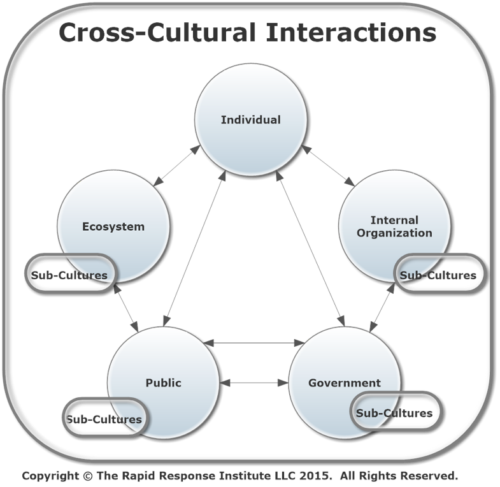
    As depicted in the title graphic, organizational cross-cultural interactions incorporate one or more of these dynamic components.

    • The Individual defined as a single human being or perhaps other entity with whom others collaborate
    • The Internal Organization defined the (legal) entity one or more individuals associate with on a daily basis
    • The Government defined elected officials as all levels of the Federal, State and Local governance bodies including any and all regulatory bodies or other agencies
    • The Public defined as communities and other interest groups including the media as well as its social aspect
    • The Ecosystem defined as the broad group of constituents which includes clients/customers, the supply chain as well a professional services engaged with the organization

    Note that sub-cultures abound across the four elements other than the individual.  Four example, a taskforce or team may be formed to implement a global IT system.  In this case, the team may be composed of individual from several countries as well as  Internal and External IT professionals..  In this case this would be an Internal Organization Sub-Culture.  Another Sub-Culture might be the NYC office with a distinct local flavor.

    These five elements are built upon a pretty straightforward peer reviewed behavioral framework.   

    The RBC Framework

    The Relationships, Behaviors, Conditions (RBC) Framework was originally developed to address the International Cross-Cultural Negotiation process.  Briefly, this is a dynamic model with emphasis on interactive relationships resulting from multiple levels of behavioral analysis.

    • Relationship dynamics are the focus including, commonality of interest, trust, balance of power and conflict intensity
    • Behaviors are defined from a broad multi-dimensional perspective and includes intentional as well as unintentional
    • Conditions include circumstances, capabilities and competencies of the parties, cultural considerations and the environment

    For almost 30 years we have been expanding and enhancing this model.  It is now used for ANY human interaction as well as Machine-Human interfaces, i.e. Artificial Intelligence (AI).

    Finally, we see this construct as very fabric of the modern organizational Team.

    What is a Team?

    By one definition a team is, “a group of people who perform interdependent tasks to work toward accomplishing a common mission or specific objective.”  As a general rule, teams are composed of individuals either appointed politically or assigned based on talent and expertise.

    When politically assigned to meet somewhat arbitrary DEI driven goals, one can expect such teams to fail–often visibly as a great calamity.  Thus driving survivors and others away from new similar teams.

    Thirty years ago this pundit witnessed the implementation of the then new Enterprise Resource Planning (ERP) IT systems.  Most were late and way over budget.  They rightfully earned the badge of ‘Career Killer.’  Not surprisingly, no one wanted to be assigned to this type of project.  Most consulting firms implementing these systems wanted someone with knowledge of the business on the project as well as IT professionals.  Key personnel could not be spared from operations and often junior or less qualified IT employees were assigned.  Needless to say, some level of disappointing performance was almost certainty guaranteed.  These were diverse teams composed of third party consultants, operations and finance individuals as well as internal IT people.

    These were not effective teams.  Many were even destructive.

    Creating an Effective Team

    A Google search of the term ‘teambuilding’ generates 160 million hits.  It is a well documented process, so why are successful teams so elusive?

    Most critical teams undergo a selection process as described previously with some training.  The project commences often with significant time and budget constraints.  In many cases the team malfunctions from the ‘get go.’  So why would DEI efforts end differently?  One suspects most do not.

    When students participate in active learning, they learn more.  This has been known for some time.  Sadly, and often in the DEI space, workshops do not address the actual issue organizations are facing.  However, their is a more successful learning model.

    Organizational Team Truths

    As noted above, organizations build teams to solve critical problems.  They do not group Individuals by category or classification.  High Performance Teams are anything but homogeneous.  

    • First, teams must form.  A mission/goal(s), set of deliverables, budget (if appropriate) and time frame must be developed and agreed to by management.
    • Then, members must get to know each other, roles and tasks assigned, etc.
    • What does success look like?  Metrics established.

    Most teams do not live in a vacuum so if they are to collaborate with one or more other teams (Internal or Ecosystem) this process is extended.  In many cases such as a merger or safety initiative, Government and even the Public will need to be engaged.

    Now a collaborative negotiation between ‘semi-independent’ parties to arrive at mutual success.  This is generally an iterative process.

    To create an active learning environment to cost effectively train new teams in a timely manner, simulations and game theory play a critical role.

    Moreover, to maximize effectiveness, such a Serious Game must be based on a Behavioral Science Framework.  This type of Team-to-Team interaction is available using video conferencing to engage teams meaningful training using ‘real world’ scenarios.

    The graphic below depicts this process.  Readers will also note a number of metrics will provide feedback to students to further enhance their learning experience.

    DEI ROI

    One comment routinely heard regarding DEI is the lack of return on the effort.  Not necessarily monetary return but the learning does not ‘stick.’

    Benjamin Franklin is credited with the quotation, “Tell me and I forget, teach me and I may remember, involve me and I learn.”  When these teams are composed of a variety of Individuals working to solve realistic collective problems the result better reflects actual organization life.  All aspects of DEI can be incorporated into the game scenario.  All students benefit from a much better learning experience and by extension the organizations they represent.

    The following short video is aligned with this discussion.  Well worth the few minutes it will take to watch it.

    Realizing DEI

    Simon makes the point that strong Organizations are more diverse.  In this pundit’s long international career, I support his contention. Moreover, true strength from a diverse Organization and its Ecosystem cannot be reached if individuals are not treated fairly and included in the process.  The serious game scenarios help assure all individuals participate.

    Want some help upping your DEI game?  Contact Us.

    For More Information

    Please note, RRI does not endorse or advocate the links to any third-party materials herein.  They are provided for education and entertainment only.

    The author’s credentials in this field are available on his LinkedIn page.  Moreover, Dr. Shemwell is a coauthor for an in press book (to be released in Spring 2023) titled, “Smart Manufacturing: Integrating Transformational Technologies for Competitiveness and Sustainability.”  His focus is on Operational Technologies.

    “People fail to get along because they fear each other; they fear each other because they don’t know each other; they don’t know each other because they have not communicated with each other.” (Martin Luther King speech at Cornell College, 1962).  For more information on Cross Cultural Engagement, check out our Cross Cultural Serious Game.  You can contact this author as well.

    The video by Simon Sinek is from YouTube.

    For more details regarding climate change models, check out Bjorn Lomborg ands his latest book, False Alarm: How Climate Change Panic Costs Us Trillions, Hurts the Poor, and Fails to Fix the Planet.

    Regarding the economics of Climate Change, check out our recent blog, Crippling Green.

    For those start-up firms addressing energy (including renewables) challenges, the author can put you in touch with Global Energy Mentors which provide no-cost mentoring services from energy experts.  If interested, check it out and give me a shout.

  • Are Your DEI Wheels Spinning?

    Are Your DEI Wheels Spinning?

    Originally published as a LinkedIn article on July 6, 2021, this updated version is reprinted here with the permission of the author.  Links to relevant sources are added.

    Lately, many LinkedIn posts bemoan the state of Diversity, Equity, Inclusion (DEI) initiatives. The seeming slow take up of great ideas.

    Some argue that DEI initiatives are no more than window dressing or organizational efforts to stave-off litigation. To others, they have the appearance of one more management initiative that if waited out will simply go away like so many others before.

    Fundamentally, DEI initiatives require change. A change of (B)ehaviors in the face of seemingly new situations or influencing (C)onditions (Circumstances, Capabilities, Cultures, Environments). When these two variables evolve, so do exiting (R)elationships. The RBC model is well established in social science and was first used to model Cross-Cultural (international business) Negotiations.

    It is multi-dimensional including a temporal schema capable of addressing numerous aspects of human behavior. Furthermore, it encompasses cultural as well as other situational aspects such as individual backgrounds.

    We tested this model using Japanese and American executives. This culturally diverse group needed to develop a level of trust if negotiation outcomes were to be successful.

    Likewise, successful DEI initiatives require that culturally diverse groups develop a high level of trust among those working together and/or members of teams.

    “Tell Me and I Forget. Teach Me and I Remember. Involve Me and I Learn”

    Attributed to Benjamin Franklin, this quote tells us all we need to know. The so-called Death by PowerPoint lecture long in vogue are often forgettable. Instruction, along with the homework prerequisite and tests are traditional methods. Finally, engaging individuals, teams, departments and even entire organizations can create long standing sustainable knowledge that is the basis for behavioral transformation.

    Paper based serious games or “games whose purpose is other than entertainment” originated in the late 1960-70s. In a nutshell, this is an interactive training solution. Subsequently, online serious games can incorporate actual scenarios designed to immerse players solving real world challenges.

    Rather than a video game whereby players engage with electronic decision trees, human-to-human serious games train players/teams to deal with diverse yet real colleagues. Collaborative scenarios direct participants to collectively solve problems while learning how their culturally dissimilar counterparts address the same challenge.

    Scenarios can drive engagement by all players including those who may not be typically involved in decision making processes. This is also a safe, no-harm no-foul environment with little to no individual decision-making risk.

    Transformation

    Any successful ‘change’ initiative must answer the What’s in It for Me? question. Humans may resist change if they do not see personal value from such actions. Moreover, while senior executive leadership is required, heavy handed top down My Way or The Highway may result in direct resistance, and/or a more crowed freeway to the exit ramp.

    For example, the current version of the smart phone was first available circa 2007. According to Statista, approximately 1.38 billion smartphones were sold in 2020. Likewise, over 46 percent of the global population own these devices.

    What does this have to do with DEI? In 2006 cellphones were great and becoming ubiquitous. No one knew they needed a smartphone. Our collective Behavioral transformation was caused because the What’s in it for Me question was answered.

    One component of the Conditions criteria, Capability changed as this technology enabled individuals to drive new behaviors based on Apps that emerged. The resulting transformation in our Relationships is well documented, i.e., the use of text as opposed to voice.

    Sustained transformation requires continued energy. The term ‘initiative’ implies a short-term event and one that will pass.

    Trust must be established and maintained. Over time, sustained energy will result in critical mass, or the (statistically significant) number of individuals engaged and trusting each other. This self-sustaining energy is transformation.

    Reframing DEI Initiatives into the RBC Framework can enable dramatic and rapid transformation. Take advantage of these types of cross-cultural models.

    For More Information

    Please note, RRI does not endorse or advocate the links to any third-party materials.  They are provided for education and entertainment only.

    For more information on Cross Cultural Engagement, check out our Cross Cultural Serious Game

    We presented, Should Cross Cultural Serious Games Be Included in Your Diversity Program: Best Practices and Lessons Learned at the Online Conference, New Diversity Summit 2020 the week of September 14, 2020.  Check Out this timely event and contact the organizer for access to the presentations!!

    You can contact this author as well.

  • Roadmap to Decision Making In the ‘Smart’ Era

    Roadmap to Decision Making In the ‘Smart’ Era

    “Nothing is more difficult, and therefore more precious, than to be able to decide.”

    Napoleon Bonaparte

    Volumes have been written on decision-making and this pundit has offered his share of insight and comment on the subject as well.  Some of our comments regard the appropriateness of the human intercession in electronic decision making.  Others raise questions regarding algorithm fallibility.  Moreover, Human Factors must be considered for any technology initiative which are becoming increasingly important.

    If one unpacks the previous paragraph a substantial level of complexity emerges.  As complexity increases so does risk and the need from proper governance.  However, many still see this potential transformation through the lens of just another IT initiative.

    Roadmap

    The oil and gas industry faced a similar dilemma at the dawn of the 21st Century.  At the time, referred to as DOFF or Digital Oilfield of the Future, a plethora of technologies became available.  The task was to transform 100 plus years of traditional operation to what is now referred to as the Digital Oilfield, aka Integrated Operations and a number or synonyms.  While this processes continues to evolve as new solutions emerge, i.e., Cloud, at the time much was trial and error.

    In conjunction with industry leadership, we released our Roadmap to Enterprise Optimization: A Guide to the Impact of Information Driven Field Operations on the Petroleum Corporation in the fall of 2004.  We believe it was the first industry (POSC) supported effort that was not simply research but a ‘bona fide’ action plan or roadmap to success based on industry/other knowledge, standards, economic value and best practices.

    Click for full size Integrated Operations Framework or graphic

    Since then, we have updated this roadmap into an Operational Excellence Platform.  Note that Integrated Operations is a key component.  The platform is a robust detailed solution that is available not just to the energy sector but all sectors identified by Homeland Security as Critical Infrastructure.  These sectors were recently identified as susceptible to hacking by the US government.

    Getting Smart

    Enormous corporate (shareholder) wealth has been destroyed implementing ‘game changing’ technology enabled transformation efforts.  Are we about to do that again, getting smart?  The easy answer is yes, but it does not have to be.

    Roadmap constructs are well understood and provide guidance.  In some models the step by step process provide practitioners with well defined models that can lead to success–defined as on time and under budget performance against Key Performance Indicators (KPIs).

    We are in the process of writing a book, to be released in 2022.  One chapter will define a roadmap for the transformation to ‘Smart’ for a major industrial segment.  As with earlier works, it will focus on the human element aligned with a technology assessment process.

    Get Smart was a comedic TV show spoofing the Cold War ‘spy’ environment of the 1960s.  Getting Smart today may not be a lot different.  The goal under a ‘Cone of Silence‘ was to attain and sustain competitive advantaged achieving superior stakeholder returns.

    Getting smart in 2021 will require a ‘Roadmap to Smart.’  A set of ‘to do’ processes that assures success.

    What is your Organization’s Plan to put Smart Decisioning Making Processes in Place?


    For More Information

    Please note, RRI does not endorse or advocate the links to any third-party materials.  They are provided for education and entertainment only.

    For more information on Cross Cultural Engagement, check out our Cross Cultural Serious Game

    We presented, Should Cross Cultural Serious Games Be Included in Your Diversity Program: Best Practices and Lessons Learned at the Online Conference, New Diversity Summit 2020 the week of September 14, 2020.  Check Out this timely event and contact the organizer for access to the presentations!!

    You can contact this author as well.

  • ESG Implementation–Strong v Weak Revisited

    ESG Implementation–Strong v Weak Revisited

    “A healthy corporation acts on the interests of its stakeholders and customers”

    — Ari Melber, Journalist

    Currently, organizations are being implored to implement Environmental, Social, and Governance (ESG) driven business models.   Proponents even suggest that investment in organizations that do not have this imprimatur should be avoided or even divested.

    However, one wonders what has changed?  Successful firms, private and public have long understood that they must add value to their constituencies.  One example, a few decades ago an energy services provider used its high volume oilfield pumps to help a small town in Kansas where it had a district office drain flood waters.  Why would they do this?  Perhaps because employees lived in this community or perhaps it was just the right thing to do.

    Flash forward and we find organizational largess still in place.  During the recent Texas freeze, a local furniture retailer opened its doors to dispossessed individuals and families.  The owner has a long record of supporting the community and his responses to local disasters is legendary.

    After the Deepwater Horizon incident in April 2010, our firm started to look at Asset Integrity issues in oilfield operations.  Our discoveries transcended several Critical Infrastructure segments.  The recent failure of the Colonial Pipeline is a manifestation of issues uncovered yet not resolved more than a decade ago!

    Focus on Operations

    In 2011, we posited that organizational governance was not just a financial issue at the ‘C’ level.  Rather its true focus should be at the revenue generating asset level.  This led to our 2011 groundbreaking monograph, Asset/Equipment Integrity Governance: Operations–Enterprise Alignment.  Therein, we posited a new governance model that incorporated the ESG components widely discussed today.

    Moreover, in 2014 our book, IMPLEMENTING A CULTURE of SAFETY: A ROADMAP FOR PERFORMANCE BASED COMPLIANCE identified the requirement for organizations in the Critical Infrastructure space to change governance models to one of Strong Bond.

    Following the release of our AIG model, we put forth a Strong v Weak governance model to manage High Reliability Organizations (HRO) necessary for firms in Critical Infrastructure sectors.  Strong Bond is appropriate for organizations in Critical Infrastructure segments, while Weak Bonds may be better for retail.

    One suspects that ESG is another tick in the box.  If ten years (or earlier) from now another critical system fails, it will not be because HRM processes were not followed or ESG verbiage was in the annual report Letter to Shareholders; it will be because nothing really changed.  As of this writing the US Federal government is advising organizations in Critical Infrastructure sectors to more aggressively address cybersecurity risks.

    Why is this? Do Boards and CEOs need politicians and bureaucrats to tell them about the details of running a business?  If they do, investors may want to revisit their portfolios.

    One suspects that the ESG fad will fade. There will always be a new management mantra that consultants will put forth.  Well run organizations will remain well run.  Others not so much.

    Governance models come and go.  Regardless, how will you assure your organization is well run?

    For More Information

    Please note, RRI does not endorse or advocate the links to any third-party materials.  They are provided for education and entertainment only.

    For more information on Cross Cultural Engagement, check out our Cross Cultural Serious Game

    We presented, Should Cross Cultural Serious Games Be Included in Your Diversity Program: Best Practices and Lessons Learned at the Online Conference, New Diversity Summit 2020 the week of September 14, 2020.  Check Out this timely event and contact the organizer for access to the presentations!!

    You can contact this author as well.

  • Complicity or Write a Book?

    Complicity or Write a Book?

    I Need a Book Deal!


    With the change of the US federal administration, previous key individuals are now coming out and writing books regarding their former boss.  This all the while with plenty of video evidence where these individuals pontificated a position and even changed their position dramatically while in the employ and in seemingly in support of that administration’s policy.

    Now some of the very architects of the US response to the Coronavirus are claiming their innocence all the while blaming others for thousands of deaths.  The nerve.  If true, she is equally responsible and perhaps more since she is a medical doctor.  First do no harm.

    We all have a boss and most need a job; however, when does an individual’s moral compass come to play?  Senior officials who will be gainfully employed doing something else fail to come forward or even resign.  THEN they claim victimhood!  The LOVE of power is so intoxicating.

    Remember, ordinary Germans were widely condemned after World War II for much less personal involvement.

    Credibility?

    Many institutions lack any credulity today.  This is not news and is a widely held view.  Any wonder when so called responsible parties now claim they could have reduced deaths but failed to do so?

    Organizational maleficence often leads to criminal charges and many executives have gone to jail.  If many of the books written after every administration are true, should at least some authors be at least censured for the complicity they themselves are documenting?

    ESG

    We have addressed the issue of governance a number of times.  Most notably in 2011, as part of our Changing the Dialogue monographs, Asset/Equipment Integrity Governance: Operations–Enterprise Alignment (A Case for Board Oversight) addressed the role of operations including environmental and social issues as critical components of the role of organizations.

    As part of the Safety and Environmental Management System tenets, the right for individuals to express themselves without redress is sacrosanct.  Surely, this includes senior officials?  If they can’t or rather seek to write ‘tell all’ books later, governance models are at risk.

    The days of Yes Men (and Women) and Empty Suits are over.  Perhaps, organizations need to clean house.

    How Do You Know Y0ur Advisors are Being Honest with You?

    For More Information

    Please note, RRI does not endorse or advocate the links to any third-party materials.  They are provided for education and entertainment only.

    For more information on Cross Cultural Engagement, check out our Cross Cultural Serious Game

    We presented, Should Cross Cultural Serious Games Be Included in Your Diversity Program: Best Practices and Lessons Learned at the Online Conference, New Diversity Summit 2020 the week of September 14, 2020.  Check Out this timely event and contact the organizer for access to the presentations!!

    You can contact this author as well.

  • Teaming Safely

    Teaming Safely

    “For safety is not a gadget but a state of mind”


    Second only to the basic need for food, water and what is required to sustain physical life, safety and security are the next step in Maslow’s Hierarchy of Needs.  In other words one cannot love or feel belonging or achieve a level of esteem without having the warmth of safety much less attain self-actualization.

    More recently, team safety has come to be defined as Inclusive.

    There are three components of team safety:

    • Sociological — “developing and maintaining friendly social bonds is a fundamental organizing principle of human behavior”
    • Psychological — “defined as a shared belief that the team is safe for interpersonal risk taking”
    • Physiological — “relating to the way in which a living organism or bodily part functions”

    If members do not feel ‘safe’ then the team is not capable of high performance.  Moreover, the synergistic value that can be derived from team diversity can not be captured.

    Attaining Safety

    While the need to be safe is coded in our DNA so to speak, we are not inherently safe.  Individuals as well as teams must be proactive to reach situational safety.

    We are Mindful when we are in touch with ourselves and the environment through nurturing feelings.  Interesting, being mindful is a major requirement of High Reliability Organization/Team.  High reliability is a necessary ingredient for an organization’s Safety Culture and by extension its Teams (including third party ecosystem members).

    Safety is a learned behavior.  Therefore, effective training and ongoing reinforcement are necessary. Moreover, realistic scenarios are mandatory making the learning process relevant.

    Take the following maturity assessment and implement your team training program!

    What is your Team’s Culture of Safety Maturity?

    For More Information

    Please note, RRI does not endorse or advocate the links to any third-party materials.  They are provided for education and entertainment only.

    For more information on Cross Cultural Engagement, check out our Cross Cultural Serious Game

    We presented, Should Cross Cultural Serious Games Be Included in Your Diversity Program: Best Practices and Lessons Learned at the Online Conference, New Diversity Summit 2020 the week of September 14, 2020.  Check Out this timely event and contact the organizer for access to the presentations!!

    You can contact this author as well.


  • Is Your Remote Team Aligned?

    Is Your Remote Team Aligned?

    Recently, my team and I were tasked with a delicate decision making process.  Due to its nature and signatory level, team members were only authorized to explore and present options.  The final decision was mine alone.  Our project governance model clearly defined this decision making process.

    One day I received a call from remote members explaining they were going to a vendor site to assess our options–I concurred.  Several hours later they let me know that they had made a decision and signed a contract.  When challenged about their actions they informed me that the vendor had demanded that they ‘act fast.’

    Twice in my career I was the C level executive responsible for global operations.  In one case, one of my direct reports was in a different office along with my boss, the CEO.  I received multiple calls from the CEO over a period that ‘so and so’ had stopped by to talk and decisions were made about my operations.  “Well you were not here was the excuse and it seemed like a good idea to me.”  Would it surprise anyone that ‘so and so’ was relieved shortly thereafter?

    In another, the software development operation was in a different part of town.  Development plans were agreed to and then in some cases materially changed with without authority or even informing management.  Needless to say, projects were late or not completed.  After a few weeks of this, the development lead was terminated.

    Remote Management Governance

    Based on the above paragraphs, some may argue that I am not a very good manager.  Perhaps, they are right; however, the point is remote management can be very difficult.  Empowered individuals and teams must have boundaries.

    Yes, hire smart people and get out of the way.  However, there are limits as even Steve Jobs, the micromanager would agree.

    Evidence suggests that working remotely has its challenges and not everyone is well suited for it.  Some individuals will need additional support.

    There is a great deal of information available about remote management.  Some is sound, but this Though Leader on the subject disagrees with much the advice.  It seems for many, this is their ‘first rodeo’ while remote management goes back to antiquity.  While not the first, the Roman Empire functioned well from a bureaucratic or management perspective.

    Inclusive Teams

    Currently, much of the discussion focuses on the Inclusion of team members.  We are recognizing that Diversity is not enough if not every one participates.

    Previously, we had put forth the construct that cross cultural teams have many of the same characteristics of diverse groups.  We can extend this model and success that Inclusive Teams include those individual who are not as well suite for remote teams as others.

    Managing diverse remote teams and assuring that all team members are valued contributors requires a level of managerial engagement that is constant, consistent and appropriately empowering.  ALL members must be encouraged to participate and their input must be acknowledged by the others.  Only then can Steve Jobs and Elon Musk like decisions be taken and not by those who tend to dominate groups unilaterally.

    D&I in a Post-Pandemic World

    Typically, D&I has been defined as a function of ethnicity and/or gender.  Last year we put forth the construct that Cross-Cultural and D&I are similar models of human behavior and best practices from both could add value to the other.

    Diversity must now include those are not well suited for new business models; however, flawed they may be–jury is still out regarding the effectiveness and efficiency of full time remote teamsInclusion means they must be actively involved.  Leaders at all levels must assure this model is successful.

    How Do You Assure the Reluctant Remote Team Members are Included?

    For More Information

    Please note, RRI does not endorse or advocate the links to any third-party materials.  They are provided for education and entertainment only.

    For more information on Cross Cultural Engagement, check out our Cross Cultural Serious Game

    We presented, Should Cross Cultural Serious Games Be Included in Your Diversity Program: Best Practices and Lessons Learned at the Online Conference, New Diversity Summit 2020 the week of September 14, 2020.  Check Out this timely event and contact the organizer for access to the presentations!!

    You can contact this author as well.


  • Covid-19 Positive: Telemedicine Kicked into High Gear

    Covid-19 Positive: Telemedicine Kicked into High Gear

    Crisis Drives Change

    In 2001 this writer approached the Houston medical community, post tropical storm Allison which flooded many basements in the Houston Medical Center with the loss of experimental data and other records.  We proposed the development of an Internet based solution to hold and manage medical records of all types.  The response to my organization’s offer to digitize records was met with disbelief and ultimate rebuke.

    At the time I was employed by a major corporation with the technology and financial resources to accomplish this task.  Sales Objections included privacy, doctors will not ‘buy in,’ insurance will not pay for it and a host of other lame excuses.

    Flash forward to 2020.  Why are thing so different now and the idea of ‘digitalization’ almost universally accepted?

    Twenty years is a career for many, yet it took a crisis this year to kick the medical sector into action at critical mass—Coronavirus, aka Covid-19.  As often the case large organizations are content to stay with the status quo.  Culture, processes, and even individual bonuses incent lethargy and complacency.  This common trait is not limited to one sector.

    Moreover, advances in online telemetry support the physician’s ability to treat many aliments remotely.  The industry did not just ‘jump’ to the current state, it evolved over time.  For example, remote and inaccessible areas such as Antarctica have taken advantage of telemedicine including remotely directed surgeries.

    Democratization

    We may look back on 2020 as the seminal moment when medicine was digitalized.  Despite current access issues such as we are finding with K-12 education, most will have the ability to interact online in the near future.  Moreover, a number of COTS (commercial off the shelf) health solutions such as found in a variety of Smart phone products enable remote diagnosis and monitoring on a global basis.

    The catalyst for taking telemedicine to the next level is Covid-19!  A good Positive.

    How is your organization taking advantage of remote operational technologies?

    For More Information

    Please note, RRI does not endorse or advocate the links to any third-party materials.  They are provided for education and entertainment only.

    For more information on Cross Cultural Engagement, check out our Cross Cultural Serious Game

    We presented, Should Cross Cultural Serious Games Be Included in Your Diversity Program: Best Practices and Lessons Learned at the Online Conference, New Diversity Summit 2020 the week of September 14, 2020.  Check Out this timely event and contact the organizer for access to the presentations!!

    You can contact this author as well.

  • Linear Metrics in Non-Linear Times?

    Linear Metrics in Non-Linear Times?

    “If it disagrees with experiment, its wrong”

    Our point today is to assess how behavioral decisions are being made today; not about the politics of one candidate or the other.

    The race to the US presidential election has entered its final phase.  As of this writing, establishment wisdom holds the conventional candidate as the presumptive winner.

    Pollical polling is a linear straightforward process albeit with the inherent bias of ‘all’ behavioral instruments.  Effective surveys will take a statistically significant representative sample and project those results to the larger electorate.  A time-honored approach for product marketing as well.

    However, there is another school of thought.  When a new produce/idea is disruptive or not well understood, the firm needs to be proactive rather than simply reactive such as using a survey.  Steve Jobs stated, “You can’t just ask customers what they want and then try to give that to them.  By the time you get it built, they’ll want something new.

    One interpretation, ‘They don’t know what they don’t know.’  Echo the words of Donald Rumsfeld!

    Pollsters suggests that 2016 will not be repeated and they have modified their survey instrument control processes.  Recently one noted canvasser, Frank Luntz stated, “Pollsters did not do a good job in 2016.  So, if Donald Trump surprises people, if Joe Biden had a 5 or 6-point lead, my profession is done.”

    Our Lying Eyes

    When the world was the center of the universe with all the stars and galaxies rotating around us, linear projections confirmed the observed metrics.  However, famously, Nobel laureate, Richard Feynman taught us that, “If it disagrees with experiment, its wrong.”

    Galileo and Kepler among others experimented using the observable data differently.  They discovered that the universe does not revolve around our planet.

    Their assessments altered the given world forever and caused them significant personal angst in the process.  Established ‘science’ did not welcome this change readily.

    If the incumbent rallies and is elected for a second term despite expert projections using legacy linear tools, it maybe time to rethink how social beliefs and behaviors are measured.  Given the problems with Covid-19 data management, the same maybe said for that issue as well

    Hypothesis—Disruption cannot be accurately measured with traditional tools.

    Learnings

    Beyond politics and marketing, there are lessons for all of us.  Artificial Intelligence, Search Engines, Predictive, Big Data Analytics, Machine Learning, IoT et al are now all the rage.  But what if they are using the wrong algorithms?

    There are ramifications for our daily lives.  In March 2019, the Boeing Max 8 was grounded and has yet to return to service.  Will driverless automobiles put us all at risk?

    This survey question maybe answered on November 3 or whenever the final results are tabulated.  Other questions about the use of other metrics will remain unanswered; at least for now.

    How are you certain your decision supports processes and tools are providing valid and reliable data?

    For More Information

    Please note, RRI does not endorse or advocate the links to any third-party materials.  They are provided for education and entertainment only.

    For more information on Cross Cultural Engagement, check out our Cross Cultural Serious Game

    We presented, Should Cross Cultural Serious Games Be Included in Your Diversity Program: Best Practices and Lessons Learned at the Online Conference, New Diversity Summit 2020 the week of September 14, 2020.  Check Out this timely event and contact the organizer for access to the presentations!!

    You can contact this author as well.

  • The Tyranny of the Blank Sheet of Paper

    The Tyranny of the Blank Sheet of Paper

    We have all had that, “Where do I start” moment?  Confronted with the NEW, sometimes the task seems daunting.  In a recent conversation, a colleague and I were discussing an adult training program.  The subject centered on how to help students jump start a creative flow.

    We humans are fond of using so called cheat sheets.  Whether school CliffNotes, Cut and Paste, Go Bys, Best Practices or other tools to wrap our mind around a subject and launch the thought process.  In other words, anything to move us away from the cosmic void–so called ‘writer’s block.’

    Tidbits that Work for Me

    Faced with tyranny often during my formative career years, i.e., a professional services proposal, new spreadsheet, etc. a few tricks were developed.

    First—Just start writing.  Put your thoughts down as they fly out and don’t worry about the order or even if they are relevant.  You can sort these things out later, but a least your paper is no longer blank.

    Get Up—Hit a spot where nothing is pouring out of your brain? Put your (electronic) paper down and go exercise or do something totally unrelated.  You will be surprised how the creative juices will flow when you return.

    Ask a Friend—Remember the old game show where contestants could ‘phone a friend’ when stumped on a question?  Brainstorm with friend and colleagues; even those who have no knowledge of the problem your engaged with.  Sometimes, they have the best insight—true out of the box.

    Do Something Else—If time allows put the project on the shelf and work on something entirely different.  You can come back later refreshed.

    FYI, the tyranny never goes away.  Hundreds of publications and presentations later, it still can persist from time to time.  The four tidbits still work for this author.

    By one definition, tyranny is “cruel, unreasonable, or arbitrary use of power or control.”  There is no reason to let a blank sheet of paper exercise such awful authority.  Take back your creativity!

    Why Let the Blank Sheet of Paper Ruin Your Day?

    For More Information

    Please note, RRI does not endorse or advocate the links to third-party materials.  They are provided for education and entertainment only.

    For more information on Cross Cultural Engagement, check out our Cross Cultural Serious Game

    We presented, Should Cross Cultural Serious Games Be Included in Your Diversity Program: Best Practices and Lessons Learned at the Online Conference, New Diversity Summit 2020 on April 9, 2020.  The summit will be offered again soon.  Check it Out!!

    You can contact the author as well.

  • Running Across an Open Field: Strategy for Disruptive Technology?

    Running Across an Open Field: Strategy for Disruptive Technology?

    Several weeks ago, as an amateur history buff, I was watching a documentary about World War I.  During one segment the commentator discussed the apparent fact that if soldiers refused to charge out of their trenches across an open field into the teeth of waiting machine guns they would be shot.

    The brutality of such a command by (so-called) leadership is appalling.  It may have been one thing for Alexander the Great’s armies to engage in open battles with sharp pointed objects as weapons.

    It is quite another for General Pickett’s infantry at Gettysburg to charge cannons and 50+ years later to repeatedly try the same tactic (by both sides) at horrific costs.  Generals always fight the last war, so the saying goes.

    This blog is not about some of history’s follies, it is about learning so as not to repeat the mistakes of others.  These lessons apply to readers’ daily business world as well.

    When New Technology is Deployed

    New disruptive technology can tear the societal fabric.  Some old jobs and companies disappear, and new ones thrive.  This process has been repeated since antiquity.

    Our culture is having this dialogue today regarding digitalization and its suite of technological driven change, i.e., Blockchain, AI, etc.  Principal issues that must be addressed include Human Factors Engineering (HFE).

    “HFE places the human operator at the center of the complex operating environment.  HFE recognizes that this individual or set of individuals is the puppet master and is responsible for the entire show.”  In other words how do we interact with the new technological reality.

    Reliable and valid HFE is the key to successful digitalization initiatives.  It will be the vital to whatever is next as well.

    Tyranny of the Minority

    From political science, “For centuries, theorists have worried about the potential of unrestrained democracy to lead to a tyranny of the majority, in which majority groups ride roughshod over the rights of minorities.  What we often see today is instead a kind of tyranny of the minority: a system in which a particularly extreme and motivated fraction of the populace can wield outsized power in the face of a majority which is either too indifferent or too scared to oppose it,” (italics added).

    In most organizations, there are fewer leaders than those who fabricate a ‘work product.’  The responsibility of leadership is to set the vision, mission and goal as well as enabling the organization with the tools and support necessary to reach targeted stakeholder value.

    But what if this minority group is the slowest to come to grips with disruptive forces?  In the face of newness, they may ‘keep doing what they have always been doing.”  In such an environment, the organization will likely not reap the same reward as in the past.

    Does too indifferent or too scared describe your organization’s ecosystem workforce?  One suspects It would be good to know.

    Fast Fail

    In our last blog we discussed the rapid assessment of technology and when to drop it if it does not appear to be working out.  Perhaps, we should treat managerial processes the same way.  After a horrific and visible failure in leadership, conceivably one preserves best by looking for alternative?

    If charging head long across an open field leads to disaster, why keep doing it?  While a counter argument might be that we had no tools to defeat those equipped with the new technology, to this writer, that logic is suspect.

    Flanking an enemy’s line or using guerrilla tactics, et. al. are as old as human confrontation.  Unconventional warfare has a long record of documented success.

    The business lexicon is loaded with military terminology.  We often speak of business as if it is warfare, when of course it is not.  There are lessons to be learned about human and organizational behavior, however.

    Decades ago, the concept of Guerrilla Marketing was the rage.  With the advent of social media, it has advanced, and the methodology is available to all.  Huge budgets and massive media campaigns are no longer necessary.

    Head-to-Head the biggest ‘guy’ usually wins.  So, if you’re not him/her, DON’T DO IT!!  However, the small mammals may displace slow moving dinosaurs.

    Agile is not an IT term.  It should be the state of mind of leaders at all levels.  To charge across the open business landscape into technology designed to destroy your organization remains folly.

    How Are You Leading the Charge into the Future?

    For More Information

    Please note, RRI does not endorse or advocate the links to other materials.  They are provided for education and entertainment only.

    See this 3:15 minute clip for more information on living in a World War I trench.  Pathetic way for leaders to force those under their command to live.

    For more information on Cross Cultural Engagement, check out our Cross Cultural Serious Game

    You can contact the author as well.

    End Notes

      https://consult2050.com/job-disruption-due-to-digitalization/

      https://therrinstitute.com/wp-content/uploads/2018/10/HRM-in-Process-Industries-Sustained-by-Human-Factors.pdf

      Ibid.

      https://areomagazine.com/2019/04/02/the-tyranny-of-the-minority-and-how-to-prevent-it/

      https://therrinstitute.com/lessons-from-the-seventies/

      https://en.wikipedia.org/wiki/Guerrilla_marketing

  • Culture Matters A Lot!  Cultural Interactions Matter MORE!!

    Culture Matters A Lot! Cultural Interactions Matter MORE!!

    “Failures of culture have been the single biggest destroyers of value in the last five years,” states the former senior vice president of HR of Google in a recent article.  This revelation by one of the contemporary tech giants supports the previous dictum, “Culture eats strategy for breakfast.”  Depending on one’s perspective, this latter quote can be attributed to literature dating back to the mid-1980s.

    Regardless, the central role of culture in an organization has long been recognized.  One wonders, if this is true, why has so little changed in 30+ years?

    This writer is personally aware of three major cultural debacles by large publicly traded firms where shareholder value was destroyed through inter cultural challenges.  In one case, the ‘then’ acquiring firm was subsequently acquired itself in part because of a seemingly dysfunctional culture.

    The Inc. article goes on to describe three demonstrable risks management must attend to in their mitigation strategies:

    • The internal is now external—Organizational ecosystem employees/contractors/customers now have unfettered access to outside the ‘door.’ Constituent parties can use social media posts to comment about the good, bad, and ugly of an organization.
    • The data on culture shows clear economic impact—Case studies on culture are no longer ‘fuzzy’ and the impact of culture on the bottom line can now be documented.
    • People technology has advanced enough to help—Data and analytics enable organizations to develop a better understanding other their ‘workforce’ market constituency and develop strategies addressing their concerns and needs.

    The article concludes that culture is no longer a buzzword and organizations can leverage it to drive organizational alignment and behavior towards shareholder value.  Culture is now a measurable KPI.

    Care to benchmark yours?


    Cross Culture

    If one accepts the above premise, competitive value is created by the organization’s culture.  This is not a new statement and has been addressed by this author in various forums for years.

    Fundamentally, there are two types of cultural interactions:

    • Collaborative—Two or more organizations seek to work together to realize joint value. For example, the organizational ecosystem, i.e., suppliers and long-term customers.
    • Adversarial—Two or more organizations seek to realize value at the expense of others. Examples include competitors, government regulatory interactions, i.e., IRS or legal actions.

    Even an internal team is a composite of several legacy (organizational) cultures not to mention diverse ethnicity and societal circumstances.  It is this heterogeneous environment that the bottom line is ultimately impacted.

    This author began investigating cross-cultural engagement value (or lack thereof) in the era of Culture eats strategy for breakfast.  In any cross-cultural situation, the Relationship is the ultimate value developed, sustained or even lost.

    The R B C model describes a set of interpersonal Behaviors based upon a set of Conditions.  Behaviors are observable and describable (beware of observer bias) and Conditions can be equally known.  The Relationship(s) between parties are latent (not directly observed) and must be inferred.

    This inference is often the source of poor decision-making—the reason so many deals go ‘south.’  If the internal culture is now better defined, manageable and a bottom-line item, focus must be turned to intercultural engagements.

    Even as your organizational culture is more knowable.  Its relationship with other identifiable cultures is not.  If that were true, there might be fewer issues among parties.  One might even surmise; the divorce rate might be lower.

    At all levels, culture is an evolving construct.  Cigarette smoking is no longer publicly acceptable for many while marijuana consumption is.  Fashions come and go as well.

    Certainly ‘pop culture’ evolves rapidly.  Perhaps slower, but so do societal and ultimately business cultures.

    In this pundit’s opinion, successful inter-cultural engagements are the key to long term value—shared or otherwise.  The more the organization knows Who and What it is, the better it will be able to develop a ‘relationship’ with counterparts who know Who and What they are.

    Culture is the Food of Choice.  How is Your Organization Watching its Weight?

    For More Information

    Please note, RRI does not endorse or advocate this video and does not have a relationship with its producer and distributors.  It is provided for fun and entertainment only.

    You can contact the author more information as well.

    End Notes

      https://www.inc.com/michael-schneider/googles-former-head-of-hr-issues-a-warning-that-all-business-owners-leadership-teams-should-read.html

      https://quoteinvestigator.com/2017/05/23/culture-eats/

     http://www.stat.cmu.edu/~brian/905-2009/all-papers/Bollen-annurev.psych.53.100901.pdf

  • Brand Your Digital Oilfield Culture: Internalize Its Transformation

    Brand Your Digital Oilfield Culture: Internalize Its Transformation

    Our recent article, “The Digital Oilfield Culture: Transformation Value for the Organizational Ecosystem” (pp.24-26) takes a somewhat different change management approach.  Why not brand your digital oilfield culture?

    Most consumers are familiar with the so-called ‘Brand Name.’  These are names so ubiquitous that in some cases that we take them for granted.  Soft drinks, beer, fast food and automobiles are only a small sample of ‘product/service’ brands most can immediately relate to; even subconsciously.

    Hearing a brand name elicits a response, usually positive but possible negative as well.  This is the way organizations seek to have their product become part of the lexicon.  Examples include Xeroxing and Googling among others.

    Digital Oilfield Culture

    “Systemic Digital Oilfield Culture can be defined as the Core Set of Values and Behavioral Economics of ALL participants of the extended organization and its Enterprise Risk Management strategy that reflect a Strong Bond Governance commitment to behaving as a High Reliability Enterprise Ecosystem in a Safe and Environmentally responsible manner.”

    Ok, while accurate, this author’s definition of a Systemic Digital Oilfield Culture may be stiff and boring to some.  What does it mean to me and why do I care?

    As noted in past blogs and written pieces, a successful cultural transformation must address the. “What’s in it for ME” question.  Moreover, the answer must make sense to me if I am to internalize it.

    Taken from consumer marketing a, “Brand Essence is the emotional heart of a brand, summed up in a few words.  The Brand Essence Wheel is a format for capturing and communicating the conceptual subtleties of the brand.” (Chung and Doran, 2016).

    Successful brand strategies can create fierce lifelong loyalties, i.e., the cola wars of the 1970’s attempts to capture the emerging Baby Boomer demographic.  So why not take advantage of this marketing strategy when transforming the culture of an organization?  Create these fierce loyalties for your organization’s success!

    Brand Wheel Construct

    In accordance with the theory, the Digital Oilfield Culture Brand Wheel (First Draft) is composed of two major categories:

    Facts & Symbols or those components of the Brand that address the “hard” and often more measurable aspects.

      • What the Culture does do for ME
      • How I would Describe the Culture

    Brand Personality addresses the more emotional side of the Brand

      • How the Brand make ME look
      • How the Brand makes ME feel

    The wheel is then populated with those criteria of interest to the organization (generally developed through a series of workshops at all levels of the firm and its ecosystem).  One example is depicted in the following (Version 1.0) graphic.

    Final Thoughts

    There is a significant body of knowledge about the highs and lows of organizational transformation/change management.  The preponderance of the evidence suggests the transformation of a digitalized organization is difficult and often fleeting.

    The B2C sector has demonstrated repeated and sustained success creating perceived value to the individual (ME).  In B2B sectors, Rah Rah, executive sponsorship, training, etc. all have their place with change.  Yet, this is approach has proved wanting.

    Most importantly, strong Brands are sustained when the Rah-Rah fades.  Just Do It is the tag line of one major brand.  Betting most readers know what firm that is.

    Is Digital Oilfield Cultural Branding in Your Organization’s Future?

    For More Information

    The complete article is available from Petroleum Africa magazine and a ‘for fee’ copy can be downloaded.  In addition to a more detailed discussion of the branding process, it contains a high-level Implementation Plan.

    You can also contact the author as well.

    End Notes

      Shemwell, Scott M. (2019, May/June). The Digital Oilfield Culture: Transformational Value for the Organizational Ecosystem. Petroleum Africa Magazine. Issue 3. pp. 24-26.

    Petroleum Africa magazine has graciously allowed the re-publication of this edition.  See our full article.

      Ibid.

      https://en.wikipedia.org/wiki/Cola_wars

  • Fleeting Success: In Pursuit of Sustainability

    Fleeting Success: In Pursuit of Sustainability

    Winston Churchill is credited with saying, “Success is not final, failure is not fatal: it is the courage to continue that counts.”  The late Prime Minister nailed it; once again!

    Our journey through life, including our career is a marathon not a sprint.  While we celebrate success, often at happy hour or a party, we recognize it is only a moment.

    Early in this writer’s career, a multi-million-dollar deal closed after more than a year of effort.  A celebration ensued.  The next day the sales manager, “Asked what was next?”

    Attain and Sustain

    Organizational initiatives seem to procreate.  In some ways like the Tribbles of the original Star Trek series.  Cute furry things, the Tribbles multiple at such a rate as to almost consume the Enterprise.  Only the transporter beam saves the crew.

    Like the rah-rah of New Year’s Resolutions, the question is not will I go to the gym in January, but will I still set foot on the treadmill in June or even March.  The road to you know where is paved with good intentions.  It is the sustained energy of the execution that assures more successes than failures—and that failures are teachable moments.

    Culture is one of the current buzzwords, yet Cultural Transformation is the key to sustainability.  Courage requires the organization to pick itself up, so to speak and continue the journey to a sustained high level of Operational Excellence.

    Easy to Say

    According to Forbes, in 2018 “enterprises are expected to invest $1.3 trillion (USD) in digital transformation initiatives to apply digital capabilities to improve efficiencies, increase customer value and create new monetization opportunities.”  The article goes on to posit, that almost $900 billion of that spend will be wasted as goals are not attained.

    Why are these projects always seemed doomed to fail?  A quick Google search identifies a large body of knowledge over the years documenting these types of failure.  So, the beat goes on.

    Hard to Do

    There is also a body of work documenting the “should do’s” of organizational transformation.  In fact, this author has contributed several articles and books on this subject.  Most notably, Implementing a Culture of Safety: A Roadmap for Performance Based Compliance.

    A Missing Piece

    There is a lot of talk about Operational Excellence, Digitalization, High Reliability Organizations, Human Factors, Safety Culture et al.  As with the Forbes data, many are suffering the same fate.  No wonder senior management is skeptical of new spend for more ‘Tribble-itiatives.’

    For example, when a critical infrastructure sector discusses the transformation to a Safety Culture, the term is often expressed as singular, i.e., there is one industry safety culture.  However, all firms have their own ecosystems consisting of multiple and sometimes disparate entities.

    They have developed a culture that is a source of pride, competitive advantage, etc.  Their culture differentiates each organization from their peer group.

    The following figure presents the actual nature of a firm’s Safety Culture.  The reality is that a large organization’s “culture” is a combination of multiple cultural dimensions.  It is this ‘nature of culture’ that must be better understood if a transition process is to be successful and sustained.

    Readers should note that the multi-dimension structure is continuously changing as business, technology, and regulatory environments impact on the Relationships, Behaviors, and Conditions of the situation.  This dynamic requires continual managerial energy and training to sustain the change desired.

    Cross Cultural Engagement

    It would seem to be a daunting if not impossible task to effectively and efficiently train a large work force including relevant third-party suppliers on an ongoing basis.  Of course, the cost would be prohibited as well.

    Not so fast, e-learning serious games are now available to support the training requirements necessary to “sustain” the transformation.  Moreover, specific scenarios can quickly be developed to meet specific organizational requirements.

    The games are developed using Game Theory and Human Behavioral theories.  They simulate a real-world environment and have been shown to give great results over decades.  With Cloud technology, these training tools are now inexpensive and readily available to all.

    Why have your Organization’s Business Transformation Initiatives Failed?

    Check out our Cross Cultural Serious Game


      https://en.wikipedia.org/wiki/The_Trouble_with_Tribbles

      https://www.forbes.com/sites/forbestechcouncil/2018/03/13/why-digital-transformations-fail-closing-the-900-billion-hole-in-enterprise-strategy/#1f5923507b8b

      https://www.xlibris.com/Bookstore/BookDetail.aspx?BookId=SKU-0143303003

      Shemwell, Scott M. (2015, November 28). Comments and Thoughts Regarding the IAEA Technical Meeting on Developing Improvement Programmes for Safety Culture November 2-4, 2015. Vienna, Austria.

  • Resolution: Celebrating a New Operational Start–One More Time

    Resolution: Celebrating a New Operational Start–One More Time

    It is hard to believe we are now 19 years into the century.  Seems like only yesterday we were worried whether the lights would stay on at Y2K.

    Each year many of us promise to do better at a list of things, some personal and some professional.  Some days or weeks later, some or all of our resolutions go unmet.

    For many heavy industry sector firms, January 1st is also the start of a new fiscal year.  New budgets will be released, and management will extol their workforce to meet new (possibly stretch) targets.

    If the equity markets are a barometer of things to come (leading indicator), then the Conditions organizations will find themselves in will most likely be volatile and some segments may even face significant challenges.

    For example, WTI crude oil closed on January 4th at US$ 47.96/bbl.  Some are bullish on this sector, with an expectation higher prices in the future.  History has shown this faith may not bear out.

    Regardless, organizational Behavior will need the flexibility to adjust in a process relevant time frame as conditions change.  The resulting Relationship with the firm’s ecosystem is a function of the behavior in the conditions or market circumstance.

    In other words, the R B C Framework is applicable in our everyday corporate life.  Why is this important?

    One way to view the global marketplace is one of continual change.  Often purveyors of Change Management/Organizational Transformation present this as a point in time.  Statements about continuous improvement are seemingly afterthoughts.

    We have developed an Operational Excellence Platform, as depicted in the following figure.  Please note that it is built upon the R B C Framework.

    Since the nature of Relationships across the organizational ecosystem will continuously evolve based on the marketplace, it follows that maintaining Operational Excellence depends on these tree factors.  Safe and profitable operations on strong, positive relationships.

    How well does your organization understand the R B C Framework for its ecosystem?

    Further Reading

    The author and others have published extensively on this subject.  The list of appropriate articles and papers is too extensive to list here.  However, readers are invited to peruse Dr. Shemwell’s extensive list of blogs and publications.

    See our Economic Value Proposition Matrix® (EVPM) for additional information and a free version to build your own EVPM.

    For further information Contact Us.

  • Millennials Take On Our Increasingly Complex World

    Millennials Take On Our Increasingly Complex World

    Originally published in 2013.

    On January 1st at 0348 hours a young engineer employed by a service company is trying to address a problem she has encountered with a compressor on a drilling rig in the Deepwater Gulf of Mexico.  She graduated from college three years ago and went to work for a large energy services company.  However, several months ago she changed jobs and is now on her first offshore hitch as team leader with her new company, a similar size global energy services company.

    She is a competent engineer but is uncertain what the company policy is regarding a piece of rotating equipment that while seemingly malfunctioning does not appear to jeopardize safety, the environment or production at the present time.  But she worries that the situation could get worse.

    A quick call to the “graveyard” shift at the company onshore Operations Center is not reassuring.  Staffed by those who are too junior to be on vacation during the holiday season, the engineer she talked with had only been with company three years and actually had less field experience than she did.  His supervisor was not encouraging either.  Should he call and wake experts at this early hour?

    Adding to the problem, the compressor’s data plate was mostly unreadable.  And of course, a famous Texas blue northern was blowing through.  High winds, rain and cold temperatures further impaired proper equipment identification, much less working conditions.

    Both the field engineer and the operations engineer are aware that their company signed a Bridging Document with their customer as part of the new Safety and Environmental Management System (SEMS) regulatory requirements and both had attended the appropriate training for this project.  Both are knowledgeable that the Stop Work Authority (SWA) gives them the right and even the obligation to dramatically intervene with operations if they feel it necessary.

    As a new mom, the field engineer is concerned that she might develop a reputation in the company as a “flaky” female if her next decision turned out to be a mistake.  The engineer at the operations center was receiving real time data feeds from the rotating equipment but he could not “feel” the vibrations like the on-site individual could and the equipment was still within tolerances.

    Horns of a Dilemma

    The engineers in our story are competent, qualified individuals doing a great job.  Early in their careers, they are the vanguard of field operations.  Millennials by label, they are technologically savvy and among the best and the brightest in their fields.

    Things never go “bump in the night” during daylight hours in perfect weather, hence the colloquial term.  Moreover, the personal stress of a new mother concerned about her reputation and opportunities for promotion resulting from just another day at the “office” should not be underestimated by those desk bound or later and more secure in their careers.

    The real world of field operations can be very unforgiving even when the results turn out OK.  All of the individuals in our story have significant “skin in this game.”

    It is fine to “empower” people in the team building sessions.  It is an entirely different story in the middle of the proverbial stormy night when one’s career and reputation are on the line.  Field personnel must believe they company will stand behind their decisions, right or maybe less so.

    Enablement

    These best and brightest can only be as good as their supporting infrastructure.  These individuals not only face engineering issues, any actions they take must be in accordance with company policy, the Bridging Document and various regulatory compliance requirements as well.  This is a lot to put on the plate of an engineering team.

    However, since their childhood these individuals have been online.  Our field engineer mother looks in on her infant son at day care from her smart phone from a hundred miles offshore.  The operations center engineer routinely Skype’s with his girlfriend, a physician, who is in east Africa serving with Doctors Without Borders.

    These individuals are at the top of their technological game.  However, they lack the field engineering experience of their more seasoned colleagues.  This represents a demographic challenge for organizations in the middle of the Big Crew Change.  How do these young people come up to speed—quickly?

    Organizations not only depend on the individuals depicted in our story for their bottom line, shareholder value is at risk if they cannot prevent the next major mega-disaster.  And what if they can prevent a minor incident?

    Loss time, loss production, loss anything has economic consequences.  Most organizations run on margins that are thinner than they would like.  Oil companies are included in this group.  More importantly, energy service provider margins can be even lower.  This business model pushes our engineers to lower costs, reduce downtime and in some cases push the envelope.

    Millennial Transformation

    Out engineers appear to have the deck stacked against them.  Normal Accident Theory (NAT) with its roots in the Three Mile Island nuclear power plant incident suggests that tightly coupled technologies with invariant sequences and limited slack such as Deepwater drilling operations will have accidents in the normal course of events.  In other words there is a certain inevitability of a major incident on their watch.  Maybe not during this rotation but a certain possibility during their careers.

    However, these Millennials have a safety arsenal their parents did not—a new business model that capitalizes on their technology prowess.  The emerging field of High Reliability Theory (HRT) “emphasizes are a strategic prioritization of safety, careful attention to design and procedures, a limited degree of trial-and-error learning, redundancy, decentralized decision-making, continuous training often through simulation, and strong cultures that create a broad vigilance for and responsiveness to potential accidents.”

    Arm field engineers and graveyard operations watch colleagues with HRT driven policy and associated tools and then get out of their way.  A strategic or systemic safety model with a holistic perspective of the life cycle the process coupled with truly empowered key personnel trained with the latest learning tools in a strong Culture of Safety offer a new perspective for a new workforce.

    Aircraft pilots routinely retain and upgrade their skills in sophisticated flight simulators.  “What If” scenarios, whereby the team can learn by trial and error environment where the worst result is a computer animated “do-over.”  Other industry sectors train using this well documented successful approach.

    In a true Culture of Safety a mom would not worry about her job or career if she erred on the side of safe operations.  She would not be labeled nor would her co-worker in the Operations Center hesitate to wake up the experts New Year’s Eve.

    Finally, if the maintenance history and all updated equipment manuals were available on a Smart Tablet with training videos and animation support, trepidation by those new to the company/process would lessen.  Organizational policy, its Operations Management System and bridging documentation built into the workflow will enable better decision making in the High Reliability Organization of the near future.

    A decade ago the digital oilfield was labeled the Digital Oilfield of the Future.  Integrated Operations is a common model today.  The Millennial’s World-of-the-Future will mirror the concepts of an HRO.

    Will she be working for you or your competitor?

    End Notes

    http://www.doctorswithoutborders.org/

    Weick, Karl E., Sutcliffe, Kathleen M. and Obstfeld, David. (2008). Organizing for High Reliability: Processes of Collective Mindfulness. In Arjen Boin (Ed.), Crisis Management Volume III. (pp. 31-66). Los Angeles: Sage.

    Ibid.

  • Command and Control: Is this the Way to Run the modern Railroad?

    Command and Control: Is this the Way to Run the modern Railroad?

    The managerial model, Command and Control (C&C) dates back to the dawn of humanity when tribal chieftains dictated the behavior of the group.  It survives to this day in many forms.  Typically, one thinks of military operations as the current manifestation of C&C in the western world.

    According to Wikipedia, by one definition found in The US Department of Defense (DOD) Dictionary of Military and Associated Terms, “command and control functions are performed through an arrangement of personnel, equipment, communications, facilities, and procedures employed by a commander in planning, directing, coordinating, and controlling forces and operations in the accomplishment of the mission.”  This definition has evolved from a more simplistic version found in the Cambridge Dictionary, ”situation in which managers tell employees everything that they should do, rather than allowing them to decide some things for themselves.”

    One suspects that most laypeople believe the latter definition to be to be the typical approach to C&C in their organizations.  In today’s complex (often global) organizational ecosystem, that version is outdated.

    The International Command and Control Institute, publication (circa 2005) , Understanding Command and Control develops this management construct in great detail.  As the following figure suggests, even a simple C&C structure such as a heating/AC system is driven by a set of KPIs.

    This is indicative of the digitalization of the system versus the analog controls many of us can recall from our youth.  Adding another layer, today’s ‘Smart’ thermostat operates within a well-defined governance schema such as the Internet of Things.

    Strong Bond Governance

    We first made the case for “Strong Bond Governance” in our September 17, 2013 Governing Energy blog, Strong vs. Weak?  In Critical Infrastructure sectors such as energy, medicine, etc. as defined by the US Department of Homeland Security we make the case for the construct of High Reliability Management (HRM).

    The Strong Bond Governance (SBG) paradigm enables HRM.  SBG demands Board of Directors and C Suite engagement in operations.

    Not directly but by putting in place a governance structure.  This has not always been the case with a number of catastrophic man-made disasters as the result.

    In some ways, C&C mimics HRM.  However, there are some significant differences.  HRM sets in place a structure designed to meet the test of adversities.

    • Preoccupation with Failure—a recognition that ‘failure is an option’ and the organization must respond quickly and effectively to mitigate exposure and recover. C&C does not directly address is concern.


    • Reluctance to Simplify—today’s organizational ecosystems are complex. Reducing operational decisions to the so-called Power Point three bullets, High, Likely, Low is completely unsatisfactory and potentially exposes the firm to business or technical process catastrophe.  Likewise, C&C models do not directly address this approach.


    • Operational Sensitivity—the field is where organizational action is, and senior management must have a focus on this critical component of the business. C&C also has a focus on operations, especially in the military sector.


    • Resiliency—things will go ‘bump in the night.’ Organizations must but in place the processes and expertise to rapidly respond to goblins that will be encountered.  C&C does not address this process.


    • Deference to Expertise—engage those who have the ‘know how’ to solve problems and that is mostly likely not the management team. This is substantially difference than the C&C model

    HRM allows management to look at computer dashboard and get a snapshot of most if not all aspects of the organization.  However, this does not mean that these individuals can manage from afar.  Those closed to and more knowledge about this issue must take the lead.

    Concluding Thoughts

    Watching the news, History Channel and/or various movies, one can see that even the military no longer uses simplistic C&C.  Small semi-autonomous teams take on the bad guys.  To be sure there is a Mission, Rules of Engagement and other governance controls in place.

    This provides local commanders the latitude needed to accomplish the mission at a minimum of human (good guy/non-combatants) and other collateral damages.  Additionally, military aircraft employ ‘High Reliability Management’ techniques where the expertise of the entire crew is used rather than the Captain dictating operational performance.

    Asiana Flight 214 crashed attempting a landing at San Francisco in July 2013.  One causal component was deemed to be the C&C culture of the Korean pilots.  Cockpit Management might have saved this aircraft and the lives lost.

    Likewise, those organizations and their ecosystems in critical infrastructure sectors that use HRM enjoy safer and more productive track records than those that do not—better bottom line.  The October 2014 Ebola scare is an example where the public health sector employed HRM and limited the impact of a highly contagious deathly pathogen.

    There is a tendency when the stakes are high for management to take the ‘reigns.’  In other words, engage in micromanagement.  The usual results are often sub-optimal.  The ‘gut instinct’ towards simplistic C&C is a strong urge and this addiction must be put into remission.

    A well-established Strong Bond Governance, High Reliability Organization can weather any storm the markets or nature can throw at it.  However, this organization transformation must precede the advent of major challenges!

    Traditional C&C is not an OE Imperative


  • Selling Your Economic Value Proposition to the C Suite: Translating Technology to the Language of Business

    Selling Your Economic Value Proposition to the C Suite: Translating Technology to the Language of Business

    The challenge of building a Business Case for CAPEX investments with high intangible content, i.e., IoT, professional services and operational excellence, remains difficult.  Many also argue that disruptive new business models are making the old ways irrelevant.

    Hence, we simply must make the investment to remain competitive.  After all, everyone is doing it.  A matter of faith!  The returns are huge (just look at this white paper).

    To some extent technological based business model disruption has always been true, certainly throughout the industrial and cyber revolutions of the last 200 years or so.  However, one of the major issues with technological change is the nature of the cultural differences between the technologists and those who write the checks.

    We have previously described organizational culture as partly a function of an Interdisciplinary Common Vocabulary (ICV).  One can look at the gap between advocates of new technologies and/or business models and the “C” suite as the lack of shared ICV.  This gap may become egregious during economic downturns when financial concerns overtake strategy.

    Making Your Case

    As a junior sales representative and later ‘pitching’ CAPEX projects to management, I often presented the ‘Feature—Benefit’ of my suite of products and services.  My success rate was on par with my peers, but the case could be made that I was no better than average.  We all had weak value propositions.

    While I did not know it at the time, my sales ‘ah ha’ moment happened when the department of head for an Engineering, Procurement and Construction (EPIC) firm with a refinery rebuild project asked me if he would get promoted if he bought from me.  Dah, what did that have to do with anything I wondered.  I have great features and benefits.

    At least as good as my multiple competitors.  Moreover, I could lower my price and give him great value.

    Once we understood his CSFs, we won a multimillion dollar (high margin) deal.  His problem was not the technology.  All competitive specs and price points were tightly grouped.  Almost any reputable vendor would do.

    His key problem were project milestones!  He did not want a pile of products to be assembled.  He need solutions to meet deadlines and we could deliver against that critical path.  That was the value proposition he needed.  By the way, he got promoted!

    I have seen this phenomenon often, including earlier this month.  Sales people and internal proponents of new ideas often focus on the new hot stuff, for which many competitors vie.  The current crazes include IoT, Blockchain, Operational Excellence to name a few.

    How many suppliers of these technologies and methods are there and how are they differentiated?  Lots and poorly would be my bet and experience.

    C Suite Value

    The stereotypical ‘hard nose’ businessman or businesswoman is alive and well.  He and she live in the C suite and boardroom.  Preaching features and benefits, PPT bullet points of value or use case with glossary, poorly articulated and often unbelievable claims will make for a short meeting.

    Proponents of big, disruptive or simply expensive ideas can have their ‘ah ha’ moment too.  Who is the audience and what are their drivers that can you facilitate?  In a previous blog this author took umbrage with sales cold calls who wanted to meet, waste my time and “learn about my company.”

    In other words what I hear is, I don’t have time to do my homework before I meet the economic buyer.  Another deal closing strategy!  Not.

    In an invited Guest Editorial for the Professional Petroleum Data Management Association (PPDM) online magazine, Foundations we had the privilege to post a short article.  In How to Make The Case To the C-Suite: Selling Large Scale Data Management Project to the C Suite, we present a short overview of this process.  The magazine (Vol 5, Issue 2) is free; all one has to do is sign up as a Guest.

    The article tells the story of a hypothetical Chief Data Scientist as she prepares for a presentation to the Chief Financial Officer.  Readers will see that for some concerns management has, she has a lot of homework and preparation to do.  One would expect that much of this work is outside her comfort zone, but necessary.

    Driving Success

    In our hypothetical case, she has the prep work in addition to her so-called ‘day job,’ a problem most have.  Additionally, she must align with their ICV and move away from ‘data speak.’

    Since 2004, we have used our Economic Value Proposition Matrix ® (EVPM) to help guide this process for a wide range of large projects (including security).  A free version is available.  Your invited to check it out and contact us if you have any questions.

    When the economic cycle is at a low point, it is hard to sell new projects.  When the cycle is active, there are competing projects.  Throwing money at technology has failed time and time again and ruined many careers (the antithetical of ‘getting promoted’).  Building a solid business case in the ICV of senior executives is a step towards accelerating one’s career, closing a deal or enjoying a project rather than fighting every step.

    One final point, when one reads statements such as, “Our software will save you 50%” they are not true on their face and management never believes them.  So never make those claims no matter the authority of their source.  Sometimes the value can be greater.  To find out the secret look at our webpage for the answer.

    Good Selling to the Top Dogs!

    Further Reading

    The author and others have published extensively on this subject.  The list of appropriate articles and papers is too extensive to list here.  However, readers are invited to peruse Dr. Shemwell’s extensive list of blogs and publications.

  • Love to Have the Opportunity to Learn About Your Company: I Know I Can Help

    Love to Have the Opportunity to Learn About Your Company: I Know I Can Help

    It seems that the preferred CRM Cold Call script goes something like this, ”I’d love to jump on a call with you and learn more about your company.  I am sure we can help.”  Really?

    The roots of this approach may be from the “Sell me this pen” sales model whereby the sales representative queries the prospect seeking to find a need that can then be filled.  Understanding your customer and her business needs are a critical selling skill.

    However, a cold call (using this sales model) from someone the prospect does not know and may even be unclear about the product/service being offered is usually a non-starter.  Yet, increasingly this is the opening gambit in many digital marketing campaigns materials.

    What is missing from all of this is the construct of homework.  The race car driver, Bobby Unser is credited with saying, “Success is where preparation and opportunity meet.”

    Somehow, I don’t think he jumped in the car ‘cold’ the day of the race.  Long hours of preparation preceded race day.

    B2B selling is all about solving a specific issue or challenge the buyer is facing.  Whether the potential customer knows about the issue or is unaware (for example, the first-generation smart phone), he or she must perceive value from the selling firm.

    While it is usually impossible to know the details of an issue, the rep must have a starting point.  Rather than, “let’s jump on a call” articulate that the rep has some actual knowledge about the prospect.

    Value Proposition

    If the purchasing authority works on average ten hours a day (plus or including commuting time) a 30-min meeting is 5% of his or her day.  Is talking to this sales rep the best use of that time?

    Frankly, teaching an uninformed individual about the company and fielding a battery of probing questions probably is not worth it to most of us.  A more valuable approach would be to develop a ‘strawman’ value proposition.

    The usual benchmark of value is financial.  An increase in the top/bottom lines, stock price or more recently reputation (great place to work, etc.) drive operational excellence initiatives.  Whether tangible or intangible organizations seek value from business cases put forth by suppliers.

    Unfortunately, value often remains loosely defined; as shown in the text box.  Moreover, it is often difficult and time consuming to develop a viable and valid value proposition.  No matter, this homework must be done!

    At a recent conference about the Industrial Internet of Things (IIoT), two panels extoled the (technology) virtue available to heavy industry.  An inquiry from the audience regarding the project risk of implementing enterprise level IIoT was not impressively answered.  Likewise, when questioned about the value proposition one panelist timidly answered that IIoT was simply necessary to remain competitive.

    Trust me, it’s going to be good!  Not the most compelling use case.

    Early in my sales career, this rep often put forth value propositions along the line of the IIoT example.  Often, the company provided me with presentation materials to that end.

    My sales life forever changed at a Mexican restaurant one lunch when I was going through the usual pitch and was interrupted by the prospect.  His question to me paraphrased, “If I buy from you will I be promoted?”

    I thought I knew this individual reasonably well and was speechless at the question.  Later I realized that instead of a laundry list of products, spares and other materials, he was looking for a solution.

    His problem would have been apparent if I had done my homework.  He was charged with installing all the instrumentation in a $ 1 billion refinery retrofit.  When successful, he believed his career would advance

    Grilling him about his business would have made me persona non-grata as he did not have time for that.  Once I proactively engaged his organization it quickly became clear how to win the deal.  Three million dollars later our manufacturing facility was in over drive.  And he did get promoted!

    Finally, there is a level of impersonality from this selling model.  This includes the much ‘loved’ follow up email driven by CRM, “I haven’t heard from you so I thought I would resend my email.”

    Certainly, persistence is required to close deals; however, pestering will drive prospects away as fast as they can run.  Professional behavior coupled with persistence are two sales KPIs.

    You want me to give you some of my valuable time?  Then do your homework and show me why I should

    Further Reading

    The author and others have published extensively on this subject.  The list of appropriate articles and papers is too extensive to list here.  However, readers are invited to peruse Dr. Shemwell’s extensive list of blogs and publications.

    See our Economic Value Proposition Matrix® (EVPM) for additional information and a free version to build your own EVPM.

    For further information Contact Us.

  • Organizational Predators: Jackals, Hyenas, and Wolves in Managerial Clothing

    Organizational Predators: Jackals, Hyenas, and Wolves in Managerial Clothing

    Prologue

    In the author’s August 2004 edition of the then, Executive Briefing Newsletter (early online delivery) we addressed the impact on the firm of managerial misbehavior.  This article was one of a list of challenges put forth to that generation of management.

    Sadly, recent events have compelled us all to revisit this issue, although for some it is the first time.  Upon re-reading the document, we felt that it might add value to current management and those that work for them to release it again in the blog format.

    The text presented is original and only minor typographical changes have been made.  We firmly believe that historical documents need to be held to their original meaning and we invite the reader to decide its value in today’s context.

    One note, readers may feel passion seeping through.  As this author recalls, at the time one of the jackals had harassed someone close to me.

    Point of the piece, this behavior was inappropriate then and it remain inappropriate today for this kind of nonsense to exist in the workplace.  Shareholder value is destroyed by this stupid behavior.

    One would guess that over the next months and years shareholder value will be destroyed in court settlements because of the recent behaviors of Organizational Predators: Jackals, Hyenas, and Wolves in Managerial Clothing.  Won’t put the names here—Google it!

    The original text is available in Essays on Business and Information II: Maximizing Organizational Performance, pp. 85-87 of the printed edition.  Readers will find it in the Ethics Section.

    Reprint

    Originally published in August 2004

    I think I did something for the worst possible reason—just because I could. I think that’s the most, just about the most morally indefensible reason that anybody could have for doing anything.”

    – Bill Clinton

    Thank you, Mister President.  You have empowered another generation of Omega males in managerial positions who denigrate women “just because they could.”  In Bill’s case, Hillary emasculated him and moved on to become a U.S. Senator.  This option is not always available to others.

    Organizational leaders are role models for guidance in how managers relate to our female subordinates.  Dominant men (and sometimes women) are well positioned to do things just because they could.  If the organizational culture condones the just because they could model, in reality this conduct is what management offers shareholders.  As an investor, I am ready to sign up for that business model. Yah, Right—Perhaps NOT!

    Over the past three years, this newsletter has sought to put forth important and indeed even critical issues to the forefront of discussions.  I will tell readers up front, that this edition of the newsletter is different.  It is personal, and it comes about as the result of this author’s direct knowledge about how women in his professional and personal life are being treated.

    Therefore, I do not claim objectivity but seek to raise the thinking of those in similar situations as well and even the culprits themselves (and their spouses, usually wives).  In this writer’s humble opinion, this issue is not transit, but endemic.  In the list of those things that will not go away, this one is high.

    Corporate boards and CEOs should take note, as not only are there EEOC (Equal Employment Opportunity Commission) issues at stake (usually addressed by Human Resources and attorneys as background noise) but also Sarbanes Oxley exposure.  Sarbanes Oxley is usually couched along the lines of information flow to the CEO and Board, however, there is another dimension.

    The quality of management and their readiness to “hear” and incorporate the thinking of the best of the best, regardless of sex.  Just think if the CEO of Enron had actually listened to Ms. Sharon Watkins when she raised concerns instead of just blowing her off—he might still be enjoying his Aspen resort.

    You can outsource non-core activities, but you cannot outsource the corporate identity. How firm’s truly value every employee is who they are.  United States criminal law has a long history of prosecuting wife and child beating felons.  The principle is well established.

    Oh, the Humanity

    Men, more often than women, abuse the other sex and their offspring.  Predators prey upon the weak and the young, usually males dominating or destroying females and their young.  We see this in the wild animal kingdom and we see these predators on the Internet.

    We also find them inside corporate walls.  Boards and C levels often hide their heads in the sand and take a “don’t ask don’t tell” approach.  Guess what guys (and it usually is the ole boys club); the train has left the station without you.

    Fact is this train left a millennium or more ago.  Mothers are revered as the fount of life.  Regardless of ethnicity or religion, Mothers are central.

    That is until we get to corporate America or any other nation for that matter.  Once a woman choses or is forced to work, Mother’s Day goes out the window.

    Now Alpha (and those who think we are but have not yet been culled) males think we own these feminine prizes.  Guess what, you out of shape, overweight pathetic excuses for males, you do not.

    Do these women report to you and are their bonuses, promotions etc. depend on your stated and written opinion?  The answer is NO!

    Take that and shove it up your behind you legacies of the20th century.  There is a cataclysmic shift underway and while you may enjoy the short-term high of intimidating and even firing these women, Darwin rules.

    You are dead meat my friend, and probably at an age when you will least be able to afford it.  Mom is never irrelevant!

    Throughout the western United States, one can often see the skins of coyotes hanging on barbwire fences.  The clear message to other predators is this could be your fate as well.

    Similar symbolic gestures are necessary in publicly traded corporations.  Who gives some mid-level manager the right to denigrate hard working employees just as they put themselves out as bastions of righteousness?

    If these people were so smart, they would be top executives, and if they were the real comers, they think they are (with top level sponsors) petty crap would not be their forte.  Unless the organizational culture rewards the humiliation of women as part of the reward system.

    Truth is, most will never amount to anything.  While they have some short-term power, the organization does not really care about their efforts.  Fundamentally, they know this and this fact eats at them.

    Their anger is projected on their direct reports, and often the females in their organization.  This is a safe bet for an abuser!

    Who would challenge him?  Senior management demand results that he delivers for a while and his female direct reports are put through the grinder.  Pretty good gig if you can get one, especially if you are a predator by nature.

    Final Thoughts

    It is far past the time for a superior to have the audacity to state that I took advantage because I could.  This is not just a civil liberty, human rights, woman’s right, or Constitutional Amendment right.

    Organizations depend on the synergy of their organizational knowledge.  Not necessarily without friction, a necessary catalectic creative agent, but beyond retribution, physical and mental intimidation, fear of job loss or demotion, as well as physical threat posited by someone often 100 pounds or larger than his target.

    Sarbanes Oxley, global stock exchanges as well as common decency demand that our mothers, wives, sisters, nieces, and girlfriends be heard.  The rallying of the “ole boy” network does not have a place in the 21st century organization.

    Firms that overlook or down play these issues expose themselves to major lawsuits and the possibility that shareholder value may be decreased by BILLIONS.  There is no credible support for predator losers.

    The usual predator is an overweight male between 30-50 who attained his position through vigorous internal politicking or as the result of a merger where this individual had a title and thus perceived expertise.  Often, these individual distains women all the while being a pornographic connoisseur.

    This manager is impaired when dealing with women.  When a strong, woman subordinate questions his decision, this personality often retreats to his dominate position over this person and seeks to dictate.  This type of manager may have unresolved issues with his mother.

    I do not know about you, but I will not invest my hard-earned money in firms that condone, and even promote jackals.  In earlier times, these individuals would rape and pillage women unless/until challenged by a true Alpha male.  Today, as then these cowards retreat rapidly, only to reappear when they think the coast is clear—always hiding in the organizational shadows.

    When Boards and top management condone this behavior, they denigrate investor confidence. Billion-dollar class action lawsuits are not the fantasies of writers, they routinely occur.  Why should an investor support the pathetic disgusting behavior of reprehensible psychotics who usually make less than $250K? Is this the risk-reward trade off expected?

    Throw the bums out of the executive suite, but perhaps more importantly throw these true Nazis out of middle management.  Sarbanes Oxley demands nothing less.

    Proposition: All men and women are created equal.  No pathogen has the right to spend my money furthering his limitations.  A real man would just resign.

    But then again, these individuals are not men. They are Jackals, Hyenas, and Wolves in Managerial Clothing.  They may even be thieves as they destroy shareholder value.

    What a return on $250,000! CEOs, beware, SOX looms large over organizational incompetence.

    Finally, as true indictment of this testosterone starved wimps they take one of two paths in their personal life.  They either physically and emotionally beat the women (and children) in their lives (wives, daughters, nieces, step-daughters, aunts, mothers, et al) sometimes resulting in the death of these females or they kowtow to these same people and take their frustrations out on organizational female underlings.

    Regardless, these people are cowards and bullies.  There is no place for them in publicly traded corporations and I for one do not care to fund their criminal activities.

    The first CEO that tolerates or accommodates this behavior is yet to be sent to jail.  No doubt, we will soon read about such an individual.

    Earth to Wall Street. Enough is enough.  This piece is not the rambling of a female in an activist organization.  It comes from the pen of a white male born in 1948.  Demographically not high on the feminist hit parade.

    That is the point. This is not just a social issue it is an economic one.

    The psychological rape of our wives, sisters, and daughters by low life managerial predators can no longer be tolerated.  Fire these losers and put mothers in charge.

    The power of motherhood is not overrated.  We all have a mother and celebrate her wisdom every May.  Capitalize on this hidden downtrodden resource, and remove the cowardly scum whose manly prowess is limited, except perhaps in their own twisted ego.

    I for one do not care to fund such dysfunctional behavior.  I for one do not care to put my capital at risk at the hands of wife beaters and other predators.

    Set the traps, eliminate these vermin, and hang their skins on the corporate barbwire fence.  Corporate returns will surely be better without their “help.”

    Let the mothers, sisters, nieces and wives loose and let’s see if greater returns do not soon appear.  I am betting my money on Oprah and Carly and not Ken, Jeff and the others heading to jail who condoned managerial malfeasance.

    Further Reading

    Most of the issues discussed in this newsletter are part of a larger dialogue.  Readers are invited to explore additional thinking.  There are many books about abuse that you may wish to investigate.

  • A New Relationship

    A New Relationship

    This time of year, many make the so-called New Year’s Resolutions and make a personal if not short-term commitment to modify behaviors deemed as needing change.  Typical personal commitments include, losing weight, getting more exercise, becoming a better spouse/partner, etc.

    Unfortunately, most of these behavioral changes go by the wayside in short order.  Many reasons and excuses are offered and then the cycle starts all over again on January 1st of the next year.

    For example, weight loss vendors are heavily advertising at this time of year.  Most of the ads look fairly similar to the those from last year and even the year before.  Our ability to fail at resolutions seems endemic.

    The Relationships, Behaviors and Conditions (RBC) framework discussed herein and in other publications by the author is the proverbial three-legged stool.  In this model behaviors in a set of conditions determine the relationships among parties.

    When our focus on a New Year’s Resolution is only behavioral change, failure is likely.  In the example of weight loss, conditions may not change, i.e., we eat out for lunch at work every day.  A new relationship with food may not emerge in such an environment.

    Likewise, as part of our diet plan our doctor tells us to exercise but we still hate it, failure is likely.  So, what is the point?  Most resolutions are doomed!

    Not so fast.  Achieving new behavioral critical mass will sustain our resolutions and lead to sustained change.  A new relationship with the ole bogyman will cast this issue into the pit of the past.

    By definition, new behavioral critical mass is self-sustaining.  Hating the diet plan and associated exercise does not meet that criterion.

    In other words, a set of behaviors must be changed.  For example, “all things in moderation” as our mothers taught us coupled with social engagement with like minded individuals (social media and in person as well) may achieve the critical mass for sustained change.

    Note that implicit in the last statement is a change in the conditions one is surrounded by.  This does not mean that one must quit his/her job because everyone goes to lunch together every day.  However, bringing one’s lunch several days a week does change the lunch time conditions.

    None of the transformational process described herein are easy and two steps forward and one step back is often the norm.  The key incentive is the new relationship one seeks.

    Once that “stake” is set, appropriate new behaviors coupled with changes in existing conditions can ensure.  Personal transformation is difficult; however, the RBC model offers new insight into how all of us can move forward.

    There is evidence that diets do not work.  Once the target weight is reached, the old behaviors often emerge.

    In this case, the new relationship may better be defined as Better Health which may be a better incentive to change than simply dieting.  Those who make the sustained, permanent transformation may not realize they are implementing a personal RBC but in fact they are.

    Happy New Year and best of luck to all of us with our resolutions!

  • Excellent Behaviors: Assessing Relationships in the Operational Excellence Ecosystem

    Excellent Behaviors: Assessing Relationships in the Operational Excellence Ecosystem

    One of the hot business buzzwords of 2017 is “Operational Excellence.” It has been the subject for many pundits, including this one.
    In October and November we published a two part series, Assuring Operational Excellence from Contractors and Their Subcontractors through BTOES Insights. Each part included a link to additional information.

    The October edition featured an excerpt of our Implementing a Culture of Safety book. In the November edition we released our new best practice solution, Attaining & Sustaining Operational Excellence: A Best Practice Implementation Model. We are proud to make it available herein and in general.

    One of the basic tenets of the RBC Framework is the general construct that Relationships cannot be determined a priori. The well-used example is a man and a woman sitting on a bench at a bus stop. Are they married, siblings, coworkers, friends or simply two people waiting to catch the same/different bus?

    Their relationship cannot be known directly. However, their Behaviors will provide insight into how they relate to each other. Romantic behavior may indicate marriage, dating, an affair etc. They may still be coworkers but most likely are not strangers.

    The third dimension, Conditions (environment) can be considered the stage upon which behaviors play. So, what does this have to do with Operational Excellence?

    Another component of our digital environment is Human Systems Integration (HSI). In our forthcoming book, we have defined HSI as, “Human Systems Integration (HSI) considers the following seven domains: Manpower, Personnel, Training, Human Factors Engineering, Personnel Survivability, Habitability, and Environment, Safety and Occupational Health (ESOH). In simple terms, HSI focuses on human beings and their interaction with hardware, software, and the environment.”

    This suggest that our ecosystem is getting more complex and not less. While not usually thought of in these terms, machines have a behavior as well. IBM’s chess playing Watson is a simple example of this phenomena.

    With all of these behavioral dynamics, how can an organization attain and sustain Operational Excellence? If one takes the position that with complex highly interconnected systems things will fail (Perrow’s Normal Accident Theory) then OE is a mythical destination.

    However, with a High Reliability Management (HRM) business model OE cannot only be attained, there is no reason why it cannot be sustained indefinitely. As the name indicates, HRM has a strong focus on reliability or that ability to recover quickly when an event occurs.

    One example is the 2015 Ebola virus incident in Dallas, Texas. One may recall that the virus was brought to the US by a traveler from Africa. Concerns quickly mounted that an epidemic might quickly ensue.

    While a few health care workers were infected, the public health care systems, medical community and others rapidly responded and contained the problem. The system was resilient! Were there problems and lessons learned, absolutely but the system worked. For most of us, life soon returned to normal.

    Conditions may change, but behaviors need to continue to rise to levels of excellence. This is the key to developing strong relationships throughout the ecosystem.