Category: Critical Mass

  • Culture Matters A Lot!  Cultural Interactions Matter MORE!!

    Culture Matters A Lot! Cultural Interactions Matter MORE!!

    “Failures of culture have been the single biggest destroyers of value in the last five years,” states the former senior vice president of HR of Google in a recent article.  This revelation by one of the contemporary tech giants supports the previous dictum, “Culture eats strategy for breakfast.”  Depending on one’s perspective, this latter quote can be attributed to literature dating back to the mid-1980s.

    Regardless, the central role of culture in an organization has long been recognized.  One wonders, if this is true, why has so little changed in 30+ years?

    This writer is personally aware of three major cultural debacles by large publicly traded firms where shareholder value was destroyed through inter cultural challenges.  In one case, the ‘then’ acquiring firm was subsequently acquired itself in part because of a seemingly dysfunctional culture.

    The Inc. article goes on to describe three demonstrable risks management must attend to in their mitigation strategies:

    • The internal is now external—Organizational ecosystem employees/contractors/customers now have unfettered access to outside the ‘door.’ Constituent parties can use social media posts to comment about the good, bad, and ugly of an organization.
    • The data on culture shows clear economic impact—Case studies on culture are no longer ‘fuzzy’ and the impact of culture on the bottom line can now be documented.
    • People technology has advanced enough to help—Data and analytics enable organizations to develop a better understanding other their ‘workforce’ market constituency and develop strategies addressing their concerns and needs.

    The article concludes that culture is no longer a buzzword and organizations can leverage it to drive organizational alignment and behavior towards shareholder value.  Culture is now a measurable KPI.

    Care to benchmark yours?


    Cross Culture

    If one accepts the above premise, competitive value is created by the organization’s culture.  This is not a new statement and has been addressed by this author in various forums for years.

    Fundamentally, there are two types of cultural interactions:

    • Collaborative—Two or more organizations seek to work together to realize joint value. For example, the organizational ecosystem, i.e., suppliers and long-term customers.
    • Adversarial—Two or more organizations seek to realize value at the expense of others. Examples include competitors, government regulatory interactions, i.e., IRS or legal actions.

    Even an internal team is a composite of several legacy (organizational) cultures not to mention diverse ethnicity and societal circumstances.  It is this heterogeneous environment that the bottom line is ultimately impacted.

    This author began investigating cross-cultural engagement value (or lack thereof) in the era of Culture eats strategy for breakfast.  In any cross-cultural situation, the Relationship is the ultimate value developed, sustained or even lost.

    The R B C model describes a set of interpersonal Behaviors based upon a set of Conditions.  Behaviors are observable and describable (beware of observer bias) and Conditions can be equally known.  The Relationship(s) between parties are latent (not directly observed) and must be inferred.

    This inference is often the source of poor decision-making—the reason so many deals go ‘south.’  If the internal culture is now better defined, manageable and a bottom-line item, focus must be turned to intercultural engagements.

    Even as your organizational culture is more knowable.  Its relationship with other identifiable cultures is not.  If that were true, there might be fewer issues among parties.  One might even surmise; the divorce rate might be lower.

    At all levels, culture is an evolving construct.  Cigarette smoking is no longer publicly acceptable for many while marijuana consumption is.  Fashions come and go as well.

    Certainly ‘pop culture’ evolves rapidly.  Perhaps slower, but so do societal and ultimately business cultures.

    In this pundit’s opinion, successful inter-cultural engagements are the key to long term value—shared or otherwise.  The more the organization knows Who and What it is, the better it will be able to develop a ‘relationship’ with counterparts who know Who and What they are.

    Culture is the Food of Choice.  How is Your Organization Watching its Weight?

    For More Information

    Please note, RRI does not endorse or advocate this video and does not have a relationship with its producer and distributors.  It is provided for fun and entertainment only.

    You can contact the author more information as well.

    End Notes

      https://www.inc.com/michael-schneider/googles-former-head-of-hr-issues-a-warning-that-all-business-owners-leadership-teams-should-read.html

      https://quoteinvestigator.com/2017/05/23/culture-eats/

     http://www.stat.cmu.edu/~brian/905-2009/all-papers/Bollen-annurev.psych.53.100901.pdf

  • Chain of Custody: Is Your Management System Ready?

    Chain of Custody: Is Your Management System Ready?

    This eliminates the possibility for human error.”  This is an actual quote taken from one of the many blockchain ‘credible’ websites readily available—citation withheld to protect the guilty.    And, the Titanic was unsinkable!

    From another credible sources, “Is blockchain secure for my business?  Simply put, it can be.  But, not by just turning the key.  Security will depend on a variety of factors, none sic (not) the least of which requires a robust risk management framework?”

    In their white paper, KPMG argues that while the current blockchain frenzy is focused on the new technology, the question of its applicability to a business solution remains elusive.  Falling in love with a ‘shiny new software object’ has been seen before.  Most recently, digitalization and IoT.

    The organization’s economic buyer requires more depth in the decision-making process.  Has a valid Business Use Case been developed for its implementation?  This can be a time-consuming activity as the various constituencies must be queried to assess their assessment of the Economic Value of this CAPEX.  Unfortunately, there are no shortcuts to this risk mitigation process.

    This blogger has focused on the need for Governance and appropriate Management Systems for many years.  Historically it has been a challenge for business and government entities to keep up with the explosion of technology.

    While third parties are often the weakest link in supply chain management and this is one of the problems that Chain of Custody solutions address, technology alone is not a solution.  As with any transformational initiative, the broader impact, unintended consequences as well as other tangible and intangible exposures must be understood and managed accordingly.

    Just for the record, human error can never be eliminated.  It is human folly to believe that a technology can free us from our human nature.  High Reliability Organizations (HRO) recognize this frailty and respond accordingly.

    The promised of today’s technology suites can be of high value.  History teaches us that this value may not be realized if the problem being addressed, their implementation and sustained (maturity) processes are inadequately formulated.

    How Will Your Organization Assure It Will Realize the Value from Blockchain Investments?


    https://advisory.kpmg.us/articles/2017/securing-the-chain.html

    Shemwell, Scott M. (2018, October). How to make the case to the C-Suite: Selling Large Scale Data Management Projects to the C Suite. Foundations: The Journal of the Professional Petroleum Data Management Association. Volume 5 Issue 2. pp. 6-8.

    https://sceweb.uhcl.edu/helm/RationalUnifiedProcess/process/modguide/md_bucm.htm

    https://therrinstitute.com/economic-value-proposition-matrix/

    https://therrinstitute.com/are-organizational-governance-models-broken-why-cant-management-get-a-handle-on-things/

  • Man—Machine: Extension or Versus?

    Man—Machine: Extension or Versus?

    Are the emerging machines our friend or foe?  The debut of new technologies such as Artificial Intelligence (AI), Internet of Things IoT) and a host of others seem to be drowning us as we drink from a technological fire hose.  Additionally, driverless vehicles, the Gig Economy et al. are conspiring to eliminate truck drivers and full-time jobs.

    Politicians lament this progress and promise, guaranteed basic income and re-training designed transform energy extraction employees into 50 something coders.  Recent college grads are told their (high debt) degrees are worthless and others advised not to seek higher education.  What in the world are we to do?

    Well one learned, well known observer has a plan.  Fortunately, a cinematographer has captured it in the following clip.  A little over a minute long.

    https://www.youtube.com/watch?v=W97RmQCnwa4

    Well, maybe Chicken Little is not the best source for guidance.  But again, it does look like aliens played a role.  Perhaps, these new machines are really alien inspired!

    In our real world, the ‘only constant is change’ and barring a meteorite hitting one on the head, if not embraced change needs to be tolerated.  Since this writer graduated from college in 1970 prepared to enter the nuclear power industry (we all know how well that sector fared), several new (then unknown) industries now employ millions across the globe.  Including, me!

    To be sure other sectors have shrunk and even disappeared.  Most employed by those sectors had to adapt to a new business climate.  Many thrived—some did not!

    There is no doubt that individuals need to remain flexible and ‘skill relevant’ in a fast-paced market.  This was true 100 years ago and likely will be so in another 100 years.

    It Can Be Done

    3M Corporation, formerly known as the Minnesota Mining and Manufacturing Company was founded in 1902.  Initially, it provided heavy industrial products such as sandpaper.  A need for innovation was identified early in its history due to quality issues.  The firm has evolved to one with a global footprint that sells a wide variety of industrial and consumer products.

    The company has codified its Innovation Culture—”Employing the Thirty Percent Rule, 30% of each division’s revenues must come from products introduced in the last four years.  This is tracked rigorously, and employee bonuses are based on successful achievement of this goal.”

    This Agility evolved from the founding of a heavy industrial firm that started innovating early.  This and other success stories suggest than NO firm and NO employee/supplier need fear even dramatic change.  Adapt YES, give up NO.

    Are the emerging machines our friend or foe?  I guess the answer is, “It depends.”  Just like it has been since humans invented fire and found a stick to clobber something/someone with.

    President Theodore Roosevelt is credited with saying, “Keep your eyes on the stars, and your feet on the ground.”  Likely, the sky will not fall.  More likely we may be hit by Isaac Newton’s (inspirational) apple.

    Is Your Innovative Sky Falling or Is What’s Hitting You Really a Golden Apple?

    For More Information

    This subject is touched upon by this blogger herein and in other venues.  Readers are invited to review these materials with particular attention to Job Disruption Due To Digitalization: Myths And Legends—June 1, 2019.

    In the research for this blog, several versions of the Chicken Little animation were found.  In your spare time, you may find several of them very amusing.

    Please note, RRI does not endorse or advocate these films and does not have a relationship with their producers and distributors.  Provided for fun and entertainment only.

    You can contact the author more information as well.

    End Notes

      https://en.wikipedia.org/wiki/3M

      https://hbr.org/2013/08/the-innovation-mindset-in-acti-3

      https://www.brainyquote.com/quotes/theodore_roosevelt_136001

  • Zero: What If Switching Costs are Near?

    Zero: What If Switching Costs are Near?

    Customer Acquisition and Retention (CAR) are two of the most important activities of the Marketing and Sales strategies and should be KPIs for “C” suite occupants as well.  One of the classic case studies of the battle over CAR is the so-called Cola Wars initiated between Coca Cola and Pepsi Cola in the 1970s.   These two established giants of that sector fought for market Dominance in a manner that is instructive for today’s audience.

    Readers are cautioned that this Modern Marvels (The History Channel) video is almost 45 minutes in length, although with almost a million views on YouTube alone it appears that many (including this blogger) have found the information of value.

    https://www.youtube.com/watch?v=jOKnXZK0apE

    One can surmise that the reason, this match was dubbed, the Cola Wars—it was a brutal confrontation between the number one and number two economic actors in that space.  Coca Cola was heavily damaged (sometimes self-inflicted wounds) yet later recovered.  This was in part due to a loyal (emotional) following of its customers once it got over the fiasco; New Coke.

    The subsequence competitive landscape was forever changed, possibly more because of the entrants of new products by both firms.  However, the past can be prologue.

    According to one recent source;

    • “The top 10% of your patrons probably spend three times more than your average customer.
    • Acquiring a new customer can cost five times more than retaining an existing customer.
    • 33% of American customers say they consider switching companies immediately following a single instance of poor service.
    • 55% of consumers believe companies have a more important role than governments in creating a better future.
    • 77% of businesses that exceeded their revenue goals in 2018 have documented personalization strategies.
    • 95% of loyalty program members want to engage with the programs via virtual reality, wearable devices, and other cutting-edge technology.
    • Customers who are emotionally connected have a four times greater lifetime value.”

    This pundit has long argued (often on this and other blogs) that despite significant changes in Social Media and our abilities to connect worldwide, ‘human nature’ has not changed (much if any).

    For example, after the Pepsi Challenge and use of popular celebrities of the time, Coke customers did in fact ‘switch.’  However, when Coke rectified its market transgressions many switched back.

    It follows, that against the contemporary list above:

    • Coca Cola customers were committed and emotionally connected to the firm’s product, albeit not the firm itself
    • Pepsi’s acquisition strategy was expensive and, in the end, not very effective
    • Many Coke drinkers did switch when confronted especially after the New Coke strategy
    • Each cola was personal to the individual consumer

    The challenges of the distant Cola Wars may not seem relevant today.  Yet, Apple’s Steve Job’s opportunity to the then Pepsi CEO John Scully, “Do you want to sell sugar water for the rest of your life, or do you want to come with me and change the world?” may have been more apropos that subsequent events between the two men depicted.

    The Cola Wars case study holds timeless lessons.  All businesses seek to increase their customer base and stave off competitors.  This is life in the free (and not so free) enterprise sectors.

    The cautionary tale to both established and those seeking new markets is to think smart about the customer acquisition and retention processes and not cavalierly and simplistically.  This is true whether seeking to protect and installed base or switch it.

    Do You Know if Your Customer Acquisition and Retention Strategy is Actually Working?

    For More Information

    To calculate your own Risk Adjusted Customer Acquisition Cost, checkout our free model.

    You can contact the author more information as well.

    End Notes

      https://www.bartleby.com/essay/Cola-Wars-Summary-F3ZJHEKVC

      https://www.smallbizgenius.net/by-the-numbers/brand-loyalty-statistics/


  • Your Career at the Speed of Light: Or Faster?

    Your Career at the Speed of Light: Or Faster?

    As a physics student in the 1960s, I and others became fascinate by the hypothetical particle that travels faster than the speed of light; the Tachyon.  Then and to date, this particle/theory has not been found/proven.  Conventional wisdom remains that traveling faster than the speed of light is not possible.  Sorry Star Trek.

    Moving on, this became only an interesting idea with little thought on my part.  Other career/life issues seemed more pressing.  That is until recently.

    I found it fascinating to learn that the diameter of the universe may be over 93 billion light years.  Quite a feat for a physical entity thought to be only 13.8 billion years old.  This dichotomy is explained by a period called Inflation whereby the its expansion appears to exceed the speed of light boundary.

    NASA/WMAP Science Team - Original version: NASA; modified by Cherkash
    Source:  NASA/WMAP Science Team – Original version: NASA; modified by Cherkash

    If the space time continuum can be impacted, can we actually (hypothetical for now) reach warp speed and bend our perception of the physical universe?  Interesting idea but why does that matter to me?

    Outside the Box

    There is a great deal of conventional career wisdom, including some from this pundit.  If our physical container has undergone a transformation outside of the current body of physics knowledge box, why can’t we?  After all, we are inhabitants of our universe.

    For some, their career begins early and can take off quickly, i.e., teen bloggers, child movie stars, etc.  For others, career inflation occurs later or even late in life.

    I recently commented on a LinkedIn post with this ancient Chinese proverb, “People who say it cannot be done should not interrupt those who are doing it.”  Could it be that an inflationary drive is part of the human DNA tracing its roots back to the Big Bang?  Thought-provoking!

    While a bit ‘tongue-in-cheek,’ the points raised herein suggest that we too can accelerate our lives and careers in a positive manner regardless of conventional models.  So why wouldn’t you?

    What are You Doing to Energize and Inflate Your Career?

    For More Information

    You can contact the author more information as well.

    End Notes

      https://cosmosmagazine.com/physics/can-faster-than-light-tachyons-explain-dark-matter-dark-energy-and-the-big-bang

      https://futurism.com/how-can-the-diameter-of-the-universe-the-age

      https://quoteinvestigator.com/2015/01/26/doing/

  • Houston . . .

    Houston . . .

    “The Eagle has landed,” and fifty years ago mankind had accomplished the heretofore seemingly impossible.  Two men on the moon became a game changer and not in just the way most believe.

    Yes, technology advancement owes much to these early space pioneers traceable to the 1950s; realistically a long process going back much further.  Aerospace led innovation has ‘bled’ into all aspects of our 21st Century life.

    The challenge going forward—what is the next ‘small step that will lead to one giant leap.’  Return to the moon or even humans on Mars is not the next step for humankind in this writer’s opinion.  It seems that technology can readily enable those milestones; it is just a matter of spending and will power.

    Blue Marble

    As the astronauts on the moon looked back at earth, they saw our ‘blue marble;’ tiny in the cosmos.  The place we all call home is just a spec of dust in the overall physical universe—whose bounds (if they exist) have not yet been discovered.

    Explorers have always pushed the limits of the known.  Whether sailing towards the end of a ‘flat’ earth or sending robots out of the solar system (Voyagers I & II), learning about the unknown, albeit sometimes terrifying is integral to the human condition.

    In 1969, the information age was in its infancy.  One can make the case that the modern computing era began with the hypothetical Turing Machine in 1936.  However, computational power was centralized and only available to the very few.

    As a college senior majoring in physics (1969-70), I was one of a handful who had access to a time-sharing system sixty some miles away in Atlanta, GA.  Programmed using the then ‘new’ BASIC (Beginner’s All-purpose Symbolic Instruction Code)—this was state of the art.

    Communications time was expensive, so we wrote our programs and transferred them to yellow tapes used to program the distant computer.  Only then did the iterative ‘debugging’ process begin.

    The 1960s and early 1970s saw the rise of the minicomputer and other independent devices that would become the so-called IBM Personal Computer popularized in the 1980s.  The current computing device technology of choice is over 12 years old—iPhone and its competitors.

    Some argue that this platform is aging, yet has the next stage been identified yet?  The current rage, Big Data, AI, etc. are but applications and database schemas.  Game changing compute power is not yet mainstream.

    Enterprise Digitalization is also a craze.  Transforming mere mortal organizations into future juggernauts that promise to change businesses if not humankind.  As with the Space Race of the last century, technology fallout and new ways of living will most like result in the year 2069 looking a lot different than the present.

    Neil Armstrong made an interesting comment when he said, “One small step . . . “  The late comedian Eddie Cantor is credited with saying, “It takes 20 years to make an overnight success.”  That is one heck of a lot of small steps!!

    “A journey of a thousand miles begins with a single step”

    – Lao-Tzu.

    The computing sector is no longer in its infancy.  It could be that the next fifty years will become the century of something else.

    In any event, we did not get to the moon overnight and we most likely will not arrive at our next major milestone by leaping either.  Focus on your daily steps and who knows where your life long journey will take you.  Go ahead and step off the last rung of your ladder.

    How Will Your Next Small Step Become a Game Changer?

    For More Information

    You can contact the author more information as well.

    End Notes

      https://en.wikipedia.org/wiki/Database_schema

      https://www.businessinsider.com/infographic-how-computing-power-has-changed-over-time-2017-11

      https://www.brainyquote.com/quotes/eddie_cantor_309843

      https://www.libertyforrest.com/blog/2015/9/13/a-journey-of-a-thousand-miles

      https://www.techopedia.com/definition/13429/turing-machine

      https://en.wikipedia.org/wiki/BASIC

  • Celebrate Your Independence: Taking Charge of Your Career

    Celebrate Your Independence: Taking Charge of Your Career

    Today, my country celebrates its 243rd birthday.  Many observe the day with family and friends and enjoy fireworks.  Consumption of hamburgers and hot dogs will most likely be huge.

    No one in the United States is still alive from the time when the colonists rowdily left Great Britain.  Moreover, the United Kingdom is one of this country’s staunchest allies and has been for decades.  For many, the day is a time for reflection and joy.  For some it is largely symbolic.

    However, there are many lessons from history and as the saying goes, “Those who do not remember the past are condemned to repeat it.”  So what can today’s population learn from those that took the ultimate risk in that day; “We pledge to each other our lives, our fortunes, and our sacred honor.”

    Despite some of the well discussed faults of this country, not many of us today are asked to pledge it all.  However, increasingly, we are being asked to take charge of our careers.

    Certainly, our lives and fortunes depend on how we manage our profession.  The 9 to 5 days of ole are long gone, if they truly existed.

    Many pundits, including this author have addressed the changing job market and the new role of digitalization.  In fact, we recently addressed this issue in depth; Job Disruption Due To Digitalization: Myths And Legends.  Interested readers are invited to read that piece.

    Much like colonialists of almost 300 years ago, we can no longer depend on the mother company to take care of our career needs.  Proactive men and women at all stages of their professional life can be more successful than with the old career model.  Passive individuals will reap what they sow as well.

    Enjoy you holiday weekend and get back to work next week actively managing your own career.  Happy Birthday, America!

    You Own Your Career, So What Are You Doing to Assure Your Personal Equity Growth?

    For More Information

    You can contact the author more information.

    End Notes

      https://www.philforhumanity.com/Those_Who_Ignore_History_are_Doomed_to_Repeat_It.html

      http://founding.com/our-lives-our-fortunes-and-our-sacred-honor/

      https://consult2050.com/job-disruption-due-to-digitalization/

  • Brand Your Digital Oilfield Culture: Internalize Its Transformation

    Brand Your Digital Oilfield Culture: Internalize Its Transformation

    Our recent article, “The Digital Oilfield Culture: Transformation Value for the Organizational Ecosystem” (pp.24-26) takes a somewhat different change management approach.  Why not brand your digital oilfield culture?

    Most consumers are familiar with the so-called ‘Brand Name.’  These are names so ubiquitous that in some cases that we take them for granted.  Soft drinks, beer, fast food and automobiles are only a small sample of ‘product/service’ brands most can immediately relate to; even subconsciously.

    Hearing a brand name elicits a response, usually positive but possible negative as well.  This is the way organizations seek to have their product become part of the lexicon.  Examples include Xeroxing and Googling among others.

    Digital Oilfield Culture

    “Systemic Digital Oilfield Culture can be defined as the Core Set of Values and Behavioral Economics of ALL participants of the extended organization and its Enterprise Risk Management strategy that reflect a Strong Bond Governance commitment to behaving as a High Reliability Enterprise Ecosystem in a Safe and Environmentally responsible manner.”

    Ok, while accurate, this author’s definition of a Systemic Digital Oilfield Culture may be stiff and boring to some.  What does it mean to me and why do I care?

    As noted in past blogs and written pieces, a successful cultural transformation must address the. “What’s in it for ME” question.  Moreover, the answer must make sense to me if I am to internalize it.

    Taken from consumer marketing a, “Brand Essence is the emotional heart of a brand, summed up in a few words.  The Brand Essence Wheel is a format for capturing and communicating the conceptual subtleties of the brand.” (Chung and Doran, 2016).

    Successful brand strategies can create fierce lifelong loyalties, i.e., the cola wars of the 1970’s attempts to capture the emerging Baby Boomer demographic.  So why not take advantage of this marketing strategy when transforming the culture of an organization?  Create these fierce loyalties for your organization’s success!

    Brand Wheel Construct

    In accordance with the theory, the Digital Oilfield Culture Brand Wheel (First Draft) is composed of two major categories:

    Facts & Symbols or those components of the Brand that address the “hard” and often more measurable aspects.

      • What the Culture does do for ME
      • How I would Describe the Culture

    Brand Personality addresses the more emotional side of the Brand

      • How the Brand make ME look
      • How the Brand makes ME feel

    The wheel is then populated with those criteria of interest to the organization (generally developed through a series of workshops at all levels of the firm and its ecosystem).  One example is depicted in the following (Version 1.0) graphic.

    Final Thoughts

    There is a significant body of knowledge about the highs and lows of organizational transformation/change management.  The preponderance of the evidence suggests the transformation of a digitalized organization is difficult and often fleeting.

    The B2C sector has demonstrated repeated and sustained success creating perceived value to the individual (ME).  In B2B sectors, Rah Rah, executive sponsorship, training, etc. all have their place with change.  Yet, this is approach has proved wanting.

    Most importantly, strong Brands are sustained when the Rah-Rah fades.  Just Do It is the tag line of one major brand.  Betting most readers know what firm that is.

    Is Digital Oilfield Cultural Branding in Your Organization’s Future?

    For More Information

    The complete article is available from Petroleum Africa magazine and a ‘for fee’ copy can be downloaded.  In addition to a more detailed discussion of the branding process, it contains a high-level Implementation Plan.

    You can also contact the author as well.

    End Notes

      Shemwell, Scott M. (2019, May/June). The Digital Oilfield Culture: Transformational Value for the Organizational Ecosystem. Petroleum Africa Magazine. Issue 3. pp. 24-26.

    Petroleum Africa magazine has graciously allowed the re-publication of this edition.  See our full article.

      Ibid.

      https://en.wikipedia.org/wiki/Cola_wars

  • What Lies Beneath the Surface of Your Organization: Structural Dynamics?

    What Lies Beneath the Surface of Your Organization: Structural Dynamics?

    As the officers, seamen and passengers of the Titanic came to understand, it is not what you can see that gets you but what is below the visible surface.  Visualizing the unseen remains a continuing challenge.

    The current president of the United States is by many accounts the most unlikely political victor.  He is not from the ‘industry’ and has limited experience in this field of endeavor.  None-the-less, he holds the office.

    The results of the US presidential election of 2016 is the subject of innumerable discussions.  Most center around the performance of his opponent and missed opportunities by the opposing party.  This pundit argues that neither of these are the prime reason for his election.

    Almost 30 years ago this writer was a member of the Leadership Team for a major publicly traded company.  Multiple reorganizations and the advice of numerous consulting firms did not enhance our position in a difficult market.

    Something we did not understand was at work.  Why couldn’t those with decades of managerial/industry experience and all the experts fathom the forces at work?  Unless, we could no action taken would be effective.

    What are Structural Dynamics?

    During this period, management theories abounded.  Examples included The New Realities by Drucker, The Fifth Discipline by Senge and Economic Value Added (EVA) to name a few.  None seemed to be able to help us understand the latent forces that eluded us.

    As part of the doctoral dissertation, assessing cross cultural negotiations and the relationship between human Relationships, Behaviors, and Conditions (RBC) we enhanced existing theory into an actionable methodology, Structural Dynamics.

    The fundamental premise upon which the theory of Structural Dynamics is developed is the belief that structures are not static and that more often than not, these dynamics are not directly observable.

    Over time, the very nature of the structure and the very nature of the component parts of the structure may be radically different from today’s composition.

    In other words, Structural Dynamics is defined as “the morphology or patterns of motion towards process equilibrium of interpersonal systems.”  While this sounds academic, the implementation is straightforward.  Think of this as an iceberg.

    The Iceberg Principle—90% of any system’s structure is below the surface or hidden from direct observation.  This latent component controls all the processes associated with the system.

    Implementation

    While there is a quantitative aspect to Structural Dynamics, analysts can use this qualitative approach.  There is plenty of information available; however, it can be challenging to shift through it and separate actionable data from noise.

    For example, while it was evident for all to see most prognosticators wrote off the Trump rallies and the size of the crowds.  Similarly, Xerox had most of the technology for today’s PC, but it took Apple and others to realize the value.

    Think these are remote and one-off events?  Only 60 companies that were members of the Fortune 500 in 1955 were still members in 2017.  Some mergers for sure, but why did the others not see the waves that swept them away?  Sears is a recent example.

    Assessment

    Structural Dynamics analysts can use the following checklist as guidelines.  This list is not all-inclusive, nor is it meant to be a list that one simply puts a check mark next to and tallies up the number of checks versus not check.

    It is more accurately a framework for developing a Structural Dynamics model for any given industry environment.  The following criteria provide a preliminary checklist of set of questions that should be addressed when one seeks a better understanding of the latent variables associated with an industry segment or emerging environment, such as new technologies.

    1. Not obvious or normally thought of as industry driver
    2. Usually not directly related to standard industry practices
    3. Becomes more visible over time or repeated measurement
    4. Often not specific to a single industry or economy
    5. Cannot be determined by analysis of best practices
    6. Typically, not associated with a single or few number of processes
    7. Not associated with processes in a single firm
    8. Can be cyclical or seasonal in nature
    9. Not necessarily random or chaotic events in nature
    10. Not necessarily economic variables in nature
    11. Tend to be long term variables with limited reaction to specific current events
    12. Can remain dormant for long periods of time, but when they become visible the impact can be significant and swift
    13. Demographics may provide insight into emerging or future Structural Dynamics, they should not be used exclusively
    14. Often small niche (or new) players may benefit from Structural Dynamics These niches are often outside of the industry of interest, but are subsequently imported into the industry of interest
    15. Technological developments may forecast future competitive events, i.e., the impact of cellular phones on the pay phone industry
    16. Not all technology is useful in the near term. The technology developed by Xerox, Palo Alto in the 1960s was not commercialized for almost 20 years.

    Computer icon and windows technology was not commercially viable until Steve Jobs (founder of Apple Computer), and Bill Gates (Microsoft) expanded hobbyist’s niches into the personal computer revolution of the 1980s.

    Knowledge of Structural Dynamics variables can defeat the brute force of large deep-pockets organization, although this is not guaranteed.  As this construct evolves, we expect to develop a more robust set of tools, so managers and other practitioners will be better able to visualize their Structural Dynamics environment.  In the meantime, it is useful to define latent variables.

    Latent Variables Are impacting Your Organization.  What Will You Do About it?

    For More Information

    Much of this blog is taken from our monograph, Structural Dynamics: Foundation of Next Generation Management Science.  The Kindle version is available from Amazon https://www.amazon.com/gp/product/B00U0JKMT0/ref=dbs_a_def_rwt_bibl_vppi_i1

    Fundamental to our Operational Excellence Platform, also see https://therrinstitute.com/structural-dynamics/

    End Note

      http://www.aei.org/publication/fortune-500-firms-1955-v-2017-only-12-remain-thanks-to-the-creative-destruction-that-fuels-economic-prosperity/

  • Home Improvement Case Study: What’s the Value Proposition of Service Providers and Why Does It Matter to My Business?

    Home Improvement Case Study: What’s the Value Proposition of Service Providers and Why Does It Matter to My Business?

    This blog is focused on business issues and not retail services such as home repair/upgrade.  However, in recent months this writer has been in numerous discussions regarding the development and presentation to customers of a Value Proposition.

    This is an ongoing issue for each organization, product, service and other processes whereby an organization seeks to influence a market segment.  Usually the goal is to generate revenue but that is not always the case, i.e., charitable giving to any number of causes.

    The fundamental question marketers must address.  Why would a customer buy from us versus one of our many competitors?

    One of the challenges every firm face is the differentiation of their offering in a crowded space.  Buzzwords abound and are often used by all economic players.  Examples include, IT, Safety, Cloud, Virtual Reality, Online and the list goes on.

    Recent television advertisements include several firms that offer home improvement services to individuals.  Not B2B, but possibly instructive for those in the industrial segments.

    While this is a crowded fragmented space, three companies are routinely pitching their solutions.  These companies appear to this observer to be direct competitors.

    Angie’s List has been around for a long time (Internet years), while HomeAdvisor and TAKL appear to be newer entrants.  Ads for Angie’s List feature the founder, HomeAdvisor uses an actress, and TAKL has a catchy tune song by a celebrity spokesperson (and apparent investor).  All appear to be selling the same services.

    Exercise—Assessing Value to Me

    As mentioned, most of us struggle developing and articulating a believable, defendable and demonstrable value proposition.  Our focus is often inward.  Let’s look elsewhere.

    Assume you’re a home owner.  You have three projects.  You need a handyman for about six hours doing various tasks.  You also want to replace three old ceiling fans with ones that can be remotely controlled.  Finally, your roof needs replacing.

    Which of these three firms will you retain for these jobs and why?  What is your due diligence process and decision criteria?

    We invite readers to answer these questions.  The point being, why are you buying from any of these firms?

    In the answer lies the rationale—why do your customers buy from you?  If you can answer the home improvement question, hopefully that decision making process will provide insight into your selling process.

    Why Do Customers Buy From Your Company?


    For more information on Economic Value Propositions.

  • Systemic Reasoning Errors: Stink’en Think’en

    Systemic Reasoning Errors: Stink’en Think’en

    The April 13-14, 2019 edition of the Wall Street Journal featured an opinion piece by Holman W. Jenkins, Jr., Russiagate and the Media’s News Denial.  The author makes the point, “Judgement is teachable.  Long ago, in relation to the Enron debacle, I pointed to the work of Harvard’s Max Bazerman and Northwestern’s David Messick, who theorized how systematic reasoning errors can lead to unethical business judgments.”  He goes on to discuss how the journalism sector may be suffering from this problem, vis-à-vis the Trump Administration.

    Cognitive bias errors impact the way people process and interpret information.  Our attempt to simplify can lead to nonobjective, illogical and poor decision making.  So, do these poor judgement issues concern me?

    The emerging digitalization model to attain and sustain Operational Excellence by definition is systemically complex.  A highly integrated ecosystem coupled with tens of thousands of data sensors and quasi-independent processing systems support field operations.  Moreover, risk mitigation models in such an environment are themselves complex.

    Human decision-making processes in this new environment will necessarily change from the traditional management of automated systems and data analysis.  Extensive training must be part of the transformational process.

    Additionally, Governance models may need revision as well.  What is the role of the Board and ‘C’ Suite (CIO vs. COO?) with the digitalization of the organization?

    Clarification.  The term ‘stinking thinking’ refers to tactics either unintentionally or insidiously used to create expectation biases.  The title uses a colloquial term Stink’en Think’en as a function of lousy thought processes; nothing more.

    The challenges we face are much more than technology driven.  As always, human Behaviors are at the core and Conditions in the near future may be dramatically different from the present.

    New Relationships will emerge as well.  We have previously discussed the R B C model.  It is good guidance for this transformation.

    How Does Your Organization Mitigate Systemic Reasoning Errors by Its Decision Makers?

    For More Information

    How Cognitive Biases Influence How You Think and Act is a very good article on this subject.  Interested readers may want to check it out.

    You can contact the author more information as well.

    End Notes

      https://www.psychologytoday.com/us/blog/the-media-psychology-effect/201311/stinking-thinking-and-expectation-bias

      https://www.amazon.com/gp/product/B00U0JKMT0/ref=dbs_a_def_rwt_bibl_vppi_i1

  • Elevator: Going Up or Going Down?

    Elevator: Going Up or Going Down?

    True Story!  A couple of decades ago when I was the sales manager of a technology line of business that was part of a much larger organization, an excited young sales representative rushed into my office.  He just had to tell me that he just rode up the elevator and an older gentleman wearing a suit who had asked him about his business.

    He explained in the short time it took to get to our floor he had essentially ‘cored dumped’ everything he knew to this stranger.  When asked if he got his name, the answer was no.  Turns out the individual was the CEO of our division.

    While this was a discussion in an elevator, it was far from an elevator pitch.  Talking fast to get as much as you can in a short period is usually not an effective sales pitch.

    Plus, as always qualify who you are talking to and why they have a need to know.  Could have been a competitor!

    Unfortunately, we see this all the time.  Individuals try to jam in as much as they can in funding Pitch Competitions and political pundits in the media feel the same pressure to talk fast and then talk all over each other.

    However, and perhaps the worst of all selling transgressions.  We had attained a long-coveted meeting with a senior decision maker at a process plant.  We completed the pitch for our solution.  The customer team asked a couple of good questions which we apparently answered satisfactory.

    Then the senior director said words to the effect, “I can see how this can help my problem. . .” but did get a chance to complete his statement before one of our technical people ‘talked over him’ to explain blah blah blah.

    The classic, don’t wait for the customer to complete his/her question before answering it.  This usually means that it will be answered incorrectly.

    The subject changed, and the meeting ended shortly afterwards.  We never did discover how our solution could have helped in the mind of that individual.

    In our zest to close deals, we often are our own worst enemy.  When presented with an opportunity to state your case to a buyer, state it succinctly and quickly.  Then shut up and let the individual respond!

    Elevator Pitch

    According to Wikipedia, “An elevator pitch, elevator speech, or elevator statement is a short summary used to quickly and simply define a person, profession, product, service, organization or event and its value proposition.

    The name “elevator pitch” reflects the idea that it should be possible to deliver the summary in the time span of an elevator ride, or approximately thirty seconds to two minutes.  The term itself comes from a scenario of an accidental meeting with someone important in the elevator.  If the conversation inside the elevator in those few seconds is interesting and value adding, the conversation will continue after the elevator ride or end in exchange of business card or a scheduled meeting.”

    Mark Twain famously quipped, “I didn’t have time to write a short letter, so I wrote a long one instead.”  It takes time and thought to succinctly and quickly state something that is very important to its writer.

    The tendency is to say as much and as fast as we can.  Surely, everyone will want to know what I know and in detail.  This is such an important subject!

    However, if a deal is on the line what is the Return on Investment (ROI) of the time it takes to develop and refine an elevator pitch?  Like any business deal, if it will be profitable then do it.  If not, then why do we have the product/service!

    The ‘I didn’t have time’ comment is insulting to those who you explain it to in this regard.  The sales representative’s livelihood and firm’ profitability depend on you the rep’s team’s time.

    How Do I Develop an Elevator Pitch?

    To develop an effective elevator pitch, one must understand the product/service they are selling and have a ‘compelling value proposition’ already developed.  Write down every major item you want to get across and then continue to refine it until it meets the criteria above.

    What are the three most important points a customer would care about?

    Pitch it internally and then to outsiders such as mentors.  Update it as you receive additional input, both positive and critical.  Then Practice, Practice, Practice.

    It must come across effectively, not stilted nor leave the listener with the feeling they have been the subject of a ‘core dump.’  Let them respond, answer questions and ask them, “What’s the Next Step” sort of closing question.

    One caveat, since you do not know who you are talking to be careful about providing any proprietary information.  So, unless you have publicly available market or financial figures leave them out.  They can come later at follow up meetings.

    However, in the appropriate setting such as a Pitch Competition non-proprietary market and financial information will most likely be required in the elevator pitch.  Use your good judgement.

    For most of us the so called ‘blank sheet of paper’ can be intimidating.  It helps to have precedents.

    An Example

    The following is an actual elevator pitched developed a few years ago—targeting 20-30 seconds in a public setting.  It has been redacted as noted within it.

    _______ is an __________ “Enterprise Platform” that addresses _________-issues in sectors with complex ______ and ______ requiring many ____ parties and their _____.

    It seamlessly incorporates _____ and ______ enabling a _______, efficiency and effectiveness in operations—including an automatic and comprehensive ______ process.

    This cloud-based collaborative ____ solution provides ____ engineers, technicians and ______ personnel with the data and information necessary to perform their tasks in compliance with all __________________.

    There are also several examples available on line that address different requirements, i.e. sales, investor, etc. and industry sectors.  A good pitch will pay significant dividends and is well worth the time and energy necessary to develop.

    How Effective is Your Elevator Pitch?

      https://en.wikipedia.org/wiki/Elevator_pitch

  • Event Horizon: Towards Singularity

    Event Horizon: Towards Singularity

    This month a group of astronomers announced they had captured the first image of a black hole, some 55 million light years from earth.  A novel use of high-performance computing enabled this imaging and seems to hold promise for future commercial applications.

    Moreover, there is a great deal of discussion and hope that astronauts will return to the Moon and even as sustained human presence on Mars.  Space Race 2.0!

    When the USSR Sputnik satellite was launched on October 4, 1957 it sparked a technological revolution that continues to this day across a wide number of disciplines.  According to the Jet Propulsion Laboratory, California Institute of Technology there are 20 common household items that are a direct result of space travel.

    Camera Phones Scratch-Resistant Lenses CAT Scans LEDs
    Landmine Removal Athletic Shoes Foil Blankets Water Purification Systems
    Dust Busters Ear Thermometers

    Home Insulation

    The Jaws of Life
    Wireless Headsets Memory Foam Frees Dried Food Adjustable Smoke Detector
    Baby Formula Artificial Limbs Computer Mouse Portable Computer

    Additionally, NASA has a robust Intellectual Property Licensing program.  This includes some at no cost as well.

    Scientists define an Event Horizon as the boundary defined in a region of space surrounding a black hole from which nothing, including light can escape.  This effectively hides the Singularity (infinite property) at the center of a black hole.  Thus, it is not possible to observe the collapse of the laws of physics at that point.

    The current (funded) fascination with Deep Space and Interplanetary Travel will most likely fuel a technological explosion that will dwarf the last 70+ years beginning with the German V-2 rocket.  These are exciting times for technologists.

    They are even more exciting for those tasked with developing and marketing new goods and services.

    How Will Your Organization Prepare for the Coming Technology Wave?

      http://astronomy.swin.edu.au/cosmos/E/Event+Horizon

      https://www.inverse.com/article/54833-m87-black-hole-photo-data-storage-feat

      https://www.jpl.nasa.gov/infographics/infographic.view.php?id=11358

  • I Hate These Things: Why Does This Always Happen to Me?

    I Hate These Things: Why Does This Always Happen to Me?

    We have long argued that people will change if they understand the new idea/technology value proposition—what’s in it for me?  For some, this question is more difficult to answer than others.

    Moreover, we are all stuck!  This age of digitalization may pass a few ‘off the grid’ hermits by, but for the rest of us there is no turning back.  So, what if I hate these computers and they never work as they should?  What’s a person to do?

    All of us have expressed some frustration with technology.  It doesn’t work well.  It does not appear that Human Factors were considered in the development process.  Various ‘Screens of Death,’ and so forth and so on.  Of course, glitches occur at the least opportune time.

    Turns out this frustration with technology is understood.  Dystechnia is defined as, “A barrier to organizational performance—a condition of flawed or failed efficacy in the use, deployment, or logistics of technology.”  Akin to other disorders of capacity, i.e., dyslexia it is basically the impairment of the ability to control a skill.

    In other words, the inability to manage a Condition.  This becomes a reason to resist technological advancements as ‘nothing is in it for me.’  In fact, it makes my life worse!

    The Technology Acceptance Model (TAM), circa 1989 addressed two perceptions driving adoption Behavior, ‘Perceived Usefulness’ and ‘Perceived Ease of Use.’  The what’s in it for me question.

    To change the Relationship that individuals have with technology, management must understand that those who resist may exhibit two traits:

    • Impaired capacity to apply the ‘new’ to daily tasks
    • Perception that it does not help them

    Those regular readers of this blog are aware of the R B C model (Relationship, Behavior, Condition).  From our Cross-Cultural Serious Game, the model was originally developed to address issues around cross cultural (international) negotiation processes.  Relationships are the focal point of this perspective, reflecting commonality of interest, balance of power and trust as well as intensity of expressed conflict.

    Behavior in this model is defined as a broad term including multi-dimensions and intentional as well as unintentional.  Finally, Conditions are defined as active and including circumstances, capabilities and skills of the parties, culture, and the environment.  Of course, time is a variable in this model as well.

    One key feature of the R B C Framework is its emphasis on interactive relationships while providing an environment for multiple levels of behavioral analysis.

    This makes it a useful tool to better understand technology take up resistance.  As with any forensic assessor, once we understand the Structural Dynamics we can implement approaches that will resolve efforts to thwart the ‘new.’

    How Does Your Organization Overcome Resistance to Change?

      https://www.urbandictionary.com/define.php?term=dystechnia

      https://en.wikipedia.org/wiki/Technology_acceptance_model

      www.rri-ccgame.com

      https://therrinstitute.com/wp-content/uploads/2017/10/structural_dynamics_-__version.pdf

  • You Have 10 Minutes: Maybe

    You Have 10 Minutes: Maybe

    Over the past couple of weeks this writer has been part of several conversations regarding the value proposition of technology for established as well as startup companies and how to articulate it.

    This remains a tough subject and we have been addressing it over the years.  However, there is an approach that is successful when properly executed.

    As part of master’s level course, one graded test for my students goes along these lines.  You have been given the opportunity to ‘pitch’ your CAPEX/Technology Sale to the Chief Financial Officer.  In the current market environment, she is skeptical about new capital investments.  She is the economic buyer, very busy and has allocated no more than ten minutes for this meeting?  How will you close the deal?

    Students are offered the opportunity to select their own project or sales initiative, so they are very familiar with the background.  This also allows them the opportunity to ‘rehearse’ with the instructor before the actual meeting with the CFO.

    First, What Not to Do

    Sadly, many sales representatives/internal project advocates view the selling process through the following lens:

    The merits of this project or technology solution are obvious.  After all, everyone agrees we must move forward.

    The Return on Capital Employed (ROCE) or Net Present Value (NPV) is clear on the chart presented.  The justifications (spreadsheets) support our plan.

    Moreover, senior executives only want the single PowerPoint slide and high-level risk overview.  After all, she doesn’t want the details and has been briefed by her staff.  How much can be discussed in ten minutes anyway?

    Hit–Lost Deal Button!!

    If this scenario sounds far fetched, it is based on reality.  At an Internet of Things conference, one panel moderator from a major professional services firm advocated that IoT investments must be made to remain competitive because everyone else is doing it.  When this attendee asked about project governance and risk mitigation planning, was told it was outside the scope of the discussion.

    What Drives Decisions?

    One of the first things this sales guy does when preparing for a meeting with senior executives is to read the Letter to Shareholders in the customer’s Annual Report.  Typically, the strategy, challenges and priorities of the firm are easily discerned.

    If the project/solution is not aligned with business, success is much less likely.  Also, how does it fit in the firm’s portfolio of projects/technologies?

    Often risks are not as well understood as they could be with simple models suggesting exposures are low and unlikely.  Many sale representatives do not even think about the governance issues associated with the ‘spend.’

    Expect a senior executive to be engaged and ask insightful even tough questions.  They have to be answered—with authority!  Can’t wing this, only homework will prepare for this meeting!

    Finally, what drives her?  Not the company; the individual.

    Hit–Won the Deal Button!!

    Is this in the ‘too hard to do’ category?  Not at all, and processes and means are available to guide this course.  Several tools are available such as our Economic Value Proposition Matrix® and the white paper Asset/Equipment Integrity Governance: Operations—Enterprise Alignment.  These can help guide your closing efforts.

    Not a typical sales model but it works—several billion dollars later!

    Lessons from the Classroom

    As might be expected in an academic environment, many students struggled to reduce the data into a ten-minute compelling pitch.  Mark Twain is credited with saying “I didn’t have time to write a short letter, so I wrote a long one instead.”

    It takes significant effort to succinctly address complex multi-faceted problems.  A classic; when tasked to write a one-page executive summary one student submitted a multi-page report with appendices.  His retort was that the subject was too important to only write one page on it.  This response defeated the learning objective of the exercise.

    CFO’s do not make trivial decisions.  If you would have her take time to listen to you.  Be prepared!

    Is the Deal Worth Winning?

    For more information check out our Value Proposition Matrix® and the Digital Oilfield Case Study.

  • The Old Order Changeth . . . Knowledge Delivery 21st Century Style

    The Old Order Changeth . . . Knowledge Delivery 21st Century Style

    My apologies to Alfred Lord Tennyson.  The long forecast “Big Crew Change” is well underway and may in fact already be (mostly) over.  Many “Baby Boomers” have left the building and the rest will follow shortly.

    For years, this pundit has heard the lament about how to capture their knowledge before they hit the golf courses and it is lost forever.  Many Knowledge Management initiatives have had this Critical Success Factor (CSF) as one of their metrics.

    To this end, several Mentoring, Training and other Venues are available, and this writer is involved with several.  Most are somewhat successful and impart value to those who follow.

    However, some of us impart knowledge by lecturing.  We often have the perception that we know what’s best and sometimes ‘core dump’ as well.

    There may be some justification to this approach as students do need leadership and may not know exactly what to ask.  In my youth, this writer benefited greatly by On the Job training.  This is especially true in technical areas. However, there is another way!

    Instead of Information Push, how about Knowledge Pull?

    This pundit was recently approach by an organization founded by college students, Interviewing Inspiration regarding an interview.  Their mission: “Interviewing Inspiration connects students to business leaders.  We are helping students get in the passenger seat of business leaders across multiple industries.”

    The interview focused on my process of transition from college (and in my case the military) to the workforce.  What were my concerns, fears, challenges, etc. at the beginning of my career?

    The intent is to transfer those life lessons of the past to those currently or in the near future making the same transition.  Granted several decades separate my entry from those today, but one thing does not change—human nature.

    The delivery of this interview is through a Podcast and my interview is available either online https://interviewinginspiration.podbean.com/e/lessons-from-dr-scott-shemwell/ or through the iTunes store https://interviewinginspiration.podbean.com/e/lessons-from-dr-scott-shemwell/

    Other executives have been interviewed and interested readers will find more information on the Interviewing Inspiration website.

    Value Proposition

    It seems to me there are at least two take-aways from these interviews.  First, these are questions that concern this new generation and they are thirsting for knowledge as they make this transition.  It makes sense to turn to those who have gone before.  Hopefully, not to repeat many of our mistakes!

    Additionally, for employers and other interested parties (schools et al) this is insight into the emerging workforce thinking and behavior.  Unfiltered discussion that is not available through traditional surveying/interviewing techniques.

    Information from this bridge across the cultural divide between generations is captured and available to all on a Knowledge Delivery Platform that young people are comfortable with.  A great way to impart insight!

    How Does Your Organization Transfer Knowledge?

    For more information or to volunteer to be interviewed by Interviewing Inspiration Contact Us and we will facilitate the introduction.

    Full Disclosure:  Interviewing Inspiration and its principals, advisors et al and this author and/or The Rapid Response Institute LLC and its principals do not have a business/financial/investment relationship that goes beyond the recorded interview referenced herein.

      https://interviewinginspiration.podbean.com/

  • Operational Complexity: Risk Model Insufficiency

    Operational Complexity: Risk Model Insufficiency

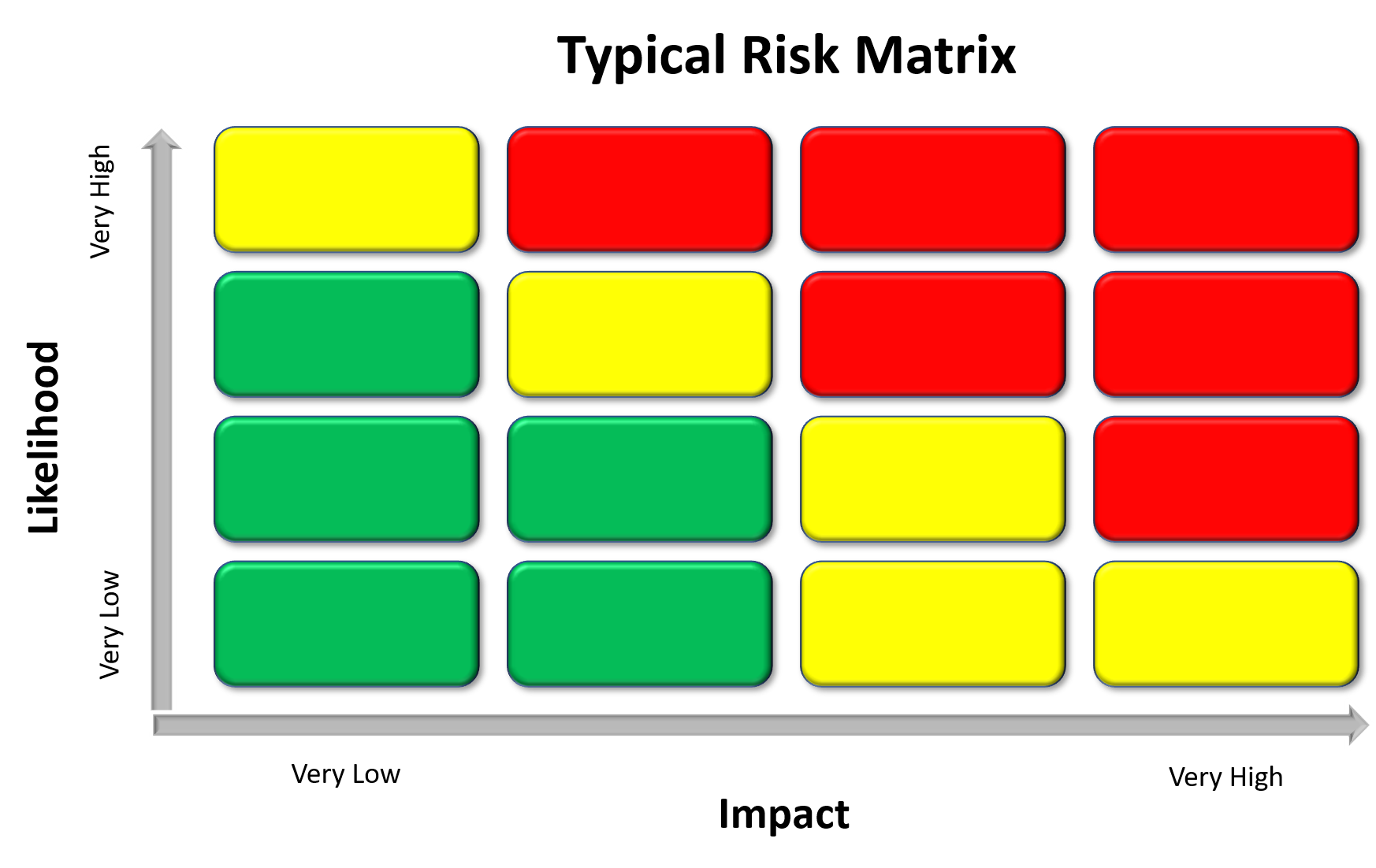
    Most readers will be familiar with the above linear Risk Matrix Model.  This graphical representation of risk exposure is useful but strict adherence to it can lead to a false sense of security.

    Systemic Risk Management

    The real world is very complex with many moving parts.  The potential interaction of processes, events and other challenges can lead to disaster.  It is often the case that the combination of a number of seemingly unrelated and in and of themselves potentially minor events can lead to catastrophe.

    A systemic approach to risk exposure is appropriate.  Field operations usually involves several to many somewhat disparate processes and individuals.

    Typically, the operator will have individuals in the field as well as the office working together.  Contractors and sub-contractors are similarly constructed.  The number of interactions can grow exponentially in a large project or program.

    Therefore, it is important to ‘see’ risk as a dynamic interacting model.  For example, the following quotation is a straightforward presentation of the actual risk field operators face.

    “Planning for the abandonment of Macondo was extremely complex.  The fundamental source of that complexity was a phenomenon well known to systems engineers: the number of potential pairwise interactions among a set of N elements grows as N times N-1, divided by 2.  That means that if there are two elements in the set, there is one potential interaction; if there are five elements, there are ten potential interactions; ten elements and there are forty-five; and so forth.  If the interactions are more complex, such as when more that two things combine, the number is larger.  Every potential interaction does not usually become an actual one, but adding the elements to a set means that complexity grows much more rapidly than ordinary intuition would expect.”

    The authors’ note that NOT all combinations can happen, but the possibility of several is likely.  Many decision makers do not expect exposures as great as they likely are in a complex environment.

    Interactive Model

    So how great is your risk?  The following calculator will give you a perspective on your organization’s exposure.  It is straightforward and easy to use.

    You are only required to input two variables:

    n = the number of elements

    m = elements from n in certain order, it is arrangement

    Taken from the Macondo model above, if n=10 and m=2, the number of combinations of m from n equals 45.


    [planetcalc cid=”977″ language=”en” code=”” label=”PLANETCALC, Combinatorics. Combinations, arrangements and permutations” colors=”#263238,#435863,#090c0d,#fa7014,#fb9b5a,#c25004″ v=”3275″]

    Addition data the calculator provides:

    Each ordered set of n is a permutation

    Generally, the number of combinations of m from n with repetitions is not useful for our purposes other than the recognition that repetition is possible.

    This calculator does not indicate where risk lies.  As the authors of Deepwater Horizon: A Systems Analysis of the Macondo Disaster suggest, it helps decision makers better understand the nature of their complex environment.

    Final Thoughts

    Simple risk models may have their place.  They are useful for presentation purposes.  However, they are insufficient when assessing the exposure of today’s complex operational situations.

    High Reliability Management requires that decision makers NOT simplify the complex.  Understanding the level of exposure using systemic risk management techniques can help clarify organizational threats.

    Are Your Organization’s Risk Management Techniques Robust Enough?

    For more information on Risk Mitigation check out our Operational Excellence Platform.

      Boebert, Earl and Blossom, James M. (2016). Deepwater Horizon: A Systems Analysis of the Macondo Disaster. Cambridge, MA: Harvard University Press. pp. 65-66.

    Appendix–The Math

    For those interested, this is the math for the calculator. It is taken directly from the Planetcalc website.

    So, assume we have a set of n elements.

    Each ordered set of n is called permutation.

    For example, we have set of three elements – А, В, and С.
    Example of ordered set (one permutation) is СВА.
    Number of permutations from n is

    P_n = n!

    Example: For set of А, В, С number of permutations is 3! = 6. Permutations: АВС, АСВ, ВАС, ВСА, САВ, СВА

    If we choose m elements from n in certain order, it is arrangement.

    For example, arrangement of 2 from 3 is АВ, and ВА is the other arrangement. Number of arrangements of m from n is

    A_{n}^m=frac{n!}{(n-m)!}

    Example: For set of А, В, С number of arrangements of 2 from 3 is 3!/1! = 6.
    Arrangements: АВ, ВА, АС, СА, ВС, СВ

    If we choose m elements from n without any order, it is combination.

    For example combination of 2 from 3 is АВ. Number of combinations of m from n is

    C_{n}^m=frac{n!}{m!(n-m)!}

    Example: For set of А, В, С number of combinations of 2 from 3 is 3!/(2!*1!) = 3.
    Combinations: АВ, АС, СВ

    Here is the dependency between permutations, combinations and arrangements

    C_{n}^m=frac{A_{n}^m}{P_m}
    Note Pm – number of permutations from m
  • Decision Making in the Digitalization Age: Who Decides?

    Decision Making in the Digitalization Age: Who Decides?

    “Ergonomics (or Human Factors) is the scientific discipline concerned with the understanding of interactions among humans and other elements of a system, and the profession that applies theory, principles, data and methods to design to optimize human well-being and overall system performance.”

    According to Gartner, “Digitalization is the use of digital technologies to change a business model and provide new revenue and value-producing opportunities; it is the process of moving to a digital business.”

    The concept of the “Human—Machine Interface” is well established for Industrial Control Systems (ICS) and is the way the human being directs the machine.  One wonders; however, if in the age of the Industrial Internet of Things (IIoT) whether this linear relationship is still true?

    If the Behaviors of quasi-independent systems are different than that of an ICS, the R B C model suggests that in these new Conditions, the Relationships between the Humans and these new Machines (digital business) will be different as well.  If this hypothesis is true, what are the implications going forward?


    We routinely let machines make life and death decisions.  Common examples include, airliner autopilots, automobile cruise control, and more recently the forthcoming self-driving cars.  Moreover, medical procedures are increasingly automated.  Boundless other instances exist as well.

    When it is appropriate for the human to intercede in automated decision-making processes?  What happens in a business setting if the human is wrong?

    High Reliability Management

    Management is evolutionary, not revolutionary.  Each generation and business model builds on thousands of years of human experience.

    The current High Reliability Management (HRM) model seems to address these emerging decision problems well.  The model consists of five traits:

    • Sensitive to operations
    • Reluctant to accept “simple” explanations for problems
    • Preoccupation with failure
    • Defer to expertise
    • Are resilient

    Applying these traits at the operational level allows the human to focus on the overall set of processes while allowing the machine to make its appropriate decisions.  With supervisory expertise coupled with an understanding that failure happens, policy can be set that enables the human to intervene as necessary without career repercussions.

    Moreover, IIoT is complex by nature and largely focuses on operational processes.  Implicit is the need to respond quickly to events, i.e., resilience.

    At the dawn of digitalization, management is already equipped with the tools to manage the largely automated enterprise.  How these tools are deployed is the difference from adding shareholder value vs destroying it.

    Do Intelligent Machines Have a Culture(s)?

    Hollywood has long presented cyborgs and other robotics as human like.  While we may be some years from truly independents machines, they do exhibit certain behaviors based on a given set of conditions.  This generates a relationship with human administrators.

    So, if organizational culture is the ‘way we do things,’ then one can surmise machines do have a culture (somewhat dependent on the human programmers).  If this hypothesis is supported, then the era of digitalization must add one more culture to its multi-cultural engagement processes.

    What is your Firm’s Decision Model in the Age of Digitalization?

    For more information on Cross Cultural Engagement, check out our Cross Cultural Serious Game


      https://en.wikipedia.org/wiki/Human_factors_and_ergonomics

      https://www.gartner.com/it-glossary/digitalization/

      Shemwell, Scott M. (1993). Management Theory—Evolution Not Revolution, Proceedings of the 11th Annual Conference of the Association of Management, 11 (2), pp. 74-78.

  • Fleeting Success: In Pursuit of Sustainability

    Fleeting Success: In Pursuit of Sustainability

    Winston Churchill is credited with saying, “Success is not final, failure is not fatal: it is the courage to continue that counts.”  The late Prime Minister nailed it; once again!

    Our journey through life, including our career is a marathon not a sprint.  While we celebrate success, often at happy hour or a party, we recognize it is only a moment.

    Early in this writer’s career, a multi-million-dollar deal closed after more than a year of effort.  A celebration ensued.  The next day the sales manager, “Asked what was next?”

    Attain and Sustain

    Organizational initiatives seem to procreate.  In some ways like the Tribbles of the original Star Trek series.  Cute furry things, the Tribbles multiple at such a rate as to almost consume the Enterprise.  Only the transporter beam saves the crew.

    Like the rah-rah of New Year’s Resolutions, the question is not will I go to the gym in January, but will I still set foot on the treadmill in June or even March.  The road to you know where is paved with good intentions.  It is the sustained energy of the execution that assures more successes than failures—and that failures are teachable moments.

    Culture is one of the current buzzwords, yet Cultural Transformation is the key to sustainability.  Courage requires the organization to pick itself up, so to speak and continue the journey to a sustained high level of Operational Excellence.

    Easy to Say

    According to Forbes, in 2018 “enterprises are expected to invest $1.3 trillion (USD) in digital transformation initiatives to apply digital capabilities to improve efficiencies, increase customer value and create new monetization opportunities.”  The article goes on to posit, that almost $900 billion of that spend will be wasted as goals are not attained.

    Why are these projects always seemed doomed to fail?  A quick Google search identifies a large body of knowledge over the years documenting these types of failure.  So, the beat goes on.

    Hard to Do

    There is also a body of work documenting the “should do’s” of organizational transformation.  In fact, this author has contributed several articles and books on this subject.  Most notably, Implementing a Culture of Safety: A Roadmap for Performance Based Compliance.

    A Missing Piece

    There is a lot of talk about Operational Excellence, Digitalization, High Reliability Organizations, Human Factors, Safety Culture et al.  As with the Forbes data, many are suffering the same fate.  No wonder senior management is skeptical of new spend for more ‘Tribble-itiatives.’

    For example, when a critical infrastructure sector discusses the transformation to a Safety Culture, the term is often expressed as singular, i.e., there is one industry safety culture.  However, all firms have their own ecosystems consisting of multiple and sometimes disparate entities.

    They have developed a culture that is a source of pride, competitive advantage, etc.  Their culture differentiates each organization from their peer group.

    The following figure presents the actual nature of a firm’s Safety Culture.  The reality is that a large organization’s “culture” is a combination of multiple cultural dimensions.  It is this ‘nature of culture’ that must be better understood if a transition process is to be successful and sustained.

    Readers should note that the multi-dimension structure is continuously changing as business, technology, and regulatory environments impact on the Relationships, Behaviors, and Conditions of the situation.  This dynamic requires continual managerial energy and training to sustain the change desired.

    Cross Cultural Engagement

    It would seem to be a daunting if not impossible task to effectively and efficiently train a large work force including relevant third-party suppliers on an ongoing basis.  Of course, the cost would be prohibited as well.

    Not so fast, e-learning serious games are now available to support the training requirements necessary to “sustain” the transformation.  Moreover, specific scenarios can quickly be developed to meet specific organizational requirements.

    The games are developed using Game Theory and Human Behavioral theories.  They simulate a real-world environment and have been shown to give great results over decades.  With Cloud technology, these training tools are now inexpensive and readily available to all.

    Why have your Organization’s Business Transformation Initiatives Failed?

    Check out our Cross Cultural Serious Game


      https://en.wikipedia.org/wiki/The_Trouble_with_Tribbles

      https://www.forbes.com/sites/forbestechcouncil/2018/03/13/why-digital-transformations-fail-closing-the-900-billion-hole-in-enterprise-strategy/#1f5923507b8b

      https://www.xlibris.com/Bookstore/BookDetail.aspx?BookId=SKU-0143303003

      Shemwell, Scott M. (2015, November 28). Comments and Thoughts Regarding the IAEA Technical Meeting on Developing Improvement Programmes for Safety Culture November 2-4, 2015. Vienna, Austria.

  • Three Years—Ten Months: How did they do it?

    Three Years—Ten Months: How did they do it?

    The United States officially entered World War II on December 8, 1941.  The war in the Pacific formally ended on September 2, 1945.

    A recent documentary on one of the history channels chronicled the path the United States took from a nation with an underdeveloped military to global dominance over this period.  What struck this author was the technological distance covered.  Not just marshaling the military and civilian workforce, but how heavy industry, including maritime (ships), aircraft, and weapons advanced so quickly.

    Some might say that this period was unique in human history with a strong focus on the survival of the nation.  No doubt this line of thinking persisted at the time, but perhaps something else was driving this behavior.

    Crisis Management is appropriate when nations, industrial sectors, organizations and even individuals are in times of stress.  By some accounts, the managerial prowess of this period stems from the knowledge of industrial manufacturing and logistical processes. 

    While the ‘War Agencies of the Executive Branch of the Federal Government’ played important roles in this wartime effort, it was not this alone that caused a juggernaut to appear.  The size of the United States, “prewar technological industrial base” and “large population” were also contributing factors.

    Large scale hostilities brings a spotlight that is not normally held during peace time.  The fight or flight instincts of all humans help bring focus in times of trial.  However, organization and management are important for societal success for either option.

    Attaining and sustaining Critical Mass in those Critical Success Factors (CSFs) were key to enabling the rapid ascent to industrial might.  Has anything changed?

    Parallels to Today

    A recent article, The Oils Shock That Never Was, reflected on the advancements the upstream oil and gas sector made during the recent downturn.  The piece makes the case that while most prognosticators predicted so-called doom and gloom often associated with downturns, the opposite seems to have happened, particularly in the shale space.

    In a previous blog, we put forth the rationale that Operational Excellence is the key to strong financial performance.  The Oil Shock article documents the transformation of the overall industry Cost Structure.  Operators are also focusing on sectors where profits are possible at current commodity price points.

    Moreover, firms are capitalizing on existing infrastructures that are supported by new technologies.  This sounds familiar to the behaviors of economic actors almost eighty years ago!

    However, challenges remain for service sector providers.  Could these firms utilize World War II business models employed by shipbuilders in the 1940s?

    Does Your Organization have Critical Mass for its CSFs?

    For more information:


      https://www.files.ethz.ch/isn/23588/mcnair50.pdf

      https://www.rigzone.com/news/the_oil_shock_that_never_was-30-jan-2019-158034-article/?utm_campaign=WEEKLY_2019_02_01&utm_source=GLOBAL_ENG&utm_medium=EM_NW_F1

      https://therrinstitute.com/beat-the-market-can-operational-excellence-increase-eps/

  • Beat the Market: Can Operational Excellence Increase EPS?

    Beat the Market: Can Operational Excellence Increase EPS?

    In a recent Houston Chronicle article, its author puts forth the premise that while oil and gas companies should do well in the stock market this year, don’t expect the energy services sector to fare as well.  As those who are either in the sector or track it (stock analysts) know all to well that when the price of oil dips, so do the Returns of those companies that provide equipment, labor and other services to the E&P sector.

    The crude oil commodity price has always been cyclical.  Often Boom—Bust, this leads to the hiring and firing of tens of thousands of employees and contractors.

    As many as 750,000 in the 1980s were fired (not to mention those businesses that provided products/services to these individuals and companies).  A lousy career choice that may limit new entrants who will not be guaranteed a salary during a short-term “shut down.”

    For years, this pundit has held the belief that due to technology advancements in both engineered products/services and information management that a return to the good ole days of $100 oil is not likely.  Economic actors in the sector must continue to adopt new business models and processes, not just to remain competitive but to stay in business.

    For example, Weatherford International, founded in the 1940s is endangered of being delisted by the New York Stock Exchange.  Baker Hughes continues to struggle as General Electric has announced its divestiture.

    We remain committed to the belief that oil is probably well within a trading range that will not provide price relief to the service sector.  That said, how can energy service survivors return shareholders reasonable value?

    The traditional business model of layoffs and equipment stacking is well underway.  Short term Stop the Bleeding which makes one wonder why this sector added 10,000 in just the last two years during a ‘weak’ recovery.

    The Future is Now

    The concept of the so-called digital oilfield has been around for decades.  This author was first formally involved with construct in the early 1990s when it was titled the Digital Oilfield of the Future.  Hasn’t the future arrived?

    In 2004 we released an industry supported research project, Roadmap to Enterprise Optimization: A Guide to the Impact of Information Driven Field Operations on the Petroleum Corporation.  Other articles, white papers, blogs and workshops continue to date.

    In the recent Houston Chronicle article, one interviewee believes that the energy service sector needs to Collaborate and Digitalize if they are to generate higher Earnings per Share. 

    This leads one to question, why after all these years is the disconnect the same as two decades ago?  We can no longer blame the Baby Boom generation as the brake on digitalization.  The Boomers have largely left the sector building.  Moreover, we can no longer blame the cost and maturity of information technology.

    So, if the blame game is over how can the sector attain and sustain these laudable process goals?  One can make a case that business/technology models and their value propositions were either fragmented or not understood by management.

    Having attended countless conferences, seminars, et al. over the years there does tend to be a narrow focus on each business need.  For example, downhole, big data, safety, decommissioning, digital oilfield, offshore, drones, onshore and so the list goes.  All vying for the same CAPEX.

    Those days may be over.  The Operational Excellence construct directly addresses all the field driven processes and technologies necessary to assure profitable performance.

    As with other initiatives, what is needed is an actionable methodology with a well understood value proposition.  Today, even smaller energy services companies can implement Operational Excellence.  A solution is available!

    Operational Excellence is the key to higher Earnings per Share and greater investor interest in the firm.  This is true for both public companies as well as private and their banking/investor relationships.

    What is Your Organizations Excuse for Not becoming Operationally Excellent?

    For more information about how to solve the weak Earnings per Share problem, check out our new Operational Excellence Platform.


      https://www.houstonchronicle.com/business/energy/article/Several-major-changes-on-the-horizon-for-troubled-13556827.php

      https://therrinstitute.com/wp-content/uploads/2019/01/Dr-Scott-M-Shemwell-Publications-and-Interviews-January-2019.pdf

  • Bull or Bear: Is there gold in them there markets?

    Bull or Bear: Is there gold in them there markets?

    Are we on the verge of another California gold rush, boom market or depression?  No one knows.  What is certain; risk mitigation must be central to any business model.

    This year may be especially challenging for the oil industry.  Recently, conventional wisdom is downgrading average crude oil prices for 2019.  Reasons include a plentiful supply and the other usual suspects.

    This pundit tends to agree with a trading WTL trading range averaging in the mid $50s/bbl.  There is likely more downward pressure than upward.  If true, hopes for top/bottom line growth may not materialize.

    The sector can continue to experience market difficulties, consolidations/spinoffs, reductions in force, etc.  However, this need not be the fate for many.

    For several years several studies have suggested that significant value is available if organizations in the oil sector implement and sustain a high level of Operational Excellence.  Typical opportunities include:

    The resulting impact on the Balance Sheet and Net Income Statement can be substantial.  The implication is that Earning per Share will also grow.

    The upstream sector has already undergone Austrian economist Joseph Schumpeter’s (1883-1950) Creative Destruction—some might refer to this process as disruption.  This is widely attributed to information technology and fraking.

    Therefore, any hopes that stronger crude prices will somehow ‘save’ the organization are misplaced.  The clear strategic hope lies with Operational Excellence.

    Since we know that ‘hope is not a strategy,’ only effective business processes will add shareholder value.  Time to roll up your operational sleeves and get to work.

    What is Your Organization’s Excuse for Not Implementing Operational Excellence?

  • Resolution: Celebrating a New Operational Start–One More Time

    Resolution: Celebrating a New Operational Start–One More Time

    It is hard to believe we are now 19 years into the century.  Seems like only yesterday we were worried whether the lights would stay on at Y2K.

    Each year many of us promise to do better at a list of things, some personal and some professional.  Some days or weeks later, some or all of our resolutions go unmet.

    For many heavy industry sector firms, January 1st is also the start of a new fiscal year.  New budgets will be released, and management will extol their workforce to meet new (possibly stretch) targets.

    If the equity markets are a barometer of things to come (leading indicator), then the Conditions organizations will find themselves in will most likely be volatile and some segments may even face significant challenges.

    For example, WTI crude oil closed on January 4th at US$ 47.96/bbl.  Some are bullish on this sector, with an expectation higher prices in the future.  History has shown this faith may not bear out.

    Regardless, organizational Behavior will need the flexibility to adjust in a process relevant time frame as conditions change.  The resulting Relationship with the firm’s ecosystem is a function of the behavior in the conditions or market circumstance.

    In other words, the R B C Framework is applicable in our everyday corporate life.  Why is this important?

    One way to view the global marketplace is one of continual change.  Often purveyors of Change Management/Organizational Transformation present this as a point in time.  Statements about continuous improvement are seemingly afterthoughts.

    We have developed an Operational Excellence Platform, as depicted in the following figure.  Please note that it is built upon the R B C Framework.

    Since the nature of Relationships across the organizational ecosystem will continuously evolve based on the marketplace, it follows that maintaining Operational Excellence depends on these tree factors.  Safe and profitable operations on strong, positive relationships.

    How well does your organization understand the R B C Framework for its ecosystem?

    Further Reading

    The author and others have published extensively on this subject.  The list of appropriate articles and papers is too extensive to list here.  However, readers are invited to peruse Dr. Shemwell’s extensive list of blogs and publications.

    See our Economic Value Proposition Matrix® (EVPM) for additional information and a free version to build your own EVPM.

    For further information Contact Us.

  • Mission Accomplished: Santa Completes Another Worldwide Transit—Incident Free!

    Mission Accomplished: Santa Completes Another Worldwide Transit—Incident Free!

    Every December 24th, this jolly ole elf embarks on one more global initiative.  We know this to be true because each year since 1955, the North American Aerospace Defense Command (NORAD and its predecessor the Continental Air Defense Command (CONAD) Operations Center in Colorado Springs, Colorado have tracked his operation–www.noradsanta.org.

    We are happy to report that as of this writing, Santa has returned to the North Pole with all his reindeer healthy having delivered almost 7.3 billion gifts.  Another 364 days of operational planning has paid off handsomely.

    So how does this bearded (non-millennial) man in a red suite and his supporting elf ecosystem routinely accomplish this logistical nightmare?  Could it be that Santa is the CEO of a High Reliability Organization (HRO)?

    Through this blog and others including our book Implementing a Culture of Safety: A Roadmap for Performance Based Compliance, the author has extensively written on the High Reliability Management (HRM).  Interested readers are invited to search these and other works on the subject.

    Briefly, an HRO focuses on operations from the top down, expects failure and puts in place resilient processes and procedures designed to recover quickly.  Moreover, Human Factors play a major role in Santa’s HRO operation.

    For example, human elves must care for the reindeer full time, not just the night of the flight.  The sled must meet certain regulatory and safety compliance requirements.  Packages must be wrapped, and hand delivered efficiently without damage.  Finally, route planning and coordination with various airspace control entities is critical to assure an incident free transit.

    Concluding Thoughts

    This ‘tongue and cheek’ mythical case study does serve a point.  Large, global, complex initiatives involving a number of constituent parties including customers require HRM.  Much is said about Operational Excellence (OE) these days and we make the case herein that without HRM, OE is also an unattainable myth.

    We are told on good authority that after a short rest, the Santa OE Ecosystem will start planning for the December 24, 2019 transit.  Children believe in Santa Claus and marvel at all he can accomplish in one night.  Perhaps those of us who are older can also learn new lessons from this jolly ole elf.

    How Do You Assure your Global Initiatives Remain Incident Free?

  • Millennials Take On Our Increasingly Complex World

    Millennials Take On Our Increasingly Complex World

    Originally published in 2013.

    On January 1st at 0348 hours a young engineer employed by a service company is trying to address a problem she has encountered with a compressor on a drilling rig in the Deepwater Gulf of Mexico.  She graduated from college three years ago and went to work for a large energy services company.  However, several months ago she changed jobs and is now on her first offshore hitch as team leader with her new company, a similar size global energy services company.

    She is a competent engineer but is uncertain what the company policy is regarding a piece of rotating equipment that while seemingly malfunctioning does not appear to jeopardize safety, the environment or production at the present time.  But she worries that the situation could get worse.

    A quick call to the “graveyard” shift at the company onshore Operations Center is not reassuring.  Staffed by those who are too junior to be on vacation during the holiday season, the engineer she talked with had only been with company three years and actually had less field experience than she did.  His supervisor was not encouraging either.  Should he call and wake experts at this early hour?

    Adding to the problem, the compressor’s data plate was mostly unreadable.  And of course, a famous Texas blue northern was blowing through.  High winds, rain and cold temperatures further impaired proper equipment identification, much less working conditions.

    Both the field engineer and the operations engineer are aware that their company signed a Bridging Document with their customer as part of the new Safety and Environmental Management System (SEMS) regulatory requirements and both had attended the appropriate training for this project.  Both are knowledgeable that the Stop Work Authority (SWA) gives them the right and even the obligation to dramatically intervene with operations if they feel it necessary.

    As a new mom, the field engineer is concerned that she might develop a reputation in the company as a “flaky” female if her next decision turned out to be a mistake.  The engineer at the operations center was receiving real time data feeds from the rotating equipment but he could not “feel” the vibrations like the on-site individual could and the equipment was still within tolerances.

    Horns of a Dilemma

    The engineers in our story are competent, qualified individuals doing a great job.  Early in their careers, they are the vanguard of field operations.  Millennials by label, they are technologically savvy and among the best and the brightest in their fields.

    Things never go “bump in the night” during daylight hours in perfect weather, hence the colloquial term.  Moreover, the personal stress of a new mother concerned about her reputation and opportunities for promotion resulting from just another day at the “office” should not be underestimated by those desk bound or later and more secure in their careers.

    The real world of field operations can be very unforgiving even when the results turn out OK.  All of the individuals in our story have significant “skin in this game.”

    It is fine to “empower” people in the team building sessions.  It is an entirely different story in the middle of the proverbial stormy night when one’s career and reputation are on the line.  Field personnel must believe they company will stand behind their decisions, right or maybe less so.

    Enablement

    These best and brightest can only be as good as their supporting infrastructure.  These individuals not only face engineering issues, any actions they take must be in accordance with company policy, the Bridging Document and various regulatory compliance requirements as well.  This is a lot to put on the plate of an engineering team.

    However, since their childhood these individuals have been online.  Our field engineer mother looks in on her infant son at day care from her smart phone from a hundred miles offshore.  The operations center engineer routinely Skype’s with his girlfriend, a physician, who is in east Africa serving with Doctors Without Borders.

    These individuals are at the top of their technological game.  However, they lack the field engineering experience of their more seasoned colleagues.  This represents a demographic challenge for organizations in the middle of the Big Crew Change.  How do these young people come up to speed—quickly?

    Organizations not only depend on the individuals depicted in our story for their bottom line, shareholder value is at risk if they cannot prevent the next major mega-disaster.  And what if they can prevent a minor incident?

    Loss time, loss production, loss anything has economic consequences.  Most organizations run on margins that are thinner than they would like.  Oil companies are included in this group.  More importantly, energy service provider margins can be even lower.  This business model pushes our engineers to lower costs, reduce downtime and in some cases push the envelope.

    Millennial Transformation

    Out engineers appear to have the deck stacked against them.  Normal Accident Theory (NAT) with its roots in the Three Mile Island nuclear power plant incident suggests that tightly coupled technologies with invariant sequences and limited slack such as Deepwater drilling operations will have accidents in the normal course of events.  In other words there is a certain inevitability of a major incident on their watch.  Maybe not during this rotation but a certain possibility during their careers.

    However, these Millennials have a safety arsenal their parents did not—a new business model that capitalizes on their technology prowess.  The emerging field of High Reliability Theory (HRT) “emphasizes are a strategic prioritization of safety, careful attention to design and procedures, a limited degree of trial-and-error learning, redundancy, decentralized decision-making, continuous training often through simulation, and strong cultures that create a broad vigilance for and responsiveness to potential accidents.”

    Arm field engineers and graveyard operations watch colleagues with HRT driven policy and associated tools and then get out of their way.  A strategic or systemic safety model with a holistic perspective of the life cycle the process coupled with truly empowered key personnel trained with the latest learning tools in a strong Culture of Safety offer a new perspective for a new workforce.

    Aircraft pilots routinely retain and upgrade their skills in sophisticated flight simulators.  “What If” scenarios, whereby the team can learn by trial and error environment where the worst result is a computer animated “do-over.”  Other industry sectors train using this well documented successful approach.

    In a true Culture of Safety a mom would not worry about her job or career if she erred on the side of safe operations.  She would not be labeled nor would her co-worker in the Operations Center hesitate to wake up the experts New Year’s Eve.

    Finally, if the maintenance history and all updated equipment manuals were available on a Smart Tablet with training videos and animation support, trepidation by those new to the company/process would lessen.  Organizational policy, its Operations Management System and bridging documentation built into the workflow will enable better decision making in the High Reliability Organization of the near future.

    A decade ago the digital oilfield was labeled the Digital Oilfield of the Future.  Integrated Operations is a common model today.  The Millennial’s World-of-the-Future will mirror the concepts of an HRO.

    Will she be working for you or your competitor?

    End Notes

    http://www.doctorswithoutborders.org/

    Weick, Karl E., Sutcliffe, Kathleen M. and Obstfeld, David. (2008). Organizing for High Reliability: Processes of Collective Mindfulness. In Arjen Boin (Ed.), Crisis Management Volume III. (pp. 31-66). Los Angeles: Sage.

    Ibid.

  • Command and Control: Is this the Way to Run the modern Railroad?

    Command and Control: Is this the Way to Run the modern Railroad?

    The managerial model, Command and Control (C&C) dates back to the dawn of humanity when tribal chieftains dictated the behavior of the group.  It survives to this day in many forms.  Typically, one thinks of military operations as the current manifestation of C&C in the western world.

    According to Wikipedia, by one definition found in The US Department of Defense (DOD) Dictionary of Military and Associated Terms, “command and control functions are performed through an arrangement of personnel, equipment, communications, facilities, and procedures employed by a commander in planning, directing, coordinating, and controlling forces and operations in the accomplishment of the mission.”  This definition has evolved from a more simplistic version found in the Cambridge Dictionary, ”situation in which managers tell employees everything that they should do, rather than allowing them to decide some things for themselves.”

    One suspects that most laypeople believe the latter definition to be to be the typical approach to C&C in their organizations.  In today’s complex (often global) organizational ecosystem, that version is outdated.

    The International Command and Control Institute, publication (circa 2005) , Understanding Command and Control develops this management construct in great detail.  As the following figure suggests, even a simple C&C structure such as a heating/AC system is driven by a set of KPIs.

    This is indicative of the digitalization of the system versus the analog controls many of us can recall from our youth.  Adding another layer, today’s ‘Smart’ thermostat operates within a well-defined governance schema such as the Internet of Things.

    Strong Bond Governance

    We first made the case for “Strong Bond Governance” in our September 17, 2013 Governing Energy blog, Strong vs. Weak?  In Critical Infrastructure sectors such as energy, medicine, etc. as defined by the US Department of Homeland Security we make the case for the construct of High Reliability Management (HRM).

    The Strong Bond Governance (SBG) paradigm enables HRM.  SBG demands Board of Directors and C Suite engagement in operations.

    Not directly but by putting in place a governance structure.  This has not always been the case with a number of catastrophic man-made disasters as the result.

    In some ways, C&C mimics HRM.  However, there are some significant differences.  HRM sets in place a structure designed to meet the test of adversities.

    • Preoccupation with Failure—a recognition that ‘failure is an option’ and the organization must respond quickly and effectively to mitigate exposure and recover. C&C does not directly address is concern.


    • Reluctance to Simplify—today’s organizational ecosystems are complex. Reducing operational decisions to the so-called Power Point three bullets, High, Likely, Low is completely unsatisfactory and potentially exposes the firm to business or technical process catastrophe.  Likewise, C&C models do not directly address this approach.


    • Operational Sensitivity—the field is where organizational action is, and senior management must have a focus on this critical component of the business. C&C also has a focus on operations, especially in the military sector.


    • Resiliency—things will go ‘bump in the night.’ Organizations must but in place the processes and expertise to rapidly respond to goblins that will be encountered.  C&C does not address this process.


    • Deference to Expertise—engage those who have the ‘know how’ to solve problems and that is mostly likely not the management team. This is substantially difference than the C&C model

    HRM allows management to look at computer dashboard and get a snapshot of most if not all aspects of the organization.  However, this does not mean that these individuals can manage from afar.  Those closed to and more knowledge about this issue must take the lead.

    Concluding Thoughts

    Watching the news, History Channel and/or various movies, one can see that even the military no longer uses simplistic C&C.  Small semi-autonomous teams take on the bad guys.  To be sure there is a Mission, Rules of Engagement and other governance controls in place.

    This provides local commanders the latitude needed to accomplish the mission at a minimum of human (good guy/non-combatants) and other collateral damages.  Additionally, military aircraft employ ‘High Reliability Management’ techniques where the expertise of the entire crew is used rather than the Captain dictating operational performance.

    Asiana Flight 214 crashed attempting a landing at San Francisco in July 2013.  One causal component was deemed to be the C&C culture of the Korean pilots.  Cockpit Management might have saved this aircraft and the lives lost.

    Likewise, those organizations and their ecosystems in critical infrastructure sectors that use HRM enjoy safer and more productive track records than those that do not—better bottom line.  The October 2014 Ebola scare is an example where the public health sector employed HRM and limited the impact of a highly contagious deathly pathogen.

    There is a tendency when the stakes are high for management to take the ‘reigns.’  In other words, engage in micromanagement.  The usual results are often sub-optimal.  The ‘gut instinct’ towards simplistic C&C is a strong urge and this addiction must be put into remission.

    A well-established Strong Bond Governance, High Reliability Organization can weather any storm the markets or nature can throw at it.  However, this organization transformation must precede the advent of major challenges!

    Traditional C&C is not an OE Imperative


  • Selling Your Economic Value Proposition to the C Suite: Translating Technology to the Language of Business

    Selling Your Economic Value Proposition to the C Suite: Translating Technology to the Language of Business

    The challenge of building a Business Case for CAPEX investments with high intangible content, i.e., IoT, professional services and operational excellence, remains difficult.  Many also argue that disruptive new business models are making the old ways irrelevant.

    Hence, we simply must make the investment to remain competitive.  After all, everyone is doing it.  A matter of faith!  The returns are huge (just look at this white paper).

    To some extent technological based business model disruption has always been true, certainly throughout the industrial and cyber revolutions of the last 200 years or so.  However, one of the major issues with technological change is the nature of the cultural differences between the technologists and those who write the checks.

    We have previously described organizational culture as partly a function of an Interdisciplinary Common Vocabulary (ICV).  One can look at the gap between advocates of new technologies and/or business models and the “C” suite as the lack of shared ICV.  This gap may become egregious during economic downturns when financial concerns overtake strategy.

    Making Your Case

    As a junior sales representative and later ‘pitching’ CAPEX projects to management, I often presented the ‘Feature—Benefit’ of my suite of products and services.  My success rate was on par with my peers, but the case could be made that I was no better than average.  We all had weak value propositions.

    While I did not know it at the time, my sales ‘ah ha’ moment happened when the department of head for an Engineering, Procurement and Construction (EPIC) firm with a refinery rebuild project asked me if he would get promoted if he bought from me.  Dah, what did that have to do with anything I wondered.  I have great features and benefits.

    At least as good as my multiple competitors.  Moreover, I could lower my price and give him great value.

    Once we understood his CSFs, we won a multimillion dollar (high margin) deal.  His problem was not the technology.  All competitive specs and price points were tightly grouped.  Almost any reputable vendor would do.

    His key problem were project milestones!  He did not want a pile of products to be assembled.  He need solutions to meet deadlines and we could deliver against that critical path.  That was the value proposition he needed.  By the way, he got promoted!

    I have seen this phenomenon often, including earlier this month.  Sales people and internal proponents of new ideas often focus on the new hot stuff, for which many competitors vie.  The current crazes include IoT, Blockchain, Operational Excellence to name a few.

    How many suppliers of these technologies and methods are there and how are they differentiated?  Lots and poorly would be my bet and experience.

    C Suite Value

    The stereotypical ‘hard nose’ businessman or businesswoman is alive and well.  He and she live in the C suite and boardroom.  Preaching features and benefits, PPT bullet points of value or use case with glossary, poorly articulated and often unbelievable claims will make for a short meeting.

    Proponents of big, disruptive or simply expensive ideas can have their ‘ah ha’ moment too.  Who is the audience and what are their drivers that can you facilitate?  In a previous blog this author took umbrage with sales cold calls who wanted to meet, waste my time and “learn about my company.”

    In other words what I hear is, I don’t have time to do my homework before I meet the economic buyer.  Another deal closing strategy!  Not.

    In an invited Guest Editorial for the Professional Petroleum Data Management Association (PPDM) online magazine, Foundations we had the privilege to post a short article.  In How to Make The Case To the C-Suite: Selling Large Scale Data Management Project to the C Suite, we present a short overview of this process.  The magazine (Vol 5, Issue 2) is free; all one has to do is sign up as a Guest.

    The article tells the story of a hypothetical Chief Data Scientist as she prepares for a presentation to the Chief Financial Officer.  Readers will see that for some concerns management has, she has a lot of homework and preparation to do.  One would expect that much of this work is outside her comfort zone, but necessary.

    Driving Success

    In our hypothetical case, she has the prep work in addition to her so-called ‘day job,’ a problem most have.  Additionally, she must align with their ICV and move away from ‘data speak.’

    Since 2004, we have used our Economic Value Proposition Matrix ® (EVPM) to help guide this process for a wide range of large projects (including security).  A free version is available.  Your invited to check it out and contact us if you have any questions.

    When the economic cycle is at a low point, it is hard to sell new projects.  When the cycle is active, there are competing projects.  Throwing money at technology has failed time and time again and ruined many careers (the antithetical of ‘getting promoted’).  Building a solid business case in the ICV of senior executives is a step towards accelerating one’s career, closing a deal or enjoying a project rather than fighting every step.

    One final point, when one reads statements such as, “Our software will save you 50%” they are not true on their face and management never believes them.  So never make those claims no matter the authority of their source.  Sometimes the value can be greater.  To find out the secret look at our webpage for the answer.

    Good Selling to the Top Dogs!

    Further Reading

    The author and others have published extensively on this subject.  The list of appropriate articles and papers is too extensive to list here.  However, readers are invited to peruse Dr. Shemwell’s extensive list of blogs and publications.

  • Are You In Distress?

    Are You In Distress?

    During a recent offshore sail from Florida to Texas the weather significantly deteriorated on this blogger and his boat mates. Our 45-foot ocean going sailboat was one in which (mostly) the same crew that has significant sea time together.

    That said, there were two days of very uncomfortable passage making. At one-point a nearby ship hailed us on the radio and inquired, “Are you in distress?” We responded, “no we were not” and thanked them for their concern. Both vessels continued their separate courses.

    At that moment, our vessel was undergoing a pounding by large waves and from the bridge of the ship, it probably did appear that our yacht was in distress and in possible need of assistance. However, our vessel was simply handling tough sea conditions.

    Experienced sailors know that anything is possible while at sea. Therefore, careful preparation is critical prior to any voyage. Simply put, the vessel must be sound, (able) seamen competent, and equipped as appropriate.

    The US Navy has identified six principles for shipboard operations, “formality, procedural compliance, level of knowledge, questioning attitude, forceful backup and integrity, focus on human performance and create the foundation for highly effective commands where errors that could lead to minor or catastrophic events are identified and stopped early. Used together, these six principles form the bedrock on which the Surface Force implements the three operating processes: operational risk management; plan, brief, execute, and debrief; and hazard reporting.”

    One could make the case that a pleasure vessel need not adhere to these six principles; however, this long time offshore sailor argues that they should as well. For example, there is always only on Master (Captain) of a vessel regardless of long time friendships. Appropriate expertise or Knowledge, Skills and Abilities (KSA) for all crew members is essential as well.

    Some may notice that the six principles and three operating processes are akin to those found in High Reliability Organizations (HROs). In other words, this short story holds lessons for all as well.

    Our vessel was engaged in a mission—transit from Florida to Texas. This mission was supported by a number of processes and associated tools, technologies and human capital to accomplish the overall goal.

    When adversity struck, the crew (organization) responded to events on the ground (water) to address the new situation in the spirit of prudent mariners. Is this not allegorical to business?

    How Can You Assure Your Organization Will Not Be in Distress When Adversity Strikes?

  • Are Organizational Governance Models Broken: Why Can’t Management Get a Handle on Things?

    Are Organizational Governance Models Broken: Why Can’t Management Get a Handle on Things?

    Over 15 years ago, organizations such as Enron, Worldcom, Tysons, and others failed after massive managerial maleficence and even criminality.  Enron’s auditor, Arthur Andersen folded as well.

    The result of this carnage was the imprisonment of many, the death (apparent heart attack) of the disgraced former CEO of Enron, suicides, massive shareholder value destruction and the Sarbanes Oxley Act of 2002.  SOX, as the act was commonly called was supposed to fix fractures in organizational transparency!

    Later, Bernie Madoff, Robert Allen Sanford and others (Ponzi schemes) stole billions from trusting clients.  Where was the oversight for crimes of these magnitudes?

    Almost a decade ago, three major disasters causes incalculable death and destruction:

    • BP Deepwater Horizon aka Macondo—commencing April 20, 2010
    • San Bruno Pipeline Explosion—commencing September 9, 2010
    • Fukushima Daiichi Nuclear Incident—commencing March 11, 2011

    According to one 2018 report, “Close to half (46%) of senior oil and gas professionals believe that there has been under investment in inspection and maintenance of infrastructure and equipment in recent years.”  Has anything been learned about the risks posed by Critical Infrastructure to the Bottom Line and societal reputations?  What about continued loss of human life?

    Finally, our US political class tells us they cannot ‘securely’ run an election and that outside interference somehow tainted or even changed the 2016 national election.  Five plus months before the next national election, what has changed?

    Nuisance to Menacing

    Now a series of high profile Cyberbreaches (seemingly exponentially) continue as do management’s apparent attempts to hide the damage from affected customers and shareholders.  Is this lack of transparency a SOX violation?

    More regulations are not the answer.  Criminals and others with malice don’t pay much attention to laws.  They never have, whether mugging you in the park or stealing your identity online.

    Purportedly, the first ‘hack’ took place in 1903 when a demonstration of the Morse Code was disrupted and insulting messages were sent through the theater projector. Perhaps a mere nuisance then, today cyber malcontents desire vast fortunes, political intrigue and even social instability.

    In our November/December, 2017 Petroleum Africa article, A Governance Model for the Era of Digitalization: Achieving Operational Excellence Using Disruptive Data Management Techniques, we mentioned that at a conference in late 2017, an investment banker when responding to a discussion about the use of IoT as part of the digital oilfield (now how we run the business) “suggested words to the effect that if the enterprise is driven by these technologies then it is now an agenda item for the Board of Directors.”  This is consistent with this author’s previous statements to this effect.

    What’s Going On?

    In his 1984 book, Normal Accidents: Living with High-Risk Technologies, Charles Perrow put forth the theorem that in our complex world, “It takes just the right combination of circumstances to produce a catastrophe, just as it takes the right combination of inevitable errors to produce an accident.”

    We have written extensively about Governance and Operational Excellence, including methodologies for developing and sustaining both.  In 2014, we put forth the construct of Strong Bond Governance as well as ways Critical Infrastructure sectors can become High Reliability Organizations.

    Finally, we have developed and implemented a Best Practices Model for Operational Excellence that incorporates modern governance that address issues discussed herein.

    Normal Incident Theory indicates, that in any complex system accidents will happen.  This theory has been debunked just like Keynesian Economics.  Yet practitioners of both continue unswayed by empirical data.

    It appears that corporate governance models have fallen into the same trap, making assumptions that business and technology models are limited and reactive.  This appears to be a short-sighted approach with ample empirical evidence that these models are no longer relevant.

    Threats to shareholder value and even the safety and economic security of entire populations that depend on Critical Infrastructures are increasing for a variety of reasons.  Organizational Governance models must keep pace.  Clearly, this is now part of the fiduciary responsibility of Board members as well as the entire “C” suite of executives.

    Further Reading

    The author and others have published extensively on this subject.  The list of appropriate articles and papers is too extensive to list here.  However, readers are invited to peruse Dr. Shemwell’s extensive list of blogs and publications.  For more information on this and other subjects, please contact us.

  • Organizational Predators: Jackals, Hyenas, and Wolves in Managerial Clothing

    Organizational Predators: Jackals, Hyenas, and Wolves in Managerial Clothing

    Prologue

    In the author’s August 2004 edition of the then, Executive Briefing Newsletter (early online delivery) we addressed the impact on the firm of managerial misbehavior.  This article was one of a list of challenges put forth to that generation of management.

    Sadly, recent events have compelled us all to revisit this issue, although for some it is the first time.  Upon re-reading the document, we felt that it might add value to current management and those that work for them to release it again in the blog format.

    The text presented is original and only minor typographical changes have been made.  We firmly believe that historical documents need to be held to their original meaning and we invite the reader to decide its value in today’s context.

    One note, readers may feel passion seeping through.  As this author recalls, at the time one of the jackals had harassed someone close to me.

    Point of the piece, this behavior was inappropriate then and it remain inappropriate today for this kind of nonsense to exist in the workplace.  Shareholder value is destroyed by this stupid behavior.

    One would guess that over the next months and years shareholder value will be destroyed in court settlements because of the recent behaviors of Organizational Predators: Jackals, Hyenas, and Wolves in Managerial Clothing.  Won’t put the names here—Google it!

    The original text is available in Essays on Business and Information II: Maximizing Organizational Performance, pp. 85-87 of the printed edition.  Readers will find it in the Ethics Section.

    Reprint

    Originally published in August 2004

    I think I did something for the worst possible reason—just because I could. I think that’s the most, just about the most morally indefensible reason that anybody could have for doing anything.”

    – Bill Clinton

    Thank you, Mister President.  You have empowered another generation of Omega males in managerial positions who denigrate women “just because they could.”  In Bill’s case, Hillary emasculated him and moved on to become a U.S. Senator.  This option is not always available to others.

    Organizational leaders are role models for guidance in how managers relate to our female subordinates.  Dominant men (and sometimes women) are well positioned to do things just because they could.  If the organizational culture condones the just because they could model, in reality this conduct is what management offers shareholders.  As an investor, I am ready to sign up for that business model. Yah, Right—Perhaps NOT!

    Over the past three years, this newsletter has sought to put forth important and indeed even critical issues to the forefront of discussions.  I will tell readers up front, that this edition of the newsletter is different.  It is personal, and it comes about as the result of this author’s direct knowledge about how women in his professional and personal life are being treated.

    Therefore, I do not claim objectivity but seek to raise the thinking of those in similar situations as well and even the culprits themselves (and their spouses, usually wives).  In this writer’s humble opinion, this issue is not transit, but endemic.  In the list of those things that will not go away, this one is high.

    Corporate boards and CEOs should take note, as not only are there EEOC (Equal Employment Opportunity Commission) issues at stake (usually addressed by Human Resources and attorneys as background noise) but also Sarbanes Oxley exposure.  Sarbanes Oxley is usually couched along the lines of information flow to the CEO and Board, however, there is another dimension.

    The quality of management and their readiness to “hear” and incorporate the thinking of the best of the best, regardless of sex.  Just think if the CEO of Enron had actually listened to Ms. Sharon Watkins when she raised concerns instead of just blowing her off—he might still be enjoying his Aspen resort.

    You can outsource non-core activities, but you cannot outsource the corporate identity. How firm’s truly value every employee is who they are.  United States criminal law has a long history of prosecuting wife and child beating felons.  The principle is well established.

    Oh, the Humanity

    Men, more often than women, abuse the other sex and their offspring.  Predators prey upon the weak and the young, usually males dominating or destroying females and their young.  We see this in the wild animal kingdom and we see these predators on the Internet.

    We also find them inside corporate walls.  Boards and C levels often hide their heads in the sand and take a “don’t ask don’t tell” approach.  Guess what guys (and it usually is the ole boys club); the train has left the station without you.

    Fact is this train left a millennium or more ago.  Mothers are revered as the fount of life.  Regardless of ethnicity or religion, Mothers are central.

    That is until we get to corporate America or any other nation for that matter.  Once a woman choses or is forced to work, Mother’s Day goes out the window.

    Now Alpha (and those who think we are but have not yet been culled) males think we own these feminine prizes.  Guess what, you out of shape, overweight pathetic excuses for males, you do not.

    Do these women report to you and are their bonuses, promotions etc. depend on your stated and written opinion?  The answer is NO!

    Take that and shove it up your behind you legacies of the20th century.  There is a cataclysmic shift underway and while you may enjoy the short-term high of intimidating and even firing these women, Darwin rules.

    You are dead meat my friend, and probably at an age when you will least be able to afford it.  Mom is never irrelevant!

    Throughout the western United States, one can often see the skins of coyotes hanging on barbwire fences.  The clear message to other predators is this could be your fate as well.

    Similar symbolic gestures are necessary in publicly traded corporations.  Who gives some mid-level manager the right to denigrate hard working employees just as they put themselves out as bastions of righteousness?

    If these people were so smart, they would be top executives, and if they were the real comers, they think they are (with top level sponsors) petty crap would not be their forte.  Unless the organizational culture rewards the humiliation of women as part of the reward system.

    Truth is, most will never amount to anything.  While they have some short-term power, the organization does not really care about their efforts.  Fundamentally, they know this and this fact eats at them.

    Their anger is projected on their direct reports, and often the females in their organization.  This is a safe bet for an abuser!

    Who would challenge him?  Senior management demand results that he delivers for a while and his female direct reports are put through the grinder.  Pretty good gig if you can get one, especially if you are a predator by nature.

    Final Thoughts

    It is far past the time for a superior to have the audacity to state that I took advantage because I could.  This is not just a civil liberty, human rights, woman’s right, or Constitutional Amendment right.

    Organizations depend on the synergy of their organizational knowledge.  Not necessarily without friction, a necessary catalectic creative agent, but beyond retribution, physical and mental intimidation, fear of job loss or demotion, as well as physical threat posited by someone often 100 pounds or larger than his target.

    Sarbanes Oxley, global stock exchanges as well as common decency demand that our mothers, wives, sisters, nieces, and girlfriends be heard.  The rallying of the “ole boy” network does not have a place in the 21st century organization.

    Firms that overlook or down play these issues expose themselves to major lawsuits and the possibility that shareholder value may be decreased by BILLIONS.  There is no credible support for predator losers.

    The usual predator is an overweight male between 30-50 who attained his position through vigorous internal politicking or as the result of a merger where this individual had a title and thus perceived expertise.  Often, these individual distains women all the while being a pornographic connoisseur.

    This manager is impaired when dealing with women.  When a strong, woman subordinate questions his decision, this personality often retreats to his dominate position over this person and seeks to dictate.  This type of manager may have unresolved issues with his mother.

    I do not know about you, but I will not invest my hard-earned money in firms that condone, and even promote jackals.  In earlier times, these individuals would rape and pillage women unless/until challenged by a true Alpha male.  Today, as then these cowards retreat rapidly, only to reappear when they think the coast is clear—always hiding in the organizational shadows.

    When Boards and top management condone this behavior, they denigrate investor confidence. Billion-dollar class action lawsuits are not the fantasies of writers, they routinely occur.  Why should an investor support the pathetic disgusting behavior of reprehensible psychotics who usually make less than $250K? Is this the risk-reward trade off expected?

    Throw the bums out of the executive suite, but perhaps more importantly throw these true Nazis out of middle management.  Sarbanes Oxley demands nothing less.

    Proposition: All men and women are created equal.  No pathogen has the right to spend my money furthering his limitations.  A real man would just resign.

    But then again, these individuals are not men. They are Jackals, Hyenas, and Wolves in Managerial Clothing.  They may even be thieves as they destroy shareholder value.

    What a return on $250,000! CEOs, beware, SOX looms large over organizational incompetence.

    Finally, as true indictment of this testosterone starved wimps they take one of two paths in their personal life.  They either physically and emotionally beat the women (and children) in their lives (wives, daughters, nieces, step-daughters, aunts, mothers, et al) sometimes resulting in the death of these females or they kowtow to these same people and take their frustrations out on organizational female underlings.

    Regardless, these people are cowards and bullies.  There is no place for them in publicly traded corporations and I for one do not care to fund their criminal activities.

    The first CEO that tolerates or accommodates this behavior is yet to be sent to jail.  No doubt, we will soon read about such an individual.

    Earth to Wall Street. Enough is enough.  This piece is not the rambling of a female in an activist organization.  It comes from the pen of a white male born in 1948.  Demographically not high on the feminist hit parade.

    That is the point. This is not just a social issue it is an economic one.

    The psychological rape of our wives, sisters, and daughters by low life managerial predators can no longer be tolerated.  Fire these losers and put mothers in charge.

    The power of motherhood is not overrated.  We all have a mother and celebrate her wisdom every May.  Capitalize on this hidden downtrodden resource, and remove the cowardly scum whose manly prowess is limited, except perhaps in their own twisted ego.

    I for one do not care to fund such dysfunctional behavior.  I for one do not care to put my capital at risk at the hands of wife beaters and other predators.

    Set the traps, eliminate these vermin, and hang their skins on the corporate barbwire fence.  Corporate returns will surely be better without their “help.”

    Let the mothers, sisters, nieces and wives loose and let’s see if greater returns do not soon appear.  I am betting my money on Oprah and Carly and not Ken, Jeff and the others heading to jail who condoned managerial malfeasance.

    Further Reading

    Most of the issues discussed in this newsletter are part of a larger dialogue.  Readers are invited to explore additional thinking.  There are many books about abuse that you may wish to investigate.