
Tag: behavior

  • Complicity or Write a Book?

    Complicity or Write a Book?

    I Need a Book Deal!


    With the change of the US federal administration, previous key individuals are now coming out and writing books regarding their former boss.  This all the while with plenty of video evidence where these individuals pontificated a position and even changed their position dramatically while in the employ and in seemingly in support of that administration’s policy.

    Now some of the very architects of the US response to the Coronavirus are claiming their innocence all the while blaming others for thousands of deaths.  The nerve.  If true, she is equally responsible and perhaps more since she is a medical doctor.  First do no harm.

    We all have a boss and most need a job; however, when does an individual’s moral compass come to play?  Senior officials who will be gainfully employed doing something else fail to come forward or even resign.  THEN they claim victimhood!  The LOVE of power is so intoxicating.

    Remember, ordinary Germans were widely condemned after World War II for much less personal involvement.

    Credibility?

    Many institutions lack any credulity today.  This is not news and is a widely held view.  Any wonder when so called responsible parties now claim they could have reduced deaths but failed to do so?

    Organizational maleficence often leads to criminal charges and many executives have gone to jail.  If many of the books written after every administration are true, should at least some authors be at least censured for the complicity they themselves are documenting?

    ESG

    We have addressed the issue of governance a number of times.  Most notably in 2011, as part of our Changing the Dialogue monographs, Asset/Equipment Integrity Governance: Operations–Enterprise Alignment (A Case for Board Oversight) addressed the role of operations including environmental and social issues as critical components of the role of organizations.

    As part of the Safety and Environmental Management System tenets, the right for individuals to express themselves without redress is sacrosanct.  Surely, this includes senior officials?  If they can’t or rather seek to write ‘tell all’ books later, governance models are at risk.

    The days of Yes Men (and Women) and Empty Suits are over.  Perhaps, organizations need to clean house.

    How Do You Know Y0ur Advisors are Being Honest with You?

    For More Information

    Please note, RRI does not endorse or advocate the links to any third-party materials.  They are provided for education and entertainment only.

    For more information on Cross Cultural Engagement, check out our Cross Cultural Serious Game

    We presented, Should Cross Cultural Serious Games Be Included in Your Diversity Program: Best Practices and Lessons Learned at the Online Conference, New Diversity Summit 2020 the week of September 14, 2020.  Check Out this timely event and contact the organizer for access to the presentations!!

    You can contact this author as well.

  • Post Covid-19 Operational Performance

    Post Covid-19 Operational Performance

    Not the So-Called New Normal


    The light at the end of the Covid-19 tunnel may not be the train many still believe.  Populations are being inoculated at very high rates.  Moreover, there is ample evidence in my metropolitan area that the general population no longer believes or adheres to the ‘advice of experts.’  This should surprise no one who understands the US long history of civil disobedience.

    We pundits forecasting the new normal following a traumatic social event always get it wrong and so we will again this time.  There is a simple reason for this–Human Behavioral Economics.  Another leg of the three legged stool is the Technology Readiness Level (TRL) and not all technologies are at the same level or even play well together.  Finally, Organizational Culture must be ready as well.  If these situational settings are not met, the crisis passes and we get back into the comfortable and familiar.

    Following the initial euphoria that we could work from home and not wear pants, many discovered this really was not for them.  Many children did not do as well in a stay at home educational setting and teachers were challenged as well.  Moreover, many tasks require personal engagement.

    Many are Called . . .

    As always winners and losers will emerge and it will take some time for that rank order to solidify.  While digital is important and we have supported that business model for decades, bits will not physically move the barrels.  Still will take heavy industrial technology and processes.

    Using information and other technologies to drive Operations Management Systems are the future.  Not necessarily driven by IT firms but those digital engineers steeped in both disciplines.

    If Organizations are to achieve successful Sustainability, they first need a High Reliability level of Agility and Resiliency.  The only get these attributes when they perform at a high level of Excellence.

    So as we arrive at another new normal, we need to recognize that not everything from the past was bad and not everything we see today is good.  Some processes will be sustained and coupled with newer one.  New Normals do not really destroy the past; we continue to evolve.

    Even innovation from Creative Destruction is not instantaneous.

    How will your organization take advantage of emerging opportunities?

    For More Information

    Please note, RRI does not endorse or advocate the links to any third-party materials.  They are provided for education and entertainment only.

    For more information on Cross Cultural Engagement, check out our Cross Cultural Serious Game

    We presented, Should Cross Cultural Serious Games Be Included in Your Diversity Program: Best Practices and Lessons Learned at the Online Conference, New Diversity Summit 2020 the week of September 14, 2020.  Check Out this timely event and contact the organizer for access to the presentations!!

    You can contact this author as well.

  • Open Sesame

    Open Sesame

    A Year of Leadership–Or Not!

    On March 2, 2021 the Governor of Texas announced its 100% reopening–effectively proclaiming an end of the Covid-19 crisis.  Needless to say in our hyper-partisan world, many widely decried the decision and even accused him or bringing physical death to the state population.

    Mississippi announced a similar rollback of virus driven constraints.  Likewise, Connecticut is rapidly easing similar restrictions.  These state join others with loose Covid-19 protocolsThis pundit expects this trend to gain speed quickly and worldwide.

    Meanwhile, the President of the United States accuses these decisions as being made by Neanderthals, while the Director of NIAID position has move from NO mask to wearing MUTIPLE masks.  The political divide regarding the path forward remains wide.

    Consent of the Governed

    “You can fool all the people some of the time, and some of the people all the time, but you cannot fool all the people all the time,” is attributed to Abraham Lincoln.  This oft quote is usually seen through a political lens.  More importantly, it is a position from a Leader!

    Driven by suspect data we were told that this virus had an Armageddon like quality.  At one point over 2 million Americans were projected to die and the hospital systems would be overwhelmed, perhaps irrevocably.  Hospital ships were mobilized and economies brought to their knees all to save lives.  Perhaps, even our own.

    To be clear, many did succumb and many lives were destroyed or at least changed forever.  We mourn those and recognize the serious of this pathogen.


    A few of my family and friends have been infected but fortunately with only minor symptoms and limited hospitalization.  In this we are very fortunate.

    Crises can happen at any time, hurricane, winter storms, hostilities are part of the human conditions.  How we respond it the difference between chaos and inconvenience.  Leadership determines the outcome!

    If you have lost someone to Covid-19, cancer, accident, fire (I lost two family members) or other tragedies, statistical arguments are meaningless as the probability is 100%.  However, for the overall population likelihood of recovering from the coronavirus has always been quite high.

    Many questions have been raised regarding the myriad of conflicting “authoritative” information and misinformation the public has endured for 12 months.  With no conclusive or definitive game plan put forth by authorities, we were left to fend for ourselves.

    A resident of the Houston metropolitan area, this writer has noted that traffic is almost back to normal.  This suggests that the governed no longer have faith in political or medical leadership demanding yet another year under their ‘knowledgeable’ thumb.

    Once that credibility is lost, game over for leaders pontificating that to be safe we must hunker down forever.  Not sure even the Londoners did that during the Blitz.

    The Future is Bright

    Rulers attempt to dictate through a never ending series of edicts.  Knowledgeable governed conduct reasonable due diligence and make there own risk adjusted behavioral decisions.

    Likely, recent events are driven by the political class learning that enough is enough.  After all, we are adults and capable of living our own lives.

    Agree that the pathogen is still with us and we must address it.  Vaccines have a long history of success and processes are in place for safe openings.

    Society is opening with or without the politicians.  Remember the Speakeasies during Prohibition of the 1920s?

    Expect more to run to a microphone and claim leadership.  Ultimately, this process is irrelevant.  Getting out ahead of a parade and claiming to be the Grand Marshal does not make it so.

    Regardless, 2020 is over and there is NO interest in repeating it in 2021.  Message from the governed–we will take our chances going forward!  Our  R B C Framework model at work.

    Covid-19 is not over but seems to be getting to remission thanks to the army of men an women who have risen to the challenge in less than a year and saved countless lives.

    How are you leading your organization to recapture Normal?

    For More Information

    Please note, RRI does not endorse or advocate the links to any third-party materials.  They are provided for education and entertainment only.

    For more information on Cross Cultural Engagement, check out our Cross Cultural Serious Game

    We presented, Should Cross Cultural Serious Games Be Included in Your Diversity Program: Best Practices and Lessons Learned at the Online Conference, New Diversity Summit 2020 the week of September 14, 2020.  Check Out this timely event and contact the organizer for access to the presentations!!

    You can contact this author as well.

  • Teaming Safely

    Teaming Safely

    “For safety is not a gadget but a state of mind”


    Second only to the basic need for food, water and what is required to sustain physical life, safety and security are the next step in Maslow’s Hierarchy of Needs.  In other words one cannot love or feel belonging or achieve a level of esteem without having the warmth of safety much less attain self-actualization.

    More recently, team safety has come to be defined as Inclusive.

    There are three components of team safety:

    • Sociological — “developing and maintaining friendly social bonds is a fundamental organizing principle of human behavior”
    • Psychological — “defined as a shared belief that the team is safe for interpersonal risk taking”
    • Physiological — “relating to the way in which a living organism or bodily part functions”

    If members do not feel ‘safe’ then the team is not capable of high performance.  Moreover, the synergistic value that can be derived from team diversity can not be captured.

    Attaining Safety

    While the need to be safe is coded in our DNA so to speak, we are not inherently safe.  Individuals as well as teams must be proactive to reach situational safety.

    We are Mindful when we are in touch with ourselves and the environment through nurturing feelings.  Interesting, being mindful is a major requirement of High Reliability Organization/Team.  High reliability is a necessary ingredient for an organization’s Safety Culture and by extension its Teams (including third party ecosystem members).

    Safety is a learned behavior.  Therefore, effective training and ongoing reinforcement are necessary. Moreover, realistic scenarios are mandatory making the learning process relevant.

    Take the following maturity assessment and implement your team training program!

    What is your Team’s Culture of Safety Maturity?

    For More Information

    Please note, RRI does not endorse or advocate the links to any third-party materials.  They are provided for education and entertainment only.

    For more information on Cross Cultural Engagement, check out our Cross Cultural Serious Game

    We presented, Should Cross Cultural Serious Games Be Included in Your Diversity Program: Best Practices and Lessons Learned at the Online Conference, New Diversity Summit 2020 the week of September 14, 2020.  Check Out this timely event and contact the organizer for access to the presentations!!

    You can contact this author as well.


  • I Didn’t Do It, He Did — I Didn’t Do It Either, Someone Else Did

    I Didn’t Do It, He Did — I Didn’t Do It Either, Someone Else Did

    “When converted into productive thought and action, the energy it takes to blame, shame, and game is enough to launch anyone into heights of real success and happiness.”

     – Charles F Glassman

    Entrée

    It is not often that an entire geographically LARGE state loses power and water simultaneously.  Now we know it can happen!  Welcome to Texas (ERCOT) circa the dawn of the 21st Century.

    The finger pointing and claims, ‘not my responsibility’ surfaced immediately at all political levels.  As I sat in my power free, cold, waterless house, I was moved that political leadership was focused on saving their own hides.

    Benjamin Franklin’s words, “We must all hang together, or, most assuredly, we shall all hang separately” are lost on our hyper partisan world.  Earth to all polls, there is enough blame on this one to go around.  This society loves to Share and Like and is quick to find fault.

    The usual suspects will pontificate about blaming others and legal initiatives have already surfaced.  Good media, but who actually cares?

    This blog post is not about politics or the blame game.  It rather posits a solution that sees that this never happens again–anywhere.

    Operational Excellence Platform

    Excellent performance requires a conscious effort at all levels of an organization and its ecosystem.  We embodied a approach for heavy industry in our 2012 article, High Reliability Management in Process Industries: Sustained by Human Factors.  In that piece we put forth the argument that High Reliability Management is a strong methodology for management large complex systems such as the Texas Electric Power Grid.  HRM provides organizations with Agility, Resiliency and Sustainability in the face of large complex incidents.

    As we have previously put forth, Normal Accident Theory (NAT) posits, “that some accidents are inevitable because of system complexity.”  While logical, this model has its critics and lacks empirical evidence.

    The Texas electricity power grid got into process/technological/engineering trouble rather quickly.  Debate will rage for years as to what actually happened.  However, it seems practitioners at all levels practiced NAT.  Like Deepwater Horizon, this event did not have to happen.

    Safety Culture

    At the core of High Impact Performance is a strong safety culture.

    Systemic Safety Culture as the Core Set of Values and Behavioral Economics of ALL participants of the extended organization and its Enterprise Risk Management strategy that reflect a Strong Bond Governance commitment to behaving as a High Reliability Enterprise Ecosystem in a safe and environmentally responsible manner.

    Going Forward

    The over used phrase, ‘teachable moment’ suggests that we learn from our history so as not to repeat it.  Most likely oxen will be gored, witch hunts abound and the likelihood of little tangible progress will be made.

    Career losses will most like exceed the six board members who have already resigned.  All because the reactive NAT model was followed.  One is well advised not to follow this lead.

    How are you making sure that your operations processes are proactive?

    For More Information

    Please note, RRI does not endorse or advocate the links to any third-party materials.  They are provided for education and entertainment only.

    For more information on Cross Cultural Engagement, check out our Cross Cultural Serious Game

    We presented, Should Cross Cultural Serious Games Be Included in Your Diversity Program: Best Practices and Lessons Learned at the Online Conference, New Diversity Summit 2020 the week of September 14, 2020.  Check Out this timely event and contact the organizer for access to the presentations!!

    You can contact this author as well.


  • Is Your Remote Team Aligned?

    Is Your Remote Team Aligned?

    Recently, my team and I were tasked with a delicate decision making process.  Due to its nature and signatory level, team members were only authorized to explore and present options.  The final decision was mine alone.  Our project governance model clearly defined this decision making process.

    One day I received a call from remote members explaining they were going to a vendor site to assess our options–I concurred.  Several hours later they let me know that they had made a decision and signed a contract.  When challenged about their actions they informed me that the vendor had demanded that they ‘act fast.’

    Twice in my career I was the C level executive responsible for global operations.  In one case, one of my direct reports was in a different office along with my boss, the CEO.  I received multiple calls from the CEO over a period that ‘so and so’ had stopped by to talk and decisions were made about my operations.  “Well you were not here was the excuse and it seemed like a good idea to me.”  Would it surprise anyone that ‘so and so’ was relieved shortly thereafter?

    In another, the software development operation was in a different part of town.  Development plans were agreed to and then in some cases materially changed with without authority or even informing management.  Needless to say, projects were late or not completed.  After a few weeks of this, the development lead was terminated.

    Remote Management Governance

    Based on the above paragraphs, some may argue that I am not a very good manager.  Perhaps, they are right; however, the point is remote management can be very difficult.  Empowered individuals and teams must have boundaries.

    Yes, hire smart people and get out of the way.  However, there are limits as even Steve Jobs, the micromanager would agree.

    Evidence suggests that working remotely has its challenges and not everyone is well suited for it.  Some individuals will need additional support.

    There is a great deal of information available about remote management.  Some is sound, but this Though Leader on the subject disagrees with much the advice.  It seems for many, this is their ‘first rodeo’ while remote management goes back to antiquity.  While not the first, the Roman Empire functioned well from a bureaucratic or management perspective.

    Inclusive Teams

    Currently, much of the discussion focuses on the Inclusion of team members.  We are recognizing that Diversity is not enough if not every one participates.

    Previously, we had put forth the construct that cross cultural teams have many of the same characteristics of diverse groups.  We can extend this model and success that Inclusive Teams include those individual who are not as well suite for remote teams as others.

    Managing diverse remote teams and assuring that all team members are valued contributors requires a level of managerial engagement that is constant, consistent and appropriately empowering.  ALL members must be encouraged to participate and their input must be acknowledged by the others.  Only then can Steve Jobs and Elon Musk like decisions be taken and not by those who tend to dominate groups unilaterally.

    D&I in a Post-Pandemic World

    Typically, D&I has been defined as a function of ethnicity and/or gender.  Last year we put forth the construct that Cross-Cultural and D&I are similar models of human behavior and best practices from both could add value to the other.

    Diversity must now include those are not well suited for new business models; however, flawed they may be–jury is still out regarding the effectiveness and efficiency of full time remote teamsInclusion means they must be actively involved.  Leaders at all levels must assure this model is successful.

    How Do You Assure the Reluctant Remote Team Members are Included?

    For More Information

    Please note, RRI does not endorse or advocate the links to any third-party materials.  They are provided for education and entertainment only.

    For more information on Cross Cultural Engagement, check out our Cross Cultural Serious Game

    We presented, Should Cross Cultural Serious Games Be Included in Your Diversity Program: Best Practices and Lessons Learned at the Online Conference, New Diversity Summit 2020 the week of September 14, 2020.  Check Out this timely event and contact the organizer for access to the presentations!!

    You can contact this author as well.


  • What Is Your Opinion Based On?

    What Is Your Opinion Based On?

    “Without data, you’re just another person with an opinion.”

    ~ W. Edwards Deming

    Data and its use is a very hot topic these days.  Significant controversy exists over decision making regarding Covid-19 strategies and the quality or lack there of the data supporting government policies.  Scientific disagreements and so called ‘academic arguments‘ are appropriate, especially when facing the NEW.  However, the way some data is being used should give us all pause.

    We will learn a lot from this pandemic, one important opportunity is to understand how incomplete and competing data can/must be used in important decision processes.  By definition, every decision is made with incomplete and/or poor quality data.  Moreover, all data is not revealed by traditional data analysis–Latent variables play a major role in any assessment process.

    Opinions Are Like …

    There are a number of ways to complete the above sentence and we will leave that to the reader.  As Deming mentioned, if the data supporting a position is not valid and reliable, it enters the arena of “FAKE.”  According to Accenture, “Fake data is data that is unverified, maliciously tampered with, or just plain wrong.”

    Unfortunately, much of what is passed today, especially on social media might be classified in the fake category.  With no quality assurance, even by institutional resources, positions are advanced as gospel and are often not just wrong but driven by agendas.

    For example, months ago, hydroxychloroquine was vilified by an on air journalist, yet a world leading medical expert posited that it helped.  Presently, the pendulum has swung against this drug.  Questions of the efficacy of the data have been resurrected.

    It is beyond the scope of this piece to address data nuances. Interested parties may find the Public Health Research Guide: Primary & Secondary Data Definitions useful.  Moreover, it is not necessary to become a data expert or data scientist.  The construct, Wisdom of the Crowds suggest that the knowledge and decision of a large group can be better than experts.

    If you have expertise in data, ask this simple question “Is the data reliable and valid?”  Also, follow the wisdom of physicist Richard Feynman, “If it disagrees with experiment, its wrong.”

    With so many claiming to follow The Science, it is important that individuals have a level of understanding about the data that supports The Science.  Sadly, from this physicist’s perspective secondary, unvetted data is often the weak foundation of their positions.

    So, What Are Your Statements Based On?

    For More Information

    Please note, RRI does not endorse or advocate the links to any third-party materials.  They are provided for education and entertainment only.

    For more information on Cross Cultural Engagement, check out our Cross Cultural Serious Game

    We presented, Should Cross Cultural Serious Games Be Included in Your Diversity Program: Best Practices and Lessons Learned at the Online Conference, New Diversity Summit 2020 the week of September 14, 2020.  Check Out this timely event and contact the organizer for access to the presentations!!

    You can contact this author as well.

  • Passing of the Greatest Generation

    Passing of the Greatest Generation

    Salute Ladies and Gentlemen!

    December 7, 1941 was 79 years ago.  A twenty-year-old at the time would be 99 today, almost a centenarian.  My father is 98 and not likely to see 2021.

    We live in a technological age, and despite the pandemic it is relatively easy living for many.  No one is asking our youth to go to foreign lands with the likelihood of not returning.

    If the Twentieth Century has taught us anything, it is that youth has stood up repeatedly despite the dithering of politicians.  Many of this century’s young warfighters continue this proud tradition of defending our nation and our freedoms.

    Born at the dawn of the last century, this generation saw the Great Depression and volunteered for the (hopefully) final global conflict; World War II.  Since Pearl Harbor, our world has changed dramatically and quickly.

    They saw the transformation of the United States into a global Super Power and slogged through some 45 years of the Cold War.  China moved from the backward nation occupied by Japan to its current position.

    The (possible) Chinese saying/curse, “May You Live In Interesting Times” applies to this selfless generation who laid the ground work for our modern world.  On way they invented the transistor in 1947—the foundation of our “Smart Technologies.”

    As they pass from the scene, in the words of Abraham Lincoln at Gettysburg, “It is for us the living, rather, to be dedicated here to the unfinished work which they who fought here have thus far so nobly advanced.”

    We must pick up their gauntlet.  In one sense it is a heavy lift; however, those who came before us have lightened our load.

    What Are You Doing to Make Your Parents and Grandparents Proud?

    For More Information

    Please note, RRI does not endorse or advocate the links to any third-party materials.  They are provided for education and entertainment only.

    For more information on Cross Cultural Engagement, check out our Cross Cultural Serious Game

    We presented, Should Cross Cultural Serious Games Be Included in Your Diversity Program: Best Practices and Lessons Learned at the Online Conference, New Diversity Summit 2020 the week of September 14, 2020.  Check Out this timely event and contact the organizer for access to the presentations!!

    You can contact this author as well.

  • Covid-19 Positive: Telemedicine Kicked into High Gear

    Covid-19 Positive: Telemedicine Kicked into High Gear

    Crisis Drives Change

    In 2001 this writer approached the Houston medical community, post tropical storm Allison which flooded many basements in the Houston Medical Center with the loss of experimental data and other records.  We proposed the development of an Internet based solution to hold and manage medical records of all types.  The response to my organization’s offer to digitize records was met with disbelief and ultimate rebuke.

    At the time I was employed by a major corporation with the technology and financial resources to accomplish this task.  Sales Objections included privacy, doctors will not ‘buy in,’ insurance will not pay for it and a host of other lame excuses.

    Flash forward to 2020.  Why are thing so different now and the idea of ‘digitalization’ almost universally accepted?

    Twenty years is a career for many, yet it took a crisis this year to kick the medical sector into action at critical mass—Coronavirus, aka Covid-19.  As often the case large organizations are content to stay with the status quo.  Culture, processes, and even individual bonuses incent lethargy and complacency.  This common trait is not limited to one sector.

    Moreover, advances in online telemetry support the physician’s ability to treat many aliments remotely.  The industry did not just ‘jump’ to the current state, it evolved over time.  For example, remote and inaccessible areas such as Antarctica have taken advantage of telemedicine including remotely directed surgeries.

    Democratization

    We may look back on 2020 as the seminal moment when medicine was digitalized.  Despite current access issues such as we are finding with K-12 education, most will have the ability to interact online in the near future.  Moreover, a number of COTS (commercial off the shelf) health solutions such as found in a variety of Smart phone products enable remote diagnosis and monitoring on a global basis.

    The catalyst for taking telemedicine to the next level is Covid-19!  A good Positive.

    How is your organization taking advantage of remote operational technologies?

    For More Information

    Please note, RRI does not endorse or advocate the links to any third-party materials.  They are provided for education and entertainment only.

    For more information on Cross Cultural Engagement, check out our Cross Cultural Serious Game

    We presented, Should Cross Cultural Serious Games Be Included in Your Diversity Program: Best Practices and Lessons Learned at the Online Conference, New Diversity Summit 2020 the week of September 14, 2020.  Check Out this timely event and contact the organizer for access to the presentations!!

    You can contact this author as well.

  • How Bored Are You? – Adding Value During the Pandemic

    How Bored Are You? – Adding Value During the Pandemic

    A friend of mine sent me this uncited picture, so my apologies to the originator as I cannot give you the rightful credit deserved.  If you see this, let me know and I will update this blog.

    We are all enduring 2020 in our own way.  Sometimes positive but often negative.  Battling my own 2020 demons, I was never tempted to invent new mathematics.

    Other than the obvious humor of this likeness, what value add have we provided society since March?  For some dealing with job changes/loss and the kiddos at home may make developing calculus a seemingly easy task.  Some families have faced hospitalization and even the loss of loved ones.

    We all have been touched by this disease and personally, family and close friends have contracted it.  So far, all are recovering or have.

    With vaccines on the near horizon and with a pathogen (typical) lifecycle record of less than a couple of years, we may all move on and back to normal—in this pundit’s opinion not the new normal many prognosticate pontificate.  Likely, the old mask-less normal.

    We all have choices to make and in many cases have already made them.  While therapeutics and vaccines look very promising, the virus is still with us.  Personally, we have four choices.  Where we find ourselves at the end is a function of current behaviors.

    Note that developing new math is probably not one of them; however, new Apps are a distinct possibility.  New art, writing, music, businesses and a plethora of other options can be your contribution.  Carpe diem or make the most of your Isaac Newton moment.

    This virus is often compared to the 1918 so-call Spanish Flu; however, six pathogens have haunted the human race since then with another 14 in recorded history—not to mention polio that started circa 1916 and ran well into the 1950s..  Seems that one way or another we are all sentenced to live with this kind of scourge.

    How we make the best of it is up to each one of us.  Spend your time well—add value as opposed to waistline.

    What will you tell your kids you did during the 2020 pandemic?

    For More Information

    Please note, RRI does not endorse or advocate the links to any third-party materials.  They are provided for education and entertainment only.

    For more information on Cross Cultural Engagement, check out our Cross Cultural Serious Game

    We presented, Should Cross Cultural Serious Games Be Included in Your Diversity Program: Best Practices and Lessons Learned at the Online Conference, New Diversity Summit 2020 the week of September 14, 2020.  Check Out this timely event and contact the organizer for access to the presentations!!

    You can contact this author as well.

  • Input Response: Cycle Time Reaction

    Input Response: Cycle Time Reaction

    Melvin—a story of growth.  At beginning of my oil and gas career, I was partnered with my mentor to be and at the time my supervisor; Melvin.  A gruff old cuss, he was a long-time south Louisiana ‘Cajun’ field engineer.  Little did I know at the time the next months would be life changing for me.

    The task at hand was open hole logging of oil wells using electronics and later computer driven—early digital oilfield solutions.  There was the ‘book’ and Melvin’s version of the book.  Years later when I used Melvin’s approach in Mississippi and was initially challenged by my operators.  I able to show them the method was safe and faster.  Accolades later, Melvin’s added value to the process was monetized; again.

    What I learned in the early days in south Louisiana was not a short cut or work around.  Rather, it was from experts who understood the work processes better than the desktop engineers writing the manuals.

    Flash Forward

    As of this writing, the Boeing Max 8 seems to be back in the operational fleet.  Months of financial disaster when knowledgeable pilots already knew how overcome its software short comings.  What did they know that the ‘suits’ and desk bound engineers did not—experience in reality!

    The BUT is, too many depend on the technology when human override is required.  There are many stories of aircraft autopilots destroying the aircraft and killing all.  Why did the so-called pilot allowed that to happen?  Perhaps, they were not pilots but simply human observes of the technological aviators?

    One common human interaction with technology is the computer keyboard.  Often, we seek to type faster than the on-line system can accept our input.  Impatience, especially with online ‘lag’ prompts frustration and even anger.  Sometimes the result is a frozen system.

    Next

    Melvin taught this young field engineer how the real world worked.  Playing it forward, our interaction with technology is not a function of simply accepting what we are told, but understanding it uses and limitations.

    The human relationship with technology continues to evolve.  Not just IT but all manner of ways to make life better.  However, our relationship with it and how we RESPOND to it continues to evolve.

    For every ‘by the book,’ there is a Melvin who knows better.  Find your Melvin!

    How are you managing technology or is it managing you?

    For More Information

    Please note, RRI does not endorse or advocate the links to any third-party materials.  They are provided for education and entertainment only.

    For more information on Cross Cultural Engagement, check out our Cross Cultural Serious Game

    We presented, Should Cross Cultural Serious Games Be Included in Your Diversity Program: Best Practices and Lessons Learned at the Online Conference, New Diversity Summit 2020 the week of September 14, 2020.  Check Out this timely event and contact the organizer for access to the presentations!!

    You can contact this author as well.

  • How Dare You!!

    How Dare You!!

    Lessons in Leadership—how dare you put young people in jeopardy for loss of life or failures they will live with the rest of their life?

    As we end Veteran’s Week, we are reminded of President Herbert Hoover’s comment, “Older men declare war.  But it is the youth that must fight and die.”  Hoover was president in the late 1920s and died in 1964.  How many wars has the United States been in since 1930?

    Don’t bother to count—too many.  Probably more to come from political hawks who have never served much less been in combat nor have members of their family.  Not leadership but only positioning for personal gain.

    Disclosure: I have been in the military but not combat.  My father on the other hand was awarded the Silver Star during WW II.

    This piece is not about war or politics, it is about leadership or lack thereof.  After BP Horizon in 2010, this writer attended a conference where a VP responsible for operations from a well-known public oil & gas company admitted that he had never been on an offshore drilling rig but he and his colleagues were making arrangements to visit one soon.

    Dah!  What was he doing for 20 years—home office political parlor games?  Same is true for many Washington Generals/Admirals—check their resumes.

    You’ve Got to Be Kidding Me?  Yet it was true.

    This pundit repeatedly worked on drilling rigs during his 20s.  Begs the question, how can you ‘lead from behind’ when you do not have a clue what your people are dealing with?  How Dare You send young people in an operational grinder you know nothing about?

    Decision making, by definition is made with limited and incomplete data and information.  However, informed decisions are made by those who can put things in context.

    In today’ operationally intense environment, so called ‘ground truth’ is imperative.  Executives owe their employees, contractors and partners their very best and not just organizational politicly correct thinking.

    YOU are responsible for the lives and careers of your team and by extension their families.  There are countless suppliers of training, coaching, and all manner of consulting.  However, bottom line—Lead from the Front!

    The celebrated veterans of this week have blazed your trail.  The US infantry motto, “Follow Me” is not the vision of a desk bound manager espousing leadership consulting mantra.

    Admiral Chester Nimitz is credited with statement, “When you’re in command, command.”  Not the words of a manager but a leader.  I would take his dare.

    But you need to know what you are doing before you send young men and women into harm’s way, whether the military, oil field operation or any critical infrastructure mission or task.

    You owe it to them.  How Dare You if you don’t have the required expertise!  Bonuses don’t mean anything if members of your team are killed.

    Do Your People Respect Your Leadership?

    For More Information

    Please note, RRI does not endorse or advocate the links to any third-party materials.  They are provided for education and entertainment only.

    For more information on Cross Cultural Engagement, check out our Cross Cultural Serious Game

    We presented, Should Cross Cultural Serious Games Be Included in Your Diversity Program: Best Practices and Lessons Learned at the Online Conference, New Diversity Summit 2020 the week of September 14, 2020.  Check Out this timely event and contact the organizer for access to the presentations!!

    You can contact this author as well.

  • Linear Metrics in Non-Linear Times?

    Linear Metrics in Non-Linear Times?

    “If it disagrees with experiment, its wrong”

    Our point today is to assess how behavioral decisions are being made today; not about the politics of one candidate or the other.

    The race to the US presidential election has entered its final phase.  As of this writing, establishment wisdom holds the conventional candidate as the presumptive winner.

    Pollical polling is a linear straightforward process albeit with the inherent bias of ‘all’ behavioral instruments.  Effective surveys will take a statistically significant representative sample and project those results to the larger electorate.  A time-honored approach for product marketing as well.

    However, there is another school of thought.  When a new produce/idea is disruptive or not well understood, the firm needs to be proactive rather than simply reactive such as using a survey.  Steve Jobs stated, “You can’t just ask customers what they want and then try to give that to them.  By the time you get it built, they’ll want something new.

    One interpretation, ‘They don’t know what they don’t know.’  Echo the words of Donald Rumsfeld!

    Pollsters suggests that 2016 will not be repeated and they have modified their survey instrument control processes.  Recently one noted canvasser, Frank Luntz stated, “Pollsters did not do a good job in 2016.  So, if Donald Trump surprises people, if Joe Biden had a 5 or 6-point lead, my profession is done.”

    Our Lying Eyes

    When the world was the center of the universe with all the stars and galaxies rotating around us, linear projections confirmed the observed metrics.  However, famously, Nobel laureate, Richard Feynman taught us that, “If it disagrees with experiment, its wrong.”

    Galileo and Kepler among others experimented using the observable data differently.  They discovered that the universe does not revolve around our planet.

    Their assessments altered the given world forever and caused them significant personal angst in the process.  Established ‘science’ did not welcome this change readily.

    If the incumbent rallies and is elected for a second term despite expert projections using legacy linear tools, it maybe time to rethink how social beliefs and behaviors are measured.  Given the problems with Covid-19 data management, the same maybe said for that issue as well

    Hypothesis—Disruption cannot be accurately measured with traditional tools.

    Learnings

    Beyond politics and marketing, there are lessons for all of us.  Artificial Intelligence, Search Engines, Predictive, Big Data Analytics, Machine Learning, IoT et al are now all the rage.  But what if they are using the wrong algorithms?

    There are ramifications for our daily lives.  In March 2019, the Boeing Max 8 was grounded and has yet to return to service.  Will driverless automobiles put us all at risk?

    This survey question maybe answered on November 3 or whenever the final results are tabulated.  Other questions about the use of other metrics will remain unanswered; at least for now.

    How are you certain your decision supports processes and tools are providing valid and reliable data?

    For More Information

    Please note, RRI does not endorse or advocate the links to any third-party materials.  They are provided for education and entertainment only.

    For more information on Cross Cultural Engagement, check out our Cross Cultural Serious Game

    We presented, Should Cross Cultural Serious Games Be Included in Your Diversity Program: Best Practices and Lessons Learned at the Online Conference, New Diversity Summit 2020 the week of September 14, 2020.  Check Out this timely event and contact the organizer for access to the presentations!!

    You can contact this author as well.

  • Pressure Differential

    Pressure Differential

    Managing Tension at the Margin

    As September draws to a close the Houston metropolitan area has dodged two hurricane bullets; Laura and Beta.  Fingers crossed that this very active season draws to an early and quiet close.  The beauty and downside of the 24/7 news and weather reporting is that lay people learn more jargon then we ever new possible.  Take for example, the term Pressure Differential.

    One broadcaster used this phrase to describe the low at the eye-of-the-storm and circulating higher pressure.  In other words, the ‘tension at the margin’ or stress between competing bodies—the engine of power.

    Humans constantly deal with this phenomenon and sometimes the stress caused by this dichotomy can seem to be overwhelming.  Sometimes, it seems this powerful internal engine races without a governor.

    The Power of Change

    The pandemic, storm season, economy, job, family and a host of other issues tug at our margins constantly.  When writing about stress, Winston Churchill famously stated, “But the element which is constant and common in all of them is Change.”

    Mark Twain is credited with, “If you don’t like the weather, wait five minutes (and it will change).”  Hurricane pressure differentials subside and the sun shines again.  Yet, the hurricane engine does not change of its own accord.

    In the case of Beta, dry air at its margin was one element that sapped it of its strength.  Storms change as a result of exogenous events.  Humans can also incorporate endogenous actions as change agents.

    Use Case

    Recently, I commented on a LinkedIn post where the author was reminding recruiters that hospitality workers have great and transferable skills.  The example I suggested was around events.

    The traditional conference event sector has been hit hard by the pandemic with most conferences cancelled.  The toll on those employees and supporting contractors must be horrendous.

    However, there is a surge in online event like activity.  Many of the same activities for in person conferences are the same.

    The program must be developed and marketed.  Speakers, panelists, participants and others must be recruited.  Wouldn’t those sales, planners and others from the traditional sector bring immediate and significant value to the digital venue?

    The power of change is within all of us.  Govern that engine properly and your pressure differential will nullify.

    What’s Your Change Plan for these Transformative Times?

    For More Information

    Please note, RRI does not endorse or advocate the links to any third-party materials.  They are provided for education and entertainment only.

    For more information on Cross Cultural Engagement, check out our Cross Cultural Serious Game

    We presented, Should Cross Cultural Serious Games Be Included in Your Diversity Program: Best Practices and Lessons Learned at the Online Conference, New Diversity Summit 2020 the week of September 14, 2020.  Check Out this timely event and contact the organizer for access to the presentations!!

    You can contact this author as well.

  • MVP: A Case of Failure

    MVP: A Case of Failure

    Not as Easy as it Seems

    When transforming this website to the Word Press platform, this author accepted the “wisdom” of various online sources and used a so called up and coming new Page Builder.  A huge mistake!

    After many failures and indeed public page lockups, I changed to a more established solution—the one used for this writing.  Over this technological journey, I was told by a number of support individuals to ‘deactivate’ plugins and troubleshoot from there.  While this sounds good on paper (or over chat call out), it does now work well when using this technology to run a business.

    Software Architecture

    According to Wikipedia, “the fundamental structures of a software system and the discipline of creating such structures and systems.  Each structure comprises software elements, relations among them, and properties of both elements and relations.  The architecture of a software system is a metaphor, analogous to the architecture of a building.  It functions as a blueprint for the system and the developing project, laying out the tasks necessary to be executed by the design teams.”

    The proliferation of Apps, Plugins and other products are a concern in any Open Source software development process that depends on a global set of independent development firms and individuals.

    As far back as the 1980s systems integrators decried the use of third-party memory cards in DEC mini systems.  The logic was that these organizations could not assure performance if these products were use.  To some extent they were right; however, in many ways it did not matter.

    However, when it came to service or warranty, It did matter.  If the system crashed because of a third-party product the user was on their own.  Loss of revenue and destruction of reputation remained with the customer and not the technology providers.  This was also my experience in 2020; some 30+ years later!

    These systems are not trivial; they are complex.  For example, the following diagram is taken from AWS Best Practices for Word Press. Does your provider manage to this level?

    Does It Matter Now?

    In an era of turn off your plugins to troubleshoot, I am not sure this doesn’t matter—point made above.  How can one run a business or even a personal ‘fun’ site if this error message appears after an upgrade?

    One fears that in the Open Source era Generally Accepted Practices for software development are not rigorously followed.  Imagine if GAAP (Generally Accepted Accounting Practices) were not followed?  Oh wait, do I hear Enron, MCI et al?  We all know how that ended.

    So, use a ‘free’ plugin to clean up short code.  Hopefully, the tech selected will refresh when the new ultimately happens and incompatibility will not be an issue.  If this your strategy—Good luck!

    Are You Betting Your Company on this So-Called MVP Model?

    For More Information

    Please note, RRI does not endorse or advocate the links to third-party materials.  They are provided for education and entertainment only.

    For more information on Cross Cultural Engagement, check out our Cross Cultural Serious Game

    You can contact the author as well.

  • Data Bias: The Latent or Unobserved

    Data Bias: The Latent or Unobserved

    In statistics a Latent Variable can be defined as, ‘a variable inferred from observed or measured data.’ Its analysis is often used psychology, economics, and predictive modeling.  This author used Structural Equation Models (SEM) in his 1996 doctoral dissertation, Cross Cultural Negotiations Between Japanese and American Businessmen: A Systems Analysis (Exploratory Study).

    From that abstract, “The use of sophisticated statistical techniques such as structural equation modeling and game theory is becoming increasing more important.  Traditional techniques are known to be limited, particularly in the context of cross-cultural behavioral studies.”

    Survival Bias

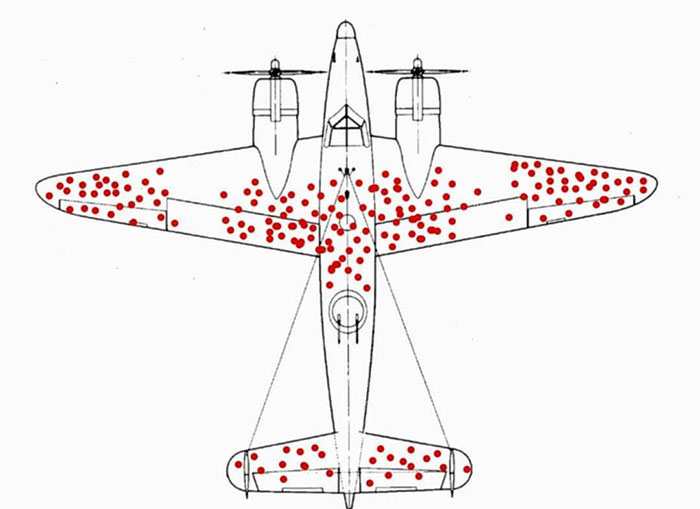
    A recent LinkedIn post alerted this writer to the inimitable perspective statistician Abraham Wald brought to the assessment of World War II Allied bomber damage upon return from missions.  He argued that observed anti-aircraft damage was non-crippling since the aircraft remained airworthy and was able to return.

    He surmised that planes that did not come home may have suffered damage to other areas making them unairworthy and hence their data was unobserved.  Based on this analysis, the U.S. Navy beefed-up armor in the less or unaffected areas and this was credited with saving lives and aircraft.

    This type of analysis came to known as Survival Bias which has its proponents and detractors.  On the surface, it seemed intuitively obvious that areas of damage need addressing while not necessarily those statistically showing fewer issues.

    It is not our intent herein to assess its merits and applicability.  Rather to help readers better understand the very nature of big data and its use, especially in predictive and behavioral models.

    Covid-19

    Today, policy and other decision makers are tasked with dealing with a deadly global pathogen.  Apparently developing quickly and spreading exponentially—a super spreading event.  As of this writing has afflicted millions in 188 countries/region in much less than 12 months.

    In this pundit’s opinion, much of the concern, confusion and clearly wrong information regarding this disease and mitigation protocols can be traced to data collection and analysis.  By now most readers will have some familiarity with the chaos associated with these predictive models.

    For example, according to the US National Library of Medicine, National Institute of Health, “A key fact for us all to remember is that, for the majority of countries, we’re not actually counting how many people have the virus—instead were counting the reports of how many people have the virus, and, like all metrics, those numbers vary according to how they’re measured.  An increase in the number of tests being carried out will result in an increase in the number of infections detected.”

    In addition to the Herculean efforts to tame this tiger from the vast medical, scientific, technology and many other disciplines, Structural Equation Modeling is being used to shed additional light on the latent variables.

    Final Thoughts

    The 2020 Coronavirus is an early test of Big Data analysis in support of decision makers both for public policy and non-government organizations.  While performance so far has been weak, this pundit believes great value can come from this effort.

    Data quality must be highly reliable and valid.  Moreover, models must assess what is not seen, the latent variables such as found in Survival Bias.  These two aspects of strong decision support models are crucial.  These are lessons for all of us.

    Where Didn’t the Bullets Hit Your Business Model?

    For More Information

    Please note, RRI does not endorse or advocate the links to third-party materials.  They are provided for education and entertainment only.

    For more information on Cross Cultural Engagement, check out our Cross Cultural Serious Game

    We are presenting, Should Cross Cultural Serious https://rri-ccgame.com/Games Be Included in Your Diversity Program: Best Practices and Lessons Learned at the Online Conference, New Diversity Summit 2020 the week of September 14, 2020.  Check Out this timely conference!!

    You can contact the author as well.

  • The Tyranny of the Blank Sheet of Paper

    The Tyranny of the Blank Sheet of Paper

    We have all had that, “Where do I start” moment?  Confronted with the NEW, sometimes the task seems daunting.  In a recent conversation, a colleague and I were discussing an adult training program.  The subject centered on how to help students jump start a creative flow.

    We humans are fond of using so called cheat sheets.  Whether school CliffNotes, Cut and Paste, Go Bys, Best Practices or other tools to wrap our mind around a subject and launch the thought process.  In other words, anything to move us away from the cosmic void–so called ‘writer’s block.’

    Tidbits that Work for Me

    Faced with tyranny often during my formative career years, i.e., a professional services proposal, new spreadsheet, etc. a few tricks were developed.

    First—Just start writing.  Put your thoughts down as they fly out and don’t worry about the order or even if they are relevant.  You can sort these things out later, but a least your paper is no longer blank.

    Get Up—Hit a spot where nothing is pouring out of your brain? Put your (electronic) paper down and go exercise or do something totally unrelated.  You will be surprised how the creative juices will flow when you return.

    Ask a Friend—Remember the old game show where contestants could ‘phone a friend’ when stumped on a question?  Brainstorm with friend and colleagues; even those who have no knowledge of the problem your engaged with.  Sometimes, they have the best insight—true out of the box.

    Do Something Else—If time allows put the project on the shelf and work on something entirely different.  You can come back later refreshed.

    FYI, the tyranny never goes away.  Hundreds of publications and presentations later, it still can persist from time to time.  The four tidbits still work for this author.

    By one definition, tyranny is “cruel, unreasonable, or arbitrary use of power or control.”  There is no reason to let a blank sheet of paper exercise such awful authority.  Take back your creativity!

    Why Let the Blank Sheet of Paper Ruin Your Day?

    For More Information

    Please note, RRI does not endorse or advocate the links to third-party materials.  They are provided for education and entertainment only.

    For more information on Cross Cultural Engagement, check out our Cross Cultural Serious Game

    We presented, Should Cross Cultural Serious Games Be Included in Your Diversity Program: Best Practices and Lessons Learned at the Online Conference, New Diversity Summit 2020 on April 9, 2020.  The summit will be offered again soon.  Check it Out!!

    You can contact the author as well.

  • Technology Assessment in the Era of Minimum Viable Product (MVP)

    Technology Assessment in the Era of Minimum Viable Product (MVP)

    App developers have fallen in love with the concept of Minimum Viable Product aka MVP.  Wikipedia defines minimum viable product (MVP) as “a version of a product with just enough features to satisfy early customers and provide feedback for future product development.”

    This development model might make some sense for consumer software or even some business data analytics but how does it work for mission critical software and those apps that allow remote connectivity to those data resources?  MVP is problematic in these cases at best.

    Most mission critical software development organizations understand that robust testing is necessary, yet sometimes the specter of the MVP mentality sneaks its camel nose under the tent.  Think this does not happen?  Think again.

    The Boeing 737 Max 8 is one current example of this phenomena.  One can argue that the costs to this organization, its customers and the flying public have been astronomical and perhaps not measurable.

    Many of us will not be flying any time soon and many months ago this writer has been told by a knowledgeable individual that safe work around for the Max8 software issues have always been readily available—even before the crashes.  There is a more onerous issue that affects everyone on the planet is widely accepted by policy makers.

    We extend the construct of MVP to Minimum Viable Thought.  MVT is defined as, “The version of a decision that the decision makers believe will be accepted by organizational executives and public policy makers.”

    As of publication, this statement is posted on The Institute for Health Metrics and Evaluation (IHME) at the University of Washington.  “To construct our “Current projection” (the line that shows what we think will most likely happen), we assume that in each location the trend of easing mandates will continue at its current trajectory until the daily death rate reaches a threshold of 8 deaths per million.  If the daily death rate in a location exceeds that threshold, we are assuming that mandates will be reintroduced for a six-week period.”

    We do not dispute modelers making assumptions.  We do that same.  However, this caveat.  Decisions made based modeling assumptions such as these often lead to cataclysmic results.

    The concept of MVP can be a slippery slope.  In an era of rapid software/data release, the risk to the public whether in airplanes or a pandemic can be huge.

    The assessment of such technological solutions needs to be robust and thought through.  Not the knee jerk response often seen.

    How do you assure new technology implementation does not material negatively impact on your business?

    For More Information

    Please note, RRI does not endorse or advocate the links to third-party materials.  They are provided for education and entertainment only.

    For more information on Cross Cultural Engagement, check out our Cross Cultural Serious Game

  • Tumultuous Decade: What’s Next for Oil & Gas?

    Tumultuous Decade: What’s Next for Oil & Gas?

    April 20, 2020 marks the tenth anniversary of one of the most horrific incidents in the upstream oil and gas sector—Deepwater Horizon.  In addition to the tragic loss of eleven lives, the sector forever changed.  Immediate restructuring of federal oversight resulted in the establishment of the Bureau of Safety and Environmental Enforcement (BSEE) and their subsequent Safety Culture Policy.

    The industry changed too.  One of the first efforts following Macondo was the formation of the Marine Well Containment Company.  Its mission is to rapidly respond to Deepwater incidents in the Gulf of Mexico.  Subsequent organizations are also positioned around the world.

    Moreover, the industry embraced Safety Culture and continues to improve based upon Systemic Safety Cultures across organizational ecosystems.  These processes are incorporated into Operations Management Systems that incorporate SEMS as part of Operational Excellence Initiatives.

    In 2014, the sector faced another slap in the face with the collapse of oil prices, yet again.  Now it is the double whammy of the Covid-19 pandemic coupled with the price war between Russia and Saudi Arabia.

    Darkest Before the Dawn

    Each time the industry is forced to retrench, it follows a predictable pattern.  Reduction in force (layoffs), corporate restructuring and turning to technology are among the most common steps.

    This chart from the Federal Reserve Bank of St. Louis shows the employment levels for the upstream sector since the early 1970s.  One can make the case that the level of employment in the sector is flat at best.  One likely cause is automation and the extensive use of information technology to manage the business.

    Note: This chart is current as of March 2020

    In 1970, the US population was a little more than 205 million.  Now it tops 330 million.  This supports a hypothesis that the per capita employment by the sector is decreasing.  We expect this to continue.

    The Digital Oilfield marches on with the advent of IT-OT Convergence, Digitalization, etc.  This process has been underway since at least the late 1970s with the advent of the first computerized data acquisition systems.  Likely, much longer if one considers for example, the invention of electric well logging by the Schlumberger brothers in 1926.

    Certainly, other technological advances have contributed as well.  The often maligned fracturing the rock traces its roots back the beginning of the industry (circa 1862).  Contemporary hydraulic fracturing was started by Halliburton in 1949 and shale ‘fracing’ by Mitchell Energy & Development Corporation during the 1990s.

    While we have not done the detailed research, historically oil companies have outsourced to engineering firms, IT companies and others that provide a service as opposed to full time employees.  Today’s disrupted employees may find better careers in the emerging sectors that support petroleum operations as well as other sectors.

    Schumpeter’s Creative Destruction is a work in ‘the patch’ today.  A lot has happened in the Deepwater Horizon incident.  Here’s to calmer waters this next ten years!

    How Are You Positioning Your Career to Capitalize on Disruption?

    For More Information

    Please note, RRI does not endorse or advocate the links to third-party materials.  They are provided for education and entertainment only.

    For more information on Cross Cultural Engagement, check out our Cross Cultural Serious Game

    We presented, Should Cross Cultural Serious Games Be Included in Your Diversity Program: Best Practices and Lessons Learned at the Online Conference, New Diversity Summit 2020 on April 9, 2020.  The summit will be offered again soon.  Check it Out!!

    You can contact the author as well.

  • Is Big Data Analysis Being Applied?

    Is Big Data Analysis Being Applied?

    We have been hearing for years how, Big Data Analysis will help us optimize our businesses and generate performance at levels here to for never hear of.  So where is it now?

    Two major sources for data on the Covid-19 virus are Johns Hopkins University and the Centers for Disease Control and Prevention.  This is fine at one level.  Living in the Houston, Texas metropolitan area, this pundit can see a general (real time) overview of the situation from either.

    However, my home is on the west side of the city.  I was recently surprised to learn that most of the local exposure is on the east side; 30+ miles from my domicile.  Is my risk lower than I am being told by the authorities?  Or is it the same or higher?

    Why am I staying at home?  Perhaps the result of a blunt policy instrument?

    It appears to me that most medical professionals are not Data Scientists.  Absolutely knowledgeable in their field, including pathogens (I personally know many in the field including a pathologist).  Is that system taking help from data scientists?  I have not heard that it is.

    Additionally, if the argument is we don’t yet have enough data, this holder of a doctoral degree will argue that Small Data set modeling can be effective as well.  My doctoral dissertation was founded on these statistics.

    I have no doubt that the best minds are working this problem.  However, if policy makers take a hammer to the nail, when perhaps a series of tacks is appropriate, significant economic damage will continue.

    The tack approach appears to be what we are hearing about certain parts of the United States coming back online in a week or so.  The concept of months some advocate makes no sense to this writer.  We will see social unrest long before that.

    The Big Data Analysis sector has been pressing their value proposition and software/solutions for years as a way of optimizing businesses.  Why is the sector quiet regarding coronavirus?

    If we can parse data and sell web advertisements based on ‘clicks’ why can’t we figure this out a level of granularity that allows the economy to restart (at least in some geographies)?  Get to work guys and prove my concerns wrong!

    Finally, what is the role for Artificial Intelligence (AI)?  Its advocates suggest it has magical powers and it  has been used to solve other problems.  Prove it on this global stage!

    Where are Big Data and AI in this fight?

    For More Information

    Please note, RRI does not endorse or advocate the links to third-party materials.  They are provided for education and entertainment only.

    For more information on Cross Cultural Engagement, check out our Cross Cultural Serious Game

    We will be presenting, Should Cross Cultural Serious Games Be Included in Your Diversity Program: Best Practices and Lessons Learned at the Online Conference, New Diversity Summit 2020 beginning April 5, 2020.  Check it Out!!

    You can contact the author as well.

  • Restoring the Global Economy: Starting Today!

    Restoring the Global Economy: Starting Today!

    Prognosticators of the future, including this one are speculating on the Post-Covid-19 world.  As with every disruptive crisis, things change going forward.  This one will be no different and will probably accelerate certain trends, end some and generate many new opportunities.  Some industry sectors and many organizations will need to transmute the way they do business.

    One thing that will not change is our dependencies on one another both for business and the global society in general.  We may modify our supply chain procedures, work more remotely, change training and education processes and so forth and so one.

    The use of certain information technologies and the need to protect them from maleficent (computer) viruses will most likely explode.  The oil and gas sector will restructure itself as it has many times over its history.  Winners and losers will emerge.

    There is a major underpinning for all of this—Cross Cultural Interactions.  In this new world order successful organizations (including governments) that develop and sustain a Strong Bond Governance model can thrive.  Others that do not will most likely struggle.  We first made this case when the oil and gas Deepwater sector was struggling post Deepwater Horizon and again during the last oil price crash.

    Building a Strong Remote Working Culture and Brand

    Probably the trend towards more Remote Working will accelerate after the Covid-19 crisis passes.  To the extent an organization prepares its ecosystem for this transformation it may secure competitive value.

    Many industrial organizations are not early adopters of technology.  Their preference is to let others lead and implement later in the technology life cycle.  While this approach worked for many in the past, it may not be the best strategy going forward.

    In 2004, we posited that Early Adopters actually captured the most value from new technology.  Integral “Calculus tells us that the area under the curve is approximately the sum of the areas of inscribed rectangles.”

    Adjusted for risk, this hypothesis is supported by mathematics.  Check it out, it might work for your organization.

    As stated in our last blog, there are underly concerns when vast numbers are working remotely for long periods of time.  One suspects there will be some media reporting on not just the technical difficulties but the human issues working remotely.

    At one level, there appears to be a clash between the value of early adoption and human challenges of remote work.  Management must be aware of this challenge and put processes in place to address real human concerns.

    Enhanced Cross Cultural & Diversity Training

    Organizations continue to be diverse including a number of cross-cultural characteristics based on geography, division, etc.  Managing diversity and cultural challenges are more acute when working remotely.

    To build this strong culture and be known as a ‘thought leadership’ organization requires training.  As we know, training can be online and not just workshop or classes.

    We humans can interact with each other in a meaningful way playing a serious game.  Our Cloud based Cross Cultural Serious Game enables diverse individuals and teams to engage in real world scenarios from remote locations.  We have found this type of training to be invaluable for diverse and remote team interaction.

    The expected increase in organizational restructuring will lead the merger and acquisition activity in the near future.  This cross-cultural training tool can add value therein as well.

    How will YOU position yourself for the next step?

    For More Information

    Please note, RRI does not endorse or advocate the links to third-party materials.  They are provided for education and entertainment only.

    For more information on Cross Cultural Engagement, check out our Cross Cultural Serious Game

    We will be presenting, Should Cross Cultural Serious Games Be Included in Your Diversity Program: Best Practices and Lessons Learned at the Online Conference, New Diversity Summit 2020 beginning April 5, 2020.  Check it Out!!

    You can contact the author as well.

  • Home Base During a Crisis: ‘get up, clean up, and dress up’

    Home Base During a Crisis: ‘get up, clean up, and dress up’

    In the middle of a global pandemic, all of us who can are advised to work from home.  Many of us have worked remotely for a while now.  Whether traveling, dealing with sick children, avoiding traffic or dealing with a natural disaster remote management has become part of our business DNA.

    Yet, this pundit was a bit surprised at some of the social chatter about working from home for extended periods.  After all, I have been working remotely for decades.  Turns out, these fears have a basis in fact.

    It appears there are two culprits at work here.  First is our individual behaviors and secondly, there are serious productivity concerns.

    First Culprit

    A day or two, here and their remote working is fine.  Things can change however; when it becomes a way of life and not everyone is well suited to labor this way.

    While it all sounds good on paper, working as an individual remotely is a difficult thing to do.  Humans are social beings.  Most of us need to interact with others; daily.

    The concept of working in my ‘underwear’ is not sustainable.  Like all aspects of life, a structured process is required.  First of all, ‘get up, clean up, and dress up.’  This is not the weekend where you check the odd email or holiday where you do the same on a beach with an umbrella drink.

    It is your job, the source of your income and often self-worth.  The risks to both of these is high when working remotely.

    While not directly on this topic.  This is one of the best videos on motivation and focus.  Well worth your time to view it.

    Working at home requires discipline as well as your ‘in office’ work ethic.  Challenge will be to sustain this effort.

    Second Culprit

    Some sectors such as Information Technology have encouraged its employees and contractors to work from home on a permanent basis.  This was long ago considered dogma.  Except that sometimes it does not work.

    In 2017, I noticed that IBM was ending its ‘work from home’ policy for many workers.  In their statement at the time, “In many fields, such as software development and digital marketing, the nature of work is changing, which requires new ways of working.  “We are bringing small, self-directed agile teams in these fields together.”  Has anything changed in less than three years?

    Further confirmation of this model can be found with most of the technology innovators and accelerators today.  Often accused of selling real estate these mostly for-profit enterprises claim that working together in a centralized environment encourages collaboration and cross pollination of ideas.

    This is the current common business model for start up organizations around the world.  In the minds of many, it must work and add value to the creative process.

    Another New Normal

    Is this a paradigm shift or just a short term inconvenience?  Reality, probably a bit of both.  E-learning has been growing and this may give that sector a boost.  Software development, the presumed online job, maybe not so much.

    While it is likely that Structural Dynamics are at work the current covid-19 situation.  Our Relationships, Behaviors, Conditions (RBC) model is a useful tool going forward.

    We are changing your blog model for the near future and will be developing this issue in more detail and offering actionable solutions.   In subsequent posts we will develop this further.

    In the meantime, if your challenged by the requirement to work remotely contact us for no cost, no obligation mentoring.

    How is Your Organization Assuring Productivity Remains During the Crisis?

    For More Information

    Please note, RRI does not endorse or advocate the links to third-party materials.  They are provided for education and entertainment only.

    For more information on Cross Cultural Engagement, check out our Cross Cultural Serious Game

    You can contact the author as well.

  • To KISS or Not?

    To KISS or Not?

    According to legend, the term KISS or ‘Keep It Simple, Stupid’ was coined by Kelly Johnson, lead engineer at the Lockheed Skunk Works and noted by the US Navy as early as 1960.  Subsequent phrases such as ‘Less is More’ followed.

    At first glance, it makes sense not to overly complicate a product, process or project.  Certainly, a non-technical audience such as senior management will need to the issue and risk management strategy explained in terms they understand.  However, in our search for Red. Yellow, Green ratings are we overly simplifying complex environments?

    Albert Einstein is created with saying, “Everything should be made as simple as possible, but not simpler.”  This begs the questions, where is that line and how do you know if you’ve crossed it?

    One of the mantras of the High Reliability Organization Mindfulness is, Preoccupation with Failure.  This is not defined as with Normal Accident Theory, where failures are inevitable.  Rather, it is an understanding the modern complex systems one must be resolute in one’s focus on operational issues and rapidly move to normalize out of limit situations.

    In 2016 (and earlier) we made the case that after the Ebola outbreak in Dallas, the Public Health sector was resilient and that issue was contained quickly (links to all three parts of this series provided below).  In this writer’s opinion, this was not possible if the process was ‘worked’ at a too simple level.  Lessons learned from that and other contagion incidents may be useful combating Coronavirus Disease 2019 (COVID-19).

    The overused phrase, “failure is not an option” is the root of contemporary Operational Excellence business models.  In fact, failure happens but mitigating its impact and rapidly recovering are the hallmark of successful organizations.

    The graphic is a fractal.  From the Fractal Foundation, “A fractal is a never-ending pattern.  Fractals are infinitely complex patterns that are self-similar across different scales.  They are created by repeating a simple process over and over in an ongoing feedback loop.  Driven by recursion, fractals are images of dynamic systems – the pictures of Chaos.  Geometrically, they exist in between our familiar dimensions.  Fractal patterns are extremely familiar, since nature is full of fractals.  For instance: trees, rivers, coastlines, mountains, clouds, seashells, hurricanes, etc.”

    Our world is a complex place.  Processes and technologies must deal with that fact.  Successful risk management strategies must take Einstein’s wisdom into consideration.

    Does Your Organization Have a Robust Enterprise Risk Mitigation Strategy?

    For More Information

    The Three-Part Series Referred to in this blog:

    Please note, RRI does not endorse or advocate the links to third-party materials.  They are provided for education and entertainment only.

    For more information on Cross Cultural Engagement, check out our Cross Cultural Serious Game

    You can contact the author as well.

  • Hanging App?

    Hanging App?

    By one measure, the US presidential primary season is off to a rough start.  In a small state, counting the ballots became a challenge.  Wasn’t technology supposed to solve the problems of past confusions?

    Yet the mechanism seemingly failed—again!  How is this different from the Boeing Max 8 disaster?  In one sense it isn’t.

    Disclaimer:  The only information this author has on the recent electoral IT problem is publicly available and he is not aware of anyone involved in that process that he may know personally.  This piece is only an opinion about a technology issue.

    Technology Adoption Process

    App developers strive to get to MVP as rapidly as possible.  Wikipedia defines a Minimum Viable Product as, “A version of a product with just enough features to satisfy early customers and provide feedback for future product development.  Gathering insights from an MVP is often less expensive than developing a product with more features, which increases costs and risk if the product fails, for example, due to incorrect assumptions.”

    Speed is of the essence in software development.  Yet, a rapid time to market should not sacrifice adequate analysis and assurance the software is robustly ‘stress tested.’

    Apps are moving from simple tools designed to call an independent driver of transport or order a burger.  They are now integral parts of enterprise solutions with broad implications if they fail.  This changes the fundamental project development process and benchmarks for release.  This is true for all App developers, even if their employee base is one or the development process is outsourced entirely.

    Release Maturity

    Most new technologies start is some’s ‘garage.’  Whether Steve Jobs’ or 3M, the processes are ad hoc and getting a so-called ‘Alpha’ product is the goal.  Those third parties who accept and test it know their risks and exposure.  Such customers would never use that release in a production environment.

    Other maturity models include Technology Readiness Levels (TRLs) by NASA and the European Association of Research and Technology Organisations.  At a minimum, testing must assure it is fit-for-purpose and that the product can ‘scale’ to meet the expected demand.

    Technology vendors to ‘critical infrastructure’ sectors such as oil and gas often express exasperation at the sometime slow take up of new solutions.  Individuals that take excessive risks deploying new technology may literally be putting their career at risk as well as their critical processes.  Therefore, they tend to be risk averse.

    There are many examples of what not to do rolling out new technology.  This month’s primary election is just the latest.  The adage, ‘no one wants to make the front page of The Wall Street Journal’ has a lot of truth to it.  Make sure you and your customer get media coverage for the right reasons.

    How Do You Know Technology is Ready for Enterprise Wide Deployment?

    For More Information

    Please note, RRI does not endorse or advocate the links to other third-party materials.  They are provided for education and entertainment only.

    For more information on Cross Cultural Engagement, check out our Cross Cultural Serious Game

    You can contact the author as well.

    End Notes

      https://en.wikipedia.org/wiki/Technology_readiness_level

      https://therrinstitute.com/critical-infrastructure-sectors/

  • Lessons in Servant Leadership: What Did You Say?

    Lessons in Servant Leadership: What Did You Say?

    Watch almost any media talk show and the interviewer will often interrupt the guest trying to answer the question just posed.  This is such a common phenomenon that it is accepted behavior perhaps driven by ratings that come from on-air confrontation.  It is part of the culture!

    Why ask the question if you’re only going to impose your view in the middle of an answer?  Perhaps guests are just convenient foils.

    When briefing senior management, colloquial wisdom is to get to the point quickly and succinctly.  Words to live by and often put forth by this pundit.  Yet it is amazing how many of us violate the axiom by continuing to talk.

    Truly listening with all senses is a rare skill.  How often have we been in a situation such as a sales call when the customer is interrupted by members of the sales team?

    It is more difficult to close a deal when the preconceived notions of the seller override the buyer’s response.  Often in such a situation the client’s body language will give a clue as to her irritation when ‘talked over.’

    The Power of Listening

    So, you have made your pitch and are now sitting quietly waiting for the client to respond.  However, the so called ‘pregnant pause’ ensues.

    The overwhelming desire is to ‘jump in’ and say something to break the silence.  But how does that close a deal when an offer has just been made?

    Such behavior usually results in either prolonged negotiation or no deal.  The human inclination to talk can be irresistible.  A better behavior is to shut up and listen!

    Some research shows that good listening is beneficial to both employees and their organizations.  However, barriers to better listening include:

    • Loss of Power—The appearance of weakness or not in control of the situation
    • Takes Time and Effort—Daily time pressures may negatively impact on the work product
    • Fear of Change—The speaker must refrain from making ‘foregone conclusions’ until a response is articulated

    In addition to certain listening skills, a good listener must have the ‘intention’ to become one and resist the urge to interrupt.  This can become the framework for real dialogue and exchange of ideas and information.

    Getting to Yes

    In a TEDx Talk, the coauthor of the negotiation book, Getting to Yes discusses the value of listening in any human interaction.  The investment of less than 16 minutes of your time will be enlightening.  One suspects the almost 900,00 viewers would agree.

    Our inherent nature to ‘rattle on’ distracts us from our goals.  We recently discussed the value of understanding the difference between Wants, Likes and Needs.

    Truly listening and understanding your counterpart’s feelings (or deeply personal Needs) will unlock the key to getting a deal done—Yes!  This is a major component of  servant leadership.

    R B C

    Human (B)ehaviors in certain situations or (C)onditions establish (R)elationships between two or more parties.  We have been extending this construct for almost 25 years and it has broad applicability.  What kind of Relationship is established if one or more individuals do not listen to others?

    How Well Do You Listen to Your Colleagues and Family Members and Do They Listen to You?

    For More Information

    Please note, RRI does not endorse or advocate the links to other third party materials.  They are provided for education and entertainment only.

    For more information on Cross Cultural Engagement, check out our Cross Cultural Serious Game

    You can contact the author as well.

    End Notes

      https://en.wiktionary.org/wiki/pregnant_pause

      https://hbr.org/2018/05/the-power-of-listening-in-helping-people-change

      https://therrinstitute.com/want-like-need/

  • Running Across an Open Field: Strategy for Disruptive Technology?

    Running Across an Open Field: Strategy for Disruptive Technology?

    Several weeks ago, as an amateur history buff, I was watching a documentary about World War I.  During one segment the commentator discussed the apparent fact that if soldiers refused to charge out of their trenches across an open field into the teeth of waiting machine guns they would be shot.

    The brutality of such a command by (so-called) leadership is appalling.  It may have been one thing for Alexander the Great’s armies to engage in open battles with sharp pointed objects as weapons.

    It is quite another for General Pickett’s infantry at Gettysburg to charge cannons and 50+ years later to repeatedly try the same tactic (by both sides) at horrific costs.  Generals always fight the last war, so the saying goes.

    This blog is not about some of history’s follies, it is about learning so as not to repeat the mistakes of others.  These lessons apply to readers’ daily business world as well.

    When New Technology is Deployed

    New disruptive technology can tear the societal fabric.  Some old jobs and companies disappear, and new ones thrive.  This process has been repeated since antiquity.

    Our culture is having this dialogue today regarding digitalization and its suite of technological driven change, i.e., Blockchain, AI, etc.  Principal issues that must be addressed include Human Factors Engineering (HFE).

    “HFE places the human operator at the center of the complex operating environment.  HFE recognizes that this individual or set of individuals is the puppet master and is responsible for the entire show.”  In other words how do we interact with the new technological reality.

    Reliable and valid HFE is the key to successful digitalization initiatives.  It will be the vital to whatever is next as well.

    Tyranny of the Minority

    From political science, “For centuries, theorists have worried about the potential of unrestrained democracy to lead to a tyranny of the majority, in which majority groups ride roughshod over the rights of minorities.  What we often see today is instead a kind of tyranny of the minority: a system in which a particularly extreme and motivated fraction of the populace can wield outsized power in the face of a majority which is either too indifferent or too scared to oppose it,” (italics added).

    In most organizations, there are fewer leaders than those who fabricate a ‘work product.’  The responsibility of leadership is to set the vision, mission and goal as well as enabling the organization with the tools and support necessary to reach targeted stakeholder value.

    But what if this minority group is the slowest to come to grips with disruptive forces?  In the face of newness, they may ‘keep doing what they have always been doing.”  In such an environment, the organization will likely not reap the same reward as in the past.

    Does too indifferent or too scared describe your organization’s ecosystem workforce?  One suspects It would be good to know.

    Fast Fail

    In our last blog we discussed the rapid assessment of technology and when to drop it if it does not appear to be working out.  Perhaps, we should treat managerial processes the same way.  After a horrific and visible failure in leadership, conceivably one preserves best by looking for alternative?

    If charging head long across an open field leads to disaster, why keep doing it?  While a counter argument might be that we had no tools to defeat those equipped with the new technology, to this writer, that logic is suspect.

    Flanking an enemy’s line or using guerrilla tactics, et. al. are as old as human confrontation.  Unconventional warfare has a long record of documented success.

    The business lexicon is loaded with military terminology.  We often speak of business as if it is warfare, when of course it is not.  There are lessons to be learned about human and organizational behavior, however.

    Decades ago, the concept of Guerrilla Marketing was the rage.  With the advent of social media, it has advanced, and the methodology is available to all.  Huge budgets and massive media campaigns are no longer necessary.

    Head-to-Head the biggest ‘guy’ usually wins.  So, if you’re not him/her, DON’T DO IT!!  However, the small mammals may displace slow moving dinosaurs.

    Agile is not an IT term.  It should be the state of mind of leaders at all levels.  To charge across the open business landscape into technology designed to destroy your organization remains folly.

    How Are You Leading the Charge into the Future?

    For More Information

    Please note, RRI does not endorse or advocate the links to other materials.  They are provided for education and entertainment only.

    See this 3:15 minute clip for more information on living in a World War I trench.  Pathetic way for leaders to force those under their command to live.

    For more information on Cross Cultural Engagement, check out our Cross Cultural Serious Game

    You can contact the author as well.

    End Notes

      https://consult2050.com/job-disruption-due-to-digitalization/

      https://therrinstitute.com/wp-content/uploads/2018/10/HRM-in-Process-Industries-Sustained-by-Human-Factors.pdf

      Ibid.

      https://areomagazine.com/2019/04/02/the-tyranny-of-the-minority-and-how-to-prevent-it/

      https://therrinstitute.com/lessons-from-the-seventies/

      https://en.wikipedia.org/wiki/Guerrilla_marketing

  • Lessons from the Seventies

    Lessons from the Seventies

    At lunch the other day and for whatever reason, the history of the 3M Post It Note became a subject of our conversation.  This technological marvel unveiled in the 1970s is still widely used today.

    As with other new or disruptive technologies, the ‘sticky note’ was panned at first and for some time.  According to Wikipedia, the technology was first developed in 1968.  It was not until 1974 that it gained some internal company support.

    When finally introduced in 1977, the pilot results were unsatisfactory.  However, things started to change in 1978 when a small (focus) group of consumers were positive about the product.

    The United States roll-out began in the spring of 1980, followed by Europe and Canada in 1981.  A bit of trivia, the reason it was originally yellow was because yellow colored scrap paper was readily available at its inception.

    Earlier the day of our lunch meeting, a discussion revolved around how long it might take an idea to become a fundable start-up company.  Several participants argued that with proper guidance, the process still might take up to two years.  This pundit argued that many entrepreneurs would see that as too long and become disinterested.

    The legacy of the Post It Note suggests that this pundit might be incorrect.  The lowly sticky note did not even begin its journey to become a Unicorn until twelve years after its technology was discovered.

    In 2015, we penned a blog, Titans of the 1940s Today.  The basic premise of that piece was when commenting about the Internet of Things (IoT) and its complexity, individuals such as Richard Feynman and John von Neumann (father of the 1945 computer architecture that is the basis of modern computing) had developed solutions for today prior to this author’s birth.

    We stand on the shoulders of these and other giants.  The challenge of every generation has been to build on what those who came before advanced.  So it remains today!

    Body of Knowledge

    Human kind has developed a rich body of knowledge in all areas of endeavor.  It is readily available for entrepreneurs as well as those employed by all types of organizations.  This knowledge base has been addressed in this blog and other writings by the author.  Interested readers are invited to review my blogs and newsletters dating back to the last century.

    Our march through history provides all of us a ‘go-by’ that can shorten our learning curve.  One example this author often cites is the depth of historical knowledge of management.  Contrary to many gurus, humans have managed others and processes for many millennia.

    Fail Fast, Fail Often?

    If 3M or Feynman et al practiced this technology development model as most interpret it, our world might be a lesser place.  Give up and move on to the next?

    One interpretation suggests, “Originating from Silicon Valley and its ocean of start-ups, the real aim of “fail fast, fail often,” is not to fail, but to be iterative.  To succeed, we must be open to failure—sure—but the intention is to ensure we are learning from our mistakes as we tweak, reset, and then redo if necessary.”

    This same article goes on to state, “Thomas Edison, by example, ‘failed’ 9,000 times before he was successful with his light bulb invention.”  Perseverance can be a lonely quality!

    Don’t lose heart.  Great ideas abound but must gestate.  It is often said that we find our soulmate when we least expect to—I know I did.  Progress is an iterative process fueled by creativity and critical thinking.

    Is Your Idea a Unicorn Waiting to be Born and Mature?

    For More Information

    Please note, RRI does not endorse or advocate the links to other materials.  They are provided for education and entertainment only.

    You can contact the author more information as well.

    End Notes

      https://en.wikipedia.org/wiki/Post-it_Note

      https://therrinstitute.com/wp-content/uploads/2018/10/Titans-of-the-1940s-Today-April-20-2015.pdf

      https://therrinstitute.com/wp-content/uploads/2019/10/1993-Management-Theory-Evolution-Not-Revolution.pdf

      https://www.forbes.com/sites/danpontefract/2018/09/15/the-foolishness-of-fail-fast-fail-often/#1db35b0e59d9

  • Want – Like – Need

    Want – Like – Need

    Years ago, as part of a never-ending series of company reorganizations, a team of our change management consultants headed to the ‘field’ to interview users.  Upon their return, they presented an extensive list of technology investments deemed necessary to remain competitive.

    Their list focused on technology and not business concerns.  Wondering, I asked who they interviewed.  Proudly, they proclaimed the “field engineers.”  When queried–did they talk with district managers, regional engineers and others with P&L or other managerial responsibilities, the answer was “no.”

    This very expensive process by a major professional services organization simply generated a wish list of junior employees.  It was what they thought they WANTED.

    In our current jargon, “cool stuff.”  Needless to say, none of these projects were funded.  Wasted time and money by those not familiar with our business!

    Today, we are driven to LIKE everything!  CRM systems demand input before we have even procured the product or service.  Log on to any given website and the request to complete a survey will hit you before you read the first line.  Five stars or thumbs-up emojis appears to be the goal.

    Do wants and likes add value?  Perhaps a like is a statement of preference, but perhaps the consumer wants the digital driven question to just go away without the hassle of someone begging for a higher ranking like.  Fibbing to surveys has become a national pastime.

    Business should be most concerned about what a prospect or returning customer NEED.  What pain point or problem does your product/service solve?  If you can’t answer that question, no amount of wants and likes will add to your bottom line.

    I may want a hamburger and go to a fast food restaurant with lots of likes.  However, if I am in a hurry and their preference is clearly to move cars via the drive-through faster than those of us waiting inside, my need to eat quickly will not be met.  I may leave without my meal or most likely not respond to a survey seeking likes.  Then never return!

    That lost customer will never surface in any analysis—not even one star.  Enough of those responses and the business will be in jeopardy and management my not even know why.  Collecting likes should never be a Key Performance Indicator (KPI).

    Finding the Pain

    In a recent Global Energy Mentors leadership meeting, an investment group recounted their business model as one that focused on identifying organizational ‘pain’ points.  Once a specific pain was articulated, the search for new technologies that would address/resolve that pain was undertaken.

    This model flies in the face of Steve Job’s, “A lot of times, people don’t know what they want until you show it to them.”  That may be and sometimes unknown needs are uncovered.

    However, in critical infrastructure sectors where failure is not be an option because it can be very expensive solving a known need is usually most important.  Without exception, this entrepreneur’s success has been focusing on addressing industrial client known pain points.  As an example, our EVPM modeling process demands input from customer groups.

    In this blog series, we have referred to successful change management that comes from addressing the—what’s in it for me question.  From a customer perspective; freeing ‘me’ from known pain is often more valuable than alleviating pain I did not know I had.

    Does Your Value Proposition Solve a Need, Address a Want, or Simply Generate a Like?

    For More Information

    Please note, RRI does not endorse or advocate the links to other materials.  They are provided for education and entertainment only.

    You can contact the author more information as well.

    End Notes

      http://globalenergymentors.org/

      https://www.helpscout.com/blog/why-steve-jobs-never-listened-to-his-customers/

      https://therrinstitute.com/brand-your-digital-oilfield-culture-internalize-its-transformation/

  • Aging Success: Never Give Up!

    Aging Success: Never Give Up!

    We live in a youth culture.  As young Baby Boomers, we were going to change the world.  Later other Gens would say the same.  Is it now too late for those over 50 to attain entrepreneurial success?

    A serial (often failed) entrepreneur, (Kentucky) Colonel Harland Sanders sold his first franchised secret receipt for “Kentucky Fired Chicken” at age 62 (1952).  After a mixed career, Winston Churchill was first elected the Prime Minister of Great Britain at age 66.  The list of older individual success stories goes on, but readers will get the point.

    According to TEDxMidAtlantic, “Backed by mathematical analysis, network theorist Albert-László Barabási explores the hidden mechanisms that drive success — no matter your field — and uncovers an intriguing connection between your age and your chance of making it big.”

    His thoughts are well worth watching.

    He makes several good points:

    • Variations of human performance is relatively small, i.e., difference between world class athletes and ‘normal’ athletes
    • Your level of success is a function of what others think (measurable) , i.e., the market
    • Success can come at any time in your career
    • Entrepreneurs over 50 are more than twice as likely to have a successful ‘exit’ than those in their 30’s
    • There is a positive correlation between productivity and success

    When viewed objectively, these observations make good sense.  For example, musicians that shoot to the top in their teens and twenties are often less productive after they have ‘made it.’  Typically, we hear less and less of them.  Don’t tell that to the Rolling Stones.

    A cliche of this author’s youth, “Hang in their baby” was typically depicted as a kitten hanging from a tree branch.  Cute then, apropos for today’s Baby Boomer entrepreneurs!

    Whether you’re a scientist, entrepreneur or simply want a better career and life, take heart.  Success comes at any age for those who persevere.  While your Condition (age), Behavior (interaction with others of all ages) may be changing in this phase of life, it will only generate new and possibly much better Relationships in the work place as well as your personal life.

    Mr. Churchill demands we “Never, Never, Never Give Up.”  So, don’t!  The best is yet to come.

    Still Have an Idea That Will Change The World?

    For More Information

    The TED Talks link has several additional video talks on the subject and Professor Albert-László Barabási has published the book: The Formula: The Universal Laws of Success.  Disclaimer: as of this writing this blogger has not yet read the book.

    You can contact the author more information as well.

    End Notes

      https://en.wikipedia.org/wiki/Colonel_Sanders

      https://www.google.com/search?q=when+was+winston+churchill+elected+prime+minister&ie=&oe=

      https://en.wikipedia.org/wiki/Hang_in_there,_Baby

  • Your Career at the Speed of Light: Or Faster?

    Your Career at the Speed of Light: Or Faster?

    As a physics student in the 1960s, I and others became fascinate by the hypothetical particle that travels faster than the speed of light; the Tachyon.  Then and to date, this particle/theory has not been found/proven.  Conventional wisdom remains that traveling faster than the speed of light is not possible.  Sorry Star Trek.

    Moving on, this became only an interesting idea with little thought on my part.  Other career/life issues seemed more pressing.  That is until recently.

    I found it fascinating to learn that the diameter of the universe may be over 93 billion light years.  Quite a feat for a physical entity thought to be only 13.8 billion years old.  This dichotomy is explained by a period called Inflation whereby the its expansion appears to exceed the speed of light boundary.

    NASA/WMAP Science Team - Original version: NASA; modified by Cherkash
    Source:  NASA/WMAP Science Team – Original version: NASA; modified by Cherkash

    If the space time continuum can be impacted, can we actually (hypothetical for now) reach warp speed and bend our perception of the physical universe?  Interesting idea but why does that matter to me?

    Outside the Box

    There is a great deal of conventional career wisdom, including some from this pundit.  If our physical container has undergone a transformation outside of the current body of physics knowledge box, why can’t we?  After all, we are inhabitants of our universe.

    For some, their career begins early and can take off quickly, i.e., teen bloggers, child movie stars, etc.  For others, career inflation occurs later or even late in life.

    I recently commented on a LinkedIn post with this ancient Chinese proverb, “People who say it cannot be done should not interrupt those who are doing it.”  Could it be that an inflationary drive is part of the human DNA tracing its roots back to the Big Bang?  Thought-provoking!

    While a bit ‘tongue-in-cheek,’ the points raised herein suggest that we too can accelerate our lives and careers in a positive manner regardless of conventional models.  So why wouldn’t you?

    What are You Doing to Energize and Inflate Your Career?

    For More Information

    You can contact the author more information as well.

    End Notes

      https://cosmosmagazine.com/physics/can-faster-than-light-tachyons-explain-dark-matter-dark-energy-and-the-big-bang

      https://futurism.com/how-can-the-diameter-of-the-universe-the-age

      https://quoteinvestigator.com/2015/01/26/doing/