
Tag: culture

  • Value from Elon Musk’s ‘Idiot Index’?

    Value from Elon Musk’s ‘Idiot Index’?

    “If the ratio is high, you’re an idiot.” – Elon Musk

    “Musk developed the ‘idiot index,’ which calculated how much more costly a finished product was than the cost of its basic materials.  If a product had a high idiot index, its cost could be reduced significantly by devising more efficient manufacturing techniques.”

    Effectively, what he is saying that if the Cost of Goods Sold (COGS) is too high, a product may either become too expensive or not sell well, if at all.  This is the basic Supply-Demand curve from Economics 101.  He is also indicating that Gross Profit will be negatively impacted as well.

    It’s the Cost Structure Stupid

    Paraphrasing the candidacy of Bill Clinton in 1992, an organization needs to develop a cost structure that not only lowers Total Cost as low as possible but sustains this approach while assuring the produced product/service is fit-for-purpose.

    According to the Corporate Finance Institute, “Cost structure refers to the various types of expenses a business incurs and is typically composed of fixed and variable costs.  Costs may also be divided into direct and indirect costs.  Fixed costs are costs that remain unchanged regardless of the amount of output a company produces, while variable costs change with production volume.

    Direct costs are costs that can be attributed to a specific product or service, and they do not need to be allocated to the specific cost object.  Indirect costs are costs that cannot be easily associated with a specific product or activity because they are involved in multiple activities.

    Operating a business must incur some kind of costs, whether it is a retail business or a service provider.  Cost structures differ between retailers and service providers, thus the expense accounts appearing on a financial statement depend on the cost objects, such as a product, service, project, customer or business activity.  Even within a company, cost structure may vary between product lines, divisions or business units, due to the distinct types of activities they perform.”

    We see that cost management is much more than simply lowering the procurement costs of parts or subcomponents going into the manufacturing product.  It is all about the design of the firm and its culture!

    Parasite Control

    One of the challenges all organizations face is ‘Cost Creep.’  Management needs to but guardrails in place to assure a low-cost structure business model remains that way.  Service firms are just as susceptible as manufactures. 

    According to one source circa 2000, professional services cost creep aka parasite control can be defined as, “Too many people whose services are not really required trying to use it as their meal ticket.”  Originally used in the context of the space exploration sector; however, in this writer’s opinion this issue is not restricted to that one industrial segment.

    At one point in my career, I was the executive responsible for a number of large successful simultaneous consulting engagements.  Other projects were either not doing as well or winding down.  Two things started happening.

    First, I discovered that those not on one of my projects were trying to bill their time to one or more projects.  Either as a direct ‘accounting code’ attempt or more frequently as a ‘contributor.’  One individual even tried to charge for his local mileage under the premise that while he lived in Houston, he was tied to a practice in Atlanta.  Thus, in his opinion he was remote.

    Point being, any project can be subject to parasite control.  “Cost Creep” is an ongoing managerial problem that must be shut down when found, the real costs clawed back and allocated correctly.

    Robust Cost Management

    Aggressively addressing costs at all levels is neither idiotic nor stupid.  It has always been a business fact of life and as of this writing, the federal government bureaucracy is discovering it is the ‘new normal.’

    Moreover, this never-ending pursuit of cost perfection will have a new player shortly.  Artificial Intelligence (AI) is rapidly gaining traction in our everyday operations.  The audit process is part of cost management, and we already have examples of the use of AI in the audit process.  Expect more to come and sooner rather than later.

    We have an Operations Management System implementation underway where AI will play a pivotal role in Phase II later this year.  We will report back once it has ‘gone live.’

    What are your organization’s plans to vigorously manage costs?

    Pre order our new book

    Navigating the Data Minefields:

    Management’s Guide to Better Decision-Making

    We are living in an era of data and software exponential growth.  A substantive flood hitting us every day.  Geek heaven!  But what if information technology is not your cup of tea and you may even have your kids help with your smart devices?  This may not be a problem at home; however, what if you job depends on Big Data and Artificial Intelligence (AI)?

    Available April 2025

    For More Information

    Please note, RRI does not endorse or advocate the links to any third-party materials herein.  They are provided for education and entertainment only.

    See our Economic Value Proposition Matrix® (EVPM) for additional information and a free version to build your own EVPM.

    The author’s credentials in this field are available on his LinkedIn page.  Moreover, Dr. Shemwell is the coauthor of the 2023 book, “Smart Manufacturing: Integrating Transformational Technologies for Competitiveness and Sustainability.”  His focus is on Operational Technologies.

    We are also pleased to announce our forthcoming book to be released by CRC Press in April 2025, Navigating the Data Minefields: Management’s Guide to Better Decision-Making.  This is a book for the non-IT executive who is faced with making major technology decisions as firms acquire advanced technologies such as Artificial Intelligence (AI).

    “People fail to get along because they fear each other; they fear each other because they don’t know each other; they don’t know each other because they have not communicated with each other.” (Martin Luther King speech at Cornell College, 1962).  For more information on Cross Cultural Engagement, check out our Cross-Cultural Serious Game.  You can contact this author as well.

    For more details regarding climate change models, check out Bjorn Lomborg and his book, False Alarm: How Climate Change Panic Costs Us Trillions, Hurts the Poor, and Fails to Fix the Planet.

    Regarding the economics of Climate Change, check out our blog, Crippling Green.

    For those start-up firms addressing energy (including renewables) challenges, the author can put you in touch with Global Energy Mentors which provide no-cost mentoring services from energy experts.  If interested, check it out and give me a shout.

  • Strategic Sourcing?

    Strategic Sourcing?

    Is outsourcing software development strategic or simply a cost saving method?

    It Depends

    The most infamous words in software development.  Yes, it depends on the task at hand, but this cop out has long been a way to forego the development of a robust economic value and risk assessment.

    According to one vendor, “Engineering started becoming a commodity.”  But is this true if your product and organizational reputation are based on the long-earned perception that your organization provides the very best in safe and cost-effective solutions?

    What is your solution must work all the time, every time, e.g. medical equipment?  The list goes on, but readers get the point.

    Strategic Sourcing

    According to CIPS, the Chartered Institute of Procurement & Supply, “Strategic sourcing is about having a targeted approach to your procurement activity.  A sourcing strategy will help you to formalise the way you gather information, so you can find the best possible value that aligns with your organisation’s goals, long term.  Strategic sourcing is a long-term process and requires continuous re-evaluation of sourcing activities, analysis of the market and recognising your organisations goals.

    Strategic sourcing is important because it can help you save costs through the monitoring of the market and sourcing the right suppliers.  It also acts as a way to maintain long-term relationships with suppliers and they are selected on their compatibility with your organisation’s goals.”

    While strategic sourcing has its value, it cannot replace organization core competency.  These are two very different business requirements.

    Core Competency

    From One definition, “core competencies refer to the capabilities, knowledge, skills and resources that constitute its defining strengths.  Core competencies distinguish a company from other organizations and are, therefore, not easily replicated by those organizations, whether they’re existing competitors or new entrants into its market.”

    Not all engineering meets the test of core competency, but management must perform proper ‘due diligence’ before outsourcing technology and processes that either do or might meet this test.  In other words, effective Risk Profiling.

    Max 8 Headlines, Again

    The once storied aerospace firm, Boeing just can’t seem to catch a break.  A self-made purgatory: the gift that keeps on giving.  Offshoring engineering software development as a cost saving method appears to have backfired.

    Damningly, Multiple investigations – including a Justice Department criminal probe – are trying to unravel how and when critical decisions were made about the Max’s software.  During the crashes of Lion Air and Ethiopian Airlines planes that killed 346 people, investigators suspect, the MCAS system pushed the planes into uncontrollable dives because of bad data from a single sensor.

    That design violated basic principles of redundancy for generations of Boeing engineers, and the company apparently never tested to see how the software would respond, Lemme said.  “It was a stunning fail,” he said.  “A lot of people should have thought of this problem – not one person – and asked about it.”

    To this observer, it appears that this software met the test for core competency.  If this is the case, why would this be outsourced to save a few bucks?  It certainly appears to be outside the organization’s culture of redundancy that has served the organization well for decade.  A third-party vendor most likely would not share this cultural trait.

    How does your organization handle Bet Your Company procurement decisions?

    Pre order our new book

    Navigating the Data Minefields:

    Management’s Guide to Better Decision-Making

    We are living in an era of data and software exponential growth.  A substantive flood hitting us every day.  Geek heaven!  But what if information technology is not your cup of tea and you may even have your kids help with your smart devices?  This may not be a problem at home; however, what if you job depends on Big Data and Artificial Intelligence (AI)?

    Available April 2025

    For More Information

    Please note, RRI does not endorse or advocate the links to any third-party materials herein.  They are provided for education and entertainment only.

    See our Economic Value Proposition Matrix® (EVPM) for additional information and a free version to build your own EVPM.

    The author’s credentials in this field are available on his LinkedIn page.  Moreover, Dr. Shemwell is a coauthor of the recently published book, “Smart Manufacturing: Integrating Transformational Technologies for Competitiveness and Sustainability.”  His focus is on Operational Technologies.

    We are also pleased to announce our forthcoming book to be published by CRC Press in 2025, Navigating the Data Minefields: Management’s Guide to Better Decision-Making.  This is a book for the non-IT executive who is faced with making major technology decisions as firms acquire advanced technologies such as Artificial Intelligence (AI).

    “People fail to get along because they fear each other; they fear each other because they don’t know each other; they don’t know each other because they have not communicated with each other.” (Martin Luther King speech at Cornell College, 1962).  For more information on Cross Cultural Engagement, check out our Cross-Cultural Serious Game.  You can contact this author as well.

    For more details regarding climate change models, check out Bjorn Lomborg and his book, False Alarm: How Climate Change Panic Costs Us Trillions, Hurts the Poor, and Fails to Fix the Planet.

    Regarding the economics of Climate Change, check out our blog, Crippling Green.

    For those start-up firms addressing energy (including renewables) challenges, the author can put you in touch with Global Energy Mentors which provide no-cost mentoring services from energy experts.  If interested, check it out and give me a shout.

  • Cultural Cognitive Dissonance

    Cultural Cognitive Dissonance

    “Cognitive dissonance is the mental discomfort that results from holding two conflicting beliefs, values, or attitudes.”  Verywellmind

    Typically, we associate this behavioral issue with individual humans.  Yet, aren’t organization comprised of human beings?  Well at least until the AI robots take over.

    There can be many issues causing individual and collective angst and some are described below.  However, it is not daily decisions management makes that we do not agree with that are the most destructive.  The real challenges groups face are the ones that challenge organizational culture–such as major change or organizational transformation efforts.

    Yet, what if cultural cognitive dissonance is not caused by major one time events?  What if it is the result of the systemic nature of the organization.  For example, employees are routinely treated poorly and not valued.

    From a personal perspective, twice in my career I blow the sales quota away by multi-millions.  My reward; thanks and we can’t pay that much in commission.  And the final coup de grâce, “we want more of this type business so we are going to hire someone to do it.”  Guess, what!  Both companies did and these huge deals were never sold again.  Oh and BTW, both went out of business not long after.

    There are consequences when organizations exhibit cultural cognitive dissonance.  Not just to the individual, but that message was clearly sent and no one ever again stepped out of their boxes.  Game, Set, Match!

    Moreover, for large global firms, there may be cultural clashes among the different global divisions/companies.  This can be managed but may often be at odds with each other.

    From Verywellmind, the following three major causes of cognitive dissonance apply to organizations as well as individuals.

    Causes of Cognitive Dissonance

    • Forced Compliance–Required to behave in a certain way that may be contrary to beliefs or desired behavior
    • New Information–Obtaining new information or data that calls into question previous positions
    • Decisions–The quandary of needing to select one of two or more similar alternatives

    According to the well regarded Cleveland Clinic, “Cognitive dissonance can feel a lot like anxiety and stress — and they often come paired together. When you’re stressed or anxious, you could affect your overall mental, emotional and physical health.”

    This observer suggests that these symptoms will apply to organizations as well.  This could contribute or lower performance and even the demise of a once viable organization.  This condition is something to be taken seriously.

    Does your organization realize there may some internal cognitive dissonances in your culture?

    For More Information

    Please note, RRI does not endorse or advocate the links to any third-party materials herein.  They are provided for education and entertainment only.

    See our Economic Value Proposition Matrix® (EVPM) for additional information and a free version to build your own EVPM.

    The author’s credentials in this field are available on his LinkedIn page.  Moreover, Dr. Shemwell is a coauthor of the just published book, “Smart Manufacturing: Integrating Transformational Technologies for Competitiveness and Sustainability.”  His focus is on Operational Technologies.

    “People fail to get along because they fear each other; they fear each other because they don’t know each other; they don’t know each other because they have not communicated with each other.” (Martin Luther King speech at Cornell College, 1962).  For more information on Cross Cultural Engagement, check out our Cross Cultural Serious Game.  You can contact this author as well.

    For more details regarding climate change models, check out Bjorn Lomborg ands his latest book, False Alarm: How Climate Change Panic Costs Us Trillions, Hurts the Poor, and Fails to Fix the Planet.

    Regarding the economics of Climate Change, check out our blog, Crippling Green.

    For those start-up firms addressing energy (including renewables) challenges, the author can put you in touch with Global Energy Mentors which provide no-cost mentoring services from energy experts.  If interested, check it out and give me a shout.

  • Tomorrow’s Culture–Today!

    Tomorrow’s Culture–Today!

    When asked when something is needed, how many of us have heard or even said, “I need it yesterday?”

    Our world is turning  faster all the time.  The now quaint old phrase, “Internet is like dog years.  One human year is equal to seven Internet years” now seems like slow motion.  Change is all around us and always has been.  Those of us using the Internet in the early 1990s or earlier could not have envisioned today’s mobile devices much less Artificial Intelligence (AI) and who knows what the next ten years will bring.

    Previously, we have addressed Organizational Initiatives and why almost all of them Fail.  Interested readers should check that post out.  This blog addresses ways to move forward desired significant changes such as Cultural Transformation.

    Leadership?

    There are a number of euphemisms for leadership or lack thereof.

    • Talk the Talk, not Walk the Walk 
    • Do as I say, not as I do
    • Rules for me, but not for thee

    These are a few that come to mind and I am sure there are many others.  Humans are very good at determining duplicity, even seeing it as dishonesty.

    Even if it is not unethical, illegal or immoral–if looks could kill comes to mind.  Where it is a politician leaving for a vacation in Mexico during one of the worst floods in US history in his state or an airline CEO flying on a private jet in the midst of major air travel snafu during a holiday season, visuals matter.

    Follow Me‘ is the mantra of the US Army Infantry.  True Leaders, Lead!

    There is no such thing as leading from behind or telling people that you will be right behind them.  What organizational hill would you die on for this non-leader?

    Bottom Line

    It is easier to accelerate change or transformation than commonly believed.  Visible, consistent and constant leadership is the hallmark of success.  Also, answering the “What’s in it for me” question all will have with a meaningful response is key.

    For cultural transformation, the CEO is the agent of change.  He/She cannot delegate this to an Executive Sponsor and move on to other initiatives that will most likely fail too.

    What is Your Leadership Style and Why Would Anyone Follow You?

    For More Information

    Please note, RRI does not endorse or advocate the links to any third-party materials herein.  They are provided for education and entertainment only.

    See our Economic Value Proposition Matrix® (EVPM) for additional information and a free version to build your own EVPM.

    The author’s credentials in this field are available on his LinkedIn page.  Moreover, Dr. Shemwell is a coauthor of the just published book, “Smart Manufacturing: Integrating Transformational Technologies for Competitiveness and Sustainability.”  His focus is on Operational Technologies.

    “People fail to get along because they fear each other; they fear each other because they don’t know each other; they don’t know each other because they have not communicated with each other.” (Martin Luther King speech at Cornell College, 1962).  For more information on Cross Cultural Engagement, check out our Cross Cultural Serious Game.  You can contact this author as well.

    For more details regarding climate change models, check out Bjorn Lomborg ands his latest book, False Alarm: How Climate Change Panic Costs Us Trillions, Hurts the Poor, and Fails to Fix the Planet.

    Regarding the economics of Climate Change, check out our recent blog, Crippling Green.

    For those start-up firms addressing energy (including renewables) challenges, the author can put you in touch with Global Energy Mentors which provide no-cost mentoring services from energy experts.  If interested, check it out and give me a shout.

  • What We’ve Got Here is Failure to Communicate!!

    What We’ve Got Here is Failure to Communicate!!

    “The single biggest problem in communication is the illusion that it has taken place.”

    George Bernard Shaw

    The 1967 movie Cool Hand Luke, popularized the term, “What we’ve got here is failure to communicate.”  The American Film Institute lists this statement as number 11 out of the top 100 movie quotes.  The basis of this exchange is the prisoner in a Florida prison camp, refusing a guard’s continual demands.

    Clash of Titans

    In our 1994 presentation, Organizational Conflict and Dispute Resolution we positioned Diversity as a Function of Culture.  Another way to look at this is a function of ‘tension at the margin.’  We defined this term as, “Stress between competing bodies—the engine of power.”  The idiom was derived from the Pressure Differential in powerful weather events such as hurricanes.  The blog went on state, “Humans constantly deal with this phenomenon and sometimes the stress caused by this dichotomy can seem to be overwhelming.  Sometimes, it seems this powerful internal engine races without a governor.”  Sometimes, cultural clashes seem to have these same titanic properties.

    Cultural Governance

    This pundit has a somewhat different opinion on ESG than typically featured in the media.  This framework is only a set of standards that responsible firms have been using for years.  We addressed this issue in June 2005 in the piece, The Corporate Bar is Raised! which is a chapter in our 2011 book, Essays on Business and Information II: Maximizing Organizational Performance.

    The final paragraph in the piece states, “The linkage between robust embracement of strong governance and shareholder rights coupled with transparency and dispatch when things go badly will provide strong positive sustainability.  The corporate bar is raised, but isn’t this where it should have been all along?”  How is this any different than current ESG models?

    Governance sets a framework as well as an ethical methodology for advancing competing positions.  In one sense collaboration is the ultimate goal as the intent of the whole is to maximize success.  Governance models that are not aligned with that goal are sub-optimal.

    R B C

    There is a great deal of discussion about Energy Transformation today.  It is not only a political football but many consulting and technology company are pushing their products and solutions.  No doubt some of dubious value.  All parties have an agenda!

    The word transformation suggests that the current Condition or environment demands changes in Behavior.  The result of these changes drives new Relationships (RBC) among economic actors.

    It is one thing to move from wood and dung as fuel to the coal that powered steamships and now other fossil fuels that power almost everything as well as the feedstocks for almost everything the modern world uses and social transformations.  There are major differences between the two Differential Pressures.

    Energy Transformation is heavily dependent on hard infrastructure.  The ability to economically replace gas stations with plug in sites, the time it takes to ‘refuel’ a mobile machine, and so forth and so one.  This is a decades long process and not something that can be done on a simplistic political timeline.

    Social Transformation is not easy either.  However, the process mostly requires changing collective mindfulness.  This process can unfold rather quickly.

    For example, events of Pearl Harbor, 9/11 as well as the adoption of ‘Smart phones,’ political party positions, weather events, etc. can transform thoughts in weeks, months and even days.  In this sense it is easier to accomplish.

    Fin

    Change happens when all parties feel like there is something in it for them.  Where exogenous or endogenous, new Conditions can drive better Behaviors and thus new Relationships.  However, individuals need to know the value they will derive.  A failure to communicate need not be fait accompli.

    Do You Know if You Are Communicating with Your Friends, Colleagues and Others?

    For More Information

    Please note, RRI does not endorse or advocate the links to any third-party materials herein.  They are provided for education and entertainment only.

    The author’s credentials in this field are available on his LinkedIn page.

    “People fail to get along because they fear each other; they fear each other because they don’t know each other; they don’t know each other because they have not communicated with each other.” (Martin Luther King speech at Cornell College, 1962).  For more information on Cross Cultural Engagement, check out our Cross Cultural Serious Game.  You can contact this author as well.

    For more information regarding climate change models, check out Bjorn Lomborg ands his latest book, False Alarm: How Climate Change Panic Costs Us Trillions, Hurts the Poor, and Fails to Fix the Planet.

    For those start-up firms addressing energy (including renewables) challenges, the author is a member of Global Energy Mentors which provide no-cost mentoring services from energy experts.  If interested, check it out and give us a shout.

  • Why Corporate Initiatives Fail

    Why Corporate Initiatives Fail

    According to the Cambridge Dictionary, one definition of initiative is. “A new plan or action to improve something or solve a problem.”  In corporate parlance this often translates into yet another short-term and often politically correct effort to demonstrate forward motion/social citizenship.  Often forgotten faster than the evening news cycle as new searches for performance take their place.

    Organizations of all types, public, private, profit and nonprofit etc. tend to announce new initiatives with great fanfare and pronouncements about ‘transforming our culture.’  So why do they continuously fall short of expectations?

    According to a Forbes Survey released just before the pandemic, “When participants in our survey were asked to create a list of reasons for (change programs) failure, ‘insufficient budget’ was cited by 23% and ‘insufficient time’ by only 17%.  Instead, participants ranked poor communication (62%), insufficient leadership and support (54%), organizational politics (50%), lack of understanding of the purpose of the change (50%), lack of user buy-in (42%) and lack of collaboration (40%) as the most critical issues.”

    In aggregate, the article suggests a total failure rate of70%.  This percentage level was first put forth in the early 1990s and is accepted by many as still correct today.  While empirical evidence is sketchy, none-the-less, the perception of failure remains high.

    This tracks with other project failure statistics this author has seen over the years.  Yet, all of these failure attributes are human and therefore, manageable and correctable.

    Today’s Buzz

    The economy is always front and center.  More so today given Inflation and Supply Chain problems.

    In this blogger’s opinion and in order of priority other key issues include Diversity, Inclusion and Equity (DEI), Climate Change and Environmental, Social and Governance (ESG).  While different organizations may face other challenges, these Four tend to dominate the news.

    Often issues overlap or compound, thus exponentially amplifying the impact on society.  For example, the electric vehicle (EV) is touted as a lynchpin to ‘fixing’ the Climate Change issue.  However, supply chain issues currently limit battery production and one can surmise this is a long-term problem and not simply current shortages or delays.  If this is correct, meeting desired climate metrics is problematic.

    Diversity, Equity and Inclusion

    Perhaps the most emotional of the Big Four, DEI seeks to level the so-called playing field for all regardless of ethnicity, gender or behavioral preferences.  Almost all organizations have a DEI Initiative underway.  Yet, they seem to be stalling much to the frustration of advocates.

    According to one source, “The DEI industry is dominated by what scholars call ‘personnel managers,’ employees in human resources.”  This is also the observation of this pundit as well.

    LinkedIn profiles include, Chief Diversity Officers, any number of DEI consultants and others carrying similar titles as well as commercial organizations offering DEI products and solutions.  Much like the plethora of Safety Culture ‘experts’ and tools that emerged after Deepwater Horizon offshore drilling rig disaster in 2010.

    From a recent Korn Ferry article, “Experts say companies must treat DE&I as they would any other business issue and use data analytics to understand why things aren’t working.”  This author interprets this to mean that DEI must be incorporated into ‘the way we do business‘ or part of the organization’s culture.

    No longer a simple initiative, the next Chief Diversity Officer may be a Caucasian male or even redundant.  Then, DEI will no longer be seen as a separate and different department.

    Energy Transformation

    The president of the United States recently said, ““ it comes to the gas prices, we’re going through an incredible transition that is taking place that, God willing, when it’s over, we’ll be stronger and the world will be stronger and less reliant on fossil fuels when this is over.”  As many countries implement Climate Change policies, this transition is economically rough to say the least.

    And with no guarantees that these efforts will actually reduce the earth’s temperature decades out, is this a Big Bet with major consequences to all of us.  In our last blog, Innovation: The Key to the Global Future we addressed the economics in detail.  Interested readers should refer to that piece.

    An extensive assessment was developed by Bjorn Lomborg in his latest book, False Alarm: How Climate Change Panic Costs Us Trillions, Hurts the Poor, and Fails to Fix the Planet.  His credentials include the fact that he believes in global warming and is not a ‘denier’ as the phase goes.

    Caution to the lemmings jumping off the Energy Transition cliff, this is the ultimate initiative as it is political by nature.  Fickle by nature, political winds can change quickly and with that the value proposition.

    To some extent we are seeing this already as governments seek to address spirally energy costs, i.e., Germany restarts coal-fired power plants.  We might see more of this after the US midterm elections in November.

    ESG

    This initiative is treated as if it is new.  Well run companies have always enjoyed higher equity value.

    In 2011, we published our White Paper, Asset/Equipment Integrity Governance: Operations–Enterprise Alignment.  In that paper, we quoted, “During that period (2002), McKinsey & Company in conjunction with the Global Corporate Governance Forum conducted a study and found that over 75% of over 200 fund managers would value a stock at a higher price point if the company could demonstrate it had strong governance in place.  Moreover, the study also revealed that for western markets, firms with strong shareholder rights averaged 12-14% higher stock prices.”

    We previously addressed ESG in detail and how it fits in our Relationships, Behaviors, Conditions (RBC) Framework  (risk mitigation).  The operative word is Relationships.  This will include every stakeholder, so the impact can be substantial.

    For some organizations, ESG is new and the source of value in the annual Letter to Shareholders.  For others, business as usual incorporates those premises.  Begs the question, which organization would you like to invest in?

    Concluding Thoughts

    In this corporate animal’s experience, initiatives are seen as short-term events.  Leadership’s ‘rubber stamp’ does not carry gravitas.  Employees often ‘wait them out’ and go just about their business.  Others create media splash which dies quickly as well.  Only when change is codified in the organization’s culture do new approaches add sustained value.

    Initiatives fail because neither the board room nor the factory floor see them as adding value.  Fads driven by political winds, activists or social desires come and go.

    Strong governance is a proven value add.  A diverse workforce can add value but climate change as currently practiced will most like fail and fail Big and Expensive.  Society has addressed similar economic issues and will again.

    Are Your Organizational Initiatives Sustainable or Simply Fads?

    For More Information

    Please note, RRI does not endorse or advocate the links to any third-party materials herein.  They are provided for education and entertainment only.

    The author’s credentials in this field are available on his LinkedIn page.

    Disclaimer, the author has no personal or business relationship with Bjorn Lomborg or his publications other than reading and commenting on his latest book, False Alarm: How Climate Change Panic Costs Us Trillions, Hurts the Poor, and Fails to Fix the Planet.

    For those start-up firms addressing energy challenges, the author is a member of Global Energy Mentors which provide no-cost mentoring services from energy experts.  If interested, check it out and give us a shout.

    For more information on Cross Cultural Engagement, check out our Cross Cultural Serious Game.  You can contact this author as well.


  • Who Let the Dogs Out?

    Who Let the Dogs Out?

    Our often called, ‘Best Friend’ has and continues to teach us all manner of life lessons.  While the Dog Days of Summer will soon be upon those who live in the northern hemisphere, not all dogs choose to stay on the porch.

    Most dogs are action oriented.  Throw a ball or a stick and some will retrieve it, seemingly endlessly.  In this they set a high bar for consistent behavior.  Their relationship with the thrower changes when the conditions or situation gets both parties off the porch.

    Often attributed to comedian Steve Harvey and others, “Dogs don’t bark at parked cars” has taken on a wide range of meanings.  The one that stands out is Leadership!

    Action oriented dogs will address issues of the day, i.e., car movement.  They are not interested in hunks of metal (dead weight) accomplishing nothing.  It makes no sense to bother with an inanimate object, unless the goal is to get inside it so you can hang you head out the window once it is on the highway.

    Focus is on the doable, not the abstract.

    Enter the Human

    Archelogy suggests that dogs were domesticated between 20-40,000 years ago.  They have been our companions, confidants and supporters longer than any other non-humans.

    Today, dogs lead in all manner of endeavors, as pets, service and support partners, drug and explosive identification and even becoming a ‘go human interest videos’ on social media including LinkedIn.

    One can argue that the bond between dog and humans is unique.  They seem to have a rare ingrained sense of our emotions.  Likewise, our bond with them is often even stronger than it is with our family members.  Indeed, they are often referred to as ‘family.’

    For some dog fun, take a look at this short video.  Puts the car-dog-human relationship into perspective.

    It is hard to imagine life without dogs in it.  This pundit sees this phenomena almost everyday when the dog walkers go by, often with 3-5 dogs.  Our lives are better because thousands of years ago they chose to adopt us.

    R B C

    We have long been a proponent of the Relationship, Behavior, Conditions (situation) model for human and cross cultural interactions.  More on this can be found on our website.

    The point of this blog is that this model is not limited to human to human interactions.  It has broad use between all manner of cultures.  Even canine to human!

    Leadership

    “If you ain’t the lead dog, the view never changes.”  A familiar statement regarding sled dog teams.  Moreover, dogs and wolves are collaborative pack animals and each pack has an Alpha Male (canine or human).

    Both humans and canines collaborate to accomplish a given task or set of tasks.  Leadership sets the path and assures that the ‘team’ remains focused and all members achieve a level of personal and organizational satisfaction during and after the project is completed.

    Dogs are good role models for all of us.  Their unconditional love and support are legendary.  Since “All dogs go to heaven,” we know that they have our best interests at heart.

    Just a Doggone Minute!  Have You Hugged Your Best Friend Today?

    For More Information

    Please note, RRI does not endorse or advocate the links to any third-party materials.  They are provided for education and entertainment only.

    For more information on Cross Cultural Engagement, check out our Cross Cultural Serious Game.  You can contact this author as well.

  • Beware The Guns of March?

    Beware The Guns of March?

    Readers know that as of this writing there is geopolitical and military tension in eastern Europe.  Hopefully, the situation will resolve peacefully.

    This piece is not about those politics.  Rather it is about the potential for accidental engagement and how that risk can be mitigated.

    President Kennedy is famously cited for the comment that referred to the origin of the War to End All Wars, “Perhaps the greatest contribution historians have made to humanity, at least as historians sometimes tell it, came during the Cuban Missile Crisis when Barbara Tuchman’s book, The Guns of August, saved the world from nuclear war.  The book is Tuchman’s narrative of the origins of the First World War, an account that, in President John F. Kennedy’s reading, showed how miscalculation and inflexible military planning could force great powers into catastrophic conflicts against their leaders’ wishes.”  We might add, against the wishes of the populations that must endure the unbearable cost of stupid interventions.  As noted by Herbert Hoover.

    “Older men declare war. But it is the youth that must fight and die.”

    While the Cuban Missile Crisis worked out well for both parties, including the world in general, it was not necessarily a given.  Miscalculations such as the US lack of knowledge regarding nuclear weapons onboard Soviet submarines or the ‘launch’ upon the invasion of the island of Cuba order could have been disastrous.

    Misunderstanding during the 1983 military exercise Able Archer is another example of a near nuclear catastrophe.  And then there all the Broken Arrows,  nuclear weapon incidents (that we know of).

    Complex Systems’ Behaviors

    This blog series has commented on complex interconnected systems a number of times.  The  Risk Profile is dramatically increased in such systems.  Geopolitical and military systems must be viewed through this lens as well.  However, we know complex systems can be properly managed and thus reduce the likelihood of major global impact events.

    This process is grounded in High Reliability Management (HRM).  Wikipedia defines, “A high reliability organization (HRO) is an organization that has succeeded in avoiding catastrophes in an environment where normal accidents can be expected due to risk factors and complexity.

    This author believes that geopolitical and military complex systems can benefit from this model.  Given that the cost of these type failures is incalculable they certainty fits HRM profile.

    Folly Revisited

    In the 1930s Brinksmanship did not end well.  Following historical patterns, especially from World War I, Europe plunged into the abyss for the second time in two decades.  Miscalculations on the side of multiple parties in both conflicts let to unthinkable destruction and loss of life.

    Today’s militaries are much more powerful than ever.  Hopefully, from Shakespeare, “Beware the ides of March” does not portend this year.

    Geopolitical miscalculations, brinksmanship and other aggressive negotiations can go badly.  This is especially the case when adversaries are not in direct and frequent communication with all parties.

    Even then cultural differences put discussions at risk.  Temperance, communication and though is what saves the world from the unthinkable.  Hopefully, cooler heads will continue to prevail during the current crisis.

    Cross Cultural Negotiation

    The importance of cross cultural understanding cannot be overstated as geopolitics and businesses deal with complex, multi-faceted issues across many nations, ethnicities and cultures.  Old international negotiation models are no longer relevant.

    Behavioral Economics is foremost today.  All parties dealt with are by definition diverse.  They are composed of different genders, ethnicities and ages etc.  This is a more accurate model that reflects the reality of organizations today.

    Also, keep in mind that no nation is homogeneous.  Each is composed of separate regions, cities, with local backgrounds, cultures and more.  So when one talks about two or more geopolitical entities to be at odds over an issue(s), that model is too simplistic and can lead to greater risks as described earlier.

    These are more contributing factors for misunderstanding and miscalculation.  Most of us never ‘step in the other’s shoes.’  However, we can recognize the differences in perspectives, behavior and cultures.

    Changing the Playing Field

    We have often discussed the Relationships, Behaviors and Conditions (RBC) construct among economic actors.  The model argues that new Conditions or Situations and Behaviors change the Relationship among parties.  This applies at all levels of human interactions from two individuals to many nations.  It is applicable here as knowledge to help diffuse difficult situations.  For an in-depth review of the model, check the linked blog.

    No Guns this Time?

    The cascading events following the assassination of the Austrian, Archduke Franz Ferdinand by a small terrorist group is widely believed to have led to the beginning of World War I.  The sceptic must put forth, “you have got to be kidding me.”  Yet, it did happen.

    Our point here is that it does not take much to launch the horrible.  How many American doughboys died for that nonsense?  It can happen again and most likely will at some point given human nature.

    Business Contingency

    Geopolitical risk has always been one component of an organization’s risk profile.  What will be the impact on your business if the unthinkable happens in Europe again?  Other risk mitigation tools include social media.

    In 2013 we published ” Mitigating Operational Risk Using the Power of Social Media” that identified a methodology to better understand the beliefs and behaviors of local populations.  From the footnoted piece, “Large global enterprises can augment existing security and risk management with the same solutions used by the government entities in the defense sector at commercial price points.  The real question is not why, but why not?”

    Since that time, there have been significant advances in these capabilities.  Other readily available tools can assist as well.  Use inexpensive technology to protect global stakeholder interests.

    How Robust is Your Firm’s Contingency Plans for Geopolitical Uncertainties?

    For More Information

    Please note, RRI does not endorse or advocate the links to any third-party materials.  They are provided for education and entertainment only.

    For more information on Cross Cultural Engagement, check out our Cross Cultural Serious Game.  You can contact this author as well.

    Footnote

    Kuiper, Marcus A. and Shemwell, Scott M. (2013, February). Mitigating Operational Risk Using the Power of Social Media. Petroleum Africa Magazine. pp. 28-31.

  • Getting to Diverse and Inclusive Teams

    Getting to Diverse and Inclusive Teams

    Diversity, Equity, and Inclusion (DEI) Team Models

    There is a tendency to see DEI through the lens of initiatives or often a process semi-outside the daily ‘organizational’ grind.  Does this represent reality?

    Organizations spend countless sums training employees and others they depend on for Operational Excellence performance.  They often trust global Teams to add stakeholder value.

    No less than Microsoft names a software product, Teams.  A tool designed to foster collaboration.

    The Way We Do Business

    Culture is often defined as ‘who we are.’  The approach an organization takes towards its ecosystem.  If this model is an accurate representation, it suggests that when organizations launch initiatives meant to address current social mores, they likely fail or at least do not live up to full potentials.

    Change management, often referred to as transformation often takes on the mantel of ‘you will be changed.’  Contemporarily, take the Covid-19 vaccine or you will be fired!  Not surprisingly, this mandate is resisted and seemingly increasingly with each new warning.

    As of this writing, the all out war (on decrees) has been declared by the likes of the Navy Seals, Health Care Workers, Law Enforcement and others with the demands from the Feds.  Likely, the result will be a draw at best, with the administration quietly acquiescing.  Too many critical, non-replaceable positions are at risk.  Not to mention votes.

    Governance

    In October 2011, we published our first draft of, Asset/Equipment Integrity Governance: Operations–Enterprise Alignment.  We recognized that traditional organizational Governance models were strictly focused on finance and maleficence therein.  The reality is that revenue is generate by operations and as such governance is critical as well.  Safety Culture, is intangible but now required by most organizations in Critical Infrastructure sectors.

    Flash forward to today and Environmental, Social, and Governance (ESG) is the model most organizations use.  Effectively, this expands governance to include a broad range of non-financial commitments.  From this blogger’s perspective, likely DEI will fall under this governance model.  Therefore, moving it from the ‘initiative status’ to the ‘way we do business.’

    Team Building

    This dynamic environment requires workforce upskilling.  The need to constantly assure that individuals have current Knowledge, Skills and Abilities (KSAs) necessary to meet current challenges.  KSAs now include the ability/necessity to work across cultural/diverse lines.

    When one thinks of a ‘team’ it is not a homogenous collection of like minded and ‘like’ individuals.  Teams are a collection of hopefully, ‘fit for purpose’ individuals who comprise the KSAs needs to accomplish the task(s) at hand.  Teams can mirror the discrete views of its members.

    For example, our early research on the subject assessed the different approaches Japanese nationals took when negotiating with white American males.  In each case, the individual players were deemed to be homogenous.

    Nothing could be further from the truth.  Each individual, in this case all males were of different ages, different education, from different regions of their respective countries, married or not and so forth and so on.

    The reality is that individuals do not negotiate deals.  Teams do.   Members of teams, like juries need to arrive at the same place prior to engaging with other collaborative counterparts.

    Juries need to be arrive at consensus.  Likewise, organizational team members must arrive at a similar place internally prior to going forward.  This not to say that individuals must cave to the will of the majority or the Tyranny of the Minority.  It is to say, a common position that all must accept as part of collaboration or consensus.

    Inclusive?

    There is no doubt that token individuals and in some case high profile figureheads have been put forth to ‘prove’ inclusivity.  Thankfully, those days are fading.

    Teams need to have the input of all members, even contrarians.  Often it is the outlier that has the most insight into a difficult problem.  Differences of opinion need to be resolved and a go forward plan agreed upon.

    Often, individuals do not speak up.  Perhaps they are new to the environment, shy or unsure of themselves.  Whatever the reason their input must be sought and at least given a fair hearing.

    Training can help elicit input from the reticent.  Moreover, they help dominate individuals acknowledge and accept said input.

    How Does Your Organization Assure Real Inclusion?

    For More Information

    Please note, RRI does not endorse or advocate the links to any third-party materials.  They are provided for education and entertainment only.

    For more information on Cross Cultural Engagement, check out our Cross Cultural Serious Game

    We presented, Should Cross Cultural Serious Games Be Included in Your Diversity Program: Best Practices and Lessons Learned at the Online Conference, New Diversity Summit 2020 the week of September 14, 2020.  Check Out this timely event and contact the organizer for access to the presentations!!

    For more on DEI Standards, see the newly released ISO-30415.

    You can contact this author as well.

  • Learn from the Big Guy

    Learn from the Big Guy

    We have all heard the flight attendant say, “Thank you for flying with us and welcome your destination, another on time arrival.”  Usually stated with gusto, as if an on time arrival was uncommon!

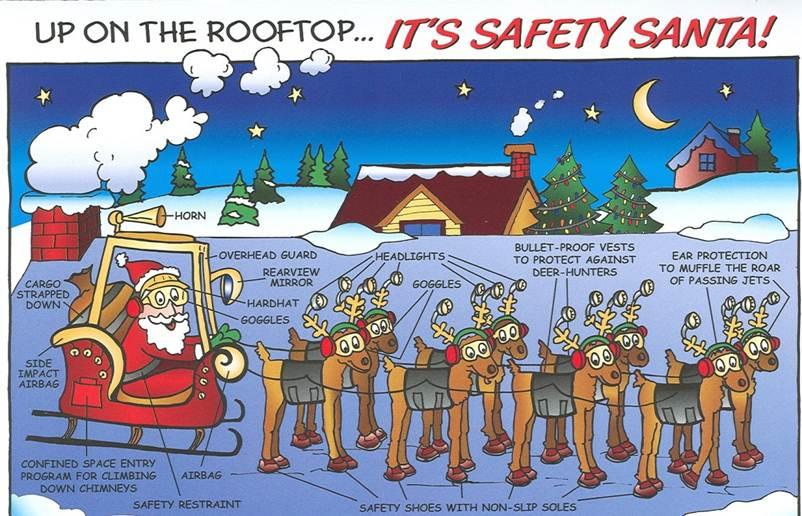
    Pundits and politicians are telling us that Santa will be late this year.  More salt on the wound, the jolly elf may not have everything on our list.  “Say it isn’t so, oh the humanities.”  Pass the eggnog please, Clark.

    This prognosticator suspects they are all wrong!!  Every young child knows that Santa, Mrs. Claus and their host of elves make all the toys, all year long at the North Pole.  So what’s the problem?  They are wrapping (pun?) things up even as you read this piece, right?

    Well, the dirty little secret is that somewhere along the way, Santa outsourced and even offshored his manufacturing and much of his distribution.  Must have been when the elves went on strike during Y2K.  Toy manufacturing no longer takes place at the North Pole.

    Be ‘SMART’ About Things

    However, Santa is a visionary.  He is a SMART Manufacturing Early Adopter, even an Innovator.  Shortly after, “The term Smart Manufacturing was coined in 2006 at a National Science Foundation workshop on Cyberinfrastructure,” Santa secretly developed his Proof of Concept and later a Pilot at a North Pole toy facility.  Legend has it that by 2012 he was deploying enterprise level SMART Toy Manufacturing at global scale.

    Today, some of Santa’s Helpers appear to be struggling against the firm deadline.  Their level of ’empowerment’ and creativity will determine how well the territory they are responsible for fares later this month.

    For those in real trouble, one suspects that Santa has already done two (2) things.  First he has probably sent in Teams of supply chain Subject Matter Expert elves to help suppliers get processes back on track  Additionally, he has transferred business from those who might miss the deadline to those forward looking firms that value High Reliability Organizational traits and will perform against the deadline.

    Santa is not only SMART, he and his organization are Resilient!

    Disruptions Amongst Us

    When things go bump-in-the-night with a supply chain, the worst thing Santa’s Helpers can do is fib.  Check is in the mail, dog ate my homework, I over slept, my car would not start, my computer crashed and so forth and so on.  Like most parents of small children, he has heard it all before over his long life.

    Santa always knows ‘who has been bad and good,’ and Data Analytics does not lie about his supply chain ecosystem.  You can try to hide but you cannot run.  While coal is out favor these days, Santa still have plenty to deliver as necessary.  Coal in your stocking would ruin a Carbon Free Holiday, so behave.

    Yes Virginia,

    There is a Santa Claus and he has never screwed things up!  He will fly from his distribution center at the North Pole the night of December 24th.  As he always has.  On the morning of the 25th, kids all over the world will celebrate.  The supply chain Grinch will not steal from the kiddos.  All will be joyful and full of song.

    Santa will deliver, despite the challenges faced.  If he can, why can’t your organization?  For those who have seen the movie Miracle on 34th Street, you know he is real?  In that movie, he delivers a house to a skeptical young girl.  He found a way.

    Santa has a global distribution problem– yet he always delivers on time to the largest customer base of all!  He has to for if he failed and his customer’s lost faith in him, it might be the end of the month of December as we know it.  The stakes could not be higher.

    Usher in the New Year

    Paraphrasing the late Secretary of Defense Donald Rumsfeld, “You go to war with the supply chain you have, not the supply chain you might want or wish to have at a later time.”  A later time always comes regardless of preparation or not.  If your organization is one of Santa’s Helpers/Suppliers that did not have business processes that were ‘smart’ enough this year, Happy New Year!  Start January 2nd to transform the old ways.

    For more about SMART Manufacturing, keep an eye our for the release of our 2022 book, “Smart Manufacturing: Integrating Transformational Technologies for Competitiveness and Sustainability.”  We will announce it on these pages when it is available.

    Hope you all found a bit of holiday cheer in this piece.  The story may be tongue-in-cheek, but the message is real.  It is time for all of us to ‘Get Smart.’  For those of you who were children of the 1960s, you will get the pun.  For the rest of you, GOOGLE IT!

    Happy Holidays

    For More Information

    Please note, RRI does not endorse or advocate the links to any third-party materials.  They are provided for education and entertainment only.

    For more information on Cross Cultural Engagement, check out our Cross Cultural Serious Game

    We presented, Should Cross Cultural Serious Games Be Included in Your Diversity Program: Best Practices and Lessons Learned at the Online Conference, New Diversity Summit 2020 the week of September 14, 2020.  Check Out this timely event and contact the organizer for access to the presentations!!

    You can contact this author as well.

  • THE SCIENCE: The Reason We Need STEM

    THE SCIENCE: The Reason We Need STEM

    Almost every day, we hear that “The Science” says . . .  We are told Covid-19 and Climate Change are based on The Science and as such we must accept that expert analyses as ‘settled.’  Then something changes and once more the science police demand we accept their new interpretation.

    The near-term result: confusion and lack of trust, even acrimony.  The Science, as presented by the media, politicians and others is a static solution.  As we follow The Science, we are told we must adjust but not necessarily why.

    There is no reason to trust to fate or our political betters (call themselves elites).  The Science is not that mysterious.  The term is meant to deride most of us, including degreed scientists like this author.  Might want to ask those pontificating to define the ‘Scientific Method.’

    Set at the beginning of the 20th Century Space Race, the movie, Hidden Figures brought broad attention to the mathematical genius of a group of then unknown women.  They were instrumental helping the fledgling NASA achieve the early goals of manned space flight, including the lunar landings.  They understood The Science better than others.

    On the Shoulders of Giants

    With the social deck stacked against them, these women rose above the norms of the time and accomplished feats unknown and certainly unexpected by contemporaries.  Perhaps more importantly, they demonstrated that math and science is not reserved for elites.  They educated all of us.

    We live in a technological age and told shortly everything will be ‘Smart.’  The workforce will change, and our view of the world will be dramatically different.  Moreover, many of us will no longer be relevant or even employable.  Balderdash!

    Science, Technology, Engineering, and Math (STEM)

    STEM is the anacronym for the set of technical knowledge embodied in these ‘hard’ disciplines.  Collectively, they form the backbone of our 21st Century economy and social advancement.  While liberal arts disciplines are important, STEM knowledge is critical if we are to hold the ‘experts’ accountable.

    Increasingly, ‘soft’ or social skills are also seen as important.  The old concept of the ‘Nerd’ is giving way to the technologist with human empathy.

    The emerging generation(s) will need STEM expertise as well as soft skills.  In some ways this is no different than previous times when the Titans of Industry changed their world.  Building on new technologies, they built business.  A successful business requires a knowledgeable workforce that can monetize technology.

    The titans this time are everyday men and women, even juveniles.  Knowledge of STEM subjects is dictating individual success or failure.  Get on the STEM train.

    Role of R B C

    We have routinely commented on the Relationships, Behaviors, Conditions model first put forth in the 1990s.  From a previous blog, “One of the basic tenets of the RBC Framework is the general construct that Relationships cannot be determined a priori.  The well-used example is a man and a woman sitting on a bench at a bus stop.  Are they married, siblings, coworkers, friends or simply two people waiting to catch the same/different bus?

    Their relationship cannot be known directly.  However, their Behaviors will provide insight into how they relate to each other.  Romantic behavior may indicate marriage, dating, an affair etc. They may still be coworkers but most likely are not strangers.

    The third dimension, Conditions (environment) can be considered the stage upon which behaviors play.”

    One can make the case that STEM is a condition or situation.  In other words, our technology environment.  The behavior of individuals with these skill sets will determine the relationship these individuals have with their peers, customers/business ecosystem and economy/society in general.

    Finally

    We spend a lot of time, quoting “The Science.”  Most vocalizing the term are not scientists or even qualified to understand its basic tenets.  But taken as gospel because of some perceived authority, i.e., politicians, newscasters, celebrities and bureaucrats among others.

    This scientist suggests that STEM is necessary to assure the emerging generations understand “The Science” and how it can actually be used to benefit mankind.  And, oh yea and make a buck!

    Where does STEM fit in Your Organization’s Strategy?

    For More Information

    Please note, RRI does not endorse or advocate the links to any third-party materials.  They are provided for education and entertainment only.

    For more information on Cross Cultural Engagement, check out our Cross Cultural Serious Game

    We presented, Should Cross Cultural Serious Games Be Included in Your Diversity Program: Best Practices and Lessons Learned at the Online Conference, New Diversity Summit 2020 the week of September 14, 2020.  Check Out this timely event and contact the organizer for access to the presentations!!

    You can contact this author as well.

  • Open Sesame

    Open Sesame

    A Year of Leadership–Or Not!

    On March 2, 2021 the Governor of Texas announced its 100% reopening–effectively proclaiming an end of the Covid-19 crisis.  Needless to say in our hyper-partisan world, many widely decried the decision and even accused him or bringing physical death to the state population.

    Mississippi announced a similar rollback of virus driven constraints.  Likewise, Connecticut is rapidly easing similar restrictions.  These state join others with loose Covid-19 protocolsThis pundit expects this trend to gain speed quickly and worldwide.

    Meanwhile, the President of the United States accuses these decisions as being made by Neanderthals, while the Director of NIAID position has move from NO mask to wearing MUTIPLE masks.  The political divide regarding the path forward remains wide.

    Consent of the Governed

    “You can fool all the people some of the time, and some of the people all the time, but you cannot fool all the people all the time,” is attributed to Abraham Lincoln.  This oft quote is usually seen through a political lens.  More importantly, it is a position from a Leader!

    Driven by suspect data we were told that this virus had an Armageddon like quality.  At one point over 2 million Americans were projected to die and the hospital systems would be overwhelmed, perhaps irrevocably.  Hospital ships were mobilized and economies brought to their knees all to save lives.  Perhaps, even our own.

    To be clear, many did succumb and many lives were destroyed or at least changed forever.  We mourn those and recognize the serious of this pathogen.


    A few of my family and friends have been infected but fortunately with only minor symptoms and limited hospitalization.  In this we are very fortunate.

    Crises can happen at any time, hurricane, winter storms, hostilities are part of the human conditions.  How we respond it the difference between chaos and inconvenience.  Leadership determines the outcome!

    If you have lost someone to Covid-19, cancer, accident, fire (I lost two family members) or other tragedies, statistical arguments are meaningless as the probability is 100%.  However, for the overall population likelihood of recovering from the coronavirus has always been quite high.

    Many questions have been raised regarding the myriad of conflicting “authoritative” information and misinformation the public has endured for 12 months.  With no conclusive or definitive game plan put forth by authorities, we were left to fend for ourselves.

    A resident of the Houston metropolitan area, this writer has noted that traffic is almost back to normal.  This suggests that the governed no longer have faith in political or medical leadership demanding yet another year under their ‘knowledgeable’ thumb.

    Once that credibility is lost, game over for leaders pontificating that to be safe we must hunker down forever.  Not sure even the Londoners did that during the Blitz.

    The Future is Bright

    Rulers attempt to dictate through a never ending series of edicts.  Knowledgeable governed conduct reasonable due diligence and make there own risk adjusted behavioral decisions.

    Likely, recent events are driven by the political class learning that enough is enough.  After all, we are adults and capable of living our own lives.

    Agree that the pathogen is still with us and we must address it.  Vaccines have a long history of success and processes are in place for safe openings.

    Society is opening with or without the politicians.  Remember the Speakeasies during Prohibition of the 1920s?

    Expect more to run to a microphone and claim leadership.  Ultimately, this process is irrelevant.  Getting out ahead of a parade and claiming to be the Grand Marshal does not make it so.

    Regardless, 2020 is over and there is NO interest in repeating it in 2021.  Message from the governed–we will take our chances going forward!  Our  R B C Framework model at work.

    Covid-19 is not over but seems to be getting to remission thanks to the army of men an women who have risen to the challenge in less than a year and saved countless lives.

    How are you leading your organization to recapture Normal?

    For More Information

    Please note, RRI does not endorse or advocate the links to any third-party materials.  They are provided for education and entertainment only.

    For more information on Cross Cultural Engagement, check out our Cross Cultural Serious Game

    We presented, Should Cross Cultural Serious Games Be Included in Your Diversity Program: Best Practices and Lessons Learned at the Online Conference, New Diversity Summit 2020 the week of September 14, 2020.  Check Out this timely event and contact the organizer for access to the presentations!!

    You can contact this author as well.

  • Teaming Safely

    Teaming Safely

    “For safety is not a gadget but a state of mind”


    Second only to the basic need for food, water and what is required to sustain physical life, safety and security are the next step in Maslow’s Hierarchy of Needs.  In other words one cannot love or feel belonging or achieve a level of esteem without having the warmth of safety much less attain self-actualization.

    More recently, team safety has come to be defined as Inclusive.

    There are three components of team safety:

    • Sociological — “developing and maintaining friendly social bonds is a fundamental organizing principle of human behavior”
    • Psychological — “defined as a shared belief that the team is safe for interpersonal risk taking”
    • Physiological — “relating to the way in which a living organism or bodily part functions”

    If members do not feel ‘safe’ then the team is not capable of high performance.  Moreover, the synergistic value that can be derived from team diversity can not be captured.

    Attaining Safety

    While the need to be safe is coded in our DNA so to speak, we are not inherently safe.  Individuals as well as teams must be proactive to reach situational safety.

    We are Mindful when we are in touch with ourselves and the environment through nurturing feelings.  Interesting, being mindful is a major requirement of High Reliability Organization/Team.  High reliability is a necessary ingredient for an organization’s Safety Culture and by extension its Teams (including third party ecosystem members).

    Safety is a learned behavior.  Therefore, effective training and ongoing reinforcement are necessary. Moreover, realistic scenarios are mandatory making the learning process relevant.

    Take the following maturity assessment and implement your team training program!

    What is your Team’s Culture of Safety Maturity?

    For More Information

    Please note, RRI does not endorse or advocate the links to any third-party materials.  They are provided for education and entertainment only.

    For more information on Cross Cultural Engagement, check out our Cross Cultural Serious Game

    We presented, Should Cross Cultural Serious Games Be Included in Your Diversity Program: Best Practices and Lessons Learned at the Online Conference, New Diversity Summit 2020 the week of September 14, 2020.  Check Out this timely event and contact the organizer for access to the presentations!!

    You can contact this author as well.


  • Is Your Remote Team Aligned?

    Is Your Remote Team Aligned?

    Recently, my team and I were tasked with a delicate decision making process.  Due to its nature and signatory level, team members were only authorized to explore and present options.  The final decision was mine alone.  Our project governance model clearly defined this decision making process.

    One day I received a call from remote members explaining they were going to a vendor site to assess our options–I concurred.  Several hours later they let me know that they had made a decision and signed a contract.  When challenged about their actions they informed me that the vendor had demanded that they ‘act fast.’

    Twice in my career I was the C level executive responsible for global operations.  In one case, one of my direct reports was in a different office along with my boss, the CEO.  I received multiple calls from the CEO over a period that ‘so and so’ had stopped by to talk and decisions were made about my operations.  “Well you were not here was the excuse and it seemed like a good idea to me.”  Would it surprise anyone that ‘so and so’ was relieved shortly thereafter?

    In another, the software development operation was in a different part of town.  Development plans were agreed to and then in some cases materially changed with without authority or even informing management.  Needless to say, projects were late or not completed.  After a few weeks of this, the development lead was terminated.

    Remote Management Governance

    Based on the above paragraphs, some may argue that I am not a very good manager.  Perhaps, they are right; however, the point is remote management can be very difficult.  Empowered individuals and teams must have boundaries.

    Yes, hire smart people and get out of the way.  However, there are limits as even Steve Jobs, the micromanager would agree.

    Evidence suggests that working remotely has its challenges and not everyone is well suited for it.  Some individuals will need additional support.

    There is a great deal of information available about remote management.  Some is sound, but this Though Leader on the subject disagrees with much the advice.  It seems for many, this is their ‘first rodeo’ while remote management goes back to antiquity.  While not the first, the Roman Empire functioned well from a bureaucratic or management perspective.

    Inclusive Teams

    Currently, much of the discussion focuses on the Inclusion of team members.  We are recognizing that Diversity is not enough if not every one participates.

    Previously, we had put forth the construct that cross cultural teams have many of the same characteristics of diverse groups.  We can extend this model and success that Inclusive Teams include those individual who are not as well suite for remote teams as others.

    Managing diverse remote teams and assuring that all team members are valued contributors requires a level of managerial engagement that is constant, consistent and appropriately empowering.  ALL members must be encouraged to participate and their input must be acknowledged by the others.  Only then can Steve Jobs and Elon Musk like decisions be taken and not by those who tend to dominate groups unilaterally.

    D&I in a Post-Pandemic World

    Typically, D&I has been defined as a function of ethnicity and/or gender.  Last year we put forth the construct that Cross-Cultural and D&I are similar models of human behavior and best practices from both could add value to the other.

    Diversity must now include those are not well suited for new business models; however, flawed they may be–jury is still out regarding the effectiveness and efficiency of full time remote teamsInclusion means they must be actively involved.  Leaders at all levels must assure this model is successful.

    How Do You Assure the Reluctant Remote Team Members are Included?

    For More Information

    Please note, RRI does not endorse or advocate the links to any third-party materials.  They are provided for education and entertainment only.

    For more information on Cross Cultural Engagement, check out our Cross Cultural Serious Game

    We presented, Should Cross Cultural Serious Games Be Included in Your Diversity Program: Best Practices and Lessons Learned at the Online Conference, New Diversity Summit 2020 the week of September 14, 2020.  Check Out this timely event and contact the organizer for access to the presentations!!

    You can contact this author as well.


  • The Tyranny of the Blank Sheet of Paper

    The Tyranny of the Blank Sheet of Paper

    We have all had that, “Where do I start” moment?  Confronted with the NEW, sometimes the task seems daunting.  In a recent conversation, a colleague and I were discussing an adult training program.  The subject centered on how to help students jump start a creative flow.

    We humans are fond of using so called cheat sheets.  Whether school CliffNotes, Cut and Paste, Go Bys, Best Practices or other tools to wrap our mind around a subject and launch the thought process.  In other words, anything to move us away from the cosmic void–so called ‘writer’s block.’

    Tidbits that Work for Me

    Faced with tyranny often during my formative career years, i.e., a professional services proposal, new spreadsheet, etc. a few tricks were developed.

    First—Just start writing.  Put your thoughts down as they fly out and don’t worry about the order or even if they are relevant.  You can sort these things out later, but a least your paper is no longer blank.

    Get Up—Hit a spot where nothing is pouring out of your brain? Put your (electronic) paper down and go exercise or do something totally unrelated.  You will be surprised how the creative juices will flow when you return.

    Ask a Friend—Remember the old game show where contestants could ‘phone a friend’ when stumped on a question?  Brainstorm with friend and colleagues; even those who have no knowledge of the problem your engaged with.  Sometimes, they have the best insight—true out of the box.

    Do Something Else—If time allows put the project on the shelf and work on something entirely different.  You can come back later refreshed.

    FYI, the tyranny never goes away.  Hundreds of publications and presentations later, it still can persist from time to time.  The four tidbits still work for this author.

    By one definition, tyranny is “cruel, unreasonable, or arbitrary use of power or control.”  There is no reason to let a blank sheet of paper exercise such awful authority.  Take back your creativity!

    Why Let the Blank Sheet of Paper Ruin Your Day?

    For More Information

    Please note, RRI does not endorse or advocate the links to third-party materials.  They are provided for education and entertainment only.

    For more information on Cross Cultural Engagement, check out our Cross Cultural Serious Game

    We presented, Should Cross Cultural Serious Games Be Included in Your Diversity Program: Best Practices and Lessons Learned at the Online Conference, New Diversity Summit 2020 on April 9, 2020.  The summit will be offered again soon.  Check it Out!!

    You can contact the author as well.

  • Technology Assessment in the Era of Minimum Viable Product (MVP)

    Technology Assessment in the Era of Minimum Viable Product (MVP)

    App developers have fallen in love with the concept of Minimum Viable Product aka MVP.  Wikipedia defines minimum viable product (MVP) as “a version of a product with just enough features to satisfy early customers and provide feedback for future product development.”

    This development model might make some sense for consumer software or even some business data analytics but how does it work for mission critical software and those apps that allow remote connectivity to those data resources?  MVP is problematic in these cases at best.

    Most mission critical software development organizations understand that robust testing is necessary, yet sometimes the specter of the MVP mentality sneaks its camel nose under the tent.  Think this does not happen?  Think again.

    The Boeing 737 Max 8 is one current example of this phenomena.  One can argue that the costs to this organization, its customers and the flying public have been astronomical and perhaps not measurable.

    Many of us will not be flying any time soon and many months ago this writer has been told by a knowledgeable individual that safe work around for the Max8 software issues have always been readily available—even before the crashes.  There is a more onerous issue that affects everyone on the planet is widely accepted by policy makers.

    We extend the construct of MVP to Minimum Viable Thought.  MVT is defined as, “The version of a decision that the decision makers believe will be accepted by organizational executives and public policy makers.”

    As of publication, this statement is posted on The Institute for Health Metrics and Evaluation (IHME) at the University of Washington.  “To construct our “Current projection” (the line that shows what we think will most likely happen), we assume that in each location the trend of easing mandates will continue at its current trajectory until the daily death rate reaches a threshold of 8 deaths per million.  If the daily death rate in a location exceeds that threshold, we are assuming that mandates will be reintroduced for a six-week period.”

    We do not dispute modelers making assumptions.  We do that same.  However, this caveat.  Decisions made based modeling assumptions such as these often lead to cataclysmic results.

    The concept of MVP can be a slippery slope.  In an era of rapid software/data release, the risk to the public whether in airplanes or a pandemic can be huge.

    The assessment of such technological solutions needs to be robust and thought through.  Not the knee jerk response often seen.

    How do you assure new technology implementation does not material negatively impact on your business?

    For More Information

    Please note, RRI does not endorse or advocate the links to third-party materials.  They are provided for education and entertainment only.

    For more information on Cross Cultural Engagement, check out our Cross Cultural Serious Game

  • Next or Back to the Future?

    Next or Back to the Future?

    Current events may have us all longing for the ‘good ole days.’  Sounds good on paper but not something any of us can realize.  Nostalgia aside we all must continue to slog on.  It is after all a one-way trip and there is no Delorean to help us.

    The Challenge of Change

    People change all the time and we have covered this before in this series a number of times.  However, some change is not without transformational difficulties.  The literature is replete with case studies where organization/industry transformation failed and sometimes spectacularly.

    Depending on one’s perspective sometime during February or March of this year, the global population became generally aware of a new and potentially devastating pathogen.  Dramatic (even draconian) measures were taken, and we were all convinced of the potential for global devastation.  Global Stay-At-Home orders wrecked economies but most of us dutifully obeyed.

    As of this writing, in a world of almost 8 billion people, according to a credible source, Johns Hopkins:

    • Cumulative Cases; Less than 8 million
    • Deaths; Less than 500k
    • Recovered; Approximately 3.7 million

    Rarely, emphasized math suggests that there are approximately 3.7 million Active cases.

    For those of you in the US (~330 million) like I am, the math looks like this:

    • Cumulative Cases; Just over 2 million
    • Deaths; Approximately 116k
    • Recovered; Approximately 560k

    Active US cases are approximately 1.4 million.

    Credibility Factor

    We have been told Covid-19 Armageddon was at hand.  Hospitals would be overwhelmed, etc.  No Mask and now Mask.  Most show few if any symptoms.  Now asymptomatic will kill the elderly and so it goes.  This list of contradictory positions goes on and change is justified by our “New Knowledge” about the pathogen.

    So What?

    Now we are told a new wave is coming from Memorial Day celebrations, protests and more from the phasing out of the lockdown.  How is the population reacting to these new pronouncements of doom?

    By engaging in normal human interactions.  Mask free in many cases to the chagrin of the medical experts.  One expert suggested that the United States does not have a coherent Covid-19 national policy.

    From my high school Civics, class, ”Enumerated powers are specific powers granted to Congress by the United States Constitution.  The framers of the Constitution wanted to ensure the new federal government would not become an overreaching entity that might subject the people to the oppression from which they had fled.  To that end, they listed, in Article 1, Section 8 of the Constitution, the authority over certain specific things.  Authority over every issue not enumerated, or assigned to Congress, is reserved for the individual states.”

    My interpretation, States are the governing body for most activities including a pandemic.

    Therefore, each state is charged with managing this process within federal law, taking guidance from resources such as the Center for Disease Control.  This is 200+ year-old policy.

    Failure to Launch

    In recent days, this writer has encountered numerous individuals seemingly in violation of the tenets of Covid-19 response.  After months of predicting the end of human interaction as we have known it and in the face of numbers that just don’t add up, we are told it isn’t over yet.  Seemingly entrenched positions prevail although data and subsequent rationale are fungible.

    Lessons Learned

    Much is being said about fundamental changes to industry, i.e., oil and gas, airlines, and others.  Societal change is presented as fait accompli and the time is now!

    The history of transformation does not support these hypotheses.

    Sustained change requires significant ongoing energy from catalysis.  Not the continuation of exogenous events but continued commitment to answer the What’s In It for Me question we all ask when confronted with a new model.

    Current events will fade and life as we knew it will likely continue.  To be sure, there will be some change but disruptive transformation in the social fabric pundits are predicting are unlikely based on the past and typical human behavior.

    How will You Assure Transformation is Sustained?

    For More Information

    Please note, RRI does not endorse or advocate the links to third-party materials.  They are provided for education and entertainment only.

    For more information on Cross Cultural Engagement, check out our Cross Cultural Serious Game

    We presented, Should Cross Cultural Serious Games Be Included in Your Diversity Program: Best Practices and Lessons Learned at the Online Conference, New Diversity Summit 2020 on April 9, 2020.  The summit will be offered again soon.  Check it Out!!

    You can contact the author as well.

  • 10, 20, 30, 40, 50 or More!

    10, 20, 30, 40, 50 or More!

    The advent of 5 G so soon after 4 G—Humm.  What’s next?  How many G’s are there?

    In 1965, Gordon Moore put forth the construct that the density of transistors in integrated circuits doubled each year.  The so-called Moore’s Law has governed technology growth ever since.  However; over 50 years later, some argue that we may be far up that power curve.  One conjectures if the latter statement is correct.

    In 1899, Charles H. Duell then the Commissioner of US patent is purported to have said, “Everything that can be invented has been invented.”  Mr. Duell died in 1920 so he missed many of the ‘new’ things we now take for granted.

    Marketers tend to categorize in buckets; Boomers, Gen Xers, Millennials and so forth.  Do any of these labels matter?  Probably not.  The same is true for technology tags as well.

    Life, technology, knowledge et al marches on, just like it has throughout human history.  Will we see the advent of 50 G networks?  Most likely; with 100 G hot on its heels!

    Less we forget, the current version of the cell phone (iPhone and its equivalents) was first released in 2007.  Much has changed in the last 13 years and we can expect that arc to continue with disruptive new mobile technology crashing in at some point.

    Agility

    Most think of an ‘agile enterprise’ as information technology driven.  In this writer’s opinion, this is a narrow perspective.  The word ‘agility’ is defined in terms of power and thinking.  In other words, the ability to make good decisions with the capacity to implement them.

    In this hyper-technology environment, it is not the adoption of a particular rendition, but the capability to incorporate the appropriate new in an economic manner.  This is true whether the organization is an ‘early adopter’ or even a ‘laggard.’

    For decades, organizational strategy has been enabled by technology.  There is no reason to change that model with many G’s to follow!

    How Does Your Organization Ingest New Technologies?


    Enjoy this flash back to the 1960’s.

    For More Information

    Please note, RRI does not endorse or advocate the links to other third-party materials.  They are provided for education and entertainment only.

    For more information on Cross Cultural Engagement, check out our Cross Cultural Serious Game

    You can contact the author as well.

    End Notes

      https://en.wikipedia.org/wiki/4G

      https://en.wikipedia.org/wiki/Moore%27s_law

      https://www.dictionary.com/browse/agility

      https://en.wikipedia.org/wiki/Technology_adoption_life_cycle

  • 2020 Vision: Are Your Stars Aligned This Year?

    2020 Vision: Are Your Stars Aligned This Year?

    Depending on one’s perspective, 2020 is either the end of the last decade or the beginning of this one.  One can argue that our actual birthday is the day we were born and 12 months later we are one year old.  This suggests that on our tenth birthday we have lived a decade and a new one begins.  Probably this conundrum will still be a subject of discussion in 3020.

    Going to our favorite breakfast cafe the Sunday after New Year’s Day, the parking lot was overflowing from patrons of the local gym in the strip center.  New Year’s resolutions in full force.  History suggests we will not have a parking problem by sometime in February.

    Another Failure of Change Management?

    Perhaps, but good intentions without an execution plan and realistic metrics play a role too.  Clarity of vision is important during times of transformation.

    Organizational lucidity is also important.  The annual Letter from the Chairman of every US public company will extol virtues for their coming fiscal year.  Note to those in sales—this is what is important to management, i.e., the organization’s value proposition so read it and act accordingly.

    Vision Duality

    We all have a vision about the future of our career.  However, another vision is emerging—machines.  One topical subject is the so-called Digital Twin or a representation of reality as a 3D graphic.

    This pundit and others have espoused this tool in support of Operational Excellence initiatives.  This extends human vision in ways that were not available in the past.

    One can surmise as this year progresses, clarity in operations may get much better.  It follows that those willing to take advantage and ‘change’ how they see the world will progress faster and farther than those who choose not to.

    Is the Future in the Stars?

    Probably, but not as many astrologers would have us believe.

    Stars will align this year for each individual who takes the initiative to make that happen.  Not astrological destiny, but proactive leadership with new ‘star’ management systems.

    The Year is Almost Three Percent Old, What Have You Done So Far?

    For More Information

    Please note, RRI does not endorse or advocate the links to other third-party materials.  They are provided for education and entertainment only.

    For more information on Cross Cultural Engagement, check out our Cross Cultural Serious Game

    You can contact the author as well.

    End Notes

      https://www.farmersalmanac.com/new-decade-2020-or-2021-100900

  • Safety Santa: Another Case of Operational Excellence Success

    Safety Santa: Another Case of Operational Excellence Success

    A year ago, it was the pleasure of this blogger to report that Santa Clause completed yet another successful global fulfillment process AND importantly, the process was in compliance with the US Federal Aviation Authority’s (FAA) regulations.  A great deal of progress since the advent of one red light on the nose of the lead reindeer!

    This year we are once again pleased to report that not only have the flying sled and its power plants remained in compliance with the FAA but has now taken additional steps forward.  Incorporating new technologies and processes, safety has been enhanced in the following manner:

    • Addressing Slips, Trips and Fails with new safety/skip proof landing gear
    • A new Confined Space program along with appropriate personal safety gear
    • An alarm Klaxon and Better Lighting
    • Enhance Safety Restraints such as airbags and an overhead guard
    • Extensive Head, Vision, and Hearing Protection systems
    • Better Work Place Violence technology enabled processes
    • A new Cargo Restraint system

    It looks like the arctic region of the Occupational Safety and Health Administration (OSHA) outreach program is having great success.  Interested readers are invited to review the above safety Infographic for further details and perhaps new insights.

    Simplified Business Model

    There are a lot of lessons herein for those who don’t live at a mythical north pole.  First, it seems that much if not all the safety improvements made are inexpensive and easily implemented.

    Next, change management and new policies appear to be welcomed by those affected.  Answering the, “What’s In It For Me” question when adopting new technologies.

    Management is also ‘walking the walk’ with employees by driving the sled and taking the same risks as the rest of the team fulfilling customer requirements, i.e., snow covered rooftops and chimneys.  One can argue that this entire team is the Customer Facing part of the system.  Finally, customers have high expectations that must be met, and late delivery is not an option—this project has a fixed deadline!

    Stakeholder Value

    With billions of children waiting and using a complex and global logistics system, this team does not disappoint.  Earlier competitors have long dropped off the map.

    So why with a clear monopoly does this organization still seek greater Operational Excellence with its transformational Safety Culture?

    Simple—safe and excellent operational performance is good business!  Less unplanned downtime increases the bottom line.  Few incidents increase morale and the bottom line.

    Fewer legal issues, regulatory matters, and so forth and so on positively impact the bottom line.  With such significant ROI, what’s a stakeholder not to like?

    Is Your Operational Safety on Par with Ole Saint Nick?

    For More Information

    Please note, RRI does not endorse or advocate the links to other third-party materials.  They are provided for education and entertainment only.

    For more information on Cross Cultural Engagement, check out our Cross Cultural Serious Game

    You can contact the author as well.

  • Running Across an Open Field: Strategy for Disruptive Technology?

    Running Across an Open Field: Strategy for Disruptive Technology?

    Several weeks ago, as an amateur history buff, I was watching a documentary about World War I.  During one segment the commentator discussed the apparent fact that if soldiers refused to charge out of their trenches across an open field into the teeth of waiting machine guns they would be shot.

    The brutality of such a command by (so-called) leadership is appalling.  It may have been one thing for Alexander the Great’s armies to engage in open battles with sharp pointed objects as weapons.

    It is quite another for General Pickett’s infantry at Gettysburg to charge cannons and 50+ years later to repeatedly try the same tactic (by both sides) at horrific costs.  Generals always fight the last war, so the saying goes.

    This blog is not about some of history’s follies, it is about learning so as not to repeat the mistakes of others.  These lessons apply to readers’ daily business world as well.

    When New Technology is Deployed

    New disruptive technology can tear the societal fabric.  Some old jobs and companies disappear, and new ones thrive.  This process has been repeated since antiquity.

    Our culture is having this dialogue today regarding digitalization and its suite of technological driven change, i.e., Blockchain, AI, etc.  Principal issues that must be addressed include Human Factors Engineering (HFE).

    “HFE places the human operator at the center of the complex operating environment.  HFE recognizes that this individual or set of individuals is the puppet master and is responsible for the entire show.”  In other words how do we interact with the new technological reality.

    Reliable and valid HFE is the key to successful digitalization initiatives.  It will be the vital to whatever is next as well.

    Tyranny of the Minority

    From political science, “For centuries, theorists have worried about the potential of unrestrained democracy to lead to a tyranny of the majority, in which majority groups ride roughshod over the rights of minorities.  What we often see today is instead a kind of tyranny of the minority: a system in which a particularly extreme and motivated fraction of the populace can wield outsized power in the face of a majority which is either too indifferent or too scared to oppose it,” (italics added).

    In most organizations, there are fewer leaders than those who fabricate a ‘work product.’  The responsibility of leadership is to set the vision, mission and goal as well as enabling the organization with the tools and support necessary to reach targeted stakeholder value.

    But what if this minority group is the slowest to come to grips with disruptive forces?  In the face of newness, they may ‘keep doing what they have always been doing.”  In such an environment, the organization will likely not reap the same reward as in the past.

    Does too indifferent or too scared describe your organization’s ecosystem workforce?  One suspects It would be good to know.

    Fast Fail

    In our last blog we discussed the rapid assessment of technology and when to drop it if it does not appear to be working out.  Perhaps, we should treat managerial processes the same way.  After a horrific and visible failure in leadership, conceivably one preserves best by looking for alternative?

    If charging head long across an open field leads to disaster, why keep doing it?  While a counter argument might be that we had no tools to defeat those equipped with the new technology, to this writer, that logic is suspect.

    Flanking an enemy’s line or using guerrilla tactics, et. al. are as old as human confrontation.  Unconventional warfare has a long record of documented success.

    The business lexicon is loaded with military terminology.  We often speak of business as if it is warfare, when of course it is not.  There are lessons to be learned about human and organizational behavior, however.

    Decades ago, the concept of Guerrilla Marketing was the rage.  With the advent of social media, it has advanced, and the methodology is available to all.  Huge budgets and massive media campaigns are no longer necessary.

    Head-to-Head the biggest ‘guy’ usually wins.  So, if you’re not him/her, DON’T DO IT!!  However, the small mammals may displace slow moving dinosaurs.

    Agile is not an IT term.  It should be the state of mind of leaders at all levels.  To charge across the open business landscape into technology designed to destroy your organization remains folly.

    How Are You Leading the Charge into the Future?

    For More Information

    Please note, RRI does not endorse or advocate the links to other materials.  They are provided for education and entertainment only.

    See this 3:15 minute clip for more information on living in a World War I trench.  Pathetic way for leaders to force those under their command to live.

    For more information on Cross Cultural Engagement, check out our Cross Cultural Serious Game

    You can contact the author as well.

    End Notes

      https://consult2050.com/job-disruption-due-to-digitalization/

      https://therrinstitute.com/wp-content/uploads/2018/10/HRM-in-Process-Industries-Sustained-by-Human-Factors.pdf

      Ibid.

      https://areomagazine.com/2019/04/02/the-tyranny-of-the-minority-and-how-to-prevent-it/

      https://therrinstitute.com/lessons-from-the-seventies/

      https://en.wikipedia.org/wiki/Guerrilla_marketing

  • Lessons from the Seventies

    Lessons from the Seventies

    At lunch the other day and for whatever reason, the history of the 3M Post It Note became a subject of our conversation.  This technological marvel unveiled in the 1970s is still widely used today.

    As with other new or disruptive technologies, the ‘sticky note’ was panned at first and for some time.  According to Wikipedia, the technology was first developed in 1968.  It was not until 1974 that it gained some internal company support.

    When finally introduced in 1977, the pilot results were unsatisfactory.  However, things started to change in 1978 when a small (focus) group of consumers were positive about the product.

    The United States roll-out began in the spring of 1980, followed by Europe and Canada in 1981.  A bit of trivia, the reason it was originally yellow was because yellow colored scrap paper was readily available at its inception.

    Earlier the day of our lunch meeting, a discussion revolved around how long it might take an idea to become a fundable start-up company.  Several participants argued that with proper guidance, the process still might take up to two years.  This pundit argued that many entrepreneurs would see that as too long and become disinterested.

    The legacy of the Post It Note suggests that this pundit might be incorrect.  The lowly sticky note did not even begin its journey to become a Unicorn until twelve years after its technology was discovered.

    In 2015, we penned a blog, Titans of the 1940s Today.  The basic premise of that piece was when commenting about the Internet of Things (IoT) and its complexity, individuals such as Richard Feynman and John von Neumann (father of the 1945 computer architecture that is the basis of modern computing) had developed solutions for today prior to this author’s birth.

    We stand on the shoulders of these and other giants.  The challenge of every generation has been to build on what those who came before advanced.  So it remains today!

    Body of Knowledge

    Human kind has developed a rich body of knowledge in all areas of endeavor.  It is readily available for entrepreneurs as well as those employed by all types of organizations.  This knowledge base has been addressed in this blog and other writings by the author.  Interested readers are invited to review my blogs and newsletters dating back to the last century.

    Our march through history provides all of us a ‘go-by’ that can shorten our learning curve.  One example this author often cites is the depth of historical knowledge of management.  Contrary to many gurus, humans have managed others and processes for many millennia.

    Fail Fast, Fail Often?

    If 3M or Feynman et al practiced this technology development model as most interpret it, our world might be a lesser place.  Give up and move on to the next?

    One interpretation suggests, “Originating from Silicon Valley and its ocean of start-ups, the real aim of “fail fast, fail often,” is not to fail, but to be iterative.  To succeed, we must be open to failure—sure—but the intention is to ensure we are learning from our mistakes as we tweak, reset, and then redo if necessary.”

    This same article goes on to state, “Thomas Edison, by example, ‘failed’ 9,000 times before he was successful with his light bulb invention.”  Perseverance can be a lonely quality!

    Don’t lose heart.  Great ideas abound but must gestate.  It is often said that we find our soulmate when we least expect to—I know I did.  Progress is an iterative process fueled by creativity and critical thinking.

    Is Your Idea a Unicorn Waiting to be Born and Mature?

    For More Information

    Please note, RRI does not endorse or advocate the links to other materials.  They are provided for education and entertainment only.

    You can contact the author more information as well.

    End Notes

      https://en.wikipedia.org/wiki/Post-it_Note

      https://therrinstitute.com/wp-content/uploads/2018/10/Titans-of-the-1940s-Today-April-20-2015.pdf

      https://therrinstitute.com/wp-content/uploads/2019/10/1993-Management-Theory-Evolution-Not-Revolution.pdf

      https://www.forbes.com/sites/danpontefract/2018/09/15/the-foolishness-of-fail-fast-fail-often/#1db35b0e59d9

  • Want – Like – Need

    Want – Like – Need

    Years ago, as part of a never-ending series of company reorganizations, a team of our change management consultants headed to the ‘field’ to interview users.  Upon their return, they presented an extensive list of technology investments deemed necessary to remain competitive.

    Their list focused on technology and not business concerns.  Wondering, I asked who they interviewed.  Proudly, they proclaimed the “field engineers.”  When queried–did they talk with district managers, regional engineers and others with P&L or other managerial responsibilities, the answer was “no.”

    This very expensive process by a major professional services organization simply generated a wish list of junior employees.  It was what they thought they WANTED.

    In our current jargon, “cool stuff.”  Needless to say, none of these projects were funded.  Wasted time and money by those not familiar with our business!

    Today, we are driven to LIKE everything!  CRM systems demand input before we have even procured the product or service.  Log on to any given website and the request to complete a survey will hit you before you read the first line.  Five stars or thumbs-up emojis appears to be the goal.

    Do wants and likes add value?  Perhaps a like is a statement of preference, but perhaps the consumer wants the digital driven question to just go away without the hassle of someone begging for a higher ranking like.  Fibbing to surveys has become a national pastime.

    Business should be most concerned about what a prospect or returning customer NEED.  What pain point or problem does your product/service solve?  If you can’t answer that question, no amount of wants and likes will add to your bottom line.

    I may want a hamburger and go to a fast food restaurant with lots of likes.  However, if I am in a hurry and their preference is clearly to move cars via the drive-through faster than those of us waiting inside, my need to eat quickly will not be met.  I may leave without my meal or most likely not respond to a survey seeking likes.  Then never return!

    That lost customer will never surface in any analysis—not even one star.  Enough of those responses and the business will be in jeopardy and management my not even know why.  Collecting likes should never be a Key Performance Indicator (KPI).

    Finding the Pain

    In a recent Global Energy Mentors leadership meeting, an investment group recounted their business model as one that focused on identifying organizational ‘pain’ points.  Once a specific pain was articulated, the search for new technologies that would address/resolve that pain was undertaken.

    This model flies in the face of Steve Job’s, “A lot of times, people don’t know what they want until you show it to them.”  That may be and sometimes unknown needs are uncovered.

    However, in critical infrastructure sectors where failure is not be an option because it can be very expensive solving a known need is usually most important.  Without exception, this entrepreneur’s success has been focusing on addressing industrial client known pain points.  As an example, our EVPM modeling process demands input from customer groups.

    In this blog series, we have referred to successful change management that comes from addressing the—what’s in it for me question.  From a customer perspective; freeing ‘me’ from known pain is often more valuable than alleviating pain I did not know I had.

    Does Your Value Proposition Solve a Need, Address a Want, or Simply Generate a Like?

    For More Information

    Please note, RRI does not endorse or advocate the links to other materials.  They are provided for education and entertainment only.

    You can contact the author more information as well.

    End Notes

      http://globalenergymentors.org/

      https://www.helpscout.com/blog/why-steve-jobs-never-listened-to-his-customers/

      https://therrinstitute.com/brand-your-digital-oilfield-culture-internalize-its-transformation/

  • It’s the Economics Stupid!

    It’s the Economics Stupid!

    Since it was first uttered in the early 1990s, the phrase “It’s the economy stupid” has been used and misused extensively.  Let’s squander the lexicon one more time.

    The US ‘silly’ political season is well underway and forecast to last almost 13 more months—no telling what voodoo economics will emerge.  Those of us with our business noses to the grindstone must ride this stormy weather to a safe port next November.

    Most have an interest in the macroeconomic policies nation states put forth but other than voting and perhaps lobbying, there is little many can do to materially impact the economy.  What we can do is focus on the economics of our business—CAPEX.  Hence, our daily mantra should be, “It’s the Economics Stupid.”

    What Is Your Value to the Customer?

    For over the fifteen our organization has been, “Helping Clients Achieve Organizational Agility, Resiliency and Sustainability.”  Assisting clients develop and articulate a viable economic value proposition has been one of the most elusive and vexing challenges.

    There is a strong tendency to make statements that are Overstated, Not Demonstrable, and Not Defendable.  Declarations such as, “Enhanced credit control system for partners through increased information visibility” are effectively meaningless—yes, this is an actual quotation from a software company.  Customers are left with the question, “What does that mean for me?”

    Translate Technology into the Language of Business

    If you leave your customer with the above and/or other questions regarding your value to their enterprise, likely the sale will not close.  Probably, a more coherent competitor will leave with the deal.

    CAPEX always undergoes extensive scrutiny; even at the Board level in some cases.  While new and cool technology may ultimately be disruptive and of extremely high value, peddlers must speak the language of the Chief Financial Officer and her staff.  These are ‘green’ deals!

    Those tasked with generating revenue from technological solutions must also take on the role of translator.  Bridging the cultural differences between cool stuff and the bottom line requires a Rosetta Stone.

    The Economic Value Proposition Matrix® model (EVPM) was originally developed with a Super Independent oil and gas operator at the first part of the century to become that Rosetta Stone.  Working with customers, technology providers can now prepare for the inevitable decision by the CFO.  Usually, the vendor will not attend said meeting but preparing the customer staff to make the case is mandatory.

    This video tells the whole story in less than 43 minutes.  Is winning your next deal worth an investment of three quarters of an hour?  If not, keep doing what your doing and hope for a different result.

    The video makes the case that technology offerings often seems similar.  The same buzzwords and euphemisms often confused clients and make it appear that since the solutions are basically the same, just go with the low dollar.  Rising above this clutter is required to be successful.

    How is Your Value Proposition Better Than Your Competitors’?

    For More Information

    Please note, RRI does not endorse or advocate the links to third party materials.  They are provided for education and entertainment only.

    You can contact the author more information as well.

    End Notes

      https://en.wikipedia.org/wiki/It%27s_the_economy,_stupid

      https://www.forbes.com/sites/briandomitrovic/2018/12/02/george-h-w-bushs-voodoo-rhetoric/#26f9ad21798a

      https://www.investopedia.com/ask/answers/042415/what-difference-between-operating-expense-and-capital-expense.asp

     https://en.wikipedia.org/wiki/Rosetta_Stone

  • Brand Your Digital Oilfield Culture: Internalize Its Transformation

    Brand Your Digital Oilfield Culture: Internalize Its Transformation

    Our recent article, “The Digital Oilfield Culture: Transformation Value for the Organizational Ecosystem” (pp.24-26) takes a somewhat different change management approach.  Why not brand your digital oilfield culture?

    Most consumers are familiar with the so-called ‘Brand Name.’  These are names so ubiquitous that in some cases that we take them for granted.  Soft drinks, beer, fast food and automobiles are only a small sample of ‘product/service’ brands most can immediately relate to; even subconsciously.

    Hearing a brand name elicits a response, usually positive but possible negative as well.  This is the way organizations seek to have their product become part of the lexicon.  Examples include Xeroxing and Googling among others.

    Digital Oilfield Culture

    “Systemic Digital Oilfield Culture can be defined as the Core Set of Values and Behavioral Economics of ALL participants of the extended organization and its Enterprise Risk Management strategy that reflect a Strong Bond Governance commitment to behaving as a High Reliability Enterprise Ecosystem in a Safe and Environmentally responsible manner.”

    Ok, while accurate, this author’s definition of a Systemic Digital Oilfield Culture may be stiff and boring to some.  What does it mean to me and why do I care?

    As noted in past blogs and written pieces, a successful cultural transformation must address the. “What’s in it for ME” question.  Moreover, the answer must make sense to me if I am to internalize it.

    Taken from consumer marketing a, “Brand Essence is the emotional heart of a brand, summed up in a few words.  The Brand Essence Wheel is a format for capturing and communicating the conceptual subtleties of the brand.” (Chung and Doran, 2016).

    Successful brand strategies can create fierce lifelong loyalties, i.e., the cola wars of the 1970’s attempts to capture the emerging Baby Boomer demographic.  So why not take advantage of this marketing strategy when transforming the culture of an organization?  Create these fierce loyalties for your organization’s success!

    Brand Wheel Construct

    In accordance with the theory, the Digital Oilfield Culture Brand Wheel (First Draft) is composed of two major categories:

    Facts & Symbols or those components of the Brand that address the “hard” and often more measurable aspects.

      • What the Culture does do for ME
      • How I would Describe the Culture

    Brand Personality addresses the more emotional side of the Brand

      • How the Brand make ME look
      • How the Brand makes ME feel

    The wheel is then populated with those criteria of interest to the organization (generally developed through a series of workshops at all levels of the firm and its ecosystem).  One example is depicted in the following (Version 1.0) graphic.

    Final Thoughts

    There is a significant body of knowledge about the highs and lows of organizational transformation/change management.  The preponderance of the evidence suggests the transformation of a digitalized organization is difficult and often fleeting.

    The B2C sector has demonstrated repeated and sustained success creating perceived value to the individual (ME).  In B2B sectors, Rah Rah, executive sponsorship, training, etc. all have their place with change.  Yet, this is approach has proved wanting.

    Most importantly, strong Brands are sustained when the Rah-Rah fades.  Just Do It is the tag line of one major brand.  Betting most readers know what firm that is.

    Is Digital Oilfield Cultural Branding in Your Organization’s Future?

    For More Information

    The complete article is available from Petroleum Africa magazine and a ‘for fee’ copy can be downloaded.  In addition to a more detailed discussion of the branding process, it contains a high-level Implementation Plan.

    You can also contact the author as well.

    End Notes

      Shemwell, Scott M. (2019, May/June). The Digital Oilfield Culture: Transformational Value for the Organizational Ecosystem. Petroleum Africa Magazine. Issue 3. pp. 24-26.

    Petroleum Africa magazine has graciously allowed the re-publication of this edition.  See our full article.

      Ibid.

      https://en.wikipedia.org/wiki/Cola_wars

  • I Hate These Things: Why Does This Always Happen to Me?

    I Hate These Things: Why Does This Always Happen to Me?

    We have long argued that people will change if they understand the new idea/technology value proposition—what’s in it for me?  For some, this question is more difficult to answer than others.

    Moreover, we are all stuck!  This age of digitalization may pass a few ‘off the grid’ hermits by, but for the rest of us there is no turning back.  So, what if I hate these computers and they never work as they should?  What’s a person to do?

    All of us have expressed some frustration with technology.  It doesn’t work well.  It does not appear that Human Factors were considered in the development process.  Various ‘Screens of Death,’ and so forth and so on.  Of course, glitches occur at the least opportune time.

    Turns out this frustration with technology is understood.  Dystechnia is defined as, “A barrier to organizational performance—a condition of flawed or failed efficacy in the use, deployment, or logistics of technology.”  Akin to other disorders of capacity, i.e., dyslexia it is basically the impairment of the ability to control a skill.

    In other words, the inability to manage a Condition.  This becomes a reason to resist technological advancements as ‘nothing is in it for me.’  In fact, it makes my life worse!

    The Technology Acceptance Model (TAM), circa 1989 addressed two perceptions driving adoption Behavior, ‘Perceived Usefulness’ and ‘Perceived Ease of Use.’  The what’s in it for me question.

    To change the Relationship that individuals have with technology, management must understand that those who resist may exhibit two traits:

    • Impaired capacity to apply the ‘new’ to daily tasks
    • Perception that it does not help them

    Those regular readers of this blog are aware of the R B C model (Relationship, Behavior, Condition).  From our Cross-Cultural Serious Game, the model was originally developed to address issues around cross cultural (international) negotiation processes.  Relationships are the focal point of this perspective, reflecting commonality of interest, balance of power and trust as well as intensity of expressed conflict.

    Behavior in this model is defined as a broad term including multi-dimensions and intentional as well as unintentional.  Finally, Conditions are defined as active and including circumstances, capabilities and skills of the parties, culture, and the environment.  Of course, time is a variable in this model as well.

    One key feature of the R B C Framework is its emphasis on interactive relationships while providing an environment for multiple levels of behavioral analysis.

    This makes it a useful tool to better understand technology take up resistance.  As with any forensic assessor, once we understand the Structural Dynamics we can implement approaches that will resolve efforts to thwart the ‘new.’

    How Does Your Organization Overcome Resistance to Change?

      https://www.urbandictionary.com/define.php?term=dystechnia

      https://en.wikipedia.org/wiki/Technology_acceptance_model

      www.rri-ccgame.com

      https://therrinstitute.com/wp-content/uploads/2017/10/structural_dynamics_-__version.pdf

  • Resolution: Celebrating a New Operational Start–One More Time

    Resolution: Celebrating a New Operational Start–One More Time

    It is hard to believe we are now 19 years into the century.  Seems like only yesterday we were worried whether the lights would stay on at Y2K.

    Each year many of us promise to do better at a list of things, some personal and some professional.  Some days or weeks later, some or all of our resolutions go unmet.

    For many heavy industry sector firms, January 1st is also the start of a new fiscal year.  New budgets will be released, and management will extol their workforce to meet new (possibly stretch) targets.

    If the equity markets are a barometer of things to come (leading indicator), then the Conditions organizations will find themselves in will most likely be volatile and some segments may even face significant challenges.

    For example, WTI crude oil closed on January 4th at US$ 47.96/bbl.  Some are bullish on this sector, with an expectation higher prices in the future.  History has shown this faith may not bear out.

    Regardless, organizational Behavior will need the flexibility to adjust in a process relevant time frame as conditions change.  The resulting Relationship with the firm’s ecosystem is a function of the behavior in the conditions or market circumstance.

    In other words, the R B C Framework is applicable in our everyday corporate life.  Why is this important?

    One way to view the global marketplace is one of continual change.  Often purveyors of Change Management/Organizational Transformation present this as a point in time.  Statements about continuous improvement are seemingly afterthoughts.

    We have developed an Operational Excellence Platform, as depicted in the following figure.  Please note that it is built upon the R B C Framework.

    Since the nature of Relationships across the organizational ecosystem will continuously evolve based on the marketplace, it follows that maintaining Operational Excellence depends on these tree factors.  Safe and profitable operations on strong, positive relationships.

    How well does your organization understand the R B C Framework for its ecosystem?

    Further Reading

    The author and others have published extensively on this subject.  The list of appropriate articles and papers is too extensive to list here.  However, readers are invited to peruse Dr. Shemwell’s extensive list of blogs and publications.

    See our Economic Value Proposition Matrix® (EVPM) for additional information and a free version to build your own EVPM.

    For further information Contact Us.