
Category: Safety Culture

  • What a Turkey

    What a Turkey

    How many times have you seen someone do something incredibly stupid, even risking their life?  What a turkey!

    Story goes that Benjamin Franklin proposed the turkey as the American National Bird.  Almost 250 years later, this bird often carries a different connotation.  Often maligned, this tasty fowl has its day once a year.  Even two are granted a presidential pardon.

    Enter Safety Culture

    This pundit has spent his career around field operations and heavy equipment, first with the military and later as an oilfield field engineer going on to extensive international travel.  I have seen and done silly, stupid and often dangerous things, yet I emerged uninjured–lucky.

    As a physicist and MBA I started looking at business/technical process from a systems perspective.  A big influence was Peter Senge’s classic book, The Fifth Discipline: The Art and Practice of the Learning Organization.  I could relate to its view of behavior from functional structure perspective.  This led me to Systems Dynamics from which we build several models.

    Finally, in the early to mid 1990s (as part of my doctoral dissertation) we developed our construct of Structural Dynamics which we defined as Structural Dynamics is defined as the morphology or patterns of motion toward process equilibrium of interpersonal systems.

    All of this prepared me for what was to happen next.  In April 2010, Deepwater Horizon exploded in the Gulf of Mexico.  My colleagues and I started looking at this incident through the systems lens described above.  What we saw was very different than conventional wisdom.

    For decades Charles Perrow’s Normal Accident Theory posits that we can expect accidents from complex systems–they are inevitable.  Enter High Reliability Management in Process Industries: Sustained by Human Factors, which suggests that accidents are NOT inevitable and management systems can be put in place to adequately manage even the most complex system of systems.  Moreover, we now know that many disasters failures such as an airliner crash are of the function of many smaller issues happening concurrently.

    This led us to develop four major solutions for better safety in Critical Infrastructure sectors.

    This solution set enables organization of all sizes (public and private) to meet their high performance, high reliability goals while maintaining a sate workplace across their ecosystems.  Also check out our book, Implementing a Culture of Safety: A Roadmap for Performance Based Compliance and perform your own Self-Assessment of your organization’s ecosystem Culture of Safety Maturity.

    A final note.  One of the best books I have read in this regard is Deepwater Horizon: A Systems Analysis of the Macondo  Disaster.  The lesson therein are useful across industry sectors.

    We all know that ‘birds of a feather flock together.’  On a complex project there are many opportunities that might bring out the turkey in us.  Tools are available to limit or prevent the foul damage.

    What processes and procedure does your organization have in place to herd your flock?

    For More Information

    Please note, RRI does not endorse or advocate the links to any third-party materials herein.  They are provided for education and entertainment only.

    See our Economic Value Proposition Matrix® (EVPM) for additional information and a free version to build your own EVPM.

    The author’s credentials in this field are available on his LinkedIn page.  Moreover, Dr. Shemwell is a coauthor of the just published book, “Smart Manufacturing: Integrating Transformational Technologies for Competitiveness and Sustainability.”  His focus is on Operational Technologies.

    “People fail to get along because they fear each other; they fear each other because they don’t know each other; they don’t know each other because they have not communicated with each other.” (Martin Luther King speech at Cornell College, 1962).  For more information on Cross Cultural Engagement, check out our Cross Cultural Serious Game.  You can contact this author as well.

    For more details regarding climate change models, check out Bjorn Lomborg ands his latest book, False Alarm: How Climate Change Panic Costs Us Trillions, Hurts the Poor, and Fails to Fix the Planet.

    Regarding the economics of Climate Change, check out our recent blog, Crippling Green.

    For those start-up firms addressing energy (including renewables) challenges, the author can put you in touch with Global Energy Mentors which provide no-cost mentoring services from energy experts.  If interested, check it out and give me a shout.

  • Teaming Safely

    Teaming Safely

    “For safety is not a gadget but a state of mind”


    Second only to the basic need for food, water and what is required to sustain physical life, safety and security are the next step in Maslow’s Hierarchy of Needs.  In other words one cannot love or feel belonging or achieve a level of esteem without having the warmth of safety much less attain self-actualization.

    More recently, team safety has come to be defined as Inclusive.

    There are three components of team safety:

    • Sociological — “developing and maintaining friendly social bonds is a fundamental organizing principle of human behavior”
    • Psychological — “defined as a shared belief that the team is safe for interpersonal risk taking”
    • Physiological — “relating to the way in which a living organism or bodily part functions”

    If members do not feel ‘safe’ then the team is not capable of high performance.  Moreover, the synergistic value that can be derived from team diversity can not be captured.

    Attaining Safety

    While the need to be safe is coded in our DNA so to speak, we are not inherently safe.  Individuals as well as teams must be proactive to reach situational safety.

    We are Mindful when we are in touch with ourselves and the environment through nurturing feelings.  Interesting, being mindful is a major requirement of High Reliability Organization/Team.  High reliability is a necessary ingredient for an organization’s Safety Culture and by extension its Teams (including third party ecosystem members).

    Safety is a learned behavior.  Therefore, effective training and ongoing reinforcement are necessary. Moreover, realistic scenarios are mandatory making the learning process relevant.

    Take the following maturity assessment and implement your team training program!

    What is your Team’s Culture of Safety Maturity?

    For More Information

    Please note, RRI does not endorse or advocate the links to any third-party materials.  They are provided for education and entertainment only.

    For more information on Cross Cultural Engagement, check out our Cross Cultural Serious Game

    We presented, Should Cross Cultural Serious Games Be Included in Your Diversity Program: Best Practices and Lessons Learned at the Online Conference, New Diversity Summit 2020 the week of September 14, 2020.  Check Out this timely event and contact the organizer for access to the presentations!!

    You can contact this author as well.


  • I Didn’t Do It, He Did — I Didn’t Do It Either, Someone Else Did

    I Didn’t Do It, He Did — I Didn’t Do It Either, Someone Else Did

    “When converted into productive thought and action, the energy it takes to blame, shame, and game is enough to launch anyone into heights of real success and happiness.”

     – Charles F Glassman

    Entrée

    It is not often that an entire geographically LARGE state loses power and water simultaneously.  Now we know it can happen!  Welcome to Texas (ERCOT) circa the dawn of the 21st Century.

    The finger pointing and claims, ‘not my responsibility’ surfaced immediately at all political levels.  As I sat in my power free, cold, waterless house, I was moved that political leadership was focused on saving their own hides.

    Benjamin Franklin’s words, “We must all hang together, or, most assuredly, we shall all hang separately” are lost on our hyper partisan world.  Earth to all polls, there is enough blame on this one to go around.  This society loves to Share and Like and is quick to find fault.

    The usual suspects will pontificate about blaming others and legal initiatives have already surfaced.  Good media, but who actually cares?

    This blog post is not about politics or the blame game.  It rather posits a solution that sees that this never happens again–anywhere.

    Operational Excellence Platform

    Excellent performance requires a conscious effort at all levels of an organization and its ecosystem.  We embodied a approach for heavy industry in our 2012 article, High Reliability Management in Process Industries: Sustained by Human Factors.  In that piece we put forth the argument that High Reliability Management is a strong methodology for management large complex systems such as the Texas Electric Power Grid.  HRM provides organizations with Agility, Resiliency and Sustainability in the face of large complex incidents.

    As we have previously put forth, Normal Accident Theory (NAT) posits, “that some accidents are inevitable because of system complexity.”  While logical, this model has its critics and lacks empirical evidence.

    The Texas electricity power grid got into process/technological/engineering trouble rather quickly.  Debate will rage for years as to what actually happened.  However, it seems practitioners at all levels practiced NAT.  Like Deepwater Horizon, this event did not have to happen.

    Safety Culture

    At the core of High Impact Performance is a strong safety culture.

    Systemic Safety Culture as the Core Set of Values and Behavioral Economics of ALL participants of the extended organization and its Enterprise Risk Management strategy that reflect a Strong Bond Governance commitment to behaving as a High Reliability Enterprise Ecosystem in a safe and environmentally responsible manner.

    Going Forward

    The over used phrase, ‘teachable moment’ suggests that we learn from our history so as not to repeat it.  Most likely oxen will be gored, witch hunts abound and the likelihood of little tangible progress will be made.

    Career losses will most like exceed the six board members who have already resigned.  All because the reactive NAT model was followed.  One is well advised not to follow this lead.

    How are you making sure that your operations processes are proactive?

    For More Information

    Please note, RRI does not endorse or advocate the links to any third-party materials.  They are provided for education and entertainment only.

    For more information on Cross Cultural Engagement, check out our Cross Cultural Serious Game

    We presented, Should Cross Cultural Serious Games Be Included in Your Diversity Program: Best Practices and Lessons Learned at the Online Conference, New Diversity Summit 2020 the week of September 14, 2020.  Check Out this timely event and contact the organizer for access to the presentations!!

    You can contact this author as well.


  • How Dare You!!

    How Dare You!!

    Lessons in Leadership—how dare you put young people in jeopardy for loss of life or failures they will live with the rest of their life?

    As we end Veteran’s Week, we are reminded of President Herbert Hoover’s comment, “Older men declare war.  But it is the youth that must fight and die.”  Hoover was president in the late 1920s and died in 1964.  How many wars has the United States been in since 1930?

    Don’t bother to count—too many.  Probably more to come from political hawks who have never served much less been in combat nor have members of their family.  Not leadership but only positioning for personal gain.

    Disclosure: I have been in the military but not combat.  My father on the other hand was awarded the Silver Star during WW II.

    This piece is not about war or politics, it is about leadership or lack thereof.  After BP Horizon in 2010, this writer attended a conference where a VP responsible for operations from a well-known public oil & gas company admitted that he had never been on an offshore drilling rig but he and his colleagues were making arrangements to visit one soon.

    Dah!  What was he doing for 20 years—home office political parlor games?  Same is true for many Washington Generals/Admirals—check their resumes.

    You’ve Got to Be Kidding Me?  Yet it was true.

    This pundit repeatedly worked on drilling rigs during his 20s.  Begs the question, how can you ‘lead from behind’ when you do not have a clue what your people are dealing with?  How Dare You send young people in an operational grinder you know nothing about?

    Decision making, by definition is made with limited and incomplete data and information.  However, informed decisions are made by those who can put things in context.

    In today’ operationally intense environment, so called ‘ground truth’ is imperative.  Executives owe their employees, contractors and partners their very best and not just organizational politicly correct thinking.

    YOU are responsible for the lives and careers of your team and by extension their families.  There are countless suppliers of training, coaching, and all manner of consulting.  However, bottom line—Lead from the Front!

    The celebrated veterans of this week have blazed your trail.  The US infantry motto, “Follow Me” is not the vision of a desk bound manager espousing leadership consulting mantra.

    Admiral Chester Nimitz is credited with statement, “When you’re in command, command.”  Not the words of a manager but a leader.  I would take his dare.

    But you need to know what you are doing before you send young men and women into harm’s way, whether the military, oil field operation or any critical infrastructure mission or task.

    You owe it to them.  How Dare You if you don’t have the required expertise!  Bonuses don’t mean anything if members of your team are killed.

    Do Your People Respect Your Leadership?

    For More Information

    Please note, RRI does not endorse or advocate the links to any third-party materials.  They are provided for education and entertainment only.

    For more information on Cross Cultural Engagement, check out our Cross Cultural Serious Game

    We presented, Should Cross Cultural Serious Games Be Included in Your Diversity Program: Best Practices and Lessons Learned at the Online Conference, New Diversity Summit 2020 the week of September 14, 2020.  Check Out this timely event and contact the organizer for access to the presentations!!

    You can contact this author as well.

  • The Tyranny of the Blank Sheet of Paper

    The Tyranny of the Blank Sheet of Paper

    We have all had that, “Where do I start” moment?  Confronted with the NEW, sometimes the task seems daunting.  In a recent conversation, a colleague and I were discussing an adult training program.  The subject centered on how to help students jump start a creative flow.

    We humans are fond of using so called cheat sheets.  Whether school CliffNotes, Cut and Paste, Go Bys, Best Practices or other tools to wrap our mind around a subject and launch the thought process.  In other words, anything to move us away from the cosmic void–so called ‘writer’s block.’

    Tidbits that Work for Me

    Faced with tyranny often during my formative career years, i.e., a professional services proposal, new spreadsheet, etc. a few tricks were developed.

    First—Just start writing.  Put your thoughts down as they fly out and don’t worry about the order or even if they are relevant.  You can sort these things out later, but a least your paper is no longer blank.

    Get Up—Hit a spot where nothing is pouring out of your brain? Put your (electronic) paper down and go exercise or do something totally unrelated.  You will be surprised how the creative juices will flow when you return.

    Ask a Friend—Remember the old game show where contestants could ‘phone a friend’ when stumped on a question?  Brainstorm with friend and colleagues; even those who have no knowledge of the problem your engaged with.  Sometimes, they have the best insight—true out of the box.

    Do Something Else—If time allows put the project on the shelf and work on something entirely different.  You can come back later refreshed.

    FYI, the tyranny never goes away.  Hundreds of publications and presentations later, it still can persist from time to time.  The four tidbits still work for this author.

    By one definition, tyranny is “cruel, unreasonable, or arbitrary use of power or control.”  There is no reason to let a blank sheet of paper exercise such awful authority.  Take back your creativity!

    Why Let the Blank Sheet of Paper Ruin Your Day?

    For More Information

    Please note, RRI does not endorse or advocate the links to third-party materials.  They are provided for education and entertainment only.

    For more information on Cross Cultural Engagement, check out our Cross Cultural Serious Game

    We presented, Should Cross Cultural Serious Games Be Included in Your Diversity Program: Best Practices and Lessons Learned at the Online Conference, New Diversity Summit 2020 on April 9, 2020.  The summit will be offered again soon.  Check it Out!!

    You can contact the author as well.

  • Tumultuous Decade: What’s Next for Oil & Gas?

    Tumultuous Decade: What’s Next for Oil & Gas?

    April 20, 2020 marks the tenth anniversary of one of the most horrific incidents in the upstream oil and gas sector—Deepwater Horizon.  In addition to the tragic loss of eleven lives, the sector forever changed.  Immediate restructuring of federal oversight resulted in the establishment of the Bureau of Safety and Environmental Enforcement (BSEE) and their subsequent Safety Culture Policy.

    The industry changed too.  One of the first efforts following Macondo was the formation of the Marine Well Containment Company.  Its mission is to rapidly respond to Deepwater incidents in the Gulf of Mexico.  Subsequent organizations are also positioned around the world.

    Moreover, the industry embraced Safety Culture and continues to improve based upon Systemic Safety Cultures across organizational ecosystems.  These processes are incorporated into Operations Management Systems that incorporate SEMS as part of Operational Excellence Initiatives.

    In 2014, the sector faced another slap in the face with the collapse of oil prices, yet again.  Now it is the double whammy of the Covid-19 pandemic coupled with the price war between Russia and Saudi Arabia.

    Darkest Before the Dawn

    Each time the industry is forced to retrench, it follows a predictable pattern.  Reduction in force (layoffs), corporate restructuring and turning to technology are among the most common steps.

    This chart from the Federal Reserve Bank of St. Louis shows the employment levels for the upstream sector since the early 1970s.  One can make the case that the level of employment in the sector is flat at best.  One likely cause is automation and the extensive use of information technology to manage the business.

    Note: This chart is current as of March 2020

    In 1970, the US population was a little more than 205 million.  Now it tops 330 million.  This supports a hypothesis that the per capita employment by the sector is decreasing.  We expect this to continue.

    The Digital Oilfield marches on with the advent of IT-OT Convergence, Digitalization, etc.  This process has been underway since at least the late 1970s with the advent of the first computerized data acquisition systems.  Likely, much longer if one considers for example, the invention of electric well logging by the Schlumberger brothers in 1926.

    Certainly, other technological advances have contributed as well.  The often maligned fracturing the rock traces its roots back the beginning of the industry (circa 1862).  Contemporary hydraulic fracturing was started by Halliburton in 1949 and shale ‘fracing’ by Mitchell Energy & Development Corporation during the 1990s.

    While we have not done the detailed research, historically oil companies have outsourced to engineering firms, IT companies and others that provide a service as opposed to full time employees.  Today’s disrupted employees may find better careers in the emerging sectors that support petroleum operations as well as other sectors.

    Schumpeter’s Creative Destruction is a work in ‘the patch’ today.  A lot has happened in the Deepwater Horizon incident.  Here’s to calmer waters this next ten years!

    How Are You Positioning Your Career to Capitalize on Disruption?

    For More Information

    Please note, RRI does not endorse or advocate the links to third-party materials.  They are provided for education and entertainment only.

    For more information on Cross Cultural Engagement, check out our Cross Cultural Serious Game

    We presented, Should Cross Cultural Serious Games Be Included in Your Diversity Program: Best Practices and Lessons Learned at the Online Conference, New Diversity Summit 2020 on April 9, 2020.  The summit will be offered again soon.  Check it Out!!

    You can contact the author as well.

  • A Funny Thing Happened on the Way to . . . Innovation!

    A Funny Thing Happened on the Way to . . . Innovation!

    The anecdote, ‘A Funny Thing Happened on the Way to’ wherever manifests itself for a number of paths.  One interpretation; we often end up somewhere other than expected.

    We find ourselves at another historical precipice.  Some suggest Armageddon, the end of life as we know it and the emergence of a new normal.  This writer only agrees with the last two words.

    New Normal

    Since the advent of Covid-19 in the United States (probably before) the medical community has been doing some great things at hyper speed.  Now it is hard to keep up with the creative, innovative and downright amazing work being done at the global scale.

    Some argue that the new normal will include an army of remote workers.  Probably some truth to that but perhaps more importantly will be the recognition that society can quickly ‘scale’ to the global level when confronted with new and unknown threats.

    Reduced Cycle Time and Cost

    This pundit has long advocated that the use of knowledge enabled by technology can reduce project cycle time dramatically.  It can also significantly reduce project cost as well.  If we visualize the Covid-19 global initiative as a project, then perhaps most importantly we can decrease the timeline pointedly.

    To be clear, this writer has no medical training and is only prognosticating that the use of knowledge enabled by technology can reduce the overall time and impact of the pandemic.  After all, this is not 1918!

    For example, many will be familiar with the TV sitcom, M*A*S*H, set in the Korean War of the early 1950s.  We are seeing modern day versions of the Mobile Army Surgical Hospital with the deployment of new ‘temporary’ hospital beds to virus hot spots like NYC.  The medical profession has established long standing triage protocols as well.

    Moreover, the use of 3D printing has augmented the medical equipment manufacturing process in ways no one could have foreseen on January 1, 2020.  Changes in Clinical Trial protocols and other pharmaceutical related processes are, as the saying goes, ‘on steroids’ destroying this virus.

    The list goes on and shortly after this publication, this post will probably be outdated—the rate of positive change is so explosive right now.

    Donald Rumsfeld gets credit for saying, “There are known knowns.  These are things we know that we know.  There are known unknowns.  That is to say, there are things that we know we don’t know.  But there are also unknown unknowns.  There are things we don’t know we don’t know.”  However, this construct has its roots in the 1950s.

    I am betting that last sentence will fall sooner rather than later.  We are rapidly learning what we don’t know we don’t know.

    Godspeed to all on the front line and those of us who are not will continue to support you in every way known and about the be known that we can.  This writer grows less concerned about the final outcome every day.  It seems that collectively Humankind is rising up to the challenge.  We will prevail!

    How is your knowledge enabled to contribute to the demise of this pandemic?

    For More Information

    Please note, RRI does not endorse or advocate the links to third-party materials.  They are provided for education and entertainment only.

    For more information on Cross Cultural Engagement, check out our Cross Cultural Serious Game

    We will be presenting, Should Cross Cultural Serious Games Be Included in Your Diversity Program: Best Practices and Lessons Learned at the Online Conference, New Diversity Summit 2020 beginning April 5, 2020.  Check it Out!!

    You can contact the author as well.

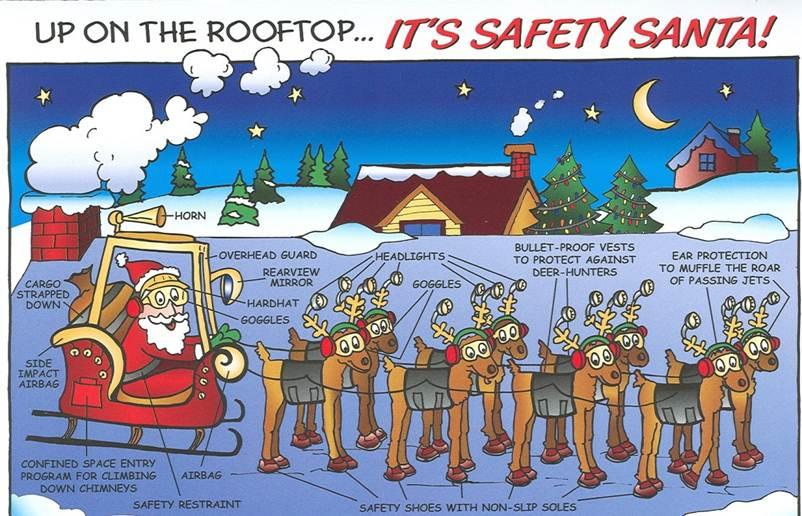
  • Safety Santa: Another Case of Operational Excellence Success

    Safety Santa: Another Case of Operational Excellence Success

    A year ago, it was the pleasure of this blogger to report that Santa Clause completed yet another successful global fulfillment process AND importantly, the process was in compliance with the US Federal Aviation Authority’s (FAA) regulations.  A great deal of progress since the advent of one red light on the nose of the lead reindeer!

    This year we are once again pleased to report that not only have the flying sled and its power plants remained in compliance with the FAA but has now taken additional steps forward.  Incorporating new technologies and processes, safety has been enhanced in the following manner:

    • Addressing Slips, Trips and Fails with new safety/skip proof landing gear
    • A new Confined Space program along with appropriate personal safety gear
    • An alarm Klaxon and Better Lighting
    • Enhance Safety Restraints such as airbags and an overhead guard
    • Extensive Head, Vision, and Hearing Protection systems
    • Better Work Place Violence technology enabled processes
    • A new Cargo Restraint system

    It looks like the arctic region of the Occupational Safety and Health Administration (OSHA) outreach program is having great success.  Interested readers are invited to review the above safety Infographic for further details and perhaps new insights.

    Simplified Business Model

    There are a lot of lessons herein for those who don’t live at a mythical north pole.  First, it seems that much if not all the safety improvements made are inexpensive and easily implemented.

    Next, change management and new policies appear to be welcomed by those affected.  Answering the, “What’s In It For Me” question when adopting new technologies.

    Management is also ‘walking the walk’ with employees by driving the sled and taking the same risks as the rest of the team fulfilling customer requirements, i.e., snow covered rooftops and chimneys.  One can argue that this entire team is the Customer Facing part of the system.  Finally, customers have high expectations that must be met, and late delivery is not an option—this project has a fixed deadline!

    Stakeholder Value

    With billions of children waiting and using a complex and global logistics system, this team does not disappoint.  Earlier competitors have long dropped off the map.

    So why with a clear monopoly does this organization still seek greater Operational Excellence with its transformational Safety Culture?

    Simple—safe and excellent operational performance is good business!  Less unplanned downtime increases the bottom line.  Few incidents increase morale and the bottom line.

    Fewer legal issues, regulatory matters, and so forth and so on positively impact the bottom line.  With such significant ROI, what’s a stakeholder not to like?

    Is Your Operational Safety on Par with Ole Saint Nick?

    For More Information

    Please note, RRI does not endorse or advocate the links to other third-party materials.  They are provided for education and entertainment only.

    For more information on Cross Cultural Engagement, check out our Cross Cultural Serious Game

    You can contact the author as well.

  • Fleeting Success: In Pursuit of Sustainability

    Fleeting Success: In Pursuit of Sustainability

    Winston Churchill is credited with saying, “Success is not final, failure is not fatal: it is the courage to continue that counts.”  The late Prime Minister nailed it; once again!

    Our journey through life, including our career is a marathon not a sprint.  While we celebrate success, often at happy hour or a party, we recognize it is only a moment.

    Early in this writer’s career, a multi-million-dollar deal closed after more than a year of effort.  A celebration ensued.  The next day the sales manager, “Asked what was next?”

    Attain and Sustain

    Organizational initiatives seem to procreate.  In some ways like the Tribbles of the original Star Trek series.  Cute furry things, the Tribbles multiple at such a rate as to almost consume the Enterprise.  Only the transporter beam saves the crew.

    Like the rah-rah of New Year’s Resolutions, the question is not will I go to the gym in January, but will I still set foot on the treadmill in June or even March.  The road to you know where is paved with good intentions.  It is the sustained energy of the execution that assures more successes than failures—and that failures are teachable moments.

    Culture is one of the current buzzwords, yet Cultural Transformation is the key to sustainability.  Courage requires the organization to pick itself up, so to speak and continue the journey to a sustained high level of Operational Excellence.

    Easy to Say

    According to Forbes, in 2018 “enterprises are expected to invest $1.3 trillion (USD) in digital transformation initiatives to apply digital capabilities to improve efficiencies, increase customer value and create new monetization opportunities.”  The article goes on to posit, that almost $900 billion of that spend will be wasted as goals are not attained.

    Why are these projects always seemed doomed to fail?  A quick Google search identifies a large body of knowledge over the years documenting these types of failure.  So, the beat goes on.

    Hard to Do

    There is also a body of work documenting the “should do’s” of organizational transformation.  In fact, this author has contributed several articles and books on this subject.  Most notably, Implementing a Culture of Safety: A Roadmap for Performance Based Compliance.

    A Missing Piece

    There is a lot of talk about Operational Excellence, Digitalization, High Reliability Organizations, Human Factors, Safety Culture et al.  As with the Forbes data, many are suffering the same fate.  No wonder senior management is skeptical of new spend for more ‘Tribble-itiatives.’

    For example, when a critical infrastructure sector discusses the transformation to a Safety Culture, the term is often expressed as singular, i.e., there is one industry safety culture.  However, all firms have their own ecosystems consisting of multiple and sometimes disparate entities.

    They have developed a culture that is a source of pride, competitive advantage, etc.  Their culture differentiates each organization from their peer group.

    The following figure presents the actual nature of a firm’s Safety Culture.  The reality is that a large organization’s “culture” is a combination of multiple cultural dimensions.  It is this ‘nature of culture’ that must be better understood if a transition process is to be successful and sustained.

    Readers should note that the multi-dimension structure is continuously changing as business, technology, and regulatory environments impact on the Relationships, Behaviors, and Conditions of the situation.  This dynamic requires continual managerial energy and training to sustain the change desired.

    Cross Cultural Engagement

    It would seem to be a daunting if not impossible task to effectively and efficiently train a large work force including relevant third-party suppliers on an ongoing basis.  Of course, the cost would be prohibited as well.

    Not so fast, e-learning serious games are now available to support the training requirements necessary to “sustain” the transformation.  Moreover, specific scenarios can quickly be developed to meet specific organizational requirements.

    The games are developed using Game Theory and Human Behavioral theories.  They simulate a real-world environment and have been shown to give great results over decades.  With Cloud technology, these training tools are now inexpensive and readily available to all.

    Why have your Organization’s Business Transformation Initiatives Failed?

    Check out our Cross Cultural Serious Game


      https://en.wikipedia.org/wiki/The_Trouble_with_Tribbles

      https://www.forbes.com/sites/forbestechcouncil/2018/03/13/why-digital-transformations-fail-closing-the-900-billion-hole-in-enterprise-strategy/#1f5923507b8b

      https://www.xlibris.com/Bookstore/BookDetail.aspx?BookId=SKU-0143303003

      Shemwell, Scott M. (2015, November 28). Comments and Thoughts Regarding the IAEA Technical Meeting on Developing Improvement Programmes for Safety Culture November 2-4, 2015. Vienna, Austria.

  • Millennials Take On Our Increasingly Complex World

    Millennials Take On Our Increasingly Complex World

    Originally published in 2013.

    On January 1st at 0348 hours a young engineer employed by a service company is trying to address a problem she has encountered with a compressor on a drilling rig in the Deepwater Gulf of Mexico.  She graduated from college three years ago and went to work for a large energy services company.  However, several months ago she changed jobs and is now on her first offshore hitch as team leader with her new company, a similar size global energy services company.

    She is a competent engineer but is uncertain what the company policy is regarding a piece of rotating equipment that while seemingly malfunctioning does not appear to jeopardize safety, the environment or production at the present time.  But she worries that the situation could get worse.

    A quick call to the “graveyard” shift at the company onshore Operations Center is not reassuring.  Staffed by those who are too junior to be on vacation during the holiday season, the engineer she talked with had only been with company three years and actually had less field experience than she did.  His supervisor was not encouraging either.  Should he call and wake experts at this early hour?

    Adding to the problem, the compressor’s data plate was mostly unreadable.  And of course, a famous Texas blue northern was blowing through.  High winds, rain and cold temperatures further impaired proper equipment identification, much less working conditions.

    Both the field engineer and the operations engineer are aware that their company signed a Bridging Document with their customer as part of the new Safety and Environmental Management System (SEMS) regulatory requirements and both had attended the appropriate training for this project.  Both are knowledgeable that the Stop Work Authority (SWA) gives them the right and even the obligation to dramatically intervene with operations if they feel it necessary.

    As a new mom, the field engineer is concerned that she might develop a reputation in the company as a “flaky” female if her next decision turned out to be a mistake.  The engineer at the operations center was receiving real time data feeds from the rotating equipment but he could not “feel” the vibrations like the on-site individual could and the equipment was still within tolerances.

    Horns of a Dilemma

    The engineers in our story are competent, qualified individuals doing a great job.  Early in their careers, they are the vanguard of field operations.  Millennials by label, they are technologically savvy and among the best and the brightest in their fields.

    Things never go “bump in the night” during daylight hours in perfect weather, hence the colloquial term.  Moreover, the personal stress of a new mother concerned about her reputation and opportunities for promotion resulting from just another day at the “office” should not be underestimated by those desk bound or later and more secure in their careers.

    The real world of field operations can be very unforgiving even when the results turn out OK.  All of the individuals in our story have significant “skin in this game.”

    It is fine to “empower” people in the team building sessions.  It is an entirely different story in the middle of the proverbial stormy night when one’s career and reputation are on the line.  Field personnel must believe they company will stand behind their decisions, right or maybe less so.

    Enablement

    These best and brightest can only be as good as their supporting infrastructure.  These individuals not only face engineering issues, any actions they take must be in accordance with company policy, the Bridging Document and various regulatory compliance requirements as well.  This is a lot to put on the plate of an engineering team.

    However, since their childhood these individuals have been online.  Our field engineer mother looks in on her infant son at day care from her smart phone from a hundred miles offshore.  The operations center engineer routinely Skype’s with his girlfriend, a physician, who is in east Africa serving with Doctors Without Borders.

    These individuals are at the top of their technological game.  However, they lack the field engineering experience of their more seasoned colleagues.  This represents a demographic challenge for organizations in the middle of the Big Crew Change.  How do these young people come up to speed—quickly?

    Organizations not only depend on the individuals depicted in our story for their bottom line, shareholder value is at risk if they cannot prevent the next major mega-disaster.  And what if they can prevent a minor incident?

    Loss time, loss production, loss anything has economic consequences.  Most organizations run on margins that are thinner than they would like.  Oil companies are included in this group.  More importantly, energy service provider margins can be even lower.  This business model pushes our engineers to lower costs, reduce downtime and in some cases push the envelope.

    Millennial Transformation

    Out engineers appear to have the deck stacked against them.  Normal Accident Theory (NAT) with its roots in the Three Mile Island nuclear power plant incident suggests that tightly coupled technologies with invariant sequences and limited slack such as Deepwater drilling operations will have accidents in the normal course of events.  In other words there is a certain inevitability of a major incident on their watch.  Maybe not during this rotation but a certain possibility during their careers.

    However, these Millennials have a safety arsenal their parents did not—a new business model that capitalizes on their technology prowess.  The emerging field of High Reliability Theory (HRT) “emphasizes are a strategic prioritization of safety, careful attention to design and procedures, a limited degree of trial-and-error learning, redundancy, decentralized decision-making, continuous training often through simulation, and strong cultures that create a broad vigilance for and responsiveness to potential accidents.”

    Arm field engineers and graveyard operations watch colleagues with HRT driven policy and associated tools and then get out of their way.  A strategic or systemic safety model with a holistic perspective of the life cycle the process coupled with truly empowered key personnel trained with the latest learning tools in a strong Culture of Safety offer a new perspective for a new workforce.

    Aircraft pilots routinely retain and upgrade their skills in sophisticated flight simulators.  “What If” scenarios, whereby the team can learn by trial and error environment where the worst result is a computer animated “do-over.”  Other industry sectors train using this well documented successful approach.

    In a true Culture of Safety a mom would not worry about her job or career if she erred on the side of safe operations.  She would not be labeled nor would her co-worker in the Operations Center hesitate to wake up the experts New Year’s Eve.

    Finally, if the maintenance history and all updated equipment manuals were available on a Smart Tablet with training videos and animation support, trepidation by those new to the company/process would lessen.  Organizational policy, its Operations Management System and bridging documentation built into the workflow will enable better decision making in the High Reliability Organization of the near future.

    A decade ago the digital oilfield was labeled the Digital Oilfield of the Future.  Integrated Operations is a common model today.  The Millennial’s World-of-the-Future will mirror the concepts of an HRO.

    Will she be working for you or your competitor?

    End Notes

    http://www.doctorswithoutborders.org/

    Weick, Karl E., Sutcliffe, Kathleen M. and Obstfeld, David. (2008). Organizing for High Reliability: Processes of Collective Mindfulness. In Arjen Boin (Ed.), Crisis Management Volume III. (pp. 31-66). Los Angeles: Sage.

    Ibid.

  • Are You In Distress?

    Are You In Distress?

    During a recent offshore sail from Florida to Texas the weather significantly deteriorated on this blogger and his boat mates. Our 45-foot ocean going sailboat was one in which (mostly) the same crew that has significant sea time together.

    That said, there were two days of very uncomfortable passage making. At one-point a nearby ship hailed us on the radio and inquired, “Are you in distress?” We responded, “no we were not” and thanked them for their concern. Both vessels continued their separate courses.

    At that moment, our vessel was undergoing a pounding by large waves and from the bridge of the ship, it probably did appear that our yacht was in distress and in possible need of assistance. However, our vessel was simply handling tough sea conditions.

    Experienced sailors know that anything is possible while at sea. Therefore, careful preparation is critical prior to any voyage. Simply put, the vessel must be sound, (able) seamen competent, and equipped as appropriate.

    The US Navy has identified six principles for shipboard operations, “formality, procedural compliance, level of knowledge, questioning attitude, forceful backup and integrity, focus on human performance and create the foundation for highly effective commands where errors that could lead to minor or catastrophic events are identified and stopped early. Used together, these six principles form the bedrock on which the Surface Force implements the three operating processes: operational risk management; plan, brief, execute, and debrief; and hazard reporting.”

    One could make the case that a pleasure vessel need not adhere to these six principles; however, this long time offshore sailor argues that they should as well. For example, there is always only on Master (Captain) of a vessel regardless of long time friendships. Appropriate expertise or Knowledge, Skills and Abilities (KSA) for all crew members is essential as well.

    Some may notice that the six principles and three operating processes are akin to those found in High Reliability Organizations (HROs). In other words, this short story holds lessons for all as well.

    Our vessel was engaged in a mission—transit from Florida to Texas. This mission was supported by a number of processes and associated tools, technologies and human capital to accomplish the overall goal.

    When adversity struck, the crew (organization) responded to events on the ground (water) to address the new situation in the spirit of prudent mariners. Is this not allegorical to business?

    How Can You Assure Your Organization Will Not Be in Distress When Adversity Strikes?

  • Are Organizational Governance Models Broken: Why Can’t Management Get a Handle on Things?

    Are Organizational Governance Models Broken: Why Can’t Management Get a Handle on Things?

    Over 15 years ago, organizations such as Enron, Worldcom, Tysons, and others failed after massive managerial maleficence and even criminality.  Enron’s auditor, Arthur Andersen folded as well.

    The result of this carnage was the imprisonment of many, the death (apparent heart attack) of the disgraced former CEO of Enron, suicides, massive shareholder value destruction and the Sarbanes Oxley Act of 2002.  SOX, as the act was commonly called was supposed to fix fractures in organizational transparency!

    Later, Bernie Madoff, Robert Allen Sanford and others (Ponzi schemes) stole billions from trusting clients.  Where was the oversight for crimes of these magnitudes?

    Almost a decade ago, three major disasters causes incalculable death and destruction:

    • BP Deepwater Horizon aka Macondo—commencing April 20, 2010
    • San Bruno Pipeline Explosion—commencing September 9, 2010
    • Fukushima Daiichi Nuclear Incident—commencing March 11, 2011

    According to one 2018 report, “Close to half (46%) of senior oil and gas professionals believe that there has been under investment in inspection and maintenance of infrastructure and equipment in recent years.”  Has anything been learned about the risks posed by Critical Infrastructure to the Bottom Line and societal reputations?  What about continued loss of human life?

    Finally, our US political class tells us they cannot ‘securely’ run an election and that outside interference somehow tainted or even changed the 2016 national election.  Five plus months before the next national election, what has changed?

    Nuisance to Menacing

    Now a series of high profile Cyberbreaches (seemingly exponentially) continue as do management’s apparent attempts to hide the damage from affected customers and shareholders.  Is this lack of transparency a SOX violation?

    More regulations are not the answer.  Criminals and others with malice don’t pay much attention to laws.  They never have, whether mugging you in the park or stealing your identity online.

    Purportedly, the first ‘hack’ took place in 1903 when a demonstration of the Morse Code was disrupted and insulting messages were sent through the theater projector. Perhaps a mere nuisance then, today cyber malcontents desire vast fortunes, political intrigue and even social instability.

    In our November/December, 2017 Petroleum Africa article, A Governance Model for the Era of Digitalization: Achieving Operational Excellence Using Disruptive Data Management Techniques, we mentioned that at a conference in late 2017, an investment banker when responding to a discussion about the use of IoT as part of the digital oilfield (now how we run the business) “suggested words to the effect that if the enterprise is driven by these technologies then it is now an agenda item for the Board of Directors.”  This is consistent with this author’s previous statements to this effect.

    What’s Going On?

    In his 1984 book, Normal Accidents: Living with High-Risk Technologies, Charles Perrow put forth the theorem that in our complex world, “It takes just the right combination of circumstances to produce a catastrophe, just as it takes the right combination of inevitable errors to produce an accident.”

    We have written extensively about Governance and Operational Excellence, including methodologies for developing and sustaining both.  In 2014, we put forth the construct of Strong Bond Governance as well as ways Critical Infrastructure sectors can become High Reliability Organizations.

    Finally, we have developed and implemented a Best Practices Model for Operational Excellence that incorporates modern governance that address issues discussed herein.

    Normal Incident Theory indicates, that in any complex system accidents will happen.  This theory has been debunked just like Keynesian Economics.  Yet practitioners of both continue unswayed by empirical data.

    It appears that corporate governance models have fallen into the same trap, making assumptions that business and technology models are limited and reactive.  This appears to be a short-sighted approach with ample empirical evidence that these models are no longer relevant.

    Threats to shareholder value and even the safety and economic security of entire populations that depend on Critical Infrastructures are increasing for a variety of reasons.  Organizational Governance models must keep pace.  Clearly, this is now part of the fiduciary responsibility of Board members as well as the entire “C” suite of executives.

    Further Reading

    The author and others have published extensively on this subject.  The list of appropriate articles and papers is too extensive to list here.  However, readers are invited to peruse Dr. Shemwell’s extensive list of blogs and publications.  For more information on this and other subjects, please contact us.

  • Organizational Predators: Jackals, Hyenas, and Wolves in Managerial Clothing

    Organizational Predators: Jackals, Hyenas, and Wolves in Managerial Clothing

    Prologue

    In the author’s August 2004 edition of the then, Executive Briefing Newsletter (early online delivery) we addressed the impact on the firm of managerial misbehavior.  This article was one of a list of challenges put forth to that generation of management.

    Sadly, recent events have compelled us all to revisit this issue, although for some it is the first time.  Upon re-reading the document, we felt that it might add value to current management and those that work for them to release it again in the blog format.

    The text presented is original and only minor typographical changes have been made.  We firmly believe that historical documents need to be held to their original meaning and we invite the reader to decide its value in today’s context.

    One note, readers may feel passion seeping through.  As this author recalls, at the time one of the jackals had harassed someone close to me.

    Point of the piece, this behavior was inappropriate then and it remain inappropriate today for this kind of nonsense to exist in the workplace.  Shareholder value is destroyed by this stupid behavior.

    One would guess that over the next months and years shareholder value will be destroyed in court settlements because of the recent behaviors of Organizational Predators: Jackals, Hyenas, and Wolves in Managerial Clothing.  Won’t put the names here—Google it!

    The original text is available in Essays on Business and Information II: Maximizing Organizational Performance, pp. 85-87 of the printed edition.  Readers will find it in the Ethics Section.

    Reprint

    Originally published in August 2004

    I think I did something for the worst possible reason—just because I could. I think that’s the most, just about the most morally indefensible reason that anybody could have for doing anything.”

    – Bill Clinton

    Thank you, Mister President.  You have empowered another generation of Omega males in managerial positions who denigrate women “just because they could.”  In Bill’s case, Hillary emasculated him and moved on to become a U.S. Senator.  This option is not always available to others.

    Organizational leaders are role models for guidance in how managers relate to our female subordinates.  Dominant men (and sometimes women) are well positioned to do things just because they could.  If the organizational culture condones the just because they could model, in reality this conduct is what management offers shareholders.  As an investor, I am ready to sign up for that business model. Yah, Right—Perhaps NOT!

    Over the past three years, this newsletter has sought to put forth important and indeed even critical issues to the forefront of discussions.  I will tell readers up front, that this edition of the newsletter is different.  It is personal, and it comes about as the result of this author’s direct knowledge about how women in his professional and personal life are being treated.

    Therefore, I do not claim objectivity but seek to raise the thinking of those in similar situations as well and even the culprits themselves (and their spouses, usually wives).  In this writer’s humble opinion, this issue is not transit, but endemic.  In the list of those things that will not go away, this one is high.

    Corporate boards and CEOs should take note, as not only are there EEOC (Equal Employment Opportunity Commission) issues at stake (usually addressed by Human Resources and attorneys as background noise) but also Sarbanes Oxley exposure.  Sarbanes Oxley is usually couched along the lines of information flow to the CEO and Board, however, there is another dimension.

    The quality of management and their readiness to “hear” and incorporate the thinking of the best of the best, regardless of sex.  Just think if the CEO of Enron had actually listened to Ms. Sharon Watkins when she raised concerns instead of just blowing her off—he might still be enjoying his Aspen resort.

    You can outsource non-core activities, but you cannot outsource the corporate identity. How firm’s truly value every employee is who they are.  United States criminal law has a long history of prosecuting wife and child beating felons.  The principle is well established.

    Oh, the Humanity

    Men, more often than women, abuse the other sex and their offspring.  Predators prey upon the weak and the young, usually males dominating or destroying females and their young.  We see this in the wild animal kingdom and we see these predators on the Internet.

    We also find them inside corporate walls.  Boards and C levels often hide their heads in the sand and take a “don’t ask don’t tell” approach.  Guess what guys (and it usually is the ole boys club); the train has left the station without you.

    Fact is this train left a millennium or more ago.  Mothers are revered as the fount of life.  Regardless of ethnicity or religion, Mothers are central.

    That is until we get to corporate America or any other nation for that matter.  Once a woman choses or is forced to work, Mother’s Day goes out the window.

    Now Alpha (and those who think we are but have not yet been culled) males think we own these feminine prizes.  Guess what, you out of shape, overweight pathetic excuses for males, you do not.

    Do these women report to you and are their bonuses, promotions etc. depend on your stated and written opinion?  The answer is NO!

    Take that and shove it up your behind you legacies of the20th century.  There is a cataclysmic shift underway and while you may enjoy the short-term high of intimidating and even firing these women, Darwin rules.

    You are dead meat my friend, and probably at an age when you will least be able to afford it.  Mom is never irrelevant!

    Throughout the western United States, one can often see the skins of coyotes hanging on barbwire fences.  The clear message to other predators is this could be your fate as well.

    Similar symbolic gestures are necessary in publicly traded corporations.  Who gives some mid-level manager the right to denigrate hard working employees just as they put themselves out as bastions of righteousness?

    If these people were so smart, they would be top executives, and if they were the real comers, they think they are (with top level sponsors) petty crap would not be their forte.  Unless the organizational culture rewards the humiliation of women as part of the reward system.

    Truth is, most will never amount to anything.  While they have some short-term power, the organization does not really care about their efforts.  Fundamentally, they know this and this fact eats at them.

    Their anger is projected on their direct reports, and often the females in their organization.  This is a safe bet for an abuser!

    Who would challenge him?  Senior management demand results that he delivers for a while and his female direct reports are put through the grinder.  Pretty good gig if you can get one, especially if you are a predator by nature.

    Final Thoughts

    It is far past the time for a superior to have the audacity to state that I took advantage because I could.  This is not just a civil liberty, human rights, woman’s right, or Constitutional Amendment right.

    Organizations depend on the synergy of their organizational knowledge.  Not necessarily without friction, a necessary catalectic creative agent, but beyond retribution, physical and mental intimidation, fear of job loss or demotion, as well as physical threat posited by someone often 100 pounds or larger than his target.

    Sarbanes Oxley, global stock exchanges as well as common decency demand that our mothers, wives, sisters, nieces, and girlfriends be heard.  The rallying of the “ole boy” network does not have a place in the 21st century organization.

    Firms that overlook or down play these issues expose themselves to major lawsuits and the possibility that shareholder value may be decreased by BILLIONS.  There is no credible support for predator losers.

    The usual predator is an overweight male between 30-50 who attained his position through vigorous internal politicking or as the result of a merger where this individual had a title and thus perceived expertise.  Often, these individual distains women all the while being a pornographic connoisseur.

    This manager is impaired when dealing with women.  When a strong, woman subordinate questions his decision, this personality often retreats to his dominate position over this person and seeks to dictate.  This type of manager may have unresolved issues with his mother.

    I do not know about you, but I will not invest my hard-earned money in firms that condone, and even promote jackals.  In earlier times, these individuals would rape and pillage women unless/until challenged by a true Alpha male.  Today, as then these cowards retreat rapidly, only to reappear when they think the coast is clear—always hiding in the organizational shadows.

    When Boards and top management condone this behavior, they denigrate investor confidence. Billion-dollar class action lawsuits are not the fantasies of writers, they routinely occur.  Why should an investor support the pathetic disgusting behavior of reprehensible psychotics who usually make less than $250K? Is this the risk-reward trade off expected?

    Throw the bums out of the executive suite, but perhaps more importantly throw these true Nazis out of middle management.  Sarbanes Oxley demands nothing less.

    Proposition: All men and women are created equal.  No pathogen has the right to spend my money furthering his limitations.  A real man would just resign.

    But then again, these individuals are not men. They are Jackals, Hyenas, and Wolves in Managerial Clothing.  They may even be thieves as they destroy shareholder value.

    What a return on $250,000! CEOs, beware, SOX looms large over organizational incompetence.

    Finally, as true indictment of this testosterone starved wimps they take one of two paths in their personal life.  They either physically and emotionally beat the women (and children) in their lives (wives, daughters, nieces, step-daughters, aunts, mothers, et al) sometimes resulting in the death of these females or they kowtow to these same people and take their frustrations out on organizational female underlings.

    Regardless, these people are cowards and bullies.  There is no place for them in publicly traded corporations and I for one do not care to fund their criminal activities.

    The first CEO that tolerates or accommodates this behavior is yet to be sent to jail.  No doubt, we will soon read about such an individual.

    Earth to Wall Street. Enough is enough.  This piece is not the rambling of a female in an activist organization.  It comes from the pen of a white male born in 1948.  Demographically not high on the feminist hit parade.

    That is the point. This is not just a social issue it is an economic one.

    The psychological rape of our wives, sisters, and daughters by low life managerial predators can no longer be tolerated.  Fire these losers and put mothers in charge.

    The power of motherhood is not overrated.  We all have a mother and celebrate her wisdom every May.  Capitalize on this hidden downtrodden resource, and remove the cowardly scum whose manly prowess is limited, except perhaps in their own twisted ego.

    I for one do not care to fund such dysfunctional behavior.  I for one do not care to put my capital at risk at the hands of wife beaters and other predators.

    Set the traps, eliminate these vermin, and hang their skins on the corporate barbwire fence.  Corporate returns will surely be better without their “help.”

    Let the mothers, sisters, nieces and wives loose and let’s see if greater returns do not soon appear.  I am betting my money on Oprah and Carly and not Ken, Jeff and the others heading to jail who condoned managerial malfeasance.

    Further Reading

    Most of the issues discussed in this newsletter are part of a larger dialogue.  Readers are invited to explore additional thinking.  There are many books about abuse that you may wish to investigate.

  • A New Relationship

    A New Relationship

    This time of year, many make the so-called New Year’s Resolutions and make a personal if not short-term commitment to modify behaviors deemed as needing change.  Typical personal commitments include, losing weight, getting more exercise, becoming a better spouse/partner, etc.

    Unfortunately, most of these behavioral changes go by the wayside in short order.  Many reasons and excuses are offered and then the cycle starts all over again on January 1st of the next year.

    For example, weight loss vendors are heavily advertising at this time of year.  Most of the ads look fairly similar to the those from last year and even the year before.  Our ability to fail at resolutions seems endemic.

    The Relationships, Behaviors and Conditions (RBC) framework discussed herein and in other publications by the author is the proverbial three-legged stool.  In this model behaviors in a set of conditions determine the relationships among parties.

    When our focus on a New Year’s Resolution is only behavioral change, failure is likely.  In the example of weight loss, conditions may not change, i.e., we eat out for lunch at work every day.  A new relationship with food may not emerge in such an environment.

    Likewise, as part of our diet plan our doctor tells us to exercise but we still hate it, failure is likely.  So, what is the point?  Most resolutions are doomed!

    Not so fast.  Achieving new behavioral critical mass will sustain our resolutions and lead to sustained change.  A new relationship with the ole bogyman will cast this issue into the pit of the past.

    By definition, new behavioral critical mass is self-sustaining.  Hating the diet plan and associated exercise does not meet that criterion.

    In other words, a set of behaviors must be changed.  For example, “all things in moderation” as our mothers taught us coupled with social engagement with like minded individuals (social media and in person as well) may achieve the critical mass for sustained change.

    Note that implicit in the last statement is a change in the conditions one is surrounded by.  This does not mean that one must quit his/her job because everyone goes to lunch together every day.  However, bringing one’s lunch several days a week does change the lunch time conditions.

    None of the transformational process described herein are easy and two steps forward and one step back is often the norm.  The key incentive is the new relationship one seeks.

    Once that “stake” is set, appropriate new behaviors coupled with changes in existing conditions can ensure.  Personal transformation is difficult; however, the RBC model offers new insight into how all of us can move forward.

    There is evidence that diets do not work.  Once the target weight is reached, the old behaviors often emerge.

    In this case, the new relationship may better be defined as Better Health which may be a better incentive to change than simply dieting.  Those who make the sustained, permanent transformation may not realize they are implementing a personal RBC but in fact they are.

    Happy New Year and best of luck to all of us with our resolutions!

  • Excellent Behaviors: Assessing Relationships in the Operational Excellence Ecosystem

    Excellent Behaviors: Assessing Relationships in the Operational Excellence Ecosystem

    One of the hot business buzzwords of 2017 is “Operational Excellence.” It has been the subject for many pundits, including this one.
    In October and November we published a two part series, Assuring Operational Excellence from Contractors and Their Subcontractors through BTOES Insights. Each part included a link to additional information.

    The October edition featured an excerpt of our Implementing a Culture of Safety book. In the November edition we released our new best practice solution, Attaining & Sustaining Operational Excellence: A Best Practice Implementation Model. We are proud to make it available herein and in general.

    One of the basic tenets of the RBC Framework is the general construct that Relationships cannot be determined a priori. The well-used example is a man and a woman sitting on a bench at a bus stop. Are they married, siblings, coworkers, friends or simply two people waiting to catch the same/different bus?

    Their relationship cannot be known directly. However, their Behaviors will provide insight into how they relate to each other. Romantic behavior may indicate marriage, dating, an affair etc. They may still be coworkers but most likely are not strangers.

    The third dimension, Conditions (environment) can be considered the stage upon which behaviors play. So, what does this have to do with Operational Excellence?

    Another component of our digital environment is Human Systems Integration (HSI). In our forthcoming book, we have defined HSI as, “Human Systems Integration (HSI) considers the following seven domains: Manpower, Personnel, Training, Human Factors Engineering, Personnel Survivability, Habitability, and Environment, Safety and Occupational Health (ESOH). In simple terms, HSI focuses on human beings and their interaction with hardware, software, and the environment.”

    This suggest that our ecosystem is getting more complex and not less. While not usually thought of in these terms, machines have a behavior as well. IBM’s chess playing Watson is a simple example of this phenomena.

    With all of these behavioral dynamics, how can an organization attain and sustain Operational Excellence? If one takes the position that with complex highly interconnected systems things will fail (Perrow’s Normal Accident Theory) then OE is a mythical destination.

    However, with a High Reliability Management (HRM) business model OE cannot only be attained, there is no reason why it cannot be sustained indefinitely. As the name indicates, HRM has a strong focus on reliability or that ability to recover quickly when an event occurs.

    One example is the 2015 Ebola virus incident in Dallas, Texas. One may recall that the virus was brought to the US by a traveler from Africa. Concerns quickly mounted that an epidemic might quickly ensue.

    While a few health care workers were infected, the public health care systems, medical community and others rapidly responded and contained the problem. The system was resilient! Were there problems and lessons learned, absolutely but the system worked. For most of us, life soon returned to normal.

    Conditions may change, but behaviors need to continue to rise to levels of excellence. This is the key to developing strong relationships throughout the ecosystem.