Tag: Cross Culture

  • Teaming Realities

    Teaming Realities

    Why are Diversity, Equity and Inclusion (DEI) initiatives failing?

    In previous blogs, we have addressed the challenges of turning organizational initiatives into culture.  Moreover, we discussed DEI and the shortcomings of those institutional efforts as well as broached the construct of Teams incorporating DEI.

    In this edition, we will expand on those subjects and develop a realistic approach toward team building that fully incorporates the precepts of DEI in a realistic manner.

    Five Elements

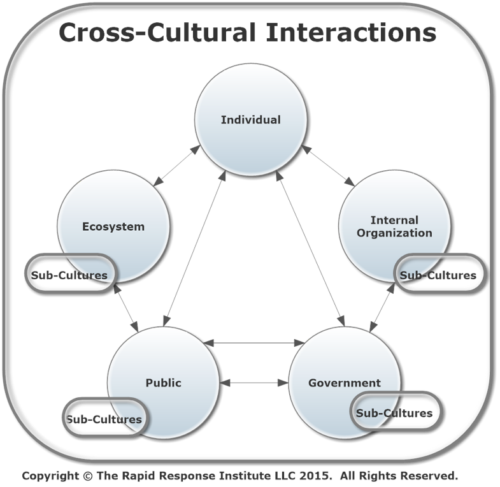
    As depicted in the title graphic, organizational cross-cultural interactions incorporate one or more of these dynamic components.

    • The Individual defined as a single human being or perhaps other entity with whom others collaborate
    • The Internal Organization defined the (legal) entity one or more individuals associate with on a daily basis
    • The Government defined elected officials as all levels of the Federal, State and Local governance bodies including any and all regulatory bodies or other agencies
    • The Public defined as communities and other interest groups including the media as well as its social aspect
    • The Ecosystem defined as the broad group of constituents which includes clients/customers, the supply chain as well a professional services engaged with the organization

    Note that sub-cultures abound across the four elements other than the individual.  Four example, a taskforce or team may be formed to implement a global IT system.  In this case, the team may be composed of individual from several countries as well as  Internal and External IT professionals..  In this case this would be an Internal Organization Sub-Culture.  Another Sub-Culture might be the NYC office with a distinct local flavor.

    These five elements are built upon a pretty straightforward peer reviewed behavioral framework.   

    The RBC Framework

    The Relationships, Behaviors, Conditions (RBC) Framework was originally developed to address the International Cross-Cultural Negotiation process.  Briefly, this is a dynamic model with emphasis on interactive relationships resulting from multiple levels of behavioral analysis.

    • Relationship dynamics are the focus including, commonality of interest, trust, balance of power and conflict intensity
    • Behaviors are defined from a broad multi-dimensional perspective and includes intentional as well as unintentional
    • Conditions include circumstances, capabilities and competencies of the parties, cultural considerations and the environment

    For almost 30 years we have been expanding and enhancing this model.  It is now used for ANY human interaction as well as Machine-Human interfaces, i.e. Artificial Intelligence (AI).

    Finally, we see this construct as very fabric of the modern organizational Team.

    What is a Team?

    By one definition a team is, “a group of people who perform interdependent tasks to work toward accomplishing a common mission or specific objective.”  As a general rule, teams are composed of individuals either appointed politically or assigned based on talent and expertise.

    When politically assigned to meet somewhat arbitrary DEI driven goals, one can expect such teams to fail–often visibly as a great calamity.  Thus driving survivors and others away from new similar teams.

    Thirty years ago this pundit witnessed the implementation of the then new Enterprise Resource Planning (ERP) IT systems.  Most were late and way over budget.  They rightfully earned the badge of ‘Career Killer.’  Not surprisingly, no one wanted to be assigned to this type of project.  Most consulting firms implementing these systems wanted someone with knowledge of the business on the project as well as IT professionals.  Key personnel could not be spared from operations and often junior or less qualified IT employees were assigned.  Needless to say, some level of disappointing performance was almost certainty guaranteed.  These were diverse teams composed of third party consultants, operations and finance individuals as well as internal IT people.

    These were not effective teams.  Many were even destructive.

    Creating an Effective Team

    A Google search of the term ‘teambuilding’ generates 160 million hits.  It is a well documented process, so why are successful teams so elusive?

    Most critical teams undergo a selection process as described previously with some training.  The project commences often with significant time and budget constraints.  In many cases the team malfunctions from the ‘get go.’  So why would DEI efforts end differently?  One suspects most do not.

    When students participate in active learning, they learn more.  This has been known for some time.  Sadly, and often in the DEI space, workshops do not address the actual issue organizations are facing.  However, their is a more successful learning model.

    Organizational Team Truths

    As noted above, organizations build teams to solve critical problems.  They do not group Individuals by category or classification.  High Performance Teams are anything but homogeneous.  

    • First, teams must form.  A mission/goal(s), set of deliverables, budget (if appropriate) and time frame must be developed and agreed to by management.
    • Then, members must get to know each other, roles and tasks assigned, etc.
    • What does success look like?  Metrics established.

    Most teams do not live in a vacuum so if they are to collaborate with one or more other teams (Internal or Ecosystem) this process is extended.  In many cases such as a merger or safety initiative, Government and even the Public will need to be engaged.

    Now a collaborative negotiation between ‘semi-independent’ parties to arrive at mutual success.  This is generally an iterative process.

    To create an active learning environment to cost effectively train new teams in a timely manner, simulations and game theory play a critical role.

    Moreover, to maximize effectiveness, such a Serious Game must be based on a Behavioral Science Framework.  This type of Team-to-Team interaction is available using video conferencing to engage teams meaningful training using ‘real world’ scenarios.

    The graphic below depicts this process.  Readers will also note a number of metrics will provide feedback to students to further enhance their learning experience.

    DEI ROI

    One comment routinely heard regarding DEI is the lack of return on the effort.  Not necessarily monetary return but the learning does not ‘stick.’

    Benjamin Franklin is credited with the quotation, “Tell me and I forget, teach me and I may remember, involve me and I learn.”  When these teams are composed of a variety of Individuals working to solve realistic collective problems the result better reflects actual organization life.  All aspects of DEI can be incorporated into the game scenario.  All students benefit from a much better learning experience and by extension the organizations they represent.

    The following short video is aligned with this discussion.  Well worth the few minutes it will take to watch it.

    Realizing DEI

    Simon makes the point that strong Organizations are more diverse.  In this pundit’s long international career, I support his contention. Moreover, true strength from a diverse Organization and its Ecosystem cannot be reached if individuals are not treated fairly and included in the process.  The serious game scenarios help assure all individuals participate.

    Want some help upping your DEI game?  Contact Us.

    For More Information

    Please note, RRI does not endorse or advocate the links to any third-party materials herein.  They are provided for education and entertainment only.

    The author’s credentials in this field are available on his LinkedIn page.  Moreover, Dr. Shemwell is a coauthor for an in press book (to be released in Spring 2023) titled, “Smart Manufacturing: Integrating Transformational Technologies for Competitiveness and Sustainability.”  His focus is on Operational Technologies.

    “People fail to get along because they fear each other; they fear each other because they don’t know each other; they don’t know each other because they have not communicated with each other.” (Martin Luther King speech at Cornell College, 1962).  For more information on Cross Cultural Engagement, check out our Cross Cultural Serious Game.  You can contact this author as well.

    The video by Simon Sinek is from YouTube.

    For more details regarding climate change models, check out Bjorn Lomborg ands his latest book, False Alarm: How Climate Change Panic Costs Us Trillions, Hurts the Poor, and Fails to Fix the Planet.

    Regarding the economics of Climate Change, check out our recent blog, Crippling Green.

    For those start-up firms addressing energy (including renewables) challenges, the author can put you in touch with Global Energy Mentors which provide no-cost mentoring services from energy experts.  If interested, check it out and give me a shout.

  • What About Today?

    What About Today?

    Why are we so worried about what the world will look like in 2050?

    In that year, this pundit will be 102 years old and most likely dead.  While not denying that our stewardship of the planet is an obligation, perhaps our focus is misplaced.  Climate Change, Climate Change, Climate Change has become the mantra for many.  But what about environmental damage done in the present?

    This author moved to Houston, TX in 1978.  For the next few years, you could smell the chemicals emitted from the refining and petrochemical sectors from the so-called ‘Ship Channel.’  Later, the odor dissipated as the environment was remediated.  Similarly, during that period the smog was so thick in the greater Los Angeles area that one could not see the mountains to the east.  That geography is now better as well.

    At least in the United States, we have shown that we can clean and sustain a decent environment.  Yet society is focused on a global long-term problem that by some accounts is not solvable.  Certainly as long as Asia continues its current energy practices.

    Almost Half a Century Later

    Now we sit at the precipice of the greatest environmental challenge since Love Canal (circa 1978), yet by all accounts “it is no big deal.”  Except to those living in and around East Palestine, Ohio.

    2050 is only 27 years away and we are told (2019)  the world as we know it will end in less than 12 years unless draconian climate steps are taken.  Call me a skeptic, but if we have not been able to stop local manmade environmental disasters, what makes us think we can fix the global climate?

    What Steps are You and Your Organization Taking to Fix the Here and Now?

    For More Information

    Please note, RRI does not endorse or advocate the links to any third-party materials herein.  They are provided for education and entertainment only.

    The author’s credentials in this field are available on his LinkedIn page.  Moreover, Dr. Shemwell is a coauthor for an in press book (to be released in Spring 2023) titled, “Smart Manufacturing: Integrating Transformational Technologies for Competitiveness and Sustainability.”  His focus is on Operational Technologies.

    “People fail to get along because they fear each other; they fear each other because they don’t know each other; they don’t know each other because they have not communicated with each other.” (Martin Luther King speech at Cornell College, 1962).  For more information on Cross Cultural Engagement, check out our Cross Cultural Serious Game.  You can contact this author as well.

    For more information regarding climate change models, check out Bjorn Lomborg ands his latest book, False Alarm: How Climate Change Panic Costs Us Trillions, Hurts the Poor, and Fails to Fix the Planet.

    Regarding the economics of Climate Change, check out our recent blog, Crippling Green.

    For those start-up firms addressing energy (including renewables) challenges, the author can put you in touch with Global Energy Mentors which provide no-cost mentoring services from energy experts.  If interested, check it out and give me a shout.

  • Delusional: The Martha Mitchell Effect 2.0

    Delusional: The Martha Mitchell Effect 2.0

    Attributed to the late Martha Mitchell, wife of the then Attorney General Oxford defines it as “A misinterpretation of a person’s justified belief as a delusion, often by a psychiatrist, clinical psychologist, or general practitioner.”

    Climate deniers, election deniers, COVID vaccine deniers, The Science deniers and all kind of deniers.  Treated as delusional and even reprehensible, anything to discredit their position and beliefs.  Some even advocate their incarceration and even death for those who hold different views.

    The so-called conventional wisdom, even The Science is often wrong.  Jumping on a politically correct and convenient Bandwagon, often leads to regret, lose of reputation, political demise or worse.

    Martha Mitchell was ultimately proved correct in her thinking, although being vilified at the time.  For that matter so was Galileo Galilei whose Inquisition by the Church was because he supported the Copernican theory that all celestial things revolved around planet Earth.  The Science has long disproved the Church in earthly matters.

    Plausible Deniability

    Perhaps those yelling DENIER the loudest are guilty of being deniers themselves.  As Shakespeare is credited with, “The lady doth protest too much, methinks.”  So if one follows this line of thinking, Scientifically.  Those screaming are actually the deniers.  Not the other way around.

    Without realistic dialogue about those issues that matter, there will always be a ‘She Said, He Said’ component of personal, business, political and social positions.  Closed minds on either side of the argument, kill constructive movement forward.

    Martha Michell was vilified in a pre-Internet period.  Yet her points were proven correct.  So was Galileo as well as others.  It seems convenient to SCREAM the other side as evil.  What good does that attitude accomplish?

    Who is the Real Denier You or the other the Denier?

    For More Information

    Please note, RRI does not endorse or advocate the links to any third-party materials herein.  They are provided for education and entertainment only.

    The author’s credentials in this field are available on his LinkedIn page.  Moreover, Dr. Shemwell is a coauthor for an in press book (to be released in Spring 2023) titled, “Smart Manufacturing: Integrating Transformational Technologies for Competitiveness and Sustainability.”  His focus is on Operational Technologies.

    “People fail to get along because they fear each other; they fear each other because they don’t know each other; they don’t know each other because they have not communicated with each other.” (Martin Luther King speech at Cornell College, 1962).  For more information on Cross Cultural Engagement, check out our Cross Cultural Serious Game.  You can contact this author as well.

    For those start-up firms addressing energy (including renewables) challenges, the author is a member of Global Energy Mentors which provide no-cost mentoring services from energy experts.  If interested, check it out and give us a shout.

  • Whoa Nellie–Delays in the Smart Horseless Carriage

    Whoa Nellie–Delays in the Smart Horseless Carriage

    In the just released NCHRP Research Report 1001/BTSCRP Research Report 2, a new framework provides government and non government parties and other stakeholders a tool for the assessment and risk management for emerging automated driving system (ADS) technologies.

    This Framework for Assessing Potential Safety Impacts of Automated Driving Systems reminds this reader with a sense that the challenge here is similar to other complex critical systems such as health care and energy.  This should not be surprising given the huge global ground transportation sector.

    ADS Maturity

    Maturity Models are useful tools helping management and others assess organizational processes and the value standardization can provide all stakeholders.  Likewise, the ADS Maturity Model follows a similar path of the established ones such as Capability Maturity Model Integration (CMMI).

    According to the automotive authority, J.D. Power Driving Automation Maturity Model contains these six steps (in reverse order):

    5 – Full Driving–Vehicle is self contained as an autonomous operation.

    4 – High Driving–Requires no human driver and most likely be used within geofence boundaries.

    3 – Conditional Driving–Significant step up this level incorporates various systems including Artificial Intelligence (AI).  As of 2021, these level of automation was not approved in the United States.

    2 – Partial Driving–Vehicles with Advanced Driving Assistance Systems (ADAS) but still requires the driver to  remain engaged.

    1 – Driver Assistance–Vehicle contains one or more systems designed to help steerage and/or braking etc.

    0 – No Driving Automation–No automation, driver entirely operates the vehicle.

    While there are some test exceptions, if as noted, Level 2 is the highest approved to date and the step to Level 3 is a big one, it appears we have a ways to go before any of us see an autonomous vehicle.  Not sure were we are on the Gartner Hype Cycle but likely there is some distance to go.

    SEMS

    Safety and Environmental Management Systems (SEMS) have been around for years.  Typically, SEMS requirements are usually integrated into Operations Management Systems.

    In this pundit’s opinion, similar integration will incorporate ADS into policies, processes and procedures for each organization.  As with other sectors, a number of Safety Cultures will emerge.  These will need to collaborate with other like minded but somewhat different business and technology models.

    The Hype

    We are often told that autonomous vehicles will be with us soon.  However, the evidence suggests otherwise.  According to the IT research firm, Gartner ““More than half of the technologies on this Hype Cycle are in the trough [of Disillusionment], which means that the hard work of commercializing many significant technologies is underway.”  Moreover, many advanced technologies necessary for Level 6 are even less developed.  Many may recall the autonomous breaking problems one manufacturer dealt with just three years ago.  Caveat Emptor in this field, at least for a while.

    How willing are you to trust your life to a Smart Vehicle?

    For More Information

    Please note, RRI does not endorse or advocate the links to any third-party materials herein.  They are provided for education and entertainment only.

    The author’s credentials in this field are available on his LinkedIn page.  Moreover, Dr. Shemwell is a coauthor for an in press book (to be released in Spring 2023) titled, “Smart Manufacturing: Integrating Transformational Technologies for Competitiveness and Sustainability.”  His focus is on Operational Technologies.

    “People fail to get along because they fear each other; they fear each other because they don’t know each other; they don’t know each other because they have not communicated with each other.” (Martin Luther King speech at Cornell College, 1962).  For more information on Cross Cultural Engagement, check out our Cross Cultural Serious Game.  You can contact this author as well.

    For those start-up firms addressing energy (including renewables) challenges, the author is a member of Global Energy Mentors which provide no-cost mentoring services from energy experts.  If interested, check it out and give us a shout.

  • It’s The Holiday Season–Maybe?

    It’s The Holiday Season–Maybe?

    At least in the United States we will soon be kicking off the Holiday Season with all the craziness it brings.

    Starting with the US Thanksgiving, followed by Black Friday (often practiced the entire month of November) many will prepare for Santa Claus then on into the New Year’s celebration.  Many religions have holy days or periods at this time of year as well,

    This 45 days or so of consumer ‘over buying’ is a bellwether for retail economic health and as well as the overall economy.  Soon the media will be counting the daily cash registers.  Economists and other pundits will will tell us all that the state of the economy depends on the success of the gift giving season.

    A Difficult Economy

    We all know the challenges most families are facing.  Inflation, high gasoline prices, supply chain shortages, etc.  We have documented some of these issues in earlier editions of this blog.  We covered such areas as:

    As of this writing, the Tech Giants are laying off thousands along with hiring freezes.  Major retailers appear not to be hiring as much seasonal help as expected.

    This suggests the major economic market may not be as robust as hoped.

    Soft or Hard?

    Economists and others talk about a Hard or Soft Landing when it comes to the down side of economic cycles.  Some believe the markets have already priced Federal Reserve (the Fed) micro policies into the price points.  For example, the shift from “Zero Interest Rate Program and Quantitative Easing to raising rates and Quantitative Tightening.”  Others suggest that not all factors are yet priced into financial markets.

    Over simplified: A Hard Landing results in a Recession.  A Soft Landing avoids a Recession.

    As of this writing opinions appear to be split with some believing the the Soft scenario and other convinced we are in for a very Hard recession in 2023.

    Going Forward

    Retail numbers this holiday season will be a significant signal for the 2023 economy.  This pundit with over five decades as an economic participant believes a Hard Landing is more Likely than a Soft one.  By December 26, 2022 we will  have a better idea of the first two quarters the next calendar year.

    What are you doing to assure that your family and your organization have the agility to weather the possible coming economic storms?

    For More Information

    Please note, RRI does not endorse or advocate the links to any third-party materials herein.  They are provided for education and entertainment only.

    The author’s credentials in this field are available on his LinkedIn page.

    There is a vast body of work regarding Hard v Soft economic Landings.  A good starting source for those interested in addition information is Investopedia.

    “People fail to get along because they fear each other; they fear each other because they don’t know each other; they don’t know each other because they have not communicated with each other.” (Martin Luther King speech at Cornell College, 1962).  For more information on Cross Cultural Engagement, check out our Cross Cultural Serious Game.  You can contact this author as well.

    For more insight regarding the economics of Climate Change, check out our recent blog, Crippling Green.

    For those start-up firms addressing energy (including renewables) challenges, the author is a member of Global Energy Mentors which provide no-cost mentoring services from energy experts.  If interested, check it out and give us a shout.

  • Hierarchy of Team Needs in Challenging Times

    Hierarchy of Team Needs in Challenging Times

    First it was Covid-19 and now a Recession?  Is a Global Military Conflict on the Horizon as well?


    Social, economic and personal pressures continue to mount.  There is already evidence of Reductions in Force, (RIF) aka layoffs are underway or planned.  With consumers stretched to the max, higher interest rates, equity markets in retreat and a struggling real estate environment, one wonders what the holiday season will bring.

    Cross Cultural (Diverse) Teams

    Ronald Reagan is credited with saying, “Recession is when your neighbor loses his job. Depression is when you lose yours.”  Would that it would be that simple.

    As we have addressed in the series on several occasions organizational teams consists of different types of people with diverse background and perspectives on life.  More importantly team members can be at different levels of maturity (both personally and organizationally).  We will address this in more detail.

    Maslow’s Hierarchy

    Many are familiar with Maslow’s Hierarchy of Needs.  While a simple physiological (group level) safety model and as my colleague Rob Jones discusses in his new book, A Hole In Science–Grammar of The Sociological Problem.  He takes a very sophisticated and well thought out approach to addressing this group dynamic problem.  For our purposes in the blog, his in-depth analysis is really for professionals and not the casual reader.  However, for those interested, I highly recommend this newly released publication.

    Released in the early 1940s, the hierarchy consists of these five levels of needs that humans progressively move through (these levels were take directly from the aforementioned linked article and should be treated as direct quotations):

    1. Physiological–Air, water, food, sleep, health, clothes, and shelter, etc.
    2. Safety–Include personal and emotional security (e.g., safety from abuse), financial security, and wellbeing.
    3. Belongingness and Love–Family connections, friendship, and intimacy.
    4. Esteem–According to Maslow, there are two subtypes of esteem.  The first is esteem reflected in others’ perceptions of us.  That is, esteem in the form of prestige, status, recognition, attention, appreciation, or admiration.  The second form of esteem is rooted in a desire for confidence, strength, independence, and the ability to achieve.
    5. Self-Actualization–Examples include the acquisition of a romantic partner, parenting, the utilization and development of one’s talents and abilities, and goal pursuit 

    Maslow and others continued to advance the model, but readers can get the gist of it from these definitions.  Moreover, the following short (2.17 min) video covers this model very effectively.

    We can look at Maslow through the lens of a Maturity Model.  For example, certain Teams and/or Individuals might be higher up the hierarchy than others.

    This may change team interactions.  Usually, such models reflect the maturity of the lowest member.

    With the stress of an economic setback, some members may move from of a position of feeling good to one of Safety if jobs or personal cash flow are threatened.

    Guidelines for Going Forward

    In one sense,, teams composed of individuals in different phases of the Hierarchy are no different than other diverse teams.  Teambuilding techniques such as found in our Cross Cultural Serious Games are good tools to teach team member about the state of mind of their team members and/or competitors.

    We have been through tough times before and we will all get through this one as well.  Be sure to learn from history so as not to repeat it.

    How are you helping your family and organization deal with challenging times?

    Note: The definition of a recession is a political football and this is a blog about organizational excellence and not politics.  Investopedia has a good and generally accepted definition of the term (recession) and it is provided herein for completeness.  Readers can decide for themselves as to  its relevance to their individual situation.

    For More Information

    Please note, RRI does not endorse or advocate the links to any third-party materials herein.  They are provided for education and entertainment only.

    The author’s credentials in this field are available on his LinkedIn page.

    “People fail to get along because they fear each other; they fear each other because they don’t know each other; they don’t know each other because they have not communicated with each other.” (Martin Luther King speech at Cornell College, 1962).  For more information on Cross Cultural Engagement, check out our Cross Cultural Serious Game.  You can contact this author as well.

    For more insight regarding the economics of Climate Change, check out our recent blog, Crippling Green.

    For those start-up firms addressing energy (including renewables) challenges, the author is a member of Global Energy Mentors which provide no-cost mentoring services from energy experts.  If interested, check it out and give us a shout.

  • At the Precipice?

    At the Precipice?

    On October 8, 2021, we posted the blog, Welcome to the 70s–Again!  The point that the awful economy of that decade could return.  It seems that one year later, those comments have come true.  Many are now freely comparing out contemporary time to that period before most adults were born.  This Baby Boomer graduated from college in 1970s and ‘enjoyed’ the full economic Stagflation experience and it was not pretty and definitely not fun.

    However, increasing global events, especially from Europe and Asia beg the question, Are we entering the 1930s again?  Seeming sinister forces both internal to the United States and global are conspiring to wreck havoc if we are not careful.  Even the word, World War  III is being ‘loosely’ tossed about by various journalists and pundits.

    On top of all these daily headlines, we are told the planet is in peril.  However, the trillions and trillions of dollars necessary do to seem to be available.  “Damned if I do, damned if I don’t.”

    What to Do?

    Geopolitical Risk is not a new concept.  Organizations have been dealing with it for many millenniums.  As always, the race goes to the best economic players.  Agile, Smart, and Decisive continue to play a big role in the success of organization live and even thrive in hard times.

    R B C

    We have long been advocates of the Relationship(s), Behavior(s), Condition(s) model first put forth to research International Negotiations by Stephen Weiss in 1993.  It is a good construct to assess behavioral changes based on situational (conditions) changes, even transformation.  Which results in changes in relationships including adding new and dropping existing.

    Interested readers can search this website, there are 14 blogs on this subject in our Critical Mass series.

    Pressure Cooker

    No one can predict the future but it is abundantly clear there a  lot of pressures on business and people in general.  This writer is not as sure that new behavioral tools are as necessary as good old fashion Leadership!  For executives, the adage, “Lead, Follow or Get Out of the Way” is applicable today as it ever was. 

    Finally, with so many mounting and rapidly changing Conditions, a constant review and assessment is in order.  For example, in the last period of great inflation, successful companies conducted ongoing review of their pricing and cost structures.

    How are You Leading Your Team/Organization/Family in these Trying Times?

    For More Information

    Please note, RRI does not endorse or advocate the links to any third-party materials herein.  They are provided for education and entertainment only.

    The author’s credentials in this field are available on his LinkedIn page.

    “People fail to get along because they fear each other; they fear each other because they don’t know each other; they don’t know each other because they have not communicated with each other.” (Martin Luther King speech at Cornell College, 1962).  For more information on Cross Cultural Engagement, check out our Cross Cultural Serious Game.  You can contact this author as well.

    For more insight regarding the economics of Climate Change, check out our recent blog, Crippling Green.

    For those start-up firms addressing energy (including renewables) challenges, the author is a member of Global Energy Mentors which provide no-cost mentoring services from energy experts.  If interested, check it out and give us a shout. 

  • Crippling Green

    Crippling Green

    “Yes, hope is a strange thing.  Peace at last.  But at what price?”

    Great Societies have been lost in the past–a number of times.  There is no reason to believe our current crop is immune!

    Ariel Durant, the co-author of the 11 volume tome, The Story of Civilization is credited with, “A great civilization is not conquered from without until it has destroyed itself from within.”

    The United States is currently engaged in a great climate civil war.  One one side there are those who advocate for expensive and expansive economic and social investment in so-called Climate Change.  Climate Change Skeptics, often derided by the aforementioned group as Climate Deniers are those who question the Scientific Consensus and the cost and return on the investment to become Net Carbon Zero.  By the way, science is never settled.

    From the observer’s perspective, there is a long term effort to shut down debate, as is typical in today’s society largely by name calling, shaming and even threats.  Dissenters seemingly risked their professional reputation, loss of grants, even safety, and more.

    And Now Questions

    Funny thing happened on the road to Net Zero.  Questions began to be raised about the efficacy of renewables, and their Total Lifecycle Cost.  Moreover, the heavy metal cost of ecological damages of mining were raised and are now under scrutiny.

    The Let Them Eat Cake Strategy

    Transitions, especially Transformations are painful.  Based on Joseph Schumpeter’s Creative Destruction, “The incessant product and process innovation mechanism by which new production units replace outdated ones,” transformation is a linchpin of Capitalism.  Now, some believe socialism is the future, history does not prove their point.  Are any to turn in the Smart Phones for the old black dial model tethered to a wall?

    However, when this natural process is driven by the ‘heavy hand’ of non-economic actors, perturbations in the process can cause warps in the economic space time continuum.  Some examples of overreach include:

    Agriculture

    Some argue that, “Agriculture accounts for 16 to 27% of human-caused climate-warming emissions.”  Nitrous oxide (N2O) is the named culprit (according to the Intergovernmental Panel on Climate Change this chemical accounts for 6% of greenhouse emissions).

    It is reported that in the Netherlands agricultural sector system manure is high in nitrous oxide.  Emotions are apparently running high between Dutch farmers who see a targeted 30% reduction in livestock heads and the government whose position seems to be this is an “unavoidable transition.”  Jobs are at risk!

    Gasoline

    It seems the President of the United States is celebrating high gasoline prices as part of “an incredible transition” to move away from fossil fuels.  As with the Dutch case, this seems to place the biggest burden on the so-called ‘little guy.”

    Truckers

    We all remember the trucker protests in Canada and the United States in early 2022, mostly regarding Covid-19 restrictions.  Around the world there was a strong level of solidarity.

    This sector is also not immune to Climate Change driven initiatives.  From one source there are two key considerations:

      • The proposed 2027 new emissions regulations for diesel-powered trucks, and
      • The 2030 goals from some states and their aggressive objectives for zero-emissions vehicle sales.

    One might project similar (Covid-19 driven) responses to these new mandates.  This might be another major negative impact to supply chains for all sectors.

    Electric Vehicles

    The US Secretary of Transportation has suggested that everyone would benefit from an EV.  At the time of his statement (October 2021), the average cost of an EV was $55,676 while a compact car was $25,240 and and SUV was $34,122.

    By this pundits calculation (at $4 a gallon), break even for the SUV is 5,389 gallons of gasoline at 20 miles per gallon.  As mathematicians will say, it follows that break even is almost 108,000 miles of driving.  Years of driving for most of us and what shape will the battery be in at that point.  While some argue the maintenance costs are less for EV, most consumers are driven by out-of-pocket buying decisions.  Then there the disposal costs of EVs at end of life (see Other Blogs below for details).

    Fracing

    Perhaps one of the more emotional fossil fuel development process is Fracing (not Fracking by the way).  Some believe the damage to the environment from fracing is the greatest of any human endeavors.

    On the other hand, the value from fracing includes:

      • The shale revolution mad the United States self-sufficient in oil and gas for the first time since 1947
      • In 2022, the US is the largest exporter of LNG (liquified natural gas)

    Given the current geopolitical situation, easy access to low-cost traditional energy sources is at least near time high value.

    There are many other areas of controversy regarding this issue.  More than likely both sides will continue to make their points and emotions will continue to play a major role.  There will be Winners and Losers over the next few years as this debate plays out.  Honest scientific debate can mitigate the emotional and political agenda at play.

    Are Green Initiatives Making the Problem Worse?

    Per the NBC piece aired on September 20, 2022, illegal gold mining in Peru not only releases mercury into the ecosystem but adds to environmental carbon when the soil is disturbed.  This makes this pundit wonder if all the heavy metal strip mining to fuel EVs will do the same in addition to its other environmental problems (see Heavy Metal Rocks below)?

    Moreover, this issue about strip mining and carbon release has been known for a long time.  In 1977 the peer reviewed scholarly article, Soil fungal populations and soil respiration in habitats variously influenced by coal strip-mining addressed this issue.

    Likewise, NBC reported on illegal gold mining in Peru in 2019.   Point being, this information is not new nor is The Science newly discovered.

    Unintended Consequences run amok?  Are lithium batteries destroying the planet?

    And the Winner Is?

    No one!  If we do nothing, we are told the oceans will rise and temperatures will become unbearable causing all manner of weather driven catastrophes as well as increased intensity and frequency of forest fires.  On the other hand, spending the multiple trillions of dollar will enrich the (very) few at the cost of economic collapse for the many.

    Lose–Lose Deal.  Either way our world ends or our economies end.  Is there a difference?

    According to Merriam-Webster, “A pyrrhic victory is a victory that comes at a great cost, perhaps making the ordeal to win not worth it.  It relates to Pyrrhus, a king of Epirus who defeated the Romans in 279 BCE but lost many of his troops.”

    Decisions–Decisions

    So Global Society is faced with two choices.  The earth is in physical peril unless we spend malevolent amounts of money as fast as possible.  Or, as a result of economic destruction on a global scale if this level of spending adds little if any value.  Then we will all live in poverty or worse.  Either way, Human Extinction is one end game proclaimed by many.  The very definition of a Dilemma.

    According to Merriam Webster, one definition of Hobson’s Choice is, “The necessity of accepting one of two or more equally objectionable alternatives.”  Not a great place to find oneself.

    The ancient Romans apparently made poor decisions as a mature and wealthy society.  It cost them dearly.  Are we now?

    How are You and Your Organization Assessing the Risk of Investing in Climate Change (Conventional Wisdom) Scenarios or Alternative Approaches?

    Other Recent Relevant Blogs

    These blogs in this series address this particular issue in greater detailed.  Together, they form a more complete picture of the author’s position on relevant components discussed here as well aligned subjects.  In reverse chronological order:

    For More Information

    Please note, RRI does not endorse or advocate the links to any third-party materials herein.  They are provided for education and entertainment only.

    The author’s credentials in this field are available on his LinkedIn page.

    Disclaimer, the author has no personal or business relationship with Bjorn Lomborg or his publications other than reading and commenting on his latest book, False Alarm: How Climate Change Panic Costs Us Trillions, Hurts the Poor, and Fails to Fix the Planet.

    Second Disclaimer, Ali Daneshy was interviewed for the referenced Forbes article on Fracing.  This author knows Mr. Daneshy and worked with him for many years at Halliburton.

    For those start-up firms addressing energy challenges, the author is a member of Global Energy Mentors which provide no-cost mentoring services from energy experts.  If interested, check it out and give us a shout.

    For more information on Cross Cultural Engagement, check out our Cross Cultural Serious Game.  You can contact this author as well.

  • Reports of Fossil Fuels Demise Premature? – Renewables Remain Marginalized?

    Reports of Fossil Fuels Demise Premature? – Renewables Remain Marginalized?

    Who would have thought that in the summer with temperatures over 100 degrees Fahrenheit the wind would stop blowing.

    According to NOAA, “The main cause of wind is a little surprising.  It’s actually temperature.  More specifically, it’s differences in temperature between different areas.”  With a major Atmospheric High Pressure parked over a large geographic area, no wonder the wind does not blow.

    Texas Heat

    July 11, 2022 was a true scorcher across the state of Texas.  According to the Dallas Morning News, “Wind speeds have fallen to extremely low levels, and that means the state’s fleet of turbines is at just 8% of their potential output.”  This resulted in this and other Texans receiving an email from the local electricity provider asking for help cut back on power use.

    Texas is major producer of wind energy with over 150 wind farms–total capability of 30,000 MW (2020).  This amounts to approximately, 33% of the state’s power–more electricity produced than any other state.  So in the midst of a major heat wave, less than 25% of the state’s (potential) power generation was effectively available.

    This Level of Unreliability is Unacceptable.

    Previously, we addressed this issue after the Texas Freeze of 2021.  It does not seem like this problem is going away.  Guessing, that like the freeze, lack of energy availability will continue to be mitigated by fossil fuel power production!

    German Cold

    According to the University of Illinois Chicago, “Patients who died because of cold temperatures were responsible for 94% of temperature-related deaths.”

    It gets cold in Germany in the winter.   While the temperature range may vary slightly, Germans need heat every winter.  Despite climate (warming) change, this is not likely to change this coming season.

    The news has reported that Germany has depended on Russian gas for some time.  With the hostilities in Ukraine, that energy source is in jeopardy.  This has caused the country to look to other, reliable sources.  Coal.  Framed as “painful but necessary,” the country had to restart coal based power production.

    Perhaps not desirable for some politicians and prognosticators, Germany has no choice.  Many will be happy with this decision on Christmas Eve.  Near term survival vs. long-term possibilities.

    Clean Fossil

    One day in the 1980s this writer left his hotel in Los Angeles for a morning run.  A few minutes later, I stopped and returned to my room.  The air was so thick with pollution I felt my heath would be better served by doing nothing as opposed to running outside.

    Flash forward to November 1987 when this writer was in Beijing, China for almost a month.  The air was so extreme that frankly my nose contained coal particles simply by breathing.  Moreover, Houston, Texas at the time had similar issues whereby the air actually ‘smelled’ in the industrial area.

    Today, the United States does not have these issues at least at this level (not true with other nations).  The US has ‘cleaned’ its act up so to speak.  Its rivers no longer catch on fire, as they once did.  All of this is the result of better stewardship of carbon based fuels.

    According to the US National Energy Technology Laboratory (NETL), “Coal-fired electricity generation is cleaner than ever.  NETL’s research shows that a new coal plant with pollution controls reduces nitrogen oxides by 83 percent, sulfur dioxide by 98 percent, and particulate matter by 99.8 percent compared to plants without controls.”

    It is possible to responsibly use carbon effectively, efficiently and cleanly.  This is missed by both sides of the climate debate.

    Demise–NOT!

    The humorist Mark Twain is credited with saying, “The reports of my death are greatly exaggerated.”  One can make the same case about fossil fuels.

    According to one source, today there are 1.446 billion motor vehicles on the planet.  Reportedly, just under 284 million are registered in the United States.  Our ‘share’ represents less than 20 % of the global fossil fueled propelled transportation.  Note that this does not include aerospace and the multitude of critical uses of carbon based feedstocks.

    According to the US Energy Information Administration, only 12% of energy was provided by renewables in 2021.  Fossil fuels in aggregate provided 79% of the basket of energy sources.  According to another credible data provider, “The share of wind and solar is rising constantly (+1 point in 2021), reaching 10.7% of the global power mix.”

    This slow growth is over approximately 20 years.

    When the wind does not blow, sun does not shine or solar panels are covered with snow, power comes from dependable fossil fuels.  Moreover, according to experts, none of this linear climate change political response will most likely make a difference anyway.

    Energy Transformation is an uninvestable amount with uncertain returns.  In other words, high and undocumented risk.  So what are we doing?

    How is Your Organization Managing the Risk associated with the Energy Transformation?

    For More Information

    Please note, RRI does not endorse or advocate the links to any third-party materials herein.  They are provided for education and entertainment only.

    The author’s credentials in this field are available on his LinkedIn page.

    “People fail to get along because they fear each other; they fear each other because they don’t know each other; they don’t know each other because they have not communicated with each other.” (Martin Luther King speech at Cornell College, 1962).  For more information on Cross Cultural Engagement, check out our Cross Cultural Serious Game.  You can contact this author as well.

    For more information regarding climate change models, check out Bjorn Lomborg ands his latest book, False Alarm: How Climate Change Panic Costs Us Trillions, Hurts the Poor, and Fails to Fix the Planet.

    For those start-up firms addressing energy challenges, the author is a member of Global Energy Mentors which provide no-cost mentoring services from energy experts.  If interested, check it out and give us a shout.

  • Why Corporate Initiatives Fail

    Why Corporate Initiatives Fail

    According to the Cambridge Dictionary, one definition of initiative is. “A new plan or action to improve something or solve a problem.”  In corporate parlance this often translates into yet another short-term and often politically correct effort to demonstrate forward motion/social citizenship.  Often forgotten faster than the evening news cycle as new searches for performance take their place.

    Organizations of all types, public, private, profit and nonprofit etc. tend to announce new initiatives with great fanfare and pronouncements about ‘transforming our culture.’  So why do they continuously fall short of expectations?

    According to a Forbes Survey released just before the pandemic, “When participants in our survey were asked to create a list of reasons for (change programs) failure, ‘insufficient budget’ was cited by 23% and ‘insufficient time’ by only 17%.  Instead, participants ranked poor communication (62%), insufficient leadership and support (54%), organizational politics (50%), lack of understanding of the purpose of the change (50%), lack of user buy-in (42%) and lack of collaboration (40%) as the most critical issues.”

    In aggregate, the article suggests a total failure rate of70%.  This percentage level was first put forth in the early 1990s and is accepted by many as still correct today.  While empirical evidence is sketchy, none-the-less, the perception of failure remains high.

    This tracks with other project failure statistics this author has seen over the years.  Yet, all of these failure attributes are human and therefore, manageable and correctable.

    Today’s Buzz

    The economy is always front and center.  More so today given Inflation and Supply Chain problems.

    In this blogger’s opinion and in order of priority other key issues include Diversity, Inclusion and Equity (DEI), Climate Change and Environmental, Social and Governance (ESG).  While different organizations may face other challenges, these Four tend to dominate the news.

    Often issues overlap or compound, thus exponentially amplifying the impact on society.  For example, the electric vehicle (EV) is touted as a lynchpin to ‘fixing’ the Climate Change issue.  However, supply chain issues currently limit battery production and one can surmise this is a long-term problem and not simply current shortages or delays.  If this is correct, meeting desired climate metrics is problematic.

    Diversity, Equity and Inclusion

    Perhaps the most emotional of the Big Four, DEI seeks to level the so-called playing field for all regardless of ethnicity, gender or behavioral preferences.  Almost all organizations have a DEI Initiative underway.  Yet, they seem to be stalling much to the frustration of advocates.

    According to one source, “The DEI industry is dominated by what scholars call ‘personnel managers,’ employees in human resources.”  This is also the observation of this pundit as well.

    LinkedIn profiles include, Chief Diversity Officers, any number of DEI consultants and others carrying similar titles as well as commercial organizations offering DEI products and solutions.  Much like the plethora of Safety Culture ‘experts’ and tools that emerged after Deepwater Horizon offshore drilling rig disaster in 2010.

    From a recent Korn Ferry article, “Experts say companies must treat DE&I as they would any other business issue and use data analytics to understand why things aren’t working.”  This author interprets this to mean that DEI must be incorporated into ‘the way we do business‘ or part of the organization’s culture.

    No longer a simple initiative, the next Chief Diversity Officer may be a Caucasian male or even redundant.  Then, DEI will no longer be seen as a separate and different department.

    Energy Transformation

    The president of the United States recently said, ““ it comes to the gas prices, we’re going through an incredible transition that is taking place that, God willing, when it’s over, we’ll be stronger and the world will be stronger and less reliant on fossil fuels when this is over.”  As many countries implement Climate Change policies, this transition is economically rough to say the least.

    And with no guarantees that these efforts will actually reduce the earth’s temperature decades out, is this a Big Bet with major consequences to all of us.  In our last blog, Innovation: The Key to the Global Future we addressed the economics in detail.  Interested readers should refer to that piece.

    An extensive assessment was developed by Bjorn Lomborg in his latest book, False Alarm: How Climate Change Panic Costs Us Trillions, Hurts the Poor, and Fails to Fix the Planet.  His credentials include the fact that he believes in global warming and is not a ‘denier’ as the phase goes.

    Caution to the lemmings jumping off the Energy Transition cliff, this is the ultimate initiative as it is political by nature.  Fickle by nature, political winds can change quickly and with that the value proposition.

    To some extent we are seeing this already as governments seek to address spirally energy costs, i.e., Germany restarts coal-fired power plants.  We might see more of this after the US midterm elections in November.

    ESG

    This initiative is treated as if it is new.  Well run companies have always enjoyed higher equity value.

    In 2011, we published our White Paper, Asset/Equipment Integrity Governance: Operations–Enterprise Alignment.  In that paper, we quoted, “During that period (2002), McKinsey & Company in conjunction with the Global Corporate Governance Forum conducted a study and found that over 75% of over 200 fund managers would value a stock at a higher price point if the company could demonstrate it had strong governance in place.  Moreover, the study also revealed that for western markets, firms with strong shareholder rights averaged 12-14% higher stock prices.”

    We previously addressed ESG in detail and how it fits in our Relationships, Behaviors, Conditions (RBC) Framework  (risk mitigation).  The operative word is Relationships.  This will include every stakeholder, so the impact can be substantial.

    For some organizations, ESG is new and the source of value in the annual Letter to Shareholders.  For others, business as usual incorporates those premises.  Begs the question, which organization would you like to invest in?

    Concluding Thoughts

    In this corporate animal’s experience, initiatives are seen as short-term events.  Leadership’s ‘rubber stamp’ does not carry gravitas.  Employees often ‘wait them out’ and go just about their business.  Others create media splash which dies quickly as well.  Only when change is codified in the organization’s culture do new approaches add sustained value.

    Initiatives fail because neither the board room nor the factory floor see them as adding value.  Fads driven by political winds, activists or social desires come and go.

    Strong governance is a proven value add.  A diverse workforce can add value but climate change as currently practiced will most like fail and fail Big and Expensive.  Society has addressed similar economic issues and will again.

    Are Your Organizational Initiatives Sustainable or Simply Fads?

    For More Information

    Please note, RRI does not endorse or advocate the links to any third-party materials herein.  They are provided for education and entertainment only.

    The author’s credentials in this field are available on his LinkedIn page.

    Disclaimer, the author has no personal or business relationship with Bjorn Lomborg or his publications other than reading and commenting on his latest book, False Alarm: How Climate Change Panic Costs Us Trillions, Hurts the Poor, and Fails to Fix the Planet.

    For those start-up firms addressing energy challenges, the author is a member of Global Energy Mentors which provide no-cost mentoring services from energy experts.  If interested, check it out and give us a shout.

    For more information on Cross Cultural Engagement, check out our Cross Cultural Serious Game.  You can contact this author as well.


  • Innovation: The Key to the Global Future

    Innovation: The Key to the Global Future

    Henry Ford, the Founder of Ford Motor Company is famously attributed to this statement.  “If I had asked people what they wanted, they would have said faster horses.”  In other words, most of us think linearly.

    One wonders if this line of reasoning is the best way during the current situation.  Perhaps, non-linear mindsets are more appropriate.

    Challenges

    Currently, many define an existential threat as Climate Change.  Additionally, the global economy, the War in Ukraine, bad actors and other ills make the daily news.  We are also told the time is of the essence.  However, it appears the window will close before the appropriate linear responses can come online.

    As the pandemic unfolded in early 2020, we penned a piece on the role innovation would play addressing the global scourge. We put forth some points we believed salient at the time such as:

    • The rise of remote work
    • The ability to scale quickly, i.e., vaccines, ventilators, et. al.
    • Changes in Clinical Trial protocols

    From the same blog, this pundit has long advocated that, “the use of knowledge enabled by technology can reduce project cycle time dramatically.  It can also significantly reduce project cost as well.”

    As we look back on that period, the collective global ‘we’ accomplished a lot.  A plethora of useful materials were developed and published by all manner Subject Matter Experts (SME) as well as those with ‘life knowledge.’  We chose to capture and repost materials (Covid-19 Business Continuity Resources) that could of use to those business executives struggling with work force issues.  These materials remain available.

    Regrettable, the term SCIENCE was terribly misused, including by medical professionals and professional scientists, all of whom should have known better.  This discussion is further developed in our blog, They Blinded Me with Science.   For interested readers, the piece develops the concepts of science and pseudo-science as well as a brief methodology all can use to help them assess what they are being told about major issues.

    Actual Science has moved humanity out of the caves and into our modern world.  Likely, it can help us address current and future global challenges.  The proven innovative use of the Scientific Method is one path forward.

    SpaceX – NASA

    Elon Musk is in the news for a number of reasons.  He is perhaps one of the best know billionaires.  In the opinion of this pundit, the partnership between his company SpaceX and NASA appears to be one of the most productive Public-Private Partnerships (PPP).  Perhaps this good or best practice could be emulated by others seeking new ways to innovate.

    Realistic Energy Transition

    Energy Transition is all the rage with all manner or organization jumping on board.  Somewhat reminds me of the late 1990s dot.com era.  According to Wikipedia, after the ensuring bust, “the NASDAQ-100 had dropped to 1,114, down 78% from its peak.”  Makes one wonder that this might not be the first rodeo for the latest ‘change the world shinny object.’

    Previously, we noted that the replacement of a major highway ramp in Houston, TX USA is slated to take two years.  Additionally, according to McKinsey, “The goal is to install 500,000 public chargers—publicly accessible charging stations compatible with all vehicles and technologies—nationwide by 2030.”  Message: infrastructure development takes a certain amount of time.

    Also from McKinsey, “Capital spending on physical assets for energy and land-use systems in the net-zero transition between 2021 and 2050 would amount to about $275 trillion, or $9.2 trillion per year on average, an annual increase of as much as $3.5 trillion from today.  To put this increase in comparative terms, the $3.5 trillion is approximately equivalent, in 2020, to half of global corporate profits, one-quarter of total tax revenue, and 7 percent of household spending.”

    As of this writing the global stock markets appear to be in freefall.  Some believe, including this author that a Recession is imminent.  This begs the obvious.  How will this linear effort be paid for and what will be the return on this huge investment?

    There must be a better way.

    Innovate, Innovate, Innovate

    In his recent book, False Alarm: How Climate Change Panic Costs Us Trillions, Hurts the Poor, and Fails to Fix the Planet noted climate change advocate, Bjorn Lomborg expresses concern regarding linear type scenarios and investments being made reduces climate change to Net Zero.

    He argues that regardless of efforts made such as described herein, we will not defeat global warming.  The temperature will rise anyway.

    If this is the case, then the ROI from a $275 trillion dollar commitment may in fact be negative.  This might spell economic disaster at a sustained level.

    Lomborg makes the case that innovation is key.  His perspective seems to be more on university led research supported by governments.  There is a role for government to fun basic research and many have for decades.

    Entrepreneurs have been advancing humankind for hundreds of years.  With proper market signals, we can expect a new generation to rise to the occasion addressing the energy transition and ultimately climate change.

    The author is aware of a number of ‘Green’ efforts underway to encourage the development of new commercial technologies.  While not advocating for investment in an Incubator or Accelerator, it seems reasonable that start-up organizations addressing these challenges be encouraged.

    What Role Does Innovation Play in Your Firm’s Approach to Climate Change?.

    For More Information

    Please note, RRI does not endorse or advocate the links to any third-party materials herein.  They are provided for education and entertainment only.

    The author’s credentials in this field are available on his LinkedIn page.

    Disclaimer, the author has no personal or business relationship with Bjorn Lomborg or his publications other than reading and commenting on his latest book, False Alarm: How Climate Change Panic Costs Us Trillions, Hurts the Poor, and Fails to Fix the Planet.

    For those start-up firms addressing energy challenges, the author is a member of Global Energy Mentors which provide no-cost mentoring services from energy experts.  If interested, check it out and give us a shout.

    For more information on Cross Cultural Engagement, check out our Cross Cultural Serious Game.  You can contact this author as well.


  • Who Let the Dogs Out?

    Who Let the Dogs Out?

    Our often called, ‘Best Friend’ has and continues to teach us all manner of life lessons.  While the Dog Days of Summer will soon be upon those who live in the northern hemisphere, not all dogs choose to stay on the porch.

    Most dogs are action oriented.  Throw a ball or a stick and some will retrieve it, seemingly endlessly.  In this they set a high bar for consistent behavior.  Their relationship with the thrower changes when the conditions or situation gets both parties off the porch.

    Often attributed to comedian Steve Harvey and others, “Dogs don’t bark at parked cars” has taken on a wide range of meanings.  The one that stands out is Leadership!

    Action oriented dogs will address issues of the day, i.e., car movement.  They are not interested in hunks of metal (dead weight) accomplishing nothing.  It makes no sense to bother with an inanimate object, unless the goal is to get inside it so you can hang you head out the window once it is on the highway.

    Focus is on the doable, not the abstract.

    Enter the Human

    Archelogy suggests that dogs were domesticated between 20-40,000 years ago.  They have been our companions, confidants and supporters longer than any other non-humans.

    Today, dogs lead in all manner of endeavors, as pets, service and support partners, drug and explosive identification and even becoming a ‘go human interest videos’ on social media including LinkedIn.

    One can argue that the bond between dog and humans is unique.  They seem to have a rare ingrained sense of our emotions.  Likewise, our bond with them is often even stronger than it is with our family members.  Indeed, they are often referred to as ‘family.’

    For some dog fun, take a look at this short video.  Puts the car-dog-human relationship into perspective.

    It is hard to imagine life without dogs in it.  This pundit sees this phenomena almost everyday when the dog walkers go by, often with 3-5 dogs.  Our lives are better because thousands of years ago they chose to adopt us.

    R B C

    We have long been a proponent of the Relationship, Behavior, Conditions (situation) model for human and cross cultural interactions.  More on this can be found on our website.

    The point of this blog is that this model is not limited to human to human interactions.  It has broad use between all manner of cultures.  Even canine to human!

    Leadership

    “If you ain’t the lead dog, the view never changes.”  A familiar statement regarding sled dog teams.  Moreover, dogs and wolves are collaborative pack animals and each pack has an Alpha Male (canine or human).

    Both humans and canines collaborate to accomplish a given task or set of tasks.  Leadership sets the path and assures that the ‘team’ remains focused and all members achieve a level of personal and organizational satisfaction during and after the project is completed.

    Dogs are good role models for all of us.  Their unconditional love and support are legendary.  Since “All dogs go to heaven,” we know that they have our best interests at heart.

    Just a Doggone Minute!  Have You Hugged Your Best Friend Today?

    For More Information

    Please note, RRI does not endorse or advocate the links to any third-party materials.  They are provided for education and entertainment only.

    For more information on Cross Cultural Engagement, check out our Cross Cultural Serious Game.  You can contact this author as well.

  • ESG Explained

    ESG Explained

    According to Investopedia, “Environmental, social, and governance (ESG) criteria are a set of standards for a company’s operations that socially conscious investors use to screen potential investments.”  Definitions of the three components are pretty straightforward:

    • Environmental–Generally refers to the stewardship of the planet and how organizations facilitate that responsibility.
    • Social–Facilitating organizational responsibility to the global society, at all levels from the globe to the local communities firms operate in.
    • (Corporate) Governance–Typically, the umbrella organizations put in place to assure issues such as transparency, fraud, safety culture and ethics are in compliance with social norms and local regulations.

    Since the Deepwater Horizon incident of April 2020, operators (oil and gas companies) have extended and enhanced the above criteria to their supply chain ecosystem and in some cases even customers with a Safety and Environmental Management System (SEMS).  This is true of most other Critical Infrastructure sectors as well.

    Likewise, the Sarbanes-Oxley Act of 2002 enhanced transparency and increased fraud protection after the Enron (and other) scandals.  Other incidents have triggered governance changes as well and some are referred to in linked materials.

    Why Is ESG Important?

    By one account, approximately $12 trillion in investments made in 2018 were driven by those who consider themselves socially responsible.  According to Forbes, in 2019 this accounted for almost 25% of total investments and are seen through the lens of sustainability.  Moreover, between 2016 to 2018, the growth rate in such firms grew at 38 percent.

    These numbers confirm our research going back to the turn of the century and perhaps earlier.  In 1993 we controversially posited that the Principles of Scientific Management were applicable to software development by Knowledge Workers.  Developed by Frederick Taylor, his monograph was published circa 1911.

    In other words, owners (investors) have always demanded top notch, legal and ethical performance.  Activist investors, i.e. Carl Icahn are not new.  As always, they have a very important role to play in the current markets.

    Asset/Equipment Integrity Governance

    There is a buzz of newness to ESG; however, from a contrarian perspective, this is not necessarily the case.  After the Deepwater Horizon failure with significant loss of live and many billions in economic losses to many parties including BP, it became clear that traditional Governance models did not have a focus on operations and the management of capital assets, i.e., manufacturing plants, marine vessels and other revenue producing sources.

    In our book we addressed a New Risk Environment from large corporate operations in which ‘failure is really not an option.”  We stated as a risk element, “Escalation of Consequences: The level of consequences of a disaster in the energy industry can now be larger than from the accidental release of a multi-megaton nuclear weapon.”

    Still governance models continued to struggle.  We believe that in the critical infrastructure sectors there is a lack of strong bonding, in other words top management is still hands off and operating from historical ‘control’ models that are no longer relevant or applicable.

    We do not believe this will change until a Strong Bond (tightly coupled) model is adopted.  We define the term as, “A strong model is used by High Reliability Organizations (HRO) and as part of that model, trained; knowledgeable personnel are empowered to make the right decisions in the field.  The strong model provides an organization with the capability to become and remain and HRO.”

    In 2011, we released our monograph, Asset/Equipment Integrity Governance: Operations–Enterprise Alignment; A Case for Board Oversight (AEIG).  In addition to developing a financial model documenting the Return on Investment (ROI) from strong governance, a Compliance Model, as well as a robust AEIG Matrix which incorporates an Asset Maturity Model are part of the solution.

    The AEIG extends the enterprise governance model to include the full ecosystem including subcontractors to its primary supply chain partners.  While not directly addressed at the time, Diversity, Equity and Inclusion (DEI) is implicit in the model.

    This roadmap is comprehensive and is a good starting point for developing and implementing a vigorous ESG initiative.  Other monographs in our Changing the Dialogue series (exploring our New Business Dynamics) include Structural Dynamics and Rapid Response Management are available online.

    Relationships, Behaviors, Conditions

    Scroll down on The Rapid Response Institute, Operational Excellence Platform page and you will find our R B C Framework Cultural Transformation model.  Shown below for ease of readership.

    The R B C model was originally developed to research international (cross cultural) negotiations.  We have extended it to support the transformation process to a robust and model organization culture such discussed herein.  Readers should note that this model is focused on Operational Excellence and is comprised on Processes & Methods supported by Enabling Tools.

    Built on Structural Dynamics which was developed as part of Dr. Shemwell’s doctoral dissertation in 1996.  It is defined as, “The morphology or patterns of motion towards process equilibrium of interpersonal systems.”

    This proven Framework is grounded in Management Science yet is a useful tool (Roadmap) that real originations can successfully and cost effectively implement.  We believe it is the best approach for attaining ESG.

    Summary

    One can view the current ESG status as part of a continuum to hold organizations accountable as appropriate and frankly, increase their Operational Excellence.  We have long known that firm’s that are well managed command superior stock market multiples and greater equity value.

    Many ‘self-serving’ consultants and pundit would have us believe ESG is breakthrough Thought Leadership in need of their help.  Nothing could be further from the truth.

    In the early 1990s, we document the history and evolution of Management Science/Thinking.   It is not written in stone, like most human endeavors it evolves and has for thousands of years.  ESG is a step in this continuum.

    How is Your Organization Addressing the Requirements of Active Investors?

    For More Information

    Please note, RRI does not endorse or advocate the links to any third-party materials.  They are provided for education and entertainment only.

    For more information on Cross Cultural Engagement, check out our Cross Cultural Serious GameTwo current online games; Safety Culture and Diverse Teams specifically address issues raised by ESG Criteria.  If you have any questions, please contact this author as well.

    Graphic Source: The Rapid Response Institute derived from a Storyblocks image under license.

  • So Here We Go Again?

    So Here We Go Again?

    Will gas lines return?

    Recent geopolitical events have driven the price of gasoline sky high–again!  As of this writing it is difficult to say where this will all lead.  What is known is that the cost of all things related to petroleum have significantly increased and may go even higher.

    According to the U.S. Department of Energy, in addition to transportation and heating, oil and gas are used in over 6,000 everyday products.  In other words, their use is pervasive in all societies and economies.

    As a response to the oil shock of 1973, in 1975 the Energy Policy and Conservation Act (EPCA) developed the Strategic Petroleum Reserve (SPR).  According to the DOE, as of December 2021 the current inventory was approximately 600 million barrels of crude oil.  It is designed to be a buffer or in digital terms a cache in case of disruption or other requirements.

    Furthermore, according to the U.S. Energy Information Administration (EIA), in 2021 the US consumed approximately 20 million barrels of oil per day.  Assuming Russia exports 8% or approximately 1.6 million barrels (including refined products) per day to the US, this shortfall can be replaced with SDR withdraws as well as increases from both domestic producers and other exporters.

    What Do We Do Now?

    Oil and Gas are commodities and are therefore subject to the same Supply and Demand processes inherent to that segment.  Other examples include, gold, cattle, pork bellies and orange juice, etc.

    Today’s global markets perceive that the demand for gasoline is higher than the available supply.  Therefore, sellers can command higher prices.

    The apparent supply can be brought into balance with demand in two fundamental ways.  First, and easiest is to cut back on consumption, i.e., work from home, carpool, mass transit, etc.

    Second, which will take some time is for domestic production to increase.  ‘Small’ increases from trading partners and domestic operators (along with government regulatory assistance) will add up as well.

    One of the worst things that can happen is hording.  Think back to the great Toilet Paper hording in the early days of Covid-19.  It was unlikely that the daily demand for bathroom tissue suddenly increased.

    In effect, households ‘held’ the inventory (instead of stores) until it was worked down.  Manufacturers did not increase production albeit retailers began to ration individual purchases.

    The gas lines of the 1970s were also an example of hording.  Once the Odd and Even license plate model went into effect, they dissipated almost immediately.

    We need NOT go through this experience again!  We all have the tools necessary to change that narrative and not relive history.

    Dealing With the Issue

    For almost two decades we have modeled large scale economic procurement initiatives, both in the public and private sectors.  Attempts to attain 25% or more in value from initiatives are almost always destined to fail.  On the other hand, finding small components of economic value across a number of processes and departments can easily exceed pronouncements of singular, overall great value to be obtained.

    For example if several areas each find 2-5% of value opportunities, 25% can be quickly exceeded.  This works for large and small organizations.  It can work for individual households too.  One need not find the Silver Bullet or make Herculean efforts to overcome difficult challenges.

    Where Can You Find Eight One-Percent Opportunities to Decrease Your Petroleum Footprint?

    For More Information

    Please note, RRI does not endorse or advocate the links to any third-party materials.  They are provided for education and entertainment only.

    Photo Source: NPR

    For more information on Cross Cultural Engagement, check out our Cross Cultural Serious Game.  You can contact this author as well.


  • Beware The Guns of March?

    Beware The Guns of March?

    Readers know that as of this writing there is geopolitical and military tension in eastern Europe.  Hopefully, the situation will resolve peacefully.

    This piece is not about those politics.  Rather it is about the potential for accidental engagement and how that risk can be mitigated.

    President Kennedy is famously cited for the comment that referred to the origin of the War to End All Wars, “Perhaps the greatest contribution historians have made to humanity, at least as historians sometimes tell it, came during the Cuban Missile Crisis when Barbara Tuchman’s book, The Guns of August, saved the world from nuclear war.  The book is Tuchman’s narrative of the origins of the First World War, an account that, in President John F. Kennedy’s reading, showed how miscalculation and inflexible military planning could force great powers into catastrophic conflicts against their leaders’ wishes.”  We might add, against the wishes of the populations that must endure the unbearable cost of stupid interventions.  As noted by Herbert Hoover.

    “Older men declare war. But it is the youth that must fight and die.”

    While the Cuban Missile Crisis worked out well for both parties, including the world in general, it was not necessarily a given.  Miscalculations such as the US lack of knowledge regarding nuclear weapons onboard Soviet submarines or the ‘launch’ upon the invasion of the island of Cuba order could have been disastrous.

    Misunderstanding during the 1983 military exercise Able Archer is another example of a near nuclear catastrophe.  And then there all the Broken Arrows,  nuclear weapon incidents (that we know of).

    Complex Systems’ Behaviors

    This blog series has commented on complex interconnected systems a number of times.  The  Risk Profile is dramatically increased in such systems.  Geopolitical and military systems must be viewed through this lens as well.  However, we know complex systems can be properly managed and thus reduce the likelihood of major global impact events.

    This process is grounded in High Reliability Management (HRM).  Wikipedia defines, “A high reliability organization (HRO) is an organization that has succeeded in avoiding catastrophes in an environment where normal accidents can be expected due to risk factors and complexity.

    This author believes that geopolitical and military complex systems can benefit from this model.  Given that the cost of these type failures is incalculable they certainty fits HRM profile.

    Folly Revisited

    In the 1930s Brinksmanship did not end well.  Following historical patterns, especially from World War I, Europe plunged into the abyss for the second time in two decades.  Miscalculations on the side of multiple parties in both conflicts let to unthinkable destruction and loss of life.

    Today’s militaries are much more powerful than ever.  Hopefully, from Shakespeare, “Beware the ides of March” does not portend this year.

    Geopolitical miscalculations, brinksmanship and other aggressive negotiations can go badly.  This is especially the case when adversaries are not in direct and frequent communication with all parties.

    Even then cultural differences put discussions at risk.  Temperance, communication and though is what saves the world from the unthinkable.  Hopefully, cooler heads will continue to prevail during the current crisis.

    Cross Cultural Negotiation

    The importance of cross cultural understanding cannot be overstated as geopolitics and businesses deal with complex, multi-faceted issues across many nations, ethnicities and cultures.  Old international negotiation models are no longer relevant.

    Behavioral Economics is foremost today.  All parties dealt with are by definition diverse.  They are composed of different genders, ethnicities and ages etc.  This is a more accurate model that reflects the reality of organizations today.

    Also, keep in mind that no nation is homogeneous.  Each is composed of separate regions, cities, with local backgrounds, cultures and more.  So when one talks about two or more geopolitical entities to be at odds over an issue(s), that model is too simplistic and can lead to greater risks as described earlier.

    These are more contributing factors for misunderstanding and miscalculation.  Most of us never ‘step in the other’s shoes.’  However, we can recognize the differences in perspectives, behavior and cultures.

    Changing the Playing Field

    We have often discussed the Relationships, Behaviors and Conditions (RBC) construct among economic actors.  The model argues that new Conditions or Situations and Behaviors change the Relationship among parties.  This applies at all levels of human interactions from two individuals to many nations.  It is applicable here as knowledge to help diffuse difficult situations.  For an in-depth review of the model, check the linked blog.

    No Guns this Time?

    The cascading events following the assassination of the Austrian, Archduke Franz Ferdinand by a small terrorist group is widely believed to have led to the beginning of World War I.  The sceptic must put forth, “you have got to be kidding me.”  Yet, it did happen.

    Our point here is that it does not take much to launch the horrible.  How many American doughboys died for that nonsense?  It can happen again and most likely will at some point given human nature.

    Business Contingency

    Geopolitical risk has always been one component of an organization’s risk profile.  What will be the impact on your business if the unthinkable happens in Europe again?  Other risk mitigation tools include social media.

    In 2013 we published ” Mitigating Operational Risk Using the Power of Social Media” that identified a methodology to better understand the beliefs and behaviors of local populations.  From the footnoted piece, “Large global enterprises can augment existing security and risk management with the same solutions used by the government entities in the defense sector at commercial price points.  The real question is not why, but why not?”

    Since that time, there have been significant advances in these capabilities.  Other readily available tools can assist as well.  Use inexpensive technology to protect global stakeholder interests.

    How Robust is Your Firm’s Contingency Plans for Geopolitical Uncertainties?

    For More Information

    Please note, RRI does not endorse or advocate the links to any third-party materials.  They are provided for education and entertainment only.

    For more information on Cross Cultural Engagement, check out our Cross Cultural Serious Game.  You can contact this author as well.

    Footnote

    Kuiper, Marcus A. and Shemwell, Scott M. (2013, February). Mitigating Operational Risk Using the Power of Social Media. Petroleum Africa Magazine. pp. 28-31.

  • 100

    100

    This edition marks the 100th post in our Critical Mass Blog series.  We have sought to provide thoughtful, unbiased insight into the contemporary business and organizational challenges we all face.  Since our first blog post on November 27, 2017 our world has turned over in ways none expected.  Likely, this trend will continue.

    This series continues a tradition of newsletters, opinion pieces and other on line punditry first begun in 1998 with our New Millennium News.  A bi-monthly email with a subscription base of approximately 7,000 readers.  A huge number at that time.  We estimate that hundreds of thousands or more have benefited from this knowledge transfer.

    Coincidentally, we reach this milestone as we begin the new year–a time of renewal.  We will continue to address critical issues individuals, businesses, agencies and others face as we all navigate an increasingly perilous path.  This series has addressed Human Resource issues including Diversity, Equity and Inclusion (DEI) Teams , the arrival of Smart Technology, International Business, Covid-19, Supply Chain Management, Operational Excellence, Cultural Transformation (including Safety Culture) Sales, Risk Mitigation and of course Leadership.  Today’s organizations must be very good at all of these disciplines!

    Available Tools

    The mission of the Rapid Response Institute (RRI) is to enable our clients with the ability to posture themselves in their market segments so that they can thrive in volatile markets and capitalize on uncertainty, not suffer because of them.  This is especially important for those economic actors in Critical Infrastructure sectors.

    In support of this mission the firm has developed a suite of Intellectual Property (IP) which includes Know How, practical roadmap Books and guidelines as well as Software as a Service (SaaS) solutions among others.  Many readers know that once a process has been standardized with minimal configuration required, the data is the ultimate driver.  This is the heart of most Enterprise Resource Planning (ERP) solutions.

    With advances in technology, RRI has taken these once multi-million dollar solutions to a price point as well as Use Case where all organizations can utilize this capability.  Moreover, our advancements in work flow such as epitomized in our Cross Cultural Serious Games, Economic Value Proposition Matrix, and Smart OpEx (Operations Management System) and Risk Simulation Modeling add immediate and significant value to the challenges faced as articulated above.  Other Free Tools are available as well.

    Pulling It All Together

    The method to our madness is–Operations!!  As some are fond of saying with derision, “It’s All About the Benjamins.”  Well, it actually is.  If ‘for-profit’ firms are not profitable, they fail.  No amount of Environmental, Social, and Governance (ESG) will save them if they cannot deliver to paying customers.

    Everything RRI does helps organizations to deliver stakeholder value, compliant with ESG standards.  That is our Bottom Line and we are also pleased that Dr. Shemwell, Managing Director has been an independent advocate for responsible corporate success since 2004.

    FYI, major losses and legal actions do not enhance stakeholder value.  Neither for employees, local communities or equity holders.  Everyone loses when in terrible scenarios such as Deepwater Horizon, internal bias corporate hubris, poor high reliability processes/human factor shortcomings or lack of actual DEI.

    This journey continues.  Stay tuned for the next 100 editions where will continue to provide our thoughts on relevant matters.  Thank you very much for your readership and support.

    How is Your Organization Positioned for the Next Four Years?

    For More Information

    Please note, RRI does not endorse or advocate the links to any third-party materials.  They are provided for education and entertainment only.

    For more information on Cross Cultural Engagement, check out our Cross Cultural Serious Game

    We presented, Should Cross Cultural Serious Games Be Included in Your Diversity Program: Best Practices and Lessons Learned at the Online Conference, New Diversity Summit 2020 the week of September 14, 2020.  Check Out this timely event and contact the organizer for access to the presentations!!

    For more on DEI Standards, see the newly released ISO-30415.

    You can contact this author as well.

  • Getting to Diverse and Inclusive Teams

    Getting to Diverse and Inclusive Teams

    Diversity, Equity, and Inclusion (DEI) Team Models

    There is a tendency to see DEI through the lens of initiatives or often a process semi-outside the daily ‘organizational’ grind.  Does this represent reality?

    Organizations spend countless sums training employees and others they depend on for Operational Excellence performance.  They often trust global Teams to add stakeholder value.

    No less than Microsoft names a software product, Teams.  A tool designed to foster collaboration.

    The Way We Do Business

    Culture is often defined as ‘who we are.’  The approach an organization takes towards its ecosystem.  If this model is an accurate representation, it suggests that when organizations launch initiatives meant to address current social mores, they likely fail or at least do not live up to full potentials.

    Change management, often referred to as transformation often takes on the mantel of ‘you will be changed.’  Contemporarily, take the Covid-19 vaccine or you will be fired!  Not surprisingly, this mandate is resisted and seemingly increasingly with each new warning.

    As of this writing, the all out war (on decrees) has been declared by the likes of the Navy Seals, Health Care Workers, Law Enforcement and others with the demands from the Feds.  Likely, the result will be a draw at best, with the administration quietly acquiescing.  Too many critical, non-replaceable positions are at risk.  Not to mention votes.

    Governance

    In October 2011, we published our first draft of, Asset/Equipment Integrity Governance: Operations–Enterprise Alignment.  We recognized that traditional organizational Governance models were strictly focused on finance and maleficence therein.  The reality is that revenue is generate by operations and as such governance is critical as well.  Safety Culture, is intangible but now required by most organizations in Critical Infrastructure sectors.

    Flash forward to today and Environmental, Social, and Governance (ESG) is the model most organizations use.  Effectively, this expands governance to include a broad range of non-financial commitments.  From this blogger’s perspective, likely DEI will fall under this governance model.  Therefore, moving it from the ‘initiative status’ to the ‘way we do business.’

    Team Building

    This dynamic environment requires workforce upskilling.  The need to constantly assure that individuals have current Knowledge, Skills and Abilities (KSAs) necessary to meet current challenges.  KSAs now include the ability/necessity to work across cultural/diverse lines.

    When one thinks of a ‘team’ it is not a homogenous collection of like minded and ‘like’ individuals.  Teams are a collection of hopefully, ‘fit for purpose’ individuals who comprise the KSAs needs to accomplish the task(s) at hand.  Teams can mirror the discrete views of its members.

    For example, our early research on the subject assessed the different approaches Japanese nationals took when negotiating with white American males.  In each case, the individual players were deemed to be homogenous.

    Nothing could be further from the truth.  Each individual, in this case all males were of different ages, different education, from different regions of their respective countries, married or not and so forth and so on.

    The reality is that individuals do not negotiate deals.  Teams do.   Members of teams, like juries need to arrive at the same place prior to engaging with other collaborative counterparts.

    Juries need to be arrive at consensus.  Likewise, organizational team members must arrive at a similar place internally prior to going forward.  This not to say that individuals must cave to the will of the majority or the Tyranny of the Minority.  It is to say, a common position that all must accept as part of collaboration or consensus.

    Inclusive?

    There is no doubt that token individuals and in some case high profile figureheads have been put forth to ‘prove’ inclusivity.  Thankfully, those days are fading.

    Teams need to have the input of all members, even contrarians.  Often it is the outlier that has the most insight into a difficult problem.  Differences of opinion need to be resolved and a go forward plan agreed upon.

    Often, individuals do not speak up.  Perhaps they are new to the environment, shy or unsure of themselves.  Whatever the reason their input must be sought and at least given a fair hearing.

    Training can help elicit input from the reticent.  Moreover, they help dominate individuals acknowledge and accept said input.

    How Does Your Organization Assure Real Inclusion?

    For More Information

    Please note, RRI does not endorse or advocate the links to any third-party materials.  They are provided for education and entertainment only.

    For more information on Cross Cultural Engagement, check out our Cross Cultural Serious Game

    We presented, Should Cross Cultural Serious Games Be Included in Your Diversity Program: Best Practices and Lessons Learned at the Online Conference, New Diversity Summit 2020 the week of September 14, 2020.  Check Out this timely event and contact the organizer for access to the presentations!!

    For more on DEI Standards, see the newly released ISO-30415.

    You can contact this author as well.

  • Heavy Metal Rocks

    Heavy Metal Rocks

    Not the rock bands of the 1960s–1980s, but the mining required to extract the heavy metals necessary for electric vehicles and other renewable energy solutions.  So, what is a heavy metal and why do we care?

    Typically, “In science, a heavy metal is a metallic element which is toxic and has a high densityspecific gravity or atomic weight. However, the term means something slightly different in common usage, referring to any metal capable of causing health problems or environmental damage.”  Often these toxic elements are carcinogenic.

    For most readers this will not come as a surprise.  The heavy metals in batteries can be recycled, thus minimizing their negative impact on the environment and subsequently, humans and other life forms, i.e., the food chain.  However, smaller batteries are typically tossed into the trash.  Larger ones such as lead acid automotive batteries are usually reclaimed (for a fee to the consumer).

    From this pundit’s perspective, it is too early in the technology maturity to fully understand how millions of EV (electric vehicle) will be recycled effectively and economically.  Managing the lifecycle of these ‘elements’ from mining, use, recycling and reuse is a significant component of these renewables.  There is a cost associated with this process, both monetary and socially.

    Total Carbon Ownership

    In the business, the term TCO usually referees to the Total Cost of Ownership.  Updated, this Lifecycle metric may better reflect the Total Carbon impact of a product/solution, i.e., large scale batteries, solar panel, fossil fuels, etc.

    TCO = Carbon as a function of two major lifecycle elements; Operations and Decommissioning.

    For this purpose we define Operations (aka Use) as the lifecycle process from mineral extraction, manufacturing, deployment and maintenance.

    Decommissioning is the process of taking out of service, removal and appropriate disposal of components, including recycling.

    Follow on from our blog of November 2, 2021, where Milton Friedman detailed the complex supply chain required to manufacture a simple yellow graphite pencil, one can only imagine how complex the requirements are for a wind turbine.  Carbon neutral is not a simple problem to solve.

    Enter Structural Dynamics

    Many readers understand that Machine Learning Algorithms use the statistical multivariable method, Multiple Linear Regression–defined as, where “one variable is estimated by the use of more than one other variable.”  While this tool can be useful when assessing the impact and relationships of several independent variables, it does not necessarily help organizations to understand their TCO.

    Theoretically, every economic actor in the supply chain or the decommissioning process can calculate their carbon footprint for each​ product/step they control.  In the real world, such intangibles, i.e., safety are open to interpretation, ‘fudging’ or worse.  Moreover, we can expect large gaps or errors (inadvertent or otherwise) in carbon models that must be addressed if we are to realistically address the carbon problem.

    In the 1990s as a result of watching a number of systemic enterprise failures and/or poor performance, and wondering how this happened with such regularity the questions was raised–why?  This led this author coin the term with the subsequent book, Structural Dynamics: Foundation of Next Generation Management Science.

    Most do not understand the processes and structural changes at work on a daily basis.  Focused on near term performance metrics, they lose sight of the forest while concentrating on the trees.  The subsequent disruption caused is often rapid and economically cataclysmic.

    Structural Dynamics uses tools such as Structural Equation Modeling (SEM) to seek to identify the underlying process and structural movements.  It appears to be a useful tool to address the Total Carbon Ownership that organizations will have to address in the very near future.

    Dealing With Residuals

    Whether heavy metals or carbon, organizations must also assure ESG (Environmental, Social, and Governance) criteria are met throughout the energy lifecycle.  However, there is a cost associated with these and other organizational structures from the deployment and/or use of energy of all types.

    TCO is a decades long cost that can transcend actual corporate life, i.e., acquisition, bankruptcy, etc.  Currently, the oil and gas industry is littered with assets no one claims ownership.  Two cases follow:

    • Stranded assets are, “those investments which are made but which, at some time prior to the end of their economic life (as assumed at the investment decision point), are no longer able to generate an economic return, as a result of changes in the market and regulatory environment.”  These resources are no longer worth continued investment.
    • Abandoned assets have reached the end of life.  By one source, it is estimated that there are approximately 53,000 Gulf of Mexico offshore oil and gas well in this category.  Remediation costs range from $500k to $10 million per well–min $26.5 billion.

    It is reasonable to expect that all sources in the ‘energy basket’ will have similar end of life futures.  Green is therefore, not unique.

    “Forewarned is Forearmed”

    A Serious Assessment

    This pundit believes that scant attention has been paid to the lifecycle (economic and social) price of renewables and that the Total Carbon Ownership cost has never been calculated–certainly not published.  However, there are tools that will shed light on this going forward.

    TCO is a function of a detailed and long lifecycle, not unlike oil and gas assets that in some cases are over half a century old.  Any subsequent model of this process is by default complex, detailed and full of unknowns, or unmeasured latent variables.

    The approached this writer has developed using Structural Equation Modeling driven by Structural Dynamics seems well fitted to address this longitudinal and futuristic problem.

    For many, the so-called ‘green energy’ seems without consequences.  The history of energy suggests otherwise.  A full assessment using Structural Dynamics can reveal gaps, misunderstandings, errors and omissions.

    This model will advise management and even regulators what the true cost of an energy source is.  The approach is worthy of a serious discussion.  By the way, this model works for all sources of energy including coal and other fossil fuels as well as renewables.

    What is Your Firm’s TCO and How Can It be Lowered?

    For More Information

    Please note, RRI does not endorse or advocate the links to any third-party materials.  They are provided for education and entertainment only.

    Interested in Cross Cultural Engagement or DEI, check out our Cross Cultural Serious Game

    We presented, Should Cross Cultural Serious Games Be Included in Your Diversity Program: Best Practices and Lessons Learned at the Online Conference, New Diversity Summit 2020 the week of September 14, 2020.

    Contact the author for information on these and others subjects covered in the Critical Mass series.

  • Data, Data Everywhere but Not an Answer in Sight

    Data, Data Everywhere but Not an Answer in Sight

    Awash with data, how many decisions made actually use it to add value?  Too few one suspects and partly because decision-making systems are not designed for this volume.  Much is made about Big Data and the value it can add to a business.  However, there is little said about the software applications and compute power that are necessary.

    Data, like information is a continuous feed from a variety of often conflicting sources. How this often subjective data is normalized which can lead to skewed results.

    One has only to look at daily news casts about any given subject to find a variety of ‘opinions’ as opposed to actual non-bias reporting.  One can argue that there is no objectivity with most analyses.

    So it is true with data analysis.  Data bias is a well known phenomena and clouds objectivity.  This matters most when organizations are making critical decisions.

    As we enter into the ‘Smart’ era data issues will not only be on the Critical Path, they will be the possibly be a major point of failure and significant operational losses and perhaps significant injury or even loss of life.

    In the last blog we discussed the difference in a methodology (The Science) vs new and often conflicting data.  We expand on the data mess, confusion, apparent flip flop, bias(es) and political agendas.

    While all of this might be political sport for a pandemic.  Can you run an organization based on this data?  Probably not a successful one!

    This author has addressed organizational governance issues for decades. We saw Sarbanes-Oxley, Asset Integrity, and now ESG.  It is time data had a seat at the board room?

    Decision Maker Beware

    Management is paid to make decisions based on uncertain, incomplete and often conflicting inputs.  It pays to have an understanding of the limitations of data and the software application decision makers.  Your career may depend on it.

    How Do You Know that the Data Upon Which You Make Decisions is Valid and Reliable?

    For More Information

    Please note, RRI does not endorse or advocate the links to any third-party materials.  They are provided for education and entertainment only.

    For more information on Cross Cultural Engagement, check out our Cross Cultural Serious Game

    We presented, Should Cross Cultural Serious Games Be Included in Your Diversity Program: Best Practices and Lessons Learned at the Online Conference, New Diversity Summit 2020 the week of September 14, 2020.  Check Out this timely event and contact the organizer for access to the presentations!!

    You can contact this author as well.


  • It’s Not THE Science, It’s THE Data

    It’s Not THE Science, It’s THE Data

    Watching one of the Sunday morning political news shows recently, as yet another pol described that the ‘science is changing‘ and mentioning the results of new data, it dawned on me that smart individuals are conflating science with data.

    By one definition, Science is “he intellectual and practical activity encompassing the systematic study of the structure and behaviour of the physical and natural world through observation and experiment.”  A number of publications suggest that the Scientific Method has been use to study the Coronavirus family of viruses  for decades.  Moreover, this Body of Scientific Knowledge regarding viruses is substantial.  By one account from 2013 (long before the current lemming like behavior), there are over one million virus types of vertebrates of which over 300,000 infect mammals.  This suggests there is a large body of scientific knowledge about virus behavior.

    What is changing over 18+ months is the data captured regarding Covid-19.  Whether diverse data sets from different collection processes is clarifying or obfuscating decision support models is up to interpretation, as it always is in these types of dynamic, evolving situations.

    So, when someone says, “they are following the science” they most likely are not knowledgeable about what they speak.  They are making decisions based on new, as well as the the sum total data set with all of its biases, errors, omissions and agendas that go  with it.  Different positions and responses to the virus is not the result of science changing but further analysis based on emerging data.  ‘The data’ is not nearly as forceful as the science says and the confusion that reigns from this approach is predictable.

    While research processes can change based on new discoveries, DATA analysis is the largest value.  For example, no one talks of new IT science, they talk about new tools and data assessment processes.

    Data Analysis is the key to New knowledge and the Scientific Method supports this Approach, not the other way around.

    For More Information

    Please note, RRI does not endorse or advocate the links to any third-party materials.  They are provided for education and entertainment only.

    For more information on Cross Cultural Engagement, check out our Cross Cultural Serious Game

    We presented, Should Cross Cultural Serious Games Be Included in Your Diversity Program: Best Practices and Lessons Learned at the Online Conference, New Diversity Summit 2020 the week of September 14, 2020.  Check Out this timely event and contact the organizer for access to the presentations!!

    You can contact this author as well.

  • Are Your DEI Wheels Spinning?

    Are Your DEI Wheels Spinning?

    Originally published as a LinkedIn article on July 6, 2021, this updated version is reprinted here with the permission of the author.  Links to relevant sources are added.

    Lately, many LinkedIn posts bemoan the state of Diversity, Equity, Inclusion (DEI) initiatives. The seeming slow take up of great ideas.

    Some argue that DEI initiatives are no more than window dressing or organizational efforts to stave-off litigation. To others, they have the appearance of one more management initiative that if waited out will simply go away like so many others before.

    Fundamentally, DEI initiatives require change. A change of (B)ehaviors in the face of seemingly new situations or influencing (C)onditions (Circumstances, Capabilities, Cultures, Environments). When these two variables evolve, so do exiting (R)elationships. The RBC model is well established in social science and was first used to model Cross-Cultural (international business) Negotiations.

    It is multi-dimensional including a temporal schema capable of addressing numerous aspects of human behavior. Furthermore, it encompasses cultural as well as other situational aspects such as individual backgrounds.

    We tested this model using Japanese and American executives. This culturally diverse group needed to develop a level of trust if negotiation outcomes were to be successful.

    Likewise, successful DEI initiatives require that culturally diverse groups develop a high level of trust among those working together and/or members of teams.

    “Tell Me and I Forget. Teach Me and I Remember. Involve Me and I Learn”

    Attributed to Benjamin Franklin, this quote tells us all we need to know. The so-called Death by PowerPoint lecture long in vogue are often forgettable. Instruction, along with the homework prerequisite and tests are traditional methods. Finally, engaging individuals, teams, departments and even entire organizations can create long standing sustainable knowledge that is the basis for behavioral transformation.

    Paper based serious games or “games whose purpose is other than entertainment” originated in the late 1960-70s. In a nutshell, this is an interactive training solution. Subsequently, online serious games can incorporate actual scenarios designed to immerse players solving real world challenges.

    Rather than a video game whereby players engage with electronic decision trees, human-to-human serious games train players/teams to deal with diverse yet real colleagues. Collaborative scenarios direct participants to collectively solve problems while learning how their culturally dissimilar counterparts address the same challenge.

    Scenarios can drive engagement by all players including those who may not be typically involved in decision making processes. This is also a safe, no-harm no-foul environment with little to no individual decision-making risk.

    Transformation

    Any successful ‘change’ initiative must answer the What’s in It for Me? question. Humans may resist change if they do not see personal value from such actions. Moreover, while senior executive leadership is required, heavy handed top down My Way or The Highway may result in direct resistance, and/or a more crowed freeway to the exit ramp.

    For example, the current version of the smart phone was first available circa 2007. According to Statista, approximately 1.38 billion smartphones were sold in 2020. Likewise, over 46 percent of the global population own these devices.

    What does this have to do with DEI? In 2006 cellphones were great and becoming ubiquitous. No one knew they needed a smartphone. Our collective Behavioral transformation was caused because the What’s in it for Me question was answered.

    One component of the Conditions criteria, Capability changed as this technology enabled individuals to drive new behaviors based on Apps that emerged. The resulting transformation in our Relationships is well documented, i.e., the use of text as opposed to voice.

    Sustained transformation requires continued energy. The term ‘initiative’ implies a short-term event and one that will pass.

    Trust must be established and maintained. Over time, sustained energy will result in critical mass, or the (statistically significant) number of individuals engaged and trusting each other. This self-sustaining energy is transformation.

    Reframing DEI Initiatives into the RBC Framework can enable dramatic and rapid transformation. Take advantage of these types of cross-cultural models.

    For More Information

    Please note, RRI does not endorse or advocate the links to any third-party materials.  They are provided for education and entertainment only.

    For more information on Cross Cultural Engagement, check out our Cross Cultural Serious Game

    We presented, Should Cross Cultural Serious Games Be Included in Your Diversity Program: Best Practices and Lessons Learned at the Online Conference, New Diversity Summit 2020 the week of September 14, 2020.  Check Out this timely event and contact the organizer for access to the presentations!!

    You can contact this author as well.

  • ESG Implementation–Strong v Weak Revisited

    ESG Implementation–Strong v Weak Revisited

    “A healthy corporation acts on the interests of its stakeholders and customers”

    — Ari Melber, Journalist

    Currently, organizations are being implored to implement Environmental, Social, and Governance (ESG) driven business models.   Proponents even suggest that investment in organizations that do not have this imprimatur should be avoided or even divested.

    However, one wonders what has changed?  Successful firms, private and public have long understood that they must add value to their constituencies.  One example, a few decades ago an energy services provider used its high volume oilfield pumps to help a small town in Kansas where it had a district office drain flood waters.  Why would they do this?  Perhaps because employees lived in this community or perhaps it was just the right thing to do.

    Flash forward and we find organizational largess still in place.  During the recent Texas freeze, a local furniture retailer opened its doors to dispossessed individuals and families.  The owner has a long record of supporting the community and his responses to local disasters is legendary.

    After the Deepwater Horizon incident in April 2010, our firm started to look at Asset Integrity issues in oilfield operations.  Our discoveries transcended several Critical Infrastructure segments.  The recent failure of the Colonial Pipeline is a manifestation of issues uncovered yet not resolved more than a decade ago!

    Focus on Operations

    In 2011, we posited that organizational governance was not just a financial issue at the ‘C’ level.  Rather its true focus should be at the revenue generating asset level.  This led to our 2011 groundbreaking monograph, Asset/Equipment Integrity Governance: Operations–Enterprise Alignment.  Therein, we posited a new governance model that incorporated the ESG components widely discussed today.

    Moreover, in 2014 our book, IMPLEMENTING A CULTURE of SAFETY: A ROADMAP FOR PERFORMANCE BASED COMPLIANCE identified the requirement for organizations in the Critical Infrastructure space to change governance models to one of Strong Bond.

    Following the release of our AIG model, we put forth a Strong v Weak governance model to manage High Reliability Organizations (HRO) necessary for firms in Critical Infrastructure sectors.  Strong Bond is appropriate for organizations in Critical Infrastructure segments, while Weak Bonds may be better for retail.

    One suspects that ESG is another tick in the box.  If ten years (or earlier) from now another critical system fails, it will not be because HRM processes were not followed or ESG verbiage was in the annual report Letter to Shareholders; it will be because nothing really changed.  As of this writing the US Federal government is advising organizations in Critical Infrastructure sectors to more aggressively address cybersecurity risks.

    Why is this? Do Boards and CEOs need politicians and bureaucrats to tell them about the details of running a business?  If they do, investors may want to revisit their portfolios.

    One suspects that the ESG fad will fade. There will always be a new management mantra that consultants will put forth.  Well run organizations will remain well run.  Others not so much.

    Governance models come and go.  Regardless, how will you assure your organization is well run?

    For More Information

    Please note, RRI does not endorse or advocate the links to any third-party materials.  They are provided for education and entertainment only.

    For more information on Cross Cultural Engagement, check out our Cross Cultural Serious Game

    We presented, Should Cross Cultural Serious Games Be Included in Your Diversity Program: Best Practices and Lessons Learned at the Online Conference, New Diversity Summit 2020 the week of September 14, 2020.  Check Out this timely event and contact the organizer for access to the presentations!!

    You can contact this author as well.

  • Its the Heart

    Its the Heart

    “A good, quick, small team can beat a big, slow team any time.”

    Paul William “Bear” Bryant, legendary college football coach

    In the early 1990s my former wife and I, both avid sailors decorated our boat for the local Christmas Boat Lane Parade.  While we had some help, most of the work was performed by the two of us.  That 27 foot sailboat, one of the smallest in the fleet that year won the overall Best In Fleet Grand Prize.  During the presentation, we were asked how many worked decorating the boat which had over 10,000 Christmas tree lights mounted on several three dimensional frames.  At the awards ceremony, when we told them that it was a very small team–this explanation was met with disbelief.

    During World War II, the mathematician, Alan Turing led a small tightly knit team breaking the German Enigma code, saving upwards to several million people.  A dramatization of his team’s challenges were captured in the 2014 movie, The Imitation Game.

    These two very different examples have one thing in common–Coach Bryant’s admonition.  Entrepreneurs such as Steve Jobs, Sir Richard Branson, Elon Musk and others have long argued that one should hire the best people and turn them loose.  Looks like sound advise.  This may be the reason start up firms consistently beat established larger organizations with greater resources.

    Inclusion

    Teams often appear to be cliques.  Much like the kids game where teams are divided up based on favoritism as ‘buddies’ are selected.  Any non-buddy can be effectively excluded since he or she may not be part of the in-crowd.

    In the movie, Turning was initially shunned by both team members as well as his superior.  He did not fit in.  In a large team he may have drifted into the background where his perspectives might not even be heard.  However, as a key ‘different’ member of a small team, his views could not be easily dismissed although they were disagreed with and even hated.  Yet they became part of the discussion and eventually the entire team supported him and ‘now their’ solution saved millions.

    During this period, the Tuskegee Airmen faced even greater challenges.  While some individuals and units may have been forced to accept them, their highly visible contributions could not be denied by those directly benefiting from their inclusion into the air bombardment task force.  Likely, this would not be as conspicuous if they were part of a larger organization.

    Bottom Line

    Not only are small high performance teams usually more successful, they offer all team members a better opportunity to be included in the activity.  This is even more true virtually when it is often difficult to prevent one party from attempting to dominate meetings.  Talking over people and/or raising one’s voice is a tried and true way to bully in a meeting and it is almost impossible to control virtually with a large group.

    Similar to atomic energy, it is not the amalgamation of large quantities of dynamite that makes the biggest bang.  It is the release of the smallest that is the Big Bang!  Harness the power of your team atom.

    What is Your Organization’s Small Team Strategy?

    For More Information

    Please note, RRI does not endorse or advocate the links to any third-party materials.  They are provided for education and entertainment only.

    For more information on Cross Cultural Engagement, check out our Cross Cultural Serious Game

    We presented, Should Cross Cultural Serious Games Be Included in Your Diversity Program: Best Practices and Lessons Learned at the Online Conference, New Diversity Summit 2020 the week of September 14, 2020.  Check Out this timely event and contact the organizer for access to the presentations!!

    You can contact this author as well.

  • Point of View

    Point of View

    What Are We Doing?


    An interesting sign of the times.  Individuals on social media who identify themselves by name, photo, job (even senior) title, organization etc. are taking controversial positions on a variety of often emotional subjects.  In the old days discussions about , sex, politics and religion were off limits in the corporate environment.  Apparently, not any more.

    If the recent election results are to be believed; 74 million voted for one candidate and 81 million for the other.  So if you are pontificating about one position, you are potentially alienating half of your clients, coworkers, superiors, etc.  What’s the point in doing this?

    Short term high possibly; however, items posted online remain forever.  Seems career limiting for a brief moment of venting.

    New Normal Model?

    First Amendment and all that aside, shouldn’t all of us govern our written feelings?  Writing, so and so is a jerk and I can’t stand him or her maybe a feel good moment.  However, do we do this in real life?  Generally not.

    Like sexting, baring your soul online might not be the best approach.  Tempered, as in the real world is probably a better model.  Most of us filter our response to controversial subjects in a business and even social environments.

    Why is this filter frequently off when we are online?  Some believe there that online presences have a level of anonymity.  Yet there is no evidence this is remotely true.

    Passions of the moment can run deep and after all it is just my opinion and it is my right to express it.  Theoretically this is correct but certain individuals are having accounts closed if the perception by monitors disagrees with their position.  More importantly, the sticky nature of posts may come back to haunt posters.

    Suggestion

    We are all entitled to our opinions and can express them in a number of ways.  The voting booth and political activism are one way.  Our religious affiliation is another and our sexual preferences are accepted these days.  Taking others to task online for their preference seems intolerant and not relevant when one is seeking to advance one’s career using social media.

    Put the older filters back on and reserve judgment for the voting booth, the bedroom and houses of worship.  The cost of venting on these subjects may be quite high and you may never know why you were not promoted, hired, or sales proposal rejected.  Finally, most organizations will have a clause as part of the employment agreement not to use company affiliation the way many are.

    We all have opinions, yet how are you remaining professional online?

    For More Information

    Please note, RRI does not endorse or advocate the links to any third-party materials.  They are provided for education and entertainment only.

    For more information on Cross Cultural Engagement, check out our Cross Cultural Serious Game

    We presented, Should Cross Cultural Serious Games Be Included in Your Diversity Program: Best Practices and Lessons Learned at the Online Conference, New Diversity Summit 2020 the week of September 14, 2020.  Check Out this timely event and contact the organizer for access to the presentations!!

    You can contact this author as well.

  • Complicity or Write a Book?

    Complicity or Write a Book?

    I Need a Book Deal!


    With the change of the US federal administration, previous key individuals are now coming out and writing books regarding their former boss.  This all the while with plenty of video evidence where these individuals pontificated a position and even changed their position dramatically while in the employ and in seemingly in support of that administration’s policy.

    Now some of the very architects of the US response to the Coronavirus are claiming their innocence all the while blaming others for thousands of deaths.  The nerve.  If true, she is equally responsible and perhaps more since she is a medical doctor.  First do no harm.

    We all have a boss and most need a job; however, when does an individual’s moral compass come to play?  Senior officials who will be gainfully employed doing something else fail to come forward or even resign.  THEN they claim victimhood!  The LOVE of power is so intoxicating.

    Remember, ordinary Germans were widely condemned after World War II for much less personal involvement.

    Credibility?

    Many institutions lack any credulity today.  This is not news and is a widely held view.  Any wonder when so called responsible parties now claim they could have reduced deaths but failed to do so?

    Organizational maleficence often leads to criminal charges and many executives have gone to jail.  If many of the books written after every administration are true, should at least some authors be at least censured for the complicity they themselves are documenting?

    ESG

    We have addressed the issue of governance a number of times.  Most notably in 2011, as part of our Changing the Dialogue monographs, Asset/Equipment Integrity Governance: Operations–Enterprise Alignment (A Case for Board Oversight) addressed the role of operations including environmental and social issues as critical components of the role of organizations.

    As part of the Safety and Environmental Management System tenets, the right for individuals to express themselves without redress is sacrosanct.  Surely, this includes senior officials?  If they can’t or rather seek to write ‘tell all’ books later, governance models are at risk.

    The days of Yes Men (and Women) and Empty Suits are over.  Perhaps, organizations need to clean house.

    How Do You Know Y0ur Advisors are Being Honest with You?

    For More Information

    Please note, RRI does not endorse or advocate the links to any third-party materials.  They are provided for education and entertainment only.

    For more information on Cross Cultural Engagement, check out our Cross Cultural Serious Game

    We presented, Should Cross Cultural Serious Games Be Included in Your Diversity Program: Best Practices and Lessons Learned at the Online Conference, New Diversity Summit 2020 the week of September 14, 2020.  Check Out this timely event and contact the organizer for access to the presentations!!

    You can contact this author as well.

  • Teaming Safely

    Teaming Safely

    “For safety is not a gadget but a state of mind”


    Second only to the basic need for food, water and what is required to sustain physical life, safety and security are the next step in Maslow’s Hierarchy of Needs.  In other words one cannot love or feel belonging or achieve a level of esteem without having the warmth of safety much less attain self-actualization.

    More recently, team safety has come to be defined as Inclusive.

    There are three components of team safety:

    • Sociological — “developing and maintaining friendly social bonds is a fundamental organizing principle of human behavior”
    • Psychological — “defined as a shared belief that the team is safe for interpersonal risk taking”
    • Physiological — “relating to the way in which a living organism or bodily part functions”

    If members do not feel ‘safe’ then the team is not capable of high performance.  Moreover, the synergistic value that can be derived from team diversity can not be captured.

    Attaining Safety

    While the need to be safe is coded in our DNA so to speak, we are not inherently safe.  Individuals as well as teams must be proactive to reach situational safety.

    We are Mindful when we are in touch with ourselves and the environment through nurturing feelings.  Interesting, being mindful is a major requirement of High Reliability Organization/Team.  High reliability is a necessary ingredient for an organization’s Safety Culture and by extension its Teams (including third party ecosystem members).

    Safety is a learned behavior.  Therefore, effective training and ongoing reinforcement are necessary. Moreover, realistic scenarios are mandatory making the learning process relevant.

    Take the following maturity assessment and implement your team training program!

    What is your Team’s Culture of Safety Maturity?

    For More Information

    Please note, RRI does not endorse or advocate the links to any third-party materials.  They are provided for education and entertainment only.

    For more information on Cross Cultural Engagement, check out our Cross Cultural Serious Game

    We presented, Should Cross Cultural Serious Games Be Included in Your Diversity Program: Best Practices and Lessons Learned at the Online Conference, New Diversity Summit 2020 the week of September 14, 2020.  Check Out this timely event and contact the organizer for access to the presentations!!

    You can contact this author as well.


  • I Didn’t Do It, He Did — I Didn’t Do It Either, Someone Else Did

    I Didn’t Do It, He Did — I Didn’t Do It Either, Someone Else Did

    “When converted into productive thought and action, the energy it takes to blame, shame, and game is enough to launch anyone into heights of real success and happiness.”

     – Charles F Glassman

    Entrée

    It is not often that an entire geographically LARGE state loses power and water simultaneously.  Now we know it can happen!  Welcome to Texas (ERCOT) circa the dawn of the 21st Century.

    The finger pointing and claims, ‘not my responsibility’ surfaced immediately at all political levels.  As I sat in my power free, cold, waterless house, I was moved that political leadership was focused on saving their own hides.

    Benjamin Franklin’s words, “We must all hang together, or, most assuredly, we shall all hang separately” are lost on our hyper partisan world.  Earth to all polls, there is enough blame on this one to go around.  This society loves to Share and Like and is quick to find fault.

    The usual suspects will pontificate about blaming others and legal initiatives have already surfaced.  Good media, but who actually cares?

    This blog post is not about politics or the blame game.  It rather posits a solution that sees that this never happens again–anywhere.

    Operational Excellence Platform

    Excellent performance requires a conscious effort at all levels of an organization and its ecosystem.  We embodied a approach for heavy industry in our 2012 article, High Reliability Management in Process Industries: Sustained by Human Factors.  In that piece we put forth the argument that High Reliability Management is a strong methodology for management large complex systems such as the Texas Electric Power Grid.  HRM provides organizations with Agility, Resiliency and Sustainability in the face of large complex incidents.

    As we have previously put forth, Normal Accident Theory (NAT) posits, “that some accidents are inevitable because of system complexity.”  While logical, this model has its critics and lacks empirical evidence.

    The Texas electricity power grid got into process/technological/engineering trouble rather quickly.  Debate will rage for years as to what actually happened.  However, it seems practitioners at all levels practiced NAT.  Like Deepwater Horizon, this event did not have to happen.

    Safety Culture

    At the core of High Impact Performance is a strong safety culture.

    Systemic Safety Culture as the Core Set of Values and Behavioral Economics of ALL participants of the extended organization and its Enterprise Risk Management strategy that reflect a Strong Bond Governance commitment to behaving as a High Reliability Enterprise Ecosystem in a safe and environmentally responsible manner.

    Going Forward

    The over used phrase, ‘teachable moment’ suggests that we learn from our history so as not to repeat it.  Most likely oxen will be gored, witch hunts abound and the likelihood of little tangible progress will be made.

    Career losses will most like exceed the six board members who have already resigned.  All because the reactive NAT model was followed.  One is well advised not to follow this lead.

    How are you making sure that your operations processes are proactive?

    For More Information

    Please note, RRI does not endorse or advocate the links to any third-party materials.  They are provided for education and entertainment only.

    For more information on Cross Cultural Engagement, check out our Cross Cultural Serious Game

    We presented, Should Cross Cultural Serious Games Be Included in Your Diversity Program: Best Practices and Lessons Learned at the Online Conference, New Diversity Summit 2020 the week of September 14, 2020.  Check Out this timely event and contact the organizer for access to the presentations!!

    You can contact this author as well.


  • Covid-19 Positive: Telemedicine Kicked into High Gear

    Covid-19 Positive: Telemedicine Kicked into High Gear

    Crisis Drives Change

    In 2001 this writer approached the Houston medical community, post tropical storm Allison which flooded many basements in the Houston Medical Center with the loss of experimental data and other records.  We proposed the development of an Internet based solution to hold and manage medical records of all types.  The response to my organization’s offer to digitize records was met with disbelief and ultimate rebuke.

    At the time I was employed by a major corporation with the technology and financial resources to accomplish this task.  Sales Objections included privacy, doctors will not ‘buy in,’ insurance will not pay for it and a host of other lame excuses.

    Flash forward to 2020.  Why are thing so different now and the idea of ‘digitalization’ almost universally accepted?

    Twenty years is a career for many, yet it took a crisis this year to kick the medical sector into action at critical mass—Coronavirus, aka Covid-19.  As often the case large organizations are content to stay with the status quo.  Culture, processes, and even individual bonuses incent lethargy and complacency.  This common trait is not limited to one sector.

    Moreover, advances in online telemetry support the physician’s ability to treat many aliments remotely.  The industry did not just ‘jump’ to the current state, it evolved over time.  For example, remote and inaccessible areas such as Antarctica have taken advantage of telemedicine including remotely directed surgeries.

    Democratization

    We may look back on 2020 as the seminal moment when medicine was digitalized.  Despite current access issues such as we are finding with K-12 education, most will have the ability to interact online in the near future.  Moreover, a number of COTS (commercial off the shelf) health solutions such as found in a variety of Smart phone products enable remote diagnosis and monitoring on a global basis.

    The catalyst for taking telemedicine to the next level is Covid-19!  A good Positive.

    How is your organization taking advantage of remote operational technologies?

    For More Information

    Please note, RRI does not endorse or advocate the links to any third-party materials.  They are provided for education and entertainment only.

    For more information on Cross Cultural Engagement, check out our Cross Cultural Serious Game

    We presented, Should Cross Cultural Serious Games Be Included in Your Diversity Program: Best Practices and Lessons Learned at the Online Conference, New Diversity Summit 2020 the week of September 14, 2020.  Check Out this timely event and contact the organizer for access to the presentations!!

    You can contact this author as well.

  • Can Never Be Proved Right!

    Can Never Be Proved Right!

    “If it disagrees with experiment, its wrong”—Richard Feynman

    Full Disclosure: this author holds a Bachelor of Science degree in Physics with a minor in Mathematics.  My doctoral dissertation developed a new Game Theory based practical solution.

    For those unfamiliar with this discipline, check out the movie Beautiful Mind or the work of John von Neumann who is also the father of the modern computing architecture.  Our approach is based on these integrated disciplines.

    This follows on the last blog and was inspired by a weekend conversation with my brother who holds a Ph.D. in physics and has invented products making the aviation world much safer.

    The incomparable (Nobel Prize in Physics) Richard Feynman knew how to teach physics to laypeople.  One of his most notable moments was when he showed the shuttle Challenger committee that freezing o-rings made them more brittle—something most living in the north intuitively know but somehow was lost during cold snaps in Florida (not entirely as some warned of this potential).  The other option was “get-there-itis” or the need to fulfill a mission no matter what.  Time, money and reputation at risk.  For more information, check out the final report on the Challenger.

    Instead of taking your time to read this pundit’s opinion, spend 10 minutes to hear what this Nobel Laurate has to say regarding the definition of Science and the Scientific Method.  He also argues that with ‘Vague Theory’ you can get multiple results, aka pseudo-science.

    I think this model works for Covid-19 as well.  After all, addressing this pathogen is largely technology based.

    “For a successful technology, reality must take precedence over public relations, for Nature cannot be fooled”

    —R. Feynman, Challenger Report

    For More Information

    Please note, RRI does not endorse or advocate the links to any third-party materials.  They are provided for education and entertainment only.

    The Short Version of this Feynman lecture.

    For more information on Cross Cultural Engagement, check out our Cross Cultural Serious Game

    We presented, Should Cross Cultural Serious Games Be Included in Your Diversity Program: Best Practices and Lessons Learned at the Online Conference, New Diversity Summit 2020 the week of September 14, 2020.  Check Out this timely event and contact the organizer for access to the presentations!!

    You can contact this author as well.