
Category: Operational Excellence

  • Strategic Sourcing?

    Strategic Sourcing?

    Is outsourcing software development strategic or simply a cost saving method?

    It Depends

    The most infamous words in software development.  Yes, it depends on the task at hand, but this cop out has long been a way to forego the development of a robust economic value and risk assessment.

    According to one vendor, “Engineering started becoming a commodity.”  But is this true if your product and organizational reputation are based on the long-earned perception that your organization provides the very best in safe and cost-effective solutions?

    What is your solution must work all the time, every time, e.g. medical equipment?  The list goes on, but readers get the point.

    Strategic Sourcing

    According to CIPS, the Chartered Institute of Procurement & Supply, “Strategic sourcing is about having a targeted approach to your procurement activity.  A sourcing strategy will help you to formalise the way you gather information, so you can find the best possible value that aligns with your organisation’s goals, long term.  Strategic sourcing is a long-term process and requires continuous re-evaluation of sourcing activities, analysis of the market and recognising your organisations goals.

    Strategic sourcing is important because it can help you save costs through the monitoring of the market and sourcing the right suppliers.  It also acts as a way to maintain long-term relationships with suppliers and they are selected on their compatibility with your organisation’s goals.”

    While strategic sourcing has its value, it cannot replace organization core competency.  These are two very different business requirements.

    Core Competency

    From One definition, “core competencies refer to the capabilities, knowledge, skills and resources that constitute its defining strengths.  Core competencies distinguish a company from other organizations and are, therefore, not easily replicated by those organizations, whether they’re existing competitors or new entrants into its market.”

    Not all engineering meets the test of core competency, but management must perform proper ‘due diligence’ before outsourcing technology and processes that either do or might meet this test.  In other words, effective Risk Profiling.

    Max 8 Headlines, Again

    The once storied aerospace firm, Boeing just can’t seem to catch a break.  A self-made purgatory: the gift that keeps on giving.  Offshoring engineering software development as a cost saving method appears to have backfired.

    Damningly, Multiple investigations – including a Justice Department criminal probe – are trying to unravel how and when critical decisions were made about the Max’s software.  During the crashes of Lion Air and Ethiopian Airlines planes that killed 346 people, investigators suspect, the MCAS system pushed the planes into uncontrollable dives because of bad data from a single sensor.

    That design violated basic principles of redundancy for generations of Boeing engineers, and the company apparently never tested to see how the software would respond, Lemme said.  “It was a stunning fail,” he said.  “A lot of people should have thought of this problem – not one person – and asked about it.”

    To this observer, it appears that this software met the test for core competency.  If this is the case, why would this be outsourced to save a few bucks?  It certainly appears to be outside the organization’s culture of redundancy that has served the organization well for decade.  A third-party vendor most likely would not share this cultural trait.

    How does your organization handle Bet Your Company procurement decisions?

    Pre order our new book

    Navigating the Data Minefields:

    Management’s Guide to Better Decision-Making

    We are living in an era of data and software exponential growth.  A substantive flood hitting us every day.  Geek heaven!  But what if information technology is not your cup of tea and you may even have your kids help with your smart devices?  This may not be a problem at home; however, what if you job depends on Big Data and Artificial Intelligence (AI)?

    Available April 2025

    For More Information

    Please note, RRI does not endorse or advocate the links to any third-party materials herein.  They are provided for education and entertainment only.

    See our Economic Value Proposition Matrix® (EVPM) for additional information and a free version to build your own EVPM.

    The author’s credentials in this field are available on his LinkedIn page.  Moreover, Dr. Shemwell is a coauthor of the recently published book, “Smart Manufacturing: Integrating Transformational Technologies for Competitiveness and Sustainability.”  His focus is on Operational Technologies.

    We are also pleased to announce our forthcoming book to be published by CRC Press in 2025, Navigating the Data Minefields: Management’s Guide to Better Decision-Making.  This is a book for the non-IT executive who is faced with making major technology decisions as firms acquire advanced technologies such as Artificial Intelligence (AI).

    “People fail to get along because they fear each other; they fear each other because they don’t know each other; they don’t know each other because they have not communicated with each other.” (Martin Luther King speech at Cornell College, 1962).  For more information on Cross Cultural Engagement, check out our Cross-Cultural Serious Game.  You can contact this author as well.

    For more details regarding climate change models, check out Bjorn Lomborg and his book, False Alarm: How Climate Change Panic Costs Us Trillions, Hurts the Poor, and Fails to Fix the Planet.

    Regarding the economics of Climate Change, check out our blog, Crippling Green.

    For those start-up firms addressing energy (including renewables) challenges, the author can put you in touch with Global Energy Mentors which provide no-cost mentoring services from energy experts.  If interested, check it out and give me a shout.

  • Business Snake (BS) Detector

    Business Snake (BS) Detector

    With a Big Smile and a hand stretched out, customers are greeted as if they are long lost cousins.

    Sound like the used car sales guy of the 1950″s?  Perhaps, but still fairly typical today in many cases.  So how does one assess the honesty of a business executive, sales representative, customer service or anyone we meet in a business setting?  From one academic source, liars with evil intent may display some of the following traits:

    • There will likely be physical signs.
    • They’ll repeat the same story over and over.
    • They’ll be oddly chronological.
    • They’ll speak more eloquently.
    • They’ll drop or change pronouns.
    • Their sentences may be full of qualifiers.

    We teach our children to beware of strangers–Stranger Danger!  However, have you ever seen a very young child recoil when something does not seem just right?  In this pundit opinion, babes are born with an understanding that not everyone is a good guy.  This innate situational awareness (0pen this link, it is a wealth of information regarding personal safety) is in all of us.

    I have always loved this song.  It has a very clear message.  a snake is a snake is a snake.  So it is with business snakes.  Their spots will not change.

    How many of us have lost corporate political battles to outright liars?  All, I suspect.  Some interesting approaches towards deal with liars include:

    Copying Tips

    1. Be on guard and prepare
    2. Keep records
    3. Keep the focus on the relationship
    4. Know not to trust behavior in the heat of the moment
    5. Ignore them
    6. Be patient
    7. Don’t feel the need to call them out on everything

    Confronting the Liar

    1. Offer a way out before you address the lie
    2. Disrupt the habit over and over
    3. Allude to their lying patterns
    4. Suggest therapy

    Understanding the Liar

    1. Know the difference between a pathological liar and a scumbag
    2. Understand why they lie
    3. Know they may hate who they actually are
    4. Take care of yourself

    The world is full of liar, criminals and other miscreate.  The organizational world is a mirror of any society, so set your expectations accordingly.  Moreover, as we know from cyber crime and scams evil does evolve.  Make your your snake detector evolves as well.

    How do you know if some seeks to take advantage of you or your organization?

    For More Information

    Please note, RRI does not endorse or advocate the links to any third-party materials herein.  They are provided for education and entertainment only.

    See our Economic Value Proposition Matrix® (EVPM) for additional information and a free version to build your own EVPM.

    The author’s credentials in this field are available on his LinkedIn page.  Moreover, Dr. Shemwell is a coauthor of the just published book, “Smart Manufacturing: Integrating Transformational Technologies for Competitiveness and Sustainability.”  His focus is on Operational Technologies.

    “People fail to get along because they fear each other; they fear each other because they don’t know each other; they don’t know each other because they have not communicated with each other.” (Martin Luther King speech at Cornell College, 1962).  For more information on Cross Cultural Engagement, check out our Cross Cultural Serious Game.  You can contact this author as well.

    For more details regarding climate change models, check out Bjorn Lomborg ands his latest book, False Alarm: How Climate Change Panic Costs Us Trillions, Hurts the Poor, and Fails to Fix the Planet.

    Regarding the economics of Climate Change, check out our blog, Crippling Green.

    For those start-up firms addressing energy (including renewables) challenges, the author can put you in touch with Global Energy Mentors which provide no-cost mentoring services from energy experts.  If interested, check it out and give me a shout.

  • Crisis Management: The Need for Internal Consistency

    Crisis Management: The Need for Internal Consistency

    Attributed to former US Senator and Governor Rhode Island, Lincoln Chafee, “Trust is built with consistency.”  Moreover, from statistics we know that Internal Consistency, “measures whether several items that propose to measure the same general construct produce similar scores.”  The follow on definition statistical reliability, “is the consistency of a set of measurements or measuring instrument, often used to describe a test.”

    In our July 20, 2021 post, Are Your DEI Wheels Spinning? we posited that positive behavioral change as a result of a new situation/condition must result in relationships built on trust.  Without said trust, positive behavioral change is unlikely.

    Situational Change and Differences of Opinion

    Responsible individuals, organizations, and even industrial sectors can disagree.  In fact, ‘academic argument’ is a key component of the Scientific Method and science is never settled.  Moreover, most situations are fluid and those in crisis tend to be agitated.

    That said, crisis management techniques demand well defined processes with identified owners.  Moreover, data must be shared and meet the dual tests of ‘valid and reliable.’  There is no room for sloppiness or data bias as was found in more than one occasion during the Covid-19 pandemic.

    Some argue that Covid-19 data issues are unique and due the global nature of the problem.  However, we are told that Big Data is the future or actually is now.  Solving Climate Change, enabling driverless electric vehicles and so on and so forth.  Based on current performance, it would appear we have a ways to go.  Despite statements to the contrary it is possible implement decision support systems quickly and with success.  This is actually not a new process.

    Street Cred

    Often viewed from the perspective of the colloquial.  One attains credibility based on perceived performance and not necessarily as a function of actual accomplishment.  Usually, highly visible this Influencer can hold sway in larger ways than are actually justified.  However, in their orbit these individuals hold the trust of their followers.  Those holding contrary views will lack trust from this group but may hold significant trust from others skeptical of said leader.

    Both sides can loose trust and cred if ‘holes’ appear in the story line, narrative or agenda.  If the internal consistency of each position is weak, internal group pressures may ultimately destroy any impression of belief and trust.

    This is somewhat where the world is with the established Public Health authorities.  Many hold the perception of perhaps actual misinterpretation, analysis and presentation of the Covid-19 data sets.  The counter position lacks credibility as well.

    R B C

    We have been a proponent of the Relationships, Behaviors, Conditions model for almost thirty years.  Simply put, when situations or conditions change, human behavior changes and vis-à-vis.  This directly impacts on the relationships between individuals or groups, even societies.

    Large, controversial conditional movements, often with poor and even incompetent supporting data can lead to the erosion and even the complete breakdown of trust among affected parties.  Emotional, hyperbole, draconian and biased positions can accelerate the breakdown of trust.

    Once this bond is broken, rebuilding trust is a very lengthy process.  Rebuilding trust is an act of leadership!

    What is your organization doing to keep trust intact?

    For More Information

    Please note, RRI does not endorse or advocate the links to any third-party materials.  They are provided for education and entertainment only.

    For more information on Cross Cultural Engagement, check out our Cross Cultural Serious Game

    We presented, Should Cross Cultural Serious Games Be Included in Your Diversity Program: Best Practices and Lessons Learned at the Online Conference, New Diversity Summit 2020 the week of September 14, 2020.  Check Out this timely event and contact the organizer for access to the presentations!!

    You can contact this author as well.

  • Are Your DEI Wheels Spinning?

    Are Your DEI Wheels Spinning?

    Originally published as a LinkedIn article on July 6, 2021, this updated version is reprinted here with the permission of the author.  Links to relevant sources are added.

    Lately, many LinkedIn posts bemoan the state of Diversity, Equity, Inclusion (DEI) initiatives. The seeming slow take up of great ideas.

    Some argue that DEI initiatives are no more than window dressing or organizational efforts to stave-off litigation. To others, they have the appearance of one more management initiative that if waited out will simply go away like so many others before.

    Fundamentally, DEI initiatives require change. A change of (B)ehaviors in the face of seemingly new situations or influencing (C)onditions (Circumstances, Capabilities, Cultures, Environments). When these two variables evolve, so do exiting (R)elationships. The RBC model is well established in social science and was first used to model Cross-Cultural (international business) Negotiations.

    It is multi-dimensional including a temporal schema capable of addressing numerous aspects of human behavior. Furthermore, it encompasses cultural as well as other situational aspects such as individual backgrounds.

    We tested this model using Japanese and American executives. This culturally diverse group needed to develop a level of trust if negotiation outcomes were to be successful.

    Likewise, successful DEI initiatives require that culturally diverse groups develop a high level of trust among those working together and/or members of teams.

    “Tell Me and I Forget. Teach Me and I Remember. Involve Me and I Learn”

    Attributed to Benjamin Franklin, this quote tells us all we need to know. The so-called Death by PowerPoint lecture long in vogue are often forgettable. Instruction, along with the homework prerequisite and tests are traditional methods. Finally, engaging individuals, teams, departments and even entire organizations can create long standing sustainable knowledge that is the basis for behavioral transformation.

    Paper based serious games or “games whose purpose is other than entertainment” originated in the late 1960-70s. In a nutshell, this is an interactive training solution. Subsequently, online serious games can incorporate actual scenarios designed to immerse players solving real world challenges.

    Rather than a video game whereby players engage with electronic decision trees, human-to-human serious games train players/teams to deal with diverse yet real colleagues. Collaborative scenarios direct participants to collectively solve problems while learning how their culturally dissimilar counterparts address the same challenge.

    Scenarios can drive engagement by all players including those who may not be typically involved in decision making processes. This is also a safe, no-harm no-foul environment with little to no individual decision-making risk.

    Transformation

    Any successful ‘change’ initiative must answer the What’s in It for Me? question. Humans may resist change if they do not see personal value from such actions. Moreover, while senior executive leadership is required, heavy handed top down My Way or The Highway may result in direct resistance, and/or a more crowed freeway to the exit ramp.

    For example, the current version of the smart phone was first available circa 2007. According to Statista, approximately 1.38 billion smartphones were sold in 2020. Likewise, over 46 percent of the global population own these devices.

    What does this have to do with DEI? In 2006 cellphones were great and becoming ubiquitous. No one knew they needed a smartphone. Our collective Behavioral transformation was caused because the What’s in it for Me question was answered.

    One component of the Conditions criteria, Capability changed as this technology enabled individuals to drive new behaviors based on Apps that emerged. The resulting transformation in our Relationships is well documented, i.e., the use of text as opposed to voice.

    Sustained transformation requires continued energy. The term ‘initiative’ implies a short-term event and one that will pass.

    Trust must be established and maintained. Over time, sustained energy will result in critical mass, or the (statistically significant) number of individuals engaged and trusting each other. This self-sustaining energy is transformation.

    Reframing DEI Initiatives into the RBC Framework can enable dramatic and rapid transformation. Take advantage of these types of cross-cultural models.

    For More Information

    Please note, RRI does not endorse or advocate the links to any third-party materials.  They are provided for education and entertainment only.

    For more information on Cross Cultural Engagement, check out our Cross Cultural Serious Game

    We presented, Should Cross Cultural Serious Games Be Included in Your Diversity Program: Best Practices and Lessons Learned at the Online Conference, New Diversity Summit 2020 the week of September 14, 2020.  Check Out this timely event and contact the organizer for access to the presentations!!

    You can contact this author as well.

  • Roadmap to Decision Making In the ‘Smart’ Era

    Roadmap to Decision Making In the ‘Smart’ Era

    “Nothing is more difficult, and therefore more precious, than to be able to decide.”

    Napoleon Bonaparte

    Volumes have been written on decision-making and this pundit has offered his share of insight and comment on the subject as well.  Some of our comments regard the appropriateness of the human intercession in electronic decision making.  Others raise questions regarding algorithm fallibility.  Moreover, Human Factors must be considered for any technology initiative which are becoming increasingly important.

    If one unpacks the previous paragraph a substantial level of complexity emerges.  As complexity increases so does risk and the need from proper governance.  However, many still see this potential transformation through the lens of just another IT initiative.

    Roadmap

    The oil and gas industry faced a similar dilemma at the dawn of the 21st Century.  At the time, referred to as DOFF or Digital Oilfield of the Future, a plethora of technologies became available.  The task was to transform 100 plus years of traditional operation to what is now referred to as the Digital Oilfield, aka Integrated Operations and a number or synonyms.  While this processes continues to evolve as new solutions emerge, i.e., Cloud, at the time much was trial and error.

    In conjunction with industry leadership, we released our Roadmap to Enterprise Optimization: A Guide to the Impact of Information Driven Field Operations on the Petroleum Corporation in the fall of 2004.  We believe it was the first industry (POSC) supported effort that was not simply research but a ‘bona fide’ action plan or roadmap to success based on industry/other knowledge, standards, economic value and best practices.

    Click for full size Integrated Operations Framework or graphic

    Since then, we have updated this roadmap into an Operational Excellence Platform.  Note that Integrated Operations is a key component.  The platform is a robust detailed solution that is available not just to the energy sector but all sectors identified by Homeland Security as Critical Infrastructure.  These sectors were recently identified as susceptible to hacking by the US government.

    Getting Smart

    Enormous corporate (shareholder) wealth has been destroyed implementing ‘game changing’ technology enabled transformation efforts.  Are we about to do that again, getting smart?  The easy answer is yes, but it does not have to be.

    Roadmap constructs are well understood and provide guidance.  In some models the step by step process provide practitioners with well defined models that can lead to success–defined as on time and under budget performance against Key Performance Indicators (KPIs).

    We are in the process of writing a book, to be released in 2022.  One chapter will define a roadmap for the transformation to ‘Smart’ for a major industrial segment.  As with earlier works, it will focus on the human element aligned with a technology assessment process.

    Get Smart was a comedic TV show spoofing the Cold War ‘spy’ environment of the 1960s.  Getting Smart today may not be a lot different.  The goal under a ‘Cone of Silence‘ was to attain and sustain competitive advantaged achieving superior stakeholder returns.

    Getting smart in 2021 will require a ‘Roadmap to Smart.’  A set of ‘to do’ processes that assures success.

    What is your Organization’s Plan to put Smart Decisioning Making Processes in Place?


    For More Information

    Please note, RRI does not endorse or advocate the links to any third-party materials.  They are provided for education and entertainment only.

    For more information on Cross Cultural Engagement, check out our Cross Cultural Serious Game

    We presented, Should Cross Cultural Serious Games Be Included in Your Diversity Program: Best Practices and Lessons Learned at the Online Conference, New Diversity Summit 2020 the week of September 14, 2020.  Check Out this timely event and contact the organizer for access to the presentations!!

    You can contact this author as well.

  • ESG Implementation–Strong v Weak Revisited

    ESG Implementation–Strong v Weak Revisited

    “A healthy corporation acts on the interests of its stakeholders and customers”

    — Ari Melber, Journalist

    Currently, organizations are being implored to implement Environmental, Social, and Governance (ESG) driven business models.   Proponents even suggest that investment in organizations that do not have this imprimatur should be avoided or even divested.

    However, one wonders what has changed?  Successful firms, private and public have long understood that they must add value to their constituencies.  One example, a few decades ago an energy services provider used its high volume oilfield pumps to help a small town in Kansas where it had a district office drain flood waters.  Why would they do this?  Perhaps because employees lived in this community or perhaps it was just the right thing to do.

    Flash forward and we find organizational largess still in place.  During the recent Texas freeze, a local furniture retailer opened its doors to dispossessed individuals and families.  The owner has a long record of supporting the community and his responses to local disasters is legendary.

    After the Deepwater Horizon incident in April 2010, our firm started to look at Asset Integrity issues in oilfield operations.  Our discoveries transcended several Critical Infrastructure segments.  The recent failure of the Colonial Pipeline is a manifestation of issues uncovered yet not resolved more than a decade ago!

    Focus on Operations

    In 2011, we posited that organizational governance was not just a financial issue at the ‘C’ level.  Rather its true focus should be at the revenue generating asset level.  This led to our 2011 groundbreaking monograph, Asset/Equipment Integrity Governance: Operations–Enterprise Alignment.  Therein, we posited a new governance model that incorporated the ESG components widely discussed today.

    Moreover, in 2014 our book, IMPLEMENTING A CULTURE of SAFETY: A ROADMAP FOR PERFORMANCE BASED COMPLIANCE identified the requirement for organizations in the Critical Infrastructure space to change governance models to one of Strong Bond.

    Following the release of our AIG model, we put forth a Strong v Weak governance model to manage High Reliability Organizations (HRO) necessary for firms in Critical Infrastructure sectors.  Strong Bond is appropriate for organizations in Critical Infrastructure segments, while Weak Bonds may be better for retail.

    One suspects that ESG is another tick in the box.  If ten years (or earlier) from now another critical system fails, it will not be because HRM processes were not followed or ESG verbiage was in the annual report Letter to Shareholders; it will be because nothing really changed.  As of this writing the US Federal government is advising organizations in Critical Infrastructure sectors to more aggressively address cybersecurity risks.

    Why is this? Do Boards and CEOs need politicians and bureaucrats to tell them about the details of running a business?  If they do, investors may want to revisit their portfolios.

    One suspects that the ESG fad will fade. There will always be a new management mantra that consultants will put forth.  Well run organizations will remain well run.  Others not so much.

    Governance models come and go.  Regardless, how will you assure your organization is well run?

    For More Information

    Please note, RRI does not endorse or advocate the links to any third-party materials.  They are provided for education and entertainment only.

    For more information on Cross Cultural Engagement, check out our Cross Cultural Serious Game

    We presented, Should Cross Cultural Serious Games Be Included in Your Diversity Program: Best Practices and Lessons Learned at the Online Conference, New Diversity Summit 2020 the week of September 14, 2020.  Check Out this timely event and contact the organizer for access to the presentations!!

    You can contact this author as well.

  • Post Covid-19 Operational Performance

    Post Covid-19 Operational Performance

    Not the So-Called New Normal


    The light at the end of the Covid-19 tunnel may not be the train many still believe.  Populations are being inoculated at very high rates.  Moreover, there is ample evidence in my metropolitan area that the general population no longer believes or adheres to the ‘advice of experts.’  This should surprise no one who understands the US long history of civil disobedience.

    We pundits forecasting the new normal following a traumatic social event always get it wrong and so we will again this time.  There is a simple reason for this–Human Behavioral Economics.  Another leg of the three legged stool is the Technology Readiness Level (TRL) and not all technologies are at the same level or even play well together.  Finally, Organizational Culture must be ready as well.  If these situational settings are not met, the crisis passes and we get back into the comfortable and familiar.

    Following the initial euphoria that we could work from home and not wear pants, many discovered this really was not for them.  Many children did not do as well in a stay at home educational setting and teachers were challenged as well.  Moreover, many tasks require personal engagement.

    Many are Called . . .

    As always winners and losers will emerge and it will take some time for that rank order to solidify.  While digital is important and we have supported that business model for decades, bits will not physically move the barrels.  Still will take heavy industrial technology and processes.

    Using information and other technologies to drive Operations Management Systems are the future.  Not necessarily driven by IT firms but those digital engineers steeped in both disciplines.

    If Organizations are to achieve successful Sustainability, they first need a High Reliability level of Agility and Resiliency.  The only get these attributes when they perform at a high level of Excellence.

    So as we arrive at another new normal, we need to recognize that not everything from the past was bad and not everything we see today is good.  Some processes will be sustained and coupled with newer one.  New Normals do not really destroy the past; we continue to evolve.

    Even innovation from Creative Destruction is not instantaneous.

    How will your organization take advantage of emerging opportunities?

    For More Information

    Please note, RRI does not endorse or advocate the links to any third-party materials.  They are provided for education and entertainment only.

    For more information on Cross Cultural Engagement, check out our Cross Cultural Serious Game

    We presented, Should Cross Cultural Serious Games Be Included in Your Diversity Program: Best Practices and Lessons Learned at the Online Conference, New Diversity Summit 2020 the week of September 14, 2020.  Check Out this timely event and contact the organizer for access to the presentations!!

    You can contact this author as well.

  • Teaming Safely

    Teaming Safely

    “For safety is not a gadget but a state of mind”


    Second only to the basic need for food, water and what is required to sustain physical life, safety and security are the next step in Maslow’s Hierarchy of Needs.  In other words one cannot love or feel belonging or achieve a level of esteem without having the warmth of safety much less attain self-actualization.

    More recently, team safety has come to be defined as Inclusive.

    There are three components of team safety:

    • Sociological — “developing and maintaining friendly social bonds is a fundamental organizing principle of human behavior”
    • Psychological — “defined as a shared belief that the team is safe for interpersonal risk taking”
    • Physiological — “relating to the way in which a living organism or bodily part functions”

    If members do not feel ‘safe’ then the team is not capable of high performance.  Moreover, the synergistic value that can be derived from team diversity can not be captured.

    Attaining Safety

    While the need to be safe is coded in our DNA so to speak, we are not inherently safe.  Individuals as well as teams must be proactive to reach situational safety.

    We are Mindful when we are in touch with ourselves and the environment through nurturing feelings.  Interesting, being mindful is a major requirement of High Reliability Organization/Team.  High reliability is a necessary ingredient for an organization’s Safety Culture and by extension its Teams (including third party ecosystem members).

    Safety is a learned behavior.  Therefore, effective training and ongoing reinforcement are necessary. Moreover, realistic scenarios are mandatory making the learning process relevant.

    Take the following maturity assessment and implement your team training program!

    What is your Team’s Culture of Safety Maturity?

    For More Information

    Please note, RRI does not endorse or advocate the links to any third-party materials.  They are provided for education and entertainment only.

    For more information on Cross Cultural Engagement, check out our Cross Cultural Serious Game

    We presented, Should Cross Cultural Serious Games Be Included in Your Diversity Program: Best Practices and Lessons Learned at the Online Conference, New Diversity Summit 2020 the week of September 14, 2020.  Check Out this timely event and contact the organizer for access to the presentations!!

    You can contact this author as well.


  • I Didn’t Do It, He Did — I Didn’t Do It Either, Someone Else Did

    I Didn’t Do It, He Did — I Didn’t Do It Either, Someone Else Did

    “When converted into productive thought and action, the energy it takes to blame, shame, and game is enough to launch anyone into heights of real success and happiness.”

     – Charles F Glassman

    Entrée

    It is not often that an entire geographically LARGE state loses power and water simultaneously.  Now we know it can happen!  Welcome to Texas (ERCOT) circa the dawn of the 21st Century.

    The finger pointing and claims, ‘not my responsibility’ surfaced immediately at all political levels.  As I sat in my power free, cold, waterless house, I was moved that political leadership was focused on saving their own hides.

    Benjamin Franklin’s words, “We must all hang together, or, most assuredly, we shall all hang separately” are lost on our hyper partisan world.  Earth to all polls, there is enough blame on this one to go around.  This society loves to Share and Like and is quick to find fault.

    The usual suspects will pontificate about blaming others and legal initiatives have already surfaced.  Good media, but who actually cares?

    This blog post is not about politics or the blame game.  It rather posits a solution that sees that this never happens again–anywhere.

    Operational Excellence Platform

    Excellent performance requires a conscious effort at all levels of an organization and its ecosystem.  We embodied a approach for heavy industry in our 2012 article, High Reliability Management in Process Industries: Sustained by Human Factors.  In that piece we put forth the argument that High Reliability Management is a strong methodology for management large complex systems such as the Texas Electric Power Grid.  HRM provides organizations with Agility, Resiliency and Sustainability in the face of large complex incidents.

    As we have previously put forth, Normal Accident Theory (NAT) posits, “that some accidents are inevitable because of system complexity.”  While logical, this model has its critics and lacks empirical evidence.

    The Texas electricity power grid got into process/technological/engineering trouble rather quickly.  Debate will rage for years as to what actually happened.  However, it seems practitioners at all levels practiced NAT.  Like Deepwater Horizon, this event did not have to happen.

    Safety Culture

    At the core of High Impact Performance is a strong safety culture.

    Systemic Safety Culture as the Core Set of Values and Behavioral Economics of ALL participants of the extended organization and its Enterprise Risk Management strategy that reflect a Strong Bond Governance commitment to behaving as a High Reliability Enterprise Ecosystem in a safe and environmentally responsible manner.

    Going Forward

    The over used phrase, ‘teachable moment’ suggests that we learn from our history so as not to repeat it.  Most likely oxen will be gored, witch hunts abound and the likelihood of little tangible progress will be made.

    Career losses will most like exceed the six board members who have already resigned.  All because the reactive NAT model was followed.  One is well advised not to follow this lead.

    How are you making sure that your operations processes are proactive?

    For More Information

    Please note, RRI does not endorse or advocate the links to any third-party materials.  They are provided for education and entertainment only.

    For more information on Cross Cultural Engagement, check out our Cross Cultural Serious Game

    We presented, Should Cross Cultural Serious Games Be Included in Your Diversity Program: Best Practices and Lessons Learned at the Online Conference, New Diversity Summit 2020 the week of September 14, 2020.  Check Out this timely event and contact the organizer for access to the presentations!!

    You can contact this author as well.


  • Is Your Remote Team Aligned?

    Is Your Remote Team Aligned?

    Recently, my team and I were tasked with a delicate decision making process.  Due to its nature and signatory level, team members were only authorized to explore and present options.  The final decision was mine alone.  Our project governance model clearly defined this decision making process.

    One day I received a call from remote members explaining they were going to a vendor site to assess our options–I concurred.  Several hours later they let me know that they had made a decision and signed a contract.  When challenged about their actions they informed me that the vendor had demanded that they ‘act fast.’

    Twice in my career I was the C level executive responsible for global operations.  In one case, one of my direct reports was in a different office along with my boss, the CEO.  I received multiple calls from the CEO over a period that ‘so and so’ had stopped by to talk and decisions were made about my operations.  “Well you were not here was the excuse and it seemed like a good idea to me.”  Would it surprise anyone that ‘so and so’ was relieved shortly thereafter?

    In another, the software development operation was in a different part of town.  Development plans were agreed to and then in some cases materially changed with without authority or even informing management.  Needless to say, projects were late or not completed.  After a few weeks of this, the development lead was terminated.

    Remote Management Governance

    Based on the above paragraphs, some may argue that I am not a very good manager.  Perhaps, they are right; however, the point is remote management can be very difficult.  Empowered individuals and teams must have boundaries.

    Yes, hire smart people and get out of the way.  However, there are limits as even Steve Jobs, the micromanager would agree.

    Evidence suggests that working remotely has its challenges and not everyone is well suited for it.  Some individuals will need additional support.

    There is a great deal of information available about remote management.  Some is sound, but this Though Leader on the subject disagrees with much the advice.  It seems for many, this is their ‘first rodeo’ while remote management goes back to antiquity.  While not the first, the Roman Empire functioned well from a bureaucratic or management perspective.

    Inclusive Teams

    Currently, much of the discussion focuses on the Inclusion of team members.  We are recognizing that Diversity is not enough if not every one participates.

    Previously, we had put forth the construct that cross cultural teams have many of the same characteristics of diverse groups.  We can extend this model and success that Inclusive Teams include those individual who are not as well suite for remote teams as others.

    Managing diverse remote teams and assuring that all team members are valued contributors requires a level of managerial engagement that is constant, consistent and appropriately empowering.  ALL members must be encouraged to participate and their input must be acknowledged by the others.  Only then can Steve Jobs and Elon Musk like decisions be taken and not by those who tend to dominate groups unilaterally.

    D&I in a Post-Pandemic World

    Typically, D&I has been defined as a function of ethnicity and/or gender.  Last year we put forth the construct that Cross-Cultural and D&I are similar models of human behavior and best practices from both could add value to the other.

    Diversity must now include those are not well suited for new business models; however, flawed they may be–jury is still out regarding the effectiveness and efficiency of full time remote teamsInclusion means they must be actively involved.  Leaders at all levels must assure this model is successful.

    How Do You Assure the Reluctant Remote Team Members are Included?

    For More Information

    Please note, RRI does not endorse or advocate the links to any third-party materials.  They are provided for education and entertainment only.

    For more information on Cross Cultural Engagement, check out our Cross Cultural Serious Game

    We presented, Should Cross Cultural Serious Games Be Included in Your Diversity Program: Best Practices and Lessons Learned at the Online Conference, New Diversity Summit 2020 the week of September 14, 2020.  Check Out this timely event and contact the organizer for access to the presentations!!

    You can contact this author as well.


  • Pressure Differential

    Pressure Differential

    Managing Tension at the Margin

    As September draws to a close the Houston metropolitan area has dodged two hurricane bullets; Laura and Beta.  Fingers crossed that this very active season draws to an early and quiet close.  The beauty and downside of the 24/7 news and weather reporting is that lay people learn more jargon then we ever new possible.  Take for example, the term Pressure Differential.

    One broadcaster used this phrase to describe the low at the eye-of-the-storm and circulating higher pressure.  In other words, the ‘tension at the margin’ or stress between competing bodies—the engine of power.

    Humans constantly deal with this phenomenon and sometimes the stress caused by this dichotomy can seem to be overwhelming.  Sometimes, it seems this powerful internal engine races without a governor.

    The Power of Change

    The pandemic, storm season, economy, job, family and a host of other issues tug at our margins constantly.  When writing about stress, Winston Churchill famously stated, “But the element which is constant and common in all of them is Change.”

    Mark Twain is credited with, “If you don’t like the weather, wait five minutes (and it will change).”  Hurricane pressure differentials subside and the sun shines again.  Yet, the hurricane engine does not change of its own accord.

    In the case of Beta, dry air at its margin was one element that sapped it of its strength.  Storms change as a result of exogenous events.  Humans can also incorporate endogenous actions as change agents.

    Use Case

    Recently, I commented on a LinkedIn post where the author was reminding recruiters that hospitality workers have great and transferable skills.  The example I suggested was around events.

    The traditional conference event sector has been hit hard by the pandemic with most conferences cancelled.  The toll on those employees and supporting contractors must be horrendous.

    However, there is a surge in online event like activity.  Many of the same activities for in person conferences are the same.

    The program must be developed and marketed.  Speakers, panelists, participants and others must be recruited.  Wouldn’t those sales, planners and others from the traditional sector bring immediate and significant value to the digital venue?

    The power of change is within all of us.  Govern that engine properly and your pressure differential will nullify.

    What’s Your Change Plan for these Transformative Times?

    For More Information

    Please note, RRI does not endorse or advocate the links to any third-party materials.  They are provided for education and entertainment only.

    For more information on Cross Cultural Engagement, check out our Cross Cultural Serious Game

    We presented, Should Cross Cultural Serious Games Be Included in Your Diversity Program: Best Practices and Lessons Learned at the Online Conference, New Diversity Summit 2020 the week of September 14, 2020.  Check Out this timely event and contact the organizer for access to the presentations!!

    You can contact this author as well.

  • Radar: Technology Game Changer!

    Radar: Technology Game Changer!

    The battle of Leyte Gulf in 1944 with over 200,000 individuals involved is possibly the largest naval battle in history.  Hopefully, one of the last ones.

    In that battle, the submarine USS Darter initially detected (on radar) the Japanese task force early on October 23.  Other US naval vessels spotted that armada shortly thereafter on their radar screens.  This advanced knowledge enabled to US Navy to seize the initiative.  After the battle, the Japanese never stood up an equivalent naval force again.

    Technological advantage can be a game changer.  There is evidence of this phenomenon throughout history.  In this instance, the result was the elimination of the adversary’s ability to recover and reengage in a meaningful way.

    History’s Lessons

    Another game changer from that era was the proximity fuse developed by the Applied Physics Laboratory of Johns Hopkins University.  This technology enabled anti-aircraft rounds to explode within 75 feet of an attacking enemy aircraft instead of requiring physical contact which had a poor track record.  Referred to as, “The real secret weapon of World War II,” it is credited with shorting the war.

    Adversity has always led to rapid technological development.  There are indications that the Covid-19 pandemic is fueling an explosion of new ideas that directly address the infection as well as drive performance when the threat has passed.

    Capturing Value

    The conventional approach is to follow the Technology Adoption Life Cycle.  But is that still the realistic model today?  In our article published in 2004 Calculus of Value Model, we argue that the exact opposite is true.

    Advantage can go to those organizations that deploy technology early and codify knowledge obtained as a result.  The resulting ‘unfair advantage’ can change an industry.

    Previously we have made the case that while the concept of Minimum Viable Product aka MVP; a product that Early Adopters will find satisfactory, “The assessment of such technological solutions needs to be robust and thought through.  Not the knee jerk response often seen.”  Meaning that certain risks must be factored in the Value Proposition, but these can be manageable.

    According to Oracle’s Larry Ellison, “If you do everything that everyone else does in business, you’re going to lose.  The only way to really be ahead, is to ‘be different’.”  So Be Different—Start Early!

    How Can You Make New Technologies Your Organizational Game Changer?

    For More Information

    Please note, RRI does not endorse or advocate the links to third-party materials.  They are provided for education and entertainment only.

    For more information on Cross Cultural Engagement, check out our Cross Cultural Serious Game

    We are presenting, Should Cross Cultural Serious Games Be Included in Your Diversity Program: Best Practices and Lessons Learned at the Online Conference, New Diversity Summit 2020 the week of September 14, 2020.  Check Out this timely event!!

    You can contact the author as well.

  • Data Bias: The Latent or Unobserved

    Data Bias: The Latent or Unobserved

    In statistics a Latent Variable can be defined as, ‘a variable inferred from observed or measured data.’ Its analysis is often used psychology, economics, and predictive modeling.  This author used Structural Equation Models (SEM) in his 1996 doctoral dissertation, Cross Cultural Negotiations Between Japanese and American Businessmen: A Systems Analysis (Exploratory Study).

    From that abstract, “The use of sophisticated statistical techniques such as structural equation modeling and game theory is becoming increasing more important.  Traditional techniques are known to be limited, particularly in the context of cross-cultural behavioral studies.”

    Survival Bias

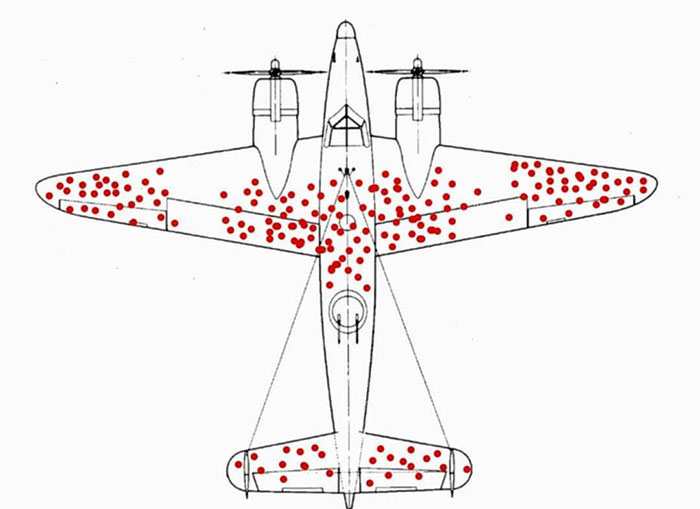
    A recent LinkedIn post alerted this writer to the inimitable perspective statistician Abraham Wald brought to the assessment of World War II Allied bomber damage upon return from missions.  He argued that observed anti-aircraft damage was non-crippling since the aircraft remained airworthy and was able to return.

    He surmised that planes that did not come home may have suffered damage to other areas making them unairworthy and hence their data was unobserved.  Based on this analysis, the U.S. Navy beefed-up armor in the less or unaffected areas and this was credited with saving lives and aircraft.

    This type of analysis came to known as Survival Bias which has its proponents and detractors.  On the surface, it seemed intuitively obvious that areas of damage need addressing while not necessarily those statistically showing fewer issues.

    It is not our intent herein to assess its merits and applicability.  Rather to help readers better understand the very nature of big data and its use, especially in predictive and behavioral models.

    Covid-19

    Today, policy and other decision makers are tasked with dealing with a deadly global pathogen.  Apparently developing quickly and spreading exponentially—a super spreading event.  As of this writing has afflicted millions in 188 countries/region in much less than 12 months.

    In this pundit’s opinion, much of the concern, confusion and clearly wrong information regarding this disease and mitigation protocols can be traced to data collection and analysis.  By now most readers will have some familiarity with the chaos associated with these predictive models.

    For example, according to the US National Library of Medicine, National Institute of Health, “A key fact for us all to remember is that, for the majority of countries, we’re not actually counting how many people have the virus—instead were counting the reports of how many people have the virus, and, like all metrics, those numbers vary according to how they’re measured.  An increase in the number of tests being carried out will result in an increase in the number of infections detected.”

    In addition to the Herculean efforts to tame this tiger from the vast medical, scientific, technology and many other disciplines, Structural Equation Modeling is being used to shed additional light on the latent variables.

    Final Thoughts

    The 2020 Coronavirus is an early test of Big Data analysis in support of decision makers both for public policy and non-government organizations.  While performance so far has been weak, this pundit believes great value can come from this effort.

    Data quality must be highly reliable and valid.  Moreover, models must assess what is not seen, the latent variables such as found in Survival Bias.  These two aspects of strong decision support models are crucial.  These are lessons for all of us.

    Where Didn’t the Bullets Hit Your Business Model?

    For More Information

    Please note, RRI does not endorse or advocate the links to third-party materials.  They are provided for education and entertainment only.

    For more information on Cross Cultural Engagement, check out our Cross Cultural Serious Game

    We are presenting, Should Cross Cultural Serious https://rri-ccgame.com/Games Be Included in Your Diversity Program: Best Practices and Lessons Learned at the Online Conference, New Diversity Summit 2020 the week of September 14, 2020.  Check Out this timely conference!!

    You can contact the author as well.

  • Agility, Resiliency, Sustainability

    Agility, Resiliency, Sustainability

    In a recent Harvard Business Review, I was struck by an article about Best Practices for small businesses.  From that piece, “To successfully navigate Volatile, Uncertain, Complex and Ambiguous (VUCA) challenges like Covid-19, family business leaders can look to best practices from another organization that specializes in VUCA situations—the U.S. military’s Special Operations Forces (SOF)” (emphasis added).  There are a lot of good ideas in the article that organizations can implement immediately.  Moreover, we have long recognized that properly vetted and adjusted as necessary, Best Practices from others can add significant value to organizations in other industries.

    Out of the Darkness

    It is easy to be overwhelmed these days.  Mildly put, most if not all organizations were thrown into chaos in less than a month.  Depending on your business you are either partially operating or still waiting to open-up.

    Regardless, how you work in June will be different than early March (~60 days as of this writing).  Traditional recession management and recovery techniques may not be applicable this time.

    There are lots of ideas about how to use technology going forward.  Digitalization, IoT, IT-OT, among others are hawked as THE solution.  Problem is, it is not that simple, and it takes time and money to implement.  Many midsize firms do not have those privileges/resources.

    There are a lot of actions most organizations can take without major CAPEX investments in time and money.

    Years ago, we recognized that certain industrial sectors, particularly those with a high-risk profile such as energy or others deemed to be part of Critical Infrastructures face unique challenges.  Some have a tendency towards incremental change or even the status quo.  Change is often slow with setbacks.

    Moreover, for every major firm there can be thousands of organizations in the supply chain ecosystems all of which must work well if total costs and profitability for all are to be effectively addressed.

    This seemingly daunting task yet it need not be.  There is a solution set available that can help organizations manage through this dark period and into the light, thriving.

    The mission of The Rapid Response Institute is;

    “Helping Clients Achieve Organizational Agility, Resiliency and Sustainability”

    To that end, we have developed solutions, methodologies, and tools enabling enterprises of all sizes to not just survive but thrive after disruptive events.  Much of this is either free or at low cost.

    Rapid Response

    In our 2009 White Paper, Rapid Response Management: Thriving in the New World Order we posited our new approach to managing your business.  “Rapid Response Management (RRM) is an organizational construct or mental model that enables the organization and its key partners to rapidly sense changes and respond accordingly–quickly.  While it maximizes the effectiveness of management knowledge to address change, it is not simply gut feel.  Rather it is a simple yet sophisticated, methodical paradigm any organization can quickly and inexpensively implement.”

    RRM is a creative and well documented method for running your business.  The thinking was well advanced by 2009 and has been further ‘stress tested’ over the past decade.

    We have updated RRM with our Operational Excellence Platform and interested readers are invited to check that out as well.  Our offerings are designed to help our clients get through crises such as Covid-19.

    We are updating this white paper and it will be available as an e-book in the near future.  If you would like to reserve a free copy, Contact us.

    We are here to shed some light during this dark period.  For no cost, no obligation discussion contact us.  We can put decades of experience dealing with business cycle adversity on your team.

    Feel like your trapped?  You’re NOT!

    For More Information

    Please note, RRI does not endorse or advocate the links to third-party materials.  They are provided for education and entertainment only.

    For more information on Cross Cultural Engagement, check out our Cross Cultural Serious Game

    We presented, Should Cross Cultural Serious Games Be Included in Your Diversity Program: Best Practices and Lessons Learned at the Online Conference, New Diversity Summit 2020 on April 9, 2020.  The summit will be offered again soon.  Check it Out!!

    You can contact the author as well.

  • Tumultuous Decade: What’s Next for Oil & Gas?

    Tumultuous Decade: What’s Next for Oil & Gas?

    April 20, 2020 marks the tenth anniversary of one of the most horrific incidents in the upstream oil and gas sector—Deepwater Horizon.  In addition to the tragic loss of eleven lives, the sector forever changed.  Immediate restructuring of federal oversight resulted in the establishment of the Bureau of Safety and Environmental Enforcement (BSEE) and their subsequent Safety Culture Policy.

    The industry changed too.  One of the first efforts following Macondo was the formation of the Marine Well Containment Company.  Its mission is to rapidly respond to Deepwater incidents in the Gulf of Mexico.  Subsequent organizations are also positioned around the world.

    Moreover, the industry embraced Safety Culture and continues to improve based upon Systemic Safety Cultures across organizational ecosystems.  These processes are incorporated into Operations Management Systems that incorporate SEMS as part of Operational Excellence Initiatives.

    In 2014, the sector faced another slap in the face with the collapse of oil prices, yet again.  Now it is the double whammy of the Covid-19 pandemic coupled with the price war between Russia and Saudi Arabia.

    Darkest Before the Dawn

    Each time the industry is forced to retrench, it follows a predictable pattern.  Reduction in force (layoffs), corporate restructuring and turning to technology are among the most common steps.

    This chart from the Federal Reserve Bank of St. Louis shows the employment levels for the upstream sector since the early 1970s.  One can make the case that the level of employment in the sector is flat at best.  One likely cause is automation and the extensive use of information technology to manage the business.

    Note: This chart is current as of March 2020

    In 1970, the US population was a little more than 205 million.  Now it tops 330 million.  This supports a hypothesis that the per capita employment by the sector is decreasing.  We expect this to continue.

    The Digital Oilfield marches on with the advent of IT-OT Convergence, Digitalization, etc.  This process has been underway since at least the late 1970s with the advent of the first computerized data acquisition systems.  Likely, much longer if one considers for example, the invention of electric well logging by the Schlumberger brothers in 1926.

    Certainly, other technological advances have contributed as well.  The often maligned fracturing the rock traces its roots back the beginning of the industry (circa 1862).  Contemporary hydraulic fracturing was started by Halliburton in 1949 and shale ‘fracing’ by Mitchell Energy & Development Corporation during the 1990s.

    While we have not done the detailed research, historically oil companies have outsourced to engineering firms, IT companies and others that provide a service as opposed to full time employees.  Today’s disrupted employees may find better careers in the emerging sectors that support petroleum operations as well as other sectors.

    Schumpeter’s Creative Destruction is a work in ‘the patch’ today.  A lot has happened in the Deepwater Horizon incident.  Here’s to calmer waters this next ten years!

    How Are You Positioning Your Career to Capitalize on Disruption?

    For More Information

    Please note, RRI does not endorse or advocate the links to third-party materials.  They are provided for education and entertainment only.

    For more information on Cross Cultural Engagement, check out our Cross Cultural Serious Game

    We presented, Should Cross Cultural Serious Games Be Included in Your Diversity Program: Best Practices and Lessons Learned at the Online Conference, New Diversity Summit 2020 on April 9, 2020.  The summit will be offered again soon.  Check it Out!!

    You can contact the author as well.

  • A Funny Thing Happened on the Way to . . . Innovation!

    A Funny Thing Happened on the Way to . . . Innovation!

    The anecdote, ‘A Funny Thing Happened on the Way to’ wherever manifests itself for a number of paths.  One interpretation; we often end up somewhere other than expected.

    We find ourselves at another historical precipice.  Some suggest Armageddon, the end of life as we know it and the emergence of a new normal.  This writer only agrees with the last two words.

    New Normal

    Since the advent of Covid-19 in the United States (probably before) the medical community has been doing some great things at hyper speed.  Now it is hard to keep up with the creative, innovative and downright amazing work being done at the global scale.

    Some argue that the new normal will include an army of remote workers.  Probably some truth to that but perhaps more importantly will be the recognition that society can quickly ‘scale’ to the global level when confronted with new and unknown threats.

    Reduced Cycle Time and Cost

    This pundit has long advocated that the use of knowledge enabled by technology can reduce project cycle time dramatically.  It can also significantly reduce project cost as well.  If we visualize the Covid-19 global initiative as a project, then perhaps most importantly we can decrease the timeline pointedly.

    To be clear, this writer has no medical training and is only prognosticating that the use of knowledge enabled by technology can reduce the overall time and impact of the pandemic.  After all, this is not 1918!

    For example, many will be familiar with the TV sitcom, M*A*S*H, set in the Korean War of the early 1950s.  We are seeing modern day versions of the Mobile Army Surgical Hospital with the deployment of new ‘temporary’ hospital beds to virus hot spots like NYC.  The medical profession has established long standing triage protocols as well.

    Moreover, the use of 3D printing has augmented the medical equipment manufacturing process in ways no one could have foreseen on January 1, 2020.  Changes in Clinical Trial protocols and other pharmaceutical related processes are, as the saying goes, ‘on steroids’ destroying this virus.

    The list goes on and shortly after this publication, this post will probably be outdated—the rate of positive change is so explosive right now.

    Donald Rumsfeld gets credit for saying, “There are known knowns.  These are things we know that we know.  There are known unknowns.  That is to say, there are things that we know we don’t know.  But there are also unknown unknowns.  There are things we don’t know we don’t know.”  However, this construct has its roots in the 1950s.

    I am betting that last sentence will fall sooner rather than later.  We are rapidly learning what we don’t know we don’t know.

    Godspeed to all on the front line and those of us who are not will continue to support you in every way known and about the be known that we can.  This writer grows less concerned about the final outcome every day.  It seems that collectively Humankind is rising up to the challenge.  We will prevail!

    How is your knowledge enabled to contribute to the demise of this pandemic?

    For More Information

    Please note, RRI does not endorse or advocate the links to third-party materials.  They are provided for education and entertainment only.

    For more information on Cross Cultural Engagement, check out our Cross Cultural Serious Game

    We will be presenting, Should Cross Cultural Serious Games Be Included in Your Diversity Program: Best Practices and Lessons Learned at the Online Conference, New Diversity Summit 2020 beginning April 5, 2020.  Check it Out!!

    You can contact the author as well.

  • Home Base During a Crisis: ‘get up, clean up, and dress up’

    Home Base During a Crisis: ‘get up, clean up, and dress up’

    In the middle of a global pandemic, all of us who can are advised to work from home.  Many of us have worked remotely for a while now.  Whether traveling, dealing with sick children, avoiding traffic or dealing with a natural disaster remote management has become part of our business DNA.

    Yet, this pundit was a bit surprised at some of the social chatter about working from home for extended periods.  After all, I have been working remotely for decades.  Turns out, these fears have a basis in fact.

    It appears there are two culprits at work here.  First is our individual behaviors and secondly, there are serious productivity concerns.

    First Culprit

    A day or two, here and their remote working is fine.  Things can change however; when it becomes a way of life and not everyone is well suited to labor this way.

    While it all sounds good on paper, working as an individual remotely is a difficult thing to do.  Humans are social beings.  Most of us need to interact with others; daily.

    The concept of working in my ‘underwear’ is not sustainable.  Like all aspects of life, a structured process is required.  First of all, ‘get up, clean up, and dress up.’  This is not the weekend where you check the odd email or holiday where you do the same on a beach with an umbrella drink.

    It is your job, the source of your income and often self-worth.  The risks to both of these is high when working remotely.

    While not directly on this topic.  This is one of the best videos on motivation and focus.  Well worth your time to view it.

    Working at home requires discipline as well as your ‘in office’ work ethic.  Challenge will be to sustain this effort.

    Second Culprit

    Some sectors such as Information Technology have encouraged its employees and contractors to work from home on a permanent basis.  This was long ago considered dogma.  Except that sometimes it does not work.

    In 2017, I noticed that IBM was ending its ‘work from home’ policy for many workers.  In their statement at the time, “In many fields, such as software development and digital marketing, the nature of work is changing, which requires new ways of working.  “We are bringing small, self-directed agile teams in these fields together.”  Has anything changed in less than three years?

    Further confirmation of this model can be found with most of the technology innovators and accelerators today.  Often accused of selling real estate these mostly for-profit enterprises claim that working together in a centralized environment encourages collaboration and cross pollination of ideas.

    This is the current common business model for start up organizations around the world.  In the minds of many, it must work and add value to the creative process.

    Another New Normal

    Is this a paradigm shift or just a short term inconvenience?  Reality, probably a bit of both.  E-learning has been growing and this may give that sector a boost.  Software development, the presumed online job, maybe not so much.

    While it is likely that Structural Dynamics are at work the current covid-19 situation.  Our Relationships, Behaviors, Conditions (RBC) model is a useful tool going forward.

    We are changing your blog model for the near future and will be developing this issue in more detail and offering actionable solutions.   In subsequent posts we will develop this further.

    In the meantime, if your challenged by the requirement to work remotely contact us for no cost, no obligation mentoring.

    How is Your Organization Assuring Productivity Remains During the Crisis?

    For More Information

    Please note, RRI does not endorse or advocate the links to third-party materials.  They are provided for education and entertainment only.

    For more information on Cross Cultural Engagement, check out our Cross Cultural Serious Game

    You can contact the author as well.

  • To KISS or Not?

    To KISS or Not?

    According to legend, the term KISS or ‘Keep It Simple, Stupid’ was coined by Kelly Johnson, lead engineer at the Lockheed Skunk Works and noted by the US Navy as early as 1960.  Subsequent phrases such as ‘Less is More’ followed.

    At first glance, it makes sense not to overly complicate a product, process or project.  Certainly, a non-technical audience such as senior management will need to the issue and risk management strategy explained in terms they understand.  However, in our search for Red. Yellow, Green ratings are we overly simplifying complex environments?

    Albert Einstein is created with saying, “Everything should be made as simple as possible, but not simpler.”  This begs the questions, where is that line and how do you know if you’ve crossed it?

    One of the mantras of the High Reliability Organization Mindfulness is, Preoccupation with Failure.  This is not defined as with Normal Accident Theory, where failures are inevitable.  Rather, it is an understanding the modern complex systems one must be resolute in one’s focus on operational issues and rapidly move to normalize out of limit situations.

    In 2016 (and earlier) we made the case that after the Ebola outbreak in Dallas, the Public Health sector was resilient and that issue was contained quickly (links to all three parts of this series provided below).  In this writer’s opinion, this was not possible if the process was ‘worked’ at a too simple level.  Lessons learned from that and other contagion incidents may be useful combating Coronavirus Disease 2019 (COVID-19).

    The overused phrase, “failure is not an option” is the root of contemporary Operational Excellence business models.  In fact, failure happens but mitigating its impact and rapidly recovering are the hallmark of successful organizations.

    The graphic is a fractal.  From the Fractal Foundation, “A fractal is a never-ending pattern.  Fractals are infinitely complex patterns that are self-similar across different scales.  They are created by repeating a simple process over and over in an ongoing feedback loop.  Driven by recursion, fractals are images of dynamic systems – the pictures of Chaos.  Geometrically, they exist in between our familiar dimensions.  Fractal patterns are extremely familiar, since nature is full of fractals.  For instance: trees, rivers, coastlines, mountains, clouds, seashells, hurricanes, etc.”

    Our world is a complex place.  Processes and technologies must deal with that fact.  Successful risk management strategies must take Einstein’s wisdom into consideration.

    Does Your Organization Have a Robust Enterprise Risk Mitigation Strategy?

    For More Information

    The Three-Part Series Referred to in this blog:

    Please note, RRI does not endorse or advocate the links to third-party materials.  They are provided for education and entertainment only.

    For more information on Cross Cultural Engagement, check out our Cross Cultural Serious Game

    You can contact the author as well.

  • Hanging App?

    Hanging App?

    By one measure, the US presidential primary season is off to a rough start.  In a small state, counting the ballots became a challenge.  Wasn’t technology supposed to solve the problems of past confusions?

    Yet the mechanism seemingly failed—again!  How is this different from the Boeing Max 8 disaster?  In one sense it isn’t.

    Disclaimer:  The only information this author has on the recent electoral IT problem is publicly available and he is not aware of anyone involved in that process that he may know personally.  This piece is only an opinion about a technology issue.

    Technology Adoption Process

    App developers strive to get to MVP as rapidly as possible.  Wikipedia defines a Minimum Viable Product as, “A version of a product with just enough features to satisfy early customers and provide feedback for future product development.  Gathering insights from an MVP is often less expensive than developing a product with more features, which increases costs and risk if the product fails, for example, due to incorrect assumptions.”

    Speed is of the essence in software development.  Yet, a rapid time to market should not sacrifice adequate analysis and assurance the software is robustly ‘stress tested.’

    Apps are moving from simple tools designed to call an independent driver of transport or order a burger.  They are now integral parts of enterprise solutions with broad implications if they fail.  This changes the fundamental project development process and benchmarks for release.  This is true for all App developers, even if their employee base is one or the development process is outsourced entirely.

    Release Maturity

    Most new technologies start is some’s ‘garage.’  Whether Steve Jobs’ or 3M, the processes are ad hoc and getting a so-called ‘Alpha’ product is the goal.  Those third parties who accept and test it know their risks and exposure.  Such customers would never use that release in a production environment.

    Other maturity models include Technology Readiness Levels (TRLs) by NASA and the European Association of Research and Technology Organisations.  At a minimum, testing must assure it is fit-for-purpose and that the product can ‘scale’ to meet the expected demand.

    Technology vendors to ‘critical infrastructure’ sectors such as oil and gas often express exasperation at the sometime slow take up of new solutions.  Individuals that take excessive risks deploying new technology may literally be putting their career at risk as well as their critical processes.  Therefore, they tend to be risk averse.

    There are many examples of what not to do rolling out new technology.  This month’s primary election is just the latest.  The adage, ‘no one wants to make the front page of The Wall Street Journal’ has a lot of truth to it.  Make sure you and your customer get media coverage for the right reasons.

    How Do You Know Technology is Ready for Enterprise Wide Deployment?

    For More Information

    Please note, RRI does not endorse or advocate the links to other third-party materials.  They are provided for education and entertainment only.

    For more information on Cross Cultural Engagement, check out our Cross Cultural Serious Game

    You can contact the author as well.

    End Notes

      https://en.wikipedia.org/wiki/Technology_readiness_level

      https://therrinstitute.com/critical-infrastructure-sectors/

  • 10, 20, 30, 40, 50 or More!

    10, 20, 30, 40, 50 or More!

    The advent of 5 G so soon after 4 G—Humm.  What’s next?  How many G’s are there?

    In 1965, Gordon Moore put forth the construct that the density of transistors in integrated circuits doubled each year.  The so-called Moore’s Law has governed technology growth ever since.  However; over 50 years later, some argue that we may be far up that power curve.  One conjectures if the latter statement is correct.

    In 1899, Charles H. Duell then the Commissioner of US patent is purported to have said, “Everything that can be invented has been invented.”  Mr. Duell died in 1920 so he missed many of the ‘new’ things we now take for granted.

    Marketers tend to categorize in buckets; Boomers, Gen Xers, Millennials and so forth.  Do any of these labels matter?  Probably not.  The same is true for technology tags as well.

    Life, technology, knowledge et al marches on, just like it has throughout human history.  Will we see the advent of 50 G networks?  Most likely; with 100 G hot on its heels!

    Less we forget, the current version of the cell phone (iPhone and its equivalents) was first released in 2007.  Much has changed in the last 13 years and we can expect that arc to continue with disruptive new mobile technology crashing in at some point.

    Agility

    Most think of an ‘agile enterprise’ as information technology driven.  In this writer’s opinion, this is a narrow perspective.  The word ‘agility’ is defined in terms of power and thinking.  In other words, the ability to make good decisions with the capacity to implement them.

    In this hyper-technology environment, it is not the adoption of a particular rendition, but the capability to incorporate the appropriate new in an economic manner.  This is true whether the organization is an ‘early adopter’ or even a ‘laggard.’

    For decades, organizational strategy has been enabled by technology.  There is no reason to change that model with many G’s to follow!

    How Does Your Organization Ingest New Technologies?


    Enjoy this flash back to the 1960’s.

    For More Information

    Please note, RRI does not endorse or advocate the links to other third-party materials.  They are provided for education and entertainment only.

    For more information on Cross Cultural Engagement, check out our Cross Cultural Serious Game

    You can contact the author as well.

    End Notes

      https://en.wikipedia.org/wiki/4G

      https://en.wikipedia.org/wiki/Moore%27s_law

      https://www.dictionary.com/browse/agility

      https://en.wikipedia.org/wiki/Technology_adoption_life_cycle

  • Reflection: Are We Near a Digital Tipping Point?

    Reflection: Are We Near a Digital Tipping Point?

    Generally, this time of year humans are wont to look back on the closing year and assess the good and the bad, and dare I say the ugly?  We celebrate successes, review the not so successes, and what is left undone.  This process prepares us for the New Year’s resolutions that are often then broken.

    Today, we will see lots of stories on the accomplishments of the year, notables that passed from this life and other celebrations and questions about the waning hours.  In this piece, let us ask another question.

    The subject of the Man—Machine relationship has long been the subject of comment and speculation.  It remains so.  Where are we along this path?

    But as the march on a continuum towards the future, it is time to assess the level of Maturity of our Operational Excellence as a function of IT-OT.

    Challenges remain.  Recently, the Boeing’s Starliner space vehicle failed to reach its planned orbit.  The glitch is apparently in the capsule’s clock where a programming error misinterpreted the stage of the mission.

    News media reporting suggests that if astronauts had been on board, they may have been able to override the system and correct the problem.  This is an area we have addressed herein on several occasions.  When does the human act?  Recent articles include:

    The decision model whether to override the computer remains elusive.  Likely, it will for some time.

    In this writer’s opinion, it is currently difficult to develop an appropriate governance model for this emerging man-machine interface.  That said, the task is upon society and individuals and organizations must proactively engage.

    Not Just Digitalization

    There is much ado about the promise of digitalization and speculation about its ability to be a game changer.  One wonders how any technology available to all warrants such status?

    Since the advent of the Turing machine, circa 1936 and its enablement of the winning of Word War II (at least in Europe), there has been a level of trust in information technology that is not always warranted.  Today, how many of us will sit with our children in the backseat of a driverless automobile?

    Human factors must be considered when new technology models are put forth.  After all, humans still govern, right?

    Maturity Assessment

    Building on the CMMI and our own maturity model development methodology we put forth a set of constructs.  Beginning in 2004, when we released our Roadmap study.  It was one of the earliest, if not the first industry wide assessment of the so-called digital oilfield and guide for organizations to transform themselves with this enabling technological model.

    As part of that study we posited a maturity model that still has applicability for heavy industry and its use of information technologies to manage the business.  An updated version is shown in the following figure.

    For many organizations, Level 3 is satisfactory and accomplished the required.  One can argue that an airline autopilot would be at least Level 4.

    The current issues Boeing has with is space capsule and 737 suggests that may not be the case.  By the way, this is not limited to this manufacturer, others have similar issues as well.

    In the opinion of this writer, as a society we are at best Level 2 when it comes to digitalization.  What do readers think?

    Paraphrasing a famous election cycle quote, “It’s the software, stupid.”  Are we near a digital tipping point?  Perhaps not.

    Much work is yet to be done.  Fear not for the robots taking your job—at least for the moment.

    What is Your Digitalization Management Maturity Level?

    For More Information

    Please note, RRI does not endorse or advocate the links to other third-party materials.  They are provided for education and entertainment only.

    For more information on Cross Cultural Engagement, check out our Cross Cultural Serious Game

    You can contact the author as well.

    End Notes

      https://www.space.com/boeing-starliner-oft-fails-to-reach-correct-orbit.html

      https://en.wikipedia.org/wiki/Turing_machine

      https://therrinstitute.com/maturity-models/

      (2004, September). Roadmap to Enterprise Optimization: A Guide to the Impact of Information Driven Field Operations on the Petroleum Corporation.

      https://www.popularmechanics.com/flight/airlines/a26854898/plane-automation-crashes-incidents/

  • Lessons in Servant Leadership: What Did You Say?

    Lessons in Servant Leadership: What Did You Say?

    Watch almost any media talk show and the interviewer will often interrupt the guest trying to answer the question just posed.  This is such a common phenomenon that it is accepted behavior perhaps driven by ratings that come from on-air confrontation.  It is part of the culture!

    Why ask the question if you’re only going to impose your view in the middle of an answer?  Perhaps guests are just convenient foils.

    When briefing senior management, colloquial wisdom is to get to the point quickly and succinctly.  Words to live by and often put forth by this pundit.  Yet it is amazing how many of us violate the axiom by continuing to talk.

    Truly listening with all senses is a rare skill.  How often have we been in a situation such as a sales call when the customer is interrupted by members of the sales team?

    It is more difficult to close a deal when the preconceived notions of the seller override the buyer’s response.  Often in such a situation the client’s body language will give a clue as to her irritation when ‘talked over.’

    The Power of Listening

    So, you have made your pitch and are now sitting quietly waiting for the client to respond.  However, the so called ‘pregnant pause’ ensues.

    The overwhelming desire is to ‘jump in’ and say something to break the silence.  But how does that close a deal when an offer has just been made?

    Such behavior usually results in either prolonged negotiation or no deal.  The human inclination to talk can be irresistible.  A better behavior is to shut up and listen!

    Some research shows that good listening is beneficial to both employees and their organizations.  However, barriers to better listening include:

    • Loss of Power—The appearance of weakness or not in control of the situation
    • Takes Time and Effort—Daily time pressures may negatively impact on the work product
    • Fear of Change—The speaker must refrain from making ‘foregone conclusions’ until a response is articulated

    In addition to certain listening skills, a good listener must have the ‘intention’ to become one and resist the urge to interrupt.  This can become the framework for real dialogue and exchange of ideas and information.

    Getting to Yes

    In a TEDx Talk, the coauthor of the negotiation book, Getting to Yes discusses the value of listening in any human interaction.  The investment of less than 16 minutes of your time will be enlightening.  One suspects the almost 900,00 viewers would agree.

    Our inherent nature to ‘rattle on’ distracts us from our goals.  We recently discussed the value of understanding the difference between Wants, Likes and Needs.

    Truly listening and understanding your counterpart’s feelings (or deeply personal Needs) will unlock the key to getting a deal done—Yes!  This is a major component of  servant leadership.

    R B C

    Human (B)ehaviors in certain situations or (C)onditions establish (R)elationships between two or more parties.  We have been extending this construct for almost 25 years and it has broad applicability.  What kind of Relationship is established if one or more individuals do not listen to others?

    How Well Do You Listen to Your Colleagues and Family Members and Do They Listen to You?

    For More Information

    Please note, RRI does not endorse or advocate the links to other third party materials.  They are provided for education and entertainment only.

    For more information on Cross Cultural Engagement, check out our Cross Cultural Serious Game

    You can contact the author as well.

    End Notes

      https://en.wiktionary.org/wiki/pregnant_pause

      https://hbr.org/2018/05/the-power-of-listening-in-helping-people-change

      https://therrinstitute.com/want-like-need/

  • Running Across an Open Field: Strategy for Disruptive Technology?

    Running Across an Open Field: Strategy for Disruptive Technology?

    Several weeks ago, as an amateur history buff, I was watching a documentary about World War I.  During one segment the commentator discussed the apparent fact that if soldiers refused to charge out of their trenches across an open field into the teeth of waiting machine guns they would be shot.

    The brutality of such a command by (so-called) leadership is appalling.  It may have been one thing for Alexander the Great’s armies to engage in open battles with sharp pointed objects as weapons.

    It is quite another for General Pickett’s infantry at Gettysburg to charge cannons and 50+ years later to repeatedly try the same tactic (by both sides) at horrific costs.  Generals always fight the last war, so the saying goes.

    This blog is not about some of history’s follies, it is about learning so as not to repeat the mistakes of others.  These lessons apply to readers’ daily business world as well.

    When New Technology is Deployed

    New disruptive technology can tear the societal fabric.  Some old jobs and companies disappear, and new ones thrive.  This process has been repeated since antiquity.

    Our culture is having this dialogue today regarding digitalization and its suite of technological driven change, i.e., Blockchain, AI, etc.  Principal issues that must be addressed include Human Factors Engineering (HFE).

    “HFE places the human operator at the center of the complex operating environment.  HFE recognizes that this individual or set of individuals is the puppet master and is responsible for the entire show.”  In other words how do we interact with the new technological reality.

    Reliable and valid HFE is the key to successful digitalization initiatives.  It will be the vital to whatever is next as well.

    Tyranny of the Minority

    From political science, “For centuries, theorists have worried about the potential of unrestrained democracy to lead to a tyranny of the majority, in which majority groups ride roughshod over the rights of minorities.  What we often see today is instead a kind of tyranny of the minority: a system in which a particularly extreme and motivated fraction of the populace can wield outsized power in the face of a majority which is either too indifferent or too scared to oppose it,” (italics added).

    In most organizations, there are fewer leaders than those who fabricate a ‘work product.’  The responsibility of leadership is to set the vision, mission and goal as well as enabling the organization with the tools and support necessary to reach targeted stakeholder value.

    But what if this minority group is the slowest to come to grips with disruptive forces?  In the face of newness, they may ‘keep doing what they have always been doing.”  In such an environment, the organization will likely not reap the same reward as in the past.

    Does too indifferent or too scared describe your organization’s ecosystem workforce?  One suspects It would be good to know.

    Fast Fail

    In our last blog we discussed the rapid assessment of technology and when to drop it if it does not appear to be working out.  Perhaps, we should treat managerial processes the same way.  After a horrific and visible failure in leadership, conceivably one preserves best by looking for alternative?

    If charging head long across an open field leads to disaster, why keep doing it?  While a counter argument might be that we had no tools to defeat those equipped with the new technology, to this writer, that logic is suspect.

    Flanking an enemy’s line or using guerrilla tactics, et. al. are as old as human confrontation.  Unconventional warfare has a long record of documented success.

    The business lexicon is loaded with military terminology.  We often speak of business as if it is warfare, when of course it is not.  There are lessons to be learned about human and organizational behavior, however.

    Decades ago, the concept of Guerrilla Marketing was the rage.  With the advent of social media, it has advanced, and the methodology is available to all.  Huge budgets and massive media campaigns are no longer necessary.

    Head-to-Head the biggest ‘guy’ usually wins.  So, if you’re not him/her, DON’T DO IT!!  However, the small mammals may displace slow moving dinosaurs.

    Agile is not an IT term.  It should be the state of mind of leaders at all levels.  To charge across the open business landscape into technology designed to destroy your organization remains folly.

    How Are You Leading the Charge into the Future?

    For More Information

    Please note, RRI does not endorse or advocate the links to other materials.  They are provided for education and entertainment only.

    See this 3:15 minute clip for more information on living in a World War I trench.  Pathetic way for leaders to force those under their command to live.

    For more information on Cross Cultural Engagement, check out our Cross Cultural Serious Game

    You can contact the author as well.

    End Notes

      https://consult2050.com/job-disruption-due-to-digitalization/

      https://therrinstitute.com/wp-content/uploads/2018/10/HRM-in-Process-Industries-Sustained-by-Human-Factors.pdf

      Ibid.

      https://areomagazine.com/2019/04/02/the-tyranny-of-the-minority-and-how-to-prevent-it/

      https://therrinstitute.com/lessons-from-the-seventies/

      https://en.wikipedia.org/wiki/Guerrilla_marketing

  • Lessons from the Seventies

    Lessons from the Seventies

    At lunch the other day and for whatever reason, the history of the 3M Post It Note became a subject of our conversation.  This technological marvel unveiled in the 1970s is still widely used today.

    As with other new or disruptive technologies, the ‘sticky note’ was panned at first and for some time.  According to Wikipedia, the technology was first developed in 1968.  It was not until 1974 that it gained some internal company support.

    When finally introduced in 1977, the pilot results were unsatisfactory.  However, things started to change in 1978 when a small (focus) group of consumers were positive about the product.

    The United States roll-out began in the spring of 1980, followed by Europe and Canada in 1981.  A bit of trivia, the reason it was originally yellow was because yellow colored scrap paper was readily available at its inception.

    Earlier the day of our lunch meeting, a discussion revolved around how long it might take an idea to become a fundable start-up company.  Several participants argued that with proper guidance, the process still might take up to two years.  This pundit argued that many entrepreneurs would see that as too long and become disinterested.

    The legacy of the Post It Note suggests that this pundit might be incorrect.  The lowly sticky note did not even begin its journey to become a Unicorn until twelve years after its technology was discovered.

    In 2015, we penned a blog, Titans of the 1940s Today.  The basic premise of that piece was when commenting about the Internet of Things (IoT) and its complexity, individuals such as Richard Feynman and John von Neumann (father of the 1945 computer architecture that is the basis of modern computing) had developed solutions for today prior to this author’s birth.

    We stand on the shoulders of these and other giants.  The challenge of every generation has been to build on what those who came before advanced.  So it remains today!

    Body of Knowledge

    Human kind has developed a rich body of knowledge in all areas of endeavor.  It is readily available for entrepreneurs as well as those employed by all types of organizations.  This knowledge base has been addressed in this blog and other writings by the author.  Interested readers are invited to review my blogs and newsletters dating back to the last century.

    Our march through history provides all of us a ‘go-by’ that can shorten our learning curve.  One example this author often cites is the depth of historical knowledge of management.  Contrary to many gurus, humans have managed others and processes for many millennia.

    Fail Fast, Fail Often?

    If 3M or Feynman et al practiced this technology development model as most interpret it, our world might be a lesser place.  Give up and move on to the next?

    One interpretation suggests, “Originating from Silicon Valley and its ocean of start-ups, the real aim of “fail fast, fail often,” is not to fail, but to be iterative.  To succeed, we must be open to failure—sure—but the intention is to ensure we are learning from our mistakes as we tweak, reset, and then redo if necessary.”

    This same article goes on to state, “Thomas Edison, by example, ‘failed’ 9,000 times before he was successful with his light bulb invention.”  Perseverance can be a lonely quality!

    Don’t lose heart.  Great ideas abound but must gestate.  It is often said that we find our soulmate when we least expect to—I know I did.  Progress is an iterative process fueled by creativity and critical thinking.

    Is Your Idea a Unicorn Waiting to be Born and Mature?

    For More Information

    Please note, RRI does not endorse or advocate the links to other materials.  They are provided for education and entertainment only.

    You can contact the author more information as well.

    End Notes

      https://en.wikipedia.org/wiki/Post-it_Note

      https://therrinstitute.com/wp-content/uploads/2018/10/Titans-of-the-1940s-Today-April-20-2015.pdf

      https://therrinstitute.com/wp-content/uploads/2019/10/1993-Management-Theory-Evolution-Not-Revolution.pdf

      https://www.forbes.com/sites/danpontefract/2018/09/15/the-foolishness-of-fail-fast-fail-often/#1db35b0e59d9

  • Want – Like – Need

    Want – Like – Need

    Years ago, as part of a never-ending series of company reorganizations, a team of our change management consultants headed to the ‘field’ to interview users.  Upon their return, they presented an extensive list of technology investments deemed necessary to remain competitive.

    Their list focused on technology and not business concerns.  Wondering, I asked who they interviewed.  Proudly, they proclaimed the “field engineers.”  When queried–did they talk with district managers, regional engineers and others with P&L or other managerial responsibilities, the answer was “no.”

    This very expensive process by a major professional services organization simply generated a wish list of junior employees.  It was what they thought they WANTED.

    In our current jargon, “cool stuff.”  Needless to say, none of these projects were funded.  Wasted time and money by those not familiar with our business!

    Today, we are driven to LIKE everything!  CRM systems demand input before we have even procured the product or service.  Log on to any given website and the request to complete a survey will hit you before you read the first line.  Five stars or thumbs-up emojis appears to be the goal.

    Do wants and likes add value?  Perhaps a like is a statement of preference, but perhaps the consumer wants the digital driven question to just go away without the hassle of someone begging for a higher ranking like.  Fibbing to surveys has become a national pastime.

    Business should be most concerned about what a prospect or returning customer NEED.  What pain point or problem does your product/service solve?  If you can’t answer that question, no amount of wants and likes will add to your bottom line.

    I may want a hamburger and go to a fast food restaurant with lots of likes.  However, if I am in a hurry and their preference is clearly to move cars via the drive-through faster than those of us waiting inside, my need to eat quickly will not be met.  I may leave without my meal or most likely not respond to a survey seeking likes.  Then never return!

    That lost customer will never surface in any analysis—not even one star.  Enough of those responses and the business will be in jeopardy and management my not even know why.  Collecting likes should never be a Key Performance Indicator (KPI).

    Finding the Pain

    In a recent Global Energy Mentors leadership meeting, an investment group recounted their business model as one that focused on identifying organizational ‘pain’ points.  Once a specific pain was articulated, the search for new technologies that would address/resolve that pain was undertaken.

    This model flies in the face of Steve Job’s, “A lot of times, people don’t know what they want until you show it to them.”  That may be and sometimes unknown needs are uncovered.

    However, in critical infrastructure sectors where failure is not be an option because it can be very expensive solving a known need is usually most important.  Without exception, this entrepreneur’s success has been focusing on addressing industrial client known pain points.  As an example, our EVPM modeling process demands input from customer groups.

    In this blog series, we have referred to successful change management that comes from addressing the—what’s in it for me question.  From a customer perspective; freeing ‘me’ from known pain is often more valuable than alleviating pain I did not know I had.

    Does Your Value Proposition Solve a Need, Address a Want, or Simply Generate a Like?

    For More Information

    Please note, RRI does not endorse or advocate the links to other materials.  They are provided for education and entertainment only.

    You can contact the author more information as well.

    End Notes

      http://globalenergymentors.org/

      https://www.helpscout.com/blog/why-steve-jobs-never-listened-to-his-customers/

      https://therrinstitute.com/brand-your-digital-oilfield-culture-internalize-its-transformation/

  • In Defense of Humans—Machines Are Not Ready Yet

    In Defense of Humans—Machines Are Not Ready Yet

    I recently submitted an internal organizational document that was spellchecked in addition to my review; several times.  One sentence where there the intent was to say, “that which is …” was change to “that witch is …”

    Did I type it wrong or did ‘auto correct’ take over the decision process?  In any event spellcheck did not perform adequately against minimal Quality Assurance standards.  And how many of us ‘fat finger’ text messages?

    Is this is the technology that is going to drive me to work safely over 200 days a year; round trip?  I hope not.

    One pervasive message—technology gets better with time (more mature).  Is this true?

    How old is spellcheck?  By some accounts it dates to the 1960s.  Most believe by the late 1970s.  So close to half a century.  Yet!

    Usually a spellchecker is not used in a life or death situation.  That is unless it’s for your resume or job application!  However, what about software that is utilized for critical processes, i.e., medicine, process control, etc.

    There are many examples where apparent software failures have negatively impacted human life.  This pundit has written this subject including a look at Man Machine Codependency.  In another blog we commented on problems associated with valid and reliable analysis of Big Data.

    In this author’s opinion, software is getting better and while most likely will not be perfect, will change our daily processes.  The human overlords will need to be trained and/or retrained for the digitalization era.

    This cautionary tale is not about this writer’s inability to use word processing tools.  As we depend on these tools for critical decision making, we must have the core knowledge of the subject we are tackling.

    During a class on digitalization for my master’s level students, I put forth several examples where errors were made by various software applications.  Most had a level of comedy to them, but ALL have potential real-world consequences (bold font).

    • All People in Canada are the Same AgeDemographics for Census or Marketing
    • In Excel 2007, multiplying 77.1 times 850 yielded 100,000 instead of the accurate answer 65,535—Accounting or Engineering
    • The Making of a Fly, a classic work in developmental biology, was listed on Amazon.com as having 17 copies for sale: 15 used from $35.54, and two new from $23,698,655.93 (plus $3.99 shipping)–Procurement
    • Finally, Airline Disaster on AutopilotSafety for the Traveling Public

    This writer has authored books, articles, speeches, presentations, and blogs for many years.  Arguably, he can claim some experience as a writer.  Subject Matter Expert?

    In one instance, the ‘witch’ word won over my intent.  Did the technology cause this error?  Probably, as the goddess of Halloween is not something I typically pontificate about—not on my radar, so to speak.

    Humans can rule for the foreseeable future.  That is unless we seed to the technology.  Most importantly, algorithmic errors can lead to cataclysmic business and even life events.

    Finally, I spellchecked this blog before publication, and it caught the ‘witch’ word this time.  Go figure.

    How Prepared is Your Organization to Oversee the Digitalization Transformation?

    For More Information

    Please note, RRI does not endorse or advocate the links to other materials.  They are provided for education and entertainment only.

    You can contact the author more information as well.

    End Notes

      https://en.wikipedia.org/wiki/Spell_checker

      https://therrinstitute.com/wp-content/uploads/2018/10/Man-Machine-Codependency-September-22-2014.pdf

      https://therrinstitute.com/wp-content/uploads/2018/10/Big-Data-Revisited-December-15-2016.pdf

      https://consult2050.com/job-disruption-due-to-digitalization/

  • Culture Matters A Lot!  Cultural Interactions Matter MORE!!

    Culture Matters A Lot! Cultural Interactions Matter MORE!!

    “Failures of culture have been the single biggest destroyers of value in the last five years,” states the former senior vice president of HR of Google in a recent article.  This revelation by one of the contemporary tech giants supports the previous dictum, “Culture eats strategy for breakfast.”  Depending on one’s perspective, this latter quote can be attributed to literature dating back to the mid-1980s.

    Regardless, the central role of culture in an organization has long been recognized.  One wonders, if this is true, why has so little changed in 30+ years?

    This writer is personally aware of three major cultural debacles by large publicly traded firms where shareholder value was destroyed through inter cultural challenges.  In one case, the ‘then’ acquiring firm was subsequently acquired itself in part because of a seemingly dysfunctional culture.

    The Inc. article goes on to describe three demonstrable risks management must attend to in their mitigation strategies:

    • The internal is now external—Organizational ecosystem employees/contractors/customers now have unfettered access to outside the ‘door.’ Constituent parties can use social media posts to comment about the good, bad, and ugly of an organization.
    • The data on culture shows clear economic impact—Case studies on culture are no longer ‘fuzzy’ and the impact of culture on the bottom line can now be documented.
    • People technology has advanced enough to help—Data and analytics enable organizations to develop a better understanding other their ‘workforce’ market constituency and develop strategies addressing their concerns and needs.

    The article concludes that culture is no longer a buzzword and organizations can leverage it to drive organizational alignment and behavior towards shareholder value.  Culture is now a measurable KPI.

    Care to benchmark yours?


    Cross Culture

    If one accepts the above premise, competitive value is created by the organization’s culture.  This is not a new statement and has been addressed by this author in various forums for years.

    Fundamentally, there are two types of cultural interactions:

    • Collaborative—Two or more organizations seek to work together to realize joint value. For example, the organizational ecosystem, i.e., suppliers and long-term customers.
    • Adversarial—Two or more organizations seek to realize value at the expense of others. Examples include competitors, government regulatory interactions, i.e., IRS or legal actions.

    Even an internal team is a composite of several legacy (organizational) cultures not to mention diverse ethnicity and societal circumstances.  It is this heterogeneous environment that the bottom line is ultimately impacted.

    This author began investigating cross-cultural engagement value (or lack thereof) in the era of Culture eats strategy for breakfast.  In any cross-cultural situation, the Relationship is the ultimate value developed, sustained or even lost.

    The R B C model describes a set of interpersonal Behaviors based upon a set of Conditions.  Behaviors are observable and describable (beware of observer bias) and Conditions can be equally known.  The Relationship(s) between parties are latent (not directly observed) and must be inferred.

    This inference is often the source of poor decision-making—the reason so many deals go ‘south.’  If the internal culture is now better defined, manageable and a bottom-line item, focus must be turned to intercultural engagements.

    Even as your organizational culture is more knowable.  Its relationship with other identifiable cultures is not.  If that were true, there might be fewer issues among parties.  One might even surmise; the divorce rate might be lower.

    At all levels, culture is an evolving construct.  Cigarette smoking is no longer publicly acceptable for many while marijuana consumption is.  Fashions come and go as well.

    Certainly ‘pop culture’ evolves rapidly.  Perhaps slower, but so do societal and ultimately business cultures.

    In this pundit’s opinion, successful inter-cultural engagements are the key to long term value—shared or otherwise.  The more the organization knows Who and What it is, the better it will be able to develop a ‘relationship’ with counterparts who know Who and What they are.

    Culture is the Food of Choice.  How is Your Organization Watching its Weight?

    For More Information

    Please note, RRI does not endorse or advocate this video and does not have a relationship with its producer and distributors.  It is provided for fun and entertainment only.

    You can contact the author more information as well.

    End Notes

      https://www.inc.com/michael-schneider/googles-former-head-of-hr-issues-a-warning-that-all-business-owners-leadership-teams-should-read.html

      https://quoteinvestigator.com/2017/05/23/culture-eats/

     http://www.stat.cmu.edu/~brian/905-2009/all-papers/Bollen-annurev.psych.53.100901.pdf

  • Chain of Custody: Is Your Management System Ready?

    Chain of Custody: Is Your Management System Ready?

    This eliminates the possibility for human error.”  This is an actual quote taken from one of the many blockchain ‘credible’ websites readily available—citation withheld to protect the guilty.    And, the Titanic was unsinkable!

    From another credible sources, “Is blockchain secure for my business?  Simply put, it can be.  But, not by just turning the key.  Security will depend on a variety of factors, none sic (not) the least of which requires a robust risk management framework?”

    In their white paper, KPMG argues that while the current blockchain frenzy is focused on the new technology, the question of its applicability to a business solution remains elusive.  Falling in love with a ‘shiny new software object’ has been seen before.  Most recently, digitalization and IoT.

    The organization’s economic buyer requires more depth in the decision-making process.  Has a valid Business Use Case been developed for its implementation?  This can be a time-consuming activity as the various constituencies must be queried to assess their assessment of the Economic Value of this CAPEX.  Unfortunately, there are no shortcuts to this risk mitigation process.

    This blogger has focused on the need for Governance and appropriate Management Systems for many years.  Historically it has been a challenge for business and government entities to keep up with the explosion of technology.

    While third parties are often the weakest link in supply chain management and this is one of the problems that Chain of Custody solutions address, technology alone is not a solution.  As with any transformational initiative, the broader impact, unintended consequences as well as other tangible and intangible exposures must be understood and managed accordingly.

    Just for the record, human error can never be eliminated.  It is human folly to believe that a technology can free us from our human nature.  High Reliability Organizations (HRO) recognize this frailty and respond accordingly.

    The promised of today’s technology suites can be of high value.  History teaches us that this value may not be realized if the problem being addressed, their implementation and sustained (maturity) processes are inadequately formulated.

    How Will Your Organization Assure It Will Realize the Value from Blockchain Investments?


    https://advisory.kpmg.us/articles/2017/securing-the-chain.html

    Shemwell, Scott M. (2018, October). How to make the case to the C-Suite: Selling Large Scale Data Management Projects to the C Suite. Foundations: The Journal of the Professional Petroleum Data Management Association. Volume 5 Issue 2. pp. 6-8.

    https://sceweb.uhcl.edu/helm/RationalUnifiedProcess/process/modguide/md_bucm.htm

    https://therrinstitute.com/economic-value-proposition-matrix/

    https://therrinstitute.com/are-organizational-governance-models-broken-why-cant-management-get-a-handle-on-things/

  • Man—Machine: Extension or Versus?

    Man—Machine: Extension or Versus?

    Are the emerging machines our friend or foe?  The debut of new technologies such as Artificial Intelligence (AI), Internet of Things IoT) and a host of others seem to be drowning us as we drink from a technological fire hose.  Additionally, driverless vehicles, the Gig Economy et al. are conspiring to eliminate truck drivers and full-time jobs.

    Politicians lament this progress and promise, guaranteed basic income and re-training designed transform energy extraction employees into 50 something coders.  Recent college grads are told their (high debt) degrees are worthless and others advised not to seek higher education.  What in the world are we to do?

    Well one learned, well known observer has a plan.  Fortunately, a cinematographer has captured it in the following clip.  A little over a minute long.

    https://www.youtube.com/watch?v=W97RmQCnwa4

    Well, maybe Chicken Little is not the best source for guidance.  But again, it does look like aliens played a role.  Perhaps, these new machines are really alien inspired!

    In our real world, the ‘only constant is change’ and barring a meteorite hitting one on the head, if not embraced change needs to be tolerated.  Since this writer graduated from college in 1970 prepared to enter the nuclear power industry (we all know how well that sector fared), several new (then unknown) industries now employ millions across the globe.  Including, me!

    To be sure other sectors have shrunk and even disappeared.  Most employed by those sectors had to adapt to a new business climate.  Many thrived—some did not!

    There is no doubt that individuals need to remain flexible and ‘skill relevant’ in a fast-paced market.  This was true 100 years ago and likely will be so in another 100 years.

    It Can Be Done

    3M Corporation, formerly known as the Minnesota Mining and Manufacturing Company was founded in 1902.  Initially, it provided heavy industrial products such as sandpaper.  A need for innovation was identified early in its history due to quality issues.  The firm has evolved to one with a global footprint that sells a wide variety of industrial and consumer products.

    The company has codified its Innovation Culture—”Employing the Thirty Percent Rule, 30% of each division’s revenues must come from products introduced in the last four years.  This is tracked rigorously, and employee bonuses are based on successful achievement of this goal.”

    This Agility evolved from the founding of a heavy industrial firm that started innovating early.  This and other success stories suggest than NO firm and NO employee/supplier need fear even dramatic change.  Adapt YES, give up NO.

    Are the emerging machines our friend or foe?  I guess the answer is, “It depends.”  Just like it has been since humans invented fire and found a stick to clobber something/someone with.

    President Theodore Roosevelt is credited with saying, “Keep your eyes on the stars, and your feet on the ground.”  Likely, the sky will not fall.  More likely we may be hit by Isaac Newton’s (inspirational) apple.

    Is Your Innovative Sky Falling or Is What’s Hitting You Really a Golden Apple?

    For More Information

    This subject is touched upon by this blogger herein and in other venues.  Readers are invited to review these materials with particular attention to Job Disruption Due To Digitalization: Myths And Legends—June 1, 2019.

    In the research for this blog, several versions of the Chicken Little animation were found.  In your spare time, you may find several of them very amusing.

    Please note, RRI does not endorse or advocate these films and does not have a relationship with their producers and distributors.  Provided for fun and entertainment only.

    You can contact the author more information as well.

    End Notes

      https://en.wikipedia.org/wiki/3M

      https://hbr.org/2013/08/the-innovation-mindset-in-acti-3

      https://www.brainyquote.com/quotes/theodore_roosevelt_136001

  • Systemic Reasoning Errors: Stink’en Think’en

    Systemic Reasoning Errors: Stink’en Think’en

    The April 13-14, 2019 edition of the Wall Street Journal featured an opinion piece by Holman W. Jenkins, Jr., Russiagate and the Media’s News Denial.  The author makes the point, “Judgement is teachable.  Long ago, in relation to the Enron debacle, I pointed to the work of Harvard’s Max Bazerman and Northwestern’s David Messick, who theorized how systematic reasoning errors can lead to unethical business judgments.”  He goes on to discuss how the journalism sector may be suffering from this problem, vis-à-vis the Trump Administration.

    Cognitive bias errors impact the way people process and interpret information.  Our attempt to simplify can lead to nonobjective, illogical and poor decision making.  So, do these poor judgement issues concern me?

    The emerging digitalization model to attain and sustain Operational Excellence by definition is systemically complex.  A highly integrated ecosystem coupled with tens of thousands of data sensors and quasi-independent processing systems support field operations.  Moreover, risk mitigation models in such an environment are themselves complex.

    Human decision-making processes in this new environment will necessarily change from the traditional management of automated systems and data analysis.  Extensive training must be part of the transformational process.

    Additionally, Governance models may need revision as well.  What is the role of the Board and ‘C’ Suite (CIO vs. COO?) with the digitalization of the organization?

    Clarification.  The term ‘stinking thinking’ refers to tactics either unintentionally or insidiously used to create expectation biases.  The title uses a colloquial term Stink’en Think’en as a function of lousy thought processes; nothing more.

    The challenges we face are much more than technology driven.  As always, human Behaviors are at the core and Conditions in the near future may be dramatically different from the present.

    New Relationships will emerge as well.  We have previously discussed the R B C model.  It is good guidance for this transformation.

    How Does Your Organization Mitigate Systemic Reasoning Errors by Its Decision Makers?

    For More Information

    How Cognitive Biases Influence How You Think and Act is a very good article on this subject.  Interested readers may want to check it out.

    You can contact the author more information as well.

    End Notes

      https://www.psychologytoday.com/us/blog/the-media-psychology-effect/201311/stinking-thinking-and-expectation-bias

      https://www.amazon.com/gp/product/B00U0JKMT0/ref=dbs_a_def_rwt_bibl_vppi_i1