
Category: Case Studies

  • A Funny Thing Happened on the Way to . . . Innovation!

    A Funny Thing Happened on the Way to . . . Innovation!

    The anecdote, ‘A Funny Thing Happened on the Way to’ wherever manifests itself for a number of paths.  One interpretation; we often end up somewhere other than expected.

    We find ourselves at another historical precipice.  Some suggest Armageddon, the end of life as we know it and the emergence of a new normal.  This writer only agrees with the last two words.

    New Normal

    Since the advent of Covid-19 in the United States (probably before) the medical community has been doing some great things at hyper speed.  Now it is hard to keep up with the creative, innovative and downright amazing work being done at the global scale.

    Some argue that the new normal will include an army of remote workers.  Probably some truth to that but perhaps more importantly will be the recognition that society can quickly ‘scale’ to the global level when confronted with new and unknown threats.

    Reduced Cycle Time and Cost

    This pundit has long advocated that the use of knowledge enabled by technology can reduce project cycle time dramatically.  It can also significantly reduce project cost as well.  If we visualize the Covid-19 global initiative as a project, then perhaps most importantly we can decrease the timeline pointedly.

    To be clear, this writer has no medical training and is only prognosticating that the use of knowledge enabled by technology can reduce the overall time and impact of the pandemic.  After all, this is not 1918!

    For example, many will be familiar with the TV sitcom, M*A*S*H, set in the Korean War of the early 1950s.  We are seeing modern day versions of the Mobile Army Surgical Hospital with the deployment of new ‘temporary’ hospital beds to virus hot spots like NYC.  The medical profession has established long standing triage protocols as well.

    Moreover, the use of 3D printing has augmented the medical equipment manufacturing process in ways no one could have foreseen on January 1, 2020.  Changes in Clinical Trial protocols and other pharmaceutical related processes are, as the saying goes, ‘on steroids’ destroying this virus.

    The list goes on and shortly after this publication, this post will probably be outdated—the rate of positive change is so explosive right now.

    Donald Rumsfeld gets credit for saying, “There are known knowns.  These are things we know that we know.  There are known unknowns.  That is to say, there are things that we know we don’t know.  But there are also unknown unknowns.  There are things we don’t know we don’t know.”  However, this construct has its roots in the 1950s.

    I am betting that last sentence will fall sooner rather than later.  We are rapidly learning what we don’t know we don’t know.

    Godspeed to all on the front line and those of us who are not will continue to support you in every way known and about the be known that we can.  This writer grows less concerned about the final outcome every day.  It seems that collectively Humankind is rising up to the challenge.  We will prevail!

    How is your knowledge enabled to contribute to the demise of this pandemic?

    For More Information

    Please note, RRI does not endorse or advocate the links to third-party materials.  They are provided for education and entertainment only.

    For more information on Cross Cultural Engagement, check out our Cross Cultural Serious Game

    We will be presenting, Should Cross Cultural Serious Games Be Included in Your Diversity Program: Best Practices and Lessons Learned at the Online Conference, New Diversity Summit 2020 beginning April 5, 2020.  Check it Out!!

    You can contact the author as well.

  • Hanging App?

    Hanging App?

    By one measure, the US presidential primary season is off to a rough start.  In a small state, counting the ballots became a challenge.  Wasn’t technology supposed to solve the problems of past confusions?

    Yet the mechanism seemingly failed—again!  How is this different from the Boeing Max 8 disaster?  In one sense it isn’t.

    Disclaimer:  The only information this author has on the recent electoral IT problem is publicly available and he is not aware of anyone involved in that process that he may know personally.  This piece is only an opinion about a technology issue.

    Technology Adoption Process

    App developers strive to get to MVP as rapidly as possible.  Wikipedia defines a Minimum Viable Product as, “A version of a product with just enough features to satisfy early customers and provide feedback for future product development.  Gathering insights from an MVP is often less expensive than developing a product with more features, which increases costs and risk if the product fails, for example, due to incorrect assumptions.”

    Speed is of the essence in software development.  Yet, a rapid time to market should not sacrifice adequate analysis and assurance the software is robustly ‘stress tested.’

    Apps are moving from simple tools designed to call an independent driver of transport or order a burger.  They are now integral parts of enterprise solutions with broad implications if they fail.  This changes the fundamental project development process and benchmarks for release.  This is true for all App developers, even if their employee base is one or the development process is outsourced entirely.

    Release Maturity

    Most new technologies start is some’s ‘garage.’  Whether Steve Jobs’ or 3M, the processes are ad hoc and getting a so-called ‘Alpha’ product is the goal.  Those third parties who accept and test it know their risks and exposure.  Such customers would never use that release in a production environment.

    Other maturity models include Technology Readiness Levels (TRLs) by NASA and the European Association of Research and Technology Organisations.  At a minimum, testing must assure it is fit-for-purpose and that the product can ‘scale’ to meet the expected demand.

    Technology vendors to ‘critical infrastructure’ sectors such as oil and gas often express exasperation at the sometime slow take up of new solutions.  Individuals that take excessive risks deploying new technology may literally be putting their career at risk as well as their critical processes.  Therefore, they tend to be risk averse.

    There are many examples of what not to do rolling out new technology.  This month’s primary election is just the latest.  The adage, ‘no one wants to make the front page of The Wall Street Journal’ has a lot of truth to it.  Make sure you and your customer get media coverage for the right reasons.

    How Do You Know Technology is Ready for Enterprise Wide Deployment?

    For More Information

    Please note, RRI does not endorse or advocate the links to other third-party materials.  They are provided for education and entertainment only.

    For more information on Cross Cultural Engagement, check out our Cross Cultural Serious Game

    You can contact the author as well.

    End Notes

      https://en.wikipedia.org/wiki/Technology_readiness_level

      https://therrinstitute.com/critical-infrastructure-sectors/

  • Safety Santa: Another Case of Operational Excellence Success

    Safety Santa: Another Case of Operational Excellence Success

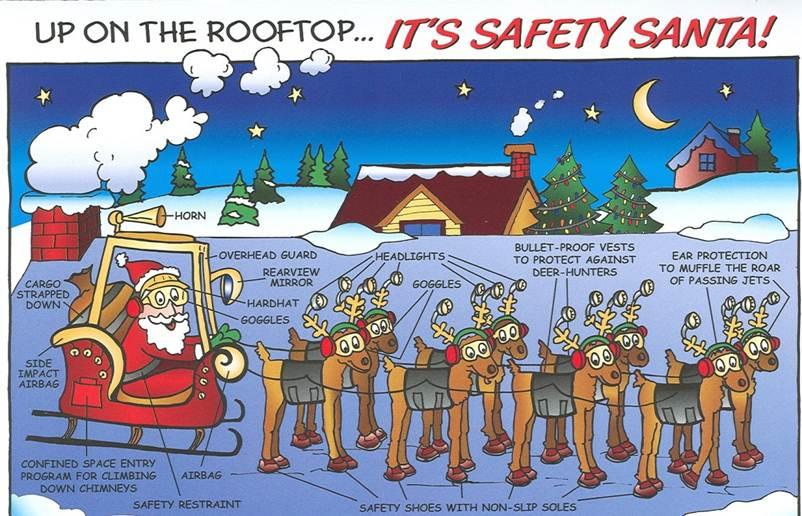
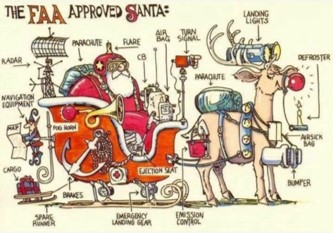
    A year ago, it was the pleasure of this blogger to report that Santa Clause completed yet another successful global fulfillment process AND importantly, the process was in compliance with the US Federal Aviation Authority’s (FAA) regulations.  A great deal of progress since the advent of one red light on the nose of the lead reindeer!

    This year we are once again pleased to report that not only have the flying sled and its power plants remained in compliance with the FAA but has now taken additional steps forward.  Incorporating new technologies and processes, safety has been enhanced in the following manner:

    • Addressing Slips, Trips and Fails with new safety/skip proof landing gear
    • A new Confined Space program along with appropriate personal safety gear
    • An alarm Klaxon and Better Lighting
    • Enhance Safety Restraints such as airbags and an overhead guard
    • Extensive Head, Vision, and Hearing Protection systems
    • Better Work Place Violence technology enabled processes
    • A new Cargo Restraint system

    It looks like the arctic region of the Occupational Safety and Health Administration (OSHA) outreach program is having great success.  Interested readers are invited to review the above safety Infographic for further details and perhaps new insights.

    Simplified Business Model

    There are a lot of lessons herein for those who don’t live at a mythical north pole.  First, it seems that much if not all the safety improvements made are inexpensive and easily implemented.

    Next, change management and new policies appear to be welcomed by those affected.  Answering the, “What’s In It For Me” question when adopting new technologies.

    Management is also ‘walking the walk’ with employees by driving the sled and taking the same risks as the rest of the team fulfilling customer requirements, i.e., snow covered rooftops and chimneys.  One can argue that this entire team is the Customer Facing part of the system.  Finally, customers have high expectations that must be met, and late delivery is not an option—this project has a fixed deadline!

    Stakeholder Value

    With billions of children waiting and using a complex and global logistics system, this team does not disappoint.  Earlier competitors have long dropped off the map.

    So why with a clear monopoly does this organization still seek greater Operational Excellence with its transformational Safety Culture?

    Simple—safe and excellent operational performance is good business!  Less unplanned downtime increases the bottom line.  Few incidents increase morale and the bottom line.

    Fewer legal issues, regulatory matters, and so forth and so on positively impact the bottom line.  With such significant ROI, what’s a stakeholder not to like?

    Is Your Operational Safety on Par with Ole Saint Nick?

    For More Information

    Please note, RRI does not endorse or advocate the links to other third-party materials.  They are provided for education and entertainment only.

    For more information on Cross Cultural Engagement, check out our Cross Cultural Serious Game

    You can contact the author as well.

  • Running Across an Open Field: Strategy for Disruptive Technology?

    Running Across an Open Field: Strategy for Disruptive Technology?

    Several weeks ago, as an amateur history buff, I was watching a documentary about World War I.  During one segment the commentator discussed the apparent fact that if soldiers refused to charge out of their trenches across an open field into the teeth of waiting machine guns they would be shot.

    The brutality of such a command by (so-called) leadership is appalling.  It may have been one thing for Alexander the Great’s armies to engage in open battles with sharp pointed objects as weapons.

    It is quite another for General Pickett’s infantry at Gettysburg to charge cannons and 50+ years later to repeatedly try the same tactic (by both sides) at horrific costs.  Generals always fight the last war, so the saying goes.

    This blog is not about some of history’s follies, it is about learning so as not to repeat the mistakes of others.  These lessons apply to readers’ daily business world as well.

    When New Technology is Deployed

    New disruptive technology can tear the societal fabric.  Some old jobs and companies disappear, and new ones thrive.  This process has been repeated since antiquity.

    Our culture is having this dialogue today regarding digitalization and its suite of technological driven change, i.e., Blockchain, AI, etc.  Principal issues that must be addressed include Human Factors Engineering (HFE).

    “HFE places the human operator at the center of the complex operating environment.  HFE recognizes that this individual or set of individuals is the puppet master and is responsible for the entire show.”  In other words how do we interact with the new technological reality.

    Reliable and valid HFE is the key to successful digitalization initiatives.  It will be the vital to whatever is next as well.

    Tyranny of the Minority

    From political science, “For centuries, theorists have worried about the potential of unrestrained democracy to lead to a tyranny of the majority, in which majority groups ride roughshod over the rights of minorities.  What we often see today is instead a kind of tyranny of the minority: a system in which a particularly extreme and motivated fraction of the populace can wield outsized power in the face of a majority which is either too indifferent or too scared to oppose it,” (italics added).

    In most organizations, there are fewer leaders than those who fabricate a ‘work product.’  The responsibility of leadership is to set the vision, mission and goal as well as enabling the organization with the tools and support necessary to reach targeted stakeholder value.

    But what if this minority group is the slowest to come to grips with disruptive forces?  In the face of newness, they may ‘keep doing what they have always been doing.”  In such an environment, the organization will likely not reap the same reward as in the past.

    Does too indifferent or too scared describe your organization’s ecosystem workforce?  One suspects It would be good to know.

    Fast Fail

    In our last blog we discussed the rapid assessment of technology and when to drop it if it does not appear to be working out.  Perhaps, we should treat managerial processes the same way.  After a horrific and visible failure in leadership, conceivably one preserves best by looking for alternative?

    If charging head long across an open field leads to disaster, why keep doing it?  While a counter argument might be that we had no tools to defeat those equipped with the new technology, to this writer, that logic is suspect.

    Flanking an enemy’s line or using guerrilla tactics, et. al. are as old as human confrontation.  Unconventional warfare has a long record of documented success.

    The business lexicon is loaded with military terminology.  We often speak of business as if it is warfare, when of course it is not.  There are lessons to be learned about human and organizational behavior, however.

    Decades ago, the concept of Guerrilla Marketing was the rage.  With the advent of social media, it has advanced, and the methodology is available to all.  Huge budgets and massive media campaigns are no longer necessary.

    Head-to-Head the biggest ‘guy’ usually wins.  So, if you’re not him/her, DON’T DO IT!!  However, the small mammals may displace slow moving dinosaurs.

    Agile is not an IT term.  It should be the state of mind of leaders at all levels.  To charge across the open business landscape into technology designed to destroy your organization remains folly.

    How Are You Leading the Charge into the Future?

    For More Information

    Please note, RRI does not endorse or advocate the links to other materials.  They are provided for education and entertainment only.

    See this 3:15 minute clip for more information on living in a World War I trench.  Pathetic way for leaders to force those under their command to live.

    For more information on Cross Cultural Engagement, check out our Cross Cultural Serious Game

    You can contact the author as well.

    End Notes

      https://consult2050.com/job-disruption-due-to-digitalization/

      https://therrinstitute.com/wp-content/uploads/2018/10/HRM-in-Process-Industries-Sustained-by-Human-Factors.pdf

      Ibid.

      https://areomagazine.com/2019/04/02/the-tyranny-of-the-minority-and-how-to-prevent-it/

      https://therrinstitute.com/lessons-from-the-seventies/

      https://en.wikipedia.org/wiki/Guerrilla_marketing

  • Lessons from the Seventies

    Lessons from the Seventies

    At lunch the other day and for whatever reason, the history of the 3M Post It Note became a subject of our conversation.  This technological marvel unveiled in the 1970s is still widely used today.

    As with other new or disruptive technologies, the ‘sticky note’ was panned at first and for some time.  According to Wikipedia, the technology was first developed in 1968.  It was not until 1974 that it gained some internal company support.

    When finally introduced in 1977, the pilot results were unsatisfactory.  However, things started to change in 1978 when a small (focus) group of consumers were positive about the product.

    The United States roll-out began in the spring of 1980, followed by Europe and Canada in 1981.  A bit of trivia, the reason it was originally yellow was because yellow colored scrap paper was readily available at its inception.

    Earlier the day of our lunch meeting, a discussion revolved around how long it might take an idea to become a fundable start-up company.  Several participants argued that with proper guidance, the process still might take up to two years.  This pundit argued that many entrepreneurs would see that as too long and become disinterested.

    The legacy of the Post It Note suggests that this pundit might be incorrect.  The lowly sticky note did not even begin its journey to become a Unicorn until twelve years after its technology was discovered.

    In 2015, we penned a blog, Titans of the 1940s Today.  The basic premise of that piece was when commenting about the Internet of Things (IoT) and its complexity, individuals such as Richard Feynman and John von Neumann (father of the 1945 computer architecture that is the basis of modern computing) had developed solutions for today prior to this author’s birth.

    We stand on the shoulders of these and other giants.  The challenge of every generation has been to build on what those who came before advanced.  So it remains today!

    Body of Knowledge

    Human kind has developed a rich body of knowledge in all areas of endeavor.  It is readily available for entrepreneurs as well as those employed by all types of organizations.  This knowledge base has been addressed in this blog and other writings by the author.  Interested readers are invited to review my blogs and newsletters dating back to the last century.

    Our march through history provides all of us a ‘go-by’ that can shorten our learning curve.  One example this author often cites is the depth of historical knowledge of management.  Contrary to many gurus, humans have managed others and processes for many millennia.

    Fail Fast, Fail Often?

    If 3M or Feynman et al practiced this technology development model as most interpret it, our world might be a lesser place.  Give up and move on to the next?

    One interpretation suggests, “Originating from Silicon Valley and its ocean of start-ups, the real aim of “fail fast, fail often,” is not to fail, but to be iterative.  To succeed, we must be open to failure—sure—but the intention is to ensure we are learning from our mistakes as we tweak, reset, and then redo if necessary.”

    This same article goes on to state, “Thomas Edison, by example, ‘failed’ 9,000 times before he was successful with his light bulb invention.”  Perseverance can be a lonely quality!

    Don’t lose heart.  Great ideas abound but must gestate.  It is often said that we find our soulmate when we least expect to—I know I did.  Progress is an iterative process fueled by creativity and critical thinking.

    Is Your Idea a Unicorn Waiting to be Born and Mature?

    For More Information

    Please note, RRI does not endorse or advocate the links to other materials.  They are provided for education and entertainment only.

    You can contact the author more information as well.

    End Notes

      https://en.wikipedia.org/wiki/Post-it_Note

      https://therrinstitute.com/wp-content/uploads/2018/10/Titans-of-the-1940s-Today-April-20-2015.pdf

      https://therrinstitute.com/wp-content/uploads/2019/10/1993-Management-Theory-Evolution-Not-Revolution.pdf

      https://www.forbes.com/sites/danpontefract/2018/09/15/the-foolishness-of-fail-fast-fail-often/#1db35b0e59d9

  • Culture Matters A Lot!  Cultural Interactions Matter MORE!!

    Culture Matters A Lot! Cultural Interactions Matter MORE!!

    “Failures of culture have been the single biggest destroyers of value in the last five years,” states the former senior vice president of HR of Google in a recent article.  This revelation by one of the contemporary tech giants supports the previous dictum, “Culture eats strategy for breakfast.”  Depending on one’s perspective, this latter quote can be attributed to literature dating back to the mid-1980s.

    Regardless, the central role of culture in an organization has long been recognized.  One wonders, if this is true, why has so little changed in 30+ years?

    This writer is personally aware of three major cultural debacles by large publicly traded firms where shareholder value was destroyed through inter cultural challenges.  In one case, the ‘then’ acquiring firm was subsequently acquired itself in part because of a seemingly dysfunctional culture.

    The Inc. article goes on to describe three demonstrable risks management must attend to in their mitigation strategies:

    • The internal is now external—Organizational ecosystem employees/contractors/customers now have unfettered access to outside the ‘door.’ Constituent parties can use social media posts to comment about the good, bad, and ugly of an organization.
    • The data on culture shows clear economic impact—Case studies on culture are no longer ‘fuzzy’ and the impact of culture on the bottom line can now be documented.
    • People technology has advanced enough to help—Data and analytics enable organizations to develop a better understanding other their ‘workforce’ market constituency and develop strategies addressing their concerns and needs.

    The article concludes that culture is no longer a buzzword and organizations can leverage it to drive organizational alignment and behavior towards shareholder value.  Culture is now a measurable KPI.

    Care to benchmark yours?


    Cross Culture

    If one accepts the above premise, competitive value is created by the organization’s culture.  This is not a new statement and has been addressed by this author in various forums for years.

    Fundamentally, there are two types of cultural interactions:

    • Collaborative—Two or more organizations seek to work together to realize joint value. For example, the organizational ecosystem, i.e., suppliers and long-term customers.
    • Adversarial—Two or more organizations seek to realize value at the expense of others. Examples include competitors, government regulatory interactions, i.e., IRS or legal actions.

    Even an internal team is a composite of several legacy (organizational) cultures not to mention diverse ethnicity and societal circumstances.  It is this heterogeneous environment that the bottom line is ultimately impacted.

    This author began investigating cross-cultural engagement value (or lack thereof) in the era of Culture eats strategy for breakfast.  In any cross-cultural situation, the Relationship is the ultimate value developed, sustained or even lost.

    The R B C model describes a set of interpersonal Behaviors based upon a set of Conditions.  Behaviors are observable and describable (beware of observer bias) and Conditions can be equally known.  The Relationship(s) between parties are latent (not directly observed) and must be inferred.

    This inference is often the source of poor decision-making—the reason so many deals go ‘south.’  If the internal culture is now better defined, manageable and a bottom-line item, focus must be turned to intercultural engagements.

    Even as your organizational culture is more knowable.  Its relationship with other identifiable cultures is not.  If that were true, there might be fewer issues among parties.  One might even surmise; the divorce rate might be lower.

    At all levels, culture is an evolving construct.  Cigarette smoking is no longer publicly acceptable for many while marijuana consumption is.  Fashions come and go as well.

    Certainly ‘pop culture’ evolves rapidly.  Perhaps slower, but so do societal and ultimately business cultures.

    In this pundit’s opinion, successful inter-cultural engagements are the key to long term value—shared or otherwise.  The more the organization knows Who and What it is, the better it will be able to develop a ‘relationship’ with counterparts who know Who and What they are.

    Culture is the Food of Choice.  How is Your Organization Watching its Weight?

    For More Information

    Please note, RRI does not endorse or advocate this video and does not have a relationship with its producer and distributors.  It is provided for fun and entertainment only.

    You can contact the author more information as well.

    End Notes

      https://www.inc.com/michael-schneider/googles-former-head-of-hr-issues-a-warning-that-all-business-owners-leadership-teams-should-read.html

      https://quoteinvestigator.com/2017/05/23/culture-eats/

     http://www.stat.cmu.edu/~brian/905-2009/all-papers/Bollen-annurev.psych.53.100901.pdf

  • Man—Machine: Extension or Versus?

    Man—Machine: Extension or Versus?

    Are the emerging machines our friend or foe?  The debut of new technologies such as Artificial Intelligence (AI), Internet of Things IoT) and a host of others seem to be drowning us as we drink from a technological fire hose.  Additionally, driverless vehicles, the Gig Economy et al. are conspiring to eliminate truck drivers and full-time jobs.

    Politicians lament this progress and promise, guaranteed basic income and re-training designed transform energy extraction employees into 50 something coders.  Recent college grads are told their (high debt) degrees are worthless and others advised not to seek higher education.  What in the world are we to do?

    Well one learned, well known observer has a plan.  Fortunately, a cinematographer has captured it in the following clip.  A little over a minute long.

    https://www.youtube.com/watch?v=W97RmQCnwa4

    Well, maybe Chicken Little is not the best source for guidance.  But again, it does look like aliens played a role.  Perhaps, these new machines are really alien inspired!

    In our real world, the ‘only constant is change’ and barring a meteorite hitting one on the head, if not embraced change needs to be tolerated.  Since this writer graduated from college in 1970 prepared to enter the nuclear power industry (we all know how well that sector fared), several new (then unknown) industries now employ millions across the globe.  Including, me!

    To be sure other sectors have shrunk and even disappeared.  Most employed by those sectors had to adapt to a new business climate.  Many thrived—some did not!

    There is no doubt that individuals need to remain flexible and ‘skill relevant’ in a fast-paced market.  This was true 100 years ago and likely will be so in another 100 years.

    It Can Be Done

    3M Corporation, formerly known as the Minnesota Mining and Manufacturing Company was founded in 1902.  Initially, it provided heavy industrial products such as sandpaper.  A need for innovation was identified early in its history due to quality issues.  The firm has evolved to one with a global footprint that sells a wide variety of industrial and consumer products.

    The company has codified its Innovation Culture—”Employing the Thirty Percent Rule, 30% of each division’s revenues must come from products introduced in the last four years.  This is tracked rigorously, and employee bonuses are based on successful achievement of this goal.”

    This Agility evolved from the founding of a heavy industrial firm that started innovating early.  This and other success stories suggest than NO firm and NO employee/supplier need fear even dramatic change.  Adapt YES, give up NO.

    Are the emerging machines our friend or foe?  I guess the answer is, “It depends.”  Just like it has been since humans invented fire and found a stick to clobber something/someone with.

    President Theodore Roosevelt is credited with saying, “Keep your eyes on the stars, and your feet on the ground.”  Likely, the sky will not fall.  More likely we may be hit by Isaac Newton’s (inspirational) apple.

    Is Your Innovative Sky Falling or Is What’s Hitting You Really a Golden Apple?

    For More Information

    This subject is touched upon by this blogger herein and in other venues.  Readers are invited to review these materials with particular attention to Job Disruption Due To Digitalization: Myths And Legends—June 1, 2019.

    In the research for this blog, several versions of the Chicken Little animation were found.  In your spare time, you may find several of them very amusing.

    Please note, RRI does not endorse or advocate these films and does not have a relationship with their producers and distributors.  Provided for fun and entertainment only.

    You can contact the author more information as well.

    End Notes

      https://en.wikipedia.org/wiki/3M

      https://hbr.org/2013/08/the-innovation-mindset-in-acti-3

      https://www.brainyquote.com/quotes/theodore_roosevelt_136001

  • Zero: What If Switching Costs are Near?

    Zero: What If Switching Costs are Near?

    Customer Acquisition and Retention (CAR) are two of the most important activities of the Marketing and Sales strategies and should be KPIs for “C” suite occupants as well.  One of the classic case studies of the battle over CAR is the so-called Cola Wars initiated between Coca Cola and Pepsi Cola in the 1970s.   These two established giants of that sector fought for market Dominance in a manner that is instructive for today’s audience.

    Readers are cautioned that this Modern Marvels (The History Channel) video is almost 45 minutes in length, although with almost a million views on YouTube alone it appears that many (including this blogger) have found the information of value.

    https://www.youtube.com/watch?v=jOKnXZK0apE

    One can surmise that the reason, this match was dubbed, the Cola Wars—it was a brutal confrontation between the number one and number two economic actors in that space.  Coca Cola was heavily damaged (sometimes self-inflicted wounds) yet later recovered.  This was in part due to a loyal (emotional) following of its customers once it got over the fiasco; New Coke.

    The subsequence competitive landscape was forever changed, possibly more because of the entrants of new products by both firms.  However, the past can be prologue.

    According to one recent source;

    • “The top 10% of your patrons probably spend three times more than your average customer.
    • Acquiring a new customer can cost five times more than retaining an existing customer.
    • 33% of American customers say they consider switching companies immediately following a single instance of poor service.
    • 55% of consumers believe companies have a more important role than governments in creating a better future.
    • 77% of businesses that exceeded their revenue goals in 2018 have documented personalization strategies.
    • 95% of loyalty program members want to engage with the programs via virtual reality, wearable devices, and other cutting-edge technology.
    • Customers who are emotionally connected have a four times greater lifetime value.”

    This pundit has long argued (often on this and other blogs) that despite significant changes in Social Media and our abilities to connect worldwide, ‘human nature’ has not changed (much if any).

    For example, after the Pepsi Challenge and use of popular celebrities of the time, Coke customers did in fact ‘switch.’  However, when Coke rectified its market transgressions many switched back.

    It follows, that against the contemporary list above:

    • Coca Cola customers were committed and emotionally connected to the firm’s product, albeit not the firm itself
    • Pepsi’s acquisition strategy was expensive and, in the end, not very effective
    • Many Coke drinkers did switch when confronted especially after the New Coke strategy
    • Each cola was personal to the individual consumer

    The challenges of the distant Cola Wars may not seem relevant today.  Yet, Apple’s Steve Job’s opportunity to the then Pepsi CEO John Scully, “Do you want to sell sugar water for the rest of your life, or do you want to come with me and change the world?” may have been more apropos that subsequent events between the two men depicted.

    The Cola Wars case study holds timeless lessons.  All businesses seek to increase their customer base and stave off competitors.  This is life in the free (and not so free) enterprise sectors.

    The cautionary tale to both established and those seeking new markets is to think smart about the customer acquisition and retention processes and not cavalierly and simplistically.  This is true whether seeking to protect and installed base or switch it.

    Do You Know if Your Customer Acquisition and Retention Strategy is Actually Working?

    For More Information

    To calculate your own Risk Adjusted Customer Acquisition Cost, checkout our free model.

    You can contact the author more information as well.

    End Notes

      https://www.bartleby.com/essay/Cola-Wars-Summary-F3ZJHEKVC

      https://www.smallbizgenius.net/by-the-numbers/brand-loyalty-statistics/


  • Houston . . .

    Houston . . .

    “The Eagle has landed,” and fifty years ago mankind had accomplished the heretofore seemingly impossible.  Two men on the moon became a game changer and not in just the way most believe.

    Yes, technology advancement owes much to these early space pioneers traceable to the 1950s; realistically a long process going back much further.  Aerospace led innovation has ‘bled’ into all aspects of our 21st Century life.

    The challenge going forward—what is the next ‘small step that will lead to one giant leap.’  Return to the moon or even humans on Mars is not the next step for humankind in this writer’s opinion.  It seems that technology can readily enable those milestones; it is just a matter of spending and will power.

    Blue Marble

    As the astronauts on the moon looked back at earth, they saw our ‘blue marble;’ tiny in the cosmos.  The place we all call home is just a spec of dust in the overall physical universe—whose bounds (if they exist) have not yet been discovered.

    Explorers have always pushed the limits of the known.  Whether sailing towards the end of a ‘flat’ earth or sending robots out of the solar system (Voyagers I & II), learning about the unknown, albeit sometimes terrifying is integral to the human condition.

    In 1969, the information age was in its infancy.  One can make the case that the modern computing era began with the hypothetical Turing Machine in 1936.  However, computational power was centralized and only available to the very few.

    As a college senior majoring in physics (1969-70), I was one of a handful who had access to a time-sharing system sixty some miles away in Atlanta, GA.  Programmed using the then ‘new’ BASIC (Beginner’s All-purpose Symbolic Instruction Code)—this was state of the art.

    Communications time was expensive, so we wrote our programs and transferred them to yellow tapes used to program the distant computer.  Only then did the iterative ‘debugging’ process begin.

    The 1960s and early 1970s saw the rise of the minicomputer and other independent devices that would become the so-called IBM Personal Computer popularized in the 1980s.  The current computing device technology of choice is over 12 years old—iPhone and its competitors.

    Some argue that this platform is aging, yet has the next stage been identified yet?  The current rage, Big Data, AI, etc. are but applications and database schemas.  Game changing compute power is not yet mainstream.

    Enterprise Digitalization is also a craze.  Transforming mere mortal organizations into future juggernauts that promise to change businesses if not humankind.  As with the Space Race of the last century, technology fallout and new ways of living will most like result in the year 2069 looking a lot different than the present.

    Neil Armstrong made an interesting comment when he said, “One small step . . . “  The late comedian Eddie Cantor is credited with saying, “It takes 20 years to make an overnight success.”  That is one heck of a lot of small steps!!

    “A journey of a thousand miles begins with a single step”

    – Lao-Tzu.

    The computing sector is no longer in its infancy.  It could be that the next fifty years will become the century of something else.

    In any event, we did not get to the moon overnight and we most likely will not arrive at our next major milestone by leaping either.  Focus on your daily steps and who knows where your life long journey will take you.  Go ahead and step off the last rung of your ladder.

    How Will Your Next Small Step Become a Game Changer?

    For More Information

    You can contact the author more information as well.

    End Notes

      https://en.wikipedia.org/wiki/Database_schema

      https://www.businessinsider.com/infographic-how-computing-power-has-changed-over-time-2017-11

      https://www.brainyquote.com/quotes/eddie_cantor_309843

      https://www.libertyforrest.com/blog/2015/9/13/a-journey-of-a-thousand-miles

      https://www.techopedia.com/definition/13429/turing-machine

      https://en.wikipedia.org/wiki/BASIC

  • Oil: In the DNA of the Silicon Valley

    Oil: In the DNA of the Silicon Valley

    When discussing the likelihood of DNA in crude oil, one source comments, “So the DNA they are talking about is like the DNA, where they’re looking at the live bacteria in the crude oil, which would be descendants of the bacteria that was around when the oil first began its degradation from organic material.”

    Time passes and the Baby Boomers that led the youth movement in the last half of the 20th Century may now be carrying the label of dinosaurs.  Likewise, the oil and gas sector is viewed as a mature sector, aka dinosaur.  And we all know that oil comes from dinosaurs (not a correct statement).


    [advanced_iframe securitykey=”ab3c8c693bafe5b2e240e6d4c1357a8337af1276″ use_shortcode_attributes_only=”true” src=”https://www.youtube.com/embed/vAA7wVYr704?t=15″ width=”100%” height=”600″ id=”advanced_iframe” ]


    However, few know the technology lineage of the sector.  Fewer still know about its long-time leadership in the advancement of information technology.

    As a Schlumberger Senior Field Engineer (circa 1977) in Houma, LA, I worked on the first electric logging truck equipped with a computer—the Cyber Service Unit (CSU) for wellsite instrumentation.  Effectively, this was a mobile real time data acquisition and analysis system.  This was a short two years after the company joined ARPAnet, the predecessor of the Internet.

    Likewise, the other major energy services company Halliburton has advanced dramatically over its 100-year history.  Furthermore, in the field of data processing, the sector was an early adopter of super computers.

    In the early 1980’s this pundit often made sales calls selling industrial technology.  With almost no base business in Austin, Texas, I saw little chance to make my quota from that city.

    In 1987, Schlumberger Ltd. opened it Austin Technology Center.  While not the first technology company with operations in that region, from this author’s perspective this commitment was a game changer for that region—so called ‘Silicon Hills.”

    The sector has long funded technology development.  As noted, a prodigious consumer of advanced technologies, the sector also invests in innovation.  One example, the seemingly never-ending thirst for Saudi (oil) money by the Silicon Valley investment community.

    Next time you hear that the era of fossil fuels is over, think again about the contribution the sector has made and continues to make to the so-called future technologies.  Could be that the technological basis of green energy is built on this 100-million-year-old organic molecule.

    Is Oil in Your Organization’s DNA?

    For More Information

    Contact the author more information.

    End Notes

      https://www.slb.com/who-we-are/our-history/1970s

      https://www.houstonchronicle.com/business/texas-inc/article/Hallburton-Turns-100-going-from-wagons-and-mules-13622229.php

      https://www.gao.gov/assets/220/214775.pdf

      https://www.nytimes.com/2018/10/12/opinion/silicon-valley-saudi-arabia.html

      https://biology.stackexchange.com/questions/31831/does-crude-oil-or-kerogen-contain-ancient-dna

  • Fleeting Success: In Pursuit of Sustainability

    Fleeting Success: In Pursuit of Sustainability

    Winston Churchill is credited with saying, “Success is not final, failure is not fatal: it is the courage to continue that counts.”  The late Prime Minister nailed it; once again!

    Our journey through life, including our career is a marathon not a sprint.  While we celebrate success, often at happy hour or a party, we recognize it is only a moment.

    Early in this writer’s career, a multi-million-dollar deal closed after more than a year of effort.  A celebration ensued.  The next day the sales manager, “Asked what was next?”

    Attain and Sustain

    Organizational initiatives seem to procreate.  In some ways like the Tribbles of the original Star Trek series.  Cute furry things, the Tribbles multiple at such a rate as to almost consume the Enterprise.  Only the transporter beam saves the crew.

    Like the rah-rah of New Year’s Resolutions, the question is not will I go to the gym in January, but will I still set foot on the treadmill in June or even March.  The road to you know where is paved with good intentions.  It is the sustained energy of the execution that assures more successes than failures—and that failures are teachable moments.

    Culture is one of the current buzzwords, yet Cultural Transformation is the key to sustainability.  Courage requires the organization to pick itself up, so to speak and continue the journey to a sustained high level of Operational Excellence.

    Easy to Say

    According to Forbes, in 2018 “enterprises are expected to invest $1.3 trillion (USD) in digital transformation initiatives to apply digital capabilities to improve efficiencies, increase customer value and create new monetization opportunities.”  The article goes on to posit, that almost $900 billion of that spend will be wasted as goals are not attained.

    Why are these projects always seemed doomed to fail?  A quick Google search identifies a large body of knowledge over the years documenting these types of failure.  So, the beat goes on.

    Hard to Do

    There is also a body of work documenting the “should do’s” of organizational transformation.  In fact, this author has contributed several articles and books on this subject.  Most notably, Implementing a Culture of Safety: A Roadmap for Performance Based Compliance.

    A Missing Piece

    There is a lot of talk about Operational Excellence, Digitalization, High Reliability Organizations, Human Factors, Safety Culture et al.  As with the Forbes data, many are suffering the same fate.  No wonder senior management is skeptical of new spend for more ‘Tribble-itiatives.’

    For example, when a critical infrastructure sector discusses the transformation to a Safety Culture, the term is often expressed as singular, i.e., there is one industry safety culture.  However, all firms have their own ecosystems consisting of multiple and sometimes disparate entities.

    They have developed a culture that is a source of pride, competitive advantage, etc.  Their culture differentiates each organization from their peer group.

    The following figure presents the actual nature of a firm’s Safety Culture.  The reality is that a large organization’s “culture” is a combination of multiple cultural dimensions.  It is this ‘nature of culture’ that must be better understood if a transition process is to be successful and sustained.

    Readers should note that the multi-dimension structure is continuously changing as business, technology, and regulatory environments impact on the Relationships, Behaviors, and Conditions of the situation.  This dynamic requires continual managerial energy and training to sustain the change desired.

    Cross Cultural Engagement

    It would seem to be a daunting if not impossible task to effectively and efficiently train a large work force including relevant third-party suppliers on an ongoing basis.  Of course, the cost would be prohibited as well.

    Not so fast, e-learning serious games are now available to support the training requirements necessary to “sustain” the transformation.  Moreover, specific scenarios can quickly be developed to meet specific organizational requirements.

    The games are developed using Game Theory and Human Behavioral theories.  They simulate a real-world environment and have been shown to give great results over decades.  With Cloud technology, these training tools are now inexpensive and readily available to all.

    Why have your Organization’s Business Transformation Initiatives Failed?

    Check out our Cross Cultural Serious Game


      https://en.wikipedia.org/wiki/The_Trouble_with_Tribbles

      https://www.forbes.com/sites/forbestechcouncil/2018/03/13/why-digital-transformations-fail-closing-the-900-billion-hole-in-enterprise-strategy/#1f5923507b8b

      https://www.xlibris.com/Bookstore/BookDetail.aspx?BookId=SKU-0143303003

      Shemwell, Scott M. (2015, November 28). Comments and Thoughts Regarding the IAEA Technical Meeting on Developing Improvement Programmes for Safety Culture November 2-4, 2015. Vienna, Austria.

  • Mission Accomplished: Santa Completes Another Worldwide Transit—Incident Free!

    Mission Accomplished: Santa Completes Another Worldwide Transit—Incident Free!

    Every December 24th, this jolly ole elf embarks on one more global initiative.  We know this to be true because each year since 1955, the North American Aerospace Defense Command (NORAD and its predecessor the Continental Air Defense Command (CONAD) Operations Center in Colorado Springs, Colorado have tracked his operation–www.noradsanta.org.

    We are happy to report that as of this writing, Santa has returned to the North Pole with all his reindeer healthy having delivered almost 7.3 billion gifts.  Another 364 days of operational planning has paid off handsomely.

    So how does this bearded (non-millennial) man in a red suite and his supporting elf ecosystem routinely accomplish this logistical nightmare?  Could it be that Santa is the CEO of a High Reliability Organization (HRO)?

    Through this blog and others including our book Implementing a Culture of Safety: A Roadmap for Performance Based Compliance, the author has extensively written on the High Reliability Management (HRM).  Interested readers are invited to search these and other works on the subject.

    Briefly, an HRO focuses on operations from the top down, expects failure and puts in place resilient processes and procedures designed to recover quickly.  Moreover, Human Factors play a major role in Santa’s HRO operation.

    For example, human elves must care for the reindeer full time, not just the night of the flight.  The sled must meet certain regulatory and safety compliance requirements.  Packages must be wrapped, and hand delivered efficiently without damage.  Finally, route planning and coordination with various airspace control entities is critical to assure an incident free transit.

    Concluding Thoughts

    This ‘tongue and cheek’ mythical case study does serve a point.  Large, global, complex initiatives involving a number of constituent parties including customers require HRM.  Much is said about Operational Excellence (OE) these days and we make the case herein that without HRM, OE is also an unattainable myth.

    We are told on good authority that after a short rest, the Santa OE Ecosystem will start planning for the December 24, 2019 transit.  Children believe in Santa Claus and marvel at all he can accomplish in one night.  Perhaps those of us who are older can also learn new lessons from this jolly ole elf.

    How Do You Assure your Global Initiatives Remain Incident Free?

  • Command and Control: Is this the Way to Run the modern Railroad?

    Command and Control: Is this the Way to Run the modern Railroad?

    The managerial model, Command and Control (C&C) dates back to the dawn of humanity when tribal chieftains dictated the behavior of the group.  It survives to this day in many forms.  Typically, one thinks of military operations as the current manifestation of C&C in the western world.

    According to Wikipedia, by one definition found in The US Department of Defense (DOD) Dictionary of Military and Associated Terms, “command and control functions are performed through an arrangement of personnel, equipment, communications, facilities, and procedures employed by a commander in planning, directing, coordinating, and controlling forces and operations in the accomplishment of the mission.”  This definition has evolved from a more simplistic version found in the Cambridge Dictionary, ”situation in which managers tell employees everything that they should do, rather than allowing them to decide some things for themselves.”

    One suspects that most laypeople believe the latter definition to be to be the typical approach to C&C in their organizations.  In today’s complex (often global) organizational ecosystem, that version is outdated.

    The International Command and Control Institute, publication (circa 2005) , Understanding Command and Control develops this management construct in great detail.  As the following figure suggests, even a simple C&C structure such as a heating/AC system is driven by a set of KPIs.

    This is indicative of the digitalization of the system versus the analog controls many of us can recall from our youth.  Adding another layer, today’s ‘Smart’ thermostat operates within a well-defined governance schema such as the Internet of Things.

    Strong Bond Governance

    We first made the case for “Strong Bond Governance” in our September 17, 2013 Governing Energy blog, Strong vs. Weak?  In Critical Infrastructure sectors such as energy, medicine, etc. as defined by the US Department of Homeland Security we make the case for the construct of High Reliability Management (HRM).

    The Strong Bond Governance (SBG) paradigm enables HRM.  SBG demands Board of Directors and C Suite engagement in operations.

    Not directly but by putting in place a governance structure.  This has not always been the case with a number of catastrophic man-made disasters as the result.

    In some ways, C&C mimics HRM.  However, there are some significant differences.  HRM sets in place a structure designed to meet the test of adversities.

    • Preoccupation with Failure—a recognition that ‘failure is an option’ and the organization must respond quickly and effectively to mitigate exposure and recover. C&C does not directly address is concern.


    • Reluctance to Simplify—today’s organizational ecosystems are complex. Reducing operational decisions to the so-called Power Point three bullets, High, Likely, Low is completely unsatisfactory and potentially exposes the firm to business or technical process catastrophe.  Likewise, C&C models do not directly address this approach.


    • Operational Sensitivity—the field is where organizational action is, and senior management must have a focus on this critical component of the business. C&C also has a focus on operations, especially in the military sector.


    • Resiliency—things will go ‘bump in the night.’ Organizations must but in place the processes and expertise to rapidly respond to goblins that will be encountered.  C&C does not address this process.


    • Deference to Expertise—engage those who have the ‘know how’ to solve problems and that is mostly likely not the management team. This is substantially difference than the C&C model

    HRM allows management to look at computer dashboard and get a snapshot of most if not all aspects of the organization.  However, this does not mean that these individuals can manage from afar.  Those closed to and more knowledge about this issue must take the lead.

    Concluding Thoughts

    Watching the news, History Channel and/or various movies, one can see that even the military no longer uses simplistic C&C.  Small semi-autonomous teams take on the bad guys.  To be sure there is a Mission, Rules of Engagement and other governance controls in place.

    This provides local commanders the latitude needed to accomplish the mission at a minimum of human (good guy/non-combatants) and other collateral damages.  Additionally, military aircraft employ ‘High Reliability Management’ techniques where the expertise of the entire crew is used rather than the Captain dictating operational performance.

    Asiana Flight 214 crashed attempting a landing at San Francisco in July 2013.  One causal component was deemed to be the C&C culture of the Korean pilots.  Cockpit Management might have saved this aircraft and the lives lost.

    Likewise, those organizations and their ecosystems in critical infrastructure sectors that use HRM enjoy safer and more productive track records than those that do not—better bottom line.  The October 2014 Ebola scare is an example where the public health sector employed HRM and limited the impact of a highly contagious deathly pathogen.

    There is a tendency when the stakes are high for management to take the ‘reigns.’  In other words, engage in micromanagement.  The usual results are often sub-optimal.  The ‘gut instinct’ towards simplistic C&C is a strong urge and this addiction must be put into remission.

    A well-established Strong Bond Governance, High Reliability Organization can weather any storm the markets or nature can throw at it.  However, this organization transformation must precede the advent of major challenges!

    Traditional C&C is not an OE Imperative


  • Are You In Distress?

    Are You In Distress?

    During a recent offshore sail from Florida to Texas the weather significantly deteriorated on this blogger and his boat mates. Our 45-foot ocean going sailboat was one in which (mostly) the same crew that has significant sea time together.

    That said, there were two days of very uncomfortable passage making. At one-point a nearby ship hailed us on the radio and inquired, “Are you in distress?” We responded, “no we were not” and thanked them for their concern. Both vessels continued their separate courses.

    At that moment, our vessel was undergoing a pounding by large waves and from the bridge of the ship, it probably did appear that our yacht was in distress and in possible need of assistance. However, our vessel was simply handling tough sea conditions.

    Experienced sailors know that anything is possible while at sea. Therefore, careful preparation is critical prior to any voyage. Simply put, the vessel must be sound, (able) seamen competent, and equipped as appropriate.

    The US Navy has identified six principles for shipboard operations, “formality, procedural compliance, level of knowledge, questioning attitude, forceful backup and integrity, focus on human performance and create the foundation for highly effective commands where errors that could lead to minor or catastrophic events are identified and stopped early. Used together, these six principles form the bedrock on which the Surface Force implements the three operating processes: operational risk management; plan, brief, execute, and debrief; and hazard reporting.”

    One could make the case that a pleasure vessel need not adhere to these six principles; however, this long time offshore sailor argues that they should as well. For example, there is always only on Master (Captain) of a vessel regardless of long time friendships. Appropriate expertise or Knowledge, Skills and Abilities (KSA) for all crew members is essential as well.

    Some may notice that the six principles and three operating processes are akin to those found in High Reliability Organizations (HROs). In other words, this short story holds lessons for all as well.

    Our vessel was engaged in a mission—transit from Florida to Texas. This mission was supported by a number of processes and associated tools, technologies and human capital to accomplish the overall goal.

    When adversity struck, the crew (organization) responded to events on the ground (water) to address the new situation in the spirit of prudent mariners. Is this not allegorical to business?

    How Can You Assure Your Organization Will Not Be in Distress When Adversity Strikes?

  • Is Your Digitalized Organization Cybersecure?

    Is Your Digitalized Organization Cybersecure?

    Here is How to Find Out!

    It seems that everyday a new major cyber breach is announced.  The Rapid Response Institute and its Principals have addressed this issue many times through a variety of venues and publications.

    We recently conducted a workshop, “Implementing Digitalization: A Game Changing Transformation of the E&P Sector.”  The Cybersecurity of this sector transformation is critical to its success.

    Moreover, since “this is the way we run our business,” Cybersecurity is now a Board of Directors issue and an integral part of its fiduciary responsibility.

    As part of our continuing effort to add value to Operational Excellence and Risk Mitigation processes, it our pleasure to feature this recent Public Television interview.

    We encourage you to watch this 30 minutes discussion with one of the world’s leading Thought Leaders in the Management of Cybersecurity for Critical Infrastructure Sectors such as oil & gas, electric power generation & distribution, medicine and others as identified by the United States Department of Homeland Security.

    Patriot Act of 2001 defined critical infrastructure as those “systems and assets, whether physical or virtual, so vital to the United States that the incapacity or destruction of such systems and assets would have a debilitating impact on security, national economic security, national public health or safety, or any combination of those matters.”

    We believe you and your organization will find watching this video time well spent.  Also, should you wish to talk further with her please contact us and we will arrange this.

    Stay Cyber Safe!