Tag: ESG

  • An Era of Hate

    An Era of Hate

    Incredible!! The level of hate as shown on any media today is just that, incredible.  Thieving, beating, sexual abusing and murdering seem taken as the “New Normal.”  Young people are throwing away future careers as they appear in the omnipresent media shouting hate towards one group.  Wearing masks simply make them look like common criminals.  What are they thinking, comes to mind.

    DEI (Diversity, Equity and Inclusion) and ESG (Environmental, Social and Governance) fads appear to be fading even as their original definitions are lost.  This pundit has been in the workforce since 1974 and before that the military experience.  To say I have seen it all is an understatement.  Well run organizations adhere to the original tenets of these two business/social models

    That said, my perspective follows:

    Servant Leadership

    With a focus on people, this leadership style seeks to develop all individuals and get the best out of cross cultural teams.

    • Diversity–We live in a world of over 8 Billion people.  We all know the level of diverse cultures, lifestyle and locales.  The likelihood that one organization is composed of all of one type is farcical.  So get over it!
    • Equity–Everyone wants to be treated fairly.  A company I was with was acquired.  The culture divided the employees into two groups.  Those who were hired directly and those who transitioned as a result of M&A activities.  As might be expected the mergers were most dilutive (huge employee turnover) and eventually that organization was eaten by an even bigger fish.  More like Lose–Lose!
    • Inclusion–People want to be included and allowed to contribute even if they are awkward about it.  One of the best true stories on this subject is depicted in the 2004 television movie, Something the Lord Made.  Two very different men in a racially challenged Jim Crow era were able to get past many issues and developed a solution for a deadly infant disease.  If you have not seen it; well worth your time.
    Stewardship

    One definition by Michael Barber; “Stewardship is leaving a system better than you found it,” is a very powerful statement.  Our Blog of April 25, 2022, ESG Explained defined these terms:

    • Environmental–Generally refers to the stewardship of the planet and how organizations facilitate that responsibility.
    • Social–Facilitating organizational responsibility to the global society, at all levels from the globe to the local communities firms operate in.
    • (Corporate) Governance–Typically, the umbrella organizations put in place to assure issues such as transparency, fraud, safety culture and ethics are in compliance with social norms and local regulations.

    Finally, over twenty years ago after all of the managerial nonsense that sent many “C” levels to jail from our 2011 White Paper Asset/Equipment Integrity Governance: Operations-Enterprise Alignment: A Case for Board Oversight, “During that period (2002), McKinsey & Company in conjunction with the Global Corporate Governance Forum conducted a study and found that over 75% of over 200 fund managers would value a stock at a higher price point if the company could demonstrate it had strong governance in place.  Moreover, the study also revealed that for western markets, firms with strong shareholder rights averaged 12-14% higher stock prices .”

    It Makes No Sense to Run any Organization Badly.  Either to stakeholders or yourself.

     Gaming the System

    Those of us at a certain age are familiar with the song, Walk A Mile In My Shoes.  What would you say if I told you that using technology multiple parties can exchange their boots?

    There is a way using Virtual Training to interact with other cultures and effectively Walk A Mile In Their Shoes (and they in yours).   “Virtual training typically refers to a specific form of online education that focuses on skill development and practical training.  It often involves structured courses or programs designed to teach specific skills or tasks.”

    Based on International Negotiation experiences, processes and technology tools we have developed an online game.  It enables collaboration or even simulate organizational conflict.

    Additional information is available on our Cross Cultural Serious Game Portal.  Check it out, I think you will like it and its a way to help cool the cultural hate being unleashed

    Walk A Virtual Mile in the Other’s Shoes.  Who Knows You May Even Like it.

    For More Information

    Please note, RRI does not endorse or advocate the links to any third-party materials herein.  They are provided for education and entertainment only.

    See our Economic Value Proposition Matrix® (EVPM) for additional information and a free version to build your own EVPM.

    The author’s credentials in this field are available on his LinkedIn page.  Moreover, Dr. Shemwell is a coauthor of the just published book, “Smart Manufacturing: Integrating Transformational Technologies for Competitiveness and Sustainability.”  His focus is on Operational Technologies.

    “People fail to get along because they fear each other; they fear each other because they don’t know each other; they don’t know each other because they have not communicated with each other.” (Martin Luther King speech at Cornell College, 1962).  For more information on Cross Cultural Engagement, check out our Cross Cultural Serious Game.  You can contact this author as well.

    For more details regarding climate change models, check out Bjorn Lomborg ands his latest book, False Alarm: How Climate Change Panic Costs Us Trillions, Hurts the Poor, and Fails to Fix the Planet.

    Regarding the economics of Climate Change, check out our recent blog, Crippling Green.

    For those start-up firms addressing energy (including renewables) challenges, the author can put you in touch with Global Energy Mentors which provide no-cost mentoring services from energy experts.  If interested, check it out and give me a shout.

  • Freedom … to Fail

    Freedom … to Fail

    An American flag flying in front of some classic architecture.

    Today, those of us in the United States and indeed many other parts of the world celebrate the 247th year of Freedom.

    Generally, freedom is seen as a function of speech, religion, lifestyle choices and even entrepreneurship.  In 1941, President Franklin Roosevelt proposed Four Fundamental Freedoms:

    1. Freedom of Speech
    2. Freedom of Worship
    3. Freedom from Want
    4. Freedom from Fear

    In some ways, these levels of freedom fit within lower levels of Maslow’s Hierarchy of needs.  However, the road to the top levels (especially self-actualization) of his pyramid can be rocky.

    “Only those who dare to fail greatly can ever achieve greatly.”

    Robert F. Kennedy

    Failure can be a great teacher.  As Thomas Edison is credited with saying, “I have not failed. I’ve just found 10,000 ways that won’t work.”  So we argue that the Freedom to Fail is as important as other freedoms.  For without failure human progress would stall.

    So as we celebrate with hot dog eating contests, fireworks and being with family, lets not forget that our modern conveniences and even political and social experiments that work are a function of many so called earlier failures.

    Topics of the day include ESG, DEI and other social trends.  However, not all processes tried will be successful.  However, we can’t get to wherever ‘there’ is with taking a chance.

    Do you allow yourself the Freedom to Fail, Learn and Move On?

    For More Information

    Please note, RRI does not endorse or advocate the links to any third-party materials herein.  They are provided for education and entertainment only.

    See our Economic Value Proposition Matrix® (EVPM) for additional information and a free version to build your own EVPM.

    The author’s credentials in this field are available on his LinkedIn page.  Moreover, Dr. Shemwell is a coauthor of the just published book, “Smart Manufacturing: Integrating Transformational Technologies for Competitiveness and Sustainability.”  His focus is on Operational Technologies.

    “People fail to get along because they fear each other; they fear each other because they don’t know each other; they don’t know each other because they have not communicated with each other.” (Martin Luther King speech at Cornell College, 1962).  For more information on Cross Cultural Engagement, check out our Cross Cultural Serious Game.  You can contact this author as well.

    For more details regarding climate change models, check out Bjorn Lomborg ands his latest book, False Alarm: How Climate Change Panic Costs Us Trillions, Hurts the Poor, and Fails to Fix the Planet.

    Regarding the economics of Climate Change, check out our recent blog, Crippling Green.

    For those start-up firms addressing energy (including renewables) challenges, the author can put you in touch with Global Energy Mentors which provide no-cost mentoring services from energy experts.  If interested, check it out and give me a shout.

  • What We’ve Got Here is Failure to Communicate!!

    What We’ve Got Here is Failure to Communicate!!

    “The single biggest problem in communication is the illusion that it has taken place.”

    George Bernard Shaw

    The 1967 movie Cool Hand Luke, popularized the term, “What we’ve got here is failure to communicate.”  The American Film Institute lists this statement as number 11 out of the top 100 movie quotes.  The basis of this exchange is the prisoner in a Florida prison camp, refusing a guard’s continual demands.

    Clash of Titans

    In our 1994 presentation, Organizational Conflict and Dispute Resolution we positioned Diversity as a Function of Culture.  Another way to look at this is a function of ‘tension at the margin.’  We defined this term as, “Stress between competing bodies—the engine of power.”  The idiom was derived from the Pressure Differential in powerful weather events such as hurricanes.  The blog went on state, “Humans constantly deal with this phenomenon and sometimes the stress caused by this dichotomy can seem to be overwhelming.  Sometimes, it seems this powerful internal engine races without a governor.”  Sometimes, cultural clashes seem to have these same titanic properties.

    Cultural Governance

    This pundit has a somewhat different opinion on ESG than typically featured in the media.  This framework is only a set of standards that responsible firms have been using for years.  We addressed this issue in June 2005 in the piece, The Corporate Bar is Raised! which is a chapter in our 2011 book, Essays on Business and Information II: Maximizing Organizational Performance.

    The final paragraph in the piece states, “The linkage between robust embracement of strong governance and shareholder rights coupled with transparency and dispatch when things go badly will provide strong positive sustainability.  The corporate bar is raised, but isn’t this where it should have been all along?”  How is this any different than current ESG models?

    Governance sets a framework as well as an ethical methodology for advancing competing positions.  In one sense collaboration is the ultimate goal as the intent of the whole is to maximize success.  Governance models that are not aligned with that goal are sub-optimal.

    R B C

    There is a great deal of discussion about Energy Transformation today.  It is not only a political football but many consulting and technology company are pushing their products and solutions.  No doubt some of dubious value.  All parties have an agenda!

    The word transformation suggests that the current Condition or environment demands changes in Behavior.  The result of these changes drives new Relationships (RBC) among economic actors.

    It is one thing to move from wood and dung as fuel to the coal that powered steamships and now other fossil fuels that power almost everything as well as the feedstocks for almost everything the modern world uses and social transformations.  There are major differences between the two Differential Pressures.

    Energy Transformation is heavily dependent on hard infrastructure.  The ability to economically replace gas stations with plug in sites, the time it takes to ‘refuel’ a mobile machine, and so forth and so one.  This is a decades long process and not something that can be done on a simplistic political timeline.

    Social Transformation is not easy either.  However, the process mostly requires changing collective mindfulness.  This process can unfold rather quickly.

    For example, events of Pearl Harbor, 9/11 as well as the adoption of ‘Smart phones,’ political party positions, weather events, etc. can transform thoughts in weeks, months and even days.  In this sense it is easier to accomplish.

    Fin

    Change happens when all parties feel like there is something in it for them.  Where exogenous or endogenous, new Conditions can drive better Behaviors and thus new Relationships.  However, individuals need to know the value they will derive.  A failure to communicate need not be fait accompli.

    Do You Know if You Are Communicating with Your Friends, Colleagues and Others?

    For More Information

    Please note, RRI does not endorse or advocate the links to any third-party materials herein.  They are provided for education and entertainment only.

    The author’s credentials in this field are available on his LinkedIn page.

    “People fail to get along because they fear each other; they fear each other because they don’t know each other; they don’t know each other because they have not communicated with each other.” (Martin Luther King speech at Cornell College, 1962).  For more information on Cross Cultural Engagement, check out our Cross Cultural Serious Game.  You can contact this author as well.

    For more information regarding climate change models, check out Bjorn Lomborg ands his latest book, False Alarm: How Climate Change Panic Costs Us Trillions, Hurts the Poor, and Fails to Fix the Planet.

    For those start-up firms addressing energy (including renewables) challenges, the author is a member of Global Energy Mentors which provide no-cost mentoring services from energy experts.  If interested, check it out and give us a shout.

  • Sun Sets in the West: Science or Commentary?

    Sun Sets in the West: Science or Commentary?

    One newscaster recently used the metaphor of the sun setting in the west as settled science so contrary views were not newsworthy.  His argument–Fairness is Over Rated!  What?  One wonders whether this is true for those who believe the world is round or for those in the Flat Earth Society?

    Yet most political commentary and views are not so apparent.  Politicians and pundits constantly refer to ‘so-called’ settled science only to have new information surface.  Moreover, we know how to test theories using the Scientific Method.  Sadly, outside of formal academic style research this tool does not appear to be in vogue these days.

    Sun Set

    We learn the truism that the sun rises in the east in the morning and sets in the west (slightly seasonally adjusted).  In fact, this calendar and timing have been known for several millennia.  This process is measurable and repeatable.  This phenomenon is supported by empirical data taken from experimentation and observation.  The data is valid (accurate) and reliable (repeatable).  Therefore, it follows that the knowledge of the sun setting in the west is based on science.

    In My Opinion . . .

    The 24/7 news cycle bombards us all with “Breaking News,” often several days after its occurrence.  In their rush to get the ‘scoop‘ facts are not available at the time, overlooked or deliberately mangled or omitted.  We are told that such and such is settled fact.  And then it isn’t!

    When one puts forth a position that while may be based on the certainty of one’s perspective on a matter, it often does not meet the test of the Scientific Method.  By definition, this type of statement is a viewpoint or a sentiment.  However, it can take on the mantle of science but is really Pseudo-Science as the hypothesis cannot be proved false.

    One’s perspective or cognitive bias on a given subject can lead to the development of an organizational, policy, political or social agenda designed to sway thinking and thus support the development and implementation of initiatives designed to operationalize said ideas.  Proponents often couch their position as “The Science.”

    Contemporary Decisions

    Our world is awash with significant economic and social challenges.  Whether ESG, Covid-19, Climate Change or Inflation everyone has an opinion with data and/or studies to support their positions.

    Consumers/Policy Makers/Decision Makers of these information will have to assess their value.   How valid and reliable are the positions taken and what is the uncertainty and risk associated with their implementation?

    The basis of all decisions include a level of incomplete or incorrect data.  This phenomenon is where the military phase, “No plan survives first contact with the enemy” comes from.

    So, it is with the confrontations of these four global issues.  A robust discussion of the various points-of-view and their basis is necessary.  Why is this not happening?

    When statements that the ‘consensus’ of vast majority of experts/scientists is blah blah blah are made, this should be a major red flag.  The statement that the ‘sun sets in the west’ has a significant body of knowledge behind it.  There is a level of uncertainty with most other prognostications.

    Louis Pasteur is credited with the statement, “Chance favors the prepared mind.”  This is just as true today as when he was developing vaccines for the anthrax and rabies scourges of his day.

    The best decisions are made even when controversial such as with Pasteur’s vaccines.  Eisenhower’s decision about D-day had similar attributes of uncertainty and risk.

    The United States, indeed the world has embarked on a multi-trillion dollar effort to solve the so-called existential threat of global warming.  Politically charged, one wonders if any of the proponents and doomsayers are basing their positions on actual science.

    How DARE THEY push false agendas that cost so much and will destroy economies.  How DARE THEY!!

    Are your organization’s decisions based on science or just someone’s opinion?

    For More Information

    Please note, RRI does not endorse or advocate the links to any third-party materials herein.  They are provided for education and entertainment only.

    The author’s credentials in this field are available on his LinkedIn page.

    “People fail to get along because they fear each other; they fear each other because they don’t know each other; they don’t know each other because they have not communicated with each other.” (Martin Luther King speech at Cornell College, 1962).  For more information on Cross Cultural Engagement, check out our Cross Cultural Serious Game.  You can contact this author as well.

    For more information regarding climate change models, check out Bjorn Lomborg ands his latest book, False Alarm: How Climate Change Panic Costs Us Trillions, Hurts the Poor, and Fails to Fix the Planet.

    For those start-up firms addressing energy challenges, the author is a member of Global Energy Mentors which provide no-cost mentoring services from energy experts.  If interested, check it out and give us a shout.

  • The Power of Synergies

    The Power of Synergies

    An oil and gas industry group, the U.S. Energy Workforce & Technology Council recently released a survey which stated, “companies with a higher percentage of women in executive positions have a 34 percent higher total return to shareholders than those that do not and companies with ethnic diversity on their executive team are 25 percent more likely to have above-average profitability and 27 percent likelihood of outperforming peers in value creation.”  This is a powerful statement!

    Frankly, this should come as a surprise to No One.

    On the Shoulders of Giants

    While not the first time, a well known diversity/inclusion synergy occurred during World War II on the American side.  The Tuskegee Airmen were a group of fighter pilots largely composed of Black men whose mission was to protect bombers (most manned by White men) whose mission was to help defeat Nazi Germany.  According to the US National Park Service, “The airmen flew over 180 combat sorties (missions) without losing a single bomber.”  While many held their prejudices, one cannot deny the success of the “Red Tails” which led to some minds being changed.

    In another high impact case, Vivien Thomas an African American medical lab assistant to a white physician, was instrumental in the pioneering work at the dawn of cardiac surgery.  Together, they developed a procedure to save infants with the Blue Baby Syndrome.  Mr. Thomas is credited as playing a pivotal role in this and other surgical processes.  Likewise, this history has been made into a movie, ‘Like Something the Lord Made.”

    Such a list would be remise if it did not include the women of Hidden Figures.  In an era of segregation (ethnic and sex), these Black women were entrusted with the human ‘computing’ of the complex mathematics necessary at the beginning of the United States (NASA) efforts to launch astronauts into space, ultimately the moon as well as the Space Shuttle.  One can surmise that President Kennedy’s commitment to get to the moon by the end of the decade could not have been met without this team.  Watching the movie, Hidden Figures is worth your time.

    There are many other case studies where a diverse group of people have worked together and significantly contributed to the advancement of human kind.  There is no reason to believe this will not continue.

    Governance

    Post Enron and other corporate malignancies, the question of good corporate governance needed to be addressed.  One approach was The Sarbanes Oxley Act of 2002.  Largely, this act spoke to financial management and reporting.

    However, another phenomenon was noticed that same year.  “McKinsey & Company in conjunction with the Global Corporate Governance Forum conducted a study and found that over 75% of over 200 fund managers would value a stock at a higher price point if the company could demonstrate it had strong governance in place.  Moreover, the study also revealed that for western markets, firms with strong shareholder rights averaged 12-14% higher stock prices.”  This 20 year old study is a powerful statement as well.

    We discuss this point in more detail in our June 21, 2022 blog, Why Corporate Initiatives Fail.  Interested parties are invited to review that material for more details regarding governance models and similar issues such as ESG.

    Capitalizing on Synergy

    Cambridge Dictionary defines synergy as, “the combined power of a group of things when they are working together that is greater than the total power achieved by each working separately.”  This definition says it all!

    Individuals such as the Tuskegee Airmen and Hidden Figures ‘flew’ the way for today’s successful team synergies.  Not just the energy sector but all sectors are benefiting greatly from the work of pioneers and can enjoy the financial and social results of diverse teams.

    There is clear evidence that well run and governed organizations add higher value to their stakeholders.  These organizations take advantage of all the talents at their disposal.  Therefore, as my math professor used to say, ‘it follows that synergic firms are leaders in their sectors.’

    How is Your Organization Capitalizing on the Power of Synergies?

    For More Information

    Please note, RRI does not endorse or advocate the links to any third-party materials herein.  They are provided for education and entertainment only.

    The author’s credentials in this field are available on his LinkedIn page.

    For more information on Cross Cultural Engagement, check out our Cross Cultural Serious Game.  You can contact this author as well.

    Interested parties can also find more information at the Tuskegee Airmen Inc. (TAI) website.

    For those start-up firms addressing energy challenges, the author is a member of Global Energy Mentors which provide no-cost mentoring services from energy experts.  If interested, check it out and give us a shout.

  • Why Corporate Initiatives Fail

    Why Corporate Initiatives Fail

    According to the Cambridge Dictionary, one definition of initiative is. “A new plan or action to improve something or solve a problem.”  In corporate parlance this often translates into yet another short-term and often politically correct effort to demonstrate forward motion/social citizenship.  Often forgotten faster than the evening news cycle as new searches for performance take their place.

    Organizations of all types, public, private, profit and nonprofit etc. tend to announce new initiatives with great fanfare and pronouncements about ‘transforming our culture.’  So why do they continuously fall short of expectations?

    According to a Forbes Survey released just before the pandemic, “When participants in our survey were asked to create a list of reasons for (change programs) failure, ‘insufficient budget’ was cited by 23% and ‘insufficient time’ by only 17%.  Instead, participants ranked poor communication (62%), insufficient leadership and support (54%), organizational politics (50%), lack of understanding of the purpose of the change (50%), lack of user buy-in (42%) and lack of collaboration (40%) as the most critical issues.”

    In aggregate, the article suggests a total failure rate of70%.  This percentage level was first put forth in the early 1990s and is accepted by many as still correct today.  While empirical evidence is sketchy, none-the-less, the perception of failure remains high.

    This tracks with other project failure statistics this author has seen over the years.  Yet, all of these failure attributes are human and therefore, manageable and correctable.

    Today’s Buzz

    The economy is always front and center.  More so today given Inflation and Supply Chain problems.

    In this blogger’s opinion and in order of priority other key issues include Diversity, Inclusion and Equity (DEI), Climate Change and Environmental, Social and Governance (ESG).  While different organizations may face other challenges, these Four tend to dominate the news.

    Often issues overlap or compound, thus exponentially amplifying the impact on society.  For example, the electric vehicle (EV) is touted as a lynchpin to ‘fixing’ the Climate Change issue.  However, supply chain issues currently limit battery production and one can surmise this is a long-term problem and not simply current shortages or delays.  If this is correct, meeting desired climate metrics is problematic.

    Diversity, Equity and Inclusion

    Perhaps the most emotional of the Big Four, DEI seeks to level the so-called playing field for all regardless of ethnicity, gender or behavioral preferences.  Almost all organizations have a DEI Initiative underway.  Yet, they seem to be stalling much to the frustration of advocates.

    According to one source, “The DEI industry is dominated by what scholars call ‘personnel managers,’ employees in human resources.”  This is also the observation of this pundit as well.

    LinkedIn profiles include, Chief Diversity Officers, any number of DEI consultants and others carrying similar titles as well as commercial organizations offering DEI products and solutions.  Much like the plethora of Safety Culture ‘experts’ and tools that emerged after Deepwater Horizon offshore drilling rig disaster in 2010.

    From a recent Korn Ferry article, “Experts say companies must treat DE&I as they would any other business issue and use data analytics to understand why things aren’t working.”  This author interprets this to mean that DEI must be incorporated into ‘the way we do business‘ or part of the organization’s culture.

    No longer a simple initiative, the next Chief Diversity Officer may be a Caucasian male or even redundant.  Then, DEI will no longer be seen as a separate and different department.

    Energy Transformation

    The president of the United States recently said, ““ it comes to the gas prices, we’re going through an incredible transition that is taking place that, God willing, when it’s over, we’ll be stronger and the world will be stronger and less reliant on fossil fuels when this is over.”  As many countries implement Climate Change policies, this transition is economically rough to say the least.

    And with no guarantees that these efforts will actually reduce the earth’s temperature decades out, is this a Big Bet with major consequences to all of us.  In our last blog, Innovation: The Key to the Global Future we addressed the economics in detail.  Interested readers should refer to that piece.

    An extensive assessment was developed by Bjorn Lomborg in his latest book, False Alarm: How Climate Change Panic Costs Us Trillions, Hurts the Poor, and Fails to Fix the Planet.  His credentials include the fact that he believes in global warming and is not a ‘denier’ as the phase goes.

    Caution to the lemmings jumping off the Energy Transition cliff, this is the ultimate initiative as it is political by nature.  Fickle by nature, political winds can change quickly and with that the value proposition.

    To some extent we are seeing this already as governments seek to address spirally energy costs, i.e., Germany restarts coal-fired power plants.  We might see more of this after the US midterm elections in November.

    ESG

    This initiative is treated as if it is new.  Well run companies have always enjoyed higher equity value.

    In 2011, we published our White Paper, Asset/Equipment Integrity Governance: Operations–Enterprise Alignment.  In that paper, we quoted, “During that period (2002), McKinsey & Company in conjunction with the Global Corporate Governance Forum conducted a study and found that over 75% of over 200 fund managers would value a stock at a higher price point if the company could demonstrate it had strong governance in place.  Moreover, the study also revealed that for western markets, firms with strong shareholder rights averaged 12-14% higher stock prices.”

    We previously addressed ESG in detail and how it fits in our Relationships, Behaviors, Conditions (RBC) Framework  (risk mitigation).  The operative word is Relationships.  This will include every stakeholder, so the impact can be substantial.

    For some organizations, ESG is new and the source of value in the annual Letter to Shareholders.  For others, business as usual incorporates those premises.  Begs the question, which organization would you like to invest in?

    Concluding Thoughts

    In this corporate animal’s experience, initiatives are seen as short-term events.  Leadership’s ‘rubber stamp’ does not carry gravitas.  Employees often ‘wait them out’ and go just about their business.  Others create media splash which dies quickly as well.  Only when change is codified in the organization’s culture do new approaches add sustained value.

    Initiatives fail because neither the board room nor the factory floor see them as adding value.  Fads driven by political winds, activists or social desires come and go.

    Strong governance is a proven value add.  A diverse workforce can add value but climate change as currently practiced will most like fail and fail Big and Expensive.  Society has addressed similar economic issues and will again.

    Are Your Organizational Initiatives Sustainable or Simply Fads?

    For More Information

    Please note, RRI does not endorse or advocate the links to any third-party materials herein.  They are provided for education and entertainment only.

    The author’s credentials in this field are available on his LinkedIn page.

    Disclaimer, the author has no personal or business relationship with Bjorn Lomborg or his publications other than reading and commenting on his latest book, False Alarm: How Climate Change Panic Costs Us Trillions, Hurts the Poor, and Fails to Fix the Planet.

    For those start-up firms addressing energy challenges, the author is a member of Global Energy Mentors which provide no-cost mentoring services from energy experts.  If interested, check it out and give us a shout.

    For more information on Cross Cultural Engagement, check out our Cross Cultural Serious Game.  You can contact this author as well.


  • A Windy Position

    A Windy Position

    In a recent online discussion, this pundit put forth the thought that fiberglass wind turbine blades can pose an environmental problem when decommissioned.  This position was quickly challenged with the rebuttal that burning coal ‘kills’ kids so it did not matter if discarded blades litter the countryside as it is worth it.

    According to research quoted by the European Wind Energy Association, “With wind turbine blades likely to account for some 50,000 tons of waste annually by 2020, growing 4 times by 2034 the landfill is not a viable long-term solution.”  Moreover, “Findings from the University of Strathclyde indicate a global increase of wind turbine blade waste from around 400,000 tons per annum in 2030 to around two million tons by 2050.”

    My rebuttal to the kills kids argument–what will this do to global population health?  Keep in mind, this is only one source of industrial (and consumer, i.e., EV automobiles) decommissioned assets.

    Disposal/Recycling

    “Glass-reinforced polymer composites (GRP), used in wind turbine blades around the world, is recognized as a hard-to-break-down source of pollution.”  Research is underway to address this problem and mostly likely progress will continue going forward.

    “Currently only a few recycling techniques are available to treat such an enormous quantity.  So most have been landfilled and many continue to be buried today.”  Other current options include:

    • Grinding–turning fiberglass into powder.  A labor intensive process that provides filler for other purposes
    • Incineration–the ash is usually disposed of in a landfill
    • Pyrolysis–decomposes into three recoverable substances: pyro-gas, pyro-oil, and solid byproduct— all of which can be recycled

    “While the overall life of the wind turbine does cause less pollution than coal-fired power plants do, the initial solution of just burying the fiberglass doesn’t seem in line with the goal to cause less pollution.” (Ibid)

    Really?  How is this saving the planet?

    Clearly, these alternative disposal processes have a financial cost greater than simply burying the blades.  If not, they would be used more frequently.

    Future generations will have to address this issue much like the current one continues to deal with asbestos from the past.  The KIDS will end up dealing with and paying for the folly of their parents and grandparents.

    A Contrarian Posture

    As noted, there is a romanticism about renewable energy sources, most commonly wind and solar.  However, we believe in the ‘no free lunch’ model.  There are risks and cost associated with every form of energy.

    In two recent editions, Heavy Metal Rocks and Going Green? Or NOT! we took an initial look at the financial cost over the renewable lifecycle as well the environmental impact that will need to be addressed.  The edition is a continuation of the premise that, “Technology Romance must be met with Fiscal Realities.”

    Society will eventually recognize the environmental damage done by solar and wind energy systems can be very high.  By then, the harm may have been done.

    As an example, many oil and gas assets are approaching end of life.  The decommission costs are very high and increasingly regulations are changing to hold asset owners accountable for these costs.  Generally, accountants refer to these as Reserves.

    Shouldn’t renewable asset holders be required to set aside reserves to cover the disposal of assets as well?

    Lifecycle Cost Structure

    For capital assets with significant planning, development, manufacture, deployment, operations & maintenance and finally decommissioning costs there is another dimension.  The Asset Maturity Model was developed to assist management understand how to best maximize asset performance over decades, in some cases.  This model is integrated into an economic value model which we be discussed herein.  There are also a number of tools and standards available to assist management, such as ISO 55001–Asset Management.

    In April 2022, Bloomberg published a piece, “Wind Power’s ‘Colossal Market Failure Threatens Climate Fight.”  The Global Wind Energy Council deemed the current wind energy situation a ‘Colossal Market Failure.’

    Blaming a mismatch (alignment) between governments policies and current markets, the risk is not only that net zero targets will not be met but the supply chain is contracting.  Moreover, one study suggests that for the US net-zero policies will cost more than 12% of our Gross Domestic Product (GDP) in 2050.  To put this in perspective, today Social Security cost 5% of GDP and Medicare/Medicaid 6.4 percent–11.4% combined.

    The ‘lack of alignment‘ is a major determent to successful organizations.  In our recent blog, ESG Explained we discussed the role organization and its ecosystem governance at length.  Building on our 2011  monograph, Asset/Equipment Integrity Governance: Operations–Enterprise Alignment; A Case for Board Oversight (AEIG) we developed the case for Operational Excellence as part of ESG.  Energy and supply chain management are key components of this enterprise approach.

    Total Cost of Ownership (TCO)

    TCO is a function of the acquisition cost, including all engineering, design, deployment, installation etc. as well as ALL costs associated with its lifecycle OPEX, including decommissioning, abandonment, and environment remediation.  It is all encompassing.  It is the long-standing metric that all projects must understand and model accordingly before a Capital Expenditure (CAPEX) is authorized.

    The following list are documented per citation links.  These are taken from a recent article challenging the Return on Investment (ROI) of current green initiatives.

    Readers will note that some are social costs, i.e., transition costs to new energy sources currently provide minuscule contributions to the Energy Basket.  These costs will grow dramatically going forward.

    •  “Making a transition from fossil fuels to green energy is costly.  Solar and wind can only deliver electricity, which accounts for less than a fifth of total energy consumption.
    • When the sun doesn’t shine or the wind doesn’t blow, prices rise quickly and we have to revert to fossil fuels for backup.
    • Batteries are inadequate and expensive, easily quadrupling solar electricity costs and failing to provide much power.
    • In 2021, Europe only had battery capacity to backup less than 1 ½ minutes of its average electricity usage.  By 2030, with 10 times the stock of batteries, and somewhat more usage needed, they’ll have enough for 12 minutes.
    • The Bank of America has found that achieving net-zero will cost $150 trillion over 30 years, almost twice the combined annual GDP of every country on Earth.
    • The annual cost of $5 trillion is more than all the world’s governments and households spend every year on education.
    • In a new study, McKinsey finds most of the poorest nations in Africa would have to pay more than 10 percent of their total national incomes every year toward climate policy.  This is more than these nations combined spend on education and health.
    • Reducing emissions just 80% will cost the United States more than $2.1 trillion every year from 2050, or more than $5,000 per person, per year.
    • The annual US cost of World War II is estimated at $1 trillion in today’s money.  Every year by 2050, climate policy could cost Americans more than twice what they paid during the Second World War.
    • Surveys show few people are willing to spend more than a few hundred dollars a year on climate policies.  Asking people to spend tens or hundreds times more is a recipe for failure.”

    These are significant tangible and intangible costs.  In this writer’s opinion, the business case has not been made for these and other total cost line items.  A more extensive study should be considered by readers who want to do a deep dive on these economics.

    Keep in mind, that these broader issues do not take into consideration regarding daily operations and maintenance.  These must be factored in as well.

    Finally, while these are ‘opinions’ from reputable sources, why are they not considered the economic models used today?  Seems like Data Bias, doesn’t it.

    EVPM

    Beginning in 2004, recognizing many of the TCO components as well as the economic value potential from a CAPEX, we developed what came to be known as our Economic Value Proposition Matrix model (EVPM).  This model is now mature, robust as well as integrating a Risk Matrix.

    It is an excellent tool for assessing both Tangible and Intangible components of value and cost.  Additionally, a free version is available and it is fully supported with training as well as other materials (including a video).

    Importantly, EVPM “Translates technology into the Language of Business” which make it an excellent tool for preparing to meet with the Chief Financial Officer (CFO) and/or Budget Committee.  Management makes decisions as a function of the risk associated economic value brought to the organization.  While technology has a level of romance to it, financial issues are the major decision making driver.

    The Energy Basket

    It is useful to look past the hype to see what the US energy basket actually looks like.   Slightly over three percent comes from wind and only 1.3 % is solar.  Fossil fuels (petroleum natural gas and coal) represent 79% of our current energy consumption.  In the opinion of this writer these disparities have been basically the same for decades.

    China and India burn 14 million tons of coal per day!  By all accounts, coal will play a major role in power production in these economies for some time to come.  As a function of the global percentage of coal used; China over 50%, India over 11% and the United States at approximately 8.5%.  Moreover, an assessment of its use by 130 countries is available to interested readers.

    The debate about ‘Clean Coal‘ continues.  None-the-Less, most likely coal will continue to be used for decades.  Keep in mind that 2050 is less than 28 year away.

    While regulation plays a role in the energy mix, economics are the fundamental driver.  Until the economics of non fossil fuels change, the basket will most likely not.

    The Lone Ranger is Missing

    Listening to some, it seems that all we have to do is focus on the Energy Transformation and in only a few short years magic will happen.  Hate to tell everyone, there is no Silver Bullet.  Transformation will take decades and should be led by those driven by market forces.

    One example, on April 29, 2022 the Texas Department of Transportation (TxDot) announced the two year closure of a major highway artery in the Houston metropolitan area to replace a concrete ramp.  Point being, road construction is well understood and a major proven technology and process.  Still, it will take a significant amount of time to perform this upgrade.

    How can we assume a major Energy Transformation using new technologies will unfold as optimistic parties suggest?  History suggests this is not likely.

    Closing Points

    This long time energy careerist believes that various energy sources from the basket should be used as economically appropriate.  While we all have an interest in a low pollution environment, if the economics as shown in this piece are close to correct, the resulting economic damage may be greater than a somewhat warmer planet.

    The data presented herein are documented.  The sources and quality of the data can be challenged but it should not be ignored.

    Finally, this piece has focused primarily on wind energy.  A similar analysis needs to be taken for every energy source including fossil fuels of all kinds.

    The demand for energy will continue to grow and even exponentially.  Clean fossil fuels are available and without strong energy balanced policies the future is bleak for many and not just because of climate change by the significantly higher cost of living and loss of opportunities due to energy starvation.

    The energy challenges are complex and dynamic.  This blog is not a comprehensive review, but simply a focus on a narrow aspect.  For example, we did not delve into issues such as Carbon Capture & Sequestration.  A calm, rational, economics discussion is in order.

    What does Energy Transition mean to you and how will you help the Less Fortunate be better off?

    For More Information

    Please note, RRI does not endorse or advocate the links to any third-party materials.  They are provided for education and entertainment only.

    For more information on Cross Cultural Engagement, check out our Cross Cultural Serious Game.  You can contact this author as well.

  • ESG Explained

    ESG Explained

    According to Investopedia, “Environmental, social, and governance (ESG) criteria are a set of standards for a company’s operations that socially conscious investors use to screen potential investments.”  Definitions of the three components are pretty straightforward:

    • Environmental–Generally refers to the stewardship of the planet and how organizations facilitate that responsibility.
    • Social–Facilitating organizational responsibility to the global society, at all levels from the globe to the local communities firms operate in.
    • (Corporate) Governance–Typically, the umbrella organizations put in place to assure issues such as transparency, fraud, safety culture and ethics are in compliance with social norms and local regulations.

    Since the Deepwater Horizon incident of April 2020, operators (oil and gas companies) have extended and enhanced the above criteria to their supply chain ecosystem and in some cases even customers with a Safety and Environmental Management System (SEMS).  This is true of most other Critical Infrastructure sectors as well.

    Likewise, the Sarbanes-Oxley Act of 2002 enhanced transparency and increased fraud protection after the Enron (and other) scandals.  Other incidents have triggered governance changes as well and some are referred to in linked materials.

    Why Is ESG Important?

    By one account, approximately $12 trillion in investments made in 2018 were driven by those who consider themselves socially responsible.  According to Forbes, in 2019 this accounted for almost 25% of total investments and are seen through the lens of sustainability.  Moreover, between 2016 to 2018, the growth rate in such firms grew at 38 percent.

    These numbers confirm our research going back to the turn of the century and perhaps earlier.  In 1993 we controversially posited that the Principles of Scientific Management were applicable to software development by Knowledge Workers.  Developed by Frederick Taylor, his monograph was published circa 1911.

    In other words, owners (investors) have always demanded top notch, legal and ethical performance.  Activist investors, i.e. Carl Icahn are not new.  As always, they have a very important role to play in the current markets.

    Asset/Equipment Integrity Governance

    There is a buzz of newness to ESG; however, from a contrarian perspective, this is not necessarily the case.  After the Deepwater Horizon failure with significant loss of live and many billions in economic losses to many parties including BP, it became clear that traditional Governance models did not have a focus on operations and the management of capital assets, i.e., manufacturing plants, marine vessels and other revenue producing sources.

    In our book we addressed a New Risk Environment from large corporate operations in which ‘failure is really not an option.”  We stated as a risk element, “Escalation of Consequences: The level of consequences of a disaster in the energy industry can now be larger than from the accidental release of a multi-megaton nuclear weapon.”

    Still governance models continued to struggle.  We believe that in the critical infrastructure sectors there is a lack of strong bonding, in other words top management is still hands off and operating from historical ‘control’ models that are no longer relevant or applicable.

    We do not believe this will change until a Strong Bond (tightly coupled) model is adopted.  We define the term as, “A strong model is used by High Reliability Organizations (HRO) and as part of that model, trained; knowledgeable personnel are empowered to make the right decisions in the field.  The strong model provides an organization with the capability to become and remain and HRO.”

    In 2011, we released our monograph, Asset/Equipment Integrity Governance: Operations–Enterprise Alignment; A Case for Board Oversight (AEIG).  In addition to developing a financial model documenting the Return on Investment (ROI) from strong governance, a Compliance Model, as well as a robust AEIG Matrix which incorporates an Asset Maturity Model are part of the solution.

    The AEIG extends the enterprise governance model to include the full ecosystem including subcontractors to its primary supply chain partners.  While not directly addressed at the time, Diversity, Equity and Inclusion (DEI) is implicit in the model.

    This roadmap is comprehensive and is a good starting point for developing and implementing a vigorous ESG initiative.  Other monographs in our Changing the Dialogue series (exploring our New Business Dynamics) include Structural Dynamics and Rapid Response Management are available online.

    Relationships, Behaviors, Conditions

    Scroll down on The Rapid Response Institute, Operational Excellence Platform page and you will find our R B C Framework Cultural Transformation model.  Shown below for ease of readership.

    The R B C model was originally developed to research international (cross cultural) negotiations.  We have extended it to support the transformation process to a robust and model organization culture such discussed herein.  Readers should note that this model is focused on Operational Excellence and is comprised on Processes & Methods supported by Enabling Tools.

    Built on Structural Dynamics which was developed as part of Dr. Shemwell’s doctoral dissertation in 1996.  It is defined as, “The morphology or patterns of motion towards process equilibrium of interpersonal systems.”

    This proven Framework is grounded in Management Science yet is a useful tool (Roadmap) that real originations can successfully and cost effectively implement.  We believe it is the best approach for attaining ESG.

    Summary

    One can view the current ESG status as part of a continuum to hold organizations accountable as appropriate and frankly, increase their Operational Excellence.  We have long known that firm’s that are well managed command superior stock market multiples and greater equity value.

    Many ‘self-serving’ consultants and pundit would have us believe ESG is breakthrough Thought Leadership in need of their help.  Nothing could be further from the truth.

    In the early 1990s, we document the history and evolution of Management Science/Thinking.   It is not written in stone, like most human endeavors it evolves and has for thousands of years.  ESG is a step in this continuum.

    How is Your Organization Addressing the Requirements of Active Investors?

    For More Information

    Please note, RRI does not endorse or advocate the links to any third-party materials.  They are provided for education and entertainment only.

    For more information on Cross Cultural Engagement, check out our Cross Cultural Serious GameTwo current online games; Safety Culture and Diverse Teams specifically address issues raised by ESG Criteria.  If you have any questions, please contact this author as well.

    Graphic Source: The Rapid Response Institute derived from a Storyblocks image under license.

  • Going Green? Or NOT!

    Going Green? Or NOT!

    The total or lifecycle carbon footprint for any energy source is a function of the manufacturing, commissioning, operation (including maintenance) and decommissioning of that asset.  Moreover, the value of an electric powered vehicles (EV) is seen as a function of the amount of fossil fuel no longer used by the vehicle.  However, this is only a sub-model of the to carbon footprint of any component in the Basket of (Energy) Goods, aka Energy Basket.

    All energy resources in the basket must be held to the same set of metrics.  These include Human Resources (including diversity and inclusion), Safety Culture, communities as well as the bottom line performance against governance standards (ESG).

    Risk Governance

    A governance framework that exceeds these standards follows.  Evolving over several decades, it reflects a comprehensive approach to operational risk that is often overlooked.  It addresses the entire life of a revenue producing asset.

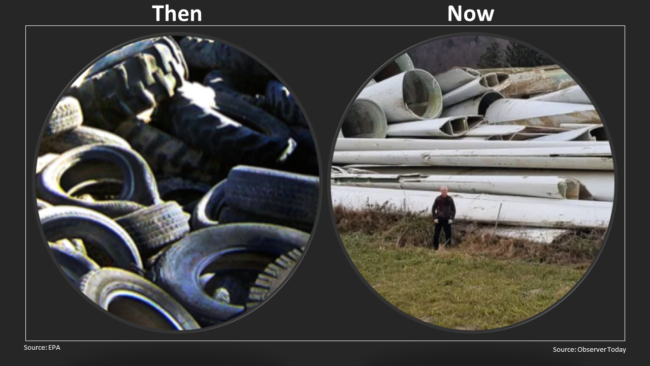
    Lifecycle risk mitigation of an energy resource must include the end of the asset life processes.  What governance driven processes are in place to prevent the accumulation of wind turbine blades or spent solar panels stacked and abandoned?  Just like the tires stacked for decades.

    Turns out the answer is few.  Long life assets such as factories, skyscrapers, fossil fuel production systems, etc. are built to the engineering, industry and local regulatory standards of that day.  Ongoing operations, maintenance, upgrades and so forth keep them performing at acceptable levels.  However, governance models are often focused on the present.  End of asset life risk does not fit into the four quarter management mindset as the event may be sometime in the future.

    The above graphic represents a governance model built around operations and associated risks.  The archetype recognizes that many risk mitigation processes are inadequate for today’s complex organizations with multi-faceted global processes.

    Its framework is built upon the work done by the Treadwell Commission several decades ago to detect financial fraud.  This structure supports the extension into field operations and provides a structure for attaining and sustaining Operational Excellence.

    Risk mitigation is both quantitative and qualitative.  The risk associate with the use of any industrial energy source must be thoroughly assessed as a function of its lifecycle, not just its initial CAPEX and ongoing operations.

    Dumping v Decommissioning

    Illegal industrial dumping has long been a problem.  Today, some in the wind turbine sector appear to be following the decades long vehicle tire disposal process (or lack thereof).

    Lady Bird Johnson at least tried to hide the piles of tire debris but no one has found a way of completely dealing with this growing and massive problem.  As of 2017, some 17% were still disposed of in landfills.  In 2003, the EPA reports that almost 300 million tires are scraped each year.  Flash forward to today and this is likely a very conservative number.  That said, 17% equals approximately 50 million tires headed to landfills as opposed to recycling.

    Moreover, there is a long history of industrial dumping trash so as not to have to pay the disposal fees.  One wonders how many millions of tires destined for landfills (and other recycling) are just dumped?

    The decommissioning process is the responsible end-of-asset-life shutdown and removal.  The intent is to return the site to a condition similar to its initial environment and properly remove and dispose of equipment and materials.  It should not include stacking wind turbine blades next to a pile of discarded vehicle tires.

    Total Carbon Lifecycle Model

    Daily, we hear about the need to reduce carbon output to (net) zero.  Promises are made by many that by such and such a time this metric will be met.  Caveat: usually the time period is beyond the expected tenure of those making the statements.  Often lost in the discussion is the carbon cost of manufacturing and decommissioning.

    Carbon output should include the mineral extraction process, recycling of older materials if appropriate, transportation, manufacturing, installation, operations and decommissioning.  It also must include the carbon cost of the supply chain necessary to support the asset across its lifecycle.  For example, the carbon cost of an EV is not just the vehicle’s operation but the lifecycle of the vehicle as well as the electric power generation and distribution necessary to operate the automobile.  Do not forget the carbon cost of manufacturing a battery and disposing of it at end of life.

    Scrap

    Materials are often staged for recycling.  They feed a process that results in new useful product(s) that may add new value.  This is a useful recycling process that makes a lot of sense.  However, sometimes this is not as economical as new manufacturing.  These economics lead to dumping as the low-cost-solution.  Fields of discarded materials may or may not be awaiting recycling.

    Defining Green

    Being green is not simply using renewable electricity instead of gasoline.  If the carbon footprint is no different or even worse, then the problem is not solved and may even be made greater.

    Keep in mind that coal is still a major fuel in the generation of electricity.  According to the US Energy Information Administration (EIA), in 2020 over 60% of power is generated using fossil fuels of which over 19% is from coal.  This does not include the carbon footprint of materials and products imported to the US.

    So if the carbon footprint of a wind turbine is defined as its lifecycle and if at the end result is abandonment in a field, is the green value of that product positive?  Or is it just dumping not unlike the pollution of a nation’s river systems?

    Being green is not just plugging in your car overnight.  Like most things in life, it is systemic.

    Is Your Organization’s Green Plan Systemic or Myopic?

    For More Information

    Please note, RRI does not endorse or advocate the links to any third-party materials.  They are provided for education and entertainment only.

    For more information on Cross Cultural Engagement, check out our Cross Cultural Serious Game

    We presented, Should Cross Cultural Serious Games Be Included in Your Diversity Program: Best Practices and Lessons Learned at the Online Conference, New Diversity Summit 2020 the week of September 14, 2020.  Check Out this timely event and contact the organizer for access to the presentations!!

    For more on DEI Standards, see the newly released ISO-30415.

    You can contact this author as well.

  • 100

    100

    This edition marks the 100th post in our Critical Mass Blog series.  We have sought to provide thoughtful, unbiased insight into the contemporary business and organizational challenges we all face.  Since our first blog post on November 27, 2017 our world has turned over in ways none expected.  Likely, this trend will continue.

    This series continues a tradition of newsletters, opinion pieces and other on line punditry first begun in 1998 with our New Millennium News.  A bi-monthly email with a subscription base of approximately 7,000 readers.  A huge number at that time.  We estimate that hundreds of thousands or more have benefited from this knowledge transfer.

    Coincidentally, we reach this milestone as we begin the new year–a time of renewal.  We will continue to address critical issues individuals, businesses, agencies and others face as we all navigate an increasingly perilous path.  This series has addressed Human Resource issues including Diversity, Equity and Inclusion (DEI) Teams , the arrival of Smart Technology, International Business, Covid-19, Supply Chain Management, Operational Excellence, Cultural Transformation (including Safety Culture) Sales, Risk Mitigation and of course Leadership.  Today’s organizations must be very good at all of these disciplines!

    Available Tools

    The mission of the Rapid Response Institute (RRI) is to enable our clients with the ability to posture themselves in their market segments so that they can thrive in volatile markets and capitalize on uncertainty, not suffer because of them.  This is especially important for those economic actors in Critical Infrastructure sectors.

    In support of this mission the firm has developed a suite of Intellectual Property (IP) which includes Know How, practical roadmap Books and guidelines as well as Software as a Service (SaaS) solutions among others.  Many readers know that once a process has been standardized with minimal configuration required, the data is the ultimate driver.  This is the heart of most Enterprise Resource Planning (ERP) solutions.

    With advances in technology, RRI has taken these once multi-million dollar solutions to a price point as well as Use Case where all organizations can utilize this capability.  Moreover, our advancements in work flow such as epitomized in our Cross Cultural Serious Games, Economic Value Proposition Matrix, and Smart OpEx (Operations Management System) and Risk Simulation Modeling add immediate and significant value to the challenges faced as articulated above.  Other Free Tools are available as well.

    Pulling It All Together

    The method to our madness is–Operations!!  As some are fond of saying with derision, “It’s All About the Benjamins.”  Well, it actually is.  If ‘for-profit’ firms are not profitable, they fail.  No amount of Environmental, Social, and Governance (ESG) will save them if they cannot deliver to paying customers.

    Everything RRI does helps organizations to deliver stakeholder value, compliant with ESG standards.  That is our Bottom Line and we are also pleased that Dr. Shemwell, Managing Director has been an independent advocate for responsible corporate success since 2004.

    FYI, major losses and legal actions do not enhance stakeholder value.  Neither for employees, local communities or equity holders.  Everyone loses when in terrible scenarios such as Deepwater Horizon, internal bias corporate hubris, poor high reliability processes/human factor shortcomings or lack of actual DEI.

    This journey continues.  Stay tuned for the next 100 editions where will continue to provide our thoughts on relevant matters.  Thank you very much for your readership and support.

    How is Your Organization Positioned for the Next Four Years?

    For More Information

    Please note, RRI does not endorse or advocate the links to any third-party materials.  They are provided for education and entertainment only.

    For more information on Cross Cultural Engagement, check out our Cross Cultural Serious Game

    We presented, Should Cross Cultural Serious Games Be Included in Your Diversity Program: Best Practices and Lessons Learned at the Online Conference, New Diversity Summit 2020 the week of September 14, 2020.  Check Out this timely event and contact the organizer for access to the presentations!!

    For more on DEI Standards, see the newly released ISO-30415.

    You can contact this author as well.

  • Heavy Metal Rocks

    Heavy Metal Rocks

    Not the rock bands of the 1960s–1980s, but the mining required to extract the heavy metals necessary for electric vehicles and other renewable energy solutions.  So, what is a heavy metal and why do we care?

    Typically, “In science, a heavy metal is a metallic element which is toxic and has a high densityspecific gravity or atomic weight. However, the term means something slightly different in common usage, referring to any metal capable of causing health problems or environmental damage.”  Often these toxic elements are carcinogenic.

    For most readers this will not come as a surprise.  The heavy metals in batteries can be recycled, thus minimizing their negative impact on the environment and subsequently, humans and other life forms, i.e., the food chain.  However, smaller batteries are typically tossed into the trash.  Larger ones such as lead acid automotive batteries are usually reclaimed (for a fee to the consumer).

    From this pundit’s perspective, it is too early in the technology maturity to fully understand how millions of EV (electric vehicle) will be recycled effectively and economically.  Managing the lifecycle of these ‘elements’ from mining, use, recycling and reuse is a significant component of these renewables.  There is a cost associated with this process, both monetary and socially.

    Total Carbon Ownership

    In the business, the term TCO usually referees to the Total Cost of Ownership.  Updated, this Lifecycle metric may better reflect the Total Carbon impact of a product/solution, i.e., large scale batteries, solar panel, fossil fuels, etc.

    TCO = Carbon as a function of two major lifecycle elements; Operations and Decommissioning.

    For this purpose we define Operations (aka Use) as the lifecycle process from mineral extraction, manufacturing, deployment and maintenance.

    Decommissioning is the process of taking out of service, removal and appropriate disposal of components, including recycling.

    Follow on from our blog of November 2, 2021, where Milton Friedman detailed the complex supply chain required to manufacture a simple yellow graphite pencil, one can only imagine how complex the requirements are for a wind turbine.  Carbon neutral is not a simple problem to solve.

    Enter Structural Dynamics

    Many readers understand that Machine Learning Algorithms use the statistical multivariable method, Multiple Linear Regression–defined as, where “one variable is estimated by the use of more than one other variable.”  While this tool can be useful when assessing the impact and relationships of several independent variables, it does not necessarily help organizations to understand their TCO.

    Theoretically, every economic actor in the supply chain or the decommissioning process can calculate their carbon footprint for each​ product/step they control.  In the real world, such intangibles, i.e., safety are open to interpretation, ‘fudging’ or worse.  Moreover, we can expect large gaps or errors (inadvertent or otherwise) in carbon models that must be addressed if we are to realistically address the carbon problem.

    In the 1990s as a result of watching a number of systemic enterprise failures and/or poor performance, and wondering how this happened with such regularity the questions was raised–why?  This led this author coin the term with the subsequent book, Structural Dynamics: Foundation of Next Generation Management Science.

    Most do not understand the processes and structural changes at work on a daily basis.  Focused on near term performance metrics, they lose sight of the forest while concentrating on the trees.  The subsequent disruption caused is often rapid and economically cataclysmic.

    Structural Dynamics uses tools such as Structural Equation Modeling (SEM) to seek to identify the underlying process and structural movements.  It appears to be a useful tool to address the Total Carbon Ownership that organizations will have to address in the very near future.

    Dealing With Residuals

    Whether heavy metals or carbon, organizations must also assure ESG (Environmental, Social, and Governance) criteria are met throughout the energy lifecycle.  However, there is a cost associated with these and other organizational structures from the deployment and/or use of energy of all types.

    TCO is a decades long cost that can transcend actual corporate life, i.e., acquisition, bankruptcy, etc.  Currently, the oil and gas industry is littered with assets no one claims ownership.  Two cases follow:

    • Stranded assets are, “those investments which are made but which, at some time prior to the end of their economic life (as assumed at the investment decision point), are no longer able to generate an economic return, as a result of changes in the market and regulatory environment.”  These resources are no longer worth continued investment.
    • Abandoned assets have reached the end of life.  By one source, it is estimated that there are approximately 53,000 Gulf of Mexico offshore oil and gas well in this category.  Remediation costs range from $500k to $10 million per well–min $26.5 billion.

    It is reasonable to expect that all sources in the ‘energy basket’ will have similar end of life futures.  Green is therefore, not unique.

    “Forewarned is Forearmed”

    A Serious Assessment

    This pundit believes that scant attention has been paid to the lifecycle (economic and social) price of renewables and that the Total Carbon Ownership cost has never been calculated–certainly not published.  However, there are tools that will shed light on this going forward.

    TCO is a function of a detailed and long lifecycle, not unlike oil and gas assets that in some cases are over half a century old.  Any subsequent model of this process is by default complex, detailed and full of unknowns, or unmeasured latent variables.

    The approached this writer has developed using Structural Equation Modeling driven by Structural Dynamics seems well fitted to address this longitudinal and futuristic problem.

    For many, the so-called ‘green energy’ seems without consequences.  The history of energy suggests otherwise.  A full assessment using Structural Dynamics can reveal gaps, misunderstandings, errors and omissions.

    This model will advise management and even regulators what the true cost of an energy source is.  The approach is worthy of a serious discussion.  By the way, this model works for all sources of energy including coal and other fossil fuels as well as renewables.

    What is Your Firm’s TCO and How Can It be Lowered?

    For More Information

    Please note, RRI does not endorse or advocate the links to any third-party materials.  They are provided for education and entertainment only.

    Interested in Cross Cultural Engagement or DEI, check out our Cross Cultural Serious Game

    We presented, Should Cross Cultural Serious Games Be Included in Your Diversity Program: Best Practices and Lessons Learned at the Online Conference, New Diversity Summit 2020 the week of September 14, 2020.

    Contact the author for information on these and others subjects covered in the Critical Mass series.

  • Complicity or Write a Book?

    Complicity or Write a Book?

    I Need a Book Deal!


    With the change of the US federal administration, previous key individuals are now coming out and writing books regarding their former boss.  This all the while with plenty of video evidence where these individuals pontificated a position and even changed their position dramatically while in the employ and in seemingly in support of that administration’s policy.

    Now some of the very architects of the US response to the Coronavirus are claiming their innocence all the while blaming others for thousands of deaths.  The nerve.  If true, she is equally responsible and perhaps more since she is a medical doctor.  First do no harm.

    We all have a boss and most need a job; however, when does an individual’s moral compass come to play?  Senior officials who will be gainfully employed doing something else fail to come forward or even resign.  THEN they claim victimhood!  The LOVE of power is so intoxicating.

    Remember, ordinary Germans were widely condemned after World War II for much less personal involvement.

    Credibility?

    Many institutions lack any credulity today.  This is not news and is a widely held view.  Any wonder when so called responsible parties now claim they could have reduced deaths but failed to do so?

    Organizational maleficence often leads to criminal charges and many executives have gone to jail.  If many of the books written after every administration are true, should at least some authors be at least censured for the complicity they themselves are documenting?

    ESG

    We have addressed the issue of governance a number of times.  Most notably in 2011, as part of our Changing the Dialogue monographs, Asset/Equipment Integrity Governance: Operations–Enterprise Alignment (A Case for Board Oversight) addressed the role of operations including environmental and social issues as critical components of the role of organizations.

    As part of the Safety and Environmental Management System tenets, the right for individuals to express themselves without redress is sacrosanct.  Surely, this includes senior officials?  If they can’t or rather seek to write ‘tell all’ books later, governance models are at risk.

    The days of Yes Men (and Women) and Empty Suits are over.  Perhaps, organizations need to clean house.

    How Do You Know Y0ur Advisors are Being Honest with You?

    For More Information

    Please note, RRI does not endorse or advocate the links to any third-party materials.  They are provided for education and entertainment only.

    For more information on Cross Cultural Engagement, check out our Cross Cultural Serious Game

    We presented, Should Cross Cultural Serious Games Be Included in Your Diversity Program: Best Practices and Lessons Learned at the Online Conference, New Diversity Summit 2020 the week of September 14, 2020.  Check Out this timely event and contact the organizer for access to the presentations!!

    You can contact this author as well.