
Category: High Reliability Management

  • Roadmap to Decision Making In the ‘Smart’ Era

    Roadmap to Decision Making In the ‘Smart’ Era

    “Nothing is more difficult, and therefore more precious, than to be able to decide.”

    Napoleon Bonaparte

    Volumes have been written on decision-making and this pundit has offered his share of insight and comment on the subject as well.  Some of our comments regard the appropriateness of the human intercession in electronic decision making.  Others raise questions regarding algorithm fallibility.  Moreover, Human Factors must be considered for any technology initiative which are becoming increasingly important.

    If one unpacks the previous paragraph a substantial level of complexity emerges.  As complexity increases so does risk and the need from proper governance.  However, many still see this potential transformation through the lens of just another IT initiative.

    Roadmap

    The oil and gas industry faced a similar dilemma at the dawn of the 21st Century.  At the time, referred to as DOFF or Digital Oilfield of the Future, a plethora of technologies became available.  The task was to transform 100 plus years of traditional operation to what is now referred to as the Digital Oilfield, aka Integrated Operations and a number or synonyms.  While this processes continues to evolve as new solutions emerge, i.e., Cloud, at the time much was trial and error.

    In conjunction with industry leadership, we released our Roadmap to Enterprise Optimization: A Guide to the Impact of Information Driven Field Operations on the Petroleum Corporation in the fall of 2004.  We believe it was the first industry (POSC) supported effort that was not simply research but a ‘bona fide’ action plan or roadmap to success based on industry/other knowledge, standards, economic value and best practices.

    Click for full size Integrated Operations Framework or graphic

    Since then, we have updated this roadmap into an Operational Excellence Platform.  Note that Integrated Operations is a key component.  The platform is a robust detailed solution that is available not just to the energy sector but all sectors identified by Homeland Security as Critical Infrastructure.  These sectors were recently identified as susceptible to hacking by the US government.

    Getting Smart

    Enormous corporate (shareholder) wealth has been destroyed implementing ‘game changing’ technology enabled transformation efforts.  Are we about to do that again, getting smart?  The easy answer is yes, but it does not have to be.

    Roadmap constructs are well understood and provide guidance.  In some models the step by step process provide practitioners with well defined models that can lead to success–defined as on time and under budget performance against Key Performance Indicators (KPIs).

    We are in the process of writing a book, to be released in 2022.  One chapter will define a roadmap for the transformation to ‘Smart’ for a major industrial segment.  As with earlier works, it will focus on the human element aligned with a technology assessment process.

    Get Smart was a comedic TV show spoofing the Cold War ‘spy’ environment of the 1960s.  Getting Smart today may not be a lot different.  The goal under a ‘Cone of Silence‘ was to attain and sustain competitive advantaged achieving superior stakeholder returns.

    Getting smart in 2021 will require a ‘Roadmap to Smart.’  A set of ‘to do’ processes that assures success.

    What is your Organization’s Plan to put Smart Decisioning Making Processes in Place?


    For More Information

    Please note, RRI does not endorse or advocate the links to any third-party materials.  They are provided for education and entertainment only.

    For more information on Cross Cultural Engagement, check out our Cross Cultural Serious Game

    We presented, Should Cross Cultural Serious Games Be Included in Your Diversity Program: Best Practices and Lessons Learned at the Online Conference, New Diversity Summit 2020 the week of September 14, 2020.  Check Out this timely event and contact the organizer for access to the presentations!!

    You can contact this author as well.

  • ESG Implementation–Strong v Weak Revisited

    ESG Implementation–Strong v Weak Revisited

    “A healthy corporation acts on the interests of its stakeholders and customers”

    — Ari Melber, Journalist

    Currently, organizations are being implored to implement Environmental, Social, and Governance (ESG) driven business models.   Proponents even suggest that investment in organizations that do not have this imprimatur should be avoided or even divested.

    However, one wonders what has changed?  Successful firms, private and public have long understood that they must add value to their constituencies.  One example, a few decades ago an energy services provider used its high volume oilfield pumps to help a small town in Kansas where it had a district office drain flood waters.  Why would they do this?  Perhaps because employees lived in this community or perhaps it was just the right thing to do.

    Flash forward and we find organizational largess still in place.  During the recent Texas freeze, a local furniture retailer opened its doors to dispossessed individuals and families.  The owner has a long record of supporting the community and his responses to local disasters is legendary.

    After the Deepwater Horizon incident in April 2010, our firm started to look at Asset Integrity issues in oilfield operations.  Our discoveries transcended several Critical Infrastructure segments.  The recent failure of the Colonial Pipeline is a manifestation of issues uncovered yet not resolved more than a decade ago!

    Focus on Operations

    In 2011, we posited that organizational governance was not just a financial issue at the ‘C’ level.  Rather its true focus should be at the revenue generating asset level.  This led to our 2011 groundbreaking monograph, Asset/Equipment Integrity Governance: Operations–Enterprise Alignment.  Therein, we posited a new governance model that incorporated the ESG components widely discussed today.

    Moreover, in 2014 our book, IMPLEMENTING A CULTURE of SAFETY: A ROADMAP FOR PERFORMANCE BASED COMPLIANCE identified the requirement for organizations in the Critical Infrastructure space to change governance models to one of Strong Bond.

    Following the release of our AIG model, we put forth a Strong v Weak governance model to manage High Reliability Organizations (HRO) necessary for firms in Critical Infrastructure sectors.  Strong Bond is appropriate for organizations in Critical Infrastructure segments, while Weak Bonds may be better for retail.

    One suspects that ESG is another tick in the box.  If ten years (or earlier) from now another critical system fails, it will not be because HRM processes were not followed or ESG verbiage was in the annual report Letter to Shareholders; it will be because nothing really changed.  As of this writing the US Federal government is advising organizations in Critical Infrastructure sectors to more aggressively address cybersecurity risks.

    Why is this? Do Boards and CEOs need politicians and bureaucrats to tell them about the details of running a business?  If they do, investors may want to revisit their portfolios.

    One suspects that the ESG fad will fade. There will always be a new management mantra that consultants will put forth.  Well run organizations will remain well run.  Others not so much.

    Governance models come and go.  Regardless, how will you assure your organization is well run?

    For More Information

    Please note, RRI does not endorse or advocate the links to any third-party materials.  They are provided for education and entertainment only.

    For more information on Cross Cultural Engagement, check out our Cross Cultural Serious Game

    We presented, Should Cross Cultural Serious Games Be Included in Your Diversity Program: Best Practices and Lessons Learned at the Online Conference, New Diversity Summit 2020 the week of September 14, 2020.  Check Out this timely event and contact the organizer for access to the presentations!!

    You can contact this author as well.

  • Post Covid-19 Operational Performance

    Post Covid-19 Operational Performance

    Not the So-Called New Normal


    The light at the end of the Covid-19 tunnel may not be the train many still believe.  Populations are being inoculated at very high rates.  Moreover, there is ample evidence in my metropolitan area that the general population no longer believes or adheres to the ‘advice of experts.’  This should surprise no one who understands the US long history of civil disobedience.

    We pundits forecasting the new normal following a traumatic social event always get it wrong and so we will again this time.  There is a simple reason for this–Human Behavioral Economics.  Another leg of the three legged stool is the Technology Readiness Level (TRL) and not all technologies are at the same level or even play well together.  Finally, Organizational Culture must be ready as well.  If these situational settings are not met, the crisis passes and we get back into the comfortable and familiar.

    Following the initial euphoria that we could work from home and not wear pants, many discovered this really was not for them.  Many children did not do as well in a stay at home educational setting and teachers were challenged as well.  Moreover, many tasks require personal engagement.

    Many are Called . . .

    As always winners and losers will emerge and it will take some time for that rank order to solidify.  While digital is important and we have supported that business model for decades, bits will not physically move the barrels.  Still will take heavy industrial technology and processes.

    Using information and other technologies to drive Operations Management Systems are the future.  Not necessarily driven by IT firms but those digital engineers steeped in both disciplines.

    If Organizations are to achieve successful Sustainability, they first need a High Reliability level of Agility and Resiliency.  The only get these attributes when they perform at a high level of Excellence.

    So as we arrive at another new normal, we need to recognize that not everything from the past was bad and not everything we see today is good.  Some processes will be sustained and coupled with newer one.  New Normals do not really destroy the past; we continue to evolve.

    Even innovation from Creative Destruction is not instantaneous.

    How will your organization take advantage of emerging opportunities?

    For More Information

    Please note, RRI does not endorse or advocate the links to any third-party materials.  They are provided for education and entertainment only.

    For more information on Cross Cultural Engagement, check out our Cross Cultural Serious Game

    We presented, Should Cross Cultural Serious Games Be Included in Your Diversity Program: Best Practices and Lessons Learned at the Online Conference, New Diversity Summit 2020 the week of September 14, 2020.  Check Out this timely event and contact the organizer for access to the presentations!!

    You can contact this author as well.

  • Teaming Safely

    Teaming Safely

    “For safety is not a gadget but a state of mind”


    Second only to the basic need for food, water and what is required to sustain physical life, safety and security are the next step in Maslow’s Hierarchy of Needs.  In other words one cannot love or feel belonging or achieve a level of esteem without having the warmth of safety much less attain self-actualization.

    More recently, team safety has come to be defined as Inclusive.

    There are three components of team safety:

    • Sociological — “developing and maintaining friendly social bonds is a fundamental organizing principle of human behavior”
    • Psychological — “defined as a shared belief that the team is safe for interpersonal risk taking”
    • Physiological — “relating to the way in which a living organism or bodily part functions”

    If members do not feel ‘safe’ then the team is not capable of high performance.  Moreover, the synergistic value that can be derived from team diversity can not be captured.

    Attaining Safety

    While the need to be safe is coded in our DNA so to speak, we are not inherently safe.  Individuals as well as teams must be proactive to reach situational safety.

    We are Mindful when we are in touch with ourselves and the environment through nurturing feelings.  Interesting, being mindful is a major requirement of High Reliability Organization/Team.  High reliability is a necessary ingredient for an organization’s Safety Culture and by extension its Teams (including third party ecosystem members).

    Safety is a learned behavior.  Therefore, effective training and ongoing reinforcement are necessary. Moreover, realistic scenarios are mandatory making the learning process relevant.

    Take the following maturity assessment and implement your team training program!

    What is your Team’s Culture of Safety Maturity?

    For More Information

    Please note, RRI does not endorse or advocate the links to any third-party materials.  They are provided for education and entertainment only.

    For more information on Cross Cultural Engagement, check out our Cross Cultural Serious Game

    We presented, Should Cross Cultural Serious Games Be Included in Your Diversity Program: Best Practices and Lessons Learned at the Online Conference, New Diversity Summit 2020 the week of September 14, 2020.  Check Out this timely event and contact the organizer for access to the presentations!!

    You can contact this author as well.


  • I Didn’t Do It, He Did — I Didn’t Do It Either, Someone Else Did

    I Didn’t Do It, He Did — I Didn’t Do It Either, Someone Else Did

    “When converted into productive thought and action, the energy it takes to blame, shame, and game is enough to launch anyone into heights of real success and happiness.”

     – Charles F Glassman

    Entrée

    It is not often that an entire geographically LARGE state loses power and water simultaneously.  Now we know it can happen!  Welcome to Texas (ERCOT) circa the dawn of the 21st Century.

    The finger pointing and claims, ‘not my responsibility’ surfaced immediately at all political levels.  As I sat in my power free, cold, waterless house, I was moved that political leadership was focused on saving their own hides.

    Benjamin Franklin’s words, “We must all hang together, or, most assuredly, we shall all hang separately” are lost on our hyper partisan world.  Earth to all polls, there is enough blame on this one to go around.  This society loves to Share and Like and is quick to find fault.

    The usual suspects will pontificate about blaming others and legal initiatives have already surfaced.  Good media, but who actually cares?

    This blog post is not about politics or the blame game.  It rather posits a solution that sees that this never happens again–anywhere.

    Operational Excellence Platform

    Excellent performance requires a conscious effort at all levels of an organization and its ecosystem.  We embodied a approach for heavy industry in our 2012 article, High Reliability Management in Process Industries: Sustained by Human Factors.  In that piece we put forth the argument that High Reliability Management is a strong methodology for management large complex systems such as the Texas Electric Power Grid.  HRM provides organizations with Agility, Resiliency and Sustainability in the face of large complex incidents.

    As we have previously put forth, Normal Accident Theory (NAT) posits, “that some accidents are inevitable because of system complexity.”  While logical, this model has its critics and lacks empirical evidence.

    The Texas electricity power grid got into process/technological/engineering trouble rather quickly.  Debate will rage for years as to what actually happened.  However, it seems practitioners at all levels practiced NAT.  Like Deepwater Horizon, this event did not have to happen.

    Safety Culture

    At the core of High Impact Performance is a strong safety culture.

    Systemic Safety Culture as the Core Set of Values and Behavioral Economics of ALL participants of the extended organization and its Enterprise Risk Management strategy that reflect a Strong Bond Governance commitment to behaving as a High Reliability Enterprise Ecosystem in a safe and environmentally responsible manner.

    Going Forward

    The over used phrase, ‘teachable moment’ suggests that we learn from our history so as not to repeat it.  Most likely oxen will be gored, witch hunts abound and the likelihood of little tangible progress will be made.

    Career losses will most like exceed the six board members who have already resigned.  All because the reactive NAT model was followed.  One is well advised not to follow this lead.

    How are you making sure that your operations processes are proactive?

    For More Information

    Please note, RRI does not endorse or advocate the links to any third-party materials.  They are provided for education and entertainment only.

    For more information on Cross Cultural Engagement, check out our Cross Cultural Serious Game

    We presented, Should Cross Cultural Serious Games Be Included in Your Diversity Program: Best Practices and Lessons Learned at the Online Conference, New Diversity Summit 2020 the week of September 14, 2020.  Check Out this timely event and contact the organizer for access to the presentations!!

    You can contact this author as well.


  • Covid-19 Positive: Telemedicine Kicked into High Gear

    Covid-19 Positive: Telemedicine Kicked into High Gear

    Crisis Drives Change

    In 2001 this writer approached the Houston medical community, post tropical storm Allison which flooded many basements in the Houston Medical Center with the loss of experimental data and other records.  We proposed the development of an Internet based solution to hold and manage medical records of all types.  The response to my organization’s offer to digitize records was met with disbelief and ultimate rebuke.

    At the time I was employed by a major corporation with the technology and financial resources to accomplish this task.  Sales Objections included privacy, doctors will not ‘buy in,’ insurance will not pay for it and a host of other lame excuses.

    Flash forward to 2020.  Why are thing so different now and the idea of ‘digitalization’ almost universally accepted?

    Twenty years is a career for many, yet it took a crisis this year to kick the medical sector into action at critical mass—Coronavirus, aka Covid-19.  As often the case large organizations are content to stay with the status quo.  Culture, processes, and even individual bonuses incent lethargy and complacency.  This common trait is not limited to one sector.

    Moreover, advances in online telemetry support the physician’s ability to treat many aliments remotely.  The industry did not just ‘jump’ to the current state, it evolved over time.  For example, remote and inaccessible areas such as Antarctica have taken advantage of telemedicine including remotely directed surgeries.

    Democratization

    We may look back on 2020 as the seminal moment when medicine was digitalized.  Despite current access issues such as we are finding with K-12 education, most will have the ability to interact online in the near future.  Moreover, a number of COTS (commercial off the shelf) health solutions such as found in a variety of Smart phone products enable remote diagnosis and monitoring on a global basis.

    The catalyst for taking telemedicine to the next level is Covid-19!  A good Positive.

    How is your organization taking advantage of remote operational technologies?

    For More Information

    Please note, RRI does not endorse or advocate the links to any third-party materials.  They are provided for education and entertainment only.

    For more information on Cross Cultural Engagement, check out our Cross Cultural Serious Game

    We presented, Should Cross Cultural Serious Games Be Included in Your Diversity Program: Best Practices and Lessons Learned at the Online Conference, New Diversity Summit 2020 the week of September 14, 2020.  Check Out this timely event and contact the organizer for access to the presentations!!

    You can contact this author as well.

  • To KISS or Not?

    To KISS or Not?

    According to legend, the term KISS or ‘Keep It Simple, Stupid’ was coined by Kelly Johnson, lead engineer at the Lockheed Skunk Works and noted by the US Navy as early as 1960.  Subsequent phrases such as ‘Less is More’ followed.

    At first glance, it makes sense not to overly complicate a product, process or project.  Certainly, a non-technical audience such as senior management will need to the issue and risk management strategy explained in terms they understand.  However, in our search for Red. Yellow, Green ratings are we overly simplifying complex environments?

    Albert Einstein is created with saying, “Everything should be made as simple as possible, but not simpler.”  This begs the questions, where is that line and how do you know if you’ve crossed it?

    One of the mantras of the High Reliability Organization Mindfulness is, Preoccupation with Failure.  This is not defined as with Normal Accident Theory, where failures are inevitable.  Rather, it is an understanding the modern complex systems one must be resolute in one’s focus on operational issues and rapidly move to normalize out of limit situations.

    In 2016 (and earlier) we made the case that after the Ebola outbreak in Dallas, the Public Health sector was resilient and that issue was contained quickly (links to all three parts of this series provided below).  In this writer’s opinion, this was not possible if the process was ‘worked’ at a too simple level.  Lessons learned from that and other contagion incidents may be useful combating Coronavirus Disease 2019 (COVID-19).

    The overused phrase, “failure is not an option” is the root of contemporary Operational Excellence business models.  In fact, failure happens but mitigating its impact and rapidly recovering are the hallmark of successful organizations.

    The graphic is a fractal.  From the Fractal Foundation, “A fractal is a never-ending pattern.  Fractals are infinitely complex patterns that are self-similar across different scales.  They are created by repeating a simple process over and over in an ongoing feedback loop.  Driven by recursion, fractals are images of dynamic systems – the pictures of Chaos.  Geometrically, they exist in between our familiar dimensions.  Fractal patterns are extremely familiar, since nature is full of fractals.  For instance: trees, rivers, coastlines, mountains, clouds, seashells, hurricanes, etc.”

    Our world is a complex place.  Processes and technologies must deal with that fact.  Successful risk management strategies must take Einstein’s wisdom into consideration.

    Does Your Organization Have a Robust Enterprise Risk Mitigation Strategy?

    For More Information

    The Three-Part Series Referred to in this blog:

    Please note, RRI does not endorse or advocate the links to third-party materials.  They are provided for education and entertainment only.

    For more information on Cross Cultural Engagement, check out our Cross Cultural Serious Game

    You can contact the author as well.

  • Safety Santa: Another Case of Operational Excellence Success

    Safety Santa: Another Case of Operational Excellence Success

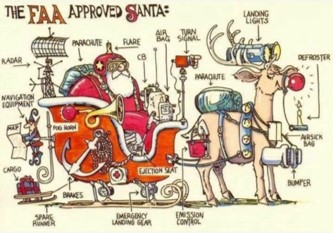
    A year ago, it was the pleasure of this blogger to report that Santa Clause completed yet another successful global fulfillment process AND importantly, the process was in compliance with the US Federal Aviation Authority’s (FAA) regulations.  A great deal of progress since the advent of one red light on the nose of the lead reindeer!

    This year we are once again pleased to report that not only have the flying sled and its power plants remained in compliance with the FAA but has now taken additional steps forward.  Incorporating new technologies and processes, safety has been enhanced in the following manner:

    • Addressing Slips, Trips and Fails with new safety/skip proof landing gear
    • A new Confined Space program along with appropriate personal safety gear
    • An alarm Klaxon and Better Lighting
    • Enhance Safety Restraints such as airbags and an overhead guard
    • Extensive Head, Vision, and Hearing Protection systems
    • Better Work Place Violence technology enabled processes
    • A new Cargo Restraint system

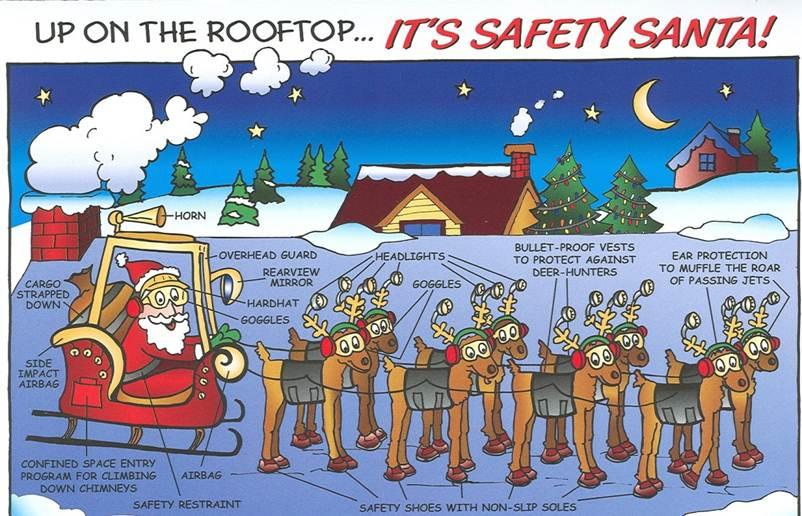
    It looks like the arctic region of the Occupational Safety and Health Administration (OSHA) outreach program is having great success.  Interested readers are invited to review the above safety Infographic for further details and perhaps new insights.

    Simplified Business Model

    There are a lot of lessons herein for those who don’t live at a mythical north pole.  First, it seems that much if not all the safety improvements made are inexpensive and easily implemented.

    Next, change management and new policies appear to be welcomed by those affected.  Answering the, “What’s In It For Me” question when adopting new technologies.

    Management is also ‘walking the walk’ with employees by driving the sled and taking the same risks as the rest of the team fulfilling customer requirements, i.e., snow covered rooftops and chimneys.  One can argue that this entire team is the Customer Facing part of the system.  Finally, customers have high expectations that must be met, and late delivery is not an option—this project has a fixed deadline!

    Stakeholder Value

    With billions of children waiting and using a complex and global logistics system, this team does not disappoint.  Earlier competitors have long dropped off the map.

    So why with a clear monopoly does this organization still seek greater Operational Excellence with its transformational Safety Culture?

    Simple—safe and excellent operational performance is good business!  Less unplanned downtime increases the bottom line.  Few incidents increase morale and the bottom line.

    Fewer legal issues, regulatory matters, and so forth and so on positively impact the bottom line.  With such significant ROI, what’s a stakeholder not to like?

    Is Your Operational Safety on Par with Ole Saint Nick?

    For More Information

    Please note, RRI does not endorse or advocate the links to other third-party materials.  They are provided for education and entertainment only.

    For more information on Cross Cultural Engagement, check out our Cross Cultural Serious Game

    You can contact the author as well.

  • Running Across an Open Field: Strategy for Disruptive Technology?

    Running Across an Open Field: Strategy for Disruptive Technology?

    Several weeks ago, as an amateur history buff, I was watching a documentary about World War I.  During one segment the commentator discussed the apparent fact that if soldiers refused to charge out of their trenches across an open field into the teeth of waiting machine guns they would be shot.

    The brutality of such a command by (so-called) leadership is appalling.  It may have been one thing for Alexander the Great’s armies to engage in open battles with sharp pointed objects as weapons.

    It is quite another for General Pickett’s infantry at Gettysburg to charge cannons and 50+ years later to repeatedly try the same tactic (by both sides) at horrific costs.  Generals always fight the last war, so the saying goes.

    This blog is not about some of history’s follies, it is about learning so as not to repeat the mistakes of others.  These lessons apply to readers’ daily business world as well.

    When New Technology is Deployed

    New disruptive technology can tear the societal fabric.  Some old jobs and companies disappear, and new ones thrive.  This process has been repeated since antiquity.

    Our culture is having this dialogue today regarding digitalization and its suite of technological driven change, i.e., Blockchain, AI, etc.  Principal issues that must be addressed include Human Factors Engineering (HFE).

    “HFE places the human operator at the center of the complex operating environment.  HFE recognizes that this individual or set of individuals is the puppet master and is responsible for the entire show.”  In other words how do we interact with the new technological reality.

    Reliable and valid HFE is the key to successful digitalization initiatives.  It will be the vital to whatever is next as well.

    Tyranny of the Minority

    From political science, “For centuries, theorists have worried about the potential of unrestrained democracy to lead to a tyranny of the majority, in which majority groups ride roughshod over the rights of minorities.  What we often see today is instead a kind of tyranny of the minority: a system in which a particularly extreme and motivated fraction of the populace can wield outsized power in the face of a majority which is either too indifferent or too scared to oppose it,” (italics added).

    In most organizations, there are fewer leaders than those who fabricate a ‘work product.’  The responsibility of leadership is to set the vision, mission and goal as well as enabling the organization with the tools and support necessary to reach targeted stakeholder value.

    But what if this minority group is the slowest to come to grips with disruptive forces?  In the face of newness, they may ‘keep doing what they have always been doing.”  In such an environment, the organization will likely not reap the same reward as in the past.

    Does too indifferent or too scared describe your organization’s ecosystem workforce?  One suspects It would be good to know.

    Fast Fail

    In our last blog we discussed the rapid assessment of technology and when to drop it if it does not appear to be working out.  Perhaps, we should treat managerial processes the same way.  After a horrific and visible failure in leadership, conceivably one preserves best by looking for alternative?

    If charging head long across an open field leads to disaster, why keep doing it?  While a counter argument might be that we had no tools to defeat those equipped with the new technology, to this writer, that logic is suspect.

    Flanking an enemy’s line or using guerrilla tactics, et. al. are as old as human confrontation.  Unconventional warfare has a long record of documented success.

    The business lexicon is loaded with military terminology.  We often speak of business as if it is warfare, when of course it is not.  There are lessons to be learned about human and organizational behavior, however.

    Decades ago, the concept of Guerrilla Marketing was the rage.  With the advent of social media, it has advanced, and the methodology is available to all.  Huge budgets and massive media campaigns are no longer necessary.

    Head-to-Head the biggest ‘guy’ usually wins.  So, if you’re not him/her, DON’T DO IT!!  However, the small mammals may displace slow moving dinosaurs.

    Agile is not an IT term.  It should be the state of mind of leaders at all levels.  To charge across the open business landscape into technology designed to destroy your organization remains folly.

    How Are You Leading the Charge into the Future?

    For More Information

    Please note, RRI does not endorse or advocate the links to other materials.  They are provided for education and entertainment only.

    See this 3:15 minute clip for more information on living in a World War I trench.  Pathetic way for leaders to force those under their command to live.

    For more information on Cross Cultural Engagement, check out our Cross Cultural Serious Game

    You can contact the author as well.

    End Notes

      https://consult2050.com/job-disruption-due-to-digitalization/

      https://therrinstitute.com/wp-content/uploads/2018/10/HRM-in-Process-Industries-Sustained-by-Human-Factors.pdf

      Ibid.

      https://areomagazine.com/2019/04/02/the-tyranny-of-the-minority-and-how-to-prevent-it/

      https://therrinstitute.com/lessons-from-the-seventies/

      https://en.wikipedia.org/wiki/Guerrilla_marketing

  • Chain of Custody: Is Your Management System Ready?

    Chain of Custody: Is Your Management System Ready?

    This eliminates the possibility for human error.”  This is an actual quote taken from one of the many blockchain ‘credible’ websites readily available—citation withheld to protect the guilty.    And, the Titanic was unsinkable!

    From another credible sources, “Is blockchain secure for my business?  Simply put, it can be.  But, not by just turning the key.  Security will depend on a variety of factors, none sic (not) the least of which requires a robust risk management framework?”

    In their white paper, KPMG argues that while the current blockchain frenzy is focused on the new technology, the question of its applicability to a business solution remains elusive.  Falling in love with a ‘shiny new software object’ has been seen before.  Most recently, digitalization and IoT.

    The organization’s economic buyer requires more depth in the decision-making process.  Has a valid Business Use Case been developed for its implementation?  This can be a time-consuming activity as the various constituencies must be queried to assess their assessment of the Economic Value of this CAPEX.  Unfortunately, there are no shortcuts to this risk mitigation process.

    This blogger has focused on the need for Governance and appropriate Management Systems for many years.  Historically it has been a challenge for business and government entities to keep up with the explosion of technology.

    While third parties are often the weakest link in supply chain management and this is one of the problems that Chain of Custody solutions address, technology alone is not a solution.  As with any transformational initiative, the broader impact, unintended consequences as well as other tangible and intangible exposures must be understood and managed accordingly.

    Just for the record, human error can never be eliminated.  It is human folly to believe that a technology can free us from our human nature.  High Reliability Organizations (HRO) recognize this frailty and respond accordingly.

    The promised of today’s technology suites can be of high value.  History teaches us that this value may not be realized if the problem being addressed, their implementation and sustained (maturity) processes are inadequately formulated.

    How Will Your Organization Assure It Will Realize the Value from Blockchain Investments?


    https://advisory.kpmg.us/articles/2017/securing-the-chain.html

    Shemwell, Scott M. (2018, October). How to make the case to the C-Suite: Selling Large Scale Data Management Projects to the C Suite. Foundations: The Journal of the Professional Petroleum Data Management Association. Volume 5 Issue 2. pp. 6-8.

    https://sceweb.uhcl.edu/helm/RationalUnifiedProcess/process/modguide/md_bucm.htm

    https://therrinstitute.com/economic-value-proposition-matrix/

    https://therrinstitute.com/are-organizational-governance-models-broken-why-cant-management-get-a-handle-on-things/

  • Operational Complexity: Risk Model Insufficiency

    Operational Complexity: Risk Model Insufficiency

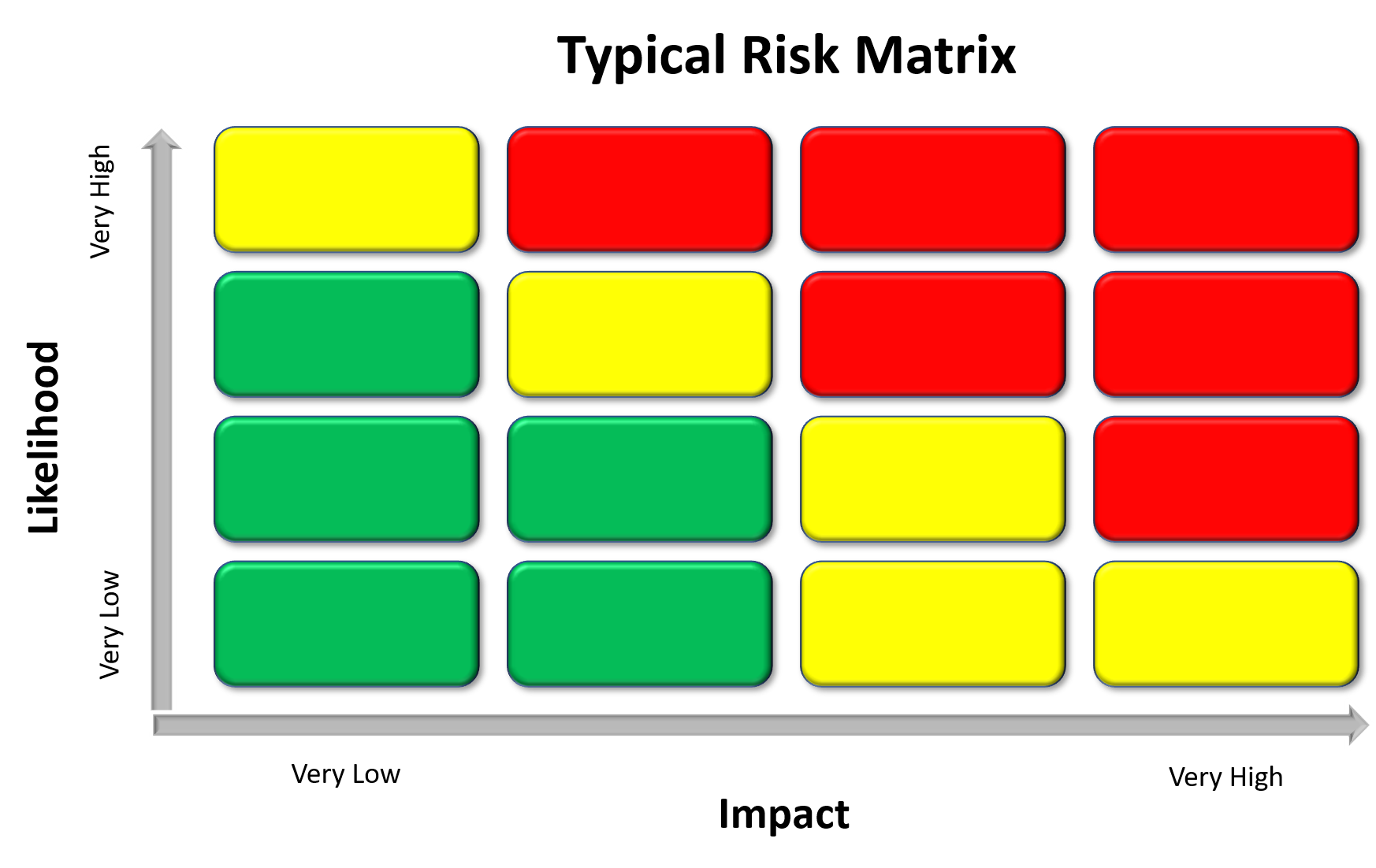
    Most readers will be familiar with the above linear Risk Matrix Model.  This graphical representation of risk exposure is useful but strict adherence to it can lead to a false sense of security.

    Systemic Risk Management

    The real world is very complex with many moving parts.  The potential interaction of processes, events and other challenges can lead to disaster.  It is often the case that the combination of a number of seemingly unrelated and in and of themselves potentially minor events can lead to catastrophe.

    A systemic approach to risk exposure is appropriate.  Field operations usually involves several to many somewhat disparate processes and individuals.

    Typically, the operator will have individuals in the field as well as the office working together.  Contractors and sub-contractors are similarly constructed.  The number of interactions can grow exponentially in a large project or program.

    Therefore, it is important to ‘see’ risk as a dynamic interacting model.  For example, the following quotation is a straightforward presentation of the actual risk field operators face.

    “Planning for the abandonment of Macondo was extremely complex.  The fundamental source of that complexity was a phenomenon well known to systems engineers: the number of potential pairwise interactions among a set of N elements grows as N times N-1, divided by 2.  That means that if there are two elements in the set, there is one potential interaction; if there are five elements, there are ten potential interactions; ten elements and there are forty-five; and so forth.  If the interactions are more complex, such as when more that two things combine, the number is larger.  Every potential interaction does not usually become an actual one, but adding the elements to a set means that complexity grows much more rapidly than ordinary intuition would expect.”

    The authors’ note that NOT all combinations can happen, but the possibility of several is likely.  Many decision makers do not expect exposures as great as they likely are in a complex environment.

    Interactive Model

    So how great is your risk?  The following calculator will give you a perspective on your organization’s exposure.  It is straightforward and easy to use.

    You are only required to input two variables:

    n = the number of elements

    m = elements from n in certain order, it is arrangement

    Taken from the Macondo model above, if n=10 and m=2, the number of combinations of m from n equals 45.


    [planetcalc cid=”977″ language=”en” code=”” label=”PLANETCALC, Combinatorics. Combinations, arrangements and permutations” colors=”#263238,#435863,#090c0d,#fa7014,#fb9b5a,#c25004″ v=”3275″]

    Addition data the calculator provides:

    Each ordered set of n is a permutation

    Generally, the number of combinations of m from n with repetitions is not useful for our purposes other than the recognition that repetition is possible.

    This calculator does not indicate where risk lies.  As the authors of Deepwater Horizon: A Systems Analysis of the Macondo Disaster suggest, it helps decision makers better understand the nature of their complex environment.

    Final Thoughts

    Simple risk models may have their place.  They are useful for presentation purposes.  However, they are insufficient when assessing the exposure of today’s complex operational situations.

    High Reliability Management requires that decision makers NOT simplify the complex.  Understanding the level of exposure using systemic risk management techniques can help clarify organizational threats.

    Are Your Organization’s Risk Management Techniques Robust Enough?

    For more information on Risk Mitigation check out our Operational Excellence Platform.

      Boebert, Earl and Blossom, James M. (2016). Deepwater Horizon: A Systems Analysis of the Macondo Disaster. Cambridge, MA: Harvard University Press. pp. 65-66.

    Appendix–The Math

    For those interested, this is the math for the calculator. It is taken directly from the Planetcalc website.

    So, assume we have a set of n elements.

    Each ordered set of n is called permutation.

    For example, we have set of three elements – А, В, and С.
    Example of ordered set (one permutation) is СВА.
    Number of permutations from n is

    P_n = n!

    Example: For set of А, В, С number of permutations is 3! = 6. Permutations: АВС, АСВ, ВАС, ВСА, САВ, СВА

    If we choose m elements from n in certain order, it is arrangement.

    For example, arrangement of 2 from 3 is АВ, and ВА is the other arrangement. Number of arrangements of m from n is

    A_{n}^m=frac{n!}{(n-m)!}

    Example: For set of А, В, С number of arrangements of 2 from 3 is 3!/1! = 6.
    Arrangements: АВ, ВА, АС, СА, ВС, СВ

    If we choose m elements from n without any order, it is combination.

    For example combination of 2 from 3 is АВ. Number of combinations of m from n is

    C_{n}^m=frac{n!}{m!(n-m)!}

    Example: For set of А, В, С number of combinations of 2 from 3 is 3!/(2!*1!) = 3.
    Combinations: АВ, АС, СВ

    Here is the dependency between permutations, combinations and arrangements

    C_{n}^m=frac{A_{n}^m}{P_m}
    Note Pm – number of permutations from m
  • Decision Making in the Digitalization Age: Who Decides?

    Decision Making in the Digitalization Age: Who Decides?

    “Ergonomics (or Human Factors) is the scientific discipline concerned with the understanding of interactions among humans and other elements of a system, and the profession that applies theory, principles, data and methods to design to optimize human well-being and overall system performance.”

    According to Gartner, “Digitalization is the use of digital technologies to change a business model and provide new revenue and value-producing opportunities; it is the process of moving to a digital business.”

    The concept of the “Human—Machine Interface” is well established for Industrial Control Systems (ICS) and is the way the human being directs the machine.  One wonders; however, if in the age of the Industrial Internet of Things (IIoT) whether this linear relationship is still true?

    If the Behaviors of quasi-independent systems are different than that of an ICS, the R B C model suggests that in these new Conditions, the Relationships between the Humans and these new Machines (digital business) will be different as well.  If this hypothesis is true, what are the implications going forward?


    We routinely let machines make life and death decisions.  Common examples include, airliner autopilots, automobile cruise control, and more recently the forthcoming self-driving cars.  Moreover, medical procedures are increasingly automated.  Boundless other instances exist as well.

    When it is appropriate for the human to intercede in automated decision-making processes?  What happens in a business setting if the human is wrong?

    High Reliability Management

    Management is evolutionary, not revolutionary.  Each generation and business model builds on thousands of years of human experience.

    The current High Reliability Management (HRM) model seems to address these emerging decision problems well.  The model consists of five traits:

    • Sensitive to operations
    • Reluctant to accept “simple” explanations for problems
    • Preoccupation with failure
    • Defer to expertise
    • Are resilient

    Applying these traits at the operational level allows the human to focus on the overall set of processes while allowing the machine to make its appropriate decisions.  With supervisory expertise coupled with an understanding that failure happens, policy can be set that enables the human to intervene as necessary without career repercussions.

    Moreover, IIoT is complex by nature and largely focuses on operational processes.  Implicit is the need to respond quickly to events, i.e., resilience.

    At the dawn of digitalization, management is already equipped with the tools to manage the largely automated enterprise.  How these tools are deployed is the difference from adding shareholder value vs destroying it.

    Do Intelligent Machines Have a Culture(s)?

    Hollywood has long presented cyborgs and other robotics as human like.  While we may be some years from truly independents machines, they do exhibit certain behaviors based on a given set of conditions.  This generates a relationship with human administrators.

    So, if organizational culture is the ‘way we do things,’ then one can surmise machines do have a culture (somewhat dependent on the human programmers).  If this hypothesis is supported, then the era of digitalization must add one more culture to its multi-cultural engagement processes.

    What is your Firm’s Decision Model in the Age of Digitalization?

    For more information on Cross Cultural Engagement, check out our Cross Cultural Serious Game


      https://en.wikipedia.org/wiki/Human_factors_and_ergonomics

      https://www.gartner.com/it-glossary/digitalization/

      Shemwell, Scott M. (1993). Management Theory—Evolution Not Revolution, Proceedings of the 11th Annual Conference of the Association of Management, 11 (2), pp. 74-78.

  • Fleeting Success: In Pursuit of Sustainability

    Fleeting Success: In Pursuit of Sustainability

    Winston Churchill is credited with saying, “Success is not final, failure is not fatal: it is the courage to continue that counts.”  The late Prime Minister nailed it; once again!

    Our journey through life, including our career is a marathon not a sprint.  While we celebrate success, often at happy hour or a party, we recognize it is only a moment.

    Early in this writer’s career, a multi-million-dollar deal closed after more than a year of effort.  A celebration ensued.  The next day the sales manager, “Asked what was next?”

    Attain and Sustain

    Organizational initiatives seem to procreate.  In some ways like the Tribbles of the original Star Trek series.  Cute furry things, the Tribbles multiple at such a rate as to almost consume the Enterprise.  Only the transporter beam saves the crew.

    Like the rah-rah of New Year’s Resolutions, the question is not will I go to the gym in January, but will I still set foot on the treadmill in June or even March.  The road to you know where is paved with good intentions.  It is the sustained energy of the execution that assures more successes than failures—and that failures are teachable moments.

    Culture is one of the current buzzwords, yet Cultural Transformation is the key to sustainability.  Courage requires the organization to pick itself up, so to speak and continue the journey to a sustained high level of Operational Excellence.

    Easy to Say

    According to Forbes, in 2018 “enterprises are expected to invest $1.3 trillion (USD) in digital transformation initiatives to apply digital capabilities to improve efficiencies, increase customer value and create new monetization opportunities.”  The article goes on to posit, that almost $900 billion of that spend will be wasted as goals are not attained.

    Why are these projects always seemed doomed to fail?  A quick Google search identifies a large body of knowledge over the years documenting these types of failure.  So, the beat goes on.

    Hard to Do

    There is also a body of work documenting the “should do’s” of organizational transformation.  In fact, this author has contributed several articles and books on this subject.  Most notably, Implementing a Culture of Safety: A Roadmap for Performance Based Compliance.

    A Missing Piece

    There is a lot of talk about Operational Excellence, Digitalization, High Reliability Organizations, Human Factors, Safety Culture et al.  As with the Forbes data, many are suffering the same fate.  No wonder senior management is skeptical of new spend for more ‘Tribble-itiatives.’

    For example, when a critical infrastructure sector discusses the transformation to a Safety Culture, the term is often expressed as singular, i.e., there is one industry safety culture.  However, all firms have their own ecosystems consisting of multiple and sometimes disparate entities.

    They have developed a culture that is a source of pride, competitive advantage, etc.  Their culture differentiates each organization from their peer group.

    The following figure presents the actual nature of a firm’s Safety Culture.  The reality is that a large organization’s “culture” is a combination of multiple cultural dimensions.  It is this ‘nature of culture’ that must be better understood if a transition process is to be successful and sustained.

    Readers should note that the multi-dimension structure is continuously changing as business, technology, and regulatory environments impact on the Relationships, Behaviors, and Conditions of the situation.  This dynamic requires continual managerial energy and training to sustain the change desired.

    Cross Cultural Engagement

    It would seem to be a daunting if not impossible task to effectively and efficiently train a large work force including relevant third-party suppliers on an ongoing basis.  Of course, the cost would be prohibited as well.

    Not so fast, e-learning serious games are now available to support the training requirements necessary to “sustain” the transformation.  Moreover, specific scenarios can quickly be developed to meet specific organizational requirements.

    The games are developed using Game Theory and Human Behavioral theories.  They simulate a real-world environment and have been shown to give great results over decades.  With Cloud technology, these training tools are now inexpensive and readily available to all.

    Why have your Organization’s Business Transformation Initiatives Failed?

    Check out our Cross Cultural Serious Game


      https://en.wikipedia.org/wiki/The_Trouble_with_Tribbles

      https://www.forbes.com/sites/forbestechcouncil/2018/03/13/why-digital-transformations-fail-closing-the-900-billion-hole-in-enterprise-strategy/#1f5923507b8b

      https://www.xlibris.com/Bookstore/BookDetail.aspx?BookId=SKU-0143303003

      Shemwell, Scott M. (2015, November 28). Comments and Thoughts Regarding the IAEA Technical Meeting on Developing Improvement Programmes for Safety Culture November 2-4, 2015. Vienna, Austria.

  • Resolution: Celebrating a New Operational Start–One More Time

    Resolution: Celebrating a New Operational Start–One More Time

    It is hard to believe we are now 19 years into the century.  Seems like only yesterday we were worried whether the lights would stay on at Y2K.

    Each year many of us promise to do better at a list of things, some personal and some professional.  Some days or weeks later, some or all of our resolutions go unmet.

    For many heavy industry sector firms, January 1st is also the start of a new fiscal year.  New budgets will be released, and management will extol their workforce to meet new (possibly stretch) targets.

    If the equity markets are a barometer of things to come (leading indicator), then the Conditions organizations will find themselves in will most likely be volatile and some segments may even face significant challenges.

    For example, WTI crude oil closed on January 4th at US$ 47.96/bbl.  Some are bullish on this sector, with an expectation higher prices in the future.  History has shown this faith may not bear out.

    Regardless, organizational Behavior will need the flexibility to adjust in a process relevant time frame as conditions change.  The resulting Relationship with the firm’s ecosystem is a function of the behavior in the conditions or market circumstance.

    In other words, the R B C Framework is applicable in our everyday corporate life.  Why is this important?

    One way to view the global marketplace is one of continual change.  Often purveyors of Change Management/Organizational Transformation present this as a point in time.  Statements about continuous improvement are seemingly afterthoughts.

    We have developed an Operational Excellence Platform, as depicted in the following figure.  Please note that it is built upon the R B C Framework.

    Since the nature of Relationships across the organizational ecosystem will continuously evolve based on the marketplace, it follows that maintaining Operational Excellence depends on these tree factors.  Safe and profitable operations on strong, positive relationships.

    How well does your organization understand the R B C Framework for its ecosystem?

    Further Reading

    The author and others have published extensively on this subject.  The list of appropriate articles and papers is too extensive to list here.  However, readers are invited to peruse Dr. Shemwell’s extensive list of blogs and publications.

    See our Economic Value Proposition Matrix® (EVPM) for additional information and a free version to build your own EVPM.

    For further information Contact Us.

  • Mission Accomplished: Santa Completes Another Worldwide Transit—Incident Free!

    Mission Accomplished: Santa Completes Another Worldwide Transit—Incident Free!

    Every December 24th, this jolly ole elf embarks on one more global initiative.  We know this to be true because each year since 1955, the North American Aerospace Defense Command (NORAD and its predecessor the Continental Air Defense Command (CONAD) Operations Center in Colorado Springs, Colorado have tracked his operation–www.noradsanta.org.

    We are happy to report that as of this writing, Santa has returned to the North Pole with all his reindeer healthy having delivered almost 7.3 billion gifts.  Another 364 days of operational planning has paid off handsomely.

    So how does this bearded (non-millennial) man in a red suite and his supporting elf ecosystem routinely accomplish this logistical nightmare?  Could it be that Santa is the CEO of a High Reliability Organization (HRO)?

    Through this blog and others including our book Implementing a Culture of Safety: A Roadmap for Performance Based Compliance, the author has extensively written on the High Reliability Management (HRM).  Interested readers are invited to search these and other works on the subject.

    Briefly, an HRO focuses on operations from the top down, expects failure and puts in place resilient processes and procedures designed to recover quickly.  Moreover, Human Factors play a major role in Santa’s HRO operation.

    For example, human elves must care for the reindeer full time, not just the night of the flight.  The sled must meet certain regulatory and safety compliance requirements.  Packages must be wrapped, and hand delivered efficiently without damage.  Finally, route planning and coordination with various airspace control entities is critical to assure an incident free transit.

    Concluding Thoughts

    This ‘tongue and cheek’ mythical case study does serve a point.  Large, global, complex initiatives involving a number of constituent parties including customers require HRM.  Much is said about Operational Excellence (OE) these days and we make the case herein that without HRM, OE is also an unattainable myth.

    We are told on good authority that after a short rest, the Santa OE Ecosystem will start planning for the December 24, 2019 transit.  Children believe in Santa Claus and marvel at all he can accomplish in one night.  Perhaps those of us who are older can also learn new lessons from this jolly ole elf.

    How Do You Assure your Global Initiatives Remain Incident Free?

  • Millennials Take On Our Increasingly Complex World

    Millennials Take On Our Increasingly Complex World

    Originally published in 2013.

    On January 1st at 0348 hours a young engineer employed by a service company is trying to address a problem she has encountered with a compressor on a drilling rig in the Deepwater Gulf of Mexico.  She graduated from college three years ago and went to work for a large energy services company.  However, several months ago she changed jobs and is now on her first offshore hitch as team leader with her new company, a similar size global energy services company.

    She is a competent engineer but is uncertain what the company policy is regarding a piece of rotating equipment that while seemingly malfunctioning does not appear to jeopardize safety, the environment or production at the present time.  But she worries that the situation could get worse.

    A quick call to the “graveyard” shift at the company onshore Operations Center is not reassuring.  Staffed by those who are too junior to be on vacation during the holiday season, the engineer she talked with had only been with company three years and actually had less field experience than she did.  His supervisor was not encouraging either.  Should he call and wake experts at this early hour?

    Adding to the problem, the compressor’s data plate was mostly unreadable.  And of course, a famous Texas blue northern was blowing through.  High winds, rain and cold temperatures further impaired proper equipment identification, much less working conditions.

    Both the field engineer and the operations engineer are aware that their company signed a Bridging Document with their customer as part of the new Safety and Environmental Management System (SEMS) regulatory requirements and both had attended the appropriate training for this project.  Both are knowledgeable that the Stop Work Authority (SWA) gives them the right and even the obligation to dramatically intervene with operations if they feel it necessary.

    As a new mom, the field engineer is concerned that she might develop a reputation in the company as a “flaky” female if her next decision turned out to be a mistake.  The engineer at the operations center was receiving real time data feeds from the rotating equipment but he could not “feel” the vibrations like the on-site individual could and the equipment was still within tolerances.

    Horns of a Dilemma

    The engineers in our story are competent, qualified individuals doing a great job.  Early in their careers, they are the vanguard of field operations.  Millennials by label, they are technologically savvy and among the best and the brightest in their fields.

    Things never go “bump in the night” during daylight hours in perfect weather, hence the colloquial term.  Moreover, the personal stress of a new mother concerned about her reputation and opportunities for promotion resulting from just another day at the “office” should not be underestimated by those desk bound or later and more secure in their careers.

    The real world of field operations can be very unforgiving even when the results turn out OK.  All of the individuals in our story have significant “skin in this game.”

    It is fine to “empower” people in the team building sessions.  It is an entirely different story in the middle of the proverbial stormy night when one’s career and reputation are on the line.  Field personnel must believe they company will stand behind their decisions, right or maybe less so.

    Enablement

    These best and brightest can only be as good as their supporting infrastructure.  These individuals not only face engineering issues, any actions they take must be in accordance with company policy, the Bridging Document and various regulatory compliance requirements as well.  This is a lot to put on the plate of an engineering team.

    However, since their childhood these individuals have been online.  Our field engineer mother looks in on her infant son at day care from her smart phone from a hundred miles offshore.  The operations center engineer routinely Skype’s with his girlfriend, a physician, who is in east Africa serving with Doctors Without Borders.

    These individuals are at the top of their technological game.  However, they lack the field engineering experience of their more seasoned colleagues.  This represents a demographic challenge for organizations in the middle of the Big Crew Change.  How do these young people come up to speed—quickly?

    Organizations not only depend on the individuals depicted in our story for their bottom line, shareholder value is at risk if they cannot prevent the next major mega-disaster.  And what if they can prevent a minor incident?

    Loss time, loss production, loss anything has economic consequences.  Most organizations run on margins that are thinner than they would like.  Oil companies are included in this group.  More importantly, energy service provider margins can be even lower.  This business model pushes our engineers to lower costs, reduce downtime and in some cases push the envelope.

    Millennial Transformation

    Out engineers appear to have the deck stacked against them.  Normal Accident Theory (NAT) with its roots in the Three Mile Island nuclear power plant incident suggests that tightly coupled technologies with invariant sequences and limited slack such as Deepwater drilling operations will have accidents in the normal course of events.  In other words there is a certain inevitability of a major incident on their watch.  Maybe not during this rotation but a certain possibility during their careers.

    However, these Millennials have a safety arsenal their parents did not—a new business model that capitalizes on their technology prowess.  The emerging field of High Reliability Theory (HRT) “emphasizes are a strategic prioritization of safety, careful attention to design and procedures, a limited degree of trial-and-error learning, redundancy, decentralized decision-making, continuous training often through simulation, and strong cultures that create a broad vigilance for and responsiveness to potential accidents.”

    Arm field engineers and graveyard operations watch colleagues with HRT driven policy and associated tools and then get out of their way.  A strategic or systemic safety model with a holistic perspective of the life cycle the process coupled with truly empowered key personnel trained with the latest learning tools in a strong Culture of Safety offer a new perspective for a new workforce.

    Aircraft pilots routinely retain and upgrade their skills in sophisticated flight simulators.  “What If” scenarios, whereby the team can learn by trial and error environment where the worst result is a computer animated “do-over.”  Other industry sectors train using this well documented successful approach.

    In a true Culture of Safety a mom would not worry about her job or career if she erred on the side of safe operations.  She would not be labeled nor would her co-worker in the Operations Center hesitate to wake up the experts New Year’s Eve.

    Finally, if the maintenance history and all updated equipment manuals were available on a Smart Tablet with training videos and animation support, trepidation by those new to the company/process would lessen.  Organizational policy, its Operations Management System and bridging documentation built into the workflow will enable better decision making in the High Reliability Organization of the near future.

    A decade ago the digital oilfield was labeled the Digital Oilfield of the Future.  Integrated Operations is a common model today.  The Millennial’s World-of-the-Future will mirror the concepts of an HRO.

    Will she be working for you or your competitor?

    End Notes

    http://www.doctorswithoutborders.org/

    Weick, Karl E., Sutcliffe, Kathleen M. and Obstfeld, David. (2008). Organizing for High Reliability: Processes of Collective Mindfulness. In Arjen Boin (Ed.), Crisis Management Volume III. (pp. 31-66). Los Angeles: Sage.

    Ibid.

  • Command and Control: Is this the Way to Run the modern Railroad?

    Command and Control: Is this the Way to Run the modern Railroad?

    The managerial model, Command and Control (C&C) dates back to the dawn of humanity when tribal chieftains dictated the behavior of the group.  It survives to this day in many forms.  Typically, one thinks of military operations as the current manifestation of C&C in the western world.

    According to Wikipedia, by one definition found in The US Department of Defense (DOD) Dictionary of Military and Associated Terms, “command and control functions are performed through an arrangement of personnel, equipment, communications, facilities, and procedures employed by a commander in planning, directing, coordinating, and controlling forces and operations in the accomplishment of the mission.”  This definition has evolved from a more simplistic version found in the Cambridge Dictionary, ”situation in which managers tell employees everything that they should do, rather than allowing them to decide some things for themselves.”

    One suspects that most laypeople believe the latter definition to be to be the typical approach to C&C in their organizations.  In today’s complex (often global) organizational ecosystem, that version is outdated.

    The International Command and Control Institute, publication (circa 2005) , Understanding Command and Control develops this management construct in great detail.  As the following figure suggests, even a simple C&C structure such as a heating/AC system is driven by a set of KPIs.

    This is indicative of the digitalization of the system versus the analog controls many of us can recall from our youth.  Adding another layer, today’s ‘Smart’ thermostat operates within a well-defined governance schema such as the Internet of Things.

    Strong Bond Governance

    We first made the case for “Strong Bond Governance” in our September 17, 2013 Governing Energy blog, Strong vs. Weak?  In Critical Infrastructure sectors such as energy, medicine, etc. as defined by the US Department of Homeland Security we make the case for the construct of High Reliability Management (HRM).

    The Strong Bond Governance (SBG) paradigm enables HRM.  SBG demands Board of Directors and C Suite engagement in operations.

    Not directly but by putting in place a governance structure.  This has not always been the case with a number of catastrophic man-made disasters as the result.

    In some ways, C&C mimics HRM.  However, there are some significant differences.  HRM sets in place a structure designed to meet the test of adversities.

    • Preoccupation with Failure—a recognition that ‘failure is an option’ and the organization must respond quickly and effectively to mitigate exposure and recover. C&C does not directly address is concern.


    • Reluctance to Simplify—today’s organizational ecosystems are complex. Reducing operational decisions to the so-called Power Point three bullets, High, Likely, Low is completely unsatisfactory and potentially exposes the firm to business or technical process catastrophe.  Likewise, C&C models do not directly address this approach.


    • Operational Sensitivity—the field is where organizational action is, and senior management must have a focus on this critical component of the business. C&C also has a focus on operations, especially in the military sector.


    • Resiliency—things will go ‘bump in the night.’ Organizations must but in place the processes and expertise to rapidly respond to goblins that will be encountered.  C&C does not address this process.


    • Deference to Expertise—engage those who have the ‘know how’ to solve problems and that is mostly likely not the management team. This is substantially difference than the C&C model

    HRM allows management to look at computer dashboard and get a snapshot of most if not all aspects of the organization.  However, this does not mean that these individuals can manage from afar.  Those closed to and more knowledge about this issue must take the lead.

    Concluding Thoughts

    Watching the news, History Channel and/or various movies, one can see that even the military no longer uses simplistic C&C.  Small semi-autonomous teams take on the bad guys.  To be sure there is a Mission, Rules of Engagement and other governance controls in place.

    This provides local commanders the latitude needed to accomplish the mission at a minimum of human (good guy/non-combatants) and other collateral damages.  Additionally, military aircraft employ ‘High Reliability Management’ techniques where the expertise of the entire crew is used rather than the Captain dictating operational performance.

    Asiana Flight 214 crashed attempting a landing at San Francisco in July 2013.  One causal component was deemed to be the C&C culture of the Korean pilots.  Cockpit Management might have saved this aircraft and the lives lost.

    Likewise, those organizations and their ecosystems in critical infrastructure sectors that use HRM enjoy safer and more productive track records than those that do not—better bottom line.  The October 2014 Ebola scare is an example where the public health sector employed HRM and limited the impact of a highly contagious deathly pathogen.

    There is a tendency when the stakes are high for management to take the ‘reigns.’  In other words, engage in micromanagement.  The usual results are often sub-optimal.  The ‘gut instinct’ towards simplistic C&C is a strong urge and this addiction must be put into remission.

    A well-established Strong Bond Governance, High Reliability Organization can weather any storm the markets or nature can throw at it.  However, this organization transformation must precede the advent of major challenges!

    Traditional C&C is not an OE Imperative