
Tag: risk

  • Birds of a Feather . . .

    Birds of a Feather . . .

    Eagles Soar, others flock.

    Post the US election, it seems that many on the losing side are circling the wagons and pointing to the ‘other guy’ to blame for a series of political sins.  Like fish in a school, the belief seems to be that the crowd provides an element of protection.  But is this belief borne out by observation?

    Experience suggests that the masses can be figuratively slaughtered while the lone leader prevails.

    Keep Doing What You’re Doing

    Paraphrasing the Brown/Einstein quote about insanity, ‘many are doubling down on past behaviors that have already cost success.’  Yet we humans keeping going back to the old playbook.  Partially, because we do not know any other options.  Shame on those without a well thought out strategy (with options) because as we know, ‘No plan survives initial contact.”  If your political party just lost a major nationwide election, why would the first post-election reaction be to do more of the same?  Not all are taking this path, but based on the public media it seems many are.

    We often refer to the concept of Groupthink, “A process through which the desire for consensus in groups can lead to poor decisions.  Rather than object to them and risk losing a sense of group solidarity, members may remain silent and lend their support,” when speaking about group dynamics.  Let me posit that this sociological model does not address the dynamics of the losing side in the recent Presidental election.

    The Abilene Paradox

    The “Abilene paradox refers to a situation wherein no member of a group decides to contest a decision taken by the group, believing it to be the consensus of everyone, when in reality, none of the group members agree with the decision.  However, none of them speak up for the fear of going against the wishes of others and end up regretting not speaking up in time.”

    To this pundit, the Abilene paradox more closely mirrors what may have been happening to the losing presidential candidate team than many other social and behavioral models.

    The following short video provides a good and concise presentation of this methodology and its origin.  Suggest readers take a few minutes to watch it.

    Early Signals from the Markets

    Note: This paragraph is the opinion of this writer and not the result of a formal data analysis or use of any methodology.  Also, it does make one wonder if the results of the US Presidental election were borne out exclusively for the reasons many pundits are putting currently putting forward.

    Thanksgiving is the informal kick off for the holidays or Christmas.  It seems that the atmosphere this year is more upbeat, even joyous than in the recent past.  For example, starting with the so-called Black Friday (the day after Thanksgiving), “E-commerce was the biggest winner over the weekend, showing the strongest growth year over year. U.S. online sales for the weekend were $41.1 billion, and online spending set new records on each of the five days, according to data from Adobe Analytics.”  Despite persistent inflation, these sales figures are extraordinarily strong.

    Moreover, advertisers seem more willing to use the phase, “Merry Christmas” more than in the recent past.

    Perhaps, the outcome of the election excited the population, but maybe there is an additional factor to be considered.

    Retail marketers must develop champaigns well in advance of the purchasing season.  Decisions regarding inventory volume and key ‘in’ styles and toys etc. must be made.  Moreover, festivities, parades and other market Pull Drivers as well Push (when appropriate) must be developed, funded and implemented.

    Bottom Line–these efforts should be seen as a major Leading Indicator.  This suggests that retailers and other consumer/hospitality sectors had supporting data many months ago, i.e., Big Data Analytics.

    Hypothesis, while very important, the personalities in the election may have played a lesser role than many believe.  The rising tide lifted the boat of the candidate(s) that could sense this underlying movement higher better than those that did not pick up on these vibrations.  This is an important leadership trait.

    This does not diminish the role of candidates and positions taken.  We simply make the case that there is a broader social and economic movement afoot.

    This writer only has access to public information and the opinions of others on this subject.  There may be other processes and behaviors taken by the presidential parties (not publicized) that can either add or detract from the arguments herein.  Additionally, some public behaviors such as campaign budgets and spending habits are known and likely contributed to the wining process as well as the losing operation.

    Final Thoughts

    In the coming years many books, research papers and other documents will be written about the 2024 US Presidental election.  Some will add real value to the discussion, yet sadly many will seek to justify positions taken.  Others will label scapegoats.

    Likely, history will show that this election is but a single yet major impact event of a very large social transformation whose final impact we cannot yet surmise. 

    To be successful in this new environment, individuals and the groups they represent only gain actionable and factual knowledge when strict and structured methodologies are use based on strong data foundations.  In this piece, the November 15, 2024, edition The Transformation of Our Spreadsheet Society and others (previously published and future editions), we attempt to participate in these early discussions.

    What have you learned from the outcomes of November 5, 2024?

    For More Information

    Please note, RRI does not endorse or advocate the links to any third-party materials herein.  They are provided for education and entertainment only.

    See our Economic Value Proposition Matrix® (EVPM) for additional information and a free version to build your own EVPM.

    The author’s credentials in this field are available on his LinkedIn page.  Moreover, Dr. Shemwell is a coauthor of the recently published book, “Smart Manufacturing: Integrating Transformational Technologies for Competitiveness and Sustainability.”  His focus is on Operational Technologies.

    We are also pleased to announce our forthcoming book to be published by CRC Press in 2025, Navigating the Data Minefields: Management’s Guide to Better Decision-Making.  This is a book for the non-IT executive who is faced with making major technology decisions as firms acquire advanced technologies such as Artificial Intelligence (AI).

    “People fail to get along because they fear each other; they fear each other because they don’t know each other; they don’t know each other because they have not communicated with each other.” (Martin Luther King speech at Cornell College, 1962).  For more information on Cross Cultural Engagement, check out our Cross Cultural Serious Game.  You can contact this author as well.

    For more details regarding climate change models, check out Bjorn Lomborg and his latest book, False Alarm: How Climate Change Panic Costs Us Trillions, Hurts the Poor, and Fails to Fix the Planet.

    Regarding the economics of Climate Change, check out our blog, Crippling Green.

    For those start-up firms addressing energy (including renewables) challenges, the author can put you in touch with Global Energy Mentors which provide no-cost mentoring services from energy experts.  If interested, check it out and give me a shout.

  • A Model for Technology Adoption

    A Model for Technology Adoption

    Oh My, I am Swamped by this Firehose of New Technologies.  How can I Understand, Much Less Use These Tools?

    Like most of us, our job is not about new bigger, better, faster IT.  We have the daily grind to attend to and quarterly metrics to make.  What we need from IT providers (internal and external) are the solutions and tools we need to do our jobs.  But how do we know what are the right software solutions and which will disappoint us?

    This is Easier than You Think

    In our forthcoming book to be published by CRC Press in 2025, Navigating the Data Minefields: Management’s Guide to Better Decision-Making we address technology adoption issues at length.  However, while you are waiting to order your copy of these guidelines, there are a few things you can begin with.

    Ask yourself the following questions:

    • What is the quality of your data and how is it used in decision-making processes.?
    • How much do you and your organization know about the challenges and trends in Big Data and associated applications, such as Artificial Intelligence (AI)?
    • How ready is your organization to fund and implement new advanced software/cloud applications?
    • Does your organization know how to realize the full and measurable economic value from these technologies?
    • What is your organization’s appetite for the risks involved from implementing new technologies?
    • How will these technologies be used in your organization?

    Getting a handle on these few questions will give you and your organization a good start in this journey.

    Final Thoughts

    One can make a case that the advent of new information technologies is ramping up.  The expectations this author has for AI, for instance, is just beginning.  Why and How organization take advantage of these solutions is not longer in the hands of the Chief Information Officer or other ‘C’ level individual responsible for keeping the firm abreast of advances.  These are now corner office decisions, and in some cases the Board of Directors will have to concur and/or approve.

    How are you preparing yourself and your organization the Brave New World?

    For More Information

    Please note, RRI does not endorse or advocate the links to any third-party materials herein.  They are provided for education and entertainment only.

    See our Economic Value Proposition Matrix® (EVPM) for additional information and a free version to build your own EVPM.

    The author’s credentials in this field are available on his LinkedIn page.  Moreover, Dr. Shemwell is a coauthor of the just published book, “Smart Manufacturing: Integrating Transformational Technologies for Competitiveness and Sustainability.”  His focus is on Operational Technologies.

    “People fail to get along because they fear each other; they fear each other because they don’t know each other; they don’t know each other because they have not communicated with each other.” (Martin Luther King speech at Cornell College, 1962).  For more information on Cross Cultural Engagement, check out our Cross Cultural Serious Game.  You can contact this author as well.

    For more details regarding climate change models, check out Bjorn Lomborg ands his latest book, False Alarm: How Climate Change Panic Costs Us Trillions, Hurts the Poor, and Fails to Fix the Planet.

    Regarding the economics of Climate Change, check out our blog, Crippling Green.

    For those start-up firms addressing energy (including renewables) challenges, the author can put you in touch with Global Energy Mentors which provide no-cost mentoring services from energy experts.  If interested, check it out and give me a shout.

  • Reports of Fossil Fuels Demise Premature? – Renewables Remain Marginalized?

    Reports of Fossil Fuels Demise Premature? – Renewables Remain Marginalized?

    Who would have thought that in the summer with temperatures over 100 degrees Fahrenheit the wind would stop blowing.

    According to NOAA, “The main cause of wind is a little surprising.  It’s actually temperature.  More specifically, it’s differences in temperature between different areas.”  With a major Atmospheric High Pressure parked over a large geographic area, no wonder the wind does not blow.

    Texas Heat

    July 11, 2022 was a true scorcher across the state of Texas.  According to the Dallas Morning News, “Wind speeds have fallen to extremely low levels, and that means the state’s fleet of turbines is at just 8% of their potential output.”  This resulted in this and other Texans receiving an email from the local electricity provider asking for help cut back on power use.

    Texas is major producer of wind energy with over 150 wind farms–total capability of 30,000 MW (2020).  This amounts to approximately, 33% of the state’s power–more electricity produced than any other state.  So in the midst of a major heat wave, less than 25% of the state’s (potential) power generation was effectively available.

    This Level of Unreliability is Unacceptable.

    Previously, we addressed this issue after the Texas Freeze of 2021.  It does not seem like this problem is going away.  Guessing, that like the freeze, lack of energy availability will continue to be mitigated by fossil fuel power production!

    German Cold

    According to the University of Illinois Chicago, “Patients who died because of cold temperatures were responsible for 94% of temperature-related deaths.”

    It gets cold in Germany in the winter.   While the temperature range may vary slightly, Germans need heat every winter.  Despite climate (warming) change, this is not likely to change this coming season.

    The news has reported that Germany has depended on Russian gas for some time.  With the hostilities in Ukraine, that energy source is in jeopardy.  This has caused the country to look to other, reliable sources.  Coal.  Framed as “painful but necessary,” the country had to restart coal based power production.

    Perhaps not desirable for some politicians and prognosticators, Germany has no choice.  Many will be happy with this decision on Christmas Eve.  Near term survival vs. long-term possibilities.

    Clean Fossil

    One day in the 1980s this writer left his hotel in Los Angeles for a morning run.  A few minutes later, I stopped and returned to my room.  The air was so thick with pollution I felt my heath would be better served by doing nothing as opposed to running outside.

    Flash forward to November 1987 when this writer was in Beijing, China for almost a month.  The air was so extreme that frankly my nose contained coal particles simply by breathing.  Moreover, Houston, Texas at the time had similar issues whereby the air actually ‘smelled’ in the industrial area.

    Today, the United States does not have these issues at least at this level (not true with other nations).  The US has ‘cleaned’ its act up so to speak.  Its rivers no longer catch on fire, as they once did.  All of this is the result of better stewardship of carbon based fuels.

    According to the US National Energy Technology Laboratory (NETL), “Coal-fired electricity generation is cleaner than ever.  NETL’s research shows that a new coal plant with pollution controls reduces nitrogen oxides by 83 percent, sulfur dioxide by 98 percent, and particulate matter by 99.8 percent compared to plants without controls.”

    It is possible to responsibly use carbon effectively, efficiently and cleanly.  This is missed by both sides of the climate debate.

    Demise–NOT!

    The humorist Mark Twain is credited with saying, “The reports of my death are greatly exaggerated.”  One can make the same case about fossil fuels.

    According to one source, today there are 1.446 billion motor vehicles on the planet.  Reportedly, just under 284 million are registered in the United States.  Our ‘share’ represents less than 20 % of the global fossil fueled propelled transportation.  Note that this does not include aerospace and the multitude of critical uses of carbon based feedstocks.

    According to the US Energy Information Administration, only 12% of energy was provided by renewables in 2021.  Fossil fuels in aggregate provided 79% of the basket of energy sources.  According to another credible data provider, “The share of wind and solar is rising constantly (+1 point in 2021), reaching 10.7% of the global power mix.”

    This slow growth is over approximately 20 years.

    When the wind does not blow, sun does not shine or solar panels are covered with snow, power comes from dependable fossil fuels.  Moreover, according to experts, none of this linear climate change political response will most likely make a difference anyway.

    Energy Transformation is an uninvestable amount with uncertain returns.  In other words, high and undocumented risk.  So what are we doing?

    How is Your Organization Managing the Risk associated with the Energy Transformation?

    For More Information

    Please note, RRI does not endorse or advocate the links to any third-party materials herein.  They are provided for education and entertainment only.

    The author’s credentials in this field are available on his LinkedIn page.

    “People fail to get along because they fear each other; they fear each other because they don’t know each other; they don’t know each other because they have not communicated with each other.” (Martin Luther King speech at Cornell College, 1962).  For more information on Cross Cultural Engagement, check out our Cross Cultural Serious Game.  You can contact this author as well.

    For more information regarding climate change models, check out Bjorn Lomborg ands his latest book, False Alarm: How Climate Change Panic Costs Us Trillions, Hurts the Poor, and Fails to Fix the Planet.

    For those start-up firms addressing energy challenges, the author is a member of Global Energy Mentors which provide no-cost mentoring services from energy experts.  If interested, check it out and give us a shout.

  • ESG Explained

    ESG Explained

    According to Investopedia, “Environmental, social, and governance (ESG) criteria are a set of standards for a company’s operations that socially conscious investors use to screen potential investments.”  Definitions of the three components are pretty straightforward:

    • Environmental–Generally refers to the stewardship of the planet and how organizations facilitate that responsibility.
    • Social–Facilitating organizational responsibility to the global society, at all levels from the globe to the local communities firms operate in.
    • (Corporate) Governance–Typically, the umbrella organizations put in place to assure issues such as transparency, fraud, safety culture and ethics are in compliance with social norms and local regulations.

    Since the Deepwater Horizon incident of April 2020, operators (oil and gas companies) have extended and enhanced the above criteria to their supply chain ecosystem and in some cases even customers with a Safety and Environmental Management System (SEMS).  This is true of most other Critical Infrastructure sectors as well.

    Likewise, the Sarbanes-Oxley Act of 2002 enhanced transparency and increased fraud protection after the Enron (and other) scandals.  Other incidents have triggered governance changes as well and some are referred to in linked materials.

    Why Is ESG Important?

    By one account, approximately $12 trillion in investments made in 2018 were driven by those who consider themselves socially responsible.  According to Forbes, in 2019 this accounted for almost 25% of total investments and are seen through the lens of sustainability.  Moreover, between 2016 to 2018, the growth rate in such firms grew at 38 percent.

    These numbers confirm our research going back to the turn of the century and perhaps earlier.  In 1993 we controversially posited that the Principles of Scientific Management were applicable to software development by Knowledge Workers.  Developed by Frederick Taylor, his monograph was published circa 1911.

    In other words, owners (investors) have always demanded top notch, legal and ethical performance.  Activist investors, i.e. Carl Icahn are not new.  As always, they have a very important role to play in the current markets.

    Asset/Equipment Integrity Governance

    There is a buzz of newness to ESG; however, from a contrarian perspective, this is not necessarily the case.  After the Deepwater Horizon failure with significant loss of live and many billions in economic losses to many parties including BP, it became clear that traditional Governance models did not have a focus on operations and the management of capital assets, i.e., manufacturing plants, marine vessels and other revenue producing sources.

    In our book we addressed a New Risk Environment from large corporate operations in which ‘failure is really not an option.”  We stated as a risk element, “Escalation of Consequences: The level of consequences of a disaster in the energy industry can now be larger than from the accidental release of a multi-megaton nuclear weapon.”

    Still governance models continued to struggle.  We believe that in the critical infrastructure sectors there is a lack of strong bonding, in other words top management is still hands off and operating from historical ‘control’ models that are no longer relevant or applicable.

    We do not believe this will change until a Strong Bond (tightly coupled) model is adopted.  We define the term as, “A strong model is used by High Reliability Organizations (HRO) and as part of that model, trained; knowledgeable personnel are empowered to make the right decisions in the field.  The strong model provides an organization with the capability to become and remain and HRO.”

    In 2011, we released our monograph, Asset/Equipment Integrity Governance: Operations–Enterprise Alignment; A Case for Board Oversight (AEIG).  In addition to developing a financial model documenting the Return on Investment (ROI) from strong governance, a Compliance Model, as well as a robust AEIG Matrix which incorporates an Asset Maturity Model are part of the solution.

    The AEIG extends the enterprise governance model to include the full ecosystem including subcontractors to its primary supply chain partners.  While not directly addressed at the time, Diversity, Equity and Inclusion (DEI) is implicit in the model.

    This roadmap is comprehensive and is a good starting point for developing and implementing a vigorous ESG initiative.  Other monographs in our Changing the Dialogue series (exploring our New Business Dynamics) include Structural Dynamics and Rapid Response Management are available online.

    Relationships, Behaviors, Conditions

    Scroll down on The Rapid Response Institute, Operational Excellence Platform page and you will find our R B C Framework Cultural Transformation model.  Shown below for ease of readership.

    The R B C model was originally developed to research international (cross cultural) negotiations.  We have extended it to support the transformation process to a robust and model organization culture such discussed herein.  Readers should note that this model is focused on Operational Excellence and is comprised on Processes & Methods supported by Enabling Tools.

    Built on Structural Dynamics which was developed as part of Dr. Shemwell’s doctoral dissertation in 1996.  It is defined as, “The morphology or patterns of motion towards process equilibrium of interpersonal systems.”

    This proven Framework is grounded in Management Science yet is a useful tool (Roadmap) that real originations can successfully and cost effectively implement.  We believe it is the best approach for attaining ESG.

    Summary

    One can view the current ESG status as part of a continuum to hold organizations accountable as appropriate and frankly, increase their Operational Excellence.  We have long known that firm’s that are well managed command superior stock market multiples and greater equity value.

    Many ‘self-serving’ consultants and pundit would have us believe ESG is breakthrough Thought Leadership in need of their help.  Nothing could be further from the truth.

    In the early 1990s, we document the history and evolution of Management Science/Thinking.   It is not written in stone, like most human endeavors it evolves and has for thousands of years.  ESG is a step in this continuum.

    How is Your Organization Addressing the Requirements of Active Investors?

    For More Information

    Please note, RRI does not endorse or advocate the links to any third-party materials.  They are provided for education and entertainment only.

    For more information on Cross Cultural Engagement, check out our Cross Cultural Serious GameTwo current online games; Safety Culture and Diverse Teams specifically address issues raised by ESG Criteria.  If you have any questions, please contact this author as well.

    Graphic Source: The Rapid Response Institute derived from a Storyblocks image under license.

  • Clickbait Redux

    Clickbait Redux

    We are offered the world at the tip of our fingers, But!  There are many prices to pay.  Theft by scam simply by clicking on a great opportunity is getting more sophisticated all the time.

    Recently, this pundit was offered a once in a lifetime possibility if only I would listen to an MS Office (voicemail) sent to my email account.  Seemed OK, how harmful could it be?  Certainty, this world class software provider tool was safe?

    Well, as the saying goes, my mama didn’t raise no fool.  Not saying I won’t be duped at some point, but I like to think the odds are against it.  Tagged as junk, I will never know what the sender had to say.  Nor do I care, since likely it was phishing at best and possibly something worse.

    That said, businesses cannot run on the basis of individual prowess, especially when the scams often exceed hundreds a week or even a day.  Junk mail filters are much better than before but still not perfect and malefactors are always launching cyber organized criminal efforts to supersede defensive protections.

    Equally, if not more important, how many legitimate businesses lose sales or even have their reputations significantly compromise as a result of scams?  If a prospects clicks on your logo and is defrauded, her or she will most likely continue to blame the logo owner and not the criminals.

    Setting the Hook

    Fisherman know how to catch fish.  They know the right locations, time of day, cloudy or not and so forth and so on the land the ‘Big One.’

    On the other hand, digital hackers do not appear to have this ingrained focused instinct.  Perhaps, this skill is not necessary for them.

    Masquerading in plain sight, spammers try to tap into the greed in all of us.  Easy, quick and large these opportunities are attractive and many fall for them.

    As a mentor and advisor to organizations of all sizes, I consistently review product/service and even enterprise value propositions.  Frankly, many are found wanting.  Currently, the Lean Canvas construct and/or Elevator Pitch are models for succinctly posturing a position quickly.

    However, it takes a lot of effort to craft the short piece.  Only then does the firm have something of value for prospects and customers.

    While Fortune 500 et al will remain targets of cyber hacking, it is possible for others to make themselves less attractive to organized crime.  Firms should ask themselves, what is the goal for their web presence?

    In 2019, this blog addressed the “what’s in it for me question” as opposed to collecting ‘Likes.’  That edition contained a real world case study of wrong-headed thinking by a consulting firm collecting the wrong data.  As the client, we did not implement that recommendation.

    There is a fine line between building market ‘Buzz’ and simply collecting ‘Likes’.  However, the real focus should be on building repeat customers.  Recommendations from others, should still be part of the business model.

    Cyber is now an important part of every firm’s business model.  Part of the organization’s cybersecurity model has to be, “Why are individuals coming to the website?”  In other words, “What value are we providing them?”

    What is the Value of a ‘Like’ to your Organization and What is the ‘Risk’ of Obtaining One?

    For More Information

    Please note, RRI does not endorse or advocate the links to any third-party materials.  They are provided for education and entertainment only.

    For more information on Cross Cultural Engagement, check out our Cross Cultural Serious Game.  You can contact this author as well.

  • Going Green? Or NOT!

    Going Green? Or NOT!

    The total or lifecycle carbon footprint for any energy source is a function of the manufacturing, commissioning, operation (including maintenance) and decommissioning of that asset.  Moreover, the value of an electric powered vehicles (EV) is seen as a function of the amount of fossil fuel no longer used by the vehicle.  However, this is only a sub-model of the to carbon footprint of any component in the Basket of (Energy) Goods, aka Energy Basket.

    All energy resources in the basket must be held to the same set of metrics.  These include Human Resources (including diversity and inclusion), Safety Culture, communities as well as the bottom line performance against governance standards (ESG).

    Risk Governance

    A governance framework that exceeds these standards follows.  Evolving over several decades, it reflects a comprehensive approach to operational risk that is often overlooked.  It addresses the entire life of a revenue producing asset.

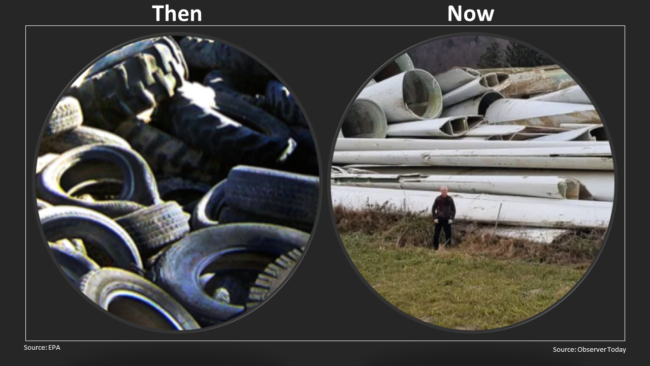
    Lifecycle risk mitigation of an energy resource must include the end of the asset life processes.  What governance driven processes are in place to prevent the accumulation of wind turbine blades or spent solar panels stacked and abandoned?  Just like the tires stacked for decades.

    Turns out the answer is few.  Long life assets such as factories, skyscrapers, fossil fuel production systems, etc. are built to the engineering, industry and local regulatory standards of that day.  Ongoing operations, maintenance, upgrades and so forth keep them performing at acceptable levels.  However, governance models are often focused on the present.  End of asset life risk does not fit into the four quarter management mindset as the event may be sometime in the future.

    The above graphic represents a governance model built around operations and associated risks.  The archetype recognizes that many risk mitigation processes are inadequate for today’s complex organizations with multi-faceted global processes.

    Its framework is built upon the work done by the Treadwell Commission several decades ago to detect financial fraud.  This structure supports the extension into field operations and provides a structure for attaining and sustaining Operational Excellence.

    Risk mitigation is both quantitative and qualitative.  The risk associate with the use of any industrial energy source must be thoroughly assessed as a function of its lifecycle, not just its initial CAPEX and ongoing operations.

    Dumping v Decommissioning

    Illegal industrial dumping has long been a problem.  Today, some in the wind turbine sector appear to be following the decades long vehicle tire disposal process (or lack thereof).

    Lady Bird Johnson at least tried to hide the piles of tire debris but no one has found a way of completely dealing with this growing and massive problem.  As of 2017, some 17% were still disposed of in landfills.  In 2003, the EPA reports that almost 300 million tires are scraped each year.  Flash forward to today and this is likely a very conservative number.  That said, 17% equals approximately 50 million tires headed to landfills as opposed to recycling.

    Moreover, there is a long history of industrial dumping trash so as not to have to pay the disposal fees.  One wonders how many millions of tires destined for landfills (and other recycling) are just dumped?

    The decommissioning process is the responsible end-of-asset-life shutdown and removal.  The intent is to return the site to a condition similar to its initial environment and properly remove and dispose of equipment and materials.  It should not include stacking wind turbine blades next to a pile of discarded vehicle tires.

    Total Carbon Lifecycle Model

    Daily, we hear about the need to reduce carbon output to (net) zero.  Promises are made by many that by such and such a time this metric will be met.  Caveat: usually the time period is beyond the expected tenure of those making the statements.  Often lost in the discussion is the carbon cost of manufacturing and decommissioning.

    Carbon output should include the mineral extraction process, recycling of older materials if appropriate, transportation, manufacturing, installation, operations and decommissioning.  It also must include the carbon cost of the supply chain necessary to support the asset across its lifecycle.  For example, the carbon cost of an EV is not just the vehicle’s operation but the lifecycle of the vehicle as well as the electric power generation and distribution necessary to operate the automobile.  Do not forget the carbon cost of manufacturing a battery and disposing of it at end of life.

    Scrap

    Materials are often staged for recycling.  They feed a process that results in new useful product(s) that may add new value.  This is a useful recycling process that makes a lot of sense.  However, sometimes this is not as economical as new manufacturing.  These economics lead to dumping as the low-cost-solution.  Fields of discarded materials may or may not be awaiting recycling.

    Defining Green

    Being green is not simply using renewable electricity instead of gasoline.  If the carbon footprint is no different or even worse, then the problem is not solved and may even be made greater.

    Keep in mind that coal is still a major fuel in the generation of electricity.  According to the US Energy Information Administration (EIA), in 2020 over 60% of power is generated using fossil fuels of which over 19% is from coal.  This does not include the carbon footprint of materials and products imported to the US.

    So if the carbon footprint of a wind turbine is defined as its lifecycle and if at the end result is abandonment in a field, is the green value of that product positive?  Or is it just dumping not unlike the pollution of a nation’s river systems?

    Being green is not just plugging in your car overnight.  Like most things in life, it is systemic.

    Is Your Organization’s Green Plan Systemic or Myopic?

    For More Information

    Please note, RRI does not endorse or advocate the links to any third-party materials.  They are provided for education and entertainment only.

    For more information on Cross Cultural Engagement, check out our Cross Cultural Serious Game

    We presented, Should Cross Cultural Serious Games Be Included in Your Diversity Program: Best Practices and Lessons Learned at the Online Conference, New Diversity Summit 2020 the week of September 14, 2020.  Check Out this timely event and contact the organizer for access to the presentations!!

    For more on DEI Standards, see the newly released ISO-30415.

    You can contact this author as well.

  • Operational Complexity: Risk Model Insufficiency

    Operational Complexity: Risk Model Insufficiency

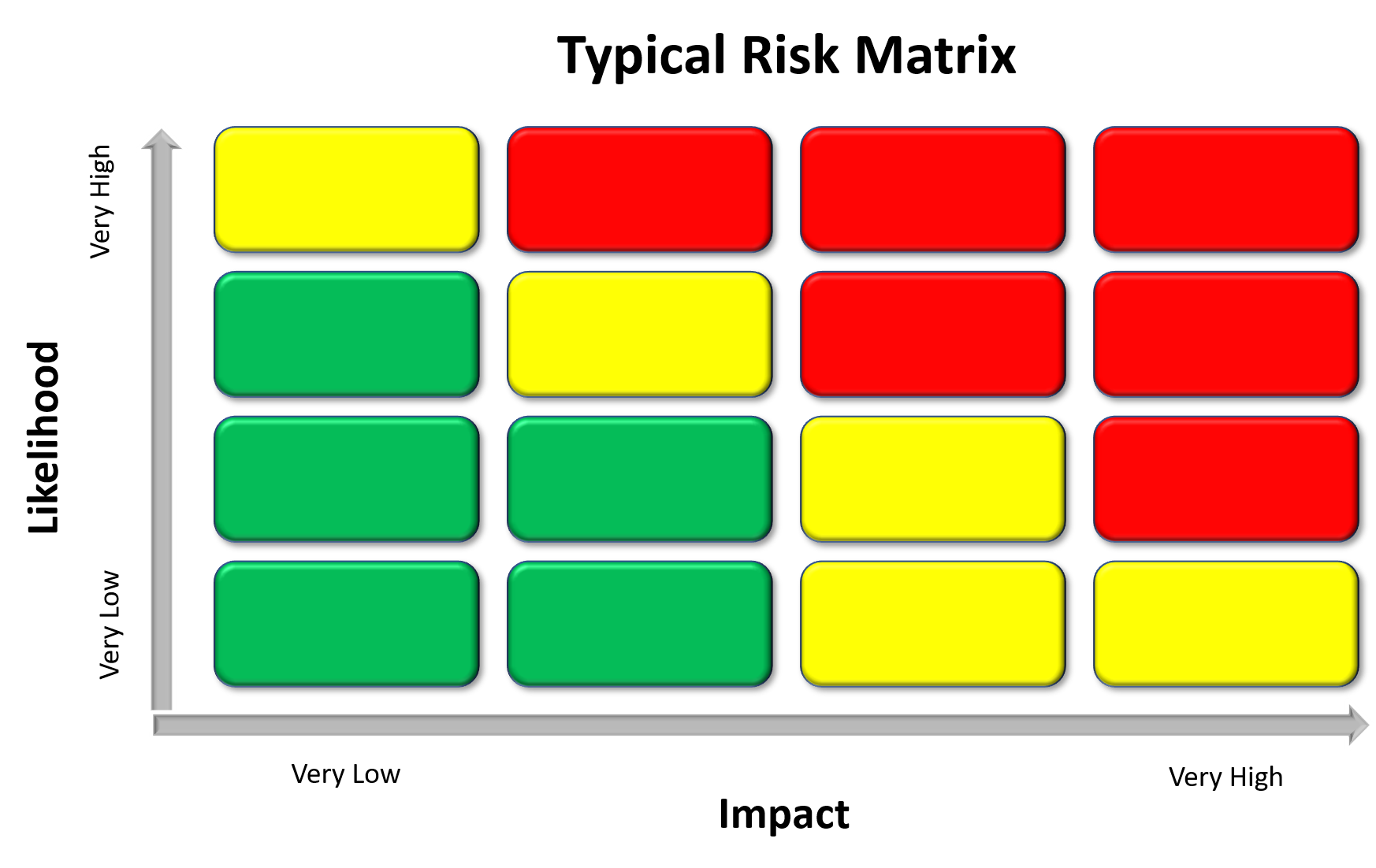
    Most readers will be familiar with the above linear Risk Matrix Model.  This graphical representation of risk exposure is useful but strict adherence to it can lead to a false sense of security.

    Systemic Risk Management

    The real world is very complex with many moving parts.  The potential interaction of processes, events and other challenges can lead to disaster.  It is often the case that the combination of a number of seemingly unrelated and in and of themselves potentially minor events can lead to catastrophe.

    A systemic approach to risk exposure is appropriate.  Field operations usually involves several to many somewhat disparate processes and individuals.

    Typically, the operator will have individuals in the field as well as the office working together.  Contractors and sub-contractors are similarly constructed.  The number of interactions can grow exponentially in a large project or program.

    Therefore, it is important to ‘see’ risk as a dynamic interacting model.  For example, the following quotation is a straightforward presentation of the actual risk field operators face.

    “Planning for the abandonment of Macondo was extremely complex.  The fundamental source of that complexity was a phenomenon well known to systems engineers: the number of potential pairwise interactions among a set of N elements grows as N times N-1, divided by 2.  That means that if there are two elements in the set, there is one potential interaction; if there are five elements, there are ten potential interactions; ten elements and there are forty-five; and so forth.  If the interactions are more complex, such as when more that two things combine, the number is larger.  Every potential interaction does not usually become an actual one, but adding the elements to a set means that complexity grows much more rapidly than ordinary intuition would expect.”

    The authors’ note that NOT all combinations can happen, but the possibility of several is likely.  Many decision makers do not expect exposures as great as they likely are in a complex environment.

    Interactive Model

    So how great is your risk?  The following calculator will give you a perspective on your organization’s exposure.  It is straightforward and easy to use.

    You are only required to input two variables:

    n = the number of elements

    m = elements from n in certain order, it is arrangement

    Taken from the Macondo model above, if n=10 and m=2, the number of combinations of m from n equals 45.


    [planetcalc cid=”977″ language=”en” code=”” label=”PLANETCALC, Combinatorics. Combinations, arrangements and permutations” colors=”#263238,#435863,#090c0d,#fa7014,#fb9b5a,#c25004″ v=”3275″]

    Addition data the calculator provides:

    Each ordered set of n is a permutation

    Generally, the number of combinations of m from n with repetitions is not useful for our purposes other than the recognition that repetition is possible.

    This calculator does not indicate where risk lies.  As the authors of Deepwater Horizon: A Systems Analysis of the Macondo Disaster suggest, it helps decision makers better understand the nature of their complex environment.

    Final Thoughts

    Simple risk models may have their place.  They are useful for presentation purposes.  However, they are insufficient when assessing the exposure of today’s complex operational situations.

    High Reliability Management requires that decision makers NOT simplify the complex.  Understanding the level of exposure using systemic risk management techniques can help clarify organizational threats.

    Are Your Organization’s Risk Management Techniques Robust Enough?

    For more information on Risk Mitigation check out our Operational Excellence Platform.

      Boebert, Earl and Blossom, James M. (2016). Deepwater Horizon: A Systems Analysis of the Macondo Disaster. Cambridge, MA: Harvard University Press. pp. 65-66.

    Appendix–The Math

    For those interested, this is the math for the calculator. It is taken directly from the Planetcalc website.

    So, assume we have a set of n elements.

    Each ordered set of n is called permutation.

    For example, we have set of three elements – А, В, and С.
    Example of ordered set (one permutation) is СВА.
    Number of permutations from n is

    P_n = n!

    Example: For set of А, В, С number of permutations is 3! = 6. Permutations: АВС, АСВ, ВАС, ВСА, САВ, СВА

    If we choose m elements from n in certain order, it is arrangement.

    For example, arrangement of 2 from 3 is АВ, and ВА is the other arrangement. Number of arrangements of m from n is

    A_{n}^m=frac{n!}{(n-m)!}

    Example: For set of А, В, С number of arrangements of 2 from 3 is 3!/1! = 6.
    Arrangements: АВ, ВА, АС, СА, ВС, СВ

    If we choose m elements from n without any order, it is combination.

    For example combination of 2 from 3 is АВ. Number of combinations of m from n is

    C_{n}^m=frac{n!}{m!(n-m)!}

    Example: For set of А, В, С number of combinations of 2 from 3 is 3!/(2!*1!) = 3.
    Combinations: АВ, АС, СВ

    Here is the dependency between permutations, combinations and arrangements

    C_{n}^m=frac{A_{n}^m}{P_m}
    Note Pm – number of permutations from m