Tag: CAPEX

  • AI–What’s Your Number?

    AI–What’s Your Number?

    There is a great deal of hype regarding AI, some is justified and some not so much.  Pundits, including this one talk about the value an organization will get and, in some cases, immediately.  But what is the actual measurable value a firm can realistically expect?

    I recently used a free AI Value Calculator, asking how an oil refinery could become more effective and safer. The following response was received:
    “**Value Proposition:** At [Your Company Name], we understand that oil companies face increasing pressure to enhance safety and efficiency within refinery operations. Our innovative solutions are designed specifically to address the unique challenges of the refining industry. By integrating advanced technology and safety protocols, we empower your team to operate more effectively while minimizing risks. With our expertise, you can expect: – **Increased Operational Efficiency:** Streamline processes with cutting-edge tools that boost productivity and reduce downtime. – **Enhanced Safety Measures:** Implement systems that prioritize employee safety and ensure compliance with industry regulations. – **Real-Time Monitoring:** Gain insights through data analytics that allow for proactive decision-making and immediate response to potential hazards. Choose [Your Company Name] as your partner in revolutionizing refinery operations, ensuring you meet both efficiency goals and safety standards. Together, we can create not just a safer workplace, but also a more effective refinery that drives success in today’s competitive landscape. For more information or to schedule a consultation, please contact us at [phone number] or visit our website at [website URL]. Let’s work together to pave the way for a more secure and productive refining environment.”

    The Problem with Value

    There are several problems with this response, and I (the user) am part of that problem.

    • My prompts were minimal and not specific
    • The response was pablum, as it did not tell me anything I did not already know.
    • What do phrases like, “Implement systems that prioritize employee safety and ensure compliance with industry regulations,” actually mean and how do I accomplish that?
    • What do I tell the “C” level executive that she can expect to see on our bottom line as a result of this expenditure and what is the risk profile?

    Determining the economic value proposition for any capital investment project has always been a challenge and is difficult to accomplish, especially when the list of intangibles is long.  The recent issues surrounding Cracker Barrel rebranding is a case in point.

    The process of assessing possible value and the associated risk of attaining said value from investments is not trivial.  It takes a lot of thinking and iterative re-thinking from a knowledgeable and qualified team, as well as input from others.  And in my opinion, there has to be a dollar value that can be documented and defended–meaning, it is a solid assessment and not wishful thinking.

    The Journey to Measurable Value

    “If you don’t know where you are going, you’ll end up someplace else.”― Yogi Berra

    We been conducting economic and financial assessments of capital projects for over two decades. Our Economic Value Proposition Matrix (EVPM) has been developed and curated with organizations in the Critical Infrastructure Sector.  It meets and exceeds the tough requirements of some of the most prestegious global firm and has demonstrated its ability to provide decision makers with an economic and financial “What If” and “Iterative” model of proposed spend before a dime is committed to the project.  We love tough questions and have learned most that are used.  Moreover, it Risk Assessment section if one of the most robust available.

    It is being used for AI Spend assessments and a case study will be available in our forthcoming book, from CRC PressThe Transformation of Our Spreadsheet Society: Moving Towards a Nonlinear, Big Data Enabled AI Environment, to be released by early 2026.

    Is AI Different Than Other Capital Expenditures (CAPEX)?

    The traditional response from IT providers is, It Depends!  In some ways this is a correct statement. However, industry/individual organizations have been through existential difficulties before and frequently.

    Most IT CAPEX is either Science/Engineering or transactional, i.e., ERP.  However, much of AI centers on behavior and therefore, involve an addition dimension–latent variables.  We have been interested in latent variables since the early 1990s and first published our approach towards learning about their impact on behavioral systems in my 1996 doctoral dissertation, Cross-cultural negotiations between Japanese and American businessmen: A systems analysis (exploratory study).

    In our forthcoming book by CRC PressThe Transformation of Our Spreadsheet Society: Moving Towards a Nonlinear, Big Data Enabled AI Environment, we develop a detail approach and representative AI model about the value that can be identified and measured using latent variable.

    So, what is a latent variable?  Largely unknown, these variables are essential in the complex data analysis and modeling needed in statistics, machine learning, and other scientific assessments.

    Very important–They cannot be measured directly but can be inferred from other measurable variables.

    This is a major and usually unrecognized problem when attempting to place an economic value on a project yet to start, i.e., the planning and funding stage.

    Our upgraded EVPM model takes latent variables into consideration giving management greater insight into the costs, return and ultimate value of AI investments.  We believe that unless this dimension is properly assessed, calculated values are WRONG and will not result in the value proponent’s advance.

    Look for further details regarding our economic value of AI model and feel free to contact us if you have specific needs or questions.

    Is your AI Economic Value Assessment model robust enough to bet your career on?

  • Leadership Selling

    Leadership Selling

    “The price of greatness is responsibility.” – Winston Churchill

    I recently watched a documentary about Three Mile Island.  I did not fact check it or try to assess bias but if much of what went wrong were correctly portrayed, leadership was missing in action.  The father of the US Nuclear Navy, Admiral Hyman G. Rickover and his demand for excellence was referred to on several occasions.  He was rightfully positioned as THE sector leader during that era when nuclear power generation was an emerging technology.

    In the context of leadership, the following is attributed to him, “Responsibility is a unique concept… You may share it with others, but your portion is not diminished. You may delegate it, but it is still with you… If responsibility is rightfully yours, no evasion, or ignorance or passing the blame can shift the burden to someone else. Unless you can point your finger at the man who is responsible when something goes wrong, then you have never had anyone really responsible.”  This is a very telling statement that is applicable to the many human foibles that have resulted in cataphoric failures, even warfare and almost all high visibility major industrial incidents.

     A clear explanation of the difference between Management and Leadership.

    What Does All This Have to Do with Selling?

    Typically, organizations refer to the process of revenue generation as Sales.  However, a more accurate description this process is Selling.  The action verb, selling can result in a sale or series of sales.  Yet, for each competitive engagement most of these costly attempts at revenue generation will result in no sales–zero revenue.   Fail at enough opportunities and the firm’s Cost of Sales can skyrocket.

    Moreover, increasingly B2B solutions are a combination of products (seller product line and possibly third parties) as well as services (can include Cloud subscriptions).  By definition, Complex Sales is getting more complex and interrelated with other new/existing systems.

    Failure is Not an Option!

    SUBSAFE was born in 1963, just two months after mechanical failures resulted in the loss of USS Thresher (SSN-593).  The program was started with a simple goal in mind: ‘. . . provide the maximum reasonable assurance that the ship will not have flooding but if flooding does occur, assures that the ship will get safely to the surface.’”  The program is deemed as a major life saving success, partially by enabling real responsibility to all including contractors.

    Safety and Environmental Management Systems (SEMS) are a similar construct.  Most organizations in Critical Infrastructure sectors incorporate SEMS into their Operations Management Systems (OMS).  For our purposes here, we will repurpose and slightly change the nine tenants of the US Bureau of Safety and Environmental Enforcement’s BSEE, SEMS.

    We posit that the following Tenants comprising our Selling Management System (SMS):

    1. Commitment to Values and Actions. Leaders demonstrate a commitment to societal and organizational values in their decisions and behaviors.
    2. Issue Identification and Risk Management. Issues potentially impacting the deal and its successful delivery are promptly identified, fully evaluated, and promptly addressed or corrected commensurate with their significance.
    3. Personal Accountability. All individuals take personal responsibility for process and personal behavior, as well as the stewardship of those entrusted to them.
    4. Work Processes. The process of planning and controlling work activities so that the selling action items are in accordance with organizational mission and policies as well as boding well for success.
    5. Continuous Improvement. Opportunities to learn and codify selling and delivery knowledge, ensuing future success and organizational learning.
    6. Environment for Raising Concerns. A work environment is maintained where personnel feel free to raise issues and concerns without fear of retaliation, intimidation, harassment, or discrimination.
    7. Effective External and Internal Communication. Communications maintain a focus of the selling efforts and processes.
    8. Respectful Work Environment. Trust and respect permeate the organization with a focus on teamwork and collaboration.
    9. Inquiring Attitude. Individuals avoid complacency and continuously consider and review existing conditions and activities in order to identify discrepancies that might result in error or inappropriate action.

    It is not surprising that action items focused on revenue generation should align with business imperatives towards effective and efficient operations.  This is especially true when operations personnel are assigned to the pursuit team as they will play a major role assuring successful delivery, i.e. most capital (CAPEX) goods and services.

    Tenant 6, Environment for Raising Concerns is perhaps one of the most important when enabling junior leadership.  For example, if a material issue is identified by a new college graduate in her or his field and unnoticed by more senior individuals schooled in early technologies, failure to be “heard” may have deal failure ramifications, i.e., engineering or software errors.

    Leadership is not part of a title, except by self-serving politicians who routine call themselves leaders.  Leaders are not born either, they are individuals (all ages and genders) who when needed, rise to occasions great and small.  The Rickover Mind Model enables leaders to emerge and that includes leadership during selling processes.

    Complex Deal Pursuit Team

    A deal Pursuit Team is a formal group assigned to drive revenue opportunities for a single deal/long-term strategic relationship or even partnership.  It can be an ad hoc assemblage or more effectively the assembly of experts with this type of experience.  Ideally, for a significant opportunity this team has a sole focus during its lifecycle, but that is not always the case or even practical in some firms or deals.

    Team composition can include, Sales Representative(s), Sales Management, Sales Support Team (as required) Executive Sponsor (if appropriate), Subject Matter Expert(s), Project Management, Third Parties (subcontractors and/or technology/professorial services providers), and others as needed.  Not all participants will be required full time.

    Typically, there are three phases to this process:

    • Relationship and Opportunity Development–The relationship building processes between seller and buyer as well as identification of value that can be added from seller products/services/solutions.
    • Formal Proposal Submission–Development and draft (with revisions) of a documented Scope of Work/Products, Deliverables and Pricing.
    • Proposal Assessment and Acceptance–Buyer review, changes and agreement to move forward–The Deal!

    Leadership is required throughout this process, and it may come from very unlikely sources.  Often top-level technologists and engineers are not the most outgoing folks.  However, their thoughts can be game changing.  It is important that those on the quiet side be actively ‘Included,’ and their ideas sought out and given serious discussion.

    Role of AI Agents

    AI sales agents are autonomous applications that analyze and learn from your sales and customer data to perform tasks with little or no human input. These agents can perform a wealth of functions, from top-of-funnel tasks like nurturing leads with email outreach, answering questions, booking meetings with sellers, and quote creation to tasks more deeply integrated inside sales teams, like active buyer roleplays and coaching. What makes them different from simple workflow automation is that agents are capable of learning, using data analysis to work more efficiently, taking action on their own.”

    The Pursuit Team is responsible for winning the deal and AI is another tool, not unlike product demonstrations and marketing efforts.  AI inputs should be calibrated and interpreted just like other data sources and analyses.

    Final Thoughts

    Remember that people buy from people and individuals on both the selling and buying teams have personal agendas, such as getting promoted.  Sellers who identify many/most of these concerns stand a better change of closing the deal.

    Closing deals generates jobs.  Both by the vendor and its ecosystem as well as the client who will use the product/service/solution to increase the stakeholder value ecosystem.  Stakeholders are broadly defined including local communities and customer’s customers.

    It is safe to say that the complex selling process is dramatically changing.  Time to get on board!

    Nothing happens until somebody sells something!  How is your company assuring the selling process is routinely successful?

    Pre order our new book

    Navigating the Data Minefields:

    Management’s Guide to Better Decision-Making

    We are living in an era of data and software exponential growth.  A substantive flood hitting us every day.  Geek heaven!  But what if information technology is not your cup of tea and you may even have your kids help with your smart devices?  This may not be a problem at home; however, what if your job depends on Big Data and Artificial Intelligence (AI)?

    Available April 2025

    We are also pleased to advise our loyal readers that CRC Press has accepted our proposal for this forthcoming book, Nonlinear Big Data and AI-Enabled Problem-Solving: Transforming From A Spreadsheet Society.  Stay tuned for more details.

    For More Information

    Please note, RRI does not endorse or advocate the links to any third-party materials herein.  They are provided for education and entertainment only.

    See our Economic Value Proposition Matrix® (EVPM) for additional information and a free version to build your own EVPM.

    The author’s credentials in this field are available on his LinkedIn page.  Moreover, Dr. Shemwell is the coauthor of the 2023 book, “Smart Manufacturing: Integrating Transformational Technologies for Competitiveness and Sustainability.”  His focus is on Operational Technologies.

    We are also pleased to announce our forthcoming book to be released by CRC Press in April 2025, Navigating the Data Minefields: Management’s Guide to Better Decision-Making.  This is a book for the non-IT executive who is faced with making major technology decisions as firms acquire advanced technologies such as Artificial Intelligence (AI).

    “People fail to get along because they fear each other; they fear each other because they don’t know each other; they don’t know each other because they have not communicated with each other.” (Martin Luther King speech at Cornell College, 1962).  For more information on Cross Cultural Engagement, check out our Cross-Cultural Serious Game.  You can contact this author as well.

    For more details regarding climate change models, check out Bjorn Lomborg and his book, False Alarm: How Climate Change Panic Costs Us Trillions, Hurts the Poor, and Fails to Fix the Planet.

    Regarding the economics of Climate Change, check out our blog, Crippling Green.

    For those start-up firms addressing energy (including renewables) challenges, the author can put you in touch with Global Energy Mentors which provide no-cost mentoring services from energy experts.  If interested, check it out and give me a shout.

  • A Windy Position

    A Windy Position

    In a recent online discussion, this pundit put forth the thought that fiberglass wind turbine blades can pose an environmental problem when decommissioned.  This position was quickly challenged with the rebuttal that burning coal ‘kills’ kids so it did not matter if discarded blades litter the countryside as it is worth it.

    According to research quoted by the European Wind Energy Association, “With wind turbine blades likely to account for some 50,000 tons of waste annually by 2020, growing 4 times by 2034 the landfill is not a viable long-term solution.”  Moreover, “Findings from the University of Strathclyde indicate a global increase of wind turbine blade waste from around 400,000 tons per annum in 2030 to around two million tons by 2050.”

    My rebuttal to the kills kids argument–what will this do to global population health?  Keep in mind, this is only one source of industrial (and consumer, i.e., EV automobiles) decommissioned assets.

    Disposal/Recycling

    “Glass-reinforced polymer composites (GRP), used in wind turbine blades around the world, is recognized as a hard-to-break-down source of pollution.”  Research is underway to address this problem and mostly likely progress will continue going forward.

    “Currently only a few recycling techniques are available to treat such an enormous quantity.  So most have been landfilled and many continue to be buried today.”  Other current options include:

    • Grinding–turning fiberglass into powder.  A labor intensive process that provides filler for other purposes
    • Incineration–the ash is usually disposed of in a landfill
    • Pyrolysis–decomposes into three recoverable substances: pyro-gas, pyro-oil, and solid byproduct— all of which can be recycled

    “While the overall life of the wind turbine does cause less pollution than coal-fired power plants do, the initial solution of just burying the fiberglass doesn’t seem in line with the goal to cause less pollution.” (Ibid)

    Really?  How is this saving the planet?

    Clearly, these alternative disposal processes have a financial cost greater than simply burying the blades.  If not, they would be used more frequently.

    Future generations will have to address this issue much like the current one continues to deal with asbestos from the past.  The KIDS will end up dealing with and paying for the folly of their parents and grandparents.

    A Contrarian Posture

    As noted, there is a romanticism about renewable energy sources, most commonly wind and solar.  However, we believe in the ‘no free lunch’ model.  There are risks and cost associated with every form of energy.

    In two recent editions, Heavy Metal Rocks and Going Green? Or NOT! we took an initial look at the financial cost over the renewable lifecycle as well the environmental impact that will need to be addressed.  The edition is a continuation of the premise that, “Technology Romance must be met with Fiscal Realities.”

    Society will eventually recognize the environmental damage done by solar and wind energy systems can be very high.  By then, the harm may have been done.

    As an example, many oil and gas assets are approaching end of life.  The decommission costs are very high and increasingly regulations are changing to hold asset owners accountable for these costs.  Generally, accountants refer to these as Reserves.

    Shouldn’t renewable asset holders be required to set aside reserves to cover the disposal of assets as well?

    Lifecycle Cost Structure

    For capital assets with significant planning, development, manufacture, deployment, operations & maintenance and finally decommissioning costs there is another dimension.  The Asset Maturity Model was developed to assist management understand how to best maximize asset performance over decades, in some cases.  This model is integrated into an economic value model which we be discussed herein.  There are also a number of tools and standards available to assist management, such as ISO 55001–Asset Management.

    In April 2022, Bloomberg published a piece, “Wind Power’s ‘Colossal Market Failure Threatens Climate Fight.”  The Global Wind Energy Council deemed the current wind energy situation a ‘Colossal Market Failure.’

    Blaming a mismatch (alignment) between governments policies and current markets, the risk is not only that net zero targets will not be met but the supply chain is contracting.  Moreover, one study suggests that for the US net-zero policies will cost more than 12% of our Gross Domestic Product (GDP) in 2050.  To put this in perspective, today Social Security cost 5% of GDP and Medicare/Medicaid 6.4 percent–11.4% combined.

    The ‘lack of alignment‘ is a major determent to successful organizations.  In our recent blog, ESG Explained we discussed the role organization and its ecosystem governance at length.  Building on our 2011  monograph, Asset/Equipment Integrity Governance: Operations–Enterprise Alignment; A Case for Board Oversight (AEIG) we developed the case for Operational Excellence as part of ESG.  Energy and supply chain management are key components of this enterprise approach.

    Total Cost of Ownership (TCO)

    TCO is a function of the acquisition cost, including all engineering, design, deployment, installation etc. as well as ALL costs associated with its lifecycle OPEX, including decommissioning, abandonment, and environment remediation.  It is all encompassing.  It is the long-standing metric that all projects must understand and model accordingly before a Capital Expenditure (CAPEX) is authorized.

    The following list are documented per citation links.  These are taken from a recent article challenging the Return on Investment (ROI) of current green initiatives.

    Readers will note that some are social costs, i.e., transition costs to new energy sources currently provide minuscule contributions to the Energy Basket.  These costs will grow dramatically going forward.

    •  “Making a transition from fossil fuels to green energy is costly.  Solar and wind can only deliver electricity, which accounts for less than a fifth of total energy consumption.
    • When the sun doesn’t shine or the wind doesn’t blow, prices rise quickly and we have to revert to fossil fuels for backup.
    • Batteries are inadequate and expensive, easily quadrupling solar electricity costs and failing to provide much power.
    • In 2021, Europe only had battery capacity to backup less than 1 ½ minutes of its average electricity usage.  By 2030, with 10 times the stock of batteries, and somewhat more usage needed, they’ll have enough for 12 minutes.
    • The Bank of America has found that achieving net-zero will cost $150 trillion over 30 years, almost twice the combined annual GDP of every country on Earth.
    • The annual cost of $5 trillion is more than all the world’s governments and households spend every year on education.
    • In a new study, McKinsey finds most of the poorest nations in Africa would have to pay more than 10 percent of their total national incomes every year toward climate policy.  This is more than these nations combined spend on education and health.
    • Reducing emissions just 80% will cost the United States more than $2.1 trillion every year from 2050, or more than $5,000 per person, per year.
    • The annual US cost of World War II is estimated at $1 trillion in today’s money.  Every year by 2050, climate policy could cost Americans more than twice what they paid during the Second World War.
    • Surveys show few people are willing to spend more than a few hundred dollars a year on climate policies.  Asking people to spend tens or hundreds times more is a recipe for failure.”

    These are significant tangible and intangible costs.  In this writer’s opinion, the business case has not been made for these and other total cost line items.  A more extensive study should be considered by readers who want to do a deep dive on these economics.

    Keep in mind, that these broader issues do not take into consideration regarding daily operations and maintenance.  These must be factored in as well.

    Finally, while these are ‘opinions’ from reputable sources, why are they not considered the economic models used today?  Seems like Data Bias, doesn’t it.

    EVPM

    Beginning in 2004, recognizing many of the TCO components as well as the economic value potential from a CAPEX, we developed what came to be known as our Economic Value Proposition Matrix model (EVPM).  This model is now mature, robust as well as integrating a Risk Matrix.

    It is an excellent tool for assessing both Tangible and Intangible components of value and cost.  Additionally, a free version is available and it is fully supported with training as well as other materials (including a video).

    Importantly, EVPM “Translates technology into the Language of Business” which make it an excellent tool for preparing to meet with the Chief Financial Officer (CFO) and/or Budget Committee.  Management makes decisions as a function of the risk associated economic value brought to the organization.  While technology has a level of romance to it, financial issues are the major decision making driver.

    The Energy Basket

    It is useful to look past the hype to see what the US energy basket actually looks like.   Slightly over three percent comes from wind and only 1.3 % is solar.  Fossil fuels (petroleum natural gas and coal) represent 79% of our current energy consumption.  In the opinion of this writer these disparities have been basically the same for decades.

    China and India burn 14 million tons of coal per day!  By all accounts, coal will play a major role in power production in these economies for some time to come.  As a function of the global percentage of coal used; China over 50%, India over 11% and the United States at approximately 8.5%.  Moreover, an assessment of its use by 130 countries is available to interested readers.

    The debate about ‘Clean Coal‘ continues.  None-the-Less, most likely coal will continue to be used for decades.  Keep in mind that 2050 is less than 28 year away.

    While regulation plays a role in the energy mix, economics are the fundamental driver.  Until the economics of non fossil fuels change, the basket will most likely not.

    The Lone Ranger is Missing

    Listening to some, it seems that all we have to do is focus on the Energy Transformation and in only a few short years magic will happen.  Hate to tell everyone, there is no Silver Bullet.  Transformation will take decades and should be led by those driven by market forces.

    One example, on April 29, 2022 the Texas Department of Transportation (TxDot) announced the two year closure of a major highway artery in the Houston metropolitan area to replace a concrete ramp.  Point being, road construction is well understood and a major proven technology and process.  Still, it will take a significant amount of time to perform this upgrade.

    How can we assume a major Energy Transformation using new technologies will unfold as optimistic parties suggest?  History suggests this is not likely.

    Closing Points

    This long time energy careerist believes that various energy sources from the basket should be used as economically appropriate.  While we all have an interest in a low pollution environment, if the economics as shown in this piece are close to correct, the resulting economic damage may be greater than a somewhat warmer planet.

    The data presented herein are documented.  The sources and quality of the data can be challenged but it should not be ignored.

    Finally, this piece has focused primarily on wind energy.  A similar analysis needs to be taken for every energy source including fossil fuels of all kinds.

    The demand for energy will continue to grow and even exponentially.  Clean fossil fuels are available and without strong energy balanced policies the future is bleak for many and not just because of climate change by the significantly higher cost of living and loss of opportunities due to energy starvation.

    The energy challenges are complex and dynamic.  This blog is not a comprehensive review, but simply a focus on a narrow aspect.  For example, we did not delve into issues such as Carbon Capture & Sequestration.  A calm, rational, economics discussion is in order.

    What does Energy Transition mean to you and how will you help the Less Fortunate be better off?

    For More Information

    Please note, RRI does not endorse or advocate the links to any third-party materials.  They are provided for education and entertainment only.

    For more information on Cross Cultural Engagement, check out our Cross Cultural Serious Game.  You can contact this author as well.

  • Going Green? Or NOT!

    Going Green? Or NOT!

    The total or lifecycle carbon footprint for any energy source is a function of the manufacturing, commissioning, operation (including maintenance) and decommissioning of that asset.  Moreover, the value of an electric powered vehicles (EV) is seen as a function of the amount of fossil fuel no longer used by the vehicle.  However, this is only a sub-model of the to carbon footprint of any component in the Basket of (Energy) Goods, aka Energy Basket.

    All energy resources in the basket must be held to the same set of metrics.  These include Human Resources (including diversity and inclusion), Safety Culture, communities as well as the bottom line performance against governance standards (ESG).

    Risk Governance

    A governance framework that exceeds these standards follows.  Evolving over several decades, it reflects a comprehensive approach to operational risk that is often overlooked.  It addresses the entire life of a revenue producing asset.

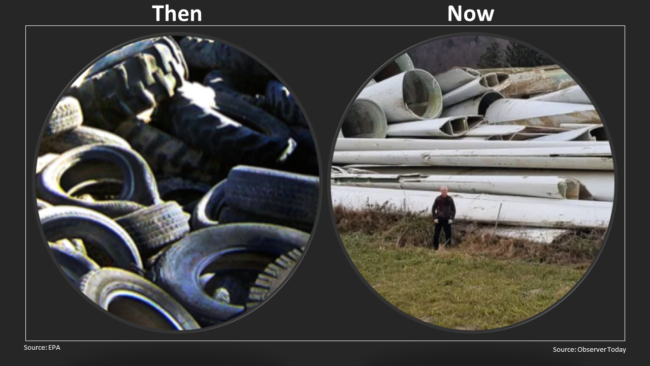
    Lifecycle risk mitigation of an energy resource must include the end of the asset life processes.  What governance driven processes are in place to prevent the accumulation of wind turbine blades or spent solar panels stacked and abandoned?  Just like the tires stacked for decades.

    Turns out the answer is few.  Long life assets such as factories, skyscrapers, fossil fuel production systems, etc. are built to the engineering, industry and local regulatory standards of that day.  Ongoing operations, maintenance, upgrades and so forth keep them performing at acceptable levels.  However, governance models are often focused on the present.  End of asset life risk does not fit into the four quarter management mindset as the event may be sometime in the future.

    The above graphic represents a governance model built around operations and associated risks.  The archetype recognizes that many risk mitigation processes are inadequate for today’s complex organizations with multi-faceted global processes.

    Its framework is built upon the work done by the Treadwell Commission several decades ago to detect financial fraud.  This structure supports the extension into field operations and provides a structure for attaining and sustaining Operational Excellence.

    Risk mitigation is both quantitative and qualitative.  The risk associate with the use of any industrial energy source must be thoroughly assessed as a function of its lifecycle, not just its initial CAPEX and ongoing operations.

    Dumping v Decommissioning

    Illegal industrial dumping has long been a problem.  Today, some in the wind turbine sector appear to be following the decades long vehicle tire disposal process (or lack thereof).

    Lady Bird Johnson at least tried to hide the piles of tire debris but no one has found a way of completely dealing with this growing and massive problem.  As of 2017, some 17% were still disposed of in landfills.  In 2003, the EPA reports that almost 300 million tires are scraped each year.  Flash forward to today and this is likely a very conservative number.  That said, 17% equals approximately 50 million tires headed to landfills as opposed to recycling.

    Moreover, there is a long history of industrial dumping trash so as not to have to pay the disposal fees.  One wonders how many millions of tires destined for landfills (and other recycling) are just dumped?

    The decommissioning process is the responsible end-of-asset-life shutdown and removal.  The intent is to return the site to a condition similar to its initial environment and properly remove and dispose of equipment and materials.  It should not include stacking wind turbine blades next to a pile of discarded vehicle tires.

    Total Carbon Lifecycle Model

    Daily, we hear about the need to reduce carbon output to (net) zero.  Promises are made by many that by such and such a time this metric will be met.  Caveat: usually the time period is beyond the expected tenure of those making the statements.  Often lost in the discussion is the carbon cost of manufacturing and decommissioning.

    Carbon output should include the mineral extraction process, recycling of older materials if appropriate, transportation, manufacturing, installation, operations and decommissioning.  It also must include the carbon cost of the supply chain necessary to support the asset across its lifecycle.  For example, the carbon cost of an EV is not just the vehicle’s operation but the lifecycle of the vehicle as well as the electric power generation and distribution necessary to operate the automobile.  Do not forget the carbon cost of manufacturing a battery and disposing of it at end of life.

    Scrap

    Materials are often staged for recycling.  They feed a process that results in new useful product(s) that may add new value.  This is a useful recycling process that makes a lot of sense.  However, sometimes this is not as economical as new manufacturing.  These economics lead to dumping as the low-cost-solution.  Fields of discarded materials may or may not be awaiting recycling.

    Defining Green

    Being green is not simply using renewable electricity instead of gasoline.  If the carbon footprint is no different or even worse, then the problem is not solved and may even be made greater.

    Keep in mind that coal is still a major fuel in the generation of electricity.  According to the US Energy Information Administration (EIA), in 2020 over 60% of power is generated using fossil fuels of which over 19% is from coal.  This does not include the carbon footprint of materials and products imported to the US.

    So if the carbon footprint of a wind turbine is defined as its lifecycle and if at the end result is abandonment in a field, is the green value of that product positive?  Or is it just dumping not unlike the pollution of a nation’s river systems?

    Being green is not just plugging in your car overnight.  Like most things in life, it is systemic.

    Is Your Organization’s Green Plan Systemic or Myopic?

    For More Information

    Please note, RRI does not endorse or advocate the links to any third-party materials.  They are provided for education and entertainment only.

    For more information on Cross Cultural Engagement, check out our Cross Cultural Serious Game

    We presented, Should Cross Cultural Serious Games Be Included in Your Diversity Program: Best Practices and Lessons Learned at the Online Conference, New Diversity Summit 2020 the week of September 14, 2020.  Check Out this timely event and contact the organizer for access to the presentations!!

    For more on DEI Standards, see the newly released ISO-30415.

    You can contact this author as well.

  • You Have 10 Minutes: Maybe

    You Have 10 Minutes: Maybe

    Over the past couple of weeks this writer has been part of several conversations regarding the value proposition of technology for established as well as startup companies and how to articulate it.

    This remains a tough subject and we have been addressing it over the years.  However, there is an approach that is successful when properly executed.

    As part of master’s level course, one graded test for my students goes along these lines.  You have been given the opportunity to ‘pitch’ your CAPEX/Technology Sale to the Chief Financial Officer.  In the current market environment, she is skeptical about new capital investments.  She is the economic buyer, very busy and has allocated no more than ten minutes for this meeting?  How will you close the deal?

    Students are offered the opportunity to select their own project or sales initiative, so they are very familiar with the background.  This also allows them the opportunity to ‘rehearse’ with the instructor before the actual meeting with the CFO.

    First, What Not to Do

    Sadly, many sales representatives/internal project advocates view the selling process through the following lens:

    The merits of this project or technology solution are obvious.  After all, everyone agrees we must move forward.

    The Return on Capital Employed (ROCE) or Net Present Value (NPV) is clear on the chart presented.  The justifications (spreadsheets) support our plan.

    Moreover, senior executives only want the single PowerPoint slide and high-level risk overview.  After all, she doesn’t want the details and has been briefed by her staff.  How much can be discussed in ten minutes anyway?

    Hit–Lost Deal Button!!

    If this scenario sounds far fetched, it is based on reality.  At an Internet of Things conference, one panel moderator from a major professional services firm advocated that IoT investments must be made to remain competitive because everyone else is doing it.  When this attendee asked about project governance and risk mitigation planning, was told it was outside the scope of the discussion.

    What Drives Decisions?

    One of the first things this sales guy does when preparing for a meeting with senior executives is to read the Letter to Shareholders in the customer’s Annual Report.  Typically, the strategy, challenges and priorities of the firm are easily discerned.

    If the project/solution is not aligned with business, success is much less likely.  Also, how does it fit in the firm’s portfolio of projects/technologies?

    Often risks are not as well understood as they could be with simple models suggesting exposures are low and unlikely.  Many sale representatives do not even think about the governance issues associated with the ‘spend.’

    Expect a senior executive to be engaged and ask insightful even tough questions.  They have to be answered—with authority!  Can’t wing this, only homework will prepare for this meeting!

    Finally, what drives her?  Not the company; the individual.

    Hit–Won the Deal Button!!

    Is this in the ‘too hard to do’ category?  Not at all, and processes and means are available to guide this course.  Several tools are available such as our Economic Value Proposition Matrix® and the white paper Asset/Equipment Integrity Governance: Operations—Enterprise Alignment.  These can help guide your closing efforts.

    Not a typical sales model but it works—several billion dollars later!

    Lessons from the Classroom

    As might be expected in an academic environment, many students struggled to reduce the data into a ten-minute compelling pitch.  Mark Twain is credited with saying “I didn’t have time to write a short letter, so I wrote a long one instead.”

    It takes significant effort to succinctly address complex multi-faceted problems.  A classic; when tasked to write a one-page executive summary one student submitted a multi-page report with appendices.  His retort was that the subject was too important to only write one page on it.  This response defeated the learning objective of the exercise.

    CFO’s do not make trivial decisions.  If you would have her take time to listen to you.  Be prepared!

    Is the Deal Worth Winning?

    For more information check out our Value Proposition Matrix® and the Digital Oilfield Case Study.