
Tag: governance

  • A Model for Technology Adoption

    A Model for Technology Adoption

    Oh My, I am Swamped by this Firehose of New Technologies.  How can I Understand, Much Less Use These Tools?

    Like most of us, our job is not about new bigger, better, faster IT.  We have the daily grind to attend to and quarterly metrics to make.  What we need from IT providers (internal and external) are the solutions and tools we need to do our jobs.  But how do we know what are the right software solutions and which will disappoint us?

    This is Easier than You Think

    In our forthcoming book to be published by CRC Press in 2025, Navigating the Data Minefields: Management’s Guide to Better Decision-Making we address technology adoption issues at length.  However, while you are waiting to order your copy of these guidelines, there are a few things you can begin with.

    Ask yourself the following questions:

    • What is the quality of your data and how is it used in decision-making processes.?
    • How much do you and your organization know about the challenges and trends in Big Data and associated applications, such as Artificial Intelligence (AI)?
    • How ready is your organization to fund and implement new advanced software/cloud applications?
    • Does your organization know how to realize the full and measurable economic value from these technologies?
    • What is your organization’s appetite for the risks involved from implementing new technologies?
    • How will these technologies be used in your organization?

    Getting a handle on these few questions will give you and your organization a good start in this journey.

    Final Thoughts

    One can make a case that the advent of new information technologies is ramping up.  The expectations this author has for AI, for instance, is just beginning.  Why and How organization take advantage of these solutions is not longer in the hands of the Chief Information Officer or other ‘C’ level individual responsible for keeping the firm abreast of advances.  These are now corner office decisions, and in some cases the Board of Directors will have to concur and/or approve.

    How are you preparing yourself and your organization the Brave New World?

    For More Information

    Please note, RRI does not endorse or advocate the links to any third-party materials herein.  They are provided for education and entertainment only.

    See our Economic Value Proposition Matrix® (EVPM) for additional information and a free version to build your own EVPM.

    The author’s credentials in this field are available on his LinkedIn page.  Moreover, Dr. Shemwell is a coauthor of the just published book, “Smart Manufacturing: Integrating Transformational Technologies for Competitiveness and Sustainability.”  His focus is on Operational Technologies.

    “People fail to get along because they fear each other; they fear each other because they don’t know each other; they don’t know each other because they have not communicated with each other.” (Martin Luther King speech at Cornell College, 1962).  For more information on Cross Cultural Engagement, check out our Cross Cultural Serious Game.  You can contact this author as well.

    For more details regarding climate change models, check out Bjorn Lomborg ands his latest book, False Alarm: How Climate Change Panic Costs Us Trillions, Hurts the Poor, and Fails to Fix the Planet.

    Regarding the economics of Climate Change, check out our blog, Crippling Green.

    For those start-up firms addressing energy (including renewables) challenges, the author can put you in touch with Global Energy Mentors which provide no-cost mentoring services from energy experts.  If interested, check it out and give me a shout.

  • What We’ve Got Here is Failure to Communicate!!

    What We’ve Got Here is Failure to Communicate!!

    “The single biggest problem in communication is the illusion that it has taken place.”

    George Bernard Shaw

    The 1967 movie Cool Hand Luke, popularized the term, “What we’ve got here is failure to communicate.”  The American Film Institute lists this statement as number 11 out of the top 100 movie quotes.  The basis of this exchange is the prisoner in a Florida prison camp, refusing a guard’s continual demands.

    Clash of Titans

    In our 1994 presentation, Organizational Conflict and Dispute Resolution we positioned Diversity as a Function of Culture.  Another way to look at this is a function of ‘tension at the margin.’  We defined this term as, “Stress between competing bodies—the engine of power.”  The idiom was derived from the Pressure Differential in powerful weather events such as hurricanes.  The blog went on state, “Humans constantly deal with this phenomenon and sometimes the stress caused by this dichotomy can seem to be overwhelming.  Sometimes, it seems this powerful internal engine races without a governor.”  Sometimes, cultural clashes seem to have these same titanic properties.

    Cultural Governance

    This pundit has a somewhat different opinion on ESG than typically featured in the media.  This framework is only a set of standards that responsible firms have been using for years.  We addressed this issue in June 2005 in the piece, The Corporate Bar is Raised! which is a chapter in our 2011 book, Essays on Business and Information II: Maximizing Organizational Performance.

    The final paragraph in the piece states, “The linkage between robust embracement of strong governance and shareholder rights coupled with transparency and dispatch when things go badly will provide strong positive sustainability.  The corporate bar is raised, but isn’t this where it should have been all along?”  How is this any different than current ESG models?

    Governance sets a framework as well as an ethical methodology for advancing competing positions.  In one sense collaboration is the ultimate goal as the intent of the whole is to maximize success.  Governance models that are not aligned with that goal are sub-optimal.

    R B C

    There is a great deal of discussion about Energy Transformation today.  It is not only a political football but many consulting and technology company are pushing their products and solutions.  No doubt some of dubious value.  All parties have an agenda!

    The word transformation suggests that the current Condition or environment demands changes in Behavior.  The result of these changes drives new Relationships (RBC) among economic actors.

    It is one thing to move from wood and dung as fuel to the coal that powered steamships and now other fossil fuels that power almost everything as well as the feedstocks for almost everything the modern world uses and social transformations.  There are major differences between the two Differential Pressures.

    Energy Transformation is heavily dependent on hard infrastructure.  The ability to economically replace gas stations with plug in sites, the time it takes to ‘refuel’ a mobile machine, and so forth and so one.  This is a decades long process and not something that can be done on a simplistic political timeline.

    Social Transformation is not easy either.  However, the process mostly requires changing collective mindfulness.  This process can unfold rather quickly.

    For example, events of Pearl Harbor, 9/11 as well as the adoption of ‘Smart phones,’ political party positions, weather events, etc. can transform thoughts in weeks, months and even days.  In this sense it is easier to accomplish.

    Fin

    Change happens when all parties feel like there is something in it for them.  Where exogenous or endogenous, new Conditions can drive better Behaviors and thus new Relationships.  However, individuals need to know the value they will derive.  A failure to communicate need not be fait accompli.

    Do You Know if You Are Communicating with Your Friends, Colleagues and Others?

    For More Information

    Please note, RRI does not endorse or advocate the links to any third-party materials herein.  They are provided for education and entertainment only.

    The author’s credentials in this field are available on his LinkedIn page.

    “People fail to get along because they fear each other; they fear each other because they don’t know each other; they don’t know each other because they have not communicated with each other.” (Martin Luther King speech at Cornell College, 1962).  For more information on Cross Cultural Engagement, check out our Cross Cultural Serious Game.  You can contact this author as well.

    For more information regarding climate change models, check out Bjorn Lomborg ands his latest book, False Alarm: How Climate Change Panic Costs Us Trillions, Hurts the Poor, and Fails to Fix the Planet.

    For those start-up firms addressing energy (including renewables) challenges, the author is a member of Global Energy Mentors which provide no-cost mentoring services from energy experts.  If interested, check it out and give us a shout.

  • The Power of Synergies

    The Power of Synergies

    An oil and gas industry group, the U.S. Energy Workforce & Technology Council recently released a survey which stated, “companies with a higher percentage of women in executive positions have a 34 percent higher total return to shareholders than those that do not and companies with ethnic diversity on their executive team are 25 percent more likely to have above-average profitability and 27 percent likelihood of outperforming peers in value creation.”  This is a powerful statement!

    Frankly, this should come as a surprise to No One.

    On the Shoulders of Giants

    While not the first time, a well known diversity/inclusion synergy occurred during World War II on the American side.  The Tuskegee Airmen were a group of fighter pilots largely composed of Black men whose mission was to protect bombers (most manned by White men) whose mission was to help defeat Nazi Germany.  According to the US National Park Service, “The airmen flew over 180 combat sorties (missions) without losing a single bomber.”  While many held their prejudices, one cannot deny the success of the “Red Tails” which led to some minds being changed.

    In another high impact case, Vivien Thomas an African American medical lab assistant to a white physician, was instrumental in the pioneering work at the dawn of cardiac surgery.  Together, they developed a procedure to save infants with the Blue Baby Syndrome.  Mr. Thomas is credited as playing a pivotal role in this and other surgical processes.  Likewise, this history has been made into a movie, ‘Like Something the Lord Made.”

    Such a list would be remise if it did not include the women of Hidden Figures.  In an era of segregation (ethnic and sex), these Black women were entrusted with the human ‘computing’ of the complex mathematics necessary at the beginning of the United States (NASA) efforts to launch astronauts into space, ultimately the moon as well as the Space Shuttle.  One can surmise that President Kennedy’s commitment to get to the moon by the end of the decade could not have been met without this team.  Watching the movie, Hidden Figures is worth your time.

    There are many other case studies where a diverse group of people have worked together and significantly contributed to the advancement of human kind.  There is no reason to believe this will not continue.

    Governance

    Post Enron and other corporate malignancies, the question of good corporate governance needed to be addressed.  One approach was The Sarbanes Oxley Act of 2002.  Largely, this act spoke to financial management and reporting.

    However, another phenomenon was noticed that same year.  “McKinsey & Company in conjunction with the Global Corporate Governance Forum conducted a study and found that over 75% of over 200 fund managers would value a stock at a higher price point if the company could demonstrate it had strong governance in place.  Moreover, the study also revealed that for western markets, firms with strong shareholder rights averaged 12-14% higher stock prices.”  This 20 year old study is a powerful statement as well.

    We discuss this point in more detail in our June 21, 2022 blog, Why Corporate Initiatives Fail.  Interested parties are invited to review that material for more details regarding governance models and similar issues such as ESG.

    Capitalizing on Synergy

    Cambridge Dictionary defines synergy as, “the combined power of a group of things when they are working together that is greater than the total power achieved by each working separately.”  This definition says it all!

    Individuals such as the Tuskegee Airmen and Hidden Figures ‘flew’ the way for today’s successful team synergies.  Not just the energy sector but all sectors are benefiting greatly from the work of pioneers and can enjoy the financial and social results of diverse teams.

    There is clear evidence that well run and governed organizations add higher value to their stakeholders.  These organizations take advantage of all the talents at their disposal.  Therefore, as my math professor used to say, ‘it follows that synergic firms are leaders in their sectors.’

    How is Your Organization Capitalizing on the Power of Synergies?

    For More Information

    Please note, RRI does not endorse or advocate the links to any third-party materials herein.  They are provided for education and entertainment only.

    The author’s credentials in this field are available on his LinkedIn page.

    For more information on Cross Cultural Engagement, check out our Cross Cultural Serious Game.  You can contact this author as well.

    Interested parties can also find more information at the Tuskegee Airmen Inc. (TAI) website.

    For those start-up firms addressing energy challenges, the author is a member of Global Energy Mentors which provide no-cost mentoring services from energy experts.  If interested, check it out and give us a shout.

  • Why Corporate Initiatives Fail

    Why Corporate Initiatives Fail

    According to the Cambridge Dictionary, one definition of initiative is. “A new plan or action to improve something or solve a problem.”  In corporate parlance this often translates into yet another short-term and often politically correct effort to demonstrate forward motion/social citizenship.  Often forgotten faster than the evening news cycle as new searches for performance take their place.

    Organizations of all types, public, private, profit and nonprofit etc. tend to announce new initiatives with great fanfare and pronouncements about ‘transforming our culture.’  So why do they continuously fall short of expectations?

    According to a Forbes Survey released just before the pandemic, “When participants in our survey were asked to create a list of reasons for (change programs) failure, ‘insufficient budget’ was cited by 23% and ‘insufficient time’ by only 17%.  Instead, participants ranked poor communication (62%), insufficient leadership and support (54%), organizational politics (50%), lack of understanding of the purpose of the change (50%), lack of user buy-in (42%) and lack of collaboration (40%) as the most critical issues.”

    In aggregate, the article suggests a total failure rate of70%.  This percentage level was first put forth in the early 1990s and is accepted by many as still correct today.  While empirical evidence is sketchy, none-the-less, the perception of failure remains high.

    This tracks with other project failure statistics this author has seen over the years.  Yet, all of these failure attributes are human and therefore, manageable and correctable.

    Today’s Buzz

    The economy is always front and center.  More so today given Inflation and Supply Chain problems.

    In this blogger’s opinion and in order of priority other key issues include Diversity, Inclusion and Equity (DEI), Climate Change and Environmental, Social and Governance (ESG).  While different organizations may face other challenges, these Four tend to dominate the news.

    Often issues overlap or compound, thus exponentially amplifying the impact on society.  For example, the electric vehicle (EV) is touted as a lynchpin to ‘fixing’ the Climate Change issue.  However, supply chain issues currently limit battery production and one can surmise this is a long-term problem and not simply current shortages or delays.  If this is correct, meeting desired climate metrics is problematic.

    Diversity, Equity and Inclusion

    Perhaps the most emotional of the Big Four, DEI seeks to level the so-called playing field for all regardless of ethnicity, gender or behavioral preferences.  Almost all organizations have a DEI Initiative underway.  Yet, they seem to be stalling much to the frustration of advocates.

    According to one source, “The DEI industry is dominated by what scholars call ‘personnel managers,’ employees in human resources.”  This is also the observation of this pundit as well.

    LinkedIn profiles include, Chief Diversity Officers, any number of DEI consultants and others carrying similar titles as well as commercial organizations offering DEI products and solutions.  Much like the plethora of Safety Culture ‘experts’ and tools that emerged after Deepwater Horizon offshore drilling rig disaster in 2010.

    From a recent Korn Ferry article, “Experts say companies must treat DE&I as they would any other business issue and use data analytics to understand why things aren’t working.”  This author interprets this to mean that DEI must be incorporated into ‘the way we do business‘ or part of the organization’s culture.

    No longer a simple initiative, the next Chief Diversity Officer may be a Caucasian male or even redundant.  Then, DEI will no longer be seen as a separate and different department.

    Energy Transformation

    The president of the United States recently said, ““ it comes to the gas prices, we’re going through an incredible transition that is taking place that, God willing, when it’s over, we’ll be stronger and the world will be stronger and less reliant on fossil fuels when this is over.”  As many countries implement Climate Change policies, this transition is economically rough to say the least.

    And with no guarantees that these efforts will actually reduce the earth’s temperature decades out, is this a Big Bet with major consequences to all of us.  In our last blog, Innovation: The Key to the Global Future we addressed the economics in detail.  Interested readers should refer to that piece.

    An extensive assessment was developed by Bjorn Lomborg in his latest book, False Alarm: How Climate Change Panic Costs Us Trillions, Hurts the Poor, and Fails to Fix the Planet.  His credentials include the fact that he believes in global warming and is not a ‘denier’ as the phase goes.

    Caution to the lemmings jumping off the Energy Transition cliff, this is the ultimate initiative as it is political by nature.  Fickle by nature, political winds can change quickly and with that the value proposition.

    To some extent we are seeing this already as governments seek to address spirally energy costs, i.e., Germany restarts coal-fired power plants.  We might see more of this after the US midterm elections in November.

    ESG

    This initiative is treated as if it is new.  Well run companies have always enjoyed higher equity value.

    In 2011, we published our White Paper, Asset/Equipment Integrity Governance: Operations–Enterprise Alignment.  In that paper, we quoted, “During that period (2002), McKinsey & Company in conjunction with the Global Corporate Governance Forum conducted a study and found that over 75% of over 200 fund managers would value a stock at a higher price point if the company could demonstrate it had strong governance in place.  Moreover, the study also revealed that for western markets, firms with strong shareholder rights averaged 12-14% higher stock prices.”

    We previously addressed ESG in detail and how it fits in our Relationships, Behaviors, Conditions (RBC) Framework  (risk mitigation).  The operative word is Relationships.  This will include every stakeholder, so the impact can be substantial.

    For some organizations, ESG is new and the source of value in the annual Letter to Shareholders.  For others, business as usual incorporates those premises.  Begs the question, which organization would you like to invest in?

    Concluding Thoughts

    In this corporate animal’s experience, initiatives are seen as short-term events.  Leadership’s ‘rubber stamp’ does not carry gravitas.  Employees often ‘wait them out’ and go just about their business.  Others create media splash which dies quickly as well.  Only when change is codified in the organization’s culture do new approaches add sustained value.

    Initiatives fail because neither the board room nor the factory floor see them as adding value.  Fads driven by political winds, activists or social desires come and go.

    Strong governance is a proven value add.  A diverse workforce can add value but climate change as currently practiced will most like fail and fail Big and Expensive.  Society has addressed similar economic issues and will again.

    Are Your Organizational Initiatives Sustainable or Simply Fads?

    For More Information

    Please note, RRI does not endorse or advocate the links to any third-party materials herein.  They are provided for education and entertainment only.

    The author’s credentials in this field are available on his LinkedIn page.

    Disclaimer, the author has no personal or business relationship with Bjorn Lomborg or his publications other than reading and commenting on his latest book, False Alarm: How Climate Change Panic Costs Us Trillions, Hurts the Poor, and Fails to Fix the Planet.

    For those start-up firms addressing energy challenges, the author is a member of Global Energy Mentors which provide no-cost mentoring services from energy experts.  If interested, check it out and give us a shout.

    For more information on Cross Cultural Engagement, check out our Cross Cultural Serious Game.  You can contact this author as well.


  • Going Green? Or NOT!

    Going Green? Or NOT!

    The total or lifecycle carbon footprint for any energy source is a function of the manufacturing, commissioning, operation (including maintenance) and decommissioning of that asset.  Moreover, the value of an electric powered vehicles (EV) is seen as a function of the amount of fossil fuel no longer used by the vehicle.  However, this is only a sub-model of the to carbon footprint of any component in the Basket of (Energy) Goods, aka Energy Basket.

    All energy resources in the basket must be held to the same set of metrics.  These include Human Resources (including diversity and inclusion), Safety Culture, communities as well as the bottom line performance against governance standards (ESG).

    Risk Governance

    A governance framework that exceeds these standards follows.  Evolving over several decades, it reflects a comprehensive approach to operational risk that is often overlooked.  It addresses the entire life of a revenue producing asset.

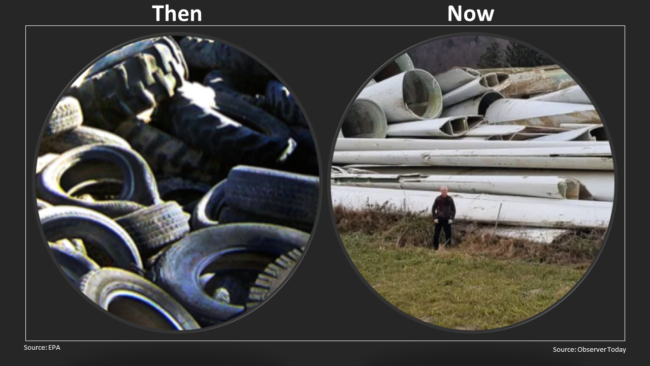
    Lifecycle risk mitigation of an energy resource must include the end of the asset life processes.  What governance driven processes are in place to prevent the accumulation of wind turbine blades or spent solar panels stacked and abandoned?  Just like the tires stacked for decades.

    Turns out the answer is few.  Long life assets such as factories, skyscrapers, fossil fuel production systems, etc. are built to the engineering, industry and local regulatory standards of that day.  Ongoing operations, maintenance, upgrades and so forth keep them performing at acceptable levels.  However, governance models are often focused on the present.  End of asset life risk does not fit into the four quarter management mindset as the event may be sometime in the future.

    The above graphic represents a governance model built around operations and associated risks.  The archetype recognizes that many risk mitigation processes are inadequate for today’s complex organizations with multi-faceted global processes.

    Its framework is built upon the work done by the Treadwell Commission several decades ago to detect financial fraud.  This structure supports the extension into field operations and provides a structure for attaining and sustaining Operational Excellence.

    Risk mitigation is both quantitative and qualitative.  The risk associate with the use of any industrial energy source must be thoroughly assessed as a function of its lifecycle, not just its initial CAPEX and ongoing operations.

    Dumping v Decommissioning

    Illegal industrial dumping has long been a problem.  Today, some in the wind turbine sector appear to be following the decades long vehicle tire disposal process (or lack thereof).

    Lady Bird Johnson at least tried to hide the piles of tire debris but no one has found a way of completely dealing with this growing and massive problem.  As of 2017, some 17% were still disposed of in landfills.  In 2003, the EPA reports that almost 300 million tires are scraped each year.  Flash forward to today and this is likely a very conservative number.  That said, 17% equals approximately 50 million tires headed to landfills as opposed to recycling.

    Moreover, there is a long history of industrial dumping trash so as not to have to pay the disposal fees.  One wonders how many millions of tires destined for landfills (and other recycling) are just dumped?

    The decommissioning process is the responsible end-of-asset-life shutdown and removal.  The intent is to return the site to a condition similar to its initial environment and properly remove and dispose of equipment and materials.  It should not include stacking wind turbine blades next to a pile of discarded vehicle tires.

    Total Carbon Lifecycle Model

    Daily, we hear about the need to reduce carbon output to (net) zero.  Promises are made by many that by such and such a time this metric will be met.  Caveat: usually the time period is beyond the expected tenure of those making the statements.  Often lost in the discussion is the carbon cost of manufacturing and decommissioning.

    Carbon output should include the mineral extraction process, recycling of older materials if appropriate, transportation, manufacturing, installation, operations and decommissioning.  It also must include the carbon cost of the supply chain necessary to support the asset across its lifecycle.  For example, the carbon cost of an EV is not just the vehicle’s operation but the lifecycle of the vehicle as well as the electric power generation and distribution necessary to operate the automobile.  Do not forget the carbon cost of manufacturing a battery and disposing of it at end of life.

    Scrap

    Materials are often staged for recycling.  They feed a process that results in new useful product(s) that may add new value.  This is a useful recycling process that makes a lot of sense.  However, sometimes this is not as economical as new manufacturing.  These economics lead to dumping as the low-cost-solution.  Fields of discarded materials may or may not be awaiting recycling.

    Defining Green

    Being green is not simply using renewable electricity instead of gasoline.  If the carbon footprint is no different or even worse, then the problem is not solved and may even be made greater.

    Keep in mind that coal is still a major fuel in the generation of electricity.  According to the US Energy Information Administration (EIA), in 2020 over 60% of power is generated using fossil fuels of which over 19% is from coal.  This does not include the carbon footprint of materials and products imported to the US.

    So if the carbon footprint of a wind turbine is defined as its lifecycle and if at the end result is abandonment in a field, is the green value of that product positive?  Or is it just dumping not unlike the pollution of a nation’s river systems?

    Being green is not just plugging in your car overnight.  Like most things in life, it is systemic.

    Is Your Organization’s Green Plan Systemic or Myopic?

    For More Information

    Please note, RRI does not endorse or advocate the links to any third-party materials.  They are provided for education and entertainment only.

    For more information on Cross Cultural Engagement, check out our Cross Cultural Serious Game

    We presented, Should Cross Cultural Serious Games Be Included in Your Diversity Program: Best Practices and Lessons Learned at the Online Conference, New Diversity Summit 2020 the week of September 14, 2020.  Check Out this timely event and contact the organizer for access to the presentations!!

    For more on DEI Standards, see the newly released ISO-30415.

    You can contact this author as well.

  • 100

    100

    This edition marks the 100th post in our Critical Mass Blog series.  We have sought to provide thoughtful, unbiased insight into the contemporary business and organizational challenges we all face.  Since our first blog post on November 27, 2017 our world has turned over in ways none expected.  Likely, this trend will continue.

    This series continues a tradition of newsletters, opinion pieces and other on line punditry first begun in 1998 with our New Millennium News.  A bi-monthly email with a subscription base of approximately 7,000 readers.  A huge number at that time.  We estimate that hundreds of thousands or more have benefited from this knowledge transfer.

    Coincidentally, we reach this milestone as we begin the new year–a time of renewal.  We will continue to address critical issues individuals, businesses, agencies and others face as we all navigate an increasingly perilous path.  This series has addressed Human Resource issues including Diversity, Equity and Inclusion (DEI) Teams , the arrival of Smart Technology, International Business, Covid-19, Supply Chain Management, Operational Excellence, Cultural Transformation (including Safety Culture) Sales, Risk Mitigation and of course Leadership.  Today’s organizations must be very good at all of these disciplines!

    Available Tools

    The mission of the Rapid Response Institute (RRI) is to enable our clients with the ability to posture themselves in their market segments so that they can thrive in volatile markets and capitalize on uncertainty, not suffer because of them.  This is especially important for those economic actors in Critical Infrastructure sectors.

    In support of this mission the firm has developed a suite of Intellectual Property (IP) which includes Know How, practical roadmap Books and guidelines as well as Software as a Service (SaaS) solutions among others.  Many readers know that once a process has been standardized with minimal configuration required, the data is the ultimate driver.  This is the heart of most Enterprise Resource Planning (ERP) solutions.

    With advances in technology, RRI has taken these once multi-million dollar solutions to a price point as well as Use Case where all organizations can utilize this capability.  Moreover, our advancements in work flow such as epitomized in our Cross Cultural Serious Games, Economic Value Proposition Matrix, and Smart OpEx (Operations Management System) and Risk Simulation Modeling add immediate and significant value to the challenges faced as articulated above.  Other Free Tools are available as well.

    Pulling It All Together

    The method to our madness is–Operations!!  As some are fond of saying with derision, “It’s All About the Benjamins.”  Well, it actually is.  If ‘for-profit’ firms are not profitable, they fail.  No amount of Environmental, Social, and Governance (ESG) will save them if they cannot deliver to paying customers.

    Everything RRI does helps organizations to deliver stakeholder value, compliant with ESG standards.  That is our Bottom Line and we are also pleased that Dr. Shemwell, Managing Director has been an independent advocate for responsible corporate success since 2004.

    FYI, major losses and legal actions do not enhance stakeholder value.  Neither for employees, local communities or equity holders.  Everyone loses when in terrible scenarios such as Deepwater Horizon, internal bias corporate hubris, poor high reliability processes/human factor shortcomings or lack of actual DEI.

    This journey continues.  Stay tuned for the next 100 editions where will continue to provide our thoughts on relevant matters.  Thank you very much for your readership and support.

    How is Your Organization Positioned for the Next Four Years?

    For More Information

    Please note, RRI does not endorse or advocate the links to any third-party materials.  They are provided for education and entertainment only.

    For more information on Cross Cultural Engagement, check out our Cross Cultural Serious Game

    We presented, Should Cross Cultural Serious Games Be Included in Your Diversity Program: Best Practices and Lessons Learned at the Online Conference, New Diversity Summit 2020 the week of September 14, 2020.  Check Out this timely event and contact the organizer for access to the presentations!!

    For more on DEI Standards, see the newly released ISO-30415.

    You can contact this author as well.

  • Getting to Diverse and Inclusive Teams

    Getting to Diverse and Inclusive Teams

    Diversity, Equity, and Inclusion (DEI) Team Models

    There is a tendency to see DEI through the lens of initiatives or often a process semi-outside the daily ‘organizational’ grind.  Does this represent reality?

    Organizations spend countless sums training employees and others they depend on for Operational Excellence performance.  They often trust global Teams to add stakeholder value.

    No less than Microsoft names a software product, Teams.  A tool designed to foster collaboration.

    The Way We Do Business

    Culture is often defined as ‘who we are.’  The approach an organization takes towards its ecosystem.  If this model is an accurate representation, it suggests that when organizations launch initiatives meant to address current social mores, they likely fail or at least do not live up to full potentials.

    Change management, often referred to as transformation often takes on the mantel of ‘you will be changed.’  Contemporarily, take the Covid-19 vaccine or you will be fired!  Not surprisingly, this mandate is resisted and seemingly increasingly with each new warning.

    As of this writing, the all out war (on decrees) has been declared by the likes of the Navy Seals, Health Care Workers, Law Enforcement and others with the demands from the Feds.  Likely, the result will be a draw at best, with the administration quietly acquiescing.  Too many critical, non-replaceable positions are at risk.  Not to mention votes.

    Governance

    In October 2011, we published our first draft of, Asset/Equipment Integrity Governance: Operations–Enterprise Alignment.  We recognized that traditional organizational Governance models were strictly focused on finance and maleficence therein.  The reality is that revenue is generate by operations and as such governance is critical as well.  Safety Culture, is intangible but now required by most organizations in Critical Infrastructure sectors.

    Flash forward to today and Environmental, Social, and Governance (ESG) is the model most organizations use.  Effectively, this expands governance to include a broad range of non-financial commitments.  From this blogger’s perspective, likely DEI will fall under this governance model.  Therefore, moving it from the ‘initiative status’ to the ‘way we do business.’

    Team Building

    This dynamic environment requires workforce upskilling.  The need to constantly assure that individuals have current Knowledge, Skills and Abilities (KSAs) necessary to meet current challenges.  KSAs now include the ability/necessity to work across cultural/diverse lines.

    When one thinks of a ‘team’ it is not a homogenous collection of like minded and ‘like’ individuals.  Teams are a collection of hopefully, ‘fit for purpose’ individuals who comprise the KSAs needs to accomplish the task(s) at hand.  Teams can mirror the discrete views of its members.

    For example, our early research on the subject assessed the different approaches Japanese nationals took when negotiating with white American males.  In each case, the individual players were deemed to be homogenous.

    Nothing could be further from the truth.  Each individual, in this case all males were of different ages, different education, from different regions of their respective countries, married or not and so forth and so on.

    The reality is that individuals do not negotiate deals.  Teams do.   Members of teams, like juries need to arrive at the same place prior to engaging with other collaborative counterparts.

    Juries need to be arrive at consensus.  Likewise, organizational team members must arrive at a similar place internally prior to going forward.  This not to say that individuals must cave to the will of the majority or the Tyranny of the Minority.  It is to say, a common position that all must accept as part of collaboration or consensus.

    Inclusive?

    There is no doubt that token individuals and in some case high profile figureheads have been put forth to ‘prove’ inclusivity.  Thankfully, those days are fading.

    Teams need to have the input of all members, even contrarians.  Often it is the outlier that has the most insight into a difficult problem.  Differences of opinion need to be resolved and a go forward plan agreed upon.

    Often, individuals do not speak up.  Perhaps they are new to the environment, shy or unsure of themselves.  Whatever the reason their input must be sought and at least given a fair hearing.

    Training can help elicit input from the reticent.  Moreover, they help dominate individuals acknowledge and accept said input.

    How Does Your Organization Assure Real Inclusion?

    For More Information

    Please note, RRI does not endorse or advocate the links to any third-party materials.  They are provided for education and entertainment only.

    For more information on Cross Cultural Engagement, check out our Cross Cultural Serious Game

    We presented, Should Cross Cultural Serious Games Be Included in Your Diversity Program: Best Practices and Lessons Learned at the Online Conference, New Diversity Summit 2020 the week of September 14, 2020.  Check Out this timely event and contact the organizer for access to the presentations!!

    For more on DEI Standards, see the newly released ISO-30415.

    You can contact this author as well.

  • Chain of Custody: Is Your Management System Ready?

    Chain of Custody: Is Your Management System Ready?

    This eliminates the possibility for human error.”  This is an actual quote taken from one of the many blockchain ‘credible’ websites readily available—citation withheld to protect the guilty.    And, the Titanic was unsinkable!

    From another credible sources, “Is blockchain secure for my business?  Simply put, it can be.  But, not by just turning the key.  Security will depend on a variety of factors, none sic (not) the least of which requires a robust risk management framework?”

    In their white paper, KPMG argues that while the current blockchain frenzy is focused on the new technology, the question of its applicability to a business solution remains elusive.  Falling in love with a ‘shiny new software object’ has been seen before.  Most recently, digitalization and IoT.

    The organization’s economic buyer requires more depth in the decision-making process.  Has a valid Business Use Case been developed for its implementation?  This can be a time-consuming activity as the various constituencies must be queried to assess their assessment of the Economic Value of this CAPEX.  Unfortunately, there are no shortcuts to this risk mitigation process.

    This blogger has focused on the need for Governance and appropriate Management Systems for many years.  Historically it has been a challenge for business and government entities to keep up with the explosion of technology.

    While third parties are often the weakest link in supply chain management and this is one of the problems that Chain of Custody solutions address, technology alone is not a solution.  As with any transformational initiative, the broader impact, unintended consequences as well as other tangible and intangible exposures must be understood and managed accordingly.

    Just for the record, human error can never be eliminated.  It is human folly to believe that a technology can free us from our human nature.  High Reliability Organizations (HRO) recognize this frailty and respond accordingly.

    The promised of today’s technology suites can be of high value.  History teaches us that this value may not be realized if the problem being addressed, their implementation and sustained (maturity) processes are inadequately formulated.

    How Will Your Organization Assure It Will Realize the Value from Blockchain Investments?


    https://advisory.kpmg.us/articles/2017/securing-the-chain.html

    Shemwell, Scott M. (2018, October). How to make the case to the C-Suite: Selling Large Scale Data Management Projects to the C Suite. Foundations: The Journal of the Professional Petroleum Data Management Association. Volume 5 Issue 2. pp. 6-8.

    https://sceweb.uhcl.edu/helm/RationalUnifiedProcess/process/modguide/md_bucm.htm

    https://therrinstitute.com/economic-value-proposition-matrix/

    https://therrinstitute.com/are-organizational-governance-models-broken-why-cant-management-get-a-handle-on-things/