
Tag: diversity and inclusion

  • Why Corporate Initiatives Fail

    Why Corporate Initiatives Fail

    According to the Cambridge Dictionary, one definition of initiative is. “A new plan or action to improve something or solve a problem.”  In corporate parlance this often translates into yet another short-term and often politically correct effort to demonstrate forward motion/social citizenship.  Often forgotten faster than the evening news cycle as new searches for performance take their place.

    Organizations of all types, public, private, profit and nonprofit etc. tend to announce new initiatives with great fanfare and pronouncements about ‘transforming our culture.’  So why do they continuously fall short of expectations?

    According to a Forbes Survey released just before the pandemic, “When participants in our survey were asked to create a list of reasons for (change programs) failure, ‘insufficient budget’ was cited by 23% and ‘insufficient time’ by only 17%.  Instead, participants ranked poor communication (62%), insufficient leadership and support (54%), organizational politics (50%), lack of understanding of the purpose of the change (50%), lack of user buy-in (42%) and lack of collaboration (40%) as the most critical issues.”

    In aggregate, the article suggests a total failure rate of70%.  This percentage level was first put forth in the early 1990s and is accepted by many as still correct today.  While empirical evidence is sketchy, none-the-less, the perception of failure remains high.

    This tracks with other project failure statistics this author has seen over the years.  Yet, all of these failure attributes are human and therefore, manageable and correctable.

    Today’s Buzz

    The economy is always front and center.  More so today given Inflation and Supply Chain problems.

    In this blogger’s opinion and in order of priority other key issues include Diversity, Inclusion and Equity (DEI), Climate Change and Environmental, Social and Governance (ESG).  While different organizations may face other challenges, these Four tend to dominate the news.

    Often issues overlap or compound, thus exponentially amplifying the impact on society.  For example, the electric vehicle (EV) is touted as a lynchpin to ‘fixing’ the Climate Change issue.  However, supply chain issues currently limit battery production and one can surmise this is a long-term problem and not simply current shortages or delays.  If this is correct, meeting desired climate metrics is problematic.

    Diversity, Equity and Inclusion

    Perhaps the most emotional of the Big Four, DEI seeks to level the so-called playing field for all regardless of ethnicity, gender or behavioral preferences.  Almost all organizations have a DEI Initiative underway.  Yet, they seem to be stalling much to the frustration of advocates.

    According to one source, “The DEI industry is dominated by what scholars call ‘personnel managers,’ employees in human resources.”  This is also the observation of this pundit as well.

    LinkedIn profiles include, Chief Diversity Officers, any number of DEI consultants and others carrying similar titles as well as commercial organizations offering DEI products and solutions.  Much like the plethora of Safety Culture ‘experts’ and tools that emerged after Deepwater Horizon offshore drilling rig disaster in 2010.

    From a recent Korn Ferry article, “Experts say companies must treat DE&I as they would any other business issue and use data analytics to understand why things aren’t working.”  This author interprets this to mean that DEI must be incorporated into ‘the way we do business‘ or part of the organization’s culture.

    No longer a simple initiative, the next Chief Diversity Officer may be a Caucasian male or even redundant.  Then, DEI will no longer be seen as a separate and different department.

    Energy Transformation

    The president of the United States recently said, ““ it comes to the gas prices, we’re going through an incredible transition that is taking place that, God willing, when it’s over, we’ll be stronger and the world will be stronger and less reliant on fossil fuels when this is over.”  As many countries implement Climate Change policies, this transition is economically rough to say the least.

    And with no guarantees that these efforts will actually reduce the earth’s temperature decades out, is this a Big Bet with major consequences to all of us.  In our last blog, Innovation: The Key to the Global Future we addressed the economics in detail.  Interested readers should refer to that piece.

    An extensive assessment was developed by Bjorn Lomborg in his latest book, False Alarm: How Climate Change Panic Costs Us Trillions, Hurts the Poor, and Fails to Fix the Planet.  His credentials include the fact that he believes in global warming and is not a ‘denier’ as the phase goes.

    Caution to the lemmings jumping off the Energy Transition cliff, this is the ultimate initiative as it is political by nature.  Fickle by nature, political winds can change quickly and with that the value proposition.

    To some extent we are seeing this already as governments seek to address spirally energy costs, i.e., Germany restarts coal-fired power plants.  We might see more of this after the US midterm elections in November.

    ESG

    This initiative is treated as if it is new.  Well run companies have always enjoyed higher equity value.

    In 2011, we published our White Paper, Asset/Equipment Integrity Governance: Operations–Enterprise Alignment.  In that paper, we quoted, “During that period (2002), McKinsey & Company in conjunction with the Global Corporate Governance Forum conducted a study and found that over 75% of over 200 fund managers would value a stock at a higher price point if the company could demonstrate it had strong governance in place.  Moreover, the study also revealed that for western markets, firms with strong shareholder rights averaged 12-14% higher stock prices.”

    We previously addressed ESG in detail and how it fits in our Relationships, Behaviors, Conditions (RBC) Framework  (risk mitigation).  The operative word is Relationships.  This will include every stakeholder, so the impact can be substantial.

    For some organizations, ESG is new and the source of value in the annual Letter to Shareholders.  For others, business as usual incorporates those premises.  Begs the question, which organization would you like to invest in?

    Concluding Thoughts

    In this corporate animal’s experience, initiatives are seen as short-term events.  Leadership’s ‘rubber stamp’ does not carry gravitas.  Employees often ‘wait them out’ and go just about their business.  Others create media splash which dies quickly as well.  Only when change is codified in the organization’s culture do new approaches add sustained value.

    Initiatives fail because neither the board room nor the factory floor see them as adding value.  Fads driven by political winds, activists or social desires come and go.

    Strong governance is a proven value add.  A diverse workforce can add value but climate change as currently practiced will most like fail and fail Big and Expensive.  Society has addressed similar economic issues and will again.

    Are Your Organizational Initiatives Sustainable or Simply Fads?

    For More Information

    Please note, RRI does not endorse or advocate the links to any third-party materials herein.  They are provided for education and entertainment only.

    The author’s credentials in this field are available on his LinkedIn page.

    Disclaimer, the author has no personal or business relationship with Bjorn Lomborg or his publications other than reading and commenting on his latest book, False Alarm: How Climate Change Panic Costs Us Trillions, Hurts the Poor, and Fails to Fix the Planet.

    For those start-up firms addressing energy challenges, the author is a member of Global Energy Mentors which provide no-cost mentoring services from energy experts.  If interested, check it out and give us a shout.

    For more information on Cross Cultural Engagement, check out our Cross Cultural Serious Game.  You can contact this author as well.


  • A Windy Position

    A Windy Position

    In a recent online discussion, this pundit put forth the thought that fiberglass wind turbine blades can pose an environmental problem when decommissioned.  This position was quickly challenged with the rebuttal that burning coal ‘kills’ kids so it did not matter if discarded blades litter the countryside as it is worth it.

    According to research quoted by the European Wind Energy Association, “With wind turbine blades likely to account for some 50,000 tons of waste annually by 2020, growing 4 times by 2034 the landfill is not a viable long-term solution.”  Moreover, “Findings from the University of Strathclyde indicate a global increase of wind turbine blade waste from around 400,000 tons per annum in 2030 to around two million tons by 2050.”

    My rebuttal to the kills kids argument–what will this do to global population health?  Keep in mind, this is only one source of industrial (and consumer, i.e., EV automobiles) decommissioned assets.

    Disposal/Recycling

    “Glass-reinforced polymer composites (GRP), used in wind turbine blades around the world, is recognized as a hard-to-break-down source of pollution.”  Research is underway to address this problem and mostly likely progress will continue going forward.

    “Currently only a few recycling techniques are available to treat such an enormous quantity.  So most have been landfilled and many continue to be buried today.”  Other current options include:

    • Grinding–turning fiberglass into powder.  A labor intensive process that provides filler for other purposes
    • Incineration–the ash is usually disposed of in a landfill
    • Pyrolysis–decomposes into three recoverable substances: pyro-gas, pyro-oil, and solid byproduct— all of which can be recycled

    “While the overall life of the wind turbine does cause less pollution than coal-fired power plants do, the initial solution of just burying the fiberglass doesn’t seem in line with the goal to cause less pollution.” (Ibid)

    Really?  How is this saving the planet?

    Clearly, these alternative disposal processes have a financial cost greater than simply burying the blades.  If not, they would be used more frequently.

    Future generations will have to address this issue much like the current one continues to deal with asbestos from the past.  The KIDS will end up dealing with and paying for the folly of their parents and grandparents.

    A Contrarian Posture

    As noted, there is a romanticism about renewable energy sources, most commonly wind and solar.  However, we believe in the ‘no free lunch’ model.  There are risks and cost associated with every form of energy.

    In two recent editions, Heavy Metal Rocks and Going Green? Or NOT! we took an initial look at the financial cost over the renewable lifecycle as well the environmental impact that will need to be addressed.  The edition is a continuation of the premise that, “Technology Romance must be met with Fiscal Realities.”

    Society will eventually recognize the environmental damage done by solar and wind energy systems can be very high.  By then, the harm may have been done.

    As an example, many oil and gas assets are approaching end of life.  The decommission costs are very high and increasingly regulations are changing to hold asset owners accountable for these costs.  Generally, accountants refer to these as Reserves.

    Shouldn’t renewable asset holders be required to set aside reserves to cover the disposal of assets as well?

    Lifecycle Cost Structure

    For capital assets with significant planning, development, manufacture, deployment, operations & maintenance and finally decommissioning costs there is another dimension.  The Asset Maturity Model was developed to assist management understand how to best maximize asset performance over decades, in some cases.  This model is integrated into an economic value model which we be discussed herein.  There are also a number of tools and standards available to assist management, such as ISO 55001–Asset Management.

    In April 2022, Bloomberg published a piece, “Wind Power’s ‘Colossal Market Failure Threatens Climate Fight.”  The Global Wind Energy Council deemed the current wind energy situation a ‘Colossal Market Failure.’

    Blaming a mismatch (alignment) between governments policies and current markets, the risk is not only that net zero targets will not be met but the supply chain is contracting.  Moreover, one study suggests that for the US net-zero policies will cost more than 12% of our Gross Domestic Product (GDP) in 2050.  To put this in perspective, today Social Security cost 5% of GDP and Medicare/Medicaid 6.4 percent–11.4% combined.

    The ‘lack of alignment‘ is a major determent to successful organizations.  In our recent blog, ESG Explained we discussed the role organization and its ecosystem governance at length.  Building on our 2011  monograph, Asset/Equipment Integrity Governance: Operations–Enterprise Alignment; A Case for Board Oversight (AEIG) we developed the case for Operational Excellence as part of ESG.  Energy and supply chain management are key components of this enterprise approach.

    Total Cost of Ownership (TCO)

    TCO is a function of the acquisition cost, including all engineering, design, deployment, installation etc. as well as ALL costs associated with its lifecycle OPEX, including decommissioning, abandonment, and environment remediation.  It is all encompassing.  It is the long-standing metric that all projects must understand and model accordingly before a Capital Expenditure (CAPEX) is authorized.

    The following list are documented per citation links.  These are taken from a recent article challenging the Return on Investment (ROI) of current green initiatives.

    Readers will note that some are social costs, i.e., transition costs to new energy sources currently provide minuscule contributions to the Energy Basket.  These costs will grow dramatically going forward.

    •  “Making a transition from fossil fuels to green energy is costly.  Solar and wind can only deliver electricity, which accounts for less than a fifth of total energy consumption.
    • When the sun doesn’t shine or the wind doesn’t blow, prices rise quickly and we have to revert to fossil fuels for backup.
    • Batteries are inadequate and expensive, easily quadrupling solar electricity costs and failing to provide much power.
    • In 2021, Europe only had battery capacity to backup less than 1 ½ minutes of its average electricity usage.  By 2030, with 10 times the stock of batteries, and somewhat more usage needed, they’ll have enough for 12 minutes.
    • The Bank of America has found that achieving net-zero will cost $150 trillion over 30 years, almost twice the combined annual GDP of every country on Earth.
    • The annual cost of $5 trillion is more than all the world’s governments and households spend every year on education.
    • In a new study, McKinsey finds most of the poorest nations in Africa would have to pay more than 10 percent of their total national incomes every year toward climate policy.  This is more than these nations combined spend on education and health.
    • Reducing emissions just 80% will cost the United States more than $2.1 trillion every year from 2050, or more than $5,000 per person, per year.
    • The annual US cost of World War II is estimated at $1 trillion in today’s money.  Every year by 2050, climate policy could cost Americans more than twice what they paid during the Second World War.
    • Surveys show few people are willing to spend more than a few hundred dollars a year on climate policies.  Asking people to spend tens or hundreds times more is a recipe for failure.”

    These are significant tangible and intangible costs.  In this writer’s opinion, the business case has not been made for these and other total cost line items.  A more extensive study should be considered by readers who want to do a deep dive on these economics.

    Keep in mind, that these broader issues do not take into consideration regarding daily operations and maintenance.  These must be factored in as well.

    Finally, while these are ‘opinions’ from reputable sources, why are they not considered the economic models used today?  Seems like Data Bias, doesn’t it.

    EVPM

    Beginning in 2004, recognizing many of the TCO components as well as the economic value potential from a CAPEX, we developed what came to be known as our Economic Value Proposition Matrix model (EVPM).  This model is now mature, robust as well as integrating a Risk Matrix.

    It is an excellent tool for assessing both Tangible and Intangible components of value and cost.  Additionally, a free version is available and it is fully supported with training as well as other materials (including a video).

    Importantly, EVPM “Translates technology into the Language of Business” which make it an excellent tool for preparing to meet with the Chief Financial Officer (CFO) and/or Budget Committee.  Management makes decisions as a function of the risk associated economic value brought to the organization.  While technology has a level of romance to it, financial issues are the major decision making driver.

    The Energy Basket

    It is useful to look past the hype to see what the US energy basket actually looks like.   Slightly over three percent comes from wind and only 1.3 % is solar.  Fossil fuels (petroleum natural gas and coal) represent 79% of our current energy consumption.  In the opinion of this writer these disparities have been basically the same for decades.

    China and India burn 14 million tons of coal per day!  By all accounts, coal will play a major role in power production in these economies for some time to come.  As a function of the global percentage of coal used; China over 50%, India over 11% and the United States at approximately 8.5%.  Moreover, an assessment of its use by 130 countries is available to interested readers.

    The debate about ‘Clean Coal‘ continues.  None-the-Less, most likely coal will continue to be used for decades.  Keep in mind that 2050 is less than 28 year away.

    While regulation plays a role in the energy mix, economics are the fundamental driver.  Until the economics of non fossil fuels change, the basket will most likely not.

    The Lone Ranger is Missing

    Listening to some, it seems that all we have to do is focus on the Energy Transformation and in only a few short years magic will happen.  Hate to tell everyone, there is no Silver Bullet.  Transformation will take decades and should be led by those driven by market forces.

    One example, on April 29, 2022 the Texas Department of Transportation (TxDot) announced the two year closure of a major highway artery in the Houston metropolitan area to replace a concrete ramp.  Point being, road construction is well understood and a major proven technology and process.  Still, it will take a significant amount of time to perform this upgrade.

    How can we assume a major Energy Transformation using new technologies will unfold as optimistic parties suggest?  History suggests this is not likely.

    Closing Points

    This long time energy careerist believes that various energy sources from the basket should be used as economically appropriate.  While we all have an interest in a low pollution environment, if the economics as shown in this piece are close to correct, the resulting economic damage may be greater than a somewhat warmer planet.

    The data presented herein are documented.  The sources and quality of the data can be challenged but it should not be ignored.

    Finally, this piece has focused primarily on wind energy.  A similar analysis needs to be taken for every energy source including fossil fuels of all kinds.

    The demand for energy will continue to grow and even exponentially.  Clean fossil fuels are available and without strong energy balanced policies the future is bleak for many and not just because of climate change by the significantly higher cost of living and loss of opportunities due to energy starvation.

    The energy challenges are complex and dynamic.  This blog is not a comprehensive review, but simply a focus on a narrow aspect.  For example, we did not delve into issues such as Carbon Capture & Sequestration.  A calm, rational, economics discussion is in order.

    What does Energy Transition mean to you and how will you help the Less Fortunate be better off?

    For More Information

    Please note, RRI does not endorse or advocate the links to any third-party materials.  They are provided for education and entertainment only.

    For more information on Cross Cultural Engagement, check out our Cross Cultural Serious Game.  You can contact this author as well.

  • Will Price Controls Work This Time?

    Will Price Controls Work This Time?

    Update: Just after we published this edition, Goldman Sachs released this comprehensive research piece; Stagflation Risk.

    Recently, one media outlet raised the suggestion of government price controls.  Generally, seen as a bad idea, none-the-less in this inflationary environment, some may perceive value from an action of this kind.

    Additionally, in the current environment some politicians favor cancelling the gasoline tax at both the state and federal levels.  This might beg the question, if these taxes can be abated, why are they in place anyway?

    In 1971, President Nixon implemented price and wage controls.   Some saw this as an election ploy and if so, it worked as he was reelected.  In 2008, the free market Republican George W. Bush stated that sometimes you have to, “abandon free‐​market principles to save the free‐​market system.”  WHAT?

    Elected politicians often think they know more about running companies and economies than those who actually do.  Printing money and regulating commercial processes that they know nothing about, usually in the name of the people who may have put them in office.  Since most of these individuals do not have a working knowledge of the economy, is it any wonder that they bugger things up when they insert themselves?

    And Now!

    Self imposed, inflation is now higher than it has been since the 1970s.  Blamed on a third world country invading its neighbor, leadership states, I “can’t do much” about gasoline prices.  Need I say, malarkey!  The world is awash with ‘clean’ fossil fuels; societies just choose not to use them effectively.

    The concept of an Energy Basket is well defined and depending on geographical location, and need requirements any or all can be used as economically feasible.  Moreover, the concept of Energy Transition is not new.

    In  1993,  Theodore Modis published this diagram in his peer reviewed work, Technological Substitutions in the Computer Industry whereby he presented a technology substitution model that both energy and silicon mapped to very well.

    While renewables were not included in the model, readers will get the point that energy transition has always been an on going process.

    We further discussed this process in our 2015 book, Structural Dynamics: Foundation of Next Generation Management Science.  We defined, Structural Dynamics “the morphology or patterns of motion towards process equilibrium of interpersonal systems.”  In other words the nexus of structure and process whereby markets seek equilibrium if only for a time.

    Markets drive technology substitution.  Only when the economics of new energy sources are acceptable does the ‘take up’ move quickly.

    Volckerism

    Tough Love by the Fed kicked Stagflation in the gut and yes it hurt the US economy for years, but it saved the country from a worse fate.  From the Federal Reserve Bank of St. Louis, “On Oct. 6, 1979, Fed Chairman Paul Volcker took dramatic steps to rein in the runaway inflation that had been sapping the strength of our economy since the mid-1960s.  Without his bold change in monetary policy and his determination to stick with it through several painful years, the U.S. economy would have continued its downward spiral.  By reversing the misguided policies of his predecessors, Volcker set the table for the long economic expansions of the 1980s and 1990s.”

    In 1965, the inflation rate was one percent.  By 1980, it had hit 14 percent.  Per Chairman Volcker’s statement, both Nixon and Carter implemented price controls with catastrophic effects on the nation.

    The Heavy Hand

    This  is not a piece on fiscal or monetary policy, rather it is meant as a wake up call from someone who lived through that period.  Distorted markets always correct, often rapidly and harshly.  The Great Depression comes to mind as well, as the Dotcom Bubble, Financial Crisis of  2008, etc.

    Those interested in the details and theory of human behavior in this period can follow up with the cited materials as well as a wealth of knowledge on  the subject of price controls.

    Bottom line, price controls did not work.  Markets became distorted.  Moreover, easy credit (very low interest rate) transformed to expensive credit (high interest rate) and eventually this painful process negatively transformed the marketplace in ways most contemporary readers have never known their whole life.

    Price controls are tempting.  It is easy to say, lets stop corporations from making obscene profits or gouging.  However, the downside negatively impacts those who need economic help the  most.

    One expects that in the coming months, especially as the election nears calls for price controls will become louder.  History has shown the results of such actions as economic suicide.

    How will your company prepare for mandated price freezes?

    For More Information

    Please note, RRI does not endorse or advocate the links to any third-party materials.  They are provided for education and entertainment only.

    For more information on Cross Cultural Engagement, check out our Cross Cultural Serious Game.  You can contact this author as well.

    References:

    Modis, Theodore. (1993). Technological Substitutions in the Computer Industry. Technological Forecasting and Social Change. 43. pp. 157-167.

  • So Here We Go Again?

    So Here We Go Again?

    Will gas lines return?

    Recent geopolitical events have driven the price of gasoline sky high–again!  As of this writing it is difficult to say where this will all lead.  What is known is that the cost of all things related to petroleum have significantly increased and may go even higher.

    According to the U.S. Department of Energy, in addition to transportation and heating, oil and gas are used in over 6,000 everyday products.  In other words, their use is pervasive in all societies and economies.

    As a response to the oil shock of 1973, in 1975 the Energy Policy and Conservation Act (EPCA) developed the Strategic Petroleum Reserve (SPR).  According to the DOE, as of December 2021 the current inventory was approximately 600 million barrels of crude oil.  It is designed to be a buffer or in digital terms a cache in case of disruption or other requirements.

    Furthermore, according to the U.S. Energy Information Administration (EIA), in 2021 the US consumed approximately 20 million barrels of oil per day.  Assuming Russia exports 8% or approximately 1.6 million barrels (including refined products) per day to the US, this shortfall can be replaced with SDR withdraws as well as increases from both domestic producers and other exporters.

    What Do We Do Now?

    Oil and Gas are commodities and are therefore subject to the same Supply and Demand processes inherent to that segment.  Other examples include, gold, cattle, pork bellies and orange juice, etc.

    Today’s global markets perceive that the demand for gasoline is higher than the available supply.  Therefore, sellers can command higher prices.

    The apparent supply can be brought into balance with demand in two fundamental ways.  First, and easiest is to cut back on consumption, i.e., work from home, carpool, mass transit, etc.

    Second, which will take some time is for domestic production to increase.  ‘Small’ increases from trading partners and domestic operators (along with government regulatory assistance) will add up as well.

    One of the worst things that can happen is hording.  Think back to the great Toilet Paper hording in the early days of Covid-19.  It was unlikely that the daily demand for bathroom tissue suddenly increased.

    In effect, households ‘held’ the inventory (instead of stores) until it was worked down.  Manufacturers did not increase production albeit retailers began to ration individual purchases.

    The gas lines of the 1970s were also an example of hording.  Once the Odd and Even license plate model went into effect, they dissipated almost immediately.

    We need NOT go through this experience again!  We all have the tools necessary to change that narrative and not relive history.

    Dealing With the Issue

    For almost two decades we have modeled large scale economic procurement initiatives, both in the public and private sectors.  Attempts to attain 25% or more in value from initiatives are almost always destined to fail.  On the other hand, finding small components of economic value across a number of processes and departments can easily exceed pronouncements of singular, overall great value to be obtained.

    For example if several areas each find 2-5% of value opportunities, 25% can be quickly exceeded.  This works for large and small organizations.  It can work for individual households too.  One need not find the Silver Bullet or make Herculean efforts to overcome difficult challenges.

    Where Can You Find Eight One-Percent Opportunities to Decrease Your Petroleum Footprint?

    For More Information

    Please note, RRI does not endorse or advocate the links to any third-party materials.  They are provided for education and entertainment only.

    Photo Source: NPR

    For more information on Cross Cultural Engagement, check out our Cross Cultural Serious Game.  You can contact this author as well.


  • Beware The Guns of March?

    Beware The Guns of March?

    Readers know that as of this writing there is geopolitical and military tension in eastern Europe.  Hopefully, the situation will resolve peacefully.

    This piece is not about those politics.  Rather it is about the potential for accidental engagement and how that risk can be mitigated.

    President Kennedy is famously cited for the comment that referred to the origin of the War to End All Wars, “Perhaps the greatest contribution historians have made to humanity, at least as historians sometimes tell it, came during the Cuban Missile Crisis when Barbara Tuchman’s book, The Guns of August, saved the world from nuclear war.  The book is Tuchman’s narrative of the origins of the First World War, an account that, in President John F. Kennedy’s reading, showed how miscalculation and inflexible military planning could force great powers into catastrophic conflicts against their leaders’ wishes.”  We might add, against the wishes of the populations that must endure the unbearable cost of stupid interventions.  As noted by Herbert Hoover.

    “Older men declare war. But it is the youth that must fight and die.”

    While the Cuban Missile Crisis worked out well for both parties, including the world in general, it was not necessarily a given.  Miscalculations such as the US lack of knowledge regarding nuclear weapons onboard Soviet submarines or the ‘launch’ upon the invasion of the island of Cuba order could have been disastrous.

    Misunderstanding during the 1983 military exercise Able Archer is another example of a near nuclear catastrophe.  And then there all the Broken Arrows,  nuclear weapon incidents (that we know of).

    Complex Systems’ Behaviors

    This blog series has commented on complex interconnected systems a number of times.  The  Risk Profile is dramatically increased in such systems.  Geopolitical and military systems must be viewed through this lens as well.  However, we know complex systems can be properly managed and thus reduce the likelihood of major global impact events.

    This process is grounded in High Reliability Management (HRM).  Wikipedia defines, “A high reliability organization (HRO) is an organization that has succeeded in avoiding catastrophes in an environment where normal accidents can be expected due to risk factors and complexity.

    This author believes that geopolitical and military complex systems can benefit from this model.  Given that the cost of these type failures is incalculable they certainty fits HRM profile.

    Folly Revisited

    In the 1930s Brinksmanship did not end well.  Following historical patterns, especially from World War I, Europe plunged into the abyss for the second time in two decades.  Miscalculations on the side of multiple parties in both conflicts let to unthinkable destruction and loss of life.

    Today’s militaries are much more powerful than ever.  Hopefully, from Shakespeare, “Beware the ides of March” does not portend this year.

    Geopolitical miscalculations, brinksmanship and other aggressive negotiations can go badly.  This is especially the case when adversaries are not in direct and frequent communication with all parties.

    Even then cultural differences put discussions at risk.  Temperance, communication and though is what saves the world from the unthinkable.  Hopefully, cooler heads will continue to prevail during the current crisis.

    Cross Cultural Negotiation

    The importance of cross cultural understanding cannot be overstated as geopolitics and businesses deal with complex, multi-faceted issues across many nations, ethnicities and cultures.  Old international negotiation models are no longer relevant.

    Behavioral Economics is foremost today.  All parties dealt with are by definition diverse.  They are composed of different genders, ethnicities and ages etc.  This is a more accurate model that reflects the reality of organizations today.

    Also, keep in mind that no nation is homogeneous.  Each is composed of separate regions, cities, with local backgrounds, cultures and more.  So when one talks about two or more geopolitical entities to be at odds over an issue(s), that model is too simplistic and can lead to greater risks as described earlier.

    These are more contributing factors for misunderstanding and miscalculation.  Most of us never ‘step in the other’s shoes.’  However, we can recognize the differences in perspectives, behavior and cultures.

    Changing the Playing Field

    We have often discussed the Relationships, Behaviors and Conditions (RBC) construct among economic actors.  The model argues that new Conditions or Situations and Behaviors change the Relationship among parties.  This applies at all levels of human interactions from two individuals to many nations.  It is applicable here as knowledge to help diffuse difficult situations.  For an in-depth review of the model, check the linked blog.

    No Guns this Time?

    The cascading events following the assassination of the Austrian, Archduke Franz Ferdinand by a small terrorist group is widely believed to have led to the beginning of World War I.  The sceptic must put forth, “you have got to be kidding me.”  Yet, it did happen.

    Our point here is that it does not take much to launch the horrible.  How many American doughboys died for that nonsense?  It can happen again and most likely will at some point given human nature.

    Business Contingency

    Geopolitical risk has always been one component of an organization’s risk profile.  What will be the impact on your business if the unthinkable happens in Europe again?  Other risk mitigation tools include social media.

    In 2013 we published ” Mitigating Operational Risk Using the Power of Social Media” that identified a methodology to better understand the beliefs and behaviors of local populations.  From the footnoted piece, “Large global enterprises can augment existing security and risk management with the same solutions used by the government entities in the defense sector at commercial price points.  The real question is not why, but why not?”

    Since that time, there have been significant advances in these capabilities.  Other readily available tools can assist as well.  Use inexpensive technology to protect global stakeholder interests.

    How Robust is Your Firm’s Contingency Plans for Geopolitical Uncertainties?

    For More Information

    Please note, RRI does not endorse or advocate the links to any third-party materials.  They are provided for education and entertainment only.

    For more information on Cross Cultural Engagement, check out our Cross Cultural Serious Game.  You can contact this author as well.

    Footnote

    Kuiper, Marcus A. and Shemwell, Scott M. (2013, February). Mitigating Operational Risk Using the Power of Social Media. Petroleum Africa Magazine. pp. 28-31.

  • Going Green? Or NOT!

    Going Green? Or NOT!

    The total or lifecycle carbon footprint for any energy source is a function of the manufacturing, commissioning, operation (including maintenance) and decommissioning of that asset.  Moreover, the value of an electric powered vehicles (EV) is seen as a function of the amount of fossil fuel no longer used by the vehicle.  However, this is only a sub-model of the to carbon footprint of any component in the Basket of (Energy) Goods, aka Energy Basket.

    All energy resources in the basket must be held to the same set of metrics.  These include Human Resources (including diversity and inclusion), Safety Culture, communities as well as the bottom line performance against governance standards (ESG).

    Risk Governance

    A governance framework that exceeds these standards follows.  Evolving over several decades, it reflects a comprehensive approach to operational risk that is often overlooked.  It addresses the entire life of a revenue producing asset.

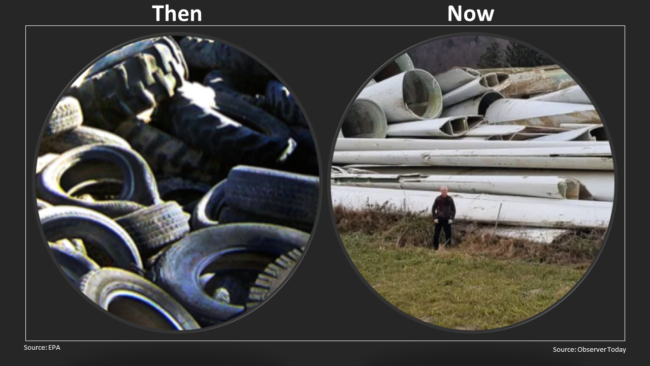
    Lifecycle risk mitigation of an energy resource must include the end of the asset life processes.  What governance driven processes are in place to prevent the accumulation of wind turbine blades or spent solar panels stacked and abandoned?  Just like the tires stacked for decades.

    Turns out the answer is few.  Long life assets such as factories, skyscrapers, fossil fuel production systems, etc. are built to the engineering, industry and local regulatory standards of that day.  Ongoing operations, maintenance, upgrades and so forth keep them performing at acceptable levels.  However, governance models are often focused on the present.  End of asset life risk does not fit into the four quarter management mindset as the event may be sometime in the future.

    The above graphic represents a governance model built around operations and associated risks.  The archetype recognizes that many risk mitigation processes are inadequate for today’s complex organizations with multi-faceted global processes.

    Its framework is built upon the work done by the Treadwell Commission several decades ago to detect financial fraud.  This structure supports the extension into field operations and provides a structure for attaining and sustaining Operational Excellence.

    Risk mitigation is both quantitative and qualitative.  The risk associate with the use of any industrial energy source must be thoroughly assessed as a function of its lifecycle, not just its initial CAPEX and ongoing operations.

    Dumping v Decommissioning

    Illegal industrial dumping has long been a problem.  Today, some in the wind turbine sector appear to be following the decades long vehicle tire disposal process (or lack thereof).

    Lady Bird Johnson at least tried to hide the piles of tire debris but no one has found a way of completely dealing with this growing and massive problem.  As of 2017, some 17% were still disposed of in landfills.  In 2003, the EPA reports that almost 300 million tires are scraped each year.  Flash forward to today and this is likely a very conservative number.  That said, 17% equals approximately 50 million tires headed to landfills as opposed to recycling.

    Moreover, there is a long history of industrial dumping trash so as not to have to pay the disposal fees.  One wonders how many millions of tires destined for landfills (and other recycling) are just dumped?

    The decommissioning process is the responsible end-of-asset-life shutdown and removal.  The intent is to return the site to a condition similar to its initial environment and properly remove and dispose of equipment and materials.  It should not include stacking wind turbine blades next to a pile of discarded vehicle tires.

    Total Carbon Lifecycle Model

    Daily, we hear about the need to reduce carbon output to (net) zero.  Promises are made by many that by such and such a time this metric will be met.  Caveat: usually the time period is beyond the expected tenure of those making the statements.  Often lost in the discussion is the carbon cost of manufacturing and decommissioning.

    Carbon output should include the mineral extraction process, recycling of older materials if appropriate, transportation, manufacturing, installation, operations and decommissioning.  It also must include the carbon cost of the supply chain necessary to support the asset across its lifecycle.  For example, the carbon cost of an EV is not just the vehicle’s operation but the lifecycle of the vehicle as well as the electric power generation and distribution necessary to operate the automobile.  Do not forget the carbon cost of manufacturing a battery and disposing of it at end of life.

    Scrap

    Materials are often staged for recycling.  They feed a process that results in new useful product(s) that may add new value.  This is a useful recycling process that makes a lot of sense.  However, sometimes this is not as economical as new manufacturing.  These economics lead to dumping as the low-cost-solution.  Fields of discarded materials may or may not be awaiting recycling.

    Defining Green

    Being green is not simply using renewable electricity instead of gasoline.  If the carbon footprint is no different or even worse, then the problem is not solved and may even be made greater.

    Keep in mind that coal is still a major fuel in the generation of electricity.  According to the US Energy Information Administration (EIA), in 2020 over 60% of power is generated using fossil fuels of which over 19% is from coal.  This does not include the carbon footprint of materials and products imported to the US.

    So if the carbon footprint of a wind turbine is defined as its lifecycle and if at the end result is abandonment in a field, is the green value of that product positive?  Or is it just dumping not unlike the pollution of a nation’s river systems?

    Being green is not just plugging in your car overnight.  Like most things in life, it is systemic.

    Is Your Organization’s Green Plan Systemic or Myopic?

    For More Information

    Please note, RRI does not endorse or advocate the links to any third-party materials.  They are provided for education and entertainment only.

    For more information on Cross Cultural Engagement, check out our Cross Cultural Serious Game

    We presented, Should Cross Cultural Serious Games Be Included in Your Diversity Program: Best Practices and Lessons Learned at the Online Conference, New Diversity Summit 2020 the week of September 14, 2020.  Check Out this timely event and contact the organizer for access to the presentations!!

    For more on DEI Standards, see the newly released ISO-30415.

    You can contact this author as well.