
Category: Critical Infrastructure

  • Roadmap to Decision Making In the ‘Smart’ Era

    Roadmap to Decision Making In the ‘Smart’ Era

    “Nothing is more difficult, and therefore more precious, than to be able to decide.”

    Napoleon Bonaparte

    Volumes have been written on decision-making and this pundit has offered his share of insight and comment on the subject as well.  Some of our comments regard the appropriateness of the human intercession in electronic decision making.  Others raise questions regarding algorithm fallibility.  Moreover, Human Factors must be considered for any technology initiative which are becoming increasingly important.

    If one unpacks the previous paragraph a substantial level of complexity emerges.  As complexity increases so does risk and the need from proper governance.  However, many still see this potential transformation through the lens of just another IT initiative.

    Roadmap

    The oil and gas industry faced a similar dilemma at the dawn of the 21st Century.  At the time, referred to as DOFF or Digital Oilfield of the Future, a plethora of technologies became available.  The task was to transform 100 plus years of traditional operation to what is now referred to as the Digital Oilfield, aka Integrated Operations and a number or synonyms.  While this processes continues to evolve as new solutions emerge, i.e., Cloud, at the time much was trial and error.

    In conjunction with industry leadership, we released our Roadmap to Enterprise Optimization: A Guide to the Impact of Information Driven Field Operations on the Petroleum Corporation in the fall of 2004.  We believe it was the first industry (POSC) supported effort that was not simply research but a ‘bona fide’ action plan or roadmap to success based on industry/other knowledge, standards, economic value and best practices.
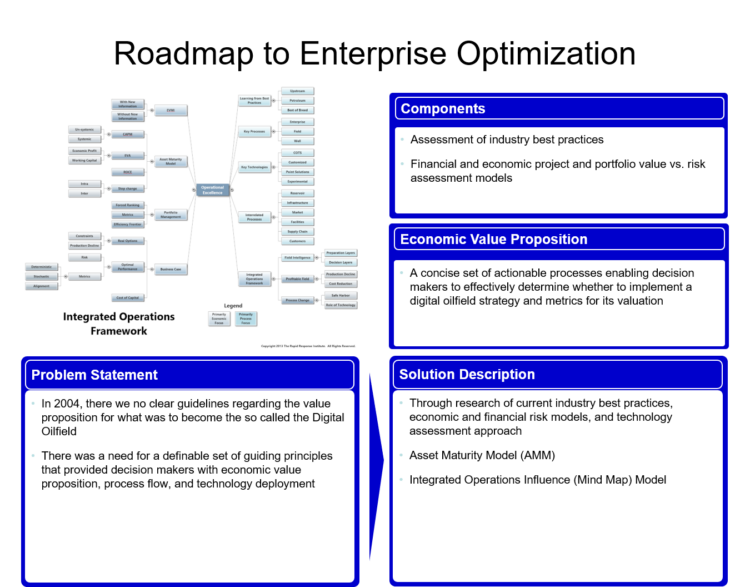
    Click for full size Integrated Operations Framework or graphic

    Since then, we have updated this roadmap into an Operational Excellence Platform.  Note that Integrated Operations is a key component.  The platform is a robust detailed solution that is available not just to the energy sector but all sectors identified by Homeland Security as Critical Infrastructure.  These sectors were recently identified as susceptible to hacking by the US government.

    Getting Smart

    Enormous corporate (shareholder) wealth has been destroyed implementing ‘game changing’ technology enabled transformation efforts.  Are we about to do that again, getting smart?  The easy answer is yes, but it does not have to be.

    Roadmap constructs are well understood and provide guidance.  In some models the step by step process provide practitioners with well defined models that can lead to success–defined as on time and under budget performance against Key Performance Indicators (KPIs).

    We are in the process of writing a book, to be released in 2022.  One chapter will define a roadmap for the transformation to ‘Smart’ for a major industrial segment.  As with earlier works, it will focus on the human element aligned with a technology assessment process.

    Get Smart was a comedic TV show spoofing the Cold War ‘spy’ environment of the 1960s.  Getting Smart today may not be a lot different.  The goal under a ‘Cone of Silence‘ was to attain and sustain competitive advantaged achieving superior stakeholder returns.

    Getting smart in 2021 will require a ‘Roadmap to Smart.’  A set of ‘to do’ processes that assures success.

    What is your Organization’s Plan to put Smart Decisioning Making Processes in Place?


    For More Information

    Please note, RRI does not endorse or advocate the links to any third-party materials.  They are provided for education and entertainment only.

    For more information on Cross Cultural Engagement, check out our Cross Cultural Serious Game

    We presented, Should Cross Cultural Serious Games Be Included in Your Diversity Program: Best Practices and Lessons Learned at the Online Conference, New Diversity Summit 2020 the week of September 14, 2020.  Check Out this timely event and contact the organizer for access to the presentations!!

    You can contact this author as well.

  • ESG Implementation–Strong v Weak Revisited

    ESG Implementation–Strong v Weak Revisited

    “A healthy corporation acts on the interests of its stakeholders and customers”

    — Ari Melber, Journalist

    Currently, organizations are being implored to implement Environmental, Social, and Governance (ESG) driven business models.   Proponents even suggest that investment in organizations that do not have this imprimatur should be avoided or even divested.

    However, one wonders what has changed?  Successful firms, private and public have long understood that they must add value to their constituencies.  One example, a few decades ago an energy services provider used its high volume oilfield pumps to help a small town in Kansas where it had a district office drain flood waters.  Why would they do this?  Perhaps because employees lived in this community or perhaps it was just the right thing to do.

    Flash forward and we find organizational largess still in place.  During the recent Texas freeze, a local furniture retailer opened its doors to dispossessed individuals and families.  The owner has a long record of supporting the community and his responses to local disasters is legendary.

    After the Deepwater Horizon incident in April 2010, our firm started to look at Asset Integrity issues in oilfield operations.  Our discoveries transcended several Critical Infrastructure segments.  The recent failure of the Colonial Pipeline is a manifestation of issues uncovered yet not resolved more than a decade ago!

    Focus on Operations

    In 2011, we posited that organizational governance was not just a financial issue at the ‘C’ level.  Rather its true focus should be at the revenue generating asset level.  This led to our 2011 groundbreaking monograph, Asset/Equipment Integrity Governance: Operations–Enterprise Alignment.  Therein, we posited a new governance model that incorporated the ESG components widely discussed today.

    Moreover, in 2014 our book, IMPLEMENTING A CULTURE of SAFETY: A ROADMAP FOR PERFORMANCE BASED COMPLIANCE identified the requirement for organizations in the Critical Infrastructure space to change governance models to one of Strong Bond.

    Following the release of our AIG model, we put forth a Strong v Weak governance model to manage High Reliability Organizations (HRO) necessary for firms in Critical Infrastructure sectors.  Strong Bond is appropriate for organizations in Critical Infrastructure segments, while Weak Bonds may be better for retail.

    One suspects that ESG is another tick in the box.  If ten years (or earlier) from now another critical system fails, it will not be because HRM processes were not followed or ESG verbiage was in the annual report Letter to Shareholders; it will be because nothing really changed.  As of this writing the US Federal government is advising organizations in Critical Infrastructure sectors to more aggressively address cybersecurity risks.

    Why is this? Do Boards and CEOs need politicians and bureaucrats to tell them about the details of running a business?  If they do, investors may want to revisit their portfolios.

    One suspects that the ESG fad will fade. There will always be a new management mantra that consultants will put forth.  Well run organizations will remain well run.  Others not so much.

    Governance models come and go.  Regardless, how will you assure your organization is well run?

    For More Information

    Please note, RRI does not endorse or advocate the links to any third-party materials.  They are provided for education and entertainment only.

    For more information on Cross Cultural Engagement, check out our Cross Cultural Serious Game

    We presented, Should Cross Cultural Serious Games Be Included in Your Diversity Program: Best Practices and Lessons Learned at the Online Conference, New Diversity Summit 2020 the week of September 14, 2020.  Check Out this timely event and contact the organizer for access to the presentations!!

    You can contact this author as well.

  • I Didn’t Do It, He Did — I Didn’t Do It Either, Someone Else Did

    I Didn’t Do It, He Did — I Didn’t Do It Either, Someone Else Did

    “When converted into productive thought and action, the energy it takes to blame, shame, and game is enough to launch anyone into heights of real success and happiness.”

     – Charles F Glassman

    Entrée

    It is not often that an entire geographically LARGE state loses power and water simultaneously.  Now we know it can happen!  Welcome to Texas (ERCOT) circa the dawn of the 21st Century.

    The finger pointing and claims, ‘not my responsibility’ surfaced immediately at all political levels.  As I sat in my power free, cold, waterless house, I was moved that political leadership was focused on saving their own hides.

    Benjamin Franklin’s words, “We must all hang together, or, most assuredly, we shall all hang separately” are lost on our hyper partisan world.  Earth to all polls, there is enough blame on this one to go around.  This society loves to Share and Like and is quick to find fault.

    The usual suspects will pontificate about blaming others and legal initiatives have already surfaced.  Good media, but who actually cares?

    This blog post is not about politics or the blame game.  It rather posits a solution that sees that this never happens again–anywhere.

    Operational Excellence Platform

    Excellent performance requires a conscious effort at all levels of an organization and its ecosystem.  We embodied a approach for heavy industry in our 2012 article, High Reliability Management in Process Industries: Sustained by Human Factors.  In that piece we put forth the argument that High Reliability Management is a strong methodology for management large complex systems such as the Texas Electric Power Grid.  HRM provides organizations with Agility, Resiliency and Sustainability in the face of large complex incidents.

    As we have previously put forth, Normal Accident Theory (NAT) posits, “that some accidents are inevitable because of system complexity.”  While logical, this model has its critics and lacks empirical evidence.

    The Texas electricity power grid got into process/technological/engineering trouble rather quickly.  Debate will rage for years as to what actually happened.  However, it seems practitioners at all levels practiced NAT.  Like Deepwater Horizon, this event did not have to happen.

    Safety Culture

    At the core of High Impact Performance is a strong safety culture.

    Systemic Safety Culture as the Core Set of Values and Behavioral Economics of ALL participants of the extended organization and its Enterprise Risk Management strategy that reflect a Strong Bond Governance commitment to behaving as a High Reliability Enterprise Ecosystem in a safe and environmentally responsible manner.

    Going Forward

    The over used phrase, ‘teachable moment’ suggests that we learn from our history so as not to repeat it.  Most likely oxen will be gored, witch hunts abound and the likelihood of little tangible progress will be made.

    Career losses will most like exceed the six board members who have already resigned.  All because the reactive NAT model was followed.  One is well advised not to follow this lead.

    How are you making sure that your operations processes are proactive?

    For More Information

    Please note, RRI does not endorse or advocate the links to any third-party materials.  They are provided for education and entertainment only.

    For more information on Cross Cultural Engagement, check out our Cross Cultural Serious Game

    We presented, Should Cross Cultural Serious Games Be Included in Your Diversity Program: Best Practices and Lessons Learned at the Online Conference, New Diversity Summit 2020 the week of September 14, 2020.  Check Out this timely event and contact the organizer for access to the presentations!!

    You can contact this author as well.

     

  • Technology Assessment in the Era of Minimum Viable Product (MVP)

    Technology Assessment in the Era of Minimum Viable Product (MVP)

    App developers have fallen in love with the concept of Minimum Viable Product aka MVP.  Wikipedia defines minimum viable product (MVP) as “a version of a product with just enough features to satisfy early customers and provide feedback for future product development.”

    This development model might make some sense for consumer software or even some business data analytics but how does it work for mission critical software and those apps that allow remote connectivity to those data resources?  MVP is problematic in these cases at best.

    Most mission critical software development organizations understand that robust testing is necessary, yet sometimes the specter of the MVP mentality sneaks its camel nose under the tent.  Think this does not happen?  Think again.

    The Boeing 737 Max 8 is one current example of this phenomena.  One can argue that the costs to this organization, its customers and the flying public have been astronomical and perhaps not measurable.

    Many of us will not be flying any time soon and many months ago this writer has been told by a knowledgeable individual that safe work around for the Max8 software issues have always been readily available—even before the crashes.  There is a more onerous issue that affects everyone on the planet is widely accepted by policy makers.

    We extend the construct of MVP to Minimum Viable Thought.  MVT is defined as, “The version of a decision that the decision makers believe will be accepted by organizational executives and public policy makers.”

    As of publication, this statement is posted on The Institute for Health Metrics and Evaluation (IHME) at the University of Washington.  “To construct our “Current projection” (the line that shows what we think will most likely happen), we assume that in each location the trend of easing mandates will continue at its current trajectory until the daily death rate reaches a threshold of 8 deaths per million.  If the daily death rate in a location exceeds that threshold, we are assuming that mandates will be reintroduced for a six-week period.”

    We do not dispute modelers making assumptions.  We do that same.  However, this caveat.  Decisions made based modeling assumptions such as these often lead to cataclysmic results.

    The concept of MVP can be a slippery slope.  In an era of rapid software/data release, the risk to the public whether in airplanes or a pandemic can be huge.

    The assessment of such technological solutions needs to be robust and thought through.  Not the knee jerk response often seen.

    How do you assure new technology implementation does not material negatively impact on your business?

    For More Information

    Please note, RRI does not endorse or advocate the links to third-party materials.  They are provided for education and entertainment only.

    For more information on Cross Cultural Engagement, check out our Cross Cultural Serious Game

  • Agility, Resiliency, Sustainability

    Agility, Resiliency, Sustainability

    In a recent Harvard Business Review, I was struck by an article about Best Practices for small businesses.  From that piece, “To successfully navigate Volatile, Uncertain, Complex and Ambiguous (VUCA) challenges like Covid-19, family business leaders can look to best practices from another organization that specializes in VUCA situations—the U.S. military’s Special Operations Forces (SOF)” (emphasis added).  There are a lot of good ideas in the article that organizations can implement immediately.  Moreover, we have long recognized that properly vetted and adjusted as necessary, Best Practices from others can add significant value to organizations in other industries.

    Out of the Darkness

    It is easy to be overwhelmed these days.  Mildly put, most if not all organizations were thrown into chaos in less than a month.  Depending on your business you are either partially operating or still waiting to open-up.

    Regardless, how you work in June will be different than early March (~60 days as of this writing).  Traditional recession management and recovery techniques may not be applicable this time.

    There are lots of ideas about how to use technology going forward.  Digitalization, IoT, IT-OT, among others are hawked as THE solution.  Problem is, it is not that simple, and it takes time and money to implement.  Many midsize firms do not have those privileges/resources.

    There are a lot of actions most organizations can take without major CAPEX investments in time and money.

    Years ago, we recognized that certain industrial sectors, particularly those with a high-risk profile such as energy or others deemed to be part of Critical Infrastructures face unique challenges.  Some have a tendency towards incremental change or even the status quo.  Change is often slow with setbacks.

    Moreover, for every major firm there can be thousands of organizations in the supply chain ecosystems all of which must work well if total costs and profitability for all are to be effectively addressed.

    This seemingly daunting task yet it need not be.  There is a solution set available that can help organizations manage through this dark period and into the light, thriving.

    The mission of The Rapid Response Institute is;

    “Helping Clients Achieve Organizational Agility, Resiliency and Sustainability”

    To that end, we have developed solutions, methodologies, and tools enabling enterprises of all sizes to not just survive but thrive after disruptive events.  Much of this is either free or at low cost.

    Rapid Response

    In our 2009 White Paper, Rapid Response Management: Thriving in the New World Order we posited our new approach to managing your business.  “Rapid Response Management (RRM) is an organizational construct or mental model that enables the organization and its key partners to rapidly sense changes and respond accordingly–quickly.  While it maximizes the effectiveness of management knowledge to address change, it is not simply gut feel.  Rather it is a simple yet sophisticated, methodical paradigm any organization can quickly and inexpensively implement.”

    RRM is a creative and well documented method for running your business.  The thinking was well advanced by 2009 and has been further ‘stress tested’ over the past decade.

    We have updated RRM with our Operational Excellence Platform and interested readers are invited to check that out as well.  Our offerings are designed to help our clients get through crises such as Covid-19.

    We are updating this white paper and it will be available as an e-book in the near future.  If you would like to reserve a free copy, Contact us.

    We are here to shed some light during this dark period.  For no cost, no obligation discussion contact us.  We can put decades of experience dealing with business cycle adversity on your team.

    Feel like your trapped?  You’re NOT!

    For More Information

    Please note, RRI does not endorse or advocate the links to third-party materials.  They are provided for education and entertainment only.

    For more information on Cross Cultural Engagement, check out our Cross Cultural Serious Game

    We presented, Should Cross Cultural Serious Games Be Included in Your Diversity Program: Best Practices and Lessons Learned at the Online Conference, New Diversity Summit 2020 on April 9, 2020.  The summit will be offered again soon.  Check it Out!!

    You can contact the author as well.

  • A Funny Thing Happened on the Way to . . . Innovation!

    A Funny Thing Happened on the Way to . . . Innovation!

    The anecdote, ‘A Funny Thing Happened on the Way to’ wherever manifests itself for a number of paths.  One interpretation; we often end up somewhere other than expected.

    We find ourselves at another historical precipice.  Some suggest Armageddon, the end of life as we know it and the emergence of a new normal.  This writer only agrees with the last two words.

    New Normal

    Since the advent of Covid-19 in the United States (probably before) the medical community has been doing some great things at hyper speed.  Now it is hard to keep up with the creative, innovative and downright amazing work being done at the global scale.

    Some argue that the new normal will include an army of remote workers.  Probably some truth to that but perhaps more importantly will be the recognition that society can quickly ‘scale’ to the global level when confronted with new and unknown threats.

    Reduced Cycle Time and Cost

    This pundit has long advocated that the use of knowledge enabled by technology can reduce project cycle time dramatically.  It can also significantly reduce project cost as well.  If we visualize the Covid-19 global initiative as a project, then perhaps most importantly we can decrease the timeline pointedly.

    To be clear, this writer has no medical training and is only prognosticating that the use of knowledge enabled by technology can reduce the overall time and impact of the pandemic.  After all, this is not 1918!

    For example, many will be familiar with the TV sitcom, M*A*S*H, set in the Korean War of the early 1950s.  We are seeing modern day versions of the Mobile Army Surgical Hospital with the deployment of new ‘temporary’ hospital beds to virus hot spots like NYC.  The medical profession has established long standing triage protocols as well.

    Moreover, the use of 3D printing has augmented the medical equipment manufacturing process in ways no one could have foreseen on January 1, 2020.  Changes in Clinical Trial protocols and other pharmaceutical related processes are, as the saying goes, ‘on steroids’ destroying this virus.

    The list goes on and shortly after this publication, this post will probably be outdated—the rate of positive change is so explosive right now.

    Donald Rumsfeld gets credit for saying, “There are known knowns.  These are things we know that we know.  There are known unknowns.  That is to say, there are things that we know we don’t know.  But there are also unknown unknowns.  There are things we don’t know we don’t know.”  However, this construct has its roots in the 1950s.

    I am betting that last sentence will fall sooner rather than later.  We are rapidly learning what we don’t know we don’t know.

    Godspeed to all on the front line and those of us who are not will continue to support you in every way known and about the be known that we can.  This writer grows less concerned about the final outcome every day.  It seems that collectively Humankind is rising up to the challenge.  We will prevail!

    How is your knowledge enabled to contribute to the demise of this pandemic?

    For More Information

    Please note, RRI does not endorse or advocate the links to third-party materials.  They are provided for education and entertainment only.

    For more information on Cross Cultural Engagement, check out our Cross Cultural Serious Game

    We will be presenting, Should Cross Cultural Serious Games Be Included in Your Diversity Program: Best Practices and Lessons Learned at the Online Conference, New Diversity Summit 2020 beginning April 5, 2020.  Check it Out!!

    You can contact the author as well.

  • Is Big Data Analysis Being Applied?

    Is Big Data Analysis Being Applied?

    We have been hearing for years how, Big Data Analysis will help us optimize our businesses and generate performance at levels here to for never hear of.  So where is it now?

    Two major sources for data on the Covid-19 virus are Johns Hopkins University and the Centers for Disease Control and Prevention.  This is fine at one level.  Living in the Houston, Texas metropolitan area, this pundit can see a general (real time) overview of the situation from either.

    However, my home is on the west side of the city.  I was recently surprised to learn that most of the local exposure is on the east side; 30+ miles from my domicile.  Is my risk lower than I am being told by the authorities?  Or is it the same or higher?

    Why am I staying at home?  Perhaps the result of a blunt policy instrument?

    It appears to me that most medical professionals are not Data Scientists.  Absolutely knowledgeable in their field, including pathogens (I personally know many in the field including a pathologist).  Is that system taking help from data scientists?  I have not heard that it is.

    Additionally, if the argument is we don’t yet have enough data, this holder of a doctoral degree will argue that Small Data set modeling can be effective as well.  My doctoral dissertation was founded on these statistics.

    I have no doubt that the best minds are working this problem.  However, if policy makers take a hammer to the nail, when perhaps a series of tacks is appropriate, significant economic damage will continue.

    The tack approach appears to be what we are hearing about certain parts of the United States coming back online in a week or so.  The concept of months some advocate makes no sense to this writer.  We will see social unrest long before that.

    The Big Data Analysis sector has been pressing their value proposition and software/solutions for years as a way of optimizing businesses.  Why is the sector quiet regarding coronavirus?

    If we can parse data and sell web advertisements based on ‘clicks’ why can’t we figure this out a level of granularity that allows the economy to restart (at least in some geographies)?  Get to work guys and prove my concerns wrong!

    Finally, what is the role for Artificial Intelligence (AI)?  Its advocates suggest it has magical powers and it  has been used to solve other problems.  Prove it on this global stage!

    Where are Big Data and AI in this fight?

    For More Information

    Please note, RRI does not endorse or advocate the links to third-party materials.  They are provided for education and entertainment only.

    For more information on Cross Cultural Engagement, check out our Cross Cultural Serious Game

    We will be presenting, Should Cross Cultural Serious Games Be Included in Your Diversity Program: Best Practices and Lessons Learned at the Online Conference, New Diversity Summit 2020 beginning April 5, 2020.  Check it Out!!

    You can contact the author as well.

  • In Defense of Humans—Machines Are Not Ready Yet

    In Defense of Humans—Machines Are Not Ready Yet

    I recently submitted an internal organizational document that was spellchecked in addition to my review; several times.  One sentence where there the intent was to say, “that which is …” was change to “that witch is …”

    Did I type it wrong or did ‘auto correct’ take over the decision process?  In any event spellcheck did not perform adequately against minimal Quality Assurance standards.  And how many of us ‘fat finger’ text messages?

    Is this is the technology that is going to drive me to work safely over 200 days a year; round trip?  I hope not.

    One pervasive message—technology gets better with time (more mature).  Is this true?

    How old is spellcheck?  By some accounts it dates to the 1960s.  Most believe by the late 1970s.  So close to half a century.  Yet!

    Usually a spellchecker is not used in a life or death situation.  That is unless it’s for your resume or job application!  However, what about software that is utilized for critical processes, i.e., medicine, process control, etc.

    There are many examples where apparent software failures have negatively impacted human life.  This pundit has written this subject including a look at Man Machine Codependency.  In another blog we commented on problems associated with valid and reliable analysis of Big Data.

    In this author’s opinion, software is getting better and while most likely will not be perfect, will change our daily processes.  The human overlords will need to be trained and/or retrained for the digitalization era.

    This cautionary tale is not about this writer’s inability to use word processing tools.  As we depend on these tools for critical decision making, we must have the core knowledge of the subject we are tackling.

    During a class on digitalization for my master’s level students, I put forth several examples where errors were made by various software applications.  Most had a level of comedy to them, but ALL have potential real-world consequences (bold font).

    • All People in Canada are the Same AgeDemographics for Census or Marketing
    • In Excel 2007, multiplying 77.1 times 850 yielded 100,000 instead of the accurate answer 65,535—Accounting or Engineering
    • The Making of a Fly, a classic work in developmental biology, was listed on Amazon.com as having 17 copies for sale: 15 used from $35.54, and two new from $23,698,655.93 (plus $3.99 shipping)–Procurement
    • Finally, Airline Disaster on AutopilotSafety for the Traveling Public

    This writer has authored books, articles, speeches, presentations, and blogs for many years.  Arguably, he can claim some experience as a writer.  Subject Matter Expert?

    In one instance, the ‘witch’ word won over my intent.  Did the technology cause this error?  Probably, as the goddess of Halloween is not something I typically pontificate about—not on my radar, so to speak.

    Humans can rule for the foreseeable future.  That is unless we seed to the technology.  Most importantly, algorithmic errors can lead to cataclysmic business and even life events.

    Finally, I spellchecked this blog before publication, and it caught the ‘witch’ word this time.  Go figure.

    How Prepared is Your Organization to Oversee the Digitalization Transformation?

    For More Information

    Please note, RRI does not endorse or advocate the links to other materials.  They are provided for education and entertainment only.

    You can contact the author more information as well.

    End Notes

      https://en.wikipedia.org/wiki/Spell_checker

      https://therrinstitute.com/wp-content/uploads/2018/10/Man-Machine-Codependency-September-22-2014.pdf

      https://therrinstitute.com/wp-content/uploads/2018/10/Big-Data-Revisited-December-15-2016.pdf

      https://consult2050.com/job-disruption-due-to-digitalization/

  • Elevator: Going Up or Going Down?

    Elevator: Going Up or Going Down?

    True Story!  A couple of decades ago when I was the sales manager of a technology line of business that was part of a much larger organization, an excited young sales representative rushed into my office.  He just had to tell me that he just rode up the elevator and an older gentleman wearing a suit who had asked him about his business.

    He explained in the short time it took to get to our floor he had essentially ‘cored dumped’ everything he knew to this stranger.  When asked if he got his name, the answer was no.  Turns out the individual was the CEO of our division.

    While this was a discussion in an elevator, it was far from an elevator pitch.  Talking fast to get as much as you can in a short period is usually not an effective sales pitch.

    Plus, as always qualify who you are talking to and why they have a need to know.  Could have been a competitor!

    Unfortunately, we see this all the time.  Individuals try to jam in as much as they can in funding Pitch Competitions and political pundits in the media feel the same pressure to talk fast and then talk all over each other.

    However, and perhaps the worst of all selling transgressions.  We had attained a long-coveted meeting with a senior decision maker at a process plant.  We completed the pitch for our solution.  The customer team asked a couple of good questions which we apparently answered satisfactory.

    Then the senior director said words to the effect, “I can see how this can help my problem. . .” but did get a chance to complete his statement before one of our technical people ‘talked over him’ to explain blah blah blah.

    The classic, don’t wait for the customer to complete his/her question before answering it.  This usually means that it will be answered incorrectly.

    The subject changed, and the meeting ended shortly afterwards.  We never did discover how our solution could have helped in the mind of that individual.

    In our zest to close deals, we often are our own worst enemy.  When presented with an opportunity to state your case to a buyer, state it succinctly and quickly.  Then shut up and let the individual respond!

    Elevator Pitch

    According to Wikipedia, “An elevator pitch, elevator speech, or elevator statement is a short summary used to quickly and simply define a person, profession, product, service, organization or event and its value proposition.

    The name “elevator pitch” reflects the idea that it should be possible to deliver the summary in the time span of an elevator ride, or approximately thirty seconds to two minutes.  The term itself comes from a scenario of an accidental meeting with someone important in the elevator.  If the conversation inside the elevator in those few seconds is interesting and value adding, the conversation will continue after the elevator ride or end in exchange of business card or a scheduled meeting.”

    Mark Twain famously quipped, “I didn’t have time to write a short letter, so I wrote a long one instead.”  It takes time and thought to succinctly and quickly state something that is very important to its writer.

    The tendency is to say as much and as fast as we can.  Surely, everyone will want to know what I know and in detail.  This is such an important subject!

    However, if a deal is on the line what is the Return on Investment (ROI) of the time it takes to develop and refine an elevator pitch?  Like any business deal, if it will be profitable then do it.  If not, then why do we have the product/service!

    The ‘I didn’t have time’ comment is insulting to those who you explain it to in this regard.  The sales representative’s livelihood and firm’ profitability depend on you the rep’s team’s time.

    How Do I Develop an Elevator Pitch?

    To develop an effective elevator pitch, one must understand the product/service they are selling and have a ‘compelling value proposition’ already developed.  Write down every major item you want to get across and then continue to refine it until it meets the criteria above.

    What are the three most important points a customer would care about?

    Pitch it internally and then to outsiders such as mentors.  Update it as you receive additional input, both positive and critical.  Then Practice, Practice, Practice.

    It must come across effectively, not stilted nor leave the listener with the feeling they have been the subject of a ‘core dump.’  Let them respond, answer questions and ask them, “What’s the Next Step” sort of closing question.

    One caveat, since you do not know who you are talking to be careful about providing any proprietary information.  So, unless you have publicly available market or financial figures leave them out.  They can come later at follow up meetings.

    However, in the appropriate setting such as a Pitch Competition non-proprietary market and financial information will most likely be required in the elevator pitch.  Use your good judgement.

    For most of us the so called ‘blank sheet of paper’ can be intimidating.  It helps to have precedents.

    An Example

    The following is an actual elevator pitched developed a few years ago—targeting 20-30 seconds in a public setting.  It has been redacted as noted within it.

    _______ is an __________ “Enterprise Platform” that addresses _________-issues in sectors with complex ______ and ______ requiring many ____ parties and their _____.

    It seamlessly incorporates _____ and ______ enabling a _______, efficiency and effectiveness in operations—including an automatic and comprehensive ______ process.

    This cloud-based collaborative ____ solution provides ____ engineers, technicians and ______ personnel with the data and information necessary to perform their tasks in compliance with all __________________.

    There are also several examples available on line that address different requirements, i.e. sales, investor, etc. and industry sectors.  A good pitch will pay significant dividends and is well worth the time and energy necessary to develop.

    How Effective is Your Elevator Pitch?

      https://en.wikipedia.org/wiki/Elevator_pitch

  • Three Years—Ten Months: How did they do it?

    Three Years—Ten Months: How did they do it?

    The United States officially entered World War II on December 8, 1941.  The war in the Pacific formally ended on September 2, 1945.

    A recent documentary on one of the history channels chronicled the path the United States took from a nation with an underdeveloped military to global dominance over this period.  What struck this author was the technological distance covered.  Not just marshaling the military and civilian workforce, but how heavy industry, including maritime (ships), aircraft, and weapons advanced so quickly.

    Some might say that this period was unique in human history with a strong focus on the survival of the nation.  No doubt this line of thinking persisted at the time, but perhaps something else was driving this behavior.

    Crisis Management is appropriate when nations, industrial sectors, organizations and even individuals are in times of stress.  By some accounts, the managerial prowess of this period stems from the knowledge of industrial manufacturing and logistical processes. 

    While the ‘War Agencies of the Executive Branch of the Federal Government’ played important roles in this wartime effort, it was not this alone that caused a juggernaut to appear.  The size of the United States, “prewar technological industrial base” and “large population” were also contributing factors.

    Large scale hostilities brings a spotlight that is not normally held during peace time.  The fight or flight instincts of all humans help bring focus in times of trial.  However, organization and management are important for societal success for either option.

    Attaining and sustaining Critical Mass in those Critical Success Factors (CSFs) were key to enabling the rapid ascent to industrial might.  Has anything changed?

    Parallels to Today

    A recent article, The Oils Shock That Never Was, reflected on the advancements the upstream oil and gas sector made during the recent downturn.  The piece makes the case that while most prognosticators predicted so-called doom and gloom often associated with downturns, the opposite seems to have happened, particularly in the shale space.

    In a previous blog, we put forth the rationale that Operational Excellence is the key to strong financial performance.  The Oil Shock article documents the transformation of the overall industry Cost Structure.  Operators are also focusing on sectors where profits are possible at current commodity price points.

    Moreover, firms are capitalizing on existing infrastructures that are supported by new technologies.  This sounds familiar to the behaviors of economic actors almost eighty years ago!

    However, challenges remain for service sector providers.  Could these firms utilize World War II business models employed by shipbuilders in the 1940s?

    Does Your Organization have Critical Mass for its CSFs?

    For more information:


      https://www.files.ethz.ch/isn/23588/mcnair50.pdf

      https://www.rigzone.com/news/the_oil_shock_that_never_was-30-jan-2019-158034-article/?utm_campaign=WEEKLY_2019_02_01&utm_source=GLOBAL_ENG&utm_medium=EM_NW_F1

      https://therrinstitute.com/beat-the-market-can-operational-excellence-increase-eps/

  • Beat the Market: Can Operational Excellence Increase EPS?

    Beat the Market: Can Operational Excellence Increase EPS?

    In a recent Houston Chronicle article, its author puts forth the premise that while oil and gas companies should do well in the stock market this year, don’t expect the energy services sector to fare as well.  As those who are either in the sector or track it (stock analysts) know all to well that when the price of oil dips, so do the Returns of those companies that provide equipment, labor and other services to the E&P sector.

    The crude oil commodity price has always been cyclical.  Often Boom—Bust, this leads to the hiring and firing of tens of thousands of employees and contractors.

    As many as 750,000 in the 1980s were fired (not to mention those businesses that provided products/services to these individuals and companies).  A lousy career choice that may limit new entrants who will not be guaranteed a salary during a short-term “shut down.”

    For years, this pundit has held the belief that due to technology advancements in both engineered products/services and information management that a return to the good ole days of $100 oil is not likely.  Economic actors in the sector must continue to adopt new business models and processes, not just to remain competitive but to stay in business.

    For example, Weatherford International, founded in the 1940s is endangered of being delisted by the New York Stock Exchange.  Baker Hughes continues to struggle as General Electric has announced its divestiture.

    We remain committed to the belief that oil is probably well within a trading range that will not provide price relief to the service sector.  That said, how can energy service survivors return shareholders reasonable value?

    The traditional business model of layoffs and equipment stacking is well underway.  Short term Stop the Bleeding which makes one wonder why this sector added 10,000 in just the last two years during a ‘weak’ recovery.

    The Future is Now

    The concept of the so-called digital oilfield has been around for decades.  This author was first formally involved with construct in the early 1990s when it was titled the Digital Oilfield of the Future.  Hasn’t the future arrived?

    In 2004 we released an industry supported research project, Roadmap to Enterprise Optimization: A Guide to the Impact of Information Driven Field Operations on the Petroleum Corporation.  Other articles, white papers, blogs and workshops continue to date.

    In the recent Houston Chronicle article, one interviewee believes that the energy service sector needs to Collaborate and Digitalize if they are to generate higher Earnings per Share. 

    This leads one to question, why after all these years is the disconnect the same as two decades ago?  We can no longer blame the Baby Boom generation as the brake on digitalization.  The Boomers have largely left the sector building.  Moreover, we can no longer blame the cost and maturity of information technology.

    So, if the blame game is over how can the sector attain and sustain these laudable process goals?  One can make a case that business/technology models and their value propositions were either fragmented or not understood by management.

    Having attended countless conferences, seminars, et al. over the years there does tend to be a narrow focus on each business need.  For example, downhole, big data, safety, decommissioning, digital oilfield, offshore, drones, onshore and so the list goes.  All vying for the same CAPEX.

    Those days may be over.  The Operational Excellence construct directly addresses all the field driven processes and technologies necessary to assure profitable performance.

    As with other initiatives, what is needed is an actionable methodology with a well understood value proposition.  Today, even smaller energy services companies can implement Operational Excellence.  A solution is available!

    Operational Excellence is the key to higher Earnings per Share and greater investor interest in the firm.  This is true for both public companies as well as private and their banking/investor relationships.

    What is Your Organizations Excuse for Not becoming Operationally Excellent?

    For more information about how to solve the weak Earnings per Share problem, check out our new Operational Excellence Platform.


      https://www.houstonchronicle.com/business/energy/article/Several-major-changes-on-the-horizon-for-troubled-13556827.php

      https://therrinstitute.com/wp-content/uploads/2019/01/Dr-Scott-M-Shemwell-Publications-and-Interviews-January-2019.pdf