
Tag: high reliability

  • Reputation, Reputation, Reputation

    Reputation, Reputation, Reputation

    “It takes 20 years to build a reputation and five minutes to ruin it.  If you think about that, you’ll do things differently.”

    – Warren Buffett

    It is fascinating how many accident videos get posted to social media.  Guess we all go to NASCAR races to see car wrecks.  In some cases, videos are personal disasters for those involved.  In some cases, they are downright funny and in the category of what were they thinking.

    Equipment and facilities damage, lost production/project time, personal injury litigation are just some obvious costs.  One hidden cost is reputational damage.  Would you hire a firm that hires, does not train, and/or tolerates some of this behavior?  Probably not, and in some case a strong safety record is part of the procurement decision process.

    Risk Mitigation

    Most of the social media video show failures in occupational safety.  Typically, in the United States these would fall under the Occupational Safety and Health Administration (OSHA) and/or state and local safety regulations.  This is laudable, but without a broader safety governance framework, a lackadaisical attitude can continue.

    Under a Strong Bond Governance Framework, a robust Operations Management System (OMS) enables both public and private firms to realize the Safety Culture they seek that will keep them off the social media most watched list.

    Strong Bond Governance

    An organizational governance model with the following attributes first put forth by the author in our seminal 2014 book, following the Deepwater Horizon incident.

    • Direct, defined relationships that enables open and valid information between governance members.
    • Led by authorities who are closely connected and strongly bonded.
    • Strong Governance, Risk, and Compliance (GRC) system.
    • Back office and field processes combined into a single information model (OT-IT).
    • Designed for application and use in Mission-Critical Environments. [i]

    [i] Holland, Winford “Dutch” E. and Shemwell, Scott M. (2014). Implementing a Culture of Safety: A Roadmap to Performance-Based Compliance. New York: Xlibris.

    Operational Excellence

    Operational Excellence is the execution of the business strategy more consistently and reliably than the competition, with lower operational risk, lower operating costs, and increased revenues relative to its competitor.  It is needed more than ever in today’s technology driven rapidly changing business models, which require organizations to undergo end-to-end business transformation. Operational Excellence can also be viewed as execution excellence. 

    However, the focus of Operational Excellence goes beyond the traditional continuous improvement methods to a long-term change in organizational culture.  Companies in pursuit of Operational Excellence do two things significantly differently than other companies: they manage their business and operational processes systematically and invest in developing the right culture. 

    Operational Excellence manifests itself through integrated performance across revenue, cost, and risk. It focuses on meeting customer expectation through the continuous improvement of the operational processes and the culture of the organization.  The goal is to develop one single, integrated enterprise level management system with ideal flow.  The second component, a culture of Operational Discipline, is commonly described as doing the right thing, the right way, every time.  This culture is built upon guiding principles of integrity, questioning attitude, always problem-solving, daily continuous improvement mind-set, level of knowledge, teamwork, and process driven.

    Organizations attain and sustain Operational Excellence using tools such as Operations Management System OMS).

    A Typical OMS Framework includes all the major areas involved in organizational processes such as shown in this graphic.

    OMS is a collection of processes and procedures enabling a company to effectively manage business practices and achieve the highest level of Operational Excellence in daily operations.

    One of the more notable examples is the Safety and Environmental Management System (SEMS).  SEMS embodies the Safety Culture into the organization’s OMS.  This systemic model is incorporated into a Strong Bond Governance Framework causing safety to become ‘the way we do business.’  In other words, the culture of the organization and by extension its Ecosystem.

    Systemic Safety Culture

    In a culture of safety, people are not merely encouraged to work toward change; they take action when it is needed.  Inaction in the face of safety problems is taboo, and eventually the pressure comes from all directions — from peers as well as leaders. There is no room in a culture of safety for those who uselessly point fingers or say, “Safety is not my responsibility, so I’ll file a report and wash my hands of it.” 

    — Institute for Healthcare Improvement

    Systemic Safety Culture is the Core Set of Values and Behavioral Economics of ALL participants of the extended organization and its Enterprise Risk Management strategy that reflect a Strong Bond Governance commitment to behaving as a High Reliability Enterprise Ecosystem in a safe and environmentally responsible manner.

    Most Safety Cultures have a set of tenets similar to the nine shown in the following list.  These are based on those developed by the Bureau of Safety and Environmental Enforcement’s (BSEE) for marine offshore oil and gas operations and are typical of those used in other Critical Infrastructure sectors.

    Nine Tenets of a Culture of Safety

    1. Leadership
    2. Problem Identification and Resolution
    3. Personal Accountability
    4. Work Processes
    5. Continuous Learning
    6. An Environment for Raising Concerns
    7. Effective Communications
    8. Trust and Respect
    9. Inquiring Attitude

    Finally, it is common practice for parties to refer to a singular industry ‘Safety Culture.’  In reality since each organization has its own culture, there are literally hundreds if not thousands of Safety Cultures in any critical infrastructure sector.  As shown in the above figure, each individual can interact routinely with a myriad of other cultures, both internal to their organization as well as with external economic players.

    After the Deepwater Horizon disaster in 2010, the authors quickly recognized that all economic players in the industry regardless of size would need to immediately adopt a Safety Culture if they were to survive.

    The resulting 2014 book, Implementing a Culture of Safety: A Roadmap for Performance Based Compliance remains one the few that readers can use as a roadmap to incorporate a Safety Culture into their Operational Excellence business model regardless of industry.

    Smart OpEx

    Fifteen years ago, large organizational Operations Management Systems were struggling to incorporate structural safety as more than the so-called, ‘slips, trips and falls’ of OSHA regulations to one where safety is endemic to the culture.  Smaller firms, often participants in the supplier ecosystem were largely forgiven.  The logic being that the major contractors and operators would assure that the final work product met Safety Culture requirements.  This is no longer the case.  Firms of all sizes in every business sector with an operations component now require an OMS to manage not just internal operations but third-party contractors as well.

    The Smart OpEx Operations Management System software solution is joint venture between The Rapid Response Institute LLC and Knowledge Ops, Inc.

    As Mr. Buffet mentions, reputations can be lost in an instant.  According to a 2007 Harvard Business Review article, “In an economy where 70% to 80% of market value comes from hard-to-assess intangible assets such as brand equity, intellectual capital, and goodwill, organizations are especially vulnerable to anything that damages their reputations.”  While almost 20 years old, the premise of the HBR piece remains the case as Boeing, Bud Light, and others can attest.

    Put systems with checks and balances in place that enable the organizational governance and protect the company from entering the Halls of the Disreputable.

    An individual’s and organization’s reputation are everything.  How are you assuring both are protected?

    Pre order our new book

    Navigating the Data Minefields:

    Management’s Guide to Better Decision-Making

    We are living in an era of data and software exponential growth.  A substantive flood hitting us every day.  Geek heaven!  But what if information technology is not your cup of tea and you may even have your kids help with your smart devices?  This may not be a problem at home; however, what if your job depends on Big Data and Artificial Intelligence (AI)?

    Available April 2025

    For More Information

    Please note, RRI does not endorse or advocate the links to any third-party materials herein.  They are provided for education and entertainment only.

    See our Economic Value Proposition Matrix® (EVPM) for additional information and a free version to build your own EVPM.

    The author’s credentials in this field are available on his LinkedIn page.  Moreover, Dr. Shemwell is the coauthor of the 2023 book, “Smart Manufacturing: Integrating Transformational Technologies for Competitiveness and Sustainability.”  His focus is on Operational Technologies.

    We are also pleased to announce our forthcoming book to be released by CRC Press in April 2025, Navigating the Data Minefields: Management’s Guide to Better Decision-Making.  This is a book for the non-IT executive who is faced with making major technology decisions as firms acquire advanced technologies such as Artificial Intelligence (AI).

    “People fail to get along because they fear each other; they fear each other because they don’t know each other; they don’t know each other because they have not communicated with each other.” (Martin Luther King speech at Cornell College, 1962).  For more information on Cross Cultural Engagement, check out our Cross-Cultural Serious Game.  You can contact this author as well.

    For more details regarding climate change models, check out Bjorn Lomborg and his book, False Alarm: How Climate Change Panic Costs Us Trillions, Hurts the Poor, and Fails to Fix the Planet.

    Regarding the economics of Climate Change, check out our blog, Crippling Green.

    For those start-up firms addressing energy (including renewables) challenges, the author can put you in touch with Global Energy Mentors which provide no-cost mentoring services from energy experts.  If interested, check it out and give me a shout.

  • How Effective at Multitasking are We?

    How Effective at Multitasking are We?

    According to no less than the Cleveland Clinic, ” Studies (regarding multitasking) show it makes us less efficient and more prone to errors.”

    Cleveland Clinic goes on to make the case:

    • When tasks are easy and routine such as, “like listening to music while walking, or folding laundry while watching TV,” these are generally not a problem.
    • However, when tasks are difficult and complex the situation changes dramatically and attempts at multitasking can be dangerous and even deadly.

    Many of us live in neighborhoods where drivers can be fined if they talk on a cell phone (even handsfree) in a school zone.  Another example is the Federal Aviation Administration’s (FAA) Sterile Cockpit Rule which states, ” requiring pilots to refrain from non-essential activities during critical phases of flight, normally below 10,000 feet (3,048 meters).”

    Moreover, multitasking does not just have to be balancing a number of concurrent tasks, it can also  include managing tasks against some criteria, i.e. budget constraints.

    Safety, Safety, Safety

    In the blog series, as well as a host of publications include our 2014 book,  Implementing a Culture of Safety: A Roadmap to Performance-Based Compliance we have sought to drive the need for ALL organizations in the Critical Infrastructure sectors to live have a strong Safety Culture coupled with High Reliability operating performance.

    Meetings, Meetings, Meetings

    Similarly, many executives seem to prefer to spend their days going from meeting to meeting.  The belief is often that keeping busy is a proxy for progress.  In reality, it usually is not.

    Final Thoughts

    The referenced Cleveland Clinic article goes on to say, “The more we multitask, the less we actually accomplish, because we slowly lose our ability to focus enough to learn.”  In this multitasker, this sentence says it all.

    It is easy to watch TV while doing daily chores.  I do this all the time.  It is an entirely different matter to managing an offshore drilling process multitasking.  The systemic mistakes made in 2010 on the Deepwater Horizon are capture in detail in the book, Deepwater Horizon: A Systems Analysis of the Macondo Disaster.  Lessons learned are applicable to all in complex working environments.

    Does your organization favor multitaskers over those who focus?  If so, stakeholder value is likely degrading.

    For More Information

    Please note, RRI does not endorse or advocate the links to any third-party materials herein.  They are provided for education and entertainment only.

    See our Economic Value Proposition Matrix® (EVPM) for additional information and a free version to build your own EVPM.

    The author’s credentials in this field are available on his LinkedIn page.  Moreover, Dr. Shemwell is a coauthor of the just published book, “Smart Manufacturing: Integrating Transformational Technologies for Competitiveness and Sustainability.”  His focus is on Operational Technologies.

    “People fail to get along because they fear each other; they fear each other because they don’t know each other; they don’t know each other because they have not communicated with each other.” (Martin Luther King speech at Cornell College, 1962).  For more information on Cross Cultural Engagement, check out our Cross Cultural Serious Game.  You can contact this author as well.

    For more details regarding climate change models, check out Bjorn Lomborg ands his latest book, False Alarm: How Climate Change Panic Costs Us Trillions, Hurts the Poor, and Fails to Fix the Planet.

    Regarding the economics of Climate Change, check out our blog, Crippling Green.

    For those start-up firms addressing energy (including renewables) challenges, the author can put you in touch with Global Energy Mentors which provide no-cost mentoring services from energy experts.  If interested, check it out and give me a shout.

  • When Does It End?

    When Does It End?

    Once Again Organizational Safety Cultures Have Failed.  Why Does This Keep Happening?

    The controversial Normal Accident Theory suggests that in complex systems accidents are enviable.  So it would seem with continued major disruptions in Critical Infrastructure Sectors.  We have argued that this is not necessarily correct.

    Systemic Safety Culture

    Following the Deepwater Horizon incident in 2010 and building off our 2014 book, IMPLEMENTING A CULTURE of SAFETY A ROADMAP FOR PERFORMANCE BASED COMPLIANCE, we continue to address the issues associated with safety failures and developed a Roadmap towards the High Reliability Organization (HRO).  An HRO faces the same challenges are its industry peers; however, it has robust processes in place to quickly mitigate safety and critical operational exposures.

    As part of our practice, we have developed a robust toolkit to facilitate the rapid transformation to an organizational Safety Culture without business disruption.  Many of the tools are provided at no cost and are easy to use–their details are available.

    Culture Eats Strategy

    The aircraft manufacture Boeing and its supply chain are undergoing increased scrutiny as result of the Alaskan Airline Max 9 inflight door failure.  This is entirely appropriate.

    As part of this process, the aircraft producer’s culture has come into question.  Some argue the firm moved away from an engineering culture to a safety culture.  This pundit believes that they are one in the same for this sector.

    A more appropriate argument is that the firm has recently exercised other values at the expensive of aircraft manufacturing technology.  Is this a loss of focus and a deviation from core values and capabilities?  Always a danger, i.e., New Coke and Bud Light.

    Get Smart

    In our recent book, “Smart Manufacturing: Integrating Transformational Technologies for Competitiveness and Sustainability, ” we make the case that the smart extended factory floor (including supply chain partners) adds significant value to organizations in that sector.  This approach supports engineering/safety cultures while enabling certain social behaviors.

    We believe that a simple Safety Culture is insufficient in complex environments.  It must be coupled with High Reliable Management.  Only then can organizations capitalize on ‘Smart’ coupled with new solutions such as Artificial Intelligence.

    Is your Safety Culture Adequate?  If not, what are you doing about it?

    For More Information

    Please note, RRI does not endorse or advocate the links to any third-party materials herein.  They are provided for education and entertainment only.

    See our Economic Value Proposition Matrix® (EVPM) for additional information and a free version to build your own EVPM.

    The author’s credentials in this field are available on his LinkedIn page.  Moreover, Dr. Shemwell is a coauthor of the just published book, “Smart Manufacturing: Integrating Transformational Technologies for Competitiveness and Sustainability.”  His focus is on Operational Technologies.

    “People fail to get along because they fear each other; they fear each other because they don’t know each other; they don’t know each other because they have not communicated with each other.” (Martin Luther King speech at Cornell College, 1962).  For more information on Cross Cultural Engagement, check out our Cross Cultural Serious Game.  You can contact this author as well.

    For more details regarding climate change models, check out Bjorn Lomborg ands his latest book, False Alarm: How Climate Change Panic Costs Us Trillions, Hurts the Poor, and Fails to Fix the Planet.

    Regarding the economics of Climate Change, check out our recent blog, Crippling Green.

    For those start-up firms addressing energy (including renewables) challenges, the author can put you in touch with Global Energy Mentors which provide no-cost mentoring services from energy experts.  If interested, check it out and give me a shout.

  • Beware The Guns of March?

    Beware The Guns of March?

    Readers know that as of this writing there is geopolitical and military tension in eastern Europe.  Hopefully, the situation will resolve peacefully.

    This piece is not about those politics.  Rather it is about the potential for accidental engagement and how that risk can be mitigated.

    President Kennedy is famously cited for the comment that referred to the origin of the War to End All Wars, “Perhaps the greatest contribution historians have made to humanity, at least as historians sometimes tell it, came during the Cuban Missile Crisis when Barbara Tuchman’s book, The Guns of August, saved the world from nuclear war.  The book is Tuchman’s narrative of the origins of the First World War, an account that, in President John F. Kennedy’s reading, showed how miscalculation and inflexible military planning could force great powers into catastrophic conflicts against their leaders’ wishes.”  We might add, against the wishes of the populations that must endure the unbearable cost of stupid interventions.  As noted by Herbert Hoover.

    “Older men declare war. But it is the youth that must fight and die.”

    While the Cuban Missile Crisis worked out well for both parties, including the world in general, it was not necessarily a given.  Miscalculations such as the US lack of knowledge regarding nuclear weapons onboard Soviet submarines or the ‘launch’ upon the invasion of the island of Cuba order could have been disastrous.

    Misunderstanding during the 1983 military exercise Able Archer is another example of a near nuclear catastrophe.  And then there all the Broken Arrows,  nuclear weapon incidents (that we know of).

    Complex Systems’ Behaviors

    This blog series has commented on complex interconnected systems a number of times.  The  Risk Profile is dramatically increased in such systems.  Geopolitical and military systems must be viewed through this lens as well.  However, we know complex systems can be properly managed and thus reduce the likelihood of major global impact events.

    This process is grounded in High Reliability Management (HRM).  Wikipedia defines, “A high reliability organization (HRO) is an organization that has succeeded in avoiding catastrophes in an environment where normal accidents can be expected due to risk factors and complexity.

    This author believes that geopolitical and military complex systems can benefit from this model.  Given that the cost of these type failures is incalculable they certainty fits HRM profile.

    Folly Revisited

    In the 1930s Brinksmanship did not end well.  Following historical patterns, especially from World War I, Europe plunged into the abyss for the second time in two decades.  Miscalculations on the side of multiple parties in both conflicts let to unthinkable destruction and loss of life.

    Today’s militaries are much more powerful than ever.  Hopefully, from Shakespeare, “Beware the ides of March” does not portend this year.

    Geopolitical miscalculations, brinksmanship and other aggressive negotiations can go badly.  This is especially the case when adversaries are not in direct and frequent communication with all parties.

    Even then cultural differences put discussions at risk.  Temperance, communication and though is what saves the world from the unthinkable.  Hopefully, cooler heads will continue to prevail during the current crisis.

    Cross Cultural Negotiation

    The importance of cross cultural understanding cannot be overstated as geopolitics and businesses deal with complex, multi-faceted issues across many nations, ethnicities and cultures.  Old international negotiation models are no longer relevant.

    Behavioral Economics is foremost today.  All parties dealt with are by definition diverse.  They are composed of different genders, ethnicities and ages etc.  This is a more accurate model that reflects the reality of organizations today.

    Also, keep in mind that no nation is homogeneous.  Each is composed of separate regions, cities, with local backgrounds, cultures and more.  So when one talks about two or more geopolitical entities to be at odds over an issue(s), that model is too simplistic and can lead to greater risks as described earlier.

    These are more contributing factors for misunderstanding and miscalculation.  Most of us never ‘step in the other’s shoes.’  However, we can recognize the differences in perspectives, behavior and cultures.

    Changing the Playing Field

    We have often discussed the Relationships, Behaviors and Conditions (RBC) construct among economic actors.  The model argues that new Conditions or Situations and Behaviors change the Relationship among parties.  This applies at all levels of human interactions from two individuals to many nations.  It is applicable here as knowledge to help diffuse difficult situations.  For an in-depth review of the model, check the linked blog.

    No Guns this Time?

    The cascading events following the assassination of the Austrian, Archduke Franz Ferdinand by a small terrorist group is widely believed to have led to the beginning of World War I.  The sceptic must put forth, “you have got to be kidding me.”  Yet, it did happen.

    Our point here is that it does not take much to launch the horrible.  How many American doughboys died for that nonsense?  It can happen again and most likely will at some point given human nature.

    Business Contingency

    Geopolitical risk has always been one component of an organization’s risk profile.  What will be the impact on your business if the unthinkable happens in Europe again?  Other risk mitigation tools include social media.

    In 2013 we published ” Mitigating Operational Risk Using the Power of Social Media” that identified a methodology to better understand the beliefs and behaviors of local populations.  From the footnoted piece, “Large global enterprises can augment existing security and risk management with the same solutions used by the government entities in the defense sector at commercial price points.  The real question is not why, but why not?”

    Since that time, there have been significant advances in these capabilities.  Other readily available tools can assist as well.  Use inexpensive technology to protect global stakeholder interests.

    How Robust is Your Firm’s Contingency Plans for Geopolitical Uncertainties?

    For More Information

    Please note, RRI does not endorse or advocate the links to any third-party materials.  They are provided for education and entertainment only.

    For more information on Cross Cultural Engagement, check out our Cross Cultural Serious Game.  You can contact this author as well.

    Footnote

    Kuiper, Marcus A. and Shemwell, Scott M. (2013, February). Mitigating Operational Risk Using the Power of Social Media. Petroleum Africa Magazine. pp. 28-31.

  • 100

    100

    This edition marks the 100th post in our Critical Mass Blog series.  We have sought to provide thoughtful, unbiased insight into the contemporary business and organizational challenges we all face.  Since our first blog post on November 27, 2017 our world has turned over in ways none expected.  Likely, this trend will continue.

    This series continues a tradition of newsletters, opinion pieces and other on line punditry first begun in 1998 with our New Millennium News.  A bi-monthly email with a subscription base of approximately 7,000 readers.  A huge number at that time.  We estimate that hundreds of thousands or more have benefited from this knowledge transfer.

    Coincidentally, we reach this milestone as we begin the new year–a time of renewal.  We will continue to address critical issues individuals, businesses, agencies and others face as we all navigate an increasingly perilous path.  This series has addressed Human Resource issues including Diversity, Equity and Inclusion (DEI) Teams , the arrival of Smart Technology, International Business, Covid-19, Supply Chain Management, Operational Excellence, Cultural Transformation (including Safety Culture) Sales, Risk Mitigation and of course Leadership.  Today’s organizations must be very good at all of these disciplines!

    Available Tools

    The mission of the Rapid Response Institute (RRI) is to enable our clients with the ability to posture themselves in their market segments so that they can thrive in volatile markets and capitalize on uncertainty, not suffer because of them.  This is especially important for those economic actors in Critical Infrastructure sectors.

    In support of this mission the firm has developed a suite of Intellectual Property (IP) which includes Know How, practical roadmap Books and guidelines as well as Software as a Service (SaaS) solutions among others.  Many readers know that once a process has been standardized with minimal configuration required, the data is the ultimate driver.  This is the heart of most Enterprise Resource Planning (ERP) solutions.

    With advances in technology, RRI has taken these once multi-million dollar solutions to a price point as well as Use Case where all organizations can utilize this capability.  Moreover, our advancements in work flow such as epitomized in our Cross Cultural Serious Games, Economic Value Proposition Matrix, and Smart OpEx (Operations Management System) and Risk Simulation Modeling add immediate and significant value to the challenges faced as articulated above.  Other Free Tools are available as well.

    Pulling It All Together

    The method to our madness is–Operations!!  As some are fond of saying with derision, “It’s All About the Benjamins.”  Well, it actually is.  If ‘for-profit’ firms are not profitable, they fail.  No amount of Environmental, Social, and Governance (ESG) will save them if they cannot deliver to paying customers.

    Everything RRI does helps organizations to deliver stakeholder value, compliant with ESG standards.  That is our Bottom Line and we are also pleased that Dr. Shemwell, Managing Director has been an independent advocate for responsible corporate success since 2004.

    FYI, major losses and legal actions do not enhance stakeholder value.  Neither for employees, local communities or equity holders.  Everyone loses when in terrible scenarios such as Deepwater Horizon, internal bias corporate hubris, poor high reliability processes/human factor shortcomings or lack of actual DEI.

    This journey continues.  Stay tuned for the next 100 editions where will continue to provide our thoughts on relevant matters.  Thank you very much for your readership and support.

    How is Your Organization Positioned for the Next Four Years?

    For More Information

    Please note, RRI does not endorse or advocate the links to any third-party materials.  They are provided for education and entertainment only.

    For more information on Cross Cultural Engagement, check out our Cross Cultural Serious Game

    We presented, Should Cross Cultural Serious Games Be Included in Your Diversity Program: Best Practices and Lessons Learned at the Online Conference, New Diversity Summit 2020 the week of September 14, 2020.  Check Out this timely event and contact the organizer for access to the presentations!!

    For more on DEI Standards, see the newly released ISO-30415.

    You can contact this author as well.

  • Learn from the Big Guy

    Learn from the Big Guy

    We have all heard the flight attendant say, “Thank you for flying with us and welcome your destination, another on time arrival.”  Usually stated with gusto, as if an on time arrival was uncommon!

    Pundits and politicians are telling us that Santa will be late this year.  More salt on the wound, the jolly elf may not have everything on our list.  “Say it isn’t so, oh the humanities.”  Pass the eggnog please, Clark.

    This prognosticator suspects they are all wrong!!  Every young child knows that Santa, Mrs. Claus and their host of elves make all the toys, all year long at the North Pole.  So what’s the problem?  They are wrapping (pun?) things up even as you read this piece, right?

    Well, the dirty little secret is that somewhere along the way, Santa outsourced and even offshored his manufacturing and much of his distribution.  Must have been when the elves went on strike during Y2K.  Toy manufacturing no longer takes place at the North Pole.

    Be ‘SMART’ About Things

    However, Santa is a visionary.  He is a SMART Manufacturing Early Adopter, even an Innovator.  Shortly after, “The term Smart Manufacturing was coined in 2006 at a National Science Foundation workshop on Cyberinfrastructure,” Santa secretly developed his Proof of Concept and later a Pilot at a North Pole toy facility.  Legend has it that by 2012 he was deploying enterprise level SMART Toy Manufacturing at global scale.

    Today, some of Santa’s Helpers appear to be struggling against the firm deadline.  Their level of ’empowerment’ and creativity will determine how well the territory they are responsible for fares later this month.

    For those in real trouble, one suspects that Santa has already done two (2) things.  First he has probably sent in Teams of supply chain Subject Matter Expert elves to help suppliers get processes back on track  Additionally, he has transferred business from those who might miss the deadline to those forward looking firms that value High Reliability Organizational traits and will perform against the deadline.

    Santa is not only SMART, he and his organization are Resilient!

    Disruptions Amongst Us

    When things go bump-in-the-night with a supply chain, the worst thing Santa’s Helpers can do is fib.  Check is in the mail, dog ate my homework, I over slept, my car would not start, my computer crashed and so forth and so on.  Like most parents of small children, he has heard it all before over his long life.

    Santa always knows ‘who has been bad and good,’ and Data Analytics does not lie about his supply chain ecosystem.  You can try to hide but you cannot run.  While coal is out favor these days, Santa still have plenty to deliver as necessary.  Coal in your stocking would ruin a Carbon Free Holiday, so behave.

    Yes Virginia,

    There is a Santa Claus and he has never screwed things up!  He will fly from his distribution center at the North Pole the night of December 24th.  As he always has.  On the morning of the 25th, kids all over the world will celebrate.  The supply chain Grinch will not steal from the kiddos.  All will be joyful and full of song.

    Santa will deliver, despite the challenges faced.  If he can, why can’t your organization?  For those who have seen the movie Miracle on 34th Street, you know he is real?  In that movie, he delivers a house to a skeptical young girl.  He found a way.

    Santa has a global distribution problem– yet he always delivers on time to the largest customer base of all!  He has to for if he failed and his customer’s lost faith in him, it might be the end of the month of December as we know it.  The stakes could not be higher.

    Usher in the New Year

    Paraphrasing the late Secretary of Defense Donald Rumsfeld, “You go to war with the supply chain you have, not the supply chain you might want or wish to have at a later time.”  A later time always comes regardless of preparation or not.  If your organization is one of Santa’s Helpers/Suppliers that did not have business processes that were ‘smart’ enough this year, Happy New Year!  Start January 2nd to transform the old ways.

    For more about SMART Manufacturing, keep an eye our for the release of our 2022 book, “Smart Manufacturing: Integrating Transformational Technologies for Competitiveness and Sustainability.”  We will announce it on these pages when it is available.

    Hope you all found a bit of holiday cheer in this piece.  The story may be tongue-in-cheek, but the message is real.  It is time for all of us to ‘Get Smart.’  For those of you who were children of the 1960s, you will get the pun.  For the rest of you, GOOGLE IT!

    Happy Holidays

    For More Information

    Please note, RRI does not endorse or advocate the links to any third-party materials.  They are provided for education and entertainment only.

    For more information on Cross Cultural Engagement, check out our Cross Cultural Serious Game

    We presented, Should Cross Cultural Serious Games Be Included in Your Diversity Program: Best Practices and Lessons Learned at the Online Conference, New Diversity Summit 2020 the week of September 14, 2020.  Check Out this timely event and contact the organizer for access to the presentations!!

    You can contact this author as well.

  • Welcome to the 70s—Again!

    Welcome to the 70s—Again!

    This Baby Boomer graduated from college in 1970.  Just in time for Saturday Night Fever and Grease, Avocado colored refrigerators and Harvest Gold dinnerware.  Plus, the best friend a then bachelor ever had–the microwave oven!

    Not to forget the Gasoline Lines and Hyper Inflation, Vietnam, Peace/Race Protests/Riots, a Major Recession, Stagflation and other wonderful (not) youthful memories–ugly political and economic time not wished on future generations.  Adjusted for inflation a gallon of gasoline was $0.36 in 1970.  By 1980 it was $1.19–greater than a 330% increase.

    Seems like as Yoga Berra once said, “It’s like déjà vu all over again,” or ‘Those who do not learn history are doomed to repeat it.”  Yet here we are again, or so it seems.

    While I am not dusting off my leisure suit or growing what’s left of my hair, if as this boomer believes we are beginning to relive the 1970s economy, so what should we do?  How should we respond to this new, yet old situation?

    Most financial planners, corporate executives, academics, regulators and others were either not old enough or even alive when the economic and political shocks of the 1970s engulfed the globe.  Without this experienced knowledge, many maybe ill equipped to deal with the current  tsunami that is building.  Perhaps a critical concern for everyone’s 401K retirement investments?

    Hyper inflation is a cancer.  It destroys economies and even societies, not to mention families and individuals in its wake.  Real estate may be a winner if anyone can afford to purchase your house.  However, equities struggle and cash is toast.  From 1970 to 1980 the Dow Jones Industrial Average advanced a scant 5 percent.

    How does this compare with an over 300% increase in the gasoline we all needed for our automobiles?  Short answer, it does not and individual households went backward during that period.

    So What Do We Do Now?

    Flight to quality.  But what represents quality?  Big Tech comes to mind but what is the underlying value proposition of a web based database?  The outage of a major player blamed on a network issue and a number of (internal) cascading issues–the plague of many industrial incidents including Deepwater Horizon questions that proposition.

    Are companies this vulnerable in our age of digitalization, or was this a sign of something else?  As with many IT oriented decisions, “It depends.”  The fact that one of the world’s largest, high profile web based companies suffered a significant outage, not as a result of a cyber attack but apparently its own technical incompetency is not reassuring in a Cloud based global economy.

    The something else–we have discussed the need for High Reliability for complex sectors including the 16 sectors the US Homeland Security deems as Critical Infrastructure.  Social media is not on that list, but manufacturing is.  In our forthcoming (2022) book, “Smart Manufacturing: Integrating Transformational Technologies for Competitiveness and Sustainability,” we address risk mitigation strategies that can inoculate organizations from such catastrophic IT failures.

    Heavy industries such as oil and gas are routinely criticized when a catastrophic incident occurs.  These need no longer happen and we have put forth strategies routinely for more than a decade including in our 2014 book, Implementing a Culture of Safety: A Roadmap to Performance-Based Compliance.

    As we move into the ‘Smart’ era, it will be incumbent on organizations to take steps to mitigate what happened to a web based chat room provider.  The exogenous risk of critical infrastructure failing is significant, per the recent Colonial Pipeline ransomware attack and the systemic damage done to the US east coast.

    The 1970s were marked by turmoil and follow on from the late 1960s.  Richard Nixon took the country off the Gold Standard opening up significant economic and individual distress.  We appear to be on the cusp of Yogi’s cautionary tale.  It does not have to be, but appears likely.  Is the US dollar no longer the world’s reserve currency in a era of bitcoin?  If so, what are the ramifications?

    Finally, as the son of parents from the Greatest Generation, I admit I never faced the challenges they endured.  During my 20s, the period was an inconvenience, yet one I do not care to relive in my 70s.  The graphic was taken from the Internet without citation.  The author is unknown but we acknowledge his/her sense of humor.  AND I can relate to it!

    The Fed has indicated Inflation (Stagflation?) is here to stay.  To this individual, this is a scary statement even though it posited as essentially ‘no big deal.’  We will see in a year if it was as big a deal as it was in the 1970s.

    How will You Manage in this Environment?

    For More Information

    Please note, RRI does not endorse or advocate the links to any third-party materials.  They are provided for education and entertainment only.

    Interested in Cross Cultural Engagement or DEI, check out our Cross Cultural Serious Game

    We presented, Should Cross Cultural Serious Games Be Included in Your Diversity Program: Best Practices and Lessons Learned at the Online Conference, New Diversity Summit 2020 the week of September 14, 2020.

    For more information on these and others subjects covered in the Critical Mass series contact this author.

  • Roadmap to Decision Making In the ‘Smart’ Era

    Roadmap to Decision Making In the ‘Smart’ Era

    “Nothing is more difficult, and therefore more precious, than to be able to decide.”

    Napoleon Bonaparte

    Volumes have been written on decision-making and this pundit has offered his share of insight and comment on the subject as well.  Some of our comments regard the appropriateness of the human intercession in electronic decision making.  Others raise questions regarding algorithm fallibility.  Moreover, Human Factors must be considered for any technology initiative which are becoming increasingly important.

    If one unpacks the previous paragraph a substantial level of complexity emerges.  As complexity increases so does risk and the need from proper governance.  However, many still see this potential transformation through the lens of just another IT initiative.

    Roadmap

    The oil and gas industry faced a similar dilemma at the dawn of the 21st Century.  At the time, referred to as DOFF or Digital Oilfield of the Future, a plethora of technologies became available.  The task was to transform 100 plus years of traditional operation to what is now referred to as the Digital Oilfield, aka Integrated Operations and a number or synonyms.  While this processes continues to evolve as new solutions emerge, i.e., Cloud, at the time much was trial and error.

    In conjunction with industry leadership, we released our Roadmap to Enterprise Optimization: A Guide to the Impact of Information Driven Field Operations on the Petroleum Corporation in the fall of 2004.  We believe it was the first industry (POSC) supported effort that was not simply research but a ‘bona fide’ action plan or roadmap to success based on industry/other knowledge, standards, economic value and best practices.

    Click for full size Integrated Operations Framework or graphic

    Since then, we have updated this roadmap into an Operational Excellence Platform.  Note that Integrated Operations is a key component.  The platform is a robust detailed solution that is available not just to the energy sector but all sectors identified by Homeland Security as Critical Infrastructure.  These sectors were recently identified as susceptible to hacking by the US government.

    Getting Smart

    Enormous corporate (shareholder) wealth has been destroyed implementing ‘game changing’ technology enabled transformation efforts.  Are we about to do that again, getting smart?  The easy answer is yes, but it does not have to be.

    Roadmap constructs are well understood and provide guidance.  In some models the step by step process provide practitioners with well defined models that can lead to success–defined as on time and under budget performance against Key Performance Indicators (KPIs).

    We are in the process of writing a book, to be released in 2022.  One chapter will define a roadmap for the transformation to ‘Smart’ for a major industrial segment.  As with earlier works, it will focus on the human element aligned with a technology assessment process.

    Get Smart was a comedic TV show spoofing the Cold War ‘spy’ environment of the 1960s.  Getting Smart today may not be a lot different.  The goal under a ‘Cone of Silence‘ was to attain and sustain competitive advantaged achieving superior stakeholder returns.

    Getting smart in 2021 will require a ‘Roadmap to Smart.’  A set of ‘to do’ processes that assures success.

    What is your Organization’s Plan to put Smart Decisioning Making Processes in Place?


    For More Information

    Please note, RRI does not endorse or advocate the links to any third-party materials.  They are provided for education and entertainment only.

    For more information on Cross Cultural Engagement, check out our Cross Cultural Serious Game

    We presented, Should Cross Cultural Serious Games Be Included in Your Diversity Program: Best Practices and Lessons Learned at the Online Conference, New Diversity Summit 2020 the week of September 14, 2020.  Check Out this timely event and contact the organizer for access to the presentations!!

    You can contact this author as well.

  • ESG Implementation–Strong v Weak Revisited

    ESG Implementation–Strong v Weak Revisited

    “A healthy corporation acts on the interests of its stakeholders and customers”

    — Ari Melber, Journalist

    Currently, organizations are being implored to implement Environmental, Social, and Governance (ESG) driven business models.   Proponents even suggest that investment in organizations that do not have this imprimatur should be avoided or even divested.

    However, one wonders what has changed?  Successful firms, private and public have long understood that they must add value to their constituencies.  One example, a few decades ago an energy services provider used its high volume oilfield pumps to help a small town in Kansas where it had a district office drain flood waters.  Why would they do this?  Perhaps because employees lived in this community or perhaps it was just the right thing to do.

    Flash forward and we find organizational largess still in place.  During the recent Texas freeze, a local furniture retailer opened its doors to dispossessed individuals and families.  The owner has a long record of supporting the community and his responses to local disasters is legendary.

    After the Deepwater Horizon incident in April 2010, our firm started to look at Asset Integrity issues in oilfield operations.  Our discoveries transcended several Critical Infrastructure segments.  The recent failure of the Colonial Pipeline is a manifestation of issues uncovered yet not resolved more than a decade ago!

    Focus on Operations

    In 2011, we posited that organizational governance was not just a financial issue at the ‘C’ level.  Rather its true focus should be at the revenue generating asset level.  This led to our 2011 groundbreaking monograph, Asset/Equipment Integrity Governance: Operations–Enterprise Alignment.  Therein, we posited a new governance model that incorporated the ESG components widely discussed today.

    Moreover, in 2014 our book, IMPLEMENTING A CULTURE of SAFETY: A ROADMAP FOR PERFORMANCE BASED COMPLIANCE identified the requirement for organizations in the Critical Infrastructure space to change governance models to one of Strong Bond.

    Following the release of our AIG model, we put forth a Strong v Weak governance model to manage High Reliability Organizations (HRO) necessary for firms in Critical Infrastructure sectors.  Strong Bond is appropriate for organizations in Critical Infrastructure segments, while Weak Bonds may be better for retail.

    One suspects that ESG is another tick in the box.  If ten years (or earlier) from now another critical system fails, it will not be because HRM processes were not followed or ESG verbiage was in the annual report Letter to Shareholders; it will be because nothing really changed.  As of this writing the US Federal government is advising organizations in Critical Infrastructure sectors to more aggressively address cybersecurity risks.

    Why is this? Do Boards and CEOs need politicians and bureaucrats to tell them about the details of running a business?  If they do, investors may want to revisit their portfolios.

    One suspects that the ESG fad will fade. There will always be a new management mantra that consultants will put forth.  Well run organizations will remain well run.  Others not so much.

    Governance models come and go.  Regardless, how will you assure your organization is well run?

    For More Information

    Please note, RRI does not endorse or advocate the links to any third-party materials.  They are provided for education and entertainment only.

    For more information on Cross Cultural Engagement, check out our Cross Cultural Serious Game

    We presented, Should Cross Cultural Serious Games Be Included in Your Diversity Program: Best Practices and Lessons Learned at the Online Conference, New Diversity Summit 2020 the week of September 14, 2020.  Check Out this timely event and contact the organizer for access to the presentations!!

    You can contact this author as well.

  • Its the Heart

    Its the Heart

    “A good, quick, small team can beat a big, slow team any time.”

    Paul William “Bear” Bryant, legendary college football coach

    In the early 1990s my former wife and I, both avid sailors decorated our boat for the local Christmas Boat Lane Parade.  While we had some help, most of the work was performed by the two of us.  That 27 foot sailboat, one of the smallest in the fleet that year won the overall Best In Fleet Grand Prize.  During the presentation, we were asked how many worked decorating the boat which had over 10,000 Christmas tree lights mounted on several three dimensional frames.  At the awards ceremony, when we told them that it was a very small team–this explanation was met with disbelief.

    During World War II, the mathematician, Alan Turing led a small tightly knit team breaking the German Enigma code, saving upwards to several million people.  A dramatization of his team’s challenges were captured in the 2014 movie, The Imitation Game.

    These two very different examples have one thing in common–Coach Bryant’s admonition.  Entrepreneurs such as Steve Jobs, Sir Richard Branson, Elon Musk and others have long argued that one should hire the best people and turn them loose.  Looks like sound advise.  This may be the reason start up firms consistently beat established larger organizations with greater resources.

    Inclusion

    Teams often appear to be cliques.  Much like the kids game where teams are divided up based on favoritism as ‘buddies’ are selected.  Any non-buddy can be effectively excluded since he or she may not be part of the in-crowd.

    In the movie, Turning was initially shunned by both team members as well as his superior.  He did not fit in.  In a large team he may have drifted into the background where his perspectives might not even be heard.  However, as a key ‘different’ member of a small team, his views could not be easily dismissed although they were disagreed with and even hated.  Yet they became part of the discussion and eventually the entire team supported him and ‘now their’ solution saved millions.

    During this period, the Tuskegee Airmen faced even greater challenges.  While some individuals and units may have been forced to accept them, their highly visible contributions could not be denied by those directly benefiting from their inclusion into the air bombardment task force.  Likely, this would not be as conspicuous if they were part of a larger organization.

    Bottom Line

    Not only are small high performance teams usually more successful, they offer all team members a better opportunity to be included in the activity.  This is even more true virtually when it is often difficult to prevent one party from attempting to dominate meetings.  Talking over people and/or raising one’s voice is a tried and true way to bully in a meeting and it is almost impossible to control virtually with a large group.

    Similar to atomic energy, it is not the amalgamation of large quantities of dynamite that makes the biggest bang.  It is the release of the smallest that is the Big Bang!  Harness the power of your team atom.

    What is Your Organization’s Small Team Strategy?

    For More Information

    Please note, RRI does not endorse or advocate the links to any third-party materials.  They are provided for education and entertainment only.

    For more information on Cross Cultural Engagement, check out our Cross Cultural Serious Game

    We presented, Should Cross Cultural Serious Games Be Included in Your Diversity Program: Best Practices and Lessons Learned at the Online Conference, New Diversity Summit 2020 the week of September 14, 2020.  Check Out this timely event and contact the organizer for access to the presentations!!

    You can contact this author as well.

  • Teaming Safely

    Teaming Safely

    “For safety is not a gadget but a state of mind”


    Second only to the basic need for food, water and what is required to sustain physical life, safety and security are the next step in Maslow’s Hierarchy of Needs.  In other words one cannot love or feel belonging or achieve a level of esteem without having the warmth of safety much less attain self-actualization.

    More recently, team safety has come to be defined as Inclusive.

    There are three components of team safety:

    • Sociological — “developing and maintaining friendly social bonds is a fundamental organizing principle of human behavior”
    • Psychological — “defined as a shared belief that the team is safe for interpersonal risk taking”
    • Physiological — “relating to the way in which a living organism or bodily part functions”

    If members do not feel ‘safe’ then the team is not capable of high performance.  Moreover, the synergistic value that can be derived from team diversity can not be captured.

    Attaining Safety

    While the need to be safe is coded in our DNA so to speak, we are not inherently safe.  Individuals as well as teams must be proactive to reach situational safety.

    We are Mindful when we are in touch with ourselves and the environment through nurturing feelings.  Interesting, being mindful is a major requirement of High Reliability Organization/Team.  High reliability is a necessary ingredient for an organization’s Safety Culture and by extension its Teams (including third party ecosystem members).

    Safety is a learned behavior.  Therefore, effective training and ongoing reinforcement are necessary. Moreover, realistic scenarios are mandatory making the learning process relevant.

    Take the following maturity assessment and implement your team training program!

    What is your Team’s Culture of Safety Maturity?

    For More Information

    Please note, RRI does not endorse or advocate the links to any third-party materials.  They are provided for education and entertainment only.

    For more information on Cross Cultural Engagement, check out our Cross Cultural Serious Game

    We presented, Should Cross Cultural Serious Games Be Included in Your Diversity Program: Best Practices and Lessons Learned at the Online Conference, New Diversity Summit 2020 the week of September 14, 2020.  Check Out this timely event and contact the organizer for access to the presentations!!

    You can contact this author as well.


  • Operational Complexity: Risk Model Insufficiency

    Operational Complexity: Risk Model Insufficiency

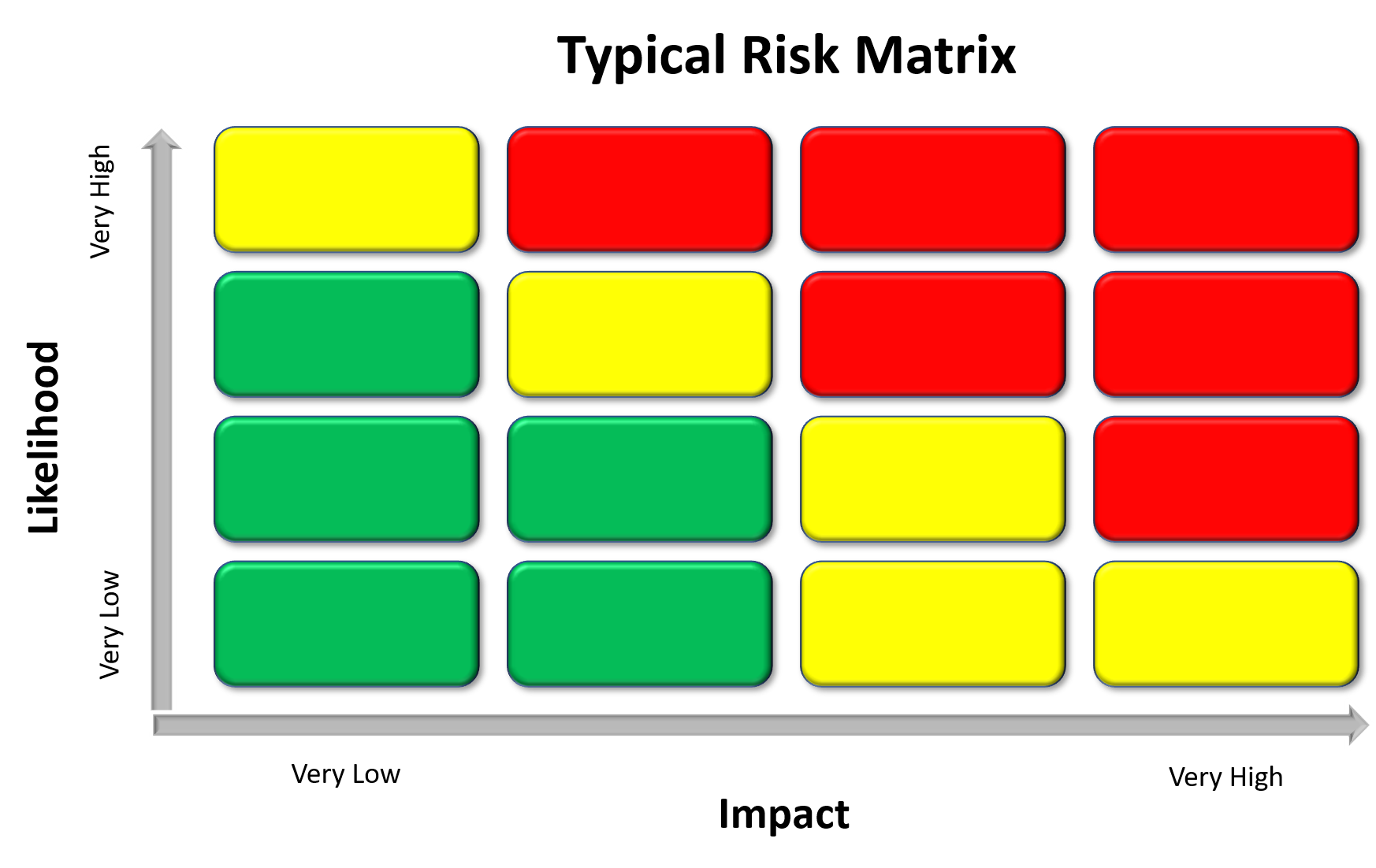
    Most readers will be familiar with the above linear Risk Matrix Model.  This graphical representation of risk exposure is useful but strict adherence to it can lead to a false sense of security.

    Systemic Risk Management

    The real world is very complex with many moving parts.  The potential interaction of processes, events and other challenges can lead to disaster.  It is often the case that the combination of a number of seemingly unrelated and in and of themselves potentially minor events can lead to catastrophe.

    A systemic approach to risk exposure is appropriate.  Field operations usually involves several to many somewhat disparate processes and individuals.

    Typically, the operator will have individuals in the field as well as the office working together.  Contractors and sub-contractors are similarly constructed.  The number of interactions can grow exponentially in a large project or program.

    Therefore, it is important to ‘see’ risk as a dynamic interacting model.  For example, the following quotation is a straightforward presentation of the actual risk field operators face.

    “Planning for the abandonment of Macondo was extremely complex.  The fundamental source of that complexity was a phenomenon well known to systems engineers: the number of potential pairwise interactions among a set of N elements grows as N times N-1, divided by 2.  That means that if there are two elements in the set, there is one potential interaction; if there are five elements, there are ten potential interactions; ten elements and there are forty-five; and so forth.  If the interactions are more complex, such as when more that two things combine, the number is larger.  Every potential interaction does not usually become an actual one, but adding the elements to a set means that complexity grows much more rapidly than ordinary intuition would expect.”

    The authors’ note that NOT all combinations can happen, but the possibility of several is likely.  Many decision makers do not expect exposures as great as they likely are in a complex environment.

    Interactive Model

    So how great is your risk?  The following calculator will give you a perspective on your organization’s exposure.  It is straightforward and easy to use.

    You are only required to input two variables:

    n = the number of elements

    m = elements from n in certain order, it is arrangement

    Taken from the Macondo model above, if n=10 and m=2, the number of combinations of m from n equals 45.


    [planetcalc cid=”977″ language=”en” code=”” label=”PLANETCALC, Combinatorics. Combinations, arrangements and permutations” colors=”#263238,#435863,#090c0d,#fa7014,#fb9b5a,#c25004″ v=”3275″]

    Addition data the calculator provides:

    Each ordered set of n is a permutation

    Generally, the number of combinations of m from n with repetitions is not useful for our purposes other than the recognition that repetition is possible.

    This calculator does not indicate where risk lies.  As the authors of Deepwater Horizon: A Systems Analysis of the Macondo Disaster suggest, it helps decision makers better understand the nature of their complex environment.

    Final Thoughts

    Simple risk models may have their place.  They are useful for presentation purposes.  However, they are insufficient when assessing the exposure of today’s complex operational situations.

    High Reliability Management requires that decision makers NOT simplify the complex.  Understanding the level of exposure using systemic risk management techniques can help clarify organizational threats.

    Are Your Organization’s Risk Management Techniques Robust Enough?

    For more information on Risk Mitigation check out our Operational Excellence Platform.

      Boebert, Earl and Blossom, James M. (2016). Deepwater Horizon: A Systems Analysis of the Macondo Disaster. Cambridge, MA: Harvard University Press. pp. 65-66.

    Appendix–The Math

    For those interested, this is the math for the calculator. It is taken directly from the Planetcalc website.

    So, assume we have a set of n elements.

    Each ordered set of n is called permutation.

    For example, we have set of three elements – А, В, and С.
    Example of ordered set (one permutation) is СВА.
    Number of permutations from n is

    P_n = n!

    Example: For set of А, В, С number of permutations is 3! = 6. Permutations: АВС, АСВ, ВАС, ВСА, САВ, СВА

    If we choose m elements from n in certain order, it is arrangement.

    For example, arrangement of 2 from 3 is АВ, and ВА is the other arrangement. Number of arrangements of m from n is

    A_{n}^m=frac{n!}{(n-m)!}

    Example: For set of А, В, С number of arrangements of 2 from 3 is 3!/1! = 6.
    Arrangements: АВ, ВА, АС, СА, ВС, СВ

    If we choose m elements from n without any order, it is combination.

    For example combination of 2 from 3 is АВ. Number of combinations of m from n is

    C_{n}^m=frac{n!}{m!(n-m)!}

    Example: For set of А, В, С number of combinations of 2 from 3 is 3!/(2!*1!) = 3.
    Combinations: АВ, АС, СВ

    Here is the dependency between permutations, combinations and arrangements

    C_{n}^m=frac{A_{n}^m}{P_m}
    Note Pm – number of permutations from m