
Tag: green

  • Cultural Cognitive Dissonance

    Cultural Cognitive Dissonance

    “Cognitive dissonance is the mental discomfort that results from holding two conflicting beliefs, values, or attitudes.”  Verywellmind

    Typically, we associate this behavioral issue with individual humans.  Yet, aren’t organization comprised of human beings?  Well at least until the AI robots take over.

    There can be many issues causing individual and collective angst and some are described below.  However, it is not daily decisions management makes that we do not agree with that are the most destructive.  The real challenges groups face are the ones that challenge organizational culture–such as major change or organizational transformation efforts.

    Yet, what if cultural cognitive dissonance is not caused by major one time events?  What if it is the result of the systemic nature of the organization.  For example, employees are routinely treated poorly and not valued.

    From a personal perspective, twice in my career I blow the sales quota away by multi-millions.  My reward; thanks and we can’t pay that much in commission.  And the final coup de grâce, “we want more of this type business so we are going to hire someone to do it.”  Guess, what!  Both companies did and these huge deals were never sold again.  Oh and BTW, both went out of business not long after.

    There are consequences when organizations exhibit cultural cognitive dissonance.  Not just to the individual, but that message was clearly sent and no one ever again stepped out of their boxes.  Game, Set, Match!

    Moreover, for large global firms, there may be cultural clashes among the different global divisions/companies.  This can be managed but may often be at odds with each other.

    From Verywellmind, the following three major causes of cognitive dissonance apply to organizations as well as individuals.

    Causes of Cognitive Dissonance

    • Forced Compliance–Required to behave in a certain way that may be contrary to beliefs or desired behavior
    • New Information–Obtaining new information or data that calls into question previous positions
    • Decisions–The quandary of needing to select one of two or more similar alternatives

    According to the well regarded Cleveland Clinic, “Cognitive dissonance can feel a lot like anxiety and stress — and they often come paired together. When you’re stressed or anxious, you could affect your overall mental, emotional and physical health.”

    This observer suggests that these symptoms will apply to organizations as well.  This could contribute or lower performance and even the demise of a once viable organization.  This condition is something to be taken seriously.

    Does your organization realize there may some internal cognitive dissonances in your culture?

    For More Information

    Please note, RRI does not endorse or advocate the links to any third-party materials herein.  They are provided for education and entertainment only.

    See our Economic Value Proposition Matrix® (EVPM) for additional information and a free version to build your own EVPM.

    The author’s credentials in this field are available on his LinkedIn page.  Moreover, Dr. Shemwell is a coauthor of the just published book, “Smart Manufacturing: Integrating Transformational Technologies for Competitiveness and Sustainability.”  His focus is on Operational Technologies.

    “People fail to get along because they fear each other; they fear each other because they don’t know each other; they don’t know each other because they have not communicated with each other.” (Martin Luther King speech at Cornell College, 1962).  For more information on Cross Cultural Engagement, check out our Cross Cultural Serious Game.  You can contact this author as well.

    For more details regarding climate change models, check out Bjorn Lomborg ands his latest book, False Alarm: How Climate Change Panic Costs Us Trillions, Hurts the Poor, and Fails to Fix the Planet.

    Regarding the economics of Climate Change, check out our blog, Crippling Green.

    For those start-up firms addressing energy (including renewables) challenges, the author can put you in touch with Global Energy Mentors which provide no-cost mentoring services from energy experts.  If interested, check it out and give me a shout.

  • Fake Science

    Fake Science

    “I would rather have questions that can’t be answered than answers that can’t be questioned.” – Richard Feynman

    I am the science.”  You have got to be kidding me Mr. Fauci.  Clearly, you have no training in the Scientific Method or maybe your just plan arrogant.  Home many lives have you and you colleagues destroyed, you fake scientist?

    As an actual degreed physicist, I have published here and other media on the process ‘real’ scientists take to address new phenomena.  Yet a singular medical doctor, not a degreed scientist claims the godlike mantel of ‘I am science?’

    Welcome to 21st Century quackery.  In his testimony before Congress, “Dr. Fauci reaffirmed shocking testimony that the ‘six feet apart’ social distancing recommendation that he promoted was arbitrary, not based on science, and ‘sort of just appeared.’”  Science?  NOT!!  Do I hear leaches and blood letting are next?

    Trillions and Trillions and Trillions

    Untold lives and treasure has been destroyed by the Covid-19 quacks.  Not just MD types but a complacent media and hapless governments (politicians as well as regulators) at all levels.

    I am not a Covid denier.  Yes, many got sick and too many died, but we are now learning is that a so call ‘medical’ approach to this problem was based on NOTHING real!  Moreover, it appears that senior officials at the  National Health Institute knowingly lied to us repeatedly.

    Let me see if I understand this, a US funded research institute focused on ‘gain of function‘ released the Covid or it came from a bat?  Readers can make their own decision.

    Pockets were padded and many had their (more) than fifteen minutes of fame.  What did the rest of us get? Lost jobs, closed (forever) small businesses, and now ‘oh joy’ inflation due to government largess.

    The National Institute of Health appears to have put in place a systematic procedure to foil Freedom of Information Act requests.   Our right to know and have oversight that limits the ability of dictatorships to emerge was compromised.

    The arrogance and disgust which these so called public service hold us, the public is beyond the pail.  But not to worry they are all multimillionaires working on GS 15 (~ $180,000) salaries.  They must get great investment advice.

    The old saying about reality is applicable, “If it looks like a duck, walks like a duck and quacks like a duck, then it just may be a duck.”  Or it may be a MD policy wonk from the government that is ‘here to help or destroy your life.’  Remember how those who questioned the conventional wisdom were treated/abused?

    Bring in the mandatory masks.  No less than the conservative (lol) AL JAZEERA reports that key Covid players now question the value of masks we were all forced to wear.  Fascism!

    What the world was put through for years by dictatorial medical types and the fake media that took down other opinions and approaches is appalling.  Jail time is too good for these liars as they got rich.  Next time they come up with the crap they should be run out of town as they have not earned any respect.

    Have you put your liar detector in place when the fake government arrives and says ‘we are here to help/mandate?’

    For More Information

    Please note, RRI does not endorse or advocate the links to any third-party materials herein.  They are provided for education and entertainment only.

    See our Economic Value Proposition Matrix® (EVPM) for additional information and a free version to build your own EVPM.

    The author’s credentials in this field are available on his LinkedIn page.  Moreover, Dr. Shemwell is a coauthor of the just published book, “Smart Manufacturing: Integrating Transformational Technologies for Competitiveness and Sustainability.”  His focus is on Operational Technologies.

    “People fail to get along because they fear each other; they fear each other because they don’t know each other; they don’t know each other because they have not communicated with each other.” (Martin Luther King speech at Cornell College, 1962).  For more information on Cross Cultural Engagement, check out our Cross Cultural Serious Game.  You can contact this author as well.

    For more details regarding climate change models, check out Bjorn Lomborg ands his latest book, False Alarm: How Climate Change Panic Costs Us Trillions, Hurts the Poor, and Fails to Fix the Planet.

    Regarding the economics of Climate Change, check out our blog, Crippling Green.

    For those start-up firms addressing energy (including renewables) challenges, the author can put you in touch with Global Energy Mentors which provide no-cost mentoring services from energy experts.  If interested, check it out and give me a shout.

  • Innovation: The Key to the Global Future

    Innovation: The Key to the Global Future

    Henry Ford, the Founder of Ford Motor Company is famously attributed to this statement.  “If I had asked people what they wanted, they would have said faster horses.”  In other words, most of us think linearly.

    One wonders if this line of reasoning is the best way during the current situation.  Perhaps, non-linear mindsets are more appropriate.

    Challenges

    Currently, many define an existential threat as Climate Change.  Additionally, the global economy, the War in Ukraine, bad actors and other ills make the daily news.  We are also told the time is of the essence.  However, it appears the window will close before the appropriate linear responses can come online.

    As the pandemic unfolded in early 2020, we penned a piece on the role innovation would play addressing the global scourge. We put forth some points we believed salient at the time such as:

    • The rise of remote work
    • The ability to scale quickly, i.e., vaccines, ventilators, et. al.
    • Changes in Clinical Trial protocols

    From the same blog, this pundit has long advocated that, “the use of knowledge enabled by technology can reduce project cycle time dramatically.  It can also significantly reduce project cost as well.”

    As we look back on that period, the collective global ‘we’ accomplished a lot.  A plethora of useful materials were developed and published by all manner Subject Matter Experts (SME) as well as those with ‘life knowledge.’  We chose to capture and repost materials (Covid-19 Business Continuity Resources) that could of use to those business executives struggling with work force issues.  These materials remain available.

    Regrettable, the term SCIENCE was terribly misused, including by medical professionals and professional scientists, all of whom should have known better.  This discussion is further developed in our blog, They Blinded Me with Science.   For interested readers, the piece develops the concepts of science and pseudo-science as well as a brief methodology all can use to help them assess what they are being told about major issues.

    Actual Science has moved humanity out of the caves and into our modern world.  Likely, it can help us address current and future global challenges.  The proven innovative use of the Scientific Method is one path forward.

    SpaceX – NASA

    Elon Musk is in the news for a number of reasons.  He is perhaps one of the best know billionaires.  In the opinion of this pundit, the partnership between his company SpaceX and NASA appears to be one of the most productive Public-Private Partnerships (PPP).  Perhaps this good or best practice could be emulated by others seeking new ways to innovate.

    Realistic Energy Transition

    Energy Transition is all the rage with all manner or organization jumping on board.  Somewhat reminds me of the late 1990s dot.com era.  According to Wikipedia, after the ensuring bust, “the NASDAQ-100 had dropped to 1,114, down 78% from its peak.”  Makes one wonder that this might not be the first rodeo for the latest ‘change the world shinny object.’

    Previously, we noted that the replacement of a major highway ramp in Houston, TX USA is slated to take two years.  Additionally, according to McKinsey, “The goal is to install 500,000 public chargers—publicly accessible charging stations compatible with all vehicles and technologies—nationwide by 2030.”  Message: infrastructure development takes a certain amount of time.

    Also from McKinsey, “Capital spending on physical assets for energy and land-use systems in the net-zero transition between 2021 and 2050 would amount to about $275 trillion, or $9.2 trillion per year on average, an annual increase of as much as $3.5 trillion from today.  To put this increase in comparative terms, the $3.5 trillion is approximately equivalent, in 2020, to half of global corporate profits, one-quarter of total tax revenue, and 7 percent of household spending.”

    As of this writing the global stock markets appear to be in freefall.  Some believe, including this author that a Recession is imminent.  This begs the obvious.  How will this linear effort be paid for and what will be the return on this huge investment?

    There must be a better way.

    Innovate, Innovate, Innovate

    In his recent book, False Alarm: How Climate Change Panic Costs Us Trillions, Hurts the Poor, and Fails to Fix the Planet noted climate change advocate, Bjorn Lomborg expresses concern regarding linear type scenarios and investments being made reduces climate change to Net Zero.

    He argues that regardless of efforts made such as described herein, we will not defeat global warming.  The temperature will rise anyway.

    If this is the case, then the ROI from a $275 trillion dollar commitment may in fact be negative.  This might spell economic disaster at a sustained level.

    Lomborg makes the case that innovation is key.  His perspective seems to be more on university led research supported by governments.  There is a role for government to fun basic research and many have for decades.

    Entrepreneurs have been advancing humankind for hundreds of years.  With proper market signals, we can expect a new generation to rise to the occasion addressing the energy transition and ultimately climate change.

    The author is aware of a number of ‘Green’ efforts underway to encourage the development of new commercial technologies.  While not advocating for investment in an Incubator or Accelerator, it seems reasonable that start-up organizations addressing these challenges be encouraged.

    What Role Does Innovation Play in Your Firm’s Approach to Climate Change?.

    For More Information

    Please note, RRI does not endorse or advocate the links to any third-party materials herein.  They are provided for education and entertainment only.

    The author’s credentials in this field are available on his LinkedIn page.

    Disclaimer, the author has no personal or business relationship with Bjorn Lomborg or his publications other than reading and commenting on his latest book, False Alarm: How Climate Change Panic Costs Us Trillions, Hurts the Poor, and Fails to Fix the Planet.

    For those start-up firms addressing energy challenges, the author is a member of Global Energy Mentors which provide no-cost mentoring services from energy experts.  If interested, check it out and give us a shout.

    For more information on Cross Cultural Engagement, check out our Cross Cultural Serious Game.  You can contact this author as well.


  • Going Green? Or NOT!

    Going Green? Or NOT!

    The total or lifecycle carbon footprint for any energy source is a function of the manufacturing, commissioning, operation (including maintenance) and decommissioning of that asset.  Moreover, the value of an electric powered vehicles (EV) is seen as a function of the amount of fossil fuel no longer used by the vehicle.  However, this is only a sub-model of the to carbon footprint of any component in the Basket of (Energy) Goods, aka Energy Basket.

    All energy resources in the basket must be held to the same set of metrics.  These include Human Resources (including diversity and inclusion), Safety Culture, communities as well as the bottom line performance against governance standards (ESG).

    Risk Governance

    A governance framework that exceeds these standards follows.  Evolving over several decades, it reflects a comprehensive approach to operational risk that is often overlooked.  It addresses the entire life of a revenue producing asset.

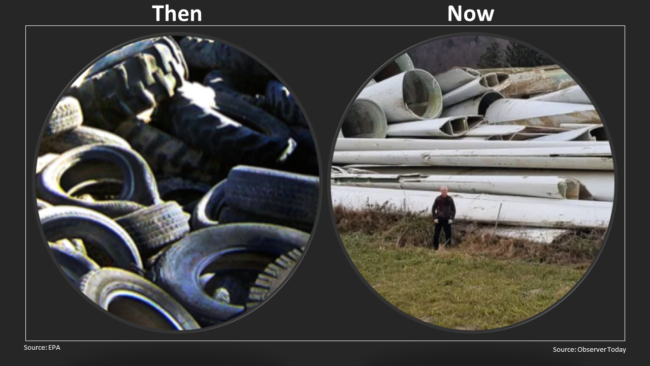
    Lifecycle risk mitigation of an energy resource must include the end of the asset life processes.  What governance driven processes are in place to prevent the accumulation of wind turbine blades or spent solar panels stacked and abandoned?  Just like the tires stacked for decades.

    Turns out the answer is few.  Long life assets such as factories, skyscrapers, fossil fuel production systems, etc. are built to the engineering, industry and local regulatory standards of that day.  Ongoing operations, maintenance, upgrades and so forth keep them performing at acceptable levels.  However, governance models are often focused on the present.  End of asset life risk does not fit into the four quarter management mindset as the event may be sometime in the future.

    The above graphic represents a governance model built around operations and associated risks.  The archetype recognizes that many risk mitigation processes are inadequate for today’s complex organizations with multi-faceted global processes.

    Its framework is built upon the work done by the Treadwell Commission several decades ago to detect financial fraud.  This structure supports the extension into field operations and provides a structure for attaining and sustaining Operational Excellence.

    Risk mitigation is both quantitative and qualitative.  The risk associate with the use of any industrial energy source must be thoroughly assessed as a function of its lifecycle, not just its initial CAPEX and ongoing operations.

    Dumping v Decommissioning

    Illegal industrial dumping has long been a problem.  Today, some in the wind turbine sector appear to be following the decades long vehicle tire disposal process (or lack thereof).

    Lady Bird Johnson at least tried to hide the piles of tire debris but no one has found a way of completely dealing with this growing and massive problem.  As of 2017, some 17% were still disposed of in landfills.  In 2003, the EPA reports that almost 300 million tires are scraped each year.  Flash forward to today and this is likely a very conservative number.  That said, 17% equals approximately 50 million tires headed to landfills as opposed to recycling.

    Moreover, there is a long history of industrial dumping trash so as not to have to pay the disposal fees.  One wonders how many millions of tires destined for landfills (and other recycling) are just dumped?

    The decommissioning process is the responsible end-of-asset-life shutdown and removal.  The intent is to return the site to a condition similar to its initial environment and properly remove and dispose of equipment and materials.  It should not include stacking wind turbine blades next to a pile of discarded vehicle tires.

    Total Carbon Lifecycle Model

    Daily, we hear about the need to reduce carbon output to (net) zero.  Promises are made by many that by such and such a time this metric will be met.  Caveat: usually the time period is beyond the expected tenure of those making the statements.  Often lost in the discussion is the carbon cost of manufacturing and decommissioning.

    Carbon output should include the mineral extraction process, recycling of older materials if appropriate, transportation, manufacturing, installation, operations and decommissioning.  It also must include the carbon cost of the supply chain necessary to support the asset across its lifecycle.  For example, the carbon cost of an EV is not just the vehicle’s operation but the lifecycle of the vehicle as well as the electric power generation and distribution necessary to operate the automobile.  Do not forget the carbon cost of manufacturing a battery and disposing of it at end of life.

    Scrap

    Materials are often staged for recycling.  They feed a process that results in new useful product(s) that may add new value.  This is a useful recycling process that makes a lot of sense.  However, sometimes this is not as economical as new manufacturing.  These economics lead to dumping as the low-cost-solution.  Fields of discarded materials may or may not be awaiting recycling.

    Defining Green

    Being green is not simply using renewable electricity instead of gasoline.  If the carbon footprint is no different or even worse, then the problem is not solved and may even be made greater.

    Keep in mind that coal is still a major fuel in the generation of electricity.  According to the US Energy Information Administration (EIA), in 2020 over 60% of power is generated using fossil fuels of which over 19% is from coal.  This does not include the carbon footprint of materials and products imported to the US.

    So if the carbon footprint of a wind turbine is defined as its lifecycle and if at the end result is abandonment in a field, is the green value of that product positive?  Or is it just dumping not unlike the pollution of a nation’s river systems?

    Being green is not just plugging in your car overnight.  Like most things in life, it is systemic.

    Is Your Organization’s Green Plan Systemic or Myopic?

    For More Information

    Please note, RRI does not endorse or advocate the links to any third-party materials.  They are provided for education and entertainment only.

    For more information on Cross Cultural Engagement, check out our Cross Cultural Serious Game

    We presented, Should Cross Cultural Serious Games Be Included in Your Diversity Program: Best Practices and Lessons Learned at the Online Conference, New Diversity Summit 2020 the week of September 14, 2020.  Check Out this timely event and contact the organizer for access to the presentations!!

    For more on DEI Standards, see the newly released ISO-30415.

    You can contact this author as well.