Tag: DEI

  • An Era of Hate

    An Era of Hate

    Incredible!! The level of hate as shown on any media today is just that, incredible.  Thieving, beating, sexual abusing and murdering seem taken as the “New Normal.”  Young people are throwing away future careers as they appear in the omnipresent media shouting hate towards one group.  Wearing masks simply make them look like common criminals.  What are they thinking, comes to mind.

    DEI (Diversity, Equity and Inclusion) and ESG (Environmental, Social and Governance) fads appear to be fading even as their original definitions are lost.  This pundit has been in the workforce since 1974 and before that the military experience.  To say I have seen it all is an understatement.  Well run organizations adhere to the original tenets of these two business/social models

    That said, my perspective follows:

    Servant Leadership

    With a focus on people, this leadership style seeks to develop all individuals and get the best out of cross cultural teams.

    • Diversity–We live in a world of over 8 Billion people.  We all know the level of diverse cultures, lifestyle and locales.  The likelihood that one organization is composed of all of one type is farcical.  So get over it!
    • Equity–Everyone wants to be treated fairly.  A company I was with was acquired.  The culture divided the employees into two groups.  Those who were hired directly and those who transitioned as a result of M&A activities.  As might be expected the mergers were most dilutive (huge employee turnover) and eventually that organization was eaten by an even bigger fish.  More like Lose–Lose!
    • Inclusion–People want to be included and allowed to contribute even if they are awkward about it.  One of the best true stories on this subject is depicted in the 2004 television movie, Something the Lord Made.  Two very different men in a racially challenged Jim Crow era were able to get past many issues and developed a solution for a deadly infant disease.  If you have not seen it; well worth your time.
    Stewardship

    One definition by Michael Barber; “Stewardship is leaving a system better than you found it,” is a very powerful statement.  Our Blog of April 25, 2022, ESG Explained defined these terms:

    • Environmental–Generally refers to the stewardship of the planet and how organizations facilitate that responsibility.
    • Social–Facilitating organizational responsibility to the global society, at all levels from the globe to the local communities firms operate in.
    • (Corporate) Governance–Typically, the umbrella organizations put in place to assure issues such as transparency, fraud, safety culture and ethics are in compliance with social norms and local regulations.

    Finally, over twenty years ago after all of the managerial nonsense that sent many “C” levels to jail from our 2011 White Paper Asset/Equipment Integrity Governance: Operations-Enterprise Alignment: A Case for Board Oversight, “During that period (2002), McKinsey & Company in conjunction with the Global Corporate Governance Forum conducted a study and found that over 75% of over 200 fund managers would value a stock at a higher price point if the company could demonstrate it had strong governance in place.  Moreover, the study also revealed that for western markets, firms with strong shareholder rights averaged 12-14% higher stock prices .”

    It Makes No Sense to Run any Organization Badly.  Either to stakeholders or yourself.

     Gaming the System

    Those of us at a certain age are familiar with the song, Walk A Mile In My Shoes.  What would you say if I told you that using technology multiple parties can exchange their boots?

    There is a way using Virtual Training to interact with other cultures and effectively Walk A Mile In Their Shoes (and they in yours).   “Virtual training typically refers to a specific form of online education that focuses on skill development and practical training.  It often involves structured courses or programs designed to teach specific skills or tasks.”

    Based on International Negotiation experiences, processes and technology tools we have developed an online game.  It enables collaboration or even simulate organizational conflict.

    Additional information is available on our Cross Cultural Serious Game Portal.  Check it out, I think you will like it and its a way to help cool the cultural hate being unleashed

    Walk A Virtual Mile in the Other’s Shoes.  Who Knows You May Even Like it.

    For More Information

    Please note, RRI does not endorse or advocate the links to any third-party materials herein.  They are provided for education and entertainment only.

    See our Economic Value Proposition Matrix® (EVPM) for additional information and a free version to build your own EVPM.

    The author’s credentials in this field are available on his LinkedIn page.  Moreover, Dr. Shemwell is a coauthor of the just published book, “Smart Manufacturing: Integrating Transformational Technologies for Competitiveness and Sustainability.”  His focus is on Operational Technologies.

    “People fail to get along because they fear each other; they fear each other because they don’t know each other; they don’t know each other because they have not communicated with each other.” (Martin Luther King speech at Cornell College, 1962).  For more information on Cross Cultural Engagement, check out our Cross Cultural Serious Game.  You can contact this author as well.

    For more details regarding climate change models, check out Bjorn Lomborg ands his latest book, False Alarm: How Climate Change Panic Costs Us Trillions, Hurts the Poor, and Fails to Fix the Planet.

    Regarding the economics of Climate Change, check out our recent blog, Crippling Green.

    For those start-up firms addressing energy (including renewables) challenges, the author can put you in touch with Global Energy Mentors which provide no-cost mentoring services from energy experts.  If interested, check it out and give me a shout.

  • Freedom … to Fail

    Freedom … to Fail

    An American flag flying in front of some classic architecture.

    Today, those of us in the United States and indeed many other parts of the world celebrate the 247th year of Freedom.

    Generally, freedom is seen as a function of speech, religion, lifestyle choices and even entrepreneurship.  In 1941, President Franklin Roosevelt proposed Four Fundamental Freedoms:

    1. Freedom of Speech
    2. Freedom of Worship
    3. Freedom from Want
    4. Freedom from Fear

    In some ways, these levels of freedom fit within lower levels of Maslow’s Hierarchy of needs.  However, the road to the top levels (especially self-actualization) of his pyramid can be rocky.

    “Only those who dare to fail greatly can ever achieve greatly.”

    Robert F. Kennedy

    Failure can be a great teacher.  As Thomas Edison is credited with saying, “I have not failed. I’ve just found 10,000 ways that won’t work.”  So we argue that the Freedom to Fail is as important as other freedoms.  For without failure human progress would stall.

    So as we celebrate with hot dog eating contests, fireworks and being with family, lets not forget that our modern conveniences and even political and social experiments that work are a function of many so called earlier failures.

    Topics of the day include ESG, DEI and other social trends.  However, not all processes tried will be successful.  However, we can’t get to wherever ‘there’ is with taking a chance.

    Do you allow yourself the Freedom to Fail, Learn and Move On?

    For More Information

    Please note, RRI does not endorse or advocate the links to any third-party materials herein.  They are provided for education and entertainment only.

    See our Economic Value Proposition Matrix® (EVPM) for additional information and a free version to build your own EVPM.

    The author’s credentials in this field are available on his LinkedIn page.  Moreover, Dr. Shemwell is a coauthor of the just published book, “Smart Manufacturing: Integrating Transformational Technologies for Competitiveness and Sustainability.”  His focus is on Operational Technologies.

    “People fail to get along because they fear each other; they fear each other because they don’t know each other; they don’t know each other because they have not communicated with each other.” (Martin Luther King speech at Cornell College, 1962).  For more information on Cross Cultural Engagement, check out our Cross Cultural Serious Game.  You can contact this author as well.

    For more details regarding climate change models, check out Bjorn Lomborg ands his latest book, False Alarm: How Climate Change Panic Costs Us Trillions, Hurts the Poor, and Fails to Fix the Planet.

    Regarding the economics of Climate Change, check out our recent blog, Crippling Green.

    For those start-up firms addressing energy (including renewables) challenges, the author can put you in touch with Global Energy Mentors which provide no-cost mentoring services from energy experts.  If interested, check it out and give me a shout.

  • Teaming Realities

    Teaming Realities

    Why are Diversity, Equity and Inclusion (DEI) initiatives failing?

    In previous blogs, we have addressed the challenges of turning organizational initiatives into culture.  Moreover, we discussed DEI and the shortcomings of those institutional efforts as well as broached the construct of Teams incorporating DEI.

    In this edition, we will expand on those subjects and develop a realistic approach toward team building that fully incorporates the precepts of DEI in a realistic manner.

    Five Elements

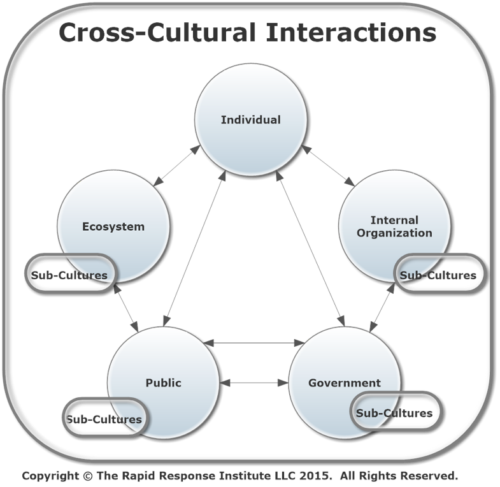
    As depicted in the title graphic, organizational cross-cultural interactions incorporate one or more of these dynamic components.

    • The Individual defined as a single human being or perhaps other entity with whom others collaborate
    • The Internal Organization defined the (legal) entity one or more individuals associate with on a daily basis
    • The Government defined elected officials as all levels of the Federal, State and Local governance bodies including any and all regulatory bodies or other agencies
    • The Public defined as communities and other interest groups including the media as well as its social aspect
    • The Ecosystem defined as the broad group of constituents which includes clients/customers, the supply chain as well a professional services engaged with the organization

    Note that sub-cultures abound across the four elements other than the individual.  Four example, a taskforce or team may be formed to implement a global IT system.  In this case, the team may be composed of individual from several countries as well as  Internal and External IT professionals..  In this case this would be an Internal Organization Sub-Culture.  Another Sub-Culture might be the NYC office with a distinct local flavor.

    These five elements are built upon a pretty straightforward peer reviewed behavioral framework.   

    The RBC Framework

    The Relationships, Behaviors, Conditions (RBC) Framework was originally developed to address the International Cross-Cultural Negotiation process.  Briefly, this is a dynamic model with emphasis on interactive relationships resulting from multiple levels of behavioral analysis.

    • Relationship dynamics are the focus including, commonality of interest, trust, balance of power and conflict intensity
    • Behaviors are defined from a broad multi-dimensional perspective and includes intentional as well as unintentional
    • Conditions include circumstances, capabilities and competencies of the parties, cultural considerations and the environment

    For almost 30 years we have been expanding and enhancing this model.  It is now used for ANY human interaction as well as Machine-Human interfaces, i.e. Artificial Intelligence (AI).

    Finally, we see this construct as very fabric of the modern organizational Team.

    What is a Team?

    By one definition a team is, “a group of people who perform interdependent tasks to work toward accomplishing a common mission or specific objective.”  As a general rule, teams are composed of individuals either appointed politically or assigned based on talent and expertise.

    When politically assigned to meet somewhat arbitrary DEI driven goals, one can expect such teams to fail–often visibly as a great calamity.  Thus driving survivors and others away from new similar teams.

    Thirty years ago this pundit witnessed the implementation of the then new Enterprise Resource Planning (ERP) IT systems.  Most were late and way over budget.  They rightfully earned the badge of ‘Career Killer.’  Not surprisingly, no one wanted to be assigned to this type of project.  Most consulting firms implementing these systems wanted someone with knowledge of the business on the project as well as IT professionals.  Key personnel could not be spared from operations and often junior or less qualified IT employees were assigned.  Needless to say, some level of disappointing performance was almost certainty guaranteed.  These were diverse teams composed of third party consultants, operations and finance individuals as well as internal IT people.

    These were not effective teams.  Many were even destructive.

    Creating an Effective Team

    A Google search of the term ‘teambuilding’ generates 160 million hits.  It is a well documented process, so why are successful teams so elusive?

    Most critical teams undergo a selection process as described previously with some training.  The project commences often with significant time and budget constraints.  In many cases the team malfunctions from the ‘get go.’  So why would DEI efforts end differently?  One suspects most do not.

    When students participate in active learning, they learn more.  This has been known for some time.  Sadly, and often in the DEI space, workshops do not address the actual issue organizations are facing.  However, their is a more successful learning model.

    Organizational Team Truths

    As noted above, organizations build teams to solve critical problems.  They do not group Individuals by category or classification.  High Performance Teams are anything but homogeneous.  

    • First, teams must form.  A mission/goal(s), set of deliverables, budget (if appropriate) and time frame must be developed and agreed to by management.
    • Then, members must get to know each other, roles and tasks assigned, etc.
    • What does success look like?  Metrics established.

    Most teams do not live in a vacuum so if they are to collaborate with one or more other teams (Internal or Ecosystem) this process is extended.  In many cases such as a merger or safety initiative, Government and even the Public will need to be engaged.

    Now a collaborative negotiation between ‘semi-independent’ parties to arrive at mutual success.  This is generally an iterative process.

    To create an active learning environment to cost effectively train new teams in a timely manner, simulations and game theory play a critical role.

    Moreover, to maximize effectiveness, such a Serious Game must be based on a Behavioral Science Framework.  This type of Team-to-Team interaction is available using video conferencing to engage teams meaningful training using ‘real world’ scenarios.

    The graphic below depicts this process.  Readers will also note a number of metrics will provide feedback to students to further enhance their learning experience.

    DEI ROI

    One comment routinely heard regarding DEI is the lack of return on the effort.  Not necessarily monetary return but the learning does not ‘stick.’

    Benjamin Franklin is credited with the quotation, “Tell me and I forget, teach me and I may remember, involve me and I learn.”  When these teams are composed of a variety of Individuals working to solve realistic collective problems the result better reflects actual organization life.  All aspects of DEI can be incorporated into the game scenario.  All students benefit from a much better learning experience and by extension the organizations they represent.

    The following short video is aligned with this discussion.  Well worth the few minutes it will take to watch it.

    Realizing DEI

    Simon makes the point that strong Organizations are more diverse.  In this pundit’s long international career, I support his contention. Moreover, true strength from a diverse Organization and its Ecosystem cannot be reached if individuals are not treated fairly and included in the process.  The serious game scenarios help assure all individuals participate.

    Want some help upping your DEI game?  Contact Us.

    For More Information

    Please note, RRI does not endorse or advocate the links to any third-party materials herein.  They are provided for education and entertainment only.

    The author’s credentials in this field are available on his LinkedIn page.  Moreover, Dr. Shemwell is a coauthor for an in press book (to be released in Spring 2023) titled, “Smart Manufacturing: Integrating Transformational Technologies for Competitiveness and Sustainability.”  His focus is on Operational Technologies.

    “People fail to get along because they fear each other; they fear each other because they don’t know each other; they don’t know each other because they have not communicated with each other.” (Martin Luther King speech at Cornell College, 1962).  For more information on Cross Cultural Engagement, check out our Cross Cultural Serious Game.  You can contact this author as well.

    The video by Simon Sinek is from YouTube.

    For more details regarding climate change models, check out Bjorn Lomborg ands his latest book, False Alarm: How Climate Change Panic Costs Us Trillions, Hurts the Poor, and Fails to Fix the Planet.

    Regarding the economics of Climate Change, check out our recent blog, Crippling Green.

    For those start-up firms addressing energy (including renewables) challenges, the author can put you in touch with Global Energy Mentors which provide no-cost mentoring services from energy experts.  If interested, check it out and give me a shout.

  • Hierarchy of Team Needs in Challenging Times

    Hierarchy of Team Needs in Challenging Times

    First it was Covid-19 and now a Recession?  Is a Global Military Conflict on the Horizon as well?


    Social, economic and personal pressures continue to mount.  There is already evidence of Reductions in Force, (RIF) aka layoffs are underway or planned.  With consumers stretched to the max, higher interest rates, equity markets in retreat and a struggling real estate environment, one wonders what the holiday season will bring.

    Cross Cultural (Diverse) Teams

    Ronald Reagan is credited with saying, “Recession is when your neighbor loses his job. Depression is when you lose yours.”  Would that it would be that simple.

    As we have addressed in the series on several occasions organizational teams consists of different types of people with diverse background and perspectives on life.  More importantly team members can be at different levels of maturity (both personally and organizationally).  We will address this in more detail.

    Maslow’s Hierarchy

    Many are familiar with Maslow’s Hierarchy of Needs.  While a simple physiological (group level) safety model and as my colleague Rob Jones discusses in his new book, A Hole In Science–Grammar of The Sociological Problem.  He takes a very sophisticated and well thought out approach to addressing this group dynamic problem.  For our purposes in the blog, his in-depth analysis is really for professionals and not the casual reader.  However, for those interested, I highly recommend this newly released publication.

    Released in the early 1940s, the hierarchy consists of these five levels of needs that humans progressively move through (these levels were take directly from the aforementioned linked article and should be treated as direct quotations):

    1. Physiological–Air, water, food, sleep, health, clothes, and shelter, etc.
    2. Safety–Include personal and emotional security (e.g., safety from abuse), financial security, and wellbeing.
    3. Belongingness and Love–Family connections, friendship, and intimacy.
    4. Esteem–According to Maslow, there are two subtypes of esteem.  The first is esteem reflected in others’ perceptions of us.  That is, esteem in the form of prestige, status, recognition, attention, appreciation, or admiration.  The second form of esteem is rooted in a desire for confidence, strength, independence, and the ability to achieve.
    5. Self-Actualization–Examples include the acquisition of a romantic partner, parenting, the utilization and development of one’s talents and abilities, and goal pursuit 

    Maslow and others continued to advance the model, but readers can get the gist of it from these definitions.  Moreover, the following short (2.17 min) video covers this model very effectively.

    We can look at Maslow through the lens of a Maturity Model.  For example, certain Teams and/or Individuals might be higher up the hierarchy than others.

    This may change team interactions.  Usually, such models reflect the maturity of the lowest member.

    With the stress of an economic setback, some members may move from of a position of feeling good to one of Safety if jobs or personal cash flow are threatened.

    Guidelines for Going Forward

    In one sense,, teams composed of individuals in different phases of the Hierarchy are no different than other diverse teams.  Teambuilding techniques such as found in our Cross Cultural Serious Games are good tools to teach team member about the state of mind of their team members and/or competitors.

    We have been through tough times before and we will all get through this one as well.  Be sure to learn from history so as not to repeat it.

    How are you helping your family and organization deal with challenging times?

    Note: The definition of a recession is a political football and this is a blog about organizational excellence and not politics.  Investopedia has a good and generally accepted definition of the term (recession) and it is provided herein for completeness.  Readers can decide for themselves as to  its relevance to their individual situation.

    For More Information

    Please note, RRI does not endorse or advocate the links to any third-party materials herein.  They are provided for education and entertainment only.

    The author’s credentials in this field are available on his LinkedIn page.

    “People fail to get along because they fear each other; they fear each other because they don’t know each other; they don’t know each other because they have not communicated with each other.” (Martin Luther King speech at Cornell College, 1962).  For more information on Cross Cultural Engagement, check out our Cross Cultural Serious Game.  You can contact this author as well.

    For more insight regarding the economics of Climate Change, check out our recent blog, Crippling Green.

    For those start-up firms addressing energy (including renewables) challenges, the author is a member of Global Energy Mentors which provide no-cost mentoring services from energy experts.  If interested, check it out and give us a shout.

  • Why Corporate Initiatives Fail

    Why Corporate Initiatives Fail

    According to the Cambridge Dictionary, one definition of initiative is. “A new plan or action to improve something or solve a problem.”  In corporate parlance this often translates into yet another short-term and often politically correct effort to demonstrate forward motion/social citizenship.  Often forgotten faster than the evening news cycle as new searches for performance take their place.

    Organizations of all types, public, private, profit and nonprofit etc. tend to announce new initiatives with great fanfare and pronouncements about ‘transforming our culture.’  So why do they continuously fall short of expectations?

    According to a Forbes Survey released just before the pandemic, “When participants in our survey were asked to create a list of reasons for (change programs) failure, ‘insufficient budget’ was cited by 23% and ‘insufficient time’ by only 17%.  Instead, participants ranked poor communication (62%), insufficient leadership and support (54%), organizational politics (50%), lack of understanding of the purpose of the change (50%), lack of user buy-in (42%) and lack of collaboration (40%) as the most critical issues.”

    In aggregate, the article suggests a total failure rate of70%.  This percentage level was first put forth in the early 1990s and is accepted by many as still correct today.  While empirical evidence is sketchy, none-the-less, the perception of failure remains high.

    This tracks with other project failure statistics this author has seen over the years.  Yet, all of these failure attributes are human and therefore, manageable and correctable.

    Today’s Buzz

    The economy is always front and center.  More so today given Inflation and Supply Chain problems.

    In this blogger’s opinion and in order of priority other key issues include Diversity, Inclusion and Equity (DEI), Climate Change and Environmental, Social and Governance (ESG).  While different organizations may face other challenges, these Four tend to dominate the news.

    Often issues overlap or compound, thus exponentially amplifying the impact on society.  For example, the electric vehicle (EV) is touted as a lynchpin to ‘fixing’ the Climate Change issue.  However, supply chain issues currently limit battery production and one can surmise this is a long-term problem and not simply current shortages or delays.  If this is correct, meeting desired climate metrics is problematic.

    Diversity, Equity and Inclusion

    Perhaps the most emotional of the Big Four, DEI seeks to level the so-called playing field for all regardless of ethnicity, gender or behavioral preferences.  Almost all organizations have a DEI Initiative underway.  Yet, they seem to be stalling much to the frustration of advocates.

    According to one source, “The DEI industry is dominated by what scholars call ‘personnel managers,’ employees in human resources.”  This is also the observation of this pundit as well.

    LinkedIn profiles include, Chief Diversity Officers, any number of DEI consultants and others carrying similar titles as well as commercial organizations offering DEI products and solutions.  Much like the plethora of Safety Culture ‘experts’ and tools that emerged after Deepwater Horizon offshore drilling rig disaster in 2010.

    From a recent Korn Ferry article, “Experts say companies must treat DE&I as they would any other business issue and use data analytics to understand why things aren’t working.”  This author interprets this to mean that DEI must be incorporated into ‘the way we do business‘ or part of the organization’s culture.

    No longer a simple initiative, the next Chief Diversity Officer may be a Caucasian male or even redundant.  Then, DEI will no longer be seen as a separate and different department.

    Energy Transformation

    The president of the United States recently said, ““ it comes to the gas prices, we’re going through an incredible transition that is taking place that, God willing, when it’s over, we’ll be stronger and the world will be stronger and less reliant on fossil fuels when this is over.”  As many countries implement Climate Change policies, this transition is economically rough to say the least.

    And with no guarantees that these efforts will actually reduce the earth’s temperature decades out, is this a Big Bet with major consequences to all of us.  In our last blog, Innovation: The Key to the Global Future we addressed the economics in detail.  Interested readers should refer to that piece.

    An extensive assessment was developed by Bjorn Lomborg in his latest book, False Alarm: How Climate Change Panic Costs Us Trillions, Hurts the Poor, and Fails to Fix the Planet.  His credentials include the fact that he believes in global warming and is not a ‘denier’ as the phase goes.

    Caution to the lemmings jumping off the Energy Transition cliff, this is the ultimate initiative as it is political by nature.  Fickle by nature, political winds can change quickly and with that the value proposition.

    To some extent we are seeing this already as governments seek to address spirally energy costs, i.e., Germany restarts coal-fired power plants.  We might see more of this after the US midterm elections in November.

    ESG

    This initiative is treated as if it is new.  Well run companies have always enjoyed higher equity value.

    In 2011, we published our White Paper, Asset/Equipment Integrity Governance: Operations–Enterprise Alignment.  In that paper, we quoted, “During that period (2002), McKinsey & Company in conjunction with the Global Corporate Governance Forum conducted a study and found that over 75% of over 200 fund managers would value a stock at a higher price point if the company could demonstrate it had strong governance in place.  Moreover, the study also revealed that for western markets, firms with strong shareholder rights averaged 12-14% higher stock prices.”

    We previously addressed ESG in detail and how it fits in our Relationships, Behaviors, Conditions (RBC) Framework  (risk mitigation).  The operative word is Relationships.  This will include every stakeholder, so the impact can be substantial.

    For some organizations, ESG is new and the source of value in the annual Letter to Shareholders.  For others, business as usual incorporates those premises.  Begs the question, which organization would you like to invest in?

    Concluding Thoughts

    In this corporate animal’s experience, initiatives are seen as short-term events.  Leadership’s ‘rubber stamp’ does not carry gravitas.  Employees often ‘wait them out’ and go just about their business.  Others create media splash which dies quickly as well.  Only when change is codified in the organization’s culture do new approaches add sustained value.

    Initiatives fail because neither the board room nor the factory floor see them as adding value.  Fads driven by political winds, activists or social desires come and go.

    Strong governance is a proven value add.  A diverse workforce can add value but climate change as currently practiced will most like fail and fail Big and Expensive.  Society has addressed similar economic issues and will again.

    Are Your Organizational Initiatives Sustainable or Simply Fads?

    For More Information

    Please note, RRI does not endorse or advocate the links to any third-party materials herein.  They are provided for education and entertainment only.

    The author’s credentials in this field are available on his LinkedIn page.

    Disclaimer, the author has no personal or business relationship with Bjorn Lomborg or his publications other than reading and commenting on his latest book, False Alarm: How Climate Change Panic Costs Us Trillions, Hurts the Poor, and Fails to Fix the Planet.

    For those start-up firms addressing energy challenges, the author is a member of Global Energy Mentors which provide no-cost mentoring services from energy experts.  If interested, check it out and give us a shout.

    For more information on Cross Cultural Engagement, check out our Cross Cultural Serious Game.  You can contact this author as well.


  • ESG Explained

    ESG Explained

    According to Investopedia, “Environmental, social, and governance (ESG) criteria are a set of standards for a company’s operations that socially conscious investors use to screen potential investments.”  Definitions of the three components are pretty straightforward:

    • Environmental–Generally refers to the stewardship of the planet and how organizations facilitate that responsibility.
    • Social–Facilitating organizational responsibility to the global society, at all levels from the globe to the local communities firms operate in.
    • (Corporate) Governance–Typically, the umbrella organizations put in place to assure issues such as transparency, fraud, safety culture and ethics are in compliance with social norms and local regulations.

    Since the Deepwater Horizon incident of April 2020, operators (oil and gas companies) have extended and enhanced the above criteria to their supply chain ecosystem and in some cases even customers with a Safety and Environmental Management System (SEMS).  This is true of most other Critical Infrastructure sectors as well.

    Likewise, the Sarbanes-Oxley Act of 2002 enhanced transparency and increased fraud protection after the Enron (and other) scandals.  Other incidents have triggered governance changes as well and some are referred to in linked materials.

    Why Is ESG Important?

    By one account, approximately $12 trillion in investments made in 2018 were driven by those who consider themselves socially responsible.  According to Forbes, in 2019 this accounted for almost 25% of total investments and are seen through the lens of sustainability.  Moreover, between 2016 to 2018, the growth rate in such firms grew at 38 percent.

    These numbers confirm our research going back to the turn of the century and perhaps earlier.  In 1993 we controversially posited that the Principles of Scientific Management were applicable to software development by Knowledge Workers.  Developed by Frederick Taylor, his monograph was published circa 1911.

    In other words, owners (investors) have always demanded top notch, legal and ethical performance.  Activist investors, i.e. Carl Icahn are not new.  As always, they have a very important role to play in the current markets.

    Asset/Equipment Integrity Governance

    There is a buzz of newness to ESG; however, from a contrarian perspective, this is not necessarily the case.  After the Deepwater Horizon failure with significant loss of live and many billions in economic losses to many parties including BP, it became clear that traditional Governance models did not have a focus on operations and the management of capital assets, i.e., manufacturing plants, marine vessels and other revenue producing sources.

    In our book we addressed a New Risk Environment from large corporate operations in which ‘failure is really not an option.”  We stated as a risk element, “Escalation of Consequences: The level of consequences of a disaster in the energy industry can now be larger than from the accidental release of a multi-megaton nuclear weapon.”

    Still governance models continued to struggle.  We believe that in the critical infrastructure sectors there is a lack of strong bonding, in other words top management is still hands off and operating from historical ‘control’ models that are no longer relevant or applicable.

    We do not believe this will change until a Strong Bond (tightly coupled) model is adopted.  We define the term as, “A strong model is used by High Reliability Organizations (HRO) and as part of that model, trained; knowledgeable personnel are empowered to make the right decisions in the field.  The strong model provides an organization with the capability to become and remain and HRO.”

    In 2011, we released our monograph, Asset/Equipment Integrity Governance: Operations–Enterprise Alignment; A Case for Board Oversight (AEIG).  In addition to developing a financial model documenting the Return on Investment (ROI) from strong governance, a Compliance Model, as well as a robust AEIG Matrix which incorporates an Asset Maturity Model are part of the solution.

    The AEIG extends the enterprise governance model to include the full ecosystem including subcontractors to its primary supply chain partners.  While not directly addressed at the time, Diversity, Equity and Inclusion (DEI) is implicit in the model.

    This roadmap is comprehensive and is a good starting point for developing and implementing a vigorous ESG initiative.  Other monographs in our Changing the Dialogue series (exploring our New Business Dynamics) include Structural Dynamics and Rapid Response Management are available online.

    Relationships, Behaviors, Conditions

    Scroll down on The Rapid Response Institute, Operational Excellence Platform page and you will find our R B C Framework Cultural Transformation model.  Shown below for ease of readership.

    The R B C model was originally developed to research international (cross cultural) negotiations.  We have extended it to support the transformation process to a robust and model organization culture such discussed herein.  Readers should note that this model is focused on Operational Excellence and is comprised on Processes & Methods supported by Enabling Tools.

    Built on Structural Dynamics which was developed as part of Dr. Shemwell’s doctoral dissertation in 1996.  It is defined as, “The morphology or patterns of motion towards process equilibrium of interpersonal systems.”

    This proven Framework is grounded in Management Science yet is a useful tool (Roadmap) that real originations can successfully and cost effectively implement.  We believe it is the best approach for attaining ESG.

    Summary

    One can view the current ESG status as part of a continuum to hold organizations accountable as appropriate and frankly, increase their Operational Excellence.  We have long known that firm’s that are well managed command superior stock market multiples and greater equity value.

    Many ‘self-serving’ consultants and pundit would have us believe ESG is breakthrough Thought Leadership in need of their help.  Nothing could be further from the truth.

    In the early 1990s, we document the history and evolution of Management Science/Thinking.   It is not written in stone, like most human endeavors it evolves and has for thousands of years.  ESG is a step in this continuum.

    How is Your Organization Addressing the Requirements of Active Investors?

    For More Information

    Please note, RRI does not endorse or advocate the links to any third-party materials.  They are provided for education and entertainment only.

    For more information on Cross Cultural Engagement, check out our Cross Cultural Serious GameTwo current online games; Safety Culture and Diverse Teams specifically address issues raised by ESG Criteria.  If you have any questions, please contact this author as well.

    Graphic Source: The Rapid Response Institute derived from a Storyblocks image under license.

  • Going Green? Or NOT!

    Going Green? Or NOT!

    The total or lifecycle carbon footprint for any energy source is a function of the manufacturing, commissioning, operation (including maintenance) and decommissioning of that asset.  Moreover, the value of an electric powered vehicles (EV) is seen as a function of the amount of fossil fuel no longer used by the vehicle.  However, this is only a sub-model of the to carbon footprint of any component in the Basket of (Energy) Goods, aka Energy Basket.

    All energy resources in the basket must be held to the same set of metrics.  These include Human Resources (including diversity and inclusion), Safety Culture, communities as well as the bottom line performance against governance standards (ESG).

    Risk Governance

    A governance framework that exceeds these standards follows.  Evolving over several decades, it reflects a comprehensive approach to operational risk that is often overlooked.  It addresses the entire life of a revenue producing asset.

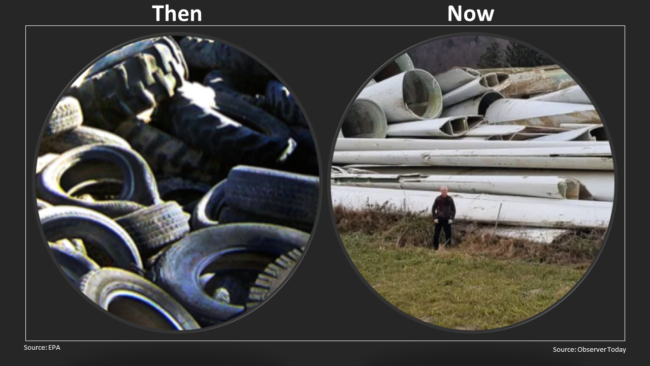
    Lifecycle risk mitigation of an energy resource must include the end of the asset life processes.  What governance driven processes are in place to prevent the accumulation of wind turbine blades or spent solar panels stacked and abandoned?  Just like the tires stacked for decades.

    Turns out the answer is few.  Long life assets such as factories, skyscrapers, fossil fuel production systems, etc. are built to the engineering, industry and local regulatory standards of that day.  Ongoing operations, maintenance, upgrades and so forth keep them performing at acceptable levels.  However, governance models are often focused on the present.  End of asset life risk does not fit into the four quarter management mindset as the event may be sometime in the future.

    The above graphic represents a governance model built around operations and associated risks.  The archetype recognizes that many risk mitigation processes are inadequate for today’s complex organizations with multi-faceted global processes.

    Its framework is built upon the work done by the Treadwell Commission several decades ago to detect financial fraud.  This structure supports the extension into field operations and provides a structure for attaining and sustaining Operational Excellence.

    Risk mitigation is both quantitative and qualitative.  The risk associate with the use of any industrial energy source must be thoroughly assessed as a function of its lifecycle, not just its initial CAPEX and ongoing operations.

    Dumping v Decommissioning

    Illegal industrial dumping has long been a problem.  Today, some in the wind turbine sector appear to be following the decades long vehicle tire disposal process (or lack thereof).

    Lady Bird Johnson at least tried to hide the piles of tire debris but no one has found a way of completely dealing with this growing and massive problem.  As of 2017, some 17% were still disposed of in landfills.  In 2003, the EPA reports that almost 300 million tires are scraped each year.  Flash forward to today and this is likely a very conservative number.  That said, 17% equals approximately 50 million tires headed to landfills as opposed to recycling.

    Moreover, there is a long history of industrial dumping trash so as not to have to pay the disposal fees.  One wonders how many millions of tires destined for landfills (and other recycling) are just dumped?

    The decommissioning process is the responsible end-of-asset-life shutdown and removal.  The intent is to return the site to a condition similar to its initial environment and properly remove and dispose of equipment and materials.  It should not include stacking wind turbine blades next to a pile of discarded vehicle tires.

    Total Carbon Lifecycle Model

    Daily, we hear about the need to reduce carbon output to (net) zero.  Promises are made by many that by such and such a time this metric will be met.  Caveat: usually the time period is beyond the expected tenure of those making the statements.  Often lost in the discussion is the carbon cost of manufacturing and decommissioning.

    Carbon output should include the mineral extraction process, recycling of older materials if appropriate, transportation, manufacturing, installation, operations and decommissioning.  It also must include the carbon cost of the supply chain necessary to support the asset across its lifecycle.  For example, the carbon cost of an EV is not just the vehicle’s operation but the lifecycle of the vehicle as well as the electric power generation and distribution necessary to operate the automobile.  Do not forget the carbon cost of manufacturing a battery and disposing of it at end of life.

    Scrap

    Materials are often staged for recycling.  They feed a process that results in new useful product(s) that may add new value.  This is a useful recycling process that makes a lot of sense.  However, sometimes this is not as economical as new manufacturing.  These economics lead to dumping as the low-cost-solution.  Fields of discarded materials may or may not be awaiting recycling.

    Defining Green

    Being green is not simply using renewable electricity instead of gasoline.  If the carbon footprint is no different or even worse, then the problem is not solved and may even be made greater.

    Keep in mind that coal is still a major fuel in the generation of electricity.  According to the US Energy Information Administration (EIA), in 2020 over 60% of power is generated using fossil fuels of which over 19% is from coal.  This does not include the carbon footprint of materials and products imported to the US.

    So if the carbon footprint of a wind turbine is defined as its lifecycle and if at the end result is abandonment in a field, is the green value of that product positive?  Or is it just dumping not unlike the pollution of a nation’s river systems?

    Being green is not just plugging in your car overnight.  Like most things in life, it is systemic.

    Is Your Organization’s Green Plan Systemic or Myopic?

    For More Information

    Please note, RRI does not endorse or advocate the links to any third-party materials.  They are provided for education and entertainment only.

    For more information on Cross Cultural Engagement, check out our Cross Cultural Serious Game

    We presented, Should Cross Cultural Serious Games Be Included in Your Diversity Program: Best Practices and Lessons Learned at the Online Conference, New Diversity Summit 2020 the week of September 14, 2020.  Check Out this timely event and contact the organizer for access to the presentations!!

    For more on DEI Standards, see the newly released ISO-30415.

    You can contact this author as well.

  • 100

    100

    This edition marks the 100th post in our Critical Mass Blog series.  We have sought to provide thoughtful, unbiased insight into the contemporary business and organizational challenges we all face.  Since our first blog post on November 27, 2017 our world has turned over in ways none expected.  Likely, this trend will continue.

    This series continues a tradition of newsletters, opinion pieces and other on line punditry first begun in 1998 with our New Millennium News.  A bi-monthly email with a subscription base of approximately 7,000 readers.  A huge number at that time.  We estimate that hundreds of thousands or more have benefited from this knowledge transfer.

    Coincidentally, we reach this milestone as we begin the new year–a time of renewal.  We will continue to address critical issues individuals, businesses, agencies and others face as we all navigate an increasingly perilous path.  This series has addressed Human Resource issues including Diversity, Equity and Inclusion (DEI) Teams , the arrival of Smart Technology, International Business, Covid-19, Supply Chain Management, Operational Excellence, Cultural Transformation (including Safety Culture) Sales, Risk Mitigation and of course Leadership.  Today’s organizations must be very good at all of these disciplines!

    Available Tools

    The mission of the Rapid Response Institute (RRI) is to enable our clients with the ability to posture themselves in their market segments so that they can thrive in volatile markets and capitalize on uncertainty, not suffer because of them.  This is especially important for those economic actors in Critical Infrastructure sectors.

    In support of this mission the firm has developed a suite of Intellectual Property (IP) which includes Know How, practical roadmap Books and guidelines as well as Software as a Service (SaaS) solutions among others.  Many readers know that once a process has been standardized with minimal configuration required, the data is the ultimate driver.  This is the heart of most Enterprise Resource Planning (ERP) solutions.

    With advances in technology, RRI has taken these once multi-million dollar solutions to a price point as well as Use Case where all organizations can utilize this capability.  Moreover, our advancements in work flow such as epitomized in our Cross Cultural Serious Games, Economic Value Proposition Matrix, and Smart OpEx (Operations Management System) and Risk Simulation Modeling add immediate and significant value to the challenges faced as articulated above.  Other Free Tools are available as well.

    Pulling It All Together

    The method to our madness is–Operations!!  As some are fond of saying with derision, “It’s All About the Benjamins.”  Well, it actually is.  If ‘for-profit’ firms are not profitable, they fail.  No amount of Environmental, Social, and Governance (ESG) will save them if they cannot deliver to paying customers.

    Everything RRI does helps organizations to deliver stakeholder value, compliant with ESG standards.  That is our Bottom Line and we are also pleased that Dr. Shemwell, Managing Director has been an independent advocate for responsible corporate success since 2004.

    FYI, major losses and legal actions do not enhance stakeholder value.  Neither for employees, local communities or equity holders.  Everyone loses when in terrible scenarios such as Deepwater Horizon, internal bias corporate hubris, poor high reliability processes/human factor shortcomings or lack of actual DEI.

    This journey continues.  Stay tuned for the next 100 editions where will continue to provide our thoughts on relevant matters.  Thank you very much for your readership and support.

    How is Your Organization Positioned for the Next Four Years?

    For More Information

    Please note, RRI does not endorse or advocate the links to any third-party materials.  They are provided for education and entertainment only.

    For more information on Cross Cultural Engagement, check out our Cross Cultural Serious Game

    We presented, Should Cross Cultural Serious Games Be Included in Your Diversity Program: Best Practices and Lessons Learned at the Online Conference, New Diversity Summit 2020 the week of September 14, 2020.  Check Out this timely event and contact the organizer for access to the presentations!!

    For more on DEI Standards, see the newly released ISO-30415.

    You can contact this author as well.

  • Getting to Diverse and Inclusive Teams

    Getting to Diverse and Inclusive Teams

    Diversity, Equity, and Inclusion (DEI) Team Models

    There is a tendency to see DEI through the lens of initiatives or often a process semi-outside the daily ‘organizational’ grind.  Does this represent reality?

    Organizations spend countless sums training employees and others they depend on for Operational Excellence performance.  They often trust global Teams to add stakeholder value.

    No less than Microsoft names a software product, Teams.  A tool designed to foster collaboration.

    The Way We Do Business

    Culture is often defined as ‘who we are.’  The approach an organization takes towards its ecosystem.  If this model is an accurate representation, it suggests that when organizations launch initiatives meant to address current social mores, they likely fail or at least do not live up to full potentials.

    Change management, often referred to as transformation often takes on the mantel of ‘you will be changed.’  Contemporarily, take the Covid-19 vaccine or you will be fired!  Not surprisingly, this mandate is resisted and seemingly increasingly with each new warning.

    As of this writing, the all out war (on decrees) has been declared by the likes of the Navy Seals, Health Care Workers, Law Enforcement and others with the demands from the Feds.  Likely, the result will be a draw at best, with the administration quietly acquiescing.  Too many critical, non-replaceable positions are at risk.  Not to mention votes.

    Governance

    In October 2011, we published our first draft of, Asset/Equipment Integrity Governance: Operations–Enterprise Alignment.  We recognized that traditional organizational Governance models were strictly focused on finance and maleficence therein.  The reality is that revenue is generate by operations and as such governance is critical as well.  Safety Culture, is intangible but now required by most organizations in Critical Infrastructure sectors.

    Flash forward to today and Environmental, Social, and Governance (ESG) is the model most organizations use.  Effectively, this expands governance to include a broad range of non-financial commitments.  From this blogger’s perspective, likely DEI will fall under this governance model.  Therefore, moving it from the ‘initiative status’ to the ‘way we do business.’

    Team Building

    This dynamic environment requires workforce upskilling.  The need to constantly assure that individuals have current Knowledge, Skills and Abilities (KSAs) necessary to meet current challenges.  KSAs now include the ability/necessity to work across cultural/diverse lines.

    When one thinks of a ‘team’ it is not a homogenous collection of like minded and ‘like’ individuals.  Teams are a collection of hopefully, ‘fit for purpose’ individuals who comprise the KSAs needs to accomplish the task(s) at hand.  Teams can mirror the discrete views of its members.

    For example, our early research on the subject assessed the different approaches Japanese nationals took when negotiating with white American males.  In each case, the individual players were deemed to be homogenous.

    Nothing could be further from the truth.  Each individual, in this case all males were of different ages, different education, from different regions of their respective countries, married or not and so forth and so on.

    The reality is that individuals do not negotiate deals.  Teams do.   Members of teams, like juries need to arrive at the same place prior to engaging with other collaborative counterparts.

    Juries need to be arrive at consensus.  Likewise, organizational team members must arrive at a similar place internally prior to going forward.  This not to say that individuals must cave to the will of the majority or the Tyranny of the Minority.  It is to say, a common position that all must accept as part of collaboration or consensus.

    Inclusive?

    There is no doubt that token individuals and in some case high profile figureheads have been put forth to ‘prove’ inclusivity.  Thankfully, those days are fading.

    Teams need to have the input of all members, even contrarians.  Often it is the outlier that has the most insight into a difficult problem.  Differences of opinion need to be resolved and a go forward plan agreed upon.

    Often, individuals do not speak up.  Perhaps they are new to the environment, shy or unsure of themselves.  Whatever the reason their input must be sought and at least given a fair hearing.

    Training can help elicit input from the reticent.  Moreover, they help dominate individuals acknowledge and accept said input.

    How Does Your Organization Assure Real Inclusion?

    For More Information

    Please note, RRI does not endorse or advocate the links to any third-party materials.  They are provided for education and entertainment only.

    For more information on Cross Cultural Engagement, check out our Cross Cultural Serious Game

    We presented, Should Cross Cultural Serious Games Be Included in Your Diversity Program: Best Practices and Lessons Learned at the Online Conference, New Diversity Summit 2020 the week of September 14, 2020.  Check Out this timely event and contact the organizer for access to the presentations!!

    For more on DEI Standards, see the newly released ISO-30415.

    You can contact this author as well.

  • Crisis Management: The Need for Internal Consistency

    Crisis Management: The Need for Internal Consistency

    Attributed to former US Senator and Governor Rhode Island, Lincoln Chafee, “Trust is built with consistency.”  Moreover, from statistics we know that Internal Consistency, “measures whether several items that propose to measure the same general construct produce similar scores.”  The follow on definition statistical reliability, “is the consistency of a set of measurements or measuring instrument, often used to describe a test.”

    In our July 20, 2021 post, Are Your DEI Wheels Spinning? we posited that positive behavioral change as a result of a new situation/condition must result in relationships built on trust.  Without said trust, positive behavioral change is unlikely.

    Situational Change and Differences of Opinion

    Responsible individuals, organizations, and even industrial sectors can disagree.  In fact, ‘academic argument’ is a key component of the Scientific Method and science is never settled.  Moreover, most situations are fluid and those in crisis tend to be agitated.

    That said, crisis management techniques demand well defined processes with identified owners.  Moreover, data must be shared and meet the dual tests of ‘valid and reliable.’  There is no room for sloppiness or data bias as was found in more than one occasion during the Covid-19 pandemic.

    Some argue that Covid-19 data issues are unique and due the global nature of the problem.  However, we are told that Big Data is the future or actually is now.  Solving Climate Change, enabling driverless electric vehicles and so on and so forth.  Based on current performance, it would appear we have a ways to go.  Despite statements to the contrary it is possible implement decision support systems quickly and with success.  This is actually not a new process.

    Street Cred

    Often viewed from the perspective of the colloquial.  One attains credibility based on perceived performance and not necessarily as a function of actual accomplishment.  Usually, highly visible this Influencer can hold sway in larger ways than are actually justified.  However, in their orbit these individuals hold the trust of their followers.  Those holding contrary views will lack trust from this group but may hold significant trust from others skeptical of said leader.

    Both sides can loose trust and cred if ‘holes’ appear in the story line, narrative or agenda.  If the internal consistency of each position is weak, internal group pressures may ultimately destroy any impression of belief and trust.

    This is somewhat where the world is with the established Public Health authorities.  Many hold the perception of perhaps actual misinterpretation, analysis and presentation of the Covid-19 data sets.  The counter position lacks credibility as well.

    R B C

    We have been a proponent of the Relationships, Behaviors, Conditions model for almost thirty years.  Simply put, when situations or conditions change, human behavior changes and vis-à-vis.  This directly impacts on the relationships between individuals or groups, even societies.

    Large, controversial conditional movements, often with poor and even incompetent supporting data can lead to the erosion and even the complete breakdown of trust among affected parties.  Emotional, hyperbole, draconian and biased positions can accelerate the breakdown of trust.

    Once this bond is broken, rebuilding trust is a very lengthy process.  Rebuilding trust is an act of leadership!

    What is your organization doing to keep trust intact?

    For More Information

    Please note, RRI does not endorse or advocate the links to any third-party materials.  They are provided for education and entertainment only.

    For more information on Cross Cultural Engagement, check out our Cross Cultural Serious Game

    We presented, Should Cross Cultural Serious Games Be Included in Your Diversity Program: Best Practices and Lessons Learned at the Online Conference, New Diversity Summit 2020 the week of September 14, 2020.  Check Out this timely event and contact the organizer for access to the presentations!!

    You can contact this author as well.

  • Are Your DEI Wheels Spinning?

    Are Your DEI Wheels Spinning?

    Originally published as a LinkedIn article on July 6, 2021, this updated version is reprinted here with the permission of the author.  Links to relevant sources are added.

    Lately, many LinkedIn posts bemoan the state of Diversity, Equity, Inclusion (DEI) initiatives. The seeming slow take up of great ideas.

    Some argue that DEI initiatives are no more than window dressing or organizational efforts to stave-off litigation. To others, they have the appearance of one more management initiative that if waited out will simply go away like so many others before.

    Fundamentally, DEI initiatives require change. A change of (B)ehaviors in the face of seemingly new situations or influencing (C)onditions (Circumstances, Capabilities, Cultures, Environments). When these two variables evolve, so do exiting (R)elationships. The RBC model is well established in social science and was first used to model Cross-Cultural (international business) Negotiations.

    It is multi-dimensional including a temporal schema capable of addressing numerous aspects of human behavior. Furthermore, it encompasses cultural as well as other situational aspects such as individual backgrounds.

    We tested this model using Japanese and American executives. This culturally diverse group needed to develop a level of trust if negotiation outcomes were to be successful.

    Likewise, successful DEI initiatives require that culturally diverse groups develop a high level of trust among those working together and/or members of teams.

    “Tell Me and I Forget. Teach Me and I Remember. Involve Me and I Learn”

    Attributed to Benjamin Franklin, this quote tells us all we need to know. The so-called Death by PowerPoint lecture long in vogue are often forgettable. Instruction, along with the homework prerequisite and tests are traditional methods. Finally, engaging individuals, teams, departments and even entire organizations can create long standing sustainable knowledge that is the basis for behavioral transformation.

    Paper based serious games or “games whose purpose is other than entertainment” originated in the late 1960-70s. In a nutshell, this is an interactive training solution. Subsequently, online serious games can incorporate actual scenarios designed to immerse players solving real world challenges.

    Rather than a video game whereby players engage with electronic decision trees, human-to-human serious games train players/teams to deal with diverse yet real colleagues. Collaborative scenarios direct participants to collectively solve problems while learning how their culturally dissimilar counterparts address the same challenge.

    Scenarios can drive engagement by all players including those who may not be typically involved in decision making processes. This is also a safe, no-harm no-foul environment with little to no individual decision-making risk.

    Transformation

    Any successful ‘change’ initiative must answer the What’s in It for Me? question. Humans may resist change if they do not see personal value from such actions. Moreover, while senior executive leadership is required, heavy handed top down My Way or The Highway may result in direct resistance, and/or a more crowed freeway to the exit ramp.

    For example, the current version of the smart phone was first available circa 2007. According to Statista, approximately 1.38 billion smartphones were sold in 2020. Likewise, over 46 percent of the global population own these devices.

    What does this have to do with DEI? In 2006 cellphones were great and becoming ubiquitous. No one knew they needed a smartphone. Our collective Behavioral transformation was caused because the What’s in it for Me question was answered.

    One component of the Conditions criteria, Capability changed as this technology enabled individuals to drive new behaviors based on Apps that emerged. The resulting transformation in our Relationships is well documented, i.e., the use of text as opposed to voice.

    Sustained transformation requires continued energy. The term ‘initiative’ implies a short-term event and one that will pass.

    Trust must be established and maintained. Over time, sustained energy will result in critical mass, or the (statistically significant) number of individuals engaged and trusting each other. This self-sustaining energy is transformation.

    Reframing DEI Initiatives into the RBC Framework can enable dramatic and rapid transformation. Take advantage of these types of cross-cultural models.

    For More Information

    Please note, RRI does not endorse or advocate the links to any third-party materials.  They are provided for education and entertainment only.

    For more information on Cross Cultural Engagement, check out our Cross Cultural Serious Game

    We presented, Should Cross Cultural Serious Games Be Included in Your Diversity Program: Best Practices and Lessons Learned at the Online Conference, New Diversity Summit 2020 the week of September 14, 2020.  Check Out this timely event and contact the organizer for access to the presentations!!

    You can contact this author as well.