
Tag: carbon footprint

  • Burrattery

    Burrattery

    Burr!  Its winter in the northern hemisphere and many shiver from the cold.  The ‘Many’ include batteries.

    We have know for generations that cold weather negatively affects electrical batteries.  So, it should come as no surprise that Electric Vehicles (EVs) performance can suffer greatly when the temperatures are extremely cold.  This phenomenon is not limited to this power source, diesel engines face similar challenges at very low temperatures.

    Is It All Hype?

    The IT research firm, Gartner has developed a model describing the process from the inception of new technologies to their general acceptance.  The Gartner Hype Cycle is widely viewed as a reasonable model of this process and is applied to a wide variety of technological innovations.  As the title suggests, technology undergoes a process of innovation, disappointment and finally broad acceptance.  Moreover, this process can take many years with the demise of many startup companies that were perhaps even too early in the process.

    According to Gartner, “Data-enabled services, electrification and smart cabins are a part of many technologies in this Hype Cycle.  Most of these technologies continue to be in the Innovation Trigger and Peak of Inflated Expectations, showing they have a lot of potential to disrupt the automotive space, but yet have some way to go before reaching mainstream adoption.”

    Diffusion of Innovations

    Most readers are probably familiar with the so-called Technology Adoption model which is composed of five types of users/buyers:

    1. Innovators
    2. Early Adopters
    3. Early Majority
    4. Late Majority
    5. Laggards

    For these and more reasons (including high prices), it seems that EVs may have a way to go before wide acceptance with more robust battery technologies.  Finally, we previously challenged the perceived low Carbon Footprint of batteries and documented these technologies are not as green as portrayed.  Interested readers can take a look at our blog Crippling Green discussion regarding the economics of Climate Change.

    Where does your organization fall on either or both of these curves for battery technologies?

    For More Information

    Please note, RRI does not endorse or advocate the links to any third-party materials herein.  They are provided for education and entertainment only.

    See our Economic Value Proposition Matrix® (EVPM) for additional information and a free version to build your own EVPM.

    The author’s credentials in this field are available on his LinkedIn page.  Moreover, Dr. Shemwell is a coauthor of the just published book, “Smart Manufacturing: Integrating Transformational Technologies for Competitiveness and Sustainability.”  His focus is on Operational Technologies.

    “People fail to get along because they fear each other; they fear each other because they don’t know each other; they don’t know each other because they have not communicated with each other.” (Martin Luther King speech at Cornell College, 1962).  For more information on Cross Cultural Engagement, check out our Cross Cultural Serious Game.  You can contact this author as well.

    For more details regarding climate change models, check out Bjorn Lomborg ands his latest book, False Alarm: How Climate Change Panic Costs Us Trillions, Hurts the Poor, and Fails to Fix the Planet.

    Regarding the economics of Climate Change, check out our blog, Crippling Green.

    For those start-up firms addressing energy (including renewables) challenges, the author can put you in touch with Global Energy Mentors which provide no-cost mentoring services from energy experts.  If interested, check it out and give me a shout.

  • Reports of Fossil Fuels Demise Premature? – Renewables Remain Marginalized?

    Reports of Fossil Fuels Demise Premature? – Renewables Remain Marginalized?

    Who would have thought that in the summer with temperatures over 100 degrees Fahrenheit the wind would stop blowing.

    According to NOAA, “The main cause of wind is a little surprising.  It’s actually temperature.  More specifically, it’s differences in temperature between different areas.”  With a major Atmospheric High Pressure parked over a large geographic area, no wonder the wind does not blow.

    Texas Heat

    July 11, 2022 was a true scorcher across the state of Texas.  According to the Dallas Morning News, “Wind speeds have fallen to extremely low levels, and that means the state’s fleet of turbines is at just 8% of their potential output.”  This resulted in this and other Texans receiving an email from the local electricity provider asking for help cut back on power use.

    Texas is major producer of wind energy with over 150 wind farms–total capability of 30,000 MW (2020).  This amounts to approximately, 33% of the state’s power–more electricity produced than any other state.  So in the midst of a major heat wave, less than 25% of the state’s (potential) power generation was effectively available.

    This Level of Unreliability is Unacceptable.

    Previously, we addressed this issue after the Texas Freeze of 2021.  It does not seem like this problem is going away.  Guessing, that like the freeze, lack of energy availability will continue to be mitigated by fossil fuel power production!

    German Cold

    According to the University of Illinois Chicago, “Patients who died because of cold temperatures were responsible for 94% of temperature-related deaths.”

    It gets cold in Germany in the winter.   While the temperature range may vary slightly, Germans need heat every winter.  Despite climate (warming) change, this is not likely to change this coming season.

    The news has reported that Germany has depended on Russian gas for some time.  With the hostilities in Ukraine, that energy source is in jeopardy.  This has caused the country to look to other, reliable sources.  Coal.  Framed as “painful but necessary,” the country had to restart coal based power production.

    Perhaps not desirable for some politicians and prognosticators, Germany has no choice.  Many will be happy with this decision on Christmas Eve.  Near term survival vs. long-term possibilities.

    Clean Fossil

    One day in the 1980s this writer left his hotel in Los Angeles for a morning run.  A few minutes later, I stopped and returned to my room.  The air was so thick with pollution I felt my heath would be better served by doing nothing as opposed to running outside.

    Flash forward to November 1987 when this writer was in Beijing, China for almost a month.  The air was so extreme that frankly my nose contained coal particles simply by breathing.  Moreover, Houston, Texas at the time had similar issues whereby the air actually ‘smelled’ in the industrial area.

    Today, the United States does not have these issues at least at this level (not true with other nations).  The US has ‘cleaned’ its act up so to speak.  Its rivers no longer catch on fire, as they once did.  All of this is the result of better stewardship of carbon based fuels.

    According to the US National Energy Technology Laboratory (NETL), “Coal-fired electricity generation is cleaner than ever.  NETL’s research shows that a new coal plant with pollution controls reduces nitrogen oxides by 83 percent, sulfur dioxide by 98 percent, and particulate matter by 99.8 percent compared to plants without controls.”

    It is possible to responsibly use carbon effectively, efficiently and cleanly.  This is missed by both sides of the climate debate.

    Demise–NOT!

    The humorist Mark Twain is credited with saying, “The reports of my death are greatly exaggerated.”  One can make the same case about fossil fuels.

    According to one source, today there are 1.446 billion motor vehicles on the planet.  Reportedly, just under 284 million are registered in the United States.  Our ‘share’ represents less than 20 % of the global fossil fueled propelled transportation.  Note that this does not include aerospace and the multitude of critical uses of carbon based feedstocks.

    According to the US Energy Information Administration, only 12% of energy was provided by renewables in 2021.  Fossil fuels in aggregate provided 79% of the basket of energy sources.  According to another credible data provider, “The share of wind and solar is rising constantly (+1 point in 2021), reaching 10.7% of the global power mix.”

    This slow growth is over approximately 20 years.

    When the wind does not blow, sun does not shine or solar panels are covered with snow, power comes from dependable fossil fuels.  Moreover, according to experts, none of this linear climate change political response will most likely make a difference anyway.

    Energy Transformation is an uninvestable amount with uncertain returns.  In other words, high and undocumented risk.  So what are we doing?

    How is Your Organization Managing the Risk associated with the Energy Transformation?

    For More Information

    Please note, RRI does not endorse or advocate the links to any third-party materials herein.  They are provided for education and entertainment only.

    The author’s credentials in this field are available on his LinkedIn page.

    “People fail to get along because they fear each other; they fear each other because they don’t know each other; they don’t know each other because they have not communicated with each other.” (Martin Luther King speech at Cornell College, 1962).  For more information on Cross Cultural Engagement, check out our Cross Cultural Serious Game.  You can contact this author as well.

    For more information regarding climate change models, check out Bjorn Lomborg ands his latest book, False Alarm: How Climate Change Panic Costs Us Trillions, Hurts the Poor, and Fails to Fix the Planet.

    For those start-up firms addressing energy challenges, the author is a member of Global Energy Mentors which provide no-cost mentoring services from energy experts.  If interested, check it out and give us a shout.

  • Going Green? Or NOT!

    Going Green? Or NOT!

    The total or lifecycle carbon footprint for any energy source is a function of the manufacturing, commissioning, operation (including maintenance) and decommissioning of that asset.  Moreover, the value of an electric powered vehicles (EV) is seen as a function of the amount of fossil fuel no longer used by the vehicle.  However, this is only a sub-model of the to carbon footprint of any component in the Basket of (Energy) Goods, aka Energy Basket.

    All energy resources in the basket must be held to the same set of metrics.  These include Human Resources (including diversity and inclusion), Safety Culture, communities as well as the bottom line performance against governance standards (ESG).

    Risk Governance

    A governance framework that exceeds these standards follows.  Evolving over several decades, it reflects a comprehensive approach to operational risk that is often overlooked.  It addresses the entire life of a revenue producing asset.

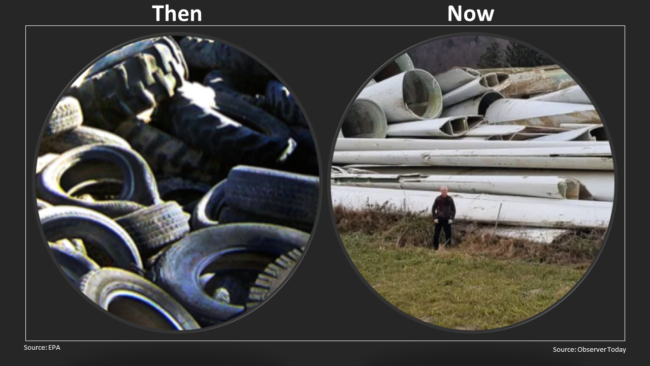
    Lifecycle risk mitigation of an energy resource must include the end of the asset life processes.  What governance driven processes are in place to prevent the accumulation of wind turbine blades or spent solar panels stacked and abandoned?  Just like the tires stacked for decades.

    Turns out the answer is few.  Long life assets such as factories, skyscrapers, fossil fuel production systems, etc. are built to the engineering, industry and local regulatory standards of that day.  Ongoing operations, maintenance, upgrades and so forth keep them performing at acceptable levels.  However, governance models are often focused on the present.  End of asset life risk does not fit into the four quarter management mindset as the event may be sometime in the future.

    The above graphic represents a governance model built around operations and associated risks.  The archetype recognizes that many risk mitigation processes are inadequate for today’s complex organizations with multi-faceted global processes.

    Its framework is built upon the work done by the Treadwell Commission several decades ago to detect financial fraud.  This structure supports the extension into field operations and provides a structure for attaining and sustaining Operational Excellence.

    Risk mitigation is both quantitative and qualitative.  The risk associate with the use of any industrial energy source must be thoroughly assessed as a function of its lifecycle, not just its initial CAPEX and ongoing operations.

    Dumping v Decommissioning

    Illegal industrial dumping has long been a problem.  Today, some in the wind turbine sector appear to be following the decades long vehicle tire disposal process (or lack thereof).

    Lady Bird Johnson at least tried to hide the piles of tire debris but no one has found a way of completely dealing with this growing and massive problem.  As of 2017, some 17% were still disposed of in landfills.  In 2003, the EPA reports that almost 300 million tires are scraped each year.  Flash forward to today and this is likely a very conservative number.  That said, 17% equals approximately 50 million tires headed to landfills as opposed to recycling.

    Moreover, there is a long history of industrial dumping trash so as not to have to pay the disposal fees.  One wonders how many millions of tires destined for landfills (and other recycling) are just dumped?

    The decommissioning process is the responsible end-of-asset-life shutdown and removal.  The intent is to return the site to a condition similar to its initial environment and properly remove and dispose of equipment and materials.  It should not include stacking wind turbine blades next to a pile of discarded vehicle tires.

    Total Carbon Lifecycle Model

    Daily, we hear about the need to reduce carbon output to (net) zero.  Promises are made by many that by such and such a time this metric will be met.  Caveat: usually the time period is beyond the expected tenure of those making the statements.  Often lost in the discussion is the carbon cost of manufacturing and decommissioning.

    Carbon output should include the mineral extraction process, recycling of older materials if appropriate, transportation, manufacturing, installation, operations and decommissioning.  It also must include the carbon cost of the supply chain necessary to support the asset across its lifecycle.  For example, the carbon cost of an EV is not just the vehicle’s operation but the lifecycle of the vehicle as well as the electric power generation and distribution necessary to operate the automobile.  Do not forget the carbon cost of manufacturing a battery and disposing of it at end of life.

    Scrap

    Materials are often staged for recycling.  They feed a process that results in new useful product(s) that may add new value.  This is a useful recycling process that makes a lot of sense.  However, sometimes this is not as economical as new manufacturing.  These economics lead to dumping as the low-cost-solution.  Fields of discarded materials may or may not be awaiting recycling.

    Defining Green

    Being green is not simply using renewable electricity instead of gasoline.  If the carbon footprint is no different or even worse, then the problem is not solved and may even be made greater.

    Keep in mind that coal is still a major fuel in the generation of electricity.  According to the US Energy Information Administration (EIA), in 2020 over 60% of power is generated using fossil fuels of which over 19% is from coal.  This does not include the carbon footprint of materials and products imported to the US.

    So if the carbon footprint of a wind turbine is defined as its lifecycle and if at the end result is abandonment in a field, is the green value of that product positive?  Or is it just dumping not unlike the pollution of a nation’s river systems?

    Being green is not just plugging in your car overnight.  Like most things in life, it is systemic.

    Is Your Organization’s Green Plan Systemic or Myopic?

    For More Information

    Please note, RRI does not endorse or advocate the links to any third-party materials.  They are provided for education and entertainment only.

    For more information on Cross Cultural Engagement, check out our Cross Cultural Serious Game

    We presented, Should Cross Cultural Serious Games Be Included in Your Diversity Program: Best Practices and Lessons Learned at the Online Conference, New Diversity Summit 2020 the week of September 14, 2020.  Check Out this timely event and contact the organizer for access to the presentations!!

    For more on DEI Standards, see the newly released ISO-30415.

    You can contact this author as well.