
Tag: Big Data

  • Reputation, Reputation, Reputation

    Reputation, Reputation, Reputation

    “It takes 20 years to build a reputation and five minutes to ruin it.  If you think about that, you’ll do things differently.”

    – Warren Buffett

    It is fascinating how many accident videos get posted to social media.  Guess we all go to NASCAR races to see car wrecks.  In some cases, videos are personal disasters for those involved.  In some cases, they are downright funny and in the category of what were they thinking.

    Equipment and facilities damage, lost production/project time, personal injury litigation are just some obvious costs.  One hidden cost is reputational damage.  Would you hire a firm that hires, does not train, and/or tolerates some of this behavior?  Probably not, and in some case a strong safety record is part of the procurement decision process.

    Risk Mitigation

    Most of the social media video show failures in occupational safety.  Typically, in the United States these would fall under the Occupational Safety and Health Administration (OSHA) and/or state and local safety regulations.  This is laudable, but without a broader safety governance framework, a lackadaisical attitude can continue.

    Under a Strong Bond Governance Framework, a robust Operations Management System (OMS) enables both public and private firms to realize the Safety Culture they seek that will keep them off the social media most watched list.

    Strong Bond Governance

    An organizational governance model with the following attributes first put forth by the author in our seminal 2014 book, following the Deepwater Horizon incident.

    • Direct, defined relationships that enables open and valid information between governance members.
    • Led by authorities who are closely connected and strongly bonded.
    • Strong Governance, Risk, and Compliance (GRC) system.
    • Back office and field processes combined into a single information model (OT-IT).
    • Designed for application and use in Mission-Critical Environments. [i]

    [i] Holland, Winford “Dutch” E. and Shemwell, Scott M. (2014). Implementing a Culture of Safety: A Roadmap to Performance-Based Compliance. New York: Xlibris.

    Operational Excellence

    Operational Excellence is the execution of the business strategy more consistently and reliably than the competition, with lower operational risk, lower operating costs, and increased revenues relative to its competitor.  It is needed more than ever in today’s technology driven rapidly changing business models, which require organizations to undergo end-to-end business transformation. Operational Excellence can also be viewed as execution excellence. 

    However, the focus of Operational Excellence goes beyond the traditional continuous improvement methods to a long-term change in organizational culture.  Companies in pursuit of Operational Excellence do two things significantly differently than other companies: they manage their business and operational processes systematically and invest in developing the right culture. 

    Operational Excellence manifests itself through integrated performance across revenue, cost, and risk. It focuses on meeting customer expectation through the continuous improvement of the operational processes and the culture of the organization.  The goal is to develop one single, integrated enterprise level management system with ideal flow.  The second component, a culture of Operational Discipline, is commonly described as doing the right thing, the right way, every time.  This culture is built upon guiding principles of integrity, questioning attitude, always problem-solving, daily continuous improvement mind-set, level of knowledge, teamwork, and process driven.

    Organizations attain and sustain Operational Excellence using tools such as Operations Management System OMS).

    A Typical OMS Framework includes all the major areas involved in organizational processes such as shown in this graphic.

    OMS is a collection of processes and procedures enabling a company to effectively manage business practices and achieve the highest level of Operational Excellence in daily operations.

    One of the more notable examples is the Safety and Environmental Management System (SEMS).  SEMS embodies the Safety Culture into the organization’s OMS.  This systemic model is incorporated into a Strong Bond Governance Framework causing safety to become ‘the way we do business.’  In other words, the culture of the organization and by extension its Ecosystem.

    Systemic Safety Culture

    In a culture of safety, people are not merely encouraged to work toward change; they take action when it is needed.  Inaction in the face of safety problems is taboo, and eventually the pressure comes from all directions — from peers as well as leaders. There is no room in a culture of safety for those who uselessly point fingers or say, “Safety is not my responsibility, so I’ll file a report and wash my hands of it.” 

    — Institute for Healthcare Improvement

    Systemic Safety Culture is the Core Set of Values and Behavioral Economics of ALL participants of the extended organization and its Enterprise Risk Management strategy that reflect a Strong Bond Governance commitment to behaving as a High Reliability Enterprise Ecosystem in a safe and environmentally responsible manner.

    Most Safety Cultures have a set of tenets similar to the nine shown in the following list.  These are based on those developed by the Bureau of Safety and Environmental Enforcement’s (BSEE) for marine offshore oil and gas operations and are typical of those used in other Critical Infrastructure sectors.

    Nine Tenets of a Culture of Safety

    1. Leadership
    2. Problem Identification and Resolution
    3. Personal Accountability
    4. Work Processes
    5. Continuous Learning
    6. An Environment for Raising Concerns
    7. Effective Communications
    8. Trust and Respect
    9. Inquiring Attitude

    Finally, it is common practice for parties to refer to a singular industry ‘Safety Culture.’  In reality since each organization has its own culture, there are literally hundreds if not thousands of Safety Cultures in any critical infrastructure sector.  As shown in the above figure, each individual can interact routinely with a myriad of other cultures, both internal to their organization as well as with external economic players.

    After the Deepwater Horizon disaster in 2010, the authors quickly recognized that all economic players in the industry regardless of size would need to immediately adopt a Safety Culture if they were to survive.

    The resulting 2014 book, Implementing a Culture of Safety: A Roadmap for Performance Based Compliance remains one the few that readers can use as a roadmap to incorporate a Safety Culture into their Operational Excellence business model regardless of industry.

    Smart OpEx

    Fifteen years ago, large organizational Operations Management Systems were struggling to incorporate structural safety as more than the so-called, ‘slips, trips and falls’ of OSHA regulations to one where safety is endemic to the culture.  Smaller firms, often participants in the supplier ecosystem were largely forgiven.  The logic being that the major contractors and operators would assure that the final work product met Safety Culture requirements.  This is no longer the case.  Firms of all sizes in every business sector with an operations component now require an OMS to manage not just internal operations but third-party contractors as well.

    The Smart OpEx Operations Management System software solution is joint venture between The Rapid Response Institute LLC and Knowledge Ops, Inc.

    As Mr. Buffet mentions, reputations can be lost in an instant.  According to a 2007 Harvard Business Review article, “In an economy where 70% to 80% of market value comes from hard-to-assess intangible assets such as brand equity, intellectual capital, and goodwill, organizations are especially vulnerable to anything that damages their reputations.”  While almost 20 years old, the premise of the HBR piece remains the case as Boeing, Bud Light, and others can attest.

    Put systems with checks and balances in place that enable the organizational governance and protect the company from entering the Halls of the Disreputable.

    An individual’s and organization’s reputation are everything.  How are you assuring both are protected?

    Pre order our new book

    Navigating the Data Minefields:

    Management’s Guide to Better Decision-Making

    We are living in an era of data and software exponential growth.  A substantive flood hitting us every day.  Geek heaven!  But what if information technology is not your cup of tea and you may even have your kids help with your smart devices?  This may not be a problem at home; however, what if your job depends on Big Data and Artificial Intelligence (AI)?

    Available April 2025

    For More Information

    Please note, RRI does not endorse or advocate the links to any third-party materials herein.  They are provided for education and entertainment only.

    See our Economic Value Proposition Matrix® (EVPM) for additional information and a free version to build your own EVPM.

    The author’s credentials in this field are available on his LinkedIn page.  Moreover, Dr. Shemwell is the coauthor of the 2023 book, “Smart Manufacturing: Integrating Transformational Technologies for Competitiveness and Sustainability.”  His focus is on Operational Technologies.

    We are also pleased to announce our forthcoming book to be released by CRC Press in April 2025, Navigating the Data Minefields: Management’s Guide to Better Decision-Making.  This is a book for the non-IT executive who is faced with making major technology decisions as firms acquire advanced technologies such as Artificial Intelligence (AI).

    “People fail to get along because they fear each other; they fear each other because they don’t know each other; they don’t know each other because they have not communicated with each other.” (Martin Luther King speech at Cornell College, 1962).  For more information on Cross Cultural Engagement, check out our Cross-Cultural Serious Game.  You can contact this author as well.

    For more details regarding climate change models, check out Bjorn Lomborg and his book, False Alarm: How Climate Change Panic Costs Us Trillions, Hurts the Poor, and Fails to Fix the Planet.

    Regarding the economics of Climate Change, check out our blog, Crippling Green.

    For those start-up firms addressing energy (including renewables) challenges, the author can put you in touch with Global Energy Mentors which provide no-cost mentoring services from energy experts.  If interested, check it out and give me a shout.

  • Value from Elon Musk’s ‘Idiot Index’?

    Value from Elon Musk’s ‘Idiot Index’?

    “If the ratio is high, you’re an idiot.” – Elon Musk

    “Musk developed the ‘idiot index,’ which calculated how much more costly a finished product was than the cost of its basic materials.  If a product had a high idiot index, its cost could be reduced significantly by devising more efficient manufacturing techniques.”

    Effectively, what he is saying that if the Cost of Goods Sold (COGS) is too high, a product may either become too expensive or not sell well, if at all.  This is the basic Supply-Demand curve from Economics 101.  He is also indicating that Gross Profit will be negatively impacted as well.

    It’s the Cost Structure Stupid

    Paraphrasing the candidacy of Bill Clinton in 1992, an organization needs to develop a cost structure that not only lowers Total Cost as low as possible but sustains this approach while assuring the produced product/service is fit-for-purpose.

    According to the Corporate Finance Institute, “Cost structure refers to the various types of expenses a business incurs and is typically composed of fixed and variable costs.  Costs may also be divided into direct and indirect costs.  Fixed costs are costs that remain unchanged regardless of the amount of output a company produces, while variable costs change with production volume.

    Direct costs are costs that can be attributed to a specific product or service, and they do not need to be allocated to the specific cost object.  Indirect costs are costs that cannot be easily associated with a specific product or activity because they are involved in multiple activities.

    Operating a business must incur some kind of costs, whether it is a retail business or a service provider.  Cost structures differ between retailers and service providers, thus the expense accounts appearing on a financial statement depend on the cost objects, such as a product, service, project, customer or business activity.  Even within a company, cost structure may vary between product lines, divisions or business units, due to the distinct types of activities they perform.”

    We see that cost management is much more than simply lowering the procurement costs of parts or subcomponents going into the manufacturing product.  It is all about the design of the firm and its culture!

    Parasite Control

    One of the challenges all organizations face is ‘Cost Creep.’  Management needs to but guardrails in place to assure a low-cost structure business model remains that way.  Service firms are just as susceptible as manufactures. 

    According to one source circa 2000, professional services cost creep aka parasite control can be defined as, “Too many people whose services are not really required trying to use it as their meal ticket.”  Originally used in the context of the space exploration sector; however, in this writer’s opinion this issue is not restricted to that one industrial segment.

    At one point in my career, I was the executive responsible for a number of large successful simultaneous consulting engagements.  Other projects were either not doing as well or winding down.  Two things started happening.

    First, I discovered that those not on one of my projects were trying to bill their time to one or more projects.  Either as a direct ‘accounting code’ attempt or more frequently as a ‘contributor.’  One individual even tried to charge for his local mileage under the premise that while he lived in Houston, he was tied to a practice in Atlanta.  Thus, in his opinion he was remote.

    Point being, any project can be subject to parasite control.  “Cost Creep” is an ongoing managerial problem that must be shut down when found, the real costs clawed back and allocated correctly.

    Robust Cost Management

    Aggressively addressing costs at all levels is neither idiotic nor stupid.  It has always been a business fact of life and as of this writing, the federal government bureaucracy is discovering it is the ‘new normal.’

    Moreover, this never-ending pursuit of cost perfection will have a new player shortly.  Artificial Intelligence (AI) is rapidly gaining traction in our everyday operations.  The audit process is part of cost management, and we already have examples of the use of AI in the audit process.  Expect more to come and sooner rather than later.

    We have an Operations Management System implementation underway where AI will play a pivotal role in Phase II later this year.  We will report back once it has ‘gone live.’

    What are your organization’s plans to vigorously manage costs?

    Pre order our new book

    Navigating the Data Minefields:

    Management’s Guide to Better Decision-Making

    We are living in an era of data and software exponential growth.  A substantive flood hitting us every day.  Geek heaven!  But what if information technology is not your cup of tea and you may even have your kids help with your smart devices?  This may not be a problem at home; however, what if you job depends on Big Data and Artificial Intelligence (AI)?

    Available April 2025

    For More Information

    Please note, RRI does not endorse or advocate the links to any third-party materials herein.  They are provided for education and entertainment only.

    See our Economic Value Proposition Matrix® (EVPM) for additional information and a free version to build your own EVPM.

    The author’s credentials in this field are available on his LinkedIn page.  Moreover, Dr. Shemwell is the coauthor of the 2023 book, “Smart Manufacturing: Integrating Transformational Technologies for Competitiveness and Sustainability.”  His focus is on Operational Technologies.

    We are also pleased to announce our forthcoming book to be released by CRC Press in April 2025, Navigating the Data Minefields: Management’s Guide to Better Decision-Making.  This is a book for the non-IT executive who is faced with making major technology decisions as firms acquire advanced technologies such as Artificial Intelligence (AI).

    “People fail to get along because they fear each other; they fear each other because they don’t know each other; they don’t know each other because they have not communicated with each other.” (Martin Luther King speech at Cornell College, 1962).  For more information on Cross Cultural Engagement, check out our Cross-Cultural Serious Game.  You can contact this author as well.

    For more details regarding climate change models, check out Bjorn Lomborg and his book, False Alarm: How Climate Change Panic Costs Us Trillions, Hurts the Poor, and Fails to Fix the Planet.

    Regarding the economics of Climate Change, check out our blog, Crippling Green.

    For those start-up firms addressing energy (including renewables) challenges, the author can put you in touch with Global Energy Mentors which provide no-cost mentoring services from energy experts.  If interested, check it out and give me a shout.

  • The Transformation of Our Spreadsheet Society

    The Transformation of Our Spreadsheet Society


    “The only rules are the ones dictated by the laws of physics.  Everything else is a recommendation.”  — Walter Isaacson/Elon Musk


    We live in a spreadsheet society.  Columns of Categories of People and Rows of Wants, Needs, and Desires.  This model is too simplistic.  What is needed, and Big Data can provide, is a more sophisticated approach.

    This spreadsheet approach was shown in the recent US elections to be detrimental to the party mainly depending on this view of society.  How many times did we hear pollsters opine that X percent of a certain population was voting for one candidate vs. the other?  The categories of people were divided along traditional lines.  This whole model was shattered on November 2, 2024, and likely some providers of data in this format may no longer be in business for the next cycle.

    However, this belief system is not limited to the political class.  We all can fall into this stereotype.

    For decades we have been taught that data categories can be captured under a Normal Distribution (Bell) Curve of a category and row of interest, i.e., the distribution of the height of a class of male senior high school students or SAT scores.  Another more relevant example, retailers’ pertinacious obsession with the 18–34-year-old group.

    These are fairly simple models, and in this Blogger’s opinion, this representation rarely works anymore, if it ever did.  For example, the resulting retail sector inventory overages as a result of dependencies on this gross data model are not an effective return on shareholder value.  Other recent missteps based on faulty interpretation of the customer/prospect base include the Bud Lite advertising fiasco and the Target marketing failure.

    It is ok to make marketing mistakes, that is going to happen.  The problem with these two (and other) campaigns is the analysis of risk, return, etc. was likely shallow or mathematically primitive.

    There are ways to appeal to new consumers without alienating a large existing base.  It’s all in the big numbers.

    There are several validated models of human behavior and we will discuss two of them herein, Maslow’s Hierarchy and the Relationships, Behaviors, Conditions model.  Some readers may prefer others, and they will most likely work within this construct as well.

    Maslow’s Hierarchy of Needs

    This perspective on human needs and subsequent behaviors dates back to the 1940s.  As shown, it consists of five steps from survival to the ultimate Self Actualization.  Note that we adapt this model in two ways.  First, we view this as a growth process as opposed to five discrete steps.  Additionally, the bottom two lower ranges focus mostly on the physical issues we all face.  Fundamental survival and security both physically, mentally, emotionally and spiritually.  Once we have attained, sustained, and believe, we are ready to transition towards an end game, “the realization or fulfillment of one’s talents and potentialities, especially considered as a drive or need present in everyone.”

    Next, we will discuss how we can use this and the RBC solutions to realize specific and measurable value that changes this dynamic.

    The color gradient is meant to reflect that this journey is a process and often each field begins slowly before accelerating into the next range.

    Another perspective of each the Five Platforms consists of a number of smaller steps, which when assessed using Integral Calculus, generates a continuum.

    Relationships, Behaviors, and Conditions (RBC)

    The following is taken from our Cross-Cultural Online Game site:

    The RELATIONSHIPSBEHAVIORS, and CONDITIONS (RBC) model was originally developed to address issues around cross cultural (international) negotiation processes.   As shown in the figure, Relationships are the focal point of this perspective, reflecting commonality of interest, balance of power and trust as well as intensity of expressed conflict.  Behaviors in this model is defined as a broad term including multi-dimensions and intentional as well as unintentional.  Finally, Conditions are defined as active and including circumstances, capabilities and skills of the parties, culture, and the environment.  Of course, Time is a variable in this model as well.

    Moreover, we have defined Behavioral Economics as “the decision-making model that incorporates societal, cultural, emotions and other human biases into the process as opposed to the classic rational economic actor.

    One key feature of the R B C Framework is its emphasis on interactive relationships while providing an environment for multiple levels of behavioral analysis.   This makes it a useful tool to better understand the new Big Data/AI processes currently unfolding.

    The following graphic is a derivative of our Cross-Cultural Interactions model.  It is a peer reviewed model and is a very good way to calibrate interactions.  Additional information is available on the above link.

    This author has long believed that we do not live in a linear or mathematically deterministic world.  A strong belief in stochastic, matrices drive much of my thinking.  This is reflected in the figure on the left.  The RBC model is the foundation for the five parties and their collective Behaviors.  The resulting Relationships range from one-on-one to small groups or in some cases a wide and varied constituency.

    Note that there is an Ecosystem, (something, such as a network of businesses, considered to resemble an ecological ecosystem especially because of its complex interdependent parts) associated with each entity other that the individuals’ who are the other four.

    This is a wide array of influences on any given individual.  Not easily measured, linearly!

    Scientific Method

    Most readers are familiar with how science has been brought into bolster the position of pundits/advocates of policy, especially related to Covid-19.  The word is tossed around casually, as if most who use it know what they are talking about.  Spoiler Alert–Most Do Not! This includes some with advanced technical or medical bona fides.

    Most think that by using the word ‘science’ this assessment process is out of their wheelhouse.  Previously, we argued that there is a layperson’s approach that works fine for most of our daily needs.  Details can be found on our Blog, They Blinded Me with Science.

    For space reasons, this (guidelines) model will not be repeated here but check it out, it is a short read.

    The late Nobel Laureate, Richard Feynman has a brief and layperson-oriented presentation on the Scientific Method.  He is an excellent teacher, and this clip is informative as well as entertaining.

     “If it disagrees with experiment, its wrong”—Richard Feynman

    Human Input Still Needed

    To be clear, pollsters and marketers will still need to ask questions that will also help structure the model, but the processes posited herein can change the weighting processes driving toward equilibrium and Pareto Optimality (Pareto efficiency implies that resources are allocated in the most economically efficient manner but does not imply equality or fairness) in the final analysis.  In other words, higher quality results.

    These numbers can also be seen as ‘first value’ in a simulation.  Another way to look at this is to the logic the Turing (Bombe) Machine of World War II.  Not setting a number as itself.

    Then AI can take the model to the next level and provide pollsters/marketers with real, modern solutions.  Finally, other uses will most likely be derivatives of this solution.

    The Data Management Problem

    We have identified a general problem as well as three valid and reliable theories.  This is only a nice discussion without relevance with Valid, Reliable, and Timely (VRT) data.  Data Management has been a problem as long as there has been data, stone, paper or electronic.  It has always been an issue.  “Herman Hollerith is given credit for adapting the punch cards used for weaving looms to act as the memory for a mechanical tabulating machine, in 1890.”  Much later (circa 1950s) digital database management schemas emerged.  Today, we are flooded by data of all types including telemetry and deliberately false data/information.

    How can this be effectively managed and how can an executive without a technology background survive much less thrive in such an environment?

    For decades, this author has been involved in almost all computer system development from the yellow punch tape of the 1960s until today.  There have been several constants over that period.

    One of the biggest chronic challenges has been database management; from the acquisition of data through its life cycle until achieve.  An outcome of poor data management has been decisions that have even led to the demise of firms, along with tens of thousands (if not more) of suboptimal decisions at the expense of shareholder value (bottom line/stock price).  What makes the current crop of Big Data/Artificial Intelligence advocates any smarter than those who came before?  Nothing!  Unless some things are changed.

    Our forthcoming book to be published by CRC Press in 2025, Navigating the Data Minefields: Management’s Guide to Better Decision-Making is a book for the non-IT executive who is faced with making major technology decisions as firms acquire advanced technologies such as Artificial Intelligence (AI).  The following and other managerial action items are developed in detail.

    • How to determine the quality of the data and its relevance to the decision-making processes.
    • Current Challenges and Trends in Big Data and associated applications.
    • Proposed organization structure such as High Reliability Organization and an understanding of Human Factors to fully realize the full and measurable economic value from these technologies.
    • A full set of Risk Mitigation and a Governance model including Disaster Recovery and Cyber Security.
    • How these technologies are used in Operations, a proposed Management System as well as numerous Case Studies across a number of industries and types of problems.

    The challenge of managing this suite of emerging AI/Big Data is daunting and one that cannot be dodged or delegated.  How organizations respond can be the difference between success or the destruction of shareholder value.

    It’s The Data Stupid

    Our pollsters are collecting and analyzing data that are self-reported.

    • A questionnaire is developed which may or may not reflect bias.
    • These questions are posed to potential respondents (phone and otherwise) who may detect a voice tone, and/or the subject may intentionally lie or mislead.
    • Finally, who answers the phone these days?  This skews the data sample and perhaps badly.

    Data collected in this manner is not subject to rigor and most likely wrong or skewed.  Finally, data collected in this manner is not suitable for the new Big Data Analytic models.

    One Proposed Better Way

    There are probably several much better ways to address political and marketing problems.  While no data source is perfect, we posit the following way to use the US Census data.  We can treat it as a function of columns and rows yet apply sophistical data analysis algorithms.

    Categories

    As mentioned, we tend to clump or stereotype individuals into preconceived ‘buckets.’  Over time, these buckets have taken on an aura of, it’s the only way.  Basically, the construct that ‘we have always done it this way.’
     
    This is no longer a viable business or social model.  Our world is much too dynamic for the older static approach to targeting the likelihood of a specific demographic to perform in a preconceived prescriptive manner.
     
    One place to start looking is at the United States Census data.  This data set consists of 57 profiles, The United States and each State and Territory.  Each Profile is divided into several Sub-Categories, Populations and People, Income and Poverty, Education, Employment, Housing, Health, Business and Economy, Race and Ethnicity, and Nearby States.  Each Sub-Category is further detailed.
     
    We might even call the data in these Categories/Sub-Categories, Conditions from the RBC model.  Each Platform in Maslow’s Hierarchy can be considered a Category with infinite Sub-Categories.  Likewise, Conditions.

    Rows

    We have identified the following three variable model as representative of human Behaviors–Wants, Needs, and Desires.  We have previously reviewed some of this in our Blog, Want – Like – Need  in 2019.  These can also be mapped to Behaviors in both the RBC and Maslow models.
     
    Details and a short list of some variables follow.  These definitions can overlap, and readers will note that there is some duplication across all three classes below.  Researchers use different definitions for each class.  This does not detract from the fundamentals of Rows selected for analysis.  
    The point is to develop a list of behaviors that is indicative of the problem to be solved.

    Wants

    For purposes of this model, we define Want as something that an individual might seek as part of normal life, i.e., and ice cream cone.

    Needs

    Those fundamentals of life, especially as defined in Maslow’s Hierarchy, platforms one and two.

    Desires

    Different from Wants, Desires are perhaps beyond his/her reach.  Coveting a promotion and willing to back stab co-workers to get it rather than compete on merit.

    Sources of Wants, Needs, and Desires

    We have suggested that a starting point for Categories is the very large US Census database.  No such singular source exists for these behaviors and there is an overlap in definitions.  This list gives readers a starting point.  In no particular order, this non-comprehensive includes:

    The list goes on, but readers get the point.  A large row of behaviors will help develop a robust model.

    And The Answer Is

    While we know that the solution to the political pollster and/or marketing manager is not a definitive answer, we can do better than we are.  We know how to management data in this environment and we have models for assessing and making decisions based on results.  As we move from simple, small data set, linear models to robust Big Data Analysis, we need to consider a few additional action items.

    Scientific Method

    Do not forget to use this methodology to define and refine your problem statement.

    Model Limits

    • While we are using a significant number of independent and dependent variables, we are not trying to solve world hunger.  Therefore, we need to put limits on (Bound) the model.  This is an age-old problem we first addressed in 2015, Bounding the Boundless.
    • From a scientific perspective, “Across all science, modelling is our most powerful tool, as models let us focus on the few details that matter most, leaving many others aside.  Models also help reveal the typically far-from-intuitive consequences when multiple causal factors act in combination.”
    • Additionally, “Getting AI/ML/DL systems to work has been one of the biggest leaps in technology in recent years, but understanding how to control and optimize them as they adapt isn’t nearly as far along.  These systems are generally opaque if a problem develops in the field.  There is little or no visibility into how algorithms are utilized, or how weights that determine their behavior will change with a particular use case or interactions with other technology.”
    • Moreover, “the European Union this week (2021) issued guidelines for AI — specifically including ML and automated decision-making systems — limiting the ability of these systems to act autonomously, requiring ‘secure and reliable systems software,’ and requiring mechanisms for ensuring responsibility and accountability for AI systems and their outcomes.”

    Diminishing Returns

    Since we are not boiling the ocean, at some point continuing with the model will result reduced performance.  According to Economists, “The law of diminishing returns says that, if you keep increasing one factor in the production of goods (such as your workforce) while keeping all other factors the same, you’ll reach a point beyond which additional increases will result in a progressive decline in output.  In other words, there’s a point when adding more inputs will begin to hamper the production process.”

    “Data is just a way of codifying information. Any data gathered should be relevant to a problem, otherwise useless data clouds the results of a query.  If there are too many degrees of freedom, you are begging for a spurious correlation.”

    Readers may be familiar with, “The Pareto Principle, also known as the 80-20 rule, is a concept that many have adopted for their life and time management.  It is the idea that 20% of the effort, or input, leads to 80% of the results or output.  The point of this principle is to recognize that most things in life are not distributed evenly.”  This may be a satisfactory approach to this application.
     

    Need for a Data Scientist

    This approach may require the use of a professional data scientist to realize a valid and reliable outcome.  “A data scientist is an analytics professional who is responsible for collecting, analyzing and interpreting data to help drive decision-making in an organization.  The data scientist role combines elements of several traditional and technical jobs, including mathematician, scientist, statistician and computer programmer.  It involves the use of advanced analytics techniques, such as machine learning and predictive modeling, along with the application of scientific principles.  As part of data science initiatives, data scientists often must work with large amounts of data to develop and test hypotheses, make inferences and analyze things such as customer and market trends, financial risks, cybersecurity threats, stock trades, equipment maintenance needs and medical conditions.”

    More

    This is not a definitive list and is provided to give readers an understanding of what it will take to move forward with the Big Data Analysis model.  Appropriate research and problem definition may reveal additional or fewer requirements.

    Demise of Linear

    The Linear broadcast approach to selling or changing minds is not the relevant delivery vehicle for new micro-data analysis.  Directed notifications is better although practice this with care.  This last election cycle, I received a text, words to the effect, “can we count of your vote for X?”  I was very much against X and no reason was offered to help me change my mind.  Get with the program and don’t be so lazy developing your spiel or message.

    Elon Musk’s ‘Algorithm’

    This is an interesting approach to problem solving that can have relevance to the issue discussed herein.  Can we reduce complexity without losing data fidelity, “The accuracy, completeness, consistency, and timeliness of data.  In other words, it’s the degree to which data can be trusted to be accurate and reliable.”

    His Five Step Process:

    1. Question Every Requirement

    2. Delete Any Part or Process You Can

    3. Simplify and Optimize

    4. Accelerate Cycle Time

    5. Automate

    Readers may ask, how does this fit in this discussion?  We bring this to your attention because it may help identify and bound the problem to be solved.

    Also, perhaps of some value is his, “idiot index, which calculated how much more costly a finished product was than the cost of its basic materials.  If a product had a high idiot index, its cost could be reduced significantly by devising more efficient manufacturing techniques.”  A survey, analysis, etc. are all products and may benefit from this index model.

    Final Thoughts

    Most financial professionals will tell you that spreadsheets must foot (the sum of all rows must equal the sum of all columns).  Can societies or multiple societies foot their columns and rows?  Most likely not and if that is the case, data from this model is not valid or reliable.

    Most likely, this type of data will take the form of a Scatter Diagram (without correlation?) with some clumps or areas of intensity of a specific category or group of categories.

    This may not be an approach that many will take; however, it is clear that the original premise of this piece, that we live in a spreadsheet society is no longer appropriate.  “If you always do what you always did, you will always get what you always got.” ― Albert Einstein.  It will be interesting to see how future polling is conducted.

    Non-Linear Speed Ahead

    Sometimes pieces like this summarize a conclusion.  In the high-pressure environment, we are not concluding anything.  We are carving a way forward–A Growth Model of the Data Economy.

    As of this writing the incoming US administration appears to be moving at hyper speed across a broad front.  Moreover, AI in particular exploding.  Those interested in keeping up may want to to Subscribe | Generative’s AI Newsletter (not an endorsement but seems be a good daily source of information).  Mostly, just keeping up will not be enough, if top quartile success is the goal.

    It will be interesting to see the role the family of Artificial Intelligence (AI) software solutions play in this field going forward.

    Micro-targeting is certainly a place for Big Data to shine.  That said the problem to be solved and the confidence in the validity and reliability of the data must ascertained. 

    Society faces some real challenges with how we manage, analyze and decide using data.  This is but one example where old methods no longer produce valid and reliable results.  How will you and your organization go forward?

    For More Information

    Please note, RRI does not endorse or advocate the links to any third-party materials herein.  They are provided for education and entertainment only.

    See our Economic Value Proposition Matrix® (EVPM) for additional information and a free version to build your own EVPM.

    The author’s credentials in this field are available on his LinkedIn page.  Moreover, Dr. Shemwell is a coauthor of the recently published book, “Smart Manufacturing: Integrating Transformational Technologies for Competitiveness and Sustainability.”  His focus is on Operational Technologies.

    We are also pleased to announce our forthcoming book to be published by CRC Press in 2025, Navigating the Data Minefields: Management’s Guide to Better Decision-Making.  This is a book for the non-IT executive who is faced with making major technology decisions as firms acquire advanced technologies such as Artificial Intelligence (AI).

    “People fail to get along because they fear each other; they fear each other because they don’t know each other; they don’t know each other because they have not communicated with each other.” (Martin Luther King speech at Cornell College, 1962).  For more information on Cross Cultural Engagement, check out our Cross Cultural Serious Game.  You can contact this author as well.

    For more details regarding climate change models, check out Bjorn Lomborg ands his latest book, False Alarm: How Climate Change Panic Costs Us Trillions, Hurts the Poor, and Fails to Fix the Planet.

    Regarding the economics of Climate Change, check out our blog, Crippling Green.

    For those start-up firms addressing energy (including renewables) challenges, the author can put you in touch with Global Energy Mentors which provide no-cost mentoring services from energy experts.  If interested, check it out and give me a shout.

    Copyright © 2024 The Rapid Response Institute LLC.  All rights reserved.

  • Operational Excellence Enabled by Leadership in Technology

    Operational Excellence Enabled by Leadership in Technology

    Both books focus on the use of advanced information technologies to attain and sustain Operational Excellence.  Today, organizations are drinking from a firehose of advanced solutions such as Big Data, Artificial Intelligence, Machine Learning, Business Intelligence, Virtual Reality, Digital Twins and much more.

    Moreover, the roles of executives at all levels are changing.  It is no longer satisfactory to leave major decision to Chief Technology/Digital/Information types.  Everyone has a stake in these (in some case $100 million or more, bet you company decisions).  For example,

    • The business need must be identified, verified and a detailed plan put in place to acquire and implement the technology of choice.
    • Is this aligned with organizational objectives?
    • How will these new technologies integrate into existing systems, if at all?
    • Does the organization have the maturity to undertake this process?  In other words, is it culturally ready and if not, what must be done to get ready?  Examples include upskilling the workforce, what new skills will be needed and so forth.

    The list is lengthy and detailed which is further explained the new book mentioned.  Additionally, what role do non-IT executives play in this process.  The Blogger believes is it no longer satisfactory to outsource the future ‘core competencies’ to the technology staff or key third parties, including Systems Integrators.  The so-called experts.  What agendas do these parties have and are they aligned with the organization mission and strategy?

    Bet Your Career

    These advanced and emerging and sometimes very immature software solutions will touch every division, department and individual employees as well at the organizational ecosystem.  Poor performance will end careers and possibly organizations.  As always, there will be winners and losers, both at the organization level as well as individuals.

    We could go on, but readers get the point.  This is game-changing for industry sectors, organizations including government agencies and finally for individuals.  Big decisions will need to be made and soon.

    What are you doing to prepare of this transformational tsunami?

    For More Information

    Please note, RRI does not endorse or advocate the links to any third-party materials herein.  They are provided for education and entertainment only.

    See our Economic Value Proposition Matrix® (EVPM) for additional information and a free version to build your own EVPM.

    The author’s credentials in this field are available on his LinkedIn page.  Moreover, Dr. Shemwell is a coauthor of the just published book, “Smart Manufacturing: Integrating Transformational Technologies for Competitiveness and Sustainability.”  His focus is on Operational Technologies.

    We are also pleased to announce our forthcoming book to be published by CRC Press in 2025, Navigating the Data Minefields: Management’s Guide to Better Decision-Making This is a book for the non-IT executive who is faced with making major technology decisions as firms acquire advanced technologies such as Artificial Intelligence (AI).

    “People fail to get along because they fear each other; they fear each other because they don’t know each other; they don’t know each other because they have not communicated with each other.” (Martin Luther King speech at Cornell College, 1962).  For more information on Cross Cultural Engagement, check out our Cross Cultural Serious Game.  You can contact this author as well.

    For more details regarding climate change models, check out Bjorn Lomborg ands his latest book, False Alarm: How Climate Change Panic Costs Us Trillions, Hurts the Poor, and Fails to Fix the Planet.

    Regarding the economics of Climate Change, check out our blog, Crippling Green.

    For those start-up firms addressing energy (including renewables) challenges, the author can put you in touch with Global Energy Mentors which provide no-cost mentoring services from energy experts.  If interested, check it out and give me a shout.

  • A Windy Position

    A Windy Position

    In a recent online discussion, this pundit put forth the thought that fiberglass wind turbine blades can pose an environmental problem when decommissioned.  This position was quickly challenged with the rebuttal that burning coal ‘kills’ kids so it did not matter if discarded blades litter the countryside as it is worth it.

    According to research quoted by the European Wind Energy Association, “With wind turbine blades likely to account for some 50,000 tons of waste annually by 2020, growing 4 times by 2034 the landfill is not a viable long-term solution.”  Moreover, “Findings from the University of Strathclyde indicate a global increase of wind turbine blade waste from around 400,000 tons per annum in 2030 to around two million tons by 2050.”

    My rebuttal to the kills kids argument–what will this do to global population health?  Keep in mind, this is only one source of industrial (and consumer, i.e., EV automobiles) decommissioned assets.

    Disposal/Recycling

    “Glass-reinforced polymer composites (GRP), used in wind turbine blades around the world, is recognized as a hard-to-break-down source of pollution.”  Research is underway to address this problem and mostly likely progress will continue going forward.

    “Currently only a few recycling techniques are available to treat such an enormous quantity.  So most have been landfilled and many continue to be buried today.”  Other current options include:

    • Grinding–turning fiberglass into powder.  A labor intensive process that provides filler for other purposes
    • Incineration–the ash is usually disposed of in a landfill
    • Pyrolysis–decomposes into three recoverable substances: pyro-gas, pyro-oil, and solid byproduct— all of which can be recycled

    “While the overall life of the wind turbine does cause less pollution than coal-fired power plants do, the initial solution of just burying the fiberglass doesn’t seem in line with the goal to cause less pollution.” (Ibid)

    Really?  How is this saving the planet?

    Clearly, these alternative disposal processes have a financial cost greater than simply burying the blades.  If not, they would be used more frequently.

    Future generations will have to address this issue much like the current one continues to deal with asbestos from the past.  The KIDS will end up dealing with and paying for the folly of their parents and grandparents.

    A Contrarian Posture

    As noted, there is a romanticism about renewable energy sources, most commonly wind and solar.  However, we believe in the ‘no free lunch’ model.  There are risks and cost associated with every form of energy.

    In two recent editions, Heavy Metal Rocks and Going Green? Or NOT! we took an initial look at the financial cost over the renewable lifecycle as well the environmental impact that will need to be addressed.  The edition is a continuation of the premise that, “Technology Romance must be met with Fiscal Realities.”

    Society will eventually recognize the environmental damage done by solar and wind energy systems can be very high.  By then, the harm may have been done.

    As an example, many oil and gas assets are approaching end of life.  The decommission costs are very high and increasingly regulations are changing to hold asset owners accountable for these costs.  Generally, accountants refer to these as Reserves.

    Shouldn’t renewable asset holders be required to set aside reserves to cover the disposal of assets as well?

    Lifecycle Cost Structure

    For capital assets with significant planning, development, manufacture, deployment, operations & maintenance and finally decommissioning costs there is another dimension.  The Asset Maturity Model was developed to assist management understand how to best maximize asset performance over decades, in some cases.  This model is integrated into an economic value model which we be discussed herein.  There are also a number of tools and standards available to assist management, such as ISO 55001–Asset Management.

    In April 2022, Bloomberg published a piece, “Wind Power’s ‘Colossal Market Failure Threatens Climate Fight.”  The Global Wind Energy Council deemed the current wind energy situation a ‘Colossal Market Failure.’

    Blaming a mismatch (alignment) between governments policies and current markets, the risk is not only that net zero targets will not be met but the supply chain is contracting.  Moreover, one study suggests that for the US net-zero policies will cost more than 12% of our Gross Domestic Product (GDP) in 2050.  To put this in perspective, today Social Security cost 5% of GDP and Medicare/Medicaid 6.4 percent–11.4% combined.

    The ‘lack of alignment‘ is a major determent to successful organizations.  In our recent blog, ESG Explained we discussed the role organization and its ecosystem governance at length.  Building on our 2011  monograph, Asset/Equipment Integrity Governance: Operations–Enterprise Alignment; A Case for Board Oversight (AEIG) we developed the case for Operational Excellence as part of ESG.  Energy and supply chain management are key components of this enterprise approach.

    Total Cost of Ownership (TCO)

    TCO is a function of the acquisition cost, including all engineering, design, deployment, installation etc. as well as ALL costs associated with its lifecycle OPEX, including decommissioning, abandonment, and environment remediation.  It is all encompassing.  It is the long-standing metric that all projects must understand and model accordingly before a Capital Expenditure (CAPEX) is authorized.

    The following list are documented per citation links.  These are taken from a recent article challenging the Return on Investment (ROI) of current green initiatives.

    Readers will note that some are social costs, i.e., transition costs to new energy sources currently provide minuscule contributions to the Energy Basket.  These costs will grow dramatically going forward.

    •  “Making a transition from fossil fuels to green energy is costly.  Solar and wind can only deliver electricity, which accounts for less than a fifth of total energy consumption.
    • When the sun doesn’t shine or the wind doesn’t blow, prices rise quickly and we have to revert to fossil fuels for backup.
    • Batteries are inadequate and expensive, easily quadrupling solar electricity costs and failing to provide much power.
    • In 2021, Europe only had battery capacity to backup less than 1 ½ minutes of its average electricity usage.  By 2030, with 10 times the stock of batteries, and somewhat more usage needed, they’ll have enough for 12 minutes.
    • The Bank of America has found that achieving net-zero will cost $150 trillion over 30 years, almost twice the combined annual GDP of every country on Earth.
    • The annual cost of $5 trillion is more than all the world’s governments and households spend every year on education.
    • In a new study, McKinsey finds most of the poorest nations in Africa would have to pay more than 10 percent of their total national incomes every year toward climate policy.  This is more than these nations combined spend on education and health.
    • Reducing emissions just 80% will cost the United States more than $2.1 trillion every year from 2050, or more than $5,000 per person, per year.
    • The annual US cost of World War II is estimated at $1 trillion in today’s money.  Every year by 2050, climate policy could cost Americans more than twice what they paid during the Second World War.
    • Surveys show few people are willing to spend more than a few hundred dollars a year on climate policies.  Asking people to spend tens or hundreds times more is a recipe for failure.”

    These are significant tangible and intangible costs.  In this writer’s opinion, the business case has not been made for these and other total cost line items.  A more extensive study should be considered by readers who want to do a deep dive on these economics.

    Keep in mind, that these broader issues do not take into consideration regarding daily operations and maintenance.  These must be factored in as well.

    Finally, while these are ‘opinions’ from reputable sources, why are they not considered the economic models used today?  Seems like Data Bias, doesn’t it.

    EVPM

    Beginning in 2004, recognizing many of the TCO components as well as the economic value potential from a CAPEX, we developed what came to be known as our Economic Value Proposition Matrix model (EVPM).  This model is now mature, robust as well as integrating a Risk Matrix.

    It is an excellent tool for assessing both Tangible and Intangible components of value and cost.  Additionally, a free version is available and it is fully supported with training as well as other materials (including a video).

    Importantly, EVPM “Translates technology into the Language of Business” which make it an excellent tool for preparing to meet with the Chief Financial Officer (CFO) and/or Budget Committee.  Management makes decisions as a function of the risk associated economic value brought to the organization.  While technology has a level of romance to it, financial issues are the major decision making driver.

    The Energy Basket

    It is useful to look past the hype to see what the US energy basket actually looks like.   Slightly over three percent comes from wind and only 1.3 % is solar.  Fossil fuels (petroleum natural gas and coal) represent 79% of our current energy consumption.  In the opinion of this writer these disparities have been basically the same for decades.

    China and India burn 14 million tons of coal per day!  By all accounts, coal will play a major role in power production in these economies for some time to come.  As a function of the global percentage of coal used; China over 50%, India over 11% and the United States at approximately 8.5%.  Moreover, an assessment of its use by 130 countries is available to interested readers.

    The debate about ‘Clean Coal‘ continues.  None-the-Less, most likely coal will continue to be used for decades.  Keep in mind that 2050 is less than 28 year away.

    While regulation plays a role in the energy mix, economics are the fundamental driver.  Until the economics of non fossil fuels change, the basket will most likely not.

    The Lone Ranger is Missing

    Listening to some, it seems that all we have to do is focus on the Energy Transformation and in only a few short years magic will happen.  Hate to tell everyone, there is no Silver Bullet.  Transformation will take decades and should be led by those driven by market forces.

    One example, on April 29, 2022 the Texas Department of Transportation (TxDot) announced the two year closure of a major highway artery in the Houston metropolitan area to replace a concrete ramp.  Point being, road construction is well understood and a major proven technology and process.  Still, it will take a significant amount of time to perform this upgrade.

    How can we assume a major Energy Transformation using new technologies will unfold as optimistic parties suggest?  History suggests this is not likely.

    Closing Points

    This long time energy careerist believes that various energy sources from the basket should be used as economically appropriate.  While we all have an interest in a low pollution environment, if the economics as shown in this piece are close to correct, the resulting economic damage may be greater than a somewhat warmer planet.

    The data presented herein are documented.  The sources and quality of the data can be challenged but it should not be ignored.

    Finally, this piece has focused primarily on wind energy.  A similar analysis needs to be taken for every energy source including fossil fuels of all kinds.

    The demand for energy will continue to grow and even exponentially.  Clean fossil fuels are available and without strong energy balanced policies the future is bleak for many and not just because of climate change by the significantly higher cost of living and loss of opportunities due to energy starvation.

    The energy challenges are complex and dynamic.  This blog is not a comprehensive review, but simply a focus on a narrow aspect.  For example, we did not delve into issues such as Carbon Capture & Sequestration.  A calm, rational, economics discussion is in order.

    What does Energy Transition mean to you and how will you help the Less Fortunate be better off?

    For More Information

    Please note, RRI does not endorse or advocate the links to any third-party materials.  They are provided for education and entertainment only.

    For more information on Cross Cultural Engagement, check out our Cross Cultural Serious Game.  You can contact this author as well.

  • Welcome to the 70s—Again!

    Welcome to the 70s—Again!

    This Baby Boomer graduated from college in 1970.  Just in time for Saturday Night Fever and Grease, Avocado colored refrigerators and Harvest Gold dinnerware.  Plus, the best friend a then bachelor ever had–the microwave oven!

    Not to forget the Gasoline Lines and Hyper Inflation, Vietnam, Peace/Race Protests/Riots, a Major Recession, Stagflation and other wonderful (not) youthful memories–ugly political and economic time not wished on future generations.  Adjusted for inflation a gallon of gasoline was $0.36 in 1970.  By 1980 it was $1.19–greater than a 330% increase.

    Seems like as Yoga Berra once said, “It’s like déjà vu all over again,” or ‘Those who do not learn history are doomed to repeat it.”  Yet here we are again, or so it seems.

    While I am not dusting off my leisure suit or growing what’s left of my hair, if as this boomer believes we are beginning to relive the 1970s economy, so what should we do?  How should we respond to this new, yet old situation?

    Most financial planners, corporate executives, academics, regulators and others were either not old enough or even alive when the economic and political shocks of the 1970s engulfed the globe.  Without this experienced knowledge, many maybe ill equipped to deal with the current  tsunami that is building.  Perhaps a critical concern for everyone’s 401K retirement investments?

    Hyper inflation is a cancer.  It destroys economies and even societies, not to mention families and individuals in its wake.  Real estate may be a winner if anyone can afford to purchase your house.  However, equities struggle and cash is toast.  From 1970 to 1980 the Dow Jones Industrial Average advanced a scant 5 percent.

    How does this compare with an over 300% increase in the gasoline we all needed for our automobiles?  Short answer, it does not and individual households went backward during that period.

    So What Do We Do Now?

    Flight to quality.  But what represents quality?  Big Tech comes to mind but what is the underlying value proposition of a web based database?  The outage of a major player blamed on a network issue and a number of (internal) cascading issues–the plague of many industrial incidents including Deepwater Horizon questions that proposition.

    Are companies this vulnerable in our age of digitalization, or was this a sign of something else?  As with many IT oriented decisions, “It depends.”  The fact that one of the world’s largest, high profile web based companies suffered a significant outage, not as a result of a cyber attack but apparently its own technical incompetency is not reassuring in a Cloud based global economy.

    The something else–we have discussed the need for High Reliability for complex sectors including the 16 sectors the US Homeland Security deems as Critical Infrastructure.  Social media is not on that list, but manufacturing is.  In our forthcoming (2022) book, “Smart Manufacturing: Integrating Transformational Technologies for Competitiveness and Sustainability,” we address risk mitigation strategies that can inoculate organizations from such catastrophic IT failures.

    Heavy industries such as oil and gas are routinely criticized when a catastrophic incident occurs.  These need no longer happen and we have put forth strategies routinely for more than a decade including in our 2014 book, Implementing a Culture of Safety: A Roadmap to Performance-Based Compliance.

    As we move into the ‘Smart’ era, it will be incumbent on organizations to take steps to mitigate what happened to a web based chat room provider.  The exogenous risk of critical infrastructure failing is significant, per the recent Colonial Pipeline ransomware attack and the systemic damage done to the US east coast.

    The 1970s were marked by turmoil and follow on from the late 1960s.  Richard Nixon took the country off the Gold Standard opening up significant economic and individual distress.  We appear to be on the cusp of Yogi’s cautionary tale.  It does not have to be, but appears likely.  Is the US dollar no longer the world’s reserve currency in a era of bitcoin?  If so, what are the ramifications?

    Finally, as the son of parents from the Greatest Generation, I admit I never faced the challenges they endured.  During my 20s, the period was an inconvenience, yet one I do not care to relive in my 70s.  The graphic was taken from the Internet without citation.  The author is unknown but we acknowledge his/her sense of humor.  AND I can relate to it!

    The Fed has indicated Inflation (Stagflation?) is here to stay.  To this individual, this is a scary statement even though it posited as essentially ‘no big deal.’  We will see in a year if it was as big a deal as it was in the 1970s.

    How will You Manage in this Environment?

    For More Information

    Please note, RRI does not endorse or advocate the links to any third-party materials.  They are provided for education and entertainment only.

    Interested in Cross Cultural Engagement or DEI, check out our Cross Cultural Serious Game

    We presented, Should Cross Cultural Serious Games Be Included in Your Diversity Program: Best Practices and Lessons Learned at the Online Conference, New Diversity Summit 2020 the week of September 14, 2020.

    For more information on these and others subjects covered in the Critical Mass series contact this author.

  • Crisis Management: The Need for Internal Consistency

    Crisis Management: The Need for Internal Consistency

    Attributed to former US Senator and Governor Rhode Island, Lincoln Chafee, “Trust is built with consistency.”  Moreover, from statistics we know that Internal Consistency, “measures whether several items that propose to measure the same general construct produce similar scores.”  The follow on definition statistical reliability, “is the consistency of a set of measurements or measuring instrument, often used to describe a test.”

    In our July 20, 2021 post, Are Your DEI Wheels Spinning? we posited that positive behavioral change as a result of a new situation/condition must result in relationships built on trust.  Without said trust, positive behavioral change is unlikely.

    Situational Change and Differences of Opinion

    Responsible individuals, organizations, and even industrial sectors can disagree.  In fact, ‘academic argument’ is a key component of the Scientific Method and science is never settled.  Moreover, most situations are fluid and those in crisis tend to be agitated.

    That said, crisis management techniques demand well defined processes with identified owners.  Moreover, data must be shared and meet the dual tests of ‘valid and reliable.’  There is no room for sloppiness or data bias as was found in more than one occasion during the Covid-19 pandemic.

    Some argue that Covid-19 data issues are unique and due the global nature of the problem.  However, we are told that Big Data is the future or actually is now.  Solving Climate Change, enabling driverless electric vehicles and so on and so forth.  Based on current performance, it would appear we have a ways to go.  Despite statements to the contrary it is possible implement decision support systems quickly and with success.  This is actually not a new process.

    Street Cred

    Often viewed from the perspective of the colloquial.  One attains credibility based on perceived performance and not necessarily as a function of actual accomplishment.  Usually, highly visible this Influencer can hold sway in larger ways than are actually justified.  However, in their orbit these individuals hold the trust of their followers.  Those holding contrary views will lack trust from this group but may hold significant trust from others skeptical of said leader.

    Both sides can loose trust and cred if ‘holes’ appear in the story line, narrative or agenda.  If the internal consistency of each position is weak, internal group pressures may ultimately destroy any impression of belief and trust.

    This is somewhat where the world is with the established Public Health authorities.  Many hold the perception of perhaps actual misinterpretation, analysis and presentation of the Covid-19 data sets.  The counter position lacks credibility as well.

    R B C

    We have been a proponent of the Relationships, Behaviors, Conditions model for almost thirty years.  Simply put, when situations or conditions change, human behavior changes and vis-à-vis.  This directly impacts on the relationships between individuals or groups, even societies.

    Large, controversial conditional movements, often with poor and even incompetent supporting data can lead to the erosion and even the complete breakdown of trust among affected parties.  Emotional, hyperbole, draconian and biased positions can accelerate the breakdown of trust.

    Once this bond is broken, rebuilding trust is a very lengthy process.  Rebuilding trust is an act of leadership!

    What is your organization doing to keep trust intact?

    For More Information

    Please note, RRI does not endorse or advocate the links to any third-party materials.  They are provided for education and entertainment only.

    For more information on Cross Cultural Engagement, check out our Cross Cultural Serious Game

    We presented, Should Cross Cultural Serious Games Be Included in Your Diversity Program: Best Practices and Lessons Learned at the Online Conference, New Diversity Summit 2020 the week of September 14, 2020.  Check Out this timely event and contact the organizer for access to the presentations!!

    You can contact this author as well.

  • What Is Your Opinion Based On?

    What Is Your Opinion Based On?

    “Without data, you’re just another person with an opinion.”

    ~ W. Edwards Deming

    Data and its use is a very hot topic these days.  Significant controversy exists over decision making regarding Covid-19 strategies and the quality or lack there of the data supporting government policies.  Scientific disagreements and so called ‘academic arguments‘ are appropriate, especially when facing the NEW.  However, the way some data is being used should give us all pause.

    We will learn a lot from this pandemic, one important opportunity is to understand how incomplete and competing data can/must be used in important decision processes.  By definition, every decision is made with incomplete and/or poor quality data.  Moreover, all data is not revealed by traditional data analysis–Latent variables play a major role in any assessment process.

    Opinions Are Like …

    There are a number of ways to complete the above sentence and we will leave that to the reader.  As Deming mentioned, if the data supporting a position is not valid and reliable, it enters the arena of “FAKE.”  According to Accenture, “Fake data is data that is unverified, maliciously tampered with, or just plain wrong.”

    Unfortunately, much of what is passed today, especially on social media might be classified in the fake category.  With no quality assurance, even by institutional resources, positions are advanced as gospel and are often not just wrong but driven by agendas.

    For example, months ago, hydroxychloroquine was vilified by an on air journalist, yet a world leading medical expert posited that it helped.  Presently, the pendulum has swung against this drug.  Questions of the efficacy of the data have been resurrected.

    It is beyond the scope of this piece to address data nuances. Interested parties may find the Public Health Research Guide: Primary & Secondary Data Definitions useful.  Moreover, it is not necessary to become a data expert or data scientist.  The construct, Wisdom of the Crowds suggest that the knowledge and decision of a large group can be better than experts.

    If you have expertise in data, ask this simple question “Is the data reliable and valid?”  Also, follow the wisdom of physicist Richard Feynman, “If it disagrees with experiment, its wrong.”

    With so many claiming to follow The Science, it is important that individuals have a level of understanding about the data that supports The Science.  Sadly, from this physicist’s perspective secondary, unvetted data is often the weak foundation of their positions.

    So, What Are Your Statements Based On?

    For More Information

    Please note, RRI does not endorse or advocate the links to any third-party materials.  They are provided for education and entertainment only.

    For more information on Cross Cultural Engagement, check out our Cross Cultural Serious Game

    We presented, Should Cross Cultural Serious Games Be Included in Your Diversity Program: Best Practices and Lessons Learned at the Online Conference, New Diversity Summit 2020 the week of September 14, 2020.  Check Out this timely event and contact the organizer for access to the presentations!!

    You can contact this author as well.

  • Linear Metrics in Non-Linear Times?

    Linear Metrics in Non-Linear Times?

    “If it disagrees with experiment, its wrong”

    Our point today is to assess how behavioral decisions are being made today; not about the politics of one candidate or the other.

    The race to the US presidential election has entered its final phase.  As of this writing, establishment wisdom holds the conventional candidate as the presumptive winner.

    Pollical polling is a linear straightforward process albeit with the inherent bias of ‘all’ behavioral instruments.  Effective surveys will take a statistically significant representative sample and project those results to the larger electorate.  A time-honored approach for product marketing as well.

    However, there is another school of thought.  When a new produce/idea is disruptive or not well understood, the firm needs to be proactive rather than simply reactive such as using a survey.  Steve Jobs stated, “You can’t just ask customers what they want and then try to give that to them.  By the time you get it built, they’ll want something new.

    One interpretation, ‘They don’t know what they don’t know.’  Echo the words of Donald Rumsfeld!

    Pollsters suggests that 2016 will not be repeated and they have modified their survey instrument control processes.  Recently one noted canvasser, Frank Luntz stated, “Pollsters did not do a good job in 2016.  So, if Donald Trump surprises people, if Joe Biden had a 5 or 6-point lead, my profession is done.”

    Our Lying Eyes

    When the world was the center of the universe with all the stars and galaxies rotating around us, linear projections confirmed the observed metrics.  However, famously, Nobel laureate, Richard Feynman taught us that, “If it disagrees with experiment, its wrong.”

    Galileo and Kepler among others experimented using the observable data differently.  They discovered that the universe does not revolve around our planet.

    Their assessments altered the given world forever and caused them significant personal angst in the process.  Established ‘science’ did not welcome this change readily.

    If the incumbent rallies and is elected for a second term despite expert projections using legacy linear tools, it maybe time to rethink how social beliefs and behaviors are measured.  Given the problems with Covid-19 data management, the same maybe said for that issue as well

    Hypothesis—Disruption cannot be accurately measured with traditional tools.

    Learnings

    Beyond politics and marketing, there are lessons for all of us.  Artificial Intelligence, Search Engines, Predictive, Big Data Analytics, Machine Learning, IoT et al are now all the rage.  But what if they are using the wrong algorithms?

    There are ramifications for our daily lives.  In March 2019, the Boeing Max 8 was grounded and has yet to return to service.  Will driverless automobiles put us all at risk?

    This survey question maybe answered on November 3 or whenever the final results are tabulated.  Other questions about the use of other metrics will remain unanswered; at least for now.

    How are you certain your decision supports processes and tools are providing valid and reliable data?

    For More Information

    Please note, RRI does not endorse or advocate the links to any third-party materials.  They are provided for education and entertainment only.

    For more information on Cross Cultural Engagement, check out our Cross Cultural Serious Game

    We presented, Should Cross Cultural Serious Games Be Included in Your Diversity Program: Best Practices and Lessons Learned at the Online Conference, New Diversity Summit 2020 the week of September 14, 2020.  Check Out this timely event and contact the organizer for access to the presentations!!

    You can contact this author as well.

  • Data Bias: The Latent or Unobserved

    Data Bias: The Latent or Unobserved

    In statistics a Latent Variable can be defined as, ‘a variable inferred from observed or measured data.’ Its analysis is often used psychology, economics, and predictive modeling.  This author used Structural Equation Models (SEM) in his 1996 doctoral dissertation, Cross Cultural Negotiations Between Japanese and American Businessmen: A Systems Analysis (Exploratory Study).

    From that abstract, “The use of sophisticated statistical techniques such as structural equation modeling and game theory is becoming increasing more important.  Traditional techniques are known to be limited, particularly in the context of cross-cultural behavioral studies.”

    Survival Bias

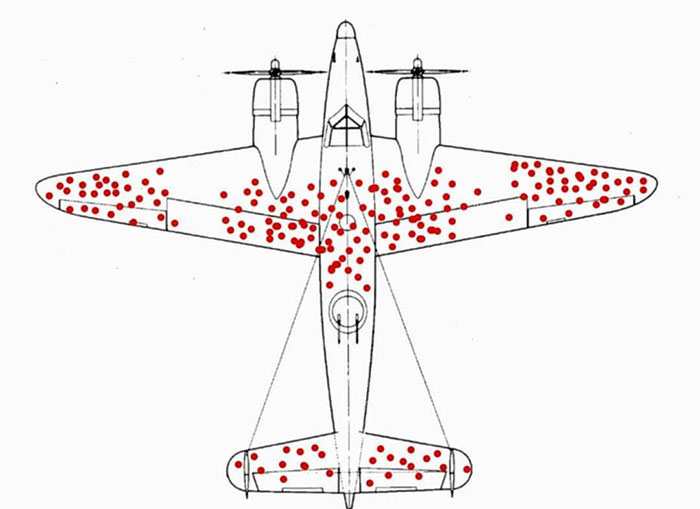
    A recent LinkedIn post alerted this writer to the inimitable perspective statistician Abraham Wald brought to the assessment of World War II Allied bomber damage upon return from missions.  He argued that observed anti-aircraft damage was non-crippling since the aircraft remained airworthy and was able to return.

    He surmised that planes that did not come home may have suffered damage to other areas making them unairworthy and hence their data was unobserved.  Based on this analysis, the U.S. Navy beefed-up armor in the less or unaffected areas and this was credited with saving lives and aircraft.

    This type of analysis came to known as Survival Bias which has its proponents and detractors.  On the surface, it seemed intuitively obvious that areas of damage need addressing while not necessarily those statistically showing fewer issues.

    It is not our intent herein to assess its merits and applicability.  Rather to help readers better understand the very nature of big data and its use, especially in predictive and behavioral models.

    Covid-19

    Today, policy and other decision makers are tasked with dealing with a deadly global pathogen.  Apparently developing quickly and spreading exponentially—a super spreading event.  As of this writing has afflicted millions in 188 countries/region in much less than 12 months.

    In this pundit’s opinion, much of the concern, confusion and clearly wrong information regarding this disease and mitigation protocols can be traced to data collection and analysis.  By now most readers will have some familiarity with the chaos associated with these predictive models.

    For example, according to the US National Library of Medicine, National Institute of Health, “A key fact for us all to remember is that, for the majority of countries, we’re not actually counting how many people have the virus—instead were counting the reports of how many people have the virus, and, like all metrics, those numbers vary according to how they’re measured.  An increase in the number of tests being carried out will result in an increase in the number of infections detected.”

    In addition to the Herculean efforts to tame this tiger from the vast medical, scientific, technology and many other disciplines, Structural Equation Modeling is being used to shed additional light on the latent variables.

    Final Thoughts

    The 2020 Coronavirus is an early test of Big Data analysis in support of decision makers both for public policy and non-government organizations.  While performance so far has been weak, this pundit believes great value can come from this effort.

    Data quality must be highly reliable and valid.  Moreover, models must assess what is not seen, the latent variables such as found in Survival Bias.  These two aspects of strong decision support models are crucial.  These are lessons for all of us.

    Where Didn’t the Bullets Hit Your Business Model?

    For More Information

    Please note, RRI does not endorse or advocate the links to third-party materials.  They are provided for education and entertainment only.

    For more information on Cross Cultural Engagement, check out our Cross Cultural Serious Game

    We are presenting, Should Cross Cultural Serious https://rri-ccgame.com/Games Be Included in Your Diversity Program: Best Practices and Lessons Learned at the Online Conference, New Diversity Summit 2020 the week of September 14, 2020.  Check Out this timely conference!!

    You can contact the author as well.

  • Is Big Data Analysis Being Applied?

    Is Big Data Analysis Being Applied?

    We have been hearing for years how, Big Data Analysis will help us optimize our businesses and generate performance at levels here to for never hear of.  So where is it now?

    Two major sources for data on the Covid-19 virus are Johns Hopkins University and the Centers for Disease Control and Prevention.  This is fine at one level.  Living in the Houston, Texas metropolitan area, this pundit can see a general (real time) overview of the situation from either.

    However, my home is on the west side of the city.  I was recently surprised to learn that most of the local exposure is on the east side; 30+ miles from my domicile.  Is my risk lower than I am being told by the authorities?  Or is it the same or higher?

    Why am I staying at home?  Perhaps the result of a blunt policy instrument?

    It appears to me that most medical professionals are not Data Scientists.  Absolutely knowledgeable in their field, including pathogens (I personally know many in the field including a pathologist).  Is that system taking help from data scientists?  I have not heard that it is.

    Additionally, if the argument is we don’t yet have enough data, this holder of a doctoral degree will argue that Small Data set modeling can be effective as well.  My doctoral dissertation was founded on these statistics.

    I have no doubt that the best minds are working this problem.  However, if policy makers take a hammer to the nail, when perhaps a series of tacks is appropriate, significant economic damage will continue.

    The tack approach appears to be what we are hearing about certain parts of the United States coming back online in a week or so.  The concept of months some advocate makes no sense to this writer.  We will see social unrest long before that.

    The Big Data Analysis sector has been pressing their value proposition and software/solutions for years as a way of optimizing businesses.  Why is the sector quiet regarding coronavirus?

    If we can parse data and sell web advertisements based on ‘clicks’ why can’t we figure this out a level of granularity that allows the economy to restart (at least in some geographies)?  Get to work guys and prove my concerns wrong!

    Finally, what is the role for Artificial Intelligence (AI)?  Its advocates suggest it has magical powers and it  has been used to solve other problems.  Prove it on this global stage!

    Where are Big Data and AI in this fight?

    For More Information

    Please note, RRI does not endorse or advocate the links to third-party materials.  They are provided for education and entertainment only.

    For more information on Cross Cultural Engagement, check out our Cross Cultural Serious Game

    We will be presenting, Should Cross Cultural Serious Games Be Included in Your Diversity Program: Best Practices and Lessons Learned at the Online Conference, New Diversity Summit 2020 beginning April 5, 2020.  Check it Out!!

    You can contact the author as well.

  • In Defense of Humans—Machines Are Not Ready Yet

    In Defense of Humans—Machines Are Not Ready Yet

    I recently submitted an internal organizational document that was spellchecked in addition to my review; several times.  One sentence where there the intent was to say, “that which is …” was change to “that witch is …”

    Did I type it wrong or did ‘auto correct’ take over the decision process?  In any event spellcheck did not perform adequately against minimal Quality Assurance standards.  And how many of us ‘fat finger’ text messages?

    Is this is the technology that is going to drive me to work safely over 200 days a year; round trip?  I hope not.

    One pervasive message—technology gets better with time (more mature).  Is this true?

    How old is spellcheck?  By some accounts it dates to the 1960s.  Most believe by the late 1970s.  So close to half a century.  Yet!

    Usually a spellchecker is not used in a life or death situation.  That is unless it’s for your resume or job application!  However, what about software that is utilized for critical processes, i.e., medicine, process control, etc.

    There are many examples where apparent software failures have negatively impacted human life.  This pundit has written this subject including a look at Man Machine Codependency.  In another blog we commented on problems associated with valid and reliable analysis of Big Data.

    In this author’s opinion, software is getting better and while most likely will not be perfect, will change our daily processes.  The human overlords will need to be trained and/or retrained for the digitalization era.

    This cautionary tale is not about this writer’s inability to use word processing tools.  As we depend on these tools for critical decision making, we must have the core knowledge of the subject we are tackling.

    During a class on digitalization for my master’s level students, I put forth several examples where errors were made by various software applications.  Most had a level of comedy to them, but ALL have potential real-world consequences (bold font).

    • All People in Canada are the Same AgeDemographics for Census or Marketing
    • In Excel 2007, multiplying 77.1 times 850 yielded 100,000 instead of the accurate answer 65,535—Accounting or Engineering
    • The Making of a Fly, a classic work in developmental biology, was listed on Amazon.com as having 17 copies for sale: 15 used from $35.54, and two new from $23,698,655.93 (plus $3.99 shipping)–Procurement
    • Finally, Airline Disaster on AutopilotSafety for the Traveling Public

    This writer has authored books, articles, speeches, presentations, and blogs for many years.  Arguably, he can claim some experience as a writer.  Subject Matter Expert?

    In one instance, the ‘witch’ word won over my intent.  Did the technology cause this error?  Probably, as the goddess of Halloween is not something I typically pontificate about—not on my radar, so to speak.

    Humans can rule for the foreseeable future.  That is unless we seed to the technology.  Most importantly, algorithmic errors can lead to cataclysmic business and even life events.

    Finally, I spellchecked this blog before publication, and it caught the ‘witch’ word this time.  Go figure.

    How Prepared is Your Organization to Oversee the Digitalization Transformation?

    For More Information

    Please note, RRI does not endorse or advocate the links to other materials.  They are provided for education and entertainment only.

    You can contact the author more information as well.

    End Notes

      https://en.wikipedia.org/wiki/Spell_checker

      https://therrinstitute.com/wp-content/uploads/2018/10/Man-Machine-Codependency-September-22-2014.pdf

      https://therrinstitute.com/wp-content/uploads/2018/10/Big-Data-Revisited-December-15-2016.pdf

      https://consult2050.com/job-disruption-due-to-digitalization/