Category: Maturity Model

  • Post Covid-19 Operational Performance

    Post Covid-19 Operational Performance

    Not the So-Called New Normal


    The light at the end of the Covid-19 tunnel may not be the train many still believe.  Populations are being inoculated at very high rates.  Moreover, there is ample evidence in my metropolitan area that the general population no longer believes or adheres to the ‘advice of experts.’  This should surprise no one who understands the US long history of civil disobedience.

    We pundits forecasting the new normal following a traumatic social event always get it wrong and so we will again this time.  There is a simple reason for this–Human Behavioral Economics.  Another leg of the three legged stool is the Technology Readiness Level (TRL) and not all technologies are at the same level or even play well together.  Finally, Organizational Culture must be ready as well.  If these situational settings are not met, the crisis passes and we get back into the comfortable and familiar.

    Following the initial euphoria that we could work from home and not wear pants, many discovered this really was not for them.  Many children did not do as well in a stay at home educational setting and teachers were challenged as well.  Moreover, many tasks require personal engagement.

    Many are Called . . .

    As always winners and losers will emerge and it will take some time for that rank order to solidify.  While digital is important and we have supported that business model for decades, bits will not physically move the barrels.  Still will take heavy industrial technology and processes.

    Using information and other technologies to drive Operations Management Systems are the future.  Not necessarily driven by IT firms but those digital engineers steeped in both disciplines.

    If Organizations are to achieve successful Sustainability, they first need a High Reliability level of Agility and Resiliency.  The only get these attributes when they perform at a high level of Excellence.

    So as we arrive at another new normal, we need to recognize that not everything from the past was bad and not everything we see today is good.  Some processes will be sustained and coupled with newer one.  New Normals do not really destroy the past; we continue to evolve.

    Even innovation from Creative Destruction is not instantaneous.

    How will your organization take advantage of emerging opportunities?

    For More Information

    Please note, RRI does not endorse or advocate the links to any third-party materials.  They are provided for education and entertainment only.

    For more information on Cross Cultural Engagement, check out our Cross Cultural Serious Game

    We presented, Should Cross Cultural Serious Games Be Included in Your Diversity Program: Best Practices and Lessons Learned at the Online Conference, New Diversity Summit 2020 the week of September 14, 2020.  Check Out this timely event and contact the organizer for access to the presentations!!

    You can contact this author as well.

  • Teaming Safely

    Teaming Safely

    “For safety is not a gadget but a state of mind”


    Second only to the basic need for food, water and what is required to sustain physical life, safety and security are the next step in Maslow’s Hierarchy of Needs.  In other words one cannot love or feel belonging or achieve a level of esteem without having the warmth of safety much less attain self-actualization.

    More recently, team safety has come to be defined as Inclusive.

    There are three components of team safety:

    • Sociological — “developing and maintaining friendly social bonds is a fundamental organizing principle of human behavior”
    • Psychological — “defined as a shared belief that the team is safe for interpersonal risk taking”
    • Physiological — “relating to the way in which a living organism or bodily part functions”

    If members do not feel ‘safe’ then the team is not capable of high performance.  Moreover, the synergistic value that can be derived from team diversity can not be captured.

    Attaining Safety

    While the need to be safe is coded in our DNA so to speak, we are not inherently safe.  Individuals as well as teams must be proactive to reach situational safety.

    We are Mindful when we are in touch with ourselves and the environment through nurturing feelings.  Interesting, being mindful is a major requirement of High Reliability Organization/Team.  High reliability is a necessary ingredient for an organization’s Safety Culture and by extension its Teams (including third party ecosystem members).

    Safety is a learned behavior.  Therefore, effective training and ongoing reinforcement are necessary. Moreover, realistic scenarios are mandatory making the learning process relevant.

    Take the following maturity assessment and implement your team training program!

    What is your Team’s Culture of Safety Maturity?

    For More Information

    Please note, RRI does not endorse or advocate the links to any third-party materials.  They are provided for education and entertainment only.

    For more information on Cross Cultural Engagement, check out our Cross Cultural Serious Game

    We presented, Should Cross Cultural Serious Games Be Included in Your Diversity Program: Best Practices and Lessons Learned at the Online Conference, New Diversity Summit 2020 the week of September 14, 2020.  Check Out this timely event and contact the organizer for access to the presentations!!

    You can contact this author as well.

     

  • Hanging App?

    Hanging App?

    By one measure, the US presidential primary season is off to a rough start.  In a small state, counting the ballots became a challenge.  Wasn’t technology supposed to solve the problems of past confusions?

    Yet the mechanism seemingly failed—again!  How is this different from the Boeing Max 8 disaster?  In one sense it isn’t.

    Disclaimer:  The only information this author has on the recent electoral IT problem is publicly available and he is not aware of anyone involved in that process that he may know personally.  This piece is only an opinion about a technology issue.

    Technology Adoption Process

    App developers strive to get to MVP as rapidly as possible.  Wikipedia defines a Minimum Viable Product as, “A version of a product with just enough features to satisfy early customers and provide feedback for future product development.  Gathering insights from an MVP is often less expensive than developing a product with more features, which increases costs and risk if the product fails, for example, due to incorrect assumptions.”

    Speed is of the essence in software development.  Yet, a rapid time to market should not sacrifice adequate analysis and assurance the software is robustly ‘stress tested.’

    Apps are moving from simple tools designed to call an independent driver of transport or order a burger.  They are now integral parts of enterprise solutions with broad implications if they fail.  This changes the fundamental project development process and benchmarks for release.  This is true for all App developers, even if their employee base is one or the development process is outsourced entirely.

    Release Maturity

    Most new technologies start is some’s ‘garage.’  Whether Steve Jobs’ or 3M, the processes are ad hoc and getting a so-called ‘Alpha’ product is the goal.  Those third parties who accept and test it know their risks and exposure.  Such customers would never use that release in a production environment.

    Other maturity models include Technology Readiness Levels (TRLs) by NASA and the European Association of Research and Technology Organisations.  At a minimum, testing must assure it is fit-for-purpose and that the product can ‘scale’ to meet the expected demand.

    Technology vendors to ‘critical infrastructure’ sectors such as oil and gas often express exasperation at the sometime slow take up of new solutions.  Individuals that take excessive risks deploying new technology may literally be putting their career at risk as well as their critical processes.  Therefore, they tend to be risk averse.

    There are many examples of what not to do rolling out new technology.  This month’s primary election is just the latest.  The adage, ‘no one wants to make the front page of The Wall Street Journal’ has a lot of truth to it.  Make sure you and your customer get media coverage for the right reasons.

    How Do You Know Technology is Ready for Enterprise Wide Deployment?

    For More Information

    Please note, RRI does not endorse or advocate the links to other third-party materials.  They are provided for education and entertainment only.

    For more information on Cross Cultural Engagement, check out our Cross Cultural Serious Game

    You can contact the author as well.

    End Notes

      https://en.wikipedia.org/wiki/Technology_readiness_level

      https://therrinstitute.com/critical-infrastructure-sectors/

  • Reflection: Are We Near a Digital Tipping Point?

    Reflection: Are We Near a Digital Tipping Point?

    Generally, this time of year humans are wont to look back on the closing year and assess the good and the bad, and dare I say the ugly?  We celebrate successes, review the not so successes, and what is left undone.  This process prepares us for the New Year’s resolutions that are often then broken.

    Today, we will see lots of stories on the accomplishments of the year, notables that passed from this life and other celebrations and questions about the waning hours.  In this piece, let us ask another question.

    The subject of the Man—Machine relationship has long been the subject of comment and speculation.  It remains so.  Where are we along this path?

    But as the march on a continuum towards the future, it is time to assess the level of Maturity of our Operational Excellence as a function of IT-OT.

    Challenges remain.  Recently, the Boeing’s Starliner space vehicle failed to reach its planned orbit.  The glitch is apparently in the capsule’s clock where a programming error misinterpreted the stage of the mission.

    News media reporting suggests that if astronauts had been on board, they may have been able to override the system and correct the problem.  This is an area we have addressed herein on several occasions.  When does the human act?  Recent articles include:

    The decision model whether to override the computer remains elusive.  Likely, it will for some time.

    In this writer’s opinion, it is currently difficult to develop an appropriate governance model for this emerging man-machine interface.  That said, the task is upon society and individuals and organizations must proactively engage.

    Not Just Digitalization

    There is much ado about the promise of digitalization and speculation about its ability to be a game changer.  One wonders how any technology available to all warrants such status?

    Since the advent of the Turing machine, circa 1936 and its enablement of the winning of Word War II (at least in Europe), there has been a level of trust in information technology that is not always warranted.  Today, how many of us will sit with our children in the backseat of a driverless automobile?

    Human factors must be considered when new technology models are put forth.  After all, humans still govern, right?

    Maturity Assessment

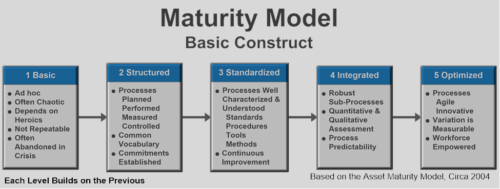
    Building on the CMMI and our own maturity model development methodology we put forth a set of constructs.  Beginning in 2004, when we released our Roadmap study.  It was one of the earliest, if not the first industry wide assessment of the so-called digital oilfield and guide for organizations to transform themselves with this enabling technological model.

    As part of that study we posited a maturity model that still has applicability for heavy industry and its use of information technologies to manage the business.  An updated version is shown in the following figure.

    For many organizations, Level 3 is satisfactory and accomplished the required.  One can argue that an airline autopilot would be at least Level 4.

    The current issues Boeing has with is space capsule and 737 suggests that may not be the case.  By the way, this is not limited to this manufacturer, others have similar issues as well.

    In the opinion of this writer, as a society we are at best Level 2 when it comes to digitalization.  What do readers think?

    Paraphrasing a famous election cycle quote, “It’s the software, stupid.”  Are we near a digital tipping point?  Perhaps not.

    Much work is yet to be done.  Fear not for the robots taking your job—at least for the moment.

    What is Your Digitalization Management Maturity Level?

    For More Information

    Please note, RRI does not endorse or advocate the links to other third-party materials.  They are provided for education and entertainment only.

    For more information on Cross Cultural Engagement, check out our Cross Cultural Serious Game

    You can contact the author as well.

    End Notes

      https://www.space.com/boeing-starliner-oft-fails-to-reach-correct-orbit.html

      https://en.wikipedia.org/wiki/Turing_machine

      https://therrinstitute.com/maturity-models/

      (2004, September). Roadmap to Enterprise Optimization: A Guide to the Impact of Information Driven Field Operations on the Petroleum Corporation.

      https://www.popularmechanics.com/flight/airlines/a26854898/plane-automation-crashes-incidents/

  • Lessons from the Seventies

    Lessons from the Seventies

    At lunch the other day and for whatever reason, the history of the 3M Post It Note became a subject of our conversation.  This technological marvel unveiled in the 1970s is still widely used today.

    As with other new or disruptive technologies, the ‘sticky note’ was panned at first and for some time.  According to Wikipedia, the technology was first developed in 1968.  It was not until 1974 that it gained some internal company support.

    When finally introduced in 1977, the pilot results were unsatisfactory.  However, things started to change in 1978 when a small (focus) group of consumers were positive about the product.

    The United States roll-out began in the spring of 1980, followed by Europe and Canada in 1981.  A bit of trivia, the reason it was originally yellow was because yellow colored scrap paper was readily available at its inception.

    Earlier the day of our lunch meeting, a discussion revolved around how long it might take an idea to become a fundable start-up company.  Several participants argued that with proper guidance, the process still might take up to two years.  This pundit argued that many entrepreneurs would see that as too long and become disinterested.

    The legacy of the Post It Note suggests that this pundit might be incorrect.  The lowly sticky note did not even begin its journey to become a Unicorn until twelve years after its technology was discovered.

    In 2015, we penned a blog, Titans of the 1940s Today.  The basic premise of that piece was when commenting about the Internet of Things (IoT) and its complexity, individuals such as Richard Feynman and John von Neumann (father of the 1945 computer architecture that is the basis of modern computing) had developed solutions for today prior to this author’s birth.

    We stand on the shoulders of these and other giants.  The challenge of every generation has been to build on what those who came before advanced.  So it remains today!

    Body of Knowledge

    Human kind has developed a rich body of knowledge in all areas of endeavor.  It is readily available for entrepreneurs as well as those employed by all types of organizations.  This knowledge base has been addressed in this blog and other writings by the author.  Interested readers are invited to review my blogs and newsletters dating back to the last century.

    Our march through history provides all of us a ‘go-by’ that can shorten our learning curve.  One example this author often cites is the depth of historical knowledge of management.  Contrary to many gurus, humans have managed others and processes for many millennia.

    Fail Fast, Fail Often?

    If 3M or Feynman et al practiced this technology development model as most interpret it, our world might be a lesser place.  Give up and move on to the next?

    One interpretation suggests, “Originating from Silicon Valley and its ocean of start-ups, the real aim of “fail fast, fail often,” is not to fail, but to be iterative.  To succeed, we must be open to failure—sure—but the intention is to ensure we are learning from our mistakes as we tweak, reset, and then redo if necessary.”

    This same article goes on to state, “Thomas Edison, by example, ‘failed’ 9,000 times before he was successful with his light bulb invention.”  Perseverance can be a lonely quality!

    Don’t lose heart.  Great ideas abound but must gestate.  It is often said that we find our soulmate when we least expect to—I know I did.  Progress is an iterative process fueled by creativity and critical thinking.

    Is Your Idea a Unicorn Waiting to be Born and Mature?

    For More Information

    Please note, RRI does not endorse or advocate the links to other materials.  They are provided for education and entertainment only.

    You can contact the author more information as well.

    End Notes

      https://en.wikipedia.org/wiki/Post-it_Note

      https://therrinstitute.com/wp-content/uploads/2018/10/Titans-of-the-1940s-Today-April-20-2015.pdf

      https://therrinstitute.com/wp-content/uploads/2019/10/1993-Management-Theory-Evolution-Not-Revolution.pdf

      https://www.forbes.com/sites/danpontefract/2018/09/15/the-foolishness-of-fail-fast-fail-often/#1db35b0e59d9

  • In Defense of Humans—Machines Are Not Ready Yet

    In Defense of Humans—Machines Are Not Ready Yet

    I recently submitted an internal organizational document that was spellchecked in addition to my review; several times.  One sentence where there the intent was to say, “that which is …” was change to “that witch is …”

    Did I type it wrong or did ‘auto correct’ take over the decision process?  In any event spellcheck did not perform adequately against minimal Quality Assurance standards.  And how many of us ‘fat finger’ text messages?

    Is this is the technology that is going to drive me to work safely over 200 days a year; round trip?  I hope not.

    One pervasive message—technology gets better with time (more mature).  Is this true?

    How old is spellcheck?  By some accounts it dates to the 1960s.  Most believe by the late 1970s.  So close to half a century.  Yet!

    Usually a spellchecker is not used in a life or death situation.  That is unless it’s for your resume or job application!  However, what about software that is utilized for critical processes, i.e., medicine, process control, etc.

    There are many examples where apparent software failures have negatively impacted human life.  This pundit has written this subject including a look at Man Machine Codependency.  In another blog we commented on problems associated with valid and reliable analysis of Big Data.

    In this author’s opinion, software is getting better and while most likely will not be perfect, will change our daily processes.  The human overlords will need to be trained and/or retrained for the digitalization era.

    This cautionary tale is not about this writer’s inability to use word processing tools.  As we depend on these tools for critical decision making, we must have the core knowledge of the subject we are tackling.

    During a class on digitalization for my master’s level students, I put forth several examples where errors were made by various software applications.  Most had a level of comedy to them, but ALL have potential real-world consequences (bold font).

    • All People in Canada are the Same AgeDemographics for Census or Marketing
    • In Excel 2007, multiplying 77.1 times 850 yielded 100,000 instead of the accurate answer 65,535—Accounting or Engineering
    • The Making of a Fly, a classic work in developmental biology, was listed on Amazon.com as having 17 copies for sale: 15 used from $35.54, and two new from $23,698,655.93 (plus $3.99 shipping)–Procurement
    • Finally, Airline Disaster on AutopilotSafety for the Traveling Public

    This writer has authored books, articles, speeches, presentations, and blogs for many years.  Arguably, he can claim some experience as a writer.  Subject Matter Expert?

    In one instance, the ‘witch’ word won over my intent.  Did the technology cause this error?  Probably, as the goddess of Halloween is not something I typically pontificate about—not on my radar, so to speak.

    Humans can rule for the foreseeable future.  That is unless we seed to the technology.  Most importantly, algorithmic errors can lead to cataclysmic business and even life events.

    Finally, I spellchecked this blog before publication, and it caught the ‘witch’ word this time.  Go figure.

    How Prepared is Your Organization to Oversee the Digitalization Transformation?

    For More Information

    Please note, RRI does not endorse or advocate the links to other materials.  They are provided for education and entertainment only.

    You can contact the author more information as well.

    End Notes

      https://en.wikipedia.org/wiki/Spell_checker

      https://therrinstitute.com/wp-content/uploads/2018/10/Man-Machine-Codependency-September-22-2014.pdf

      https://therrinstitute.com/wp-content/uploads/2018/10/Big-Data-Revisited-December-15-2016.pdf

      https://consult2050.com/job-disruption-due-to-digitalization/

  • Chain of Custody: Is Your Management System Ready?

    Chain of Custody: Is Your Management System Ready?

    This eliminates the possibility for human error.”  This is an actual quote taken from one of the many blockchain ‘credible’ websites readily available—citation withheld to protect the guilty.    And, the Titanic was unsinkable!

    From another credible sources, “Is blockchain secure for my business?  Simply put, it can be.  But, not by just turning the key.  Security will depend on a variety of factors, none sic (not) the least of which requires a robust risk management framework?”

    In their white paper, KPMG argues that while the current blockchain frenzy is focused on the new technology, the question of its applicability to a business solution remains elusive.  Falling in love with a ‘shiny new software object’ has been seen before.  Most recently, digitalization and IoT.

    The organization’s economic buyer requires more depth in the decision-making process.  Has a valid Business Use Case been developed for its implementation?  This can be a time-consuming activity as the various constituencies must be queried to assess their assessment of the Economic Value of this CAPEX.  Unfortunately, there are no shortcuts to this risk mitigation process.

    This blogger has focused on the need for Governance and appropriate Management Systems for many years.  Historically it has been a challenge for business and government entities to keep up with the explosion of technology.

    While third parties are often the weakest link in supply chain management and this is one of the problems that Chain of Custody solutions address, technology alone is not a solution.  As with any transformational initiative, the broader impact, unintended consequences as well as other tangible and intangible exposures must be understood and managed accordingly.

    Just for the record, human error can never be eliminated.  It is human folly to believe that a technology can free us from our human nature.  High Reliability Organizations (HRO) recognize this frailty and respond accordingly.

    The promised of today’s technology suites can be of high value.  History teaches us that this value may not be realized if the problem being addressed, their implementation and sustained (maturity) processes are inadequately formulated.

    How Will Your Organization Assure It Will Realize the Value from Blockchain Investments?


    https://advisory.kpmg.us/articles/2017/securing-the-chain.html

    Shemwell, Scott M. (2018, October). How to make the case to the C-Suite: Selling Large Scale Data Management Projects to the C Suite. Foundations: The Journal of the Professional Petroleum Data Management Association. Volume 5 Issue 2. pp. 6-8.

    https://sceweb.uhcl.edu/helm/RationalUnifiedProcess/process/modguide/md_bucm.htm

    https://therrinstitute.com/economic-value-proposition-matrix/

    https://therrinstitute.com/are-organizational-governance-models-broken-why-cant-management-get-a-handle-on-things/