
Tag: ISO-30415

  • Going Green? Or NOT!

    Going Green? Or NOT!

    The total or lifecycle carbon footprint for any energy source is a function of the manufacturing, commissioning, operation (including maintenance) and decommissioning of that asset.  Moreover, the value of an electric powered vehicles (EV) is seen as a function of the amount of fossil fuel no longer used by the vehicle.  However, this is only a sub-model of the to carbon footprint of any component in the Basket of (Energy) Goods, aka Energy Basket.

    All energy resources in the basket must be held to the same set of metrics.  These include Human Resources (including diversity and inclusion), Safety Culture, communities as well as the bottom line performance against governance standards (ESG).

    Risk Governance

    A governance framework that exceeds these standards follows.  Evolving over several decades, it reflects a comprehensive approach to operational risk that is often overlooked.  It addresses the entire life of a revenue producing asset.

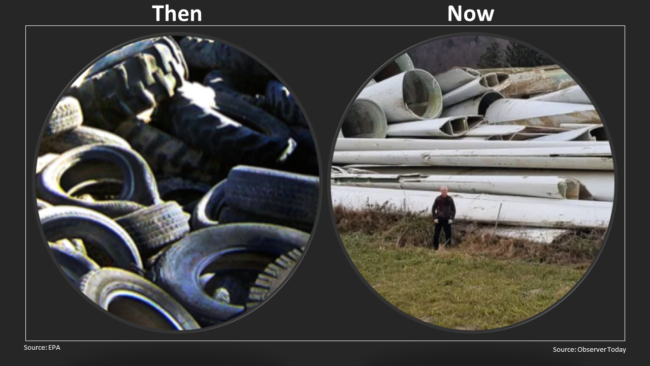
    Lifecycle risk mitigation of an energy resource must include the end of the asset life processes.  What governance driven processes are in place to prevent the accumulation of wind turbine blades or spent solar panels stacked and abandoned?  Just like the tires stacked for decades.

    Turns out the answer is few.  Long life assets such as factories, skyscrapers, fossil fuel production systems, etc. are built to the engineering, industry and local regulatory standards of that day.  Ongoing operations, maintenance, upgrades and so forth keep them performing at acceptable levels.  However, governance models are often focused on the present.  End of asset life risk does not fit into the four quarter management mindset as the event may be sometime in the future.

    The above graphic represents a governance model built around operations and associated risks.  The archetype recognizes that many risk mitigation processes are inadequate for today’s complex organizations with multi-faceted global processes.

    Its framework is built upon the work done by the Treadwell Commission several decades ago to detect financial fraud.  This structure supports the extension into field operations and provides a structure for attaining and sustaining Operational Excellence.

    Risk mitigation is both quantitative and qualitative.  The risk associate with the use of any industrial energy source must be thoroughly assessed as a function of its lifecycle, not just its initial CAPEX and ongoing operations.

    Dumping v Decommissioning

    Illegal industrial dumping has long been a problem.  Today, some in the wind turbine sector appear to be following the decades long vehicle tire disposal process (or lack thereof).

    Lady Bird Johnson at least tried to hide the piles of tire debris but no one has found a way of completely dealing with this growing and massive problem.  As of 2017, some 17% were still disposed of in landfills.  In 2003, the EPA reports that almost 300 million tires are scraped each year.  Flash forward to today and this is likely a very conservative number.  That said, 17% equals approximately 50 million tires headed to landfills as opposed to recycling.

    Moreover, there is a long history of industrial dumping trash so as not to have to pay the disposal fees.  One wonders how many millions of tires destined for landfills (and other recycling) are just dumped?

    The decommissioning process is the responsible end-of-asset-life shutdown and removal.  The intent is to return the site to a condition similar to its initial environment and properly remove and dispose of equipment and materials.  It should not include stacking wind turbine blades next to a pile of discarded vehicle tires.

    Total Carbon Lifecycle Model

    Daily, we hear about the need to reduce carbon output to (net) zero.  Promises are made by many that by such and such a time this metric will be met.  Caveat: usually the time period is beyond the expected tenure of those making the statements.  Often lost in the discussion is the carbon cost of manufacturing and decommissioning.

    Carbon output should include the mineral extraction process, recycling of older materials if appropriate, transportation, manufacturing, installation, operations and decommissioning.  It also must include the carbon cost of the supply chain necessary to support the asset across its lifecycle.  For example, the carbon cost of an EV is not just the vehicle’s operation but the lifecycle of the vehicle as well as the electric power generation and distribution necessary to operate the automobile.  Do not forget the carbon cost of manufacturing a battery and disposing of it at end of life.

    Scrap

    Materials are often staged for recycling.  They feed a process that results in new useful product(s) that may add new value.  This is a useful recycling process that makes a lot of sense.  However, sometimes this is not as economical as new manufacturing.  These economics lead to dumping as the low-cost-solution.  Fields of discarded materials may or may not be awaiting recycling.

    Defining Green

    Being green is not simply using renewable electricity instead of gasoline.  If the carbon footprint is no different or even worse, then the problem is not solved and may even be made greater.

    Keep in mind that coal is still a major fuel in the generation of electricity.  According to the US Energy Information Administration (EIA), in 2020 over 60% of power is generated using fossil fuels of which over 19% is from coal.  This does not include the carbon footprint of materials and products imported to the US.

    So if the carbon footprint of a wind turbine is defined as its lifecycle and if at the end result is abandonment in a field, is the green value of that product positive?  Or is it just dumping not unlike the pollution of a nation’s river systems?

    Being green is not just plugging in your car overnight.  Like most things in life, it is systemic.

    Is Your Organization’s Green Plan Systemic or Myopic?

    For More Information

    Please note, RRI does not endorse or advocate the links to any third-party materials.  They are provided for education and entertainment only.

    For more information on Cross Cultural Engagement, check out our Cross Cultural Serious Game

    We presented, Should Cross Cultural Serious Games Be Included in Your Diversity Program: Best Practices and Lessons Learned at the Online Conference, New Diversity Summit 2020 the week of September 14, 2020.  Check Out this timely event and contact the organizer for access to the presentations!!

    For more on DEI Standards, see the newly released ISO-30415.

    You can contact this author as well.

  • 100

    100

    This edition marks the 100th post in our Critical Mass Blog series.  We have sought to provide thoughtful, unbiased insight into the contemporary business and organizational challenges we all face.  Since our first blog post on November 27, 2017 our world has turned over in ways none expected.  Likely, this trend will continue.

    This series continues a tradition of newsletters, opinion pieces and other on line punditry first begun in 1998 with our New Millennium News.  A bi-monthly email with a subscription base of approximately 7,000 readers.  A huge number at that time.  We estimate that hundreds of thousands or more have benefited from this knowledge transfer.

    Coincidentally, we reach this milestone as we begin the new year–a time of renewal.  We will continue to address critical issues individuals, businesses, agencies and others face as we all navigate an increasingly perilous path.  This series has addressed Human Resource issues including Diversity, Equity and Inclusion (DEI) Teams , the arrival of Smart Technology, International Business, Covid-19, Supply Chain Management, Operational Excellence, Cultural Transformation (including Safety Culture) Sales, Risk Mitigation and of course Leadership.  Today’s organizations must be very good at all of these disciplines!

    Available Tools

    The mission of the Rapid Response Institute (RRI) is to enable our clients with the ability to posture themselves in their market segments so that they can thrive in volatile markets and capitalize on uncertainty, not suffer because of them.  This is especially important for those economic actors in Critical Infrastructure sectors.

    In support of this mission the firm has developed a suite of Intellectual Property (IP) which includes Know How, practical roadmap Books and guidelines as well as Software as a Service (SaaS) solutions among others.  Many readers know that once a process has been standardized with minimal configuration required, the data is the ultimate driver.  This is the heart of most Enterprise Resource Planning (ERP) solutions.

    With advances in technology, RRI has taken these once multi-million dollar solutions to a price point as well as Use Case where all organizations can utilize this capability.  Moreover, our advancements in work flow such as epitomized in our Cross Cultural Serious Games, Economic Value Proposition Matrix, and Smart OpEx (Operations Management System) and Risk Simulation Modeling add immediate and significant value to the challenges faced as articulated above.  Other Free Tools are available as well.

    Pulling It All Together

    The method to our madness is–Operations!!  As some are fond of saying with derision, “It’s All About the Benjamins.”  Well, it actually is.  If ‘for-profit’ firms are not profitable, they fail.  No amount of Environmental, Social, and Governance (ESG) will save them if they cannot deliver to paying customers.

    Everything RRI does helps organizations to deliver stakeholder value, compliant with ESG standards.  That is our Bottom Line and we are also pleased that Dr. Shemwell, Managing Director has been an independent advocate for responsible corporate success since 2004.

    FYI, major losses and legal actions do not enhance stakeholder value.  Neither for employees, local communities or equity holders.  Everyone loses when in terrible scenarios such as Deepwater Horizon, internal bias corporate hubris, poor high reliability processes/human factor shortcomings or lack of actual DEI.

    This journey continues.  Stay tuned for the next 100 editions where will continue to provide our thoughts on relevant matters.  Thank you very much for your readership and support.

    How is Your Organization Positioned for the Next Four Years?

    For More Information

    Please note, RRI does not endorse or advocate the links to any third-party materials.  They are provided for education and entertainment only.

    For more information on Cross Cultural Engagement, check out our Cross Cultural Serious Game

    We presented, Should Cross Cultural Serious Games Be Included in Your Diversity Program: Best Practices and Lessons Learned at the Online Conference, New Diversity Summit 2020 the week of September 14, 2020.  Check Out this timely event and contact the organizer for access to the presentations!!

    For more on DEI Standards, see the newly released ISO-30415.

    You can contact this author as well.

  • Getting to Diverse and Inclusive Teams

    Getting to Diverse and Inclusive Teams

    Diversity, Equity, and Inclusion (DEI) Team Models

    There is a tendency to see DEI through the lens of initiatives or often a process semi-outside the daily ‘organizational’ grind.  Does this represent reality?

    Organizations spend countless sums training employees and others they depend on for Operational Excellence performance.  They often trust global Teams to add stakeholder value.

    No less than Microsoft names a software product, Teams.  A tool designed to foster collaboration.

    The Way We Do Business

    Culture is often defined as ‘who we are.’  The approach an organization takes towards its ecosystem.  If this model is an accurate representation, it suggests that when organizations launch initiatives meant to address current social mores, they likely fail or at least do not live up to full potentials.

    Change management, often referred to as transformation often takes on the mantel of ‘you will be changed.’  Contemporarily, take the Covid-19 vaccine or you will be fired!  Not surprisingly, this mandate is resisted and seemingly increasingly with each new warning.

    As of this writing, the all out war (on decrees) has been declared by the likes of the Navy Seals, Health Care Workers, Law Enforcement and others with the demands from the Feds.  Likely, the result will be a draw at best, with the administration quietly acquiescing.  Too many critical, non-replaceable positions are at risk.  Not to mention votes.

    Governance

    In October 2011, we published our first draft of, Asset/Equipment Integrity Governance: Operations–Enterprise Alignment.  We recognized that traditional organizational Governance models were strictly focused on finance and maleficence therein.  The reality is that revenue is generate by operations and as such governance is critical as well.  Safety Culture, is intangible but now required by most organizations in Critical Infrastructure sectors.

    Flash forward to today and Environmental, Social, and Governance (ESG) is the model most organizations use.  Effectively, this expands governance to include a broad range of non-financial commitments.  From this blogger’s perspective, likely DEI will fall under this governance model.  Therefore, moving it from the ‘initiative status’ to the ‘way we do business.’

    Team Building

    This dynamic environment requires workforce upskilling.  The need to constantly assure that individuals have current Knowledge, Skills and Abilities (KSAs) necessary to meet current challenges.  KSAs now include the ability/necessity to work across cultural/diverse lines.

    When one thinks of a ‘team’ it is not a homogenous collection of like minded and ‘like’ individuals.  Teams are a collection of hopefully, ‘fit for purpose’ individuals who comprise the KSAs needs to accomplish the task(s) at hand.  Teams can mirror the discrete views of its members.

    For example, our early research on the subject assessed the different approaches Japanese nationals took when negotiating with white American males.  In each case, the individual players were deemed to be homogenous.

    Nothing could be further from the truth.  Each individual, in this case all males were of different ages, different education, from different regions of their respective countries, married or not and so forth and so on.

    The reality is that individuals do not negotiate deals.  Teams do.   Members of teams, like juries need to arrive at the same place prior to engaging with other collaborative counterparts.

    Juries need to be arrive at consensus.  Likewise, organizational team members must arrive at a similar place internally prior to going forward.  This not to say that individuals must cave to the will of the majority or the Tyranny of the Minority.  It is to say, a common position that all must accept as part of collaboration or consensus.

    Inclusive?

    There is no doubt that token individuals and in some case high profile figureheads have been put forth to ‘prove’ inclusivity.  Thankfully, those days are fading.

    Teams need to have the input of all members, even contrarians.  Often it is the outlier that has the most insight into a difficult problem.  Differences of opinion need to be resolved and a go forward plan agreed upon.

    Often, individuals do not speak up.  Perhaps they are new to the environment, shy or unsure of themselves.  Whatever the reason their input must be sought and at least given a fair hearing.

    Training can help elicit input from the reticent.  Moreover, they help dominate individuals acknowledge and accept said input.

    How Does Your Organization Assure Real Inclusion?

    For More Information

    Please note, RRI does not endorse or advocate the links to any third-party materials.  They are provided for education and entertainment only.

    For more information on Cross Cultural Engagement, check out our Cross Cultural Serious Game

    We presented, Should Cross Cultural Serious Games Be Included in Your Diversity Program: Best Practices and Lessons Learned at the Online Conference, New Diversity Summit 2020 the week of September 14, 2020.  Check Out this timely event and contact the organizer for access to the presentations!!

    For more on DEI Standards, see the newly released ISO-30415.

    You can contact this author as well.