
Tag: electric vehicle

  • Burrattery

    Burrattery

    Burr!  Its winter in the northern hemisphere and many shiver from the cold.  The ‘Many’ include batteries.

    We have know for generations that cold weather negatively affects electrical batteries.  So, it should come as no surprise that Electric Vehicles (EVs) performance can suffer greatly when the temperatures are extremely cold.  This phenomenon is not limited to this power source, diesel engines face similar challenges at very low temperatures.

    Is It All Hype?

    The IT research firm, Gartner has developed a model describing the process from the inception of new technologies to their general acceptance.  The Gartner Hype Cycle is widely viewed as a reasonable model of this process and is applied to a wide variety of technological innovations.  As the title suggests, technology undergoes a process of innovation, disappointment and finally broad acceptance.  Moreover, this process can take many years with the demise of many startup companies that were perhaps even too early in the process.

    According to Gartner, “Data-enabled services, electrification and smart cabins are a part of many technologies in this Hype Cycle.  Most of these technologies continue to be in the Innovation Trigger and Peak of Inflated Expectations, showing they have a lot of potential to disrupt the automotive space, but yet have some way to go before reaching mainstream adoption.”

    Diffusion of Innovations

    Most readers are probably familiar with the so-called Technology Adoption model which is composed of five types of users/buyers:

    1. Innovators
    2. Early Adopters
    3. Early Majority
    4. Late Majority
    5. Laggards

    For these and more reasons (including high prices), it seems that EVs may have a way to go before wide acceptance with more robust battery technologies.  Finally, we previously challenged the perceived low Carbon Footprint of batteries and documented these technologies are not as green as portrayed.  Interested readers can take a look at our blog Crippling Green discussion regarding the economics of Climate Change.

    Where does your organization fall on either or both of these curves for battery technologies?

    For More Information

    Please note, RRI does not endorse or advocate the links to any third-party materials herein.  They are provided for education and entertainment only.

    See our Economic Value Proposition Matrix® (EVPM) for additional information and a free version to build your own EVPM.

    The author’s credentials in this field are available on his LinkedIn page.  Moreover, Dr. Shemwell is a coauthor of the just published book, “Smart Manufacturing: Integrating Transformational Technologies for Competitiveness and Sustainability.”  His focus is on Operational Technologies.

    “People fail to get along because they fear each other; they fear each other because they don’t know each other; they don’t know each other because they have not communicated with each other.” (Martin Luther King speech at Cornell College, 1962).  For more information on Cross Cultural Engagement, check out our Cross Cultural Serious Game.  You can contact this author as well.

    For more details regarding climate change models, check out Bjorn Lomborg ands his latest book, False Alarm: How Climate Change Panic Costs Us Trillions, Hurts the Poor, and Fails to Fix the Planet.

    Regarding the economics of Climate Change, check out our blog, Crippling Green.

    For those start-up firms addressing energy (including renewables) challenges, the author can put you in touch with Global Energy Mentors which provide no-cost mentoring services from energy experts.  If interested, check it out and give me a shout.

  • Crippling Green

    Crippling Green

    “Yes, hope is a strange thing.  Peace at last.  But at what price?”

    Great Societies have been lost in the past–a number of times.  There is no reason to believe our current crop is immune!

    Ariel Durant, the co-author of the 11 volume tome, The Story of Civilization is credited with, “A great civilization is not conquered from without until it has destroyed itself from within.”

    The United States is currently engaged in a great climate civil war.  One one side there are those who advocate for expensive and expansive economic and social investment in so-called Climate Change.  Climate Change Skeptics, often derided by the aforementioned group as Climate Deniers are those who question the Scientific Consensus and the cost and return on the investment to become Net Carbon Zero.  By the way, science is never settled.

    From the observer’s perspective, there is a long term effort to shut down debate, as is typical in today’s society largely by name calling, shaming and even threats.  Dissenters seemingly risked their professional reputation, loss of grants, even safety, and more.

    And Now Questions

    Funny thing happened on the road to Net Zero.  Questions began to be raised about the efficacy of renewables, and their Total Lifecycle Cost.  Moreover, the heavy metal cost of ecological damages of mining were raised and are now under scrutiny.

    The Let Them Eat Cake Strategy

    Transitions, especially Transformations are painful.  Based on Joseph Schumpeter’s Creative Destruction, “The incessant product and process innovation mechanism by which new production units replace outdated ones,” transformation is a linchpin of Capitalism.  Now, some believe socialism is the future, history does not prove their point.  Are any to turn in the Smart Phones for the old black dial model tethered to a wall?

    However, when this natural process is driven by the ‘heavy hand’ of non-economic actors, perturbations in the process can cause warps in the economic space time continuum.  Some examples of overreach include:

    Agriculture

    Some argue that, “Agriculture accounts for 16 to 27% of human-caused climate-warming emissions.”  Nitrous oxide (N2O) is the named culprit (according to the Intergovernmental Panel on Climate Change this chemical accounts for 6% of greenhouse emissions).

    It is reported that in the Netherlands agricultural sector system manure is high in nitrous oxide.  Emotions are apparently running high between Dutch farmers who see a targeted 30% reduction in livestock heads and the government whose position seems to be this is an “unavoidable transition.”  Jobs are at risk!

    Gasoline

    It seems the President of the United States is celebrating high gasoline prices as part of “an incredible transition” to move away from fossil fuels.  As with the Dutch case, this seems to place the biggest burden on the so-called ‘little guy.”

    Truckers

    We all remember the trucker protests in Canada and the United States in early 2022, mostly regarding Covid-19 restrictions.  Around the world there was a strong level of solidarity.

    This sector is also not immune to Climate Change driven initiatives.  From one source there are two key considerations:

      • The proposed 2027 new emissions regulations for diesel-powered trucks, and
      • The 2030 goals from some states and their aggressive objectives for zero-emissions vehicle sales.

    One might project similar (Covid-19 driven) responses to these new mandates.  This might be another major negative impact to supply chains for all sectors.

    Electric Vehicles

    The US Secretary of Transportation has suggested that everyone would benefit from an EV.  At the time of his statement (October 2021), the average cost of an EV was $55,676 while a compact car was $25,240 and and SUV was $34,122.

    By this pundits calculation (at $4 a gallon), break even for the SUV is 5,389 gallons of gasoline at 20 miles per gallon.  As mathematicians will say, it follows that break even is almost 108,000 miles of driving.  Years of driving for most of us and what shape will the battery be in at that point.  While some argue the maintenance costs are less for EV, most consumers are driven by out-of-pocket buying decisions.  Then there the disposal costs of EVs at end of life (see Other Blogs below for details).

    Fracing

    Perhaps one of the more emotional fossil fuel development process is Fracing (not Fracking by the way).  Some believe the damage to the environment from fracing is the greatest of any human endeavors.

    On the other hand, the value from fracing includes:

      • The shale revolution mad the United States self-sufficient in oil and gas for the first time since 1947
      • In 2022, the US is the largest exporter of LNG (liquified natural gas)

    Given the current geopolitical situation, easy access to low-cost traditional energy sources is at least near time high value.

    There are many other areas of controversy regarding this issue.  More than likely both sides will continue to make their points and emotions will continue to play a major role.  There will be Winners and Losers over the next few years as this debate plays out.  Honest scientific debate can mitigate the emotional and political agenda at play.

    Are Green Initiatives Making the Problem Worse?

    Per the NBC piece aired on September 20, 2022, illegal gold mining in Peru not only releases mercury into the ecosystem but adds to environmental carbon when the soil is disturbed.  This makes this pundit wonder if all the heavy metal strip mining to fuel EVs will do the same in addition to its other environmental problems (see Heavy Metal Rocks below)?

    Moreover, this issue about strip mining and carbon release has been known for a long time.  In 1977 the peer reviewed scholarly article, Soil fungal populations and soil respiration in habitats variously influenced by coal strip-mining addressed this issue.

    Likewise, NBC reported on illegal gold mining in Peru in 2019.   Point being, this information is not new nor is The Science newly discovered.

    Unintended Consequences run amok?  Are lithium batteries destroying the planet?

    And the Winner Is?

    No one!  If we do nothing, we are told the oceans will rise and temperatures will become unbearable causing all manner of weather driven catastrophes as well as increased intensity and frequency of forest fires.  On the other hand, spending the multiple trillions of dollar will enrich the (very) few at the cost of economic collapse for the many.

    Lose–Lose Deal.  Either way our world ends or our economies end.  Is there a difference?

    According to Merriam-Webster, “A pyrrhic victory is a victory that comes at a great cost, perhaps making the ordeal to win not worth it.  It relates to Pyrrhus, a king of Epirus who defeated the Romans in 279 BCE but lost many of his troops.”

    Decisions–Decisions

    So Global Society is faced with two choices.  The earth is in physical peril unless we spend malevolent amounts of money as fast as possible.  Or, as a result of economic destruction on a global scale if this level of spending adds little if any value.  Then we will all live in poverty or worse.  Either way, Human Extinction is one end game proclaimed by many.  The very definition of a Dilemma.

    According to Merriam Webster, one definition of Hobson’s Choice is, “The necessity of accepting one of two or more equally objectionable alternatives.”  Not a great place to find oneself.

    The ancient Romans apparently made poor decisions as a mature and wealthy society.  It cost them dearly.  Are we now?

    How are You and Your Organization Assessing the Risk of Investing in Climate Change (Conventional Wisdom) Scenarios or Alternative Approaches?

    Other Recent Relevant Blogs

    These blogs in this series address this particular issue in greater detailed.  Together, they form a more complete picture of the author’s position on relevant components discussed here as well aligned subjects.  In reverse chronological order:

    For More Information

    Please note, RRI does not endorse or advocate the links to any third-party materials herein.  They are provided for education and entertainment only.

    The author’s credentials in this field are available on his LinkedIn page.

    Disclaimer, the author has no personal or business relationship with Bjorn Lomborg or his publications other than reading and commenting on his latest book, False Alarm: How Climate Change Panic Costs Us Trillions, Hurts the Poor, and Fails to Fix the Planet.

    Second Disclaimer, Ali Daneshy was interviewed for the referenced Forbes article on Fracing.  This author knows Mr. Daneshy and worked with him for many years at Halliburton.

    For those start-up firms addressing energy challenges, the author is a member of Global Energy Mentors which provide no-cost mentoring services from energy experts.  If interested, check it out and give us a shout.

    For more information on Cross Cultural Engagement, check out our Cross Cultural Serious Game.  You can contact this author as well.

  • Why Corporate Initiatives Fail

    Why Corporate Initiatives Fail

    According to the Cambridge Dictionary, one definition of initiative is. “A new plan or action to improve something or solve a problem.”  In corporate parlance this often translates into yet another short-term and often politically correct effort to demonstrate forward motion/social citizenship.  Often forgotten faster than the evening news cycle as new searches for performance take their place.

    Organizations of all types, public, private, profit and nonprofit etc. tend to announce new initiatives with great fanfare and pronouncements about ‘transforming our culture.’  So why do they continuously fall short of expectations?

    According to a Forbes Survey released just before the pandemic, “When participants in our survey were asked to create a list of reasons for (change programs) failure, ‘insufficient budget’ was cited by 23% and ‘insufficient time’ by only 17%.  Instead, participants ranked poor communication (62%), insufficient leadership and support (54%), organizational politics (50%), lack of understanding of the purpose of the change (50%), lack of user buy-in (42%) and lack of collaboration (40%) as the most critical issues.”

    In aggregate, the article suggests a total failure rate of70%.  This percentage level was first put forth in the early 1990s and is accepted by many as still correct today.  While empirical evidence is sketchy, none-the-less, the perception of failure remains high.

    This tracks with other project failure statistics this author has seen over the years.  Yet, all of these failure attributes are human and therefore, manageable and correctable.

    Today’s Buzz

    The economy is always front and center.  More so today given Inflation and Supply Chain problems.

    In this blogger’s opinion and in order of priority other key issues include Diversity, Inclusion and Equity (DEI), Climate Change and Environmental, Social and Governance (ESG).  While different organizations may face other challenges, these Four tend to dominate the news.

    Often issues overlap or compound, thus exponentially amplifying the impact on society.  For example, the electric vehicle (EV) is touted as a lynchpin to ‘fixing’ the Climate Change issue.  However, supply chain issues currently limit battery production and one can surmise this is a long-term problem and not simply current shortages or delays.  If this is correct, meeting desired climate metrics is problematic.

    Diversity, Equity and Inclusion

    Perhaps the most emotional of the Big Four, DEI seeks to level the so-called playing field for all regardless of ethnicity, gender or behavioral preferences.  Almost all organizations have a DEI Initiative underway.  Yet, they seem to be stalling much to the frustration of advocates.

    According to one source, “The DEI industry is dominated by what scholars call ‘personnel managers,’ employees in human resources.”  This is also the observation of this pundit as well.

    LinkedIn profiles include, Chief Diversity Officers, any number of DEI consultants and others carrying similar titles as well as commercial organizations offering DEI products and solutions.  Much like the plethora of Safety Culture ‘experts’ and tools that emerged after Deepwater Horizon offshore drilling rig disaster in 2010.

    From a recent Korn Ferry article, “Experts say companies must treat DE&I as they would any other business issue and use data analytics to understand why things aren’t working.”  This author interprets this to mean that DEI must be incorporated into ‘the way we do business‘ or part of the organization’s culture.

    No longer a simple initiative, the next Chief Diversity Officer may be a Caucasian male or even redundant.  Then, DEI will no longer be seen as a separate and different department.

    Energy Transformation

    The president of the United States recently said, ““ it comes to the gas prices, we’re going through an incredible transition that is taking place that, God willing, when it’s over, we’ll be stronger and the world will be stronger and less reliant on fossil fuels when this is over.”  As many countries implement Climate Change policies, this transition is economically rough to say the least.

    And with no guarantees that these efforts will actually reduce the earth’s temperature decades out, is this a Big Bet with major consequences to all of us.  In our last blog, Innovation: The Key to the Global Future we addressed the economics in detail.  Interested readers should refer to that piece.

    An extensive assessment was developed by Bjorn Lomborg in his latest book, False Alarm: How Climate Change Panic Costs Us Trillions, Hurts the Poor, and Fails to Fix the Planet.  His credentials include the fact that he believes in global warming and is not a ‘denier’ as the phase goes.

    Caution to the lemmings jumping off the Energy Transition cliff, this is the ultimate initiative as it is political by nature.  Fickle by nature, political winds can change quickly and with that the value proposition.

    To some extent we are seeing this already as governments seek to address spirally energy costs, i.e., Germany restarts coal-fired power plants.  We might see more of this after the US midterm elections in November.

    ESG

    This initiative is treated as if it is new.  Well run companies have always enjoyed higher equity value.

    In 2011, we published our White Paper, Asset/Equipment Integrity Governance: Operations–Enterprise Alignment.  In that paper, we quoted, “During that period (2002), McKinsey & Company in conjunction with the Global Corporate Governance Forum conducted a study and found that over 75% of over 200 fund managers would value a stock at a higher price point if the company could demonstrate it had strong governance in place.  Moreover, the study also revealed that for western markets, firms with strong shareholder rights averaged 12-14% higher stock prices.”

    We previously addressed ESG in detail and how it fits in our Relationships, Behaviors, Conditions (RBC) Framework  (risk mitigation).  The operative word is Relationships.  This will include every stakeholder, so the impact can be substantial.

    For some organizations, ESG is new and the source of value in the annual Letter to Shareholders.  For others, business as usual incorporates those premises.  Begs the question, which organization would you like to invest in?

    Concluding Thoughts

    In this corporate animal’s experience, initiatives are seen as short-term events.  Leadership’s ‘rubber stamp’ does not carry gravitas.  Employees often ‘wait them out’ and go just about their business.  Others create media splash which dies quickly as well.  Only when change is codified in the organization’s culture do new approaches add sustained value.

    Initiatives fail because neither the board room nor the factory floor see them as adding value.  Fads driven by political winds, activists or social desires come and go.

    Strong governance is a proven value add.  A diverse workforce can add value but climate change as currently practiced will most like fail and fail Big and Expensive.  Society has addressed similar economic issues and will again.

    Are Your Organizational Initiatives Sustainable or Simply Fads?

    For More Information

    Please note, RRI does not endorse or advocate the links to any third-party materials herein.  They are provided for education and entertainment only.

    The author’s credentials in this field are available on his LinkedIn page.

    Disclaimer, the author has no personal or business relationship with Bjorn Lomborg or his publications other than reading and commenting on his latest book, False Alarm: How Climate Change Panic Costs Us Trillions, Hurts the Poor, and Fails to Fix the Planet.

    For those start-up firms addressing energy challenges, the author is a member of Global Energy Mentors which provide no-cost mentoring services from energy experts.  If interested, check it out and give us a shout.

    For more information on Cross Cultural Engagement, check out our Cross Cultural Serious Game.  You can contact this author as well.


  • Going Green? Or NOT!

    Going Green? Or NOT!

    The total or lifecycle carbon footprint for any energy source is a function of the manufacturing, commissioning, operation (including maintenance) and decommissioning of that asset.  Moreover, the value of an electric powered vehicles (EV) is seen as a function of the amount of fossil fuel no longer used by the vehicle.  However, this is only a sub-model of the to carbon footprint of any component in the Basket of (Energy) Goods, aka Energy Basket.

    All energy resources in the basket must be held to the same set of metrics.  These include Human Resources (including diversity and inclusion), Safety Culture, communities as well as the bottom line performance against governance standards (ESG).

    Risk Governance

    A governance framework that exceeds these standards follows.  Evolving over several decades, it reflects a comprehensive approach to operational risk that is often overlooked.  It addresses the entire life of a revenue producing asset.

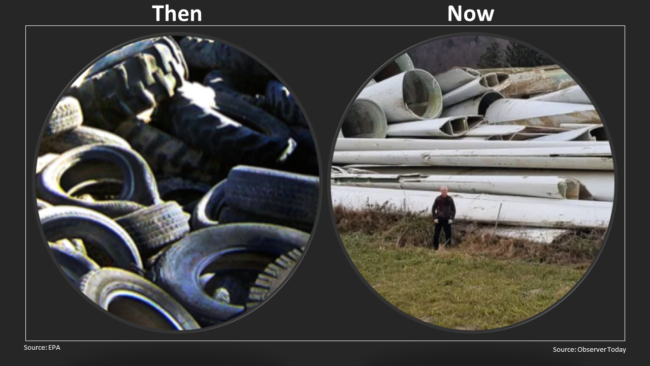
    Lifecycle risk mitigation of an energy resource must include the end of the asset life processes.  What governance driven processes are in place to prevent the accumulation of wind turbine blades or spent solar panels stacked and abandoned?  Just like the tires stacked for decades.

    Turns out the answer is few.  Long life assets such as factories, skyscrapers, fossil fuel production systems, etc. are built to the engineering, industry and local regulatory standards of that day.  Ongoing operations, maintenance, upgrades and so forth keep them performing at acceptable levels.  However, governance models are often focused on the present.  End of asset life risk does not fit into the four quarter management mindset as the event may be sometime in the future.

    The above graphic represents a governance model built around operations and associated risks.  The archetype recognizes that many risk mitigation processes are inadequate for today’s complex organizations with multi-faceted global processes.

    Its framework is built upon the work done by the Treadwell Commission several decades ago to detect financial fraud.  This structure supports the extension into field operations and provides a structure for attaining and sustaining Operational Excellence.

    Risk mitigation is both quantitative and qualitative.  The risk associate with the use of any industrial energy source must be thoroughly assessed as a function of its lifecycle, not just its initial CAPEX and ongoing operations.

    Dumping v Decommissioning

    Illegal industrial dumping has long been a problem.  Today, some in the wind turbine sector appear to be following the decades long vehicle tire disposal process (or lack thereof).

    Lady Bird Johnson at least tried to hide the piles of tire debris but no one has found a way of completely dealing with this growing and massive problem.  As of 2017, some 17% were still disposed of in landfills.  In 2003, the EPA reports that almost 300 million tires are scraped each year.  Flash forward to today and this is likely a very conservative number.  That said, 17% equals approximately 50 million tires headed to landfills as opposed to recycling.

    Moreover, there is a long history of industrial dumping trash so as not to have to pay the disposal fees.  One wonders how many millions of tires destined for landfills (and other recycling) are just dumped?

    The decommissioning process is the responsible end-of-asset-life shutdown and removal.  The intent is to return the site to a condition similar to its initial environment and properly remove and dispose of equipment and materials.  It should not include stacking wind turbine blades next to a pile of discarded vehicle tires.

    Total Carbon Lifecycle Model

    Daily, we hear about the need to reduce carbon output to (net) zero.  Promises are made by many that by such and such a time this metric will be met.  Caveat: usually the time period is beyond the expected tenure of those making the statements.  Often lost in the discussion is the carbon cost of manufacturing and decommissioning.

    Carbon output should include the mineral extraction process, recycling of older materials if appropriate, transportation, manufacturing, installation, operations and decommissioning.  It also must include the carbon cost of the supply chain necessary to support the asset across its lifecycle.  For example, the carbon cost of an EV is not just the vehicle’s operation but the lifecycle of the vehicle as well as the electric power generation and distribution necessary to operate the automobile.  Do not forget the carbon cost of manufacturing a battery and disposing of it at end of life.

    Scrap

    Materials are often staged for recycling.  They feed a process that results in new useful product(s) that may add new value.  This is a useful recycling process that makes a lot of sense.  However, sometimes this is not as economical as new manufacturing.  These economics lead to dumping as the low-cost-solution.  Fields of discarded materials may or may not be awaiting recycling.

    Defining Green

    Being green is not simply using renewable electricity instead of gasoline.  If the carbon footprint is no different or even worse, then the problem is not solved and may even be made greater.

    Keep in mind that coal is still a major fuel in the generation of electricity.  According to the US Energy Information Administration (EIA), in 2020 over 60% of power is generated using fossil fuels of which over 19% is from coal.  This does not include the carbon footprint of materials and products imported to the US.

    So if the carbon footprint of a wind turbine is defined as its lifecycle and if at the end result is abandonment in a field, is the green value of that product positive?  Or is it just dumping not unlike the pollution of a nation’s river systems?

    Being green is not just plugging in your car overnight.  Like most things in life, it is systemic.

    Is Your Organization’s Green Plan Systemic or Myopic?

    For More Information

    Please note, RRI does not endorse or advocate the links to any third-party materials.  They are provided for education and entertainment only.

    For more information on Cross Cultural Engagement, check out our Cross Cultural Serious Game

    We presented, Should Cross Cultural Serious Games Be Included in Your Diversity Program: Best Practices and Lessons Learned at the Online Conference, New Diversity Summit 2020 the week of September 14, 2020.  Check Out this timely event and contact the organizer for access to the presentations!!

    For more on DEI Standards, see the newly released ISO-30415.

    You can contact this author as well.