Category: Artificial Intelligence

  • AI–What’s Your Number?

    AI–What’s Your Number?

    There is a great deal of hype regarding AI, some is justified and some not so much.  Pundits, including this one talk about the value an organization will get and, in some cases, immediately.  But what is the actual measurable value a firm can realistically expect?

    I recently used a free AI Value Calculator, asking how an oil refinery could become more effective and safer. The following response was received:

    “**Value Proposition:** At [Your Company Name], we understand that oil companies face increasing pressure to enhance safety and efficiency within refinery operations. Our innovative solutions are designed specifically to address the unique challenges of the refining industry. By integrating advanced technology and safety protocols, we empower your team to operate more effectively while minimizing risks. With our expertise, you can expect: – **Increased Operational Efficiency:** Streamline processes with cutting-edge tools that boost productivity and reduce downtime. – **Enhanced Safety Measures:** Implement systems that prioritize employee safety and ensure compliance with industry regulations. – **Real-Time Monitoring:** Gain insights through data analytics that allow for proactive decision-making and immediate response to potential hazards. Choose [Your Company Name] as your partner in revolutionizing refinery operations, ensuring you meet both efficiency goals and safety standards. Together, we can create not just a safer workplace, but also a more effective refinery that drives success in today’s competitive landscape. For more information or to schedule a consultation, please contact us at [phone number] or visit our website at [website URL]. Let’s work together to pave the way for a more secure and productive refining environment.”

    The Problem with Value

    There are several problems with this response, and I (the user) am part of that problem.

    • My prompts were minimal and not specific
    • The response was pablum, as it did not tell me anything I did not already know.
    • What do phrases like, “Implement systems that prioritize employee safety and ensure compliance with industry regulations,” actually mean and how do I accomplish that?
    • What do I tell the “C” level executive that she can expect to see on our bottom line as a result of this expenditure and what is the risk profile?

    Determining the economic value proposition for any capital investment project has always been a challenge and is difficult to accomplish, especially when the list of intangibles is long.  The recent issues surrounding Cracker Barrel rebranding is a case in point.

    The process of assessing possible value and the associated risk of attaining said value from investments is not trivial.  It takes a lot of thinking and iterative re-thinking from a knowledgeable and qualified team, as well as input from others.  And in my opinion, there has to be a dollar value that can be documented and defended–meaning, it is a solid assessment and not wishful thinking.

    The Journey to Measurable Value

    “If you don’t know where you are going, you’ll end up someplace else.”― Yogi Berra

    We been conducting economic and financial assessments of capital projects for over two decades. Our Economic Value Proposition Matrix (EVPM) has been developed and curated with organizations in the Critical Infrastructure Sector.  It meets and exceeds the tough requirements of some of the most prestegious global firm and has demonstrated its ability to provide decision makers with an economic and financial “What If” and “Iterative” model of proposed spend before a dime is committed to the project.  We love tough questions and have learned most that are used.  Moreover, it Risk Assessment section if one of the most robust available.

    It is being used for AI Spend assessments and a case study will be available in our forthcoming book, from CRC PressThe Transformation of Our Spreadsheet Society: Moving Towards a Nonlinear, Big Data Enabled AI Environment, to be released by early 2026.

    Is AI Different Than Other Capital Expenditures (CAPEX)?

    The traditional response from IT providers is, It Depends!  In some ways this is a correct statement. However, industry/individual organizations have been through existential difficulties before and frequently.

    Most IT CAPEX is either Science/Engineering or transactional, i.e., ERP.  However, much of AI centers on behavior and therefore, involve an addition dimension–latent variables.  We have been interested in latent variables since the early 1990s and first published our approach towards learning about their impact on behavioral systems in my 1996 doctoral dissertation, Cross-cultural negotiations between Japanese and American businessmen: A systems analysis (exploratory study).

    In our forthcoming book by CRC PressThe Transformation of Our Spreadsheet Society: Moving Towards a Nonlinear, Big Data Enabled AI Environment, we develop a detail approach and representative AI model about the value that can be identified and measured using latent variable.

    So, what is a latent variable?  Largely unknown, these variables are essential in the complex data analysis and modeling needed in statistics, machine learning, and other scientific assessments.

    Very important–They cannot be measured directly but can be inferred from other measurable variables.

    This is a major and usually unrecognized problem when attempting to place an economic value on a project yet to start, i.e., the planning and funding stage.

    Our upgraded EVPM model takes latent variables into consideration giving management greater insight into the costs, return and ultimate value of AI investments.  We believe that unless this dimension is properly assessed, calculated values are WRONG and will not result in the value proponent’s advance.

    Look for further details regarding our economic value of AI model and feel free to contact us if you have specific needs or questions.


    Is your AI Economic Value Assessment model robust enough to bet your career on?

  • AI In Chaos

    AI In Chaos

    There is a daily flood of often contradictory posts regarding the tremendous and immediate value of Artificial Intelligence (AI).  But are we to believe our lying eyes?

    This picture of wiring stupidity might as well have been taken in my front yard.  Years of shoddy workmanship by firms that do not care in a city that cares even less about its neighborhoods is the result.  But that is not the theme of this post.

    The artificial intelligence software sector looks like this photograph. Tracing connections and thoughts is almost impossible and may require AI to understand AI.  Is that even possible?

    AI Is On Fire

    “We must implement AI because everyone else is doing it” is the mantra.  Expressed by those selling AI products and services, organizations feel pressure to buy immature code as individuals are told their careers are over and robots will replace them in the next few years.  This pundit challenges this rant.

    There is a method to the madness and order can be made out of the chaos of the “new kid on the block.”  It is not necessary to panic or make quick irrational decisions.

    Published in 2023, I co-authored the book, Smart Manufacturing: Integrating Transformational Technologies for Competitiveness and Sustainability and the just released, Navigating the Data Minefields: Management’s Guide to Better Decision-Making.  Moreover, the next forthcoming book by CRC Press, The Transformation of Our Spreadsheet Society: Moving Towards a Nonlinear, Big Data Enabled AI Environment, should be released in early 2026.

    The focus of all these volumes is to help management and non-IT individuals better understand game-changing technologies, how to assess, procure and deploy them and attain superior economic value for the firm.  Additionally, we address what individuals must do to keep their skills and career current and future proofed.

    I mention this because we must all remain clear eyed in this current caldron of chaos.  Rudyard Kipling is famous for his poem that begins, “If you can keep your head when all about you are losing theirs.”  Our generation should learn from this call to calm, rational thinking (readers should read the entire very powerful poem).

    Those not familiar with the IT field may not know but the sector even has a name for the development curve AI technologies are on.  The research firm, Gardner has developed a tool that can be useful. “The AI Hype Cycle is Gartner’s graphical representation of the maturity, adoption metrics and business impact of AI technologies (including GenAI).  It helps organizations understand where different AI innovations are on the path to becoming mainstream, why they are where they are and what these innovations mean in the context of the overall AI landscape.”  While the Hype Cycle is a commercial offering, a great deal is written, and a high-level understanding is readily available to all from online sources.

    The Storm Will Pass

    AI offers tremendous promise across all human endeavors.  At the moment it is a new shiny object that entices but still has a lot of unknowns.  It will mature and become as ubiquitous as the Internet.

    The rate that individuals embrace change varies widely; however, change is a fact of life, and I believe this change will benefit more than it hinders.  After all, other generations have undergone significant change that we now take for granted, i.e., automobiles (aka horseless carriage), smart devices, etc.

    What are you doing to keep yourself not only relevant but of high value in the AI world?

  • Dot Bomb 2.0 — ai Style

    Dot Bomb 2.0 — ai Style

    Are we doing this again with Artificial Intelligence?

    On March 10, 2000, a five-year dotcom bubble bursts on the Nasdaq Index. Even blue-chip tech companies lost more than 80% of their market value and it would be 15 years before Nasdaq would see that peak again.  “The dotcom bubble, also known as the Internet bubble, grew out of a combination of the presence of speculative or fad-based investing, the abundance of venture capital funding for startups, and the failure of dotcoms to turn a profit. Investors poured money into Internet startups during the 1990s hoping they would one day become profitable. Many investors and venture capitalists abandoned a cautious approach for fear of not being able to cash in on the growing use of the Internet.”

    At the height of the dotcom hype, organizations were changing their name (not just the domain) to include this suffix, i.e. Acme.com.  This attempt to differentiate almost became silly and the butt of jokes.

    Increasingly, this pundit is seeing a similar thought process when it comes to artificial intelligence. The new marketing moniker/domain is now Acme.ai.  We predict .ai identification will end in flames as did .com.  This is not to say artificial intelligence will go away but that it will become mainstream, just as the Internet did not fade into marketing oblivion. Online business is now just the way we do business and access to it is available to all at a marginal cost that approaches zero.

    Branding

    Much of this section is adapted from our report prepared for a United Nations Agency.

    The concept of the Brand is well established in marketing literature and practice.  The Brand is a messaging vehicle that seeks to position all consumers and stakeholders “on the same page.”  As discussed herein, it is a powerful construct and may be of useful to the nuclear power sector as it seeks to embody an AI Culture into all stakeholders.

    The theory of the Brand Wheel is addressed herein.  To address the Key Themes and concerns raised during the conference, it appears that “AI Culture” may need to become a “Brand.”  Strong Brands generate a powerful emotional response!

    For example, a positive brand such as BMW’s “the ultimate driving machine” (at least in the USA) transcend other issues such as the high cost of maintenance of these automobiles.  Negative branding often can never be overcome as the Coca Cola Company learned when they launched “New Coke” in 1985.  This company almost ruined a long-standing strong brand!

    Construct

    We put forth a Brand mental model for debate within the industry.  In this section, the construct or set of organizing ideas for consideration are developed.

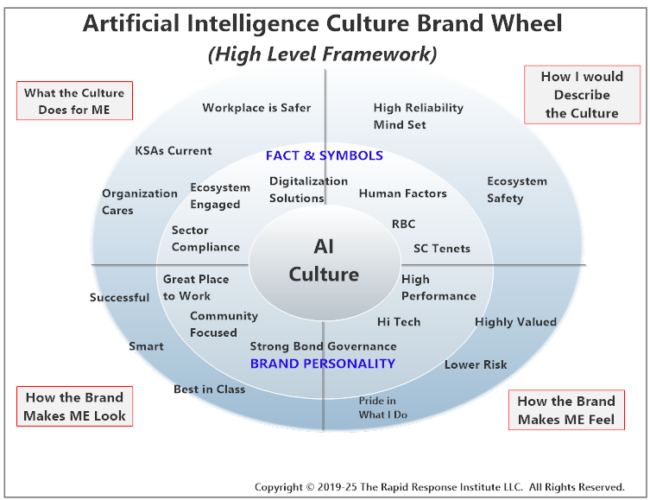
    In accordance with the theory, the AI Culture Brand Wheel (High Level Framework) is composed of two major categories:

    Facts & Symbols or those components of the Brand that address the “hard” and often more measurable aspects. 

    • What the Product, Service, or Solution does for ME
    • How I would Describe the Product, Service, or Solution

    Brand Personality addresses the more emotional side of the Brand

    • How the Brand make ME look
    • How the Brand makes ME feel

    Populating the Wheel

    The Groups (developed in a workshop) in the following diagram are believed to be representative of major issues the sector faces.  It follows that any marketing message to stakeholders should address their concerns.

    These four quadrants were populated with over twenty Groups from the Affinity Diagram process.  This is a high-level approach to populate the wheel with the almost 200 AI Culture issues (variables) identified from participants.

    The following table shows the Groups by Brand Wheel Quadrant and the Rationale behind the categorization.  The focus is on the individual person and how he or she relates to the AI Culture Brand.  By extension, how individual stakeholders feel is how their organization or group feels about the Brand.

    The Brand Wheel is an easy-to-use model that helps organization position themselves in crowded market segments.

    Graphically, these Groups are shown in the following figure.  Seven Groups fall in the top two quadrants as more tangible variables (Fact) by nature and four in the Personality quadrants.  One can surmise that a Brand such as Systemic AI Culture would require substantial “technical” support to be credible.

    The intangible Groups can be considered the Brand emotional delivery mechanisms.  Collectively, the Systemic AI Culture Brand can be considered a key aspect the industry Go-to-Market strategy—selling Systemic AI Culture.

    Similar to the way an Affinity Diagram adds high value to the team doing the work, developing the Brand Wheel adds significant value to the process itself.  Figures and charts are visual representations of concepts that are highly appealing.  The Brand Wheel is one method supported by the Affinity Diagram to capture a large set and sometimes conflicting issues into a model individuals can grasp and internalize.

    Finalizing the Brand

    A brand Tag Line would be helpful to etch the construct into the minds of all stakeholders.  For example, High Reliability Management used the concept of Mindfulness—the practice of maintaining a nonjudgmental state of heightened or complete awareness of one’s thoughts, emotions, or experiences on a moment-to-moment basis, also such a state of awareness (situational awareness).

    Concluding Thoughts

    To be clear, branding is not the end game in marketing but one of many prongs used to achieve strategic advantage and greater shareholder value.  It is a convenient framework that captures the essence of who the organization is.  This approach is immensely more successful than simply attaching .ai to the organization name, hoping for differentiation.  Any competitor can do exactly the same thing.

    Earn your value the old fashion way, with viable products that solve problems, customers, profits and return to shareholders. Forget about the hype!

    Is your organization taking Rudyard Kipling’s advice to his son, “If you can keep your head when all about you are losing theirs and blaming it on you, if you can trust yourself when all men doubt you,
    but make allowance for their doubting too!”

    Pre order our new book

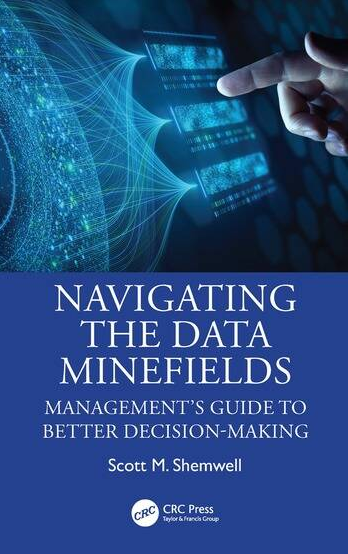
    Navigating the Data Minefields:

    Management’s Guide to Better Decision-Making

    We are living in an era of data and software exponential growth.  A substantive flood hitting us every day.  Geek heaven!  But what if information technology is not your cup of tea and you may even have your kids help with your smart devices?  This may not be a problem at home; however, what if your job depends on Big Data and Artificial Intelligence (AI)?

    Available June 2025

    We are also pleased to advise our loyal readers that CRC Press has accepted our proposal for this forthcoming book, Nonlinear Big Data and AI-Enabled Problem-Solving: Transforming From A Spreadsheet Society.  Stay tuned for more details.

    For More Information

    Please note, RRI does not endorse or advocate the links to any third-party materials herein.  They are provided for education and entertainment only.

    See our Economic Value Proposition Matrix® (EVPM) for additional information and a free version to build your own EVPM.

    The author’s credentials in this field are available on his LinkedIn page.  Moreover, Dr. Shemwell is the coauthor of the 2023 book, “Smart Manufacturing: Integrating Transformational Technologies for Competitiveness and Sustainability.”  His focus is on Operational Technologies.

    We are also pleased to announce our forthcoming book to be released by CRC Press in June 2025, Navigating the Data Minefields: Management’s Guide to Better Decision-Making.  This is a book for the non-IT executive who is faced with making major technology decisions as firms acquire advanced technologies such as Artificial Intelligence (AI).

    “People fail to get along because they fear each other; they fear each other because they don’t know each other; they don’t know each other because they have not communicated with each other.” (Martin Luther King speech at Cornell College, 1962).  For more information on Cross Cultural Engagement, check out our Cross-Cultural Serious Game.  You can contact this author as well.

    For more details regarding climate change models, check out Bjorn Lomborg and his book, False Alarm: How Climate Change Panic Costs Us Trillions, Hurts the Poor, and Fails to Fix the Planet.

    Regarding the economics of Climate Change, check out our blog, Crippling Green.

    For those start-up firms addressing energy (including renewables) challenges, the author can put you in touch with Global Energy Mentors which provide no-cost mentoring services from energy experts.  If interested, check it out and give me a shout.