
Tag: team building

  • Leadership Selling

    Leadership Selling

    “The price of greatness is responsibility.” – Winston Churchill

    I recently watched a documentary about Three Mile Island.  I did not fact check it or try to assess bias but if much of what went wrong were correctly portrayed, leadership was missing in action.  The father of the US Nuclear Navy, Admiral Hyman G. Rickover and his demand for excellence was referred to on several occasions.  He was rightfully positioned as THE sector leader during that era when nuclear power generation was an emerging technology.
    In the context of leadership, the following is attributed to him, “Responsibility is a unique concept… You may share it with others, but your portion is not diminished. You may delegate it, but it is still with you… If responsibility is rightfully yours, no evasion, or ignorance or passing the blame can shift the burden to someone else. Unless you can point your finger at the man who is responsible when something goes wrong, then you have never had anyone really responsible.”  This is a very telling statement that is applicable to the many human foibles that have resulted in cataphoric failures, even warfare and almost all high visibility major industrial incidents.

     A clear explanation of the difference between Management and Leadership.

    What Does All This Have to Do with Selling?

    Typically, organizations refer to the process of revenue generation as Sales.  However, a more accurate description this process is Selling.  The action verb, selling can result in a sale or series of sales.  Yet, for each competitive engagement most of these costly attempts at revenue generation will result in no sales–zero revenue.   Fail at enough opportunities and the firm’s Cost of Sales can skyrocket.

    Moreover, increasingly B2B solutions are a combination of products (seller product line and possibly third parties) as well as services (can include Cloud subscriptions).  By definition, Complex Sales is getting more complex and interrelated with other new/existing systems.

    Failure is Not an Option!

    SUBSAFE was born in 1963, just two months after mechanical failures resulted in the loss of USS Thresher (SSN-593).  The program was started with a simple goal in mind: ‘. . . provide the maximum reasonable assurance that the ship will not have flooding but if flooding does occur, assures that the ship will get safely to the surface.’”  The program is deemed as a major life saving success, partially by enabling real responsibility to all including contractors.

    Safety and Environmental Management Systems (SEMS) are a similar construct.  Most organizations in Critical Infrastructure sectors incorporate SEMS into their Operations Management Systems (OMS).  For our purposes here, we will repurpose and slightly change the nine tenants of the US Bureau of Safety and Environmental Enforcement’s BSEE, SEMS.

    We posit that the following Tenants comprising our Selling Management System (SMS):

    1. Commitment to Values and Actions. Leaders demonstrate a commitment to societal and organizational values in their decisions and behaviors.
    2. Issue Identification and Risk Management. Issues potentially impacting the deal and its successful delivery are promptly identified, fully evaluated, and promptly addressed or corrected commensurate with their significance.
    3. Personal Accountability. All individuals take personal responsibility for process and personal behavior, as well as the stewardship of those entrusted to them.
    4. Work Processes. The process of planning and controlling work activities so that the selling action items are in accordance with organizational mission and policies as well as boding well for success.
    5. Continuous Improvement. Opportunities to learn and codify selling and delivery knowledge, ensuing future success and organizational learning.
    6. Environment for Raising Concerns. A work environment is maintained where personnel feel free to raise issues and concerns without fear of retaliation, intimidation, harassment, or discrimination.
    7. Effective External and Internal Communication. Communications maintain a focus of the selling efforts and processes.
    8. Respectful Work Environment. Trust and respect permeate the organization with a focus on teamwork and collaboration.
    9. Inquiring Attitude. Individuals avoid complacency and continuously consider and review existing conditions and activities in order to identify discrepancies that might result in error or inappropriate action.

    It is not surprising that action items focused on revenue generation should align with business imperatives towards effective and efficient operations.  This is especially true when operations personnel are assigned to the pursuit team as they will play a major role assuring successful delivery, i.e. most capital (CAPEX) goods and services.

    Tenant 6, Environment for Raising Concerns is perhaps one of the most important when enabling junior leadership.  For example, if a material issue is identified by a new college graduate in her or his field and unnoticed by more senior individuals schooled in early technologies, failure to be “heard” may have deal failure ramifications, i.e., engineering or software errors.

    Leadership is not part of a title, except by self-serving politicians who routine call themselves leaders.  Leaders are not born either, they are individuals (all ages and genders) who when needed, rise to occasions great and small.  The Rickover Mind Model enables leaders to emerge and that includes leadership during selling processes.

    Complex Deal Pursuit Team

    A deal Pursuit Team is a formal group assigned to drive revenue opportunities for a single deal/long-term strategic relationship or even partnership.  It can be an ad hoc assemblage or more effectively the assembly of experts with this type of experience.  Ideally, for a significant opportunity this team has a sole focus during its lifecycle, but that is not always the case or even practical in some firms or deals.

    Team composition can include, Sales Representative(s), Sales Management, Sales Support Team (as required) Executive Sponsor (if appropriate), Subject Matter Expert(s), Project Management, Third Parties (subcontractors and/or technology/professorial services providers), and others as needed.  Not all participants will be required full time.

    Typically, there are three phases to this process:

    • Relationship and Opportunity Development–The relationship building processes between seller and buyer as well as identification of value that can be added from seller products/services/solutions.
    • Formal Proposal Submission–Development and draft (with revisions) of a documented Scope of Work/Products, Deliverables and Pricing.
    • Proposal Assessment and Acceptance–Buyer review, changes and agreement to move forward–The Deal!

    Leadership is required throughout this process, and it may come from very unlikely sources.  Often top-level technologists and engineers are not the most outgoing folks.  However, their thoughts can be game changing.  It is important that those on the quiet side be actively ‘Included,’ and their ideas sought out and given serious discussion.

    Role of AI Agents

    AI sales agents are autonomous applications that analyze and learn from your sales and customer data to perform tasks with little or no human input. These agents can perform a wealth of functions, from top-of-funnel tasks like nurturing leads with email outreach, answering questions, booking meetings with sellers, and quote creation to tasks more deeply integrated inside sales teams, like active buyer roleplays and coaching. What makes them different from simple workflow automation is that agents are capable of learning, using data analysis to work more efficiently, taking action on their own.”

    The Pursuit Team is responsible for winning the deal and AI is another tool, not unlike product demonstrations and marketing efforts.  AI inputs should be calibrated and interpreted just like other data sources and analyses.

    Final Thoughts

    Remember that people buy from people and individuals on both the selling and buying teams have personal agendas, such as getting promoted.  Sellers who identify many/most of these concerns stand a better change of closing the deal.

    Closing deals generates jobs.  Both by the vendor and its ecosystem as well as the client who will use the product/service/solution to increase the stakeholder value ecosystem.  Stakeholders are broadly defined including local communities and customer’s customers.

    It is safe to say that the complex selling process is dramatically changing.  Time to get on board!

    Nothing happens until somebody sells something!  How is your company assuring the selling process is routinely successful?

    Pre order our new book

    Navigating the Data Minefields:

    Management’s Guide to Better Decision-Making

    We are living in an era of data and software exponential growth.  A substantive flood hitting us every day.  Geek heaven!  But what if information technology is not your cup of tea and you may even have your kids help with your smart devices?  This may not be a problem at home; however, what if your job depends on Big Data and Artificial Intelligence (AI)?

    Available April 2025

    We are also pleased to advise our loyal readers that CRC Press has accepted our proposal for this forthcoming book, Nonlinear Big Data and AI-Enabled Problem-Solving: Transforming From A Spreadsheet Society.  Stay tuned for more details.

    For More Information

    Please note, RRI does not endorse or advocate the links to any third-party materials herein.  They are provided for education and entertainment only.

    See our Economic Value Proposition Matrix® (EVPM) for additional information and a free version to build your own EVPM.

    The author’s credentials in this field are available on his LinkedIn page.  Moreover, Dr. Shemwell is the coauthor of the 2023 book, “Smart Manufacturing: Integrating Transformational Technologies for Competitiveness and Sustainability.”  His focus is on Operational Technologies.

    We are also pleased to announce our forthcoming book to be released by CRC Press in April 2025, Navigating the Data Minefields: Management’s Guide to Better Decision-Making.  This is a book for the non-IT executive who is faced with making major technology decisions as firms acquire advanced technologies such as Artificial Intelligence (AI).

    “People fail to get along because they fear each other; they fear each other because they don’t know each other; they don’t know each other because they have not communicated with each other.” (Martin Luther King speech at Cornell College, 1962).  For more information on Cross Cultural Engagement, check out our Cross-Cultural Serious Game.  You can contact this author as well.

    For more details regarding climate change models, check out Bjorn Lomborg and his book, False Alarm: How Climate Change Panic Costs Us Trillions, Hurts the Poor, and Fails to Fix the Planet.

    Regarding the economics of Climate Change, check out our blog, Crippling Green.

    For those start-up firms addressing energy (including renewables) challenges, the author can put you in touch with Global Energy Mentors which provide no-cost mentoring services from energy experts.  If interested, check it out and give me a shout.

  • Teaming Realities

    Teaming Realities

    Why are Diversity, Equity and Inclusion (DEI) initiatives failing?

    In previous blogs, we have addressed the challenges of turning organizational initiatives into culture.  Moreover, we discussed DEI and the shortcomings of those institutional efforts as well as broached the construct of Teams incorporating DEI.

    In this edition, we will expand on those subjects and develop a realistic approach toward team building that fully incorporates the precepts of DEI in a realistic manner.

    Five Elements

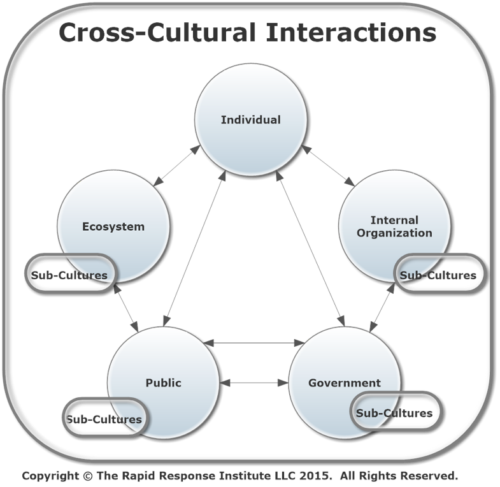
    As depicted in the title graphic, organizational cross-cultural interactions incorporate one or more of these dynamic components.

    • The Individual defined as a single human being or perhaps other entity with whom others collaborate
    • The Internal Organization defined the (legal) entity one or more individuals associate with on a daily basis
    • The Government defined elected officials as all levels of the Federal, State and Local governance bodies including any and all regulatory bodies or other agencies
    • The Public defined as communities and other interest groups including the media as well as its social aspect
    • The Ecosystem defined as the broad group of constituents which includes clients/customers, the supply chain as well a professional services engaged with the organization

    Note that sub-cultures abound across the four elements other than the individual.  Four example, a taskforce or team may be formed to implement a global IT system.  In this case, the team may be composed of individual from several countries as well as  Internal and External IT professionals..  In this case this would be an Internal Organization Sub-Culture.  Another Sub-Culture might be the NYC office with a distinct local flavor.

    These five elements are built upon a pretty straightforward peer reviewed behavioral framework.   

    The RBC Framework

    The Relationships, Behaviors, Conditions (RBC) Framework was originally developed to address the International Cross-Cultural Negotiation process.  Briefly, this is a dynamic model with emphasis on interactive relationships resulting from multiple levels of behavioral analysis.

    • Relationship dynamics are the focus including, commonality of interest, trust, balance of power and conflict intensity
    • Behaviors are defined from a broad multi-dimensional perspective and includes intentional as well as unintentional
    • Conditions include circumstances, capabilities and competencies of the parties, cultural considerations and the environment

    For almost 30 years we have been expanding and enhancing this model.  It is now used for ANY human interaction as well as Machine-Human interfaces, i.e. Artificial Intelligence (AI).

    Finally, we see this construct as very fabric of the modern organizational Team.

    What is a Team?

    By one definition a team is, “a group of people who perform interdependent tasks to work toward accomplishing a common mission or specific objective.”  As a general rule, teams are composed of individuals either appointed politically or assigned based on talent and expertise.

    When politically assigned to meet somewhat arbitrary DEI driven goals, one can expect such teams to fail–often visibly as a great calamity.  Thus driving survivors and others away from new similar teams.

    Thirty years ago this pundit witnessed the implementation of the then new Enterprise Resource Planning (ERP) IT systems.  Most were late and way over budget.  They rightfully earned the badge of ‘Career Killer.’  Not surprisingly, no one wanted to be assigned to this type of project.  Most consulting firms implementing these systems wanted someone with knowledge of the business on the project as well as IT professionals.  Key personnel could not be spared from operations and often junior or less qualified IT employees were assigned.  Needless to say, some level of disappointing performance was almost certainty guaranteed.  These were diverse teams composed of third party consultants, operations and finance individuals as well as internal IT people.

    These were not effective teams.  Many were even destructive.

    Creating an Effective Team

    A Google search of the term ‘teambuilding’ generates 160 million hits.  It is a well documented process, so why are successful teams so elusive?

    Most critical teams undergo a selection process as described previously with some training.  The project commences often with significant time and budget constraints.  In many cases the team malfunctions from the ‘get go.’  So why would DEI efforts end differently?  One suspects most do not.

    When students participate in active learning, they learn more.  This has been known for some time.  Sadly, and often in the DEI space, workshops do not address the actual issue organizations are facing.  However, their is a more successful learning model.

    Organizational Team Truths

    As noted above, organizations build teams to solve critical problems.  They do not group Individuals by category or classification.  High Performance Teams are anything but homogeneous.  

    • First, teams must form.  A mission/goal(s), set of deliverables, budget (if appropriate) and time frame must be developed and agreed to by management.
    • Then, members must get to know each other, roles and tasks assigned, etc.
    • What does success look like?  Metrics established.

    Most teams do not live in a vacuum so if they are to collaborate with one or more other teams (Internal or Ecosystem) this process is extended.  In many cases such as a merger or safety initiative, Government and even the Public will need to be engaged.

    Now a collaborative negotiation between ‘semi-independent’ parties to arrive at mutual success.  This is generally an iterative process.

    To create an active learning environment to cost effectively train new teams in a timely manner, simulations and game theory play a critical role.

    Moreover, to maximize effectiveness, such a Serious Game must be based on a Behavioral Science Framework.  This type of Team-to-Team interaction is available using video conferencing to engage teams meaningful training using ‘real world’ scenarios.

    The graphic below depicts this process.  Readers will also note a number of metrics will provide feedback to students to further enhance their learning experience.

    DEI ROI

    One comment routinely heard regarding DEI is the lack of return on the effort.  Not necessarily monetary return but the learning does not ‘stick.’

    Benjamin Franklin is credited with the quotation, “Tell me and I forget, teach me and I may remember, involve me and I learn.”  When these teams are composed of a variety of Individuals working to solve realistic collective problems the result better reflects actual organization life.  All aspects of DEI can be incorporated into the game scenario.  All students benefit from a much better learning experience and by extension the organizations they represent.

    The following short video is aligned with this discussion.  Well worth the few minutes it will take to watch it.

    Realizing DEI

    Simon makes the point that strong Organizations are more diverse.  In this pundit’s long international career, I support his contention. Moreover, true strength from a diverse Organization and its Ecosystem cannot be reached if individuals are not treated fairly and included in the process.  The serious game scenarios help assure all individuals participate.

    Want some help upping your DEI game?  Contact Us.

    For More Information

    Please note, RRI does not endorse or advocate the links to any third-party materials herein.  They are provided for education and entertainment only.

    The author’s credentials in this field are available on his LinkedIn page.  Moreover, Dr. Shemwell is a coauthor for an in press book (to be released in Spring 2023) titled, “Smart Manufacturing: Integrating Transformational Technologies for Competitiveness and Sustainability.”  His focus is on Operational Technologies.

    “People fail to get along because they fear each other; they fear each other because they don’t know each other; they don’t know each other because they have not communicated with each other.” (Martin Luther King speech at Cornell College, 1962).  For more information on Cross Cultural Engagement, check out our Cross Cultural Serious Game.  You can contact this author as well.

    The video by Simon Sinek is from YouTube.

    For more details regarding climate change models, check out Bjorn Lomborg ands his latest book, False Alarm: How Climate Change Panic Costs Us Trillions, Hurts the Poor, and Fails to Fix the Planet.

    Regarding the economics of Climate Change, check out our recent blog, Crippling Green.

    For those start-up firms addressing energy (including renewables) challenges, the author can put you in touch with Global Energy Mentors which provide no-cost mentoring services from energy experts.  If interested, check it out and give me a shout.

  • 100

    100

    This edition marks the 100th post in our Critical Mass Blog series.  We have sought to provide thoughtful, unbiased insight into the contemporary business and organizational challenges we all face.  Since our first blog post on November 27, 2017 our world has turned over in ways none expected.  Likely, this trend will continue.

    This series continues a tradition of newsletters, opinion pieces and other on line punditry first begun in 1998 with our New Millennium News.  A bi-monthly email with a subscription base of approximately 7,000 readers.  A huge number at that time.  We estimate that hundreds of thousands or more have benefited from this knowledge transfer.

    Coincidentally, we reach this milestone as we begin the new year–a time of renewal.  We will continue to address critical issues individuals, businesses, agencies and others face as we all navigate an increasingly perilous path.  This series has addressed Human Resource issues including Diversity, Equity and Inclusion (DEI) Teams , the arrival of Smart Technology, International Business, Covid-19, Supply Chain Management, Operational Excellence, Cultural Transformation (including Safety Culture) Sales, Risk Mitigation and of course Leadership.  Today’s organizations must be very good at all of these disciplines!

    Available Tools

    The mission of the Rapid Response Institute (RRI) is to enable our clients with the ability to posture themselves in their market segments so that they can thrive in volatile markets and capitalize on uncertainty, not suffer because of them.  This is especially important for those economic actors in Critical Infrastructure sectors.

    In support of this mission the firm has developed a suite of Intellectual Property (IP) which includes Know How, practical roadmap Books and guidelines as well as Software as a Service (SaaS) solutions among others.  Many readers know that once a process has been standardized with minimal configuration required, the data is the ultimate driver.  This is the heart of most Enterprise Resource Planning (ERP) solutions.

    With advances in technology, RRI has taken these once multi-million dollar solutions to a price point as well as Use Case where all organizations can utilize this capability.  Moreover, our advancements in work flow such as epitomized in our Cross Cultural Serious Games, Economic Value Proposition Matrix, and Smart OpEx (Operations Management System) and Risk Simulation Modeling add immediate and significant value to the challenges faced as articulated above.  Other Free Tools are available as well.

    Pulling It All Together

    The method to our madness is–Operations!!  As some are fond of saying with derision, “It’s All About the Benjamins.”  Well, it actually is.  If ‘for-profit’ firms are not profitable, they fail.  No amount of Environmental, Social, and Governance (ESG) will save them if they cannot deliver to paying customers.

    Everything RRI does helps organizations to deliver stakeholder value, compliant with ESG standards.  That is our Bottom Line and we are also pleased that Dr. Shemwell, Managing Director has been an independent advocate for responsible corporate success since 2004.

    FYI, major losses and legal actions do not enhance stakeholder value.  Neither for employees, local communities or equity holders.  Everyone loses when in terrible scenarios such as Deepwater Horizon, internal bias corporate hubris, poor high reliability processes/human factor shortcomings or lack of actual DEI.

    This journey continues.  Stay tuned for the next 100 editions where will continue to provide our thoughts on relevant matters.  Thank you very much for your readership and support.

    How is Your Organization Positioned for the Next Four Years?

    For More Information

    Please note, RRI does not endorse or advocate the links to any third-party materials.  They are provided for education and entertainment only.

    For more information on Cross Cultural Engagement, check out our Cross Cultural Serious Game

    We presented, Should Cross Cultural Serious Games Be Included in Your Diversity Program: Best Practices and Lessons Learned at the Online Conference, New Diversity Summit 2020 the week of September 14, 2020.  Check Out this timely event and contact the organizer for access to the presentations!!

    For more on DEI Standards, see the newly released ISO-30415.

    You can contact this author as well.